Recognition: unknown
CRT: Collision-Tolerant Residence Time for Deterministic Transmission in LEO Satellite Networks
Pith reviewed 2026-05-07 13:28 UTC · model grok-4.3
The pith
CRT uses local clocks and collision-tolerant scheduling to enable deterministic transmission in dynamic LEO satellite networks without global synchronization.
A machine-rendered reading of the paper's core claim, the machinery that carries it, and where it could break.
Core claim
CRT regulates per-hop residence time using local clocks, thereby compensating for link-delay variations without requiring strict global synchronization. To handle asynchronous collisions, CRT adopts a collision-tolerant scheduling strategy that maximizes the number of schedulable flows while bounding collision-induced jitter. The corresponding scheduling problem is formalized and shown to be NP-hard. An efficient heuristic called CRT-Fast is developed using iterative layering with path continuity to control collision intensity and improve path stability under topology changes.
What carries the argument
Per-hop residence time regulation with local clocks combined with a collision-tolerant scheduling strategy and the CRT-Fast heuristic algorithm.
Load-bearing premise
That per-hop residence time regulation with local clocks can reliably compensate for link-delay variations in highly dynamic LEO topologies and that the collision-tolerant strategy can bound jitter without violating determinism requirements.
What would settle it
A measurement in a rapidly changing LEO topology simulation or testbed where jitter exceeds the bound or determinism is violated for scheduled flows under the CRT method.
Figures



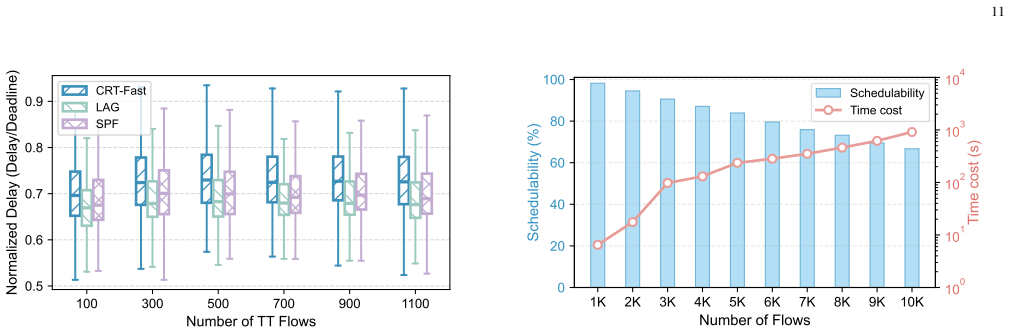

read the original abstract
Low-Earth Orbit (LEO) satellite networks are a key enabler for the 6G Non-Terrestrial Network (NTN) architecture. However, supporting time-sensitive services in LEO networks is challenging due to highly dynamic topologies and the difficulty of maintaining precise global time synchronization. Existing Time-Sensitive Networking (TSN) mechanisms largely rely on static topologies and strict synchronization, which makes them ill-suited to dynamic LEO environments. To address this issue, we propose CRT, a deterministic transmission framework tailored for LEO networks. CRT regulates per-hop residence time using local clocks, thereby compensating for link-delay variations without requiring strict global synchronization. To handle asynchronous collisions, CRT adopts a collision-tolerant scheduling strategy that maximizes the number of schedulable flows while bounding collision-induced jitter. We formalize the corresponding scheduling problem and show that it is NP-hard. We further develop CRT-Fast, an efficient heuristic algorithm. It combines iterative layering with path continuity to control collision intensity and improve path stability under topology changes. Simulations on Iridium and Starlink constellations show that the proposed method achieves lower delay jitter and high schedulability under heavy traffic loads.
Editorial analysis
A structured set of objections, weighed in public.
Referee Report
Summary. The paper proposes CRT, a deterministic transmission framework for LEO satellite networks. It regulates per-hop residence time using local clocks to compensate for link-delay variations without requiring strict global synchronization. To handle asynchronous collisions, it adopts a collision-tolerant scheduling strategy that maximizes the number of schedulable flows while bounding collision-induced jitter. The scheduling problem is formalized and proven NP-hard; an efficient heuristic CRT-Fast is developed that combines iterative layering with path continuity to control collision intensity and improve stability under topology changes. Simulations on Iridium and Starlink constellations demonstrate lower delay jitter and high schedulability under heavy traffic loads.
Significance. If the central claims hold, this work would be significant for enabling time-sensitive services in 6G NTN architectures over dynamic LEO constellations, where traditional TSN approaches fail due to rapid topology changes and synchronization difficulties. The use of local-clock residence-time regulation and explicit collision tolerance represents a pragmatic departure from strict synchronization models, potentially improving practicality. The NP-hardness formalization and heuristic design are positive steps, but the absence of analytical jitter bounds limits the strength of the determinism guarantee relative to simulation-only evidence.
major comments (2)
- [Problem formalization section] The NP-hardness proof for the scheduling problem (formalized in the section on problem definition, referenced in the abstract): the manuscript states the problem is NP-hard but provides insufficient detail on the reduction or key arguments establishing hardness. This is load-bearing because it directly justifies the development and use of the CRT-Fast heuristic rather than an exact solver.
- [CRT-Fast heuristic section] Analysis of CRT-Fast and jitter bounding (the section presenting the heuristic and its properties): no closed-form bound, approximation ratio, or invariant is shown that guarantees collision-induced jitter remains below a deterministic threshold under arbitrary LEO dynamics, topology change rates, or handover frequencies beyond the simulated regimes. The central claim that the approach 'bounds collision-induced jitter' while preserving determinism therefore rests entirely on post-simulation interpretation of Iridium/Starlink traces, which is a load-bearing gap for a determinism paper.
minor comments (2)
- [Abstract] The abstract and introduction could more explicitly quantify the jitter reductions and schedulability gains (e.g., specific percentage improvements or absolute values) rather than qualitative statements.
- [Evaluation section] Figure captions and experimental setup descriptions would benefit from additional detail on the exact traffic models, handover frequencies, and control baselines used in the Iridium and Starlink simulations to improve reproducibility.
Simulated Author's Rebuttal
We thank the referee for the constructive and detailed review. The comments identify key areas where additional rigor can strengthen the formalization and the determinism claims. We address each major comment point by point below, indicating the revisions planned for the next version of the manuscript.
read point-by-point responses
-
Referee: [Problem formalization section] The NP-hardness proof for the scheduling problem (formalized in the section on problem definition, referenced in the abstract): the manuscript states the problem is NP-hard but provides insufficient detail on the reduction or key arguments establishing hardness. This is load-bearing because it directly justifies the development and use of the CRT-Fast heuristic rather than an exact solver.
Authors: We agree that the NP-hardness result benefits from greater detail. The manuscript contains a proof by reduction, but the presentation was condensed. In the revised version we will expand this section to include the full reduction, the instance mapping, and a step-by-step argument establishing equivalence, thereby making the justification for the heuristic explicit and self-contained. revision: yes
-
Referee: [CRT-Fast heuristic section] Analysis of CRT-Fast and jitter bounding (the section presenting the heuristic and its properties): no closed-form bound, approximation ratio, or invariant is shown that guarantees collision-induced jitter remains below a deterministic threshold under arbitrary LEO dynamics, topology change rates, or handover frequencies beyond the simulated regimes. The central claim that the approach 'bounds collision-induced jitter' while preserving determinism therefore rests entirely on post-simulation interpretation of Iridium/Starlink traces, which is a load-bearing gap for a determinism paper.
Authors: We acknowledge that the current manuscript does not supply a closed-form analytical bound or approximation ratio that holds for completely arbitrary dynamics. The heuristic controls collision intensity through iterative layering and path-continuity constraints, and the Iridium/Starlink simulations demonstrate that jitter remains low under realistic loads and topology changes. We agree this empirical support is a limitation for a determinism claim. In the revision we will add an analysis subsection that derives a deterministic jitter upper bound expressed in terms of the maximum collision intensity enforced by the layering procedure, together with a discussion of the topology-change assumptions under which the bound applies. revision: partial
Circularity Check
No circularity: proposal introduces independent mechanisms, NP-hardness formalization, and heuristic evaluated on external traces
full rationale
The paper defines CRT as a new framework that regulates per-hop residence time via local clocks and introduces a collision-tolerant scheduler. It states the scheduling problem is NP-hard (a standard complexity claim requiring an independent reduction proof) and presents CRT-Fast as a heuristic combining iterative layering and path continuity. Evaluation uses Iridium and Starlink constellation traces as external inputs. No self-definitional equations, fitted parameters renamed as predictions, or load-bearing self-citations appear in the provided text. The derivation chain remains self-contained against external benchmarks and does not reduce claims to its own inputs by construction.
Axiom & Free-Parameter Ledger
axioms (1)
- domain assumption Local clocks at each hop can compensate for link-delay variations in dynamic topologies
Reference graph
Works this paper leans on
-
[1]
A first look at starlink performance,
F. Michel, M. Trevisan, D. Giordano, and O. Bonaventure, “A first look at starlink performance,” inProceedings of the 22nd ACM Internet Measurement Conference, 2022, pp. 130–136
2022
-
[2]
An operational and performance overview of the IRIDIUM low earth orbit satellite system,
S. R. Pratt, R. A. Raines, C. E. Fossa, and M. A. Temple, “An operational and performance overview of the IRIDIUM low earth orbit satellite system,”IEEE Communications Surveys, vol. 2, no. 2, pp. 2–10, 1999
1999
-
[3]
The oneweb satellite system,
Y . Henri, “The oneweb satellite system,” inHandbook of Small Satel- lites: Technology, Design, Manufacture, Applications, Economics and Regulation, 2020, pp. 1091–1100
2020
-
[4]
A perspective on time toward wireless 6G,
P. Popovski, F. Chiariotti, K. Huang, A. E. Kalør, M. Kountouris, N. Pappas, and B. Soret, “A perspective on time toward wireless 6G,” Proceedings of the IEEE, vol. 110, no. 8, pp. 1116–1146, 2022
2022
-
[5]
Toward supporting holo- graphic services over deterministic 6G integrated terrestrial and non- terrestrial networks,
H. Yu, T. Taleb, K. Samdanis, and J. Song, “Toward supporting holo- graphic services over deterministic 6G integrated terrestrial and non- terrestrial networks,”IEEE Network, vol. 38, no. 1, pp. 262–271, 2023
2023
-
[6]
Learning-driven swarm intelligence: Enabling deterministic flows scheduling in LEO satellite networks,
Z. Wang, H. Yao, T. Mai, Z. Li, and C. P. Chen, “Learning-driven swarm intelligence: Enabling deterministic flows scheduling in LEO satellite networks,”IEEE Transactions on Mobile Computing, 2024
2024
-
[7]
Joint scheduling, comput- ing, and load balancing for time sensitive traffic in sdn-enabled space- air-ground integrated 6G networks: A federated reinforcement learning approach,
H. Sun, H. Zhang, H. Ma, and V . C. Leung, “Joint scheduling, comput- ing, and load balancing for time sensitive traffic in sdn-enabled space- air-ground integrated 6G networks: A federated reinforcement learning approach,”IEEE Transactions on Mobile Computing, 2025
2025
-
[8]
LEO satellite access network (LEO-SAN) toward 6G: Challenges and approaches,
Z. Xiao, J. Yang, T. Mao, C. Xu, R. Zhang, Z. Han, and X.-G. Xia, “LEO satellite access network (LEO-SAN) toward 6G: Challenges and approaches,”IEEE Wireless Communications, vol. 31, no. 2, pp. 89–96, 2022
2022
-
[9]
Network char- acteristics of LEO satellite constellations: A starlink-based measurement from end users,
S. Ma, Y . C. Chou, H. Zhao, L. Chen, X. Ma, and J. Liu, “Network char- acteristics of LEO satellite constellations: A starlink-based measurement from end users,” inProceedings of the IEEE INFOCOM 2023-IEEE Conference on Computer Communications, 2023, pp. 1–10
2023
-
[10]
Satcp: Link-layer informed TCP adaptation for highly dynamic LEO satellite networks,
X. Cao and X. Zhang, “Satcp: Link-layer informed TCP adaptation for highly dynamic LEO satellite networks,” inProceedings of the IEEE INFOCOM 2023 -IEEE Conference on Computer Communications, 2023, pp. 1–10
2023
-
[11]
Large- scale deterministic networks: Architecture, enabling technologies, case study, and future directions,
W. Tian, C. Gu, M. Guo, S. He, J. Kang, D. Niyato, and J. Chen, “Large- scale deterministic networks: Architecture, enabling technologies, case study, and future directions,”IEEE Network, vol. 38, no. 4, pp. 284–291, 2024
2024
-
[12]
Large- scale deterministic IP networks on CENI,
S. Wang, B. Wu, C. Zhang, Y . Huang, T. Huang, and Y . Liu, “Large- scale deterministic IP networks on CENI,” inProceedings of the IEEE INFOCOM 2021-IEEE Conference on Computer Communications Workshops, 2021, pp. 1–6
2021
-
[13]
Time-deterministic networking for satellite-based internet-of-things services: Architecture, key technolo- gies, and future directions,
Y . Hu, B. Guo, C. Yang, and Z. Han, “Time-deterministic networking for satellite-based internet-of-things services: Architecture, key technolo- gies, and future directions,”IEEE Network, 2024
2024
-
[14]
Introduction to time-sensitive networking,
N. Finn, “Introduction to time-sensitive networking,”IEEE Communi- cations Standards Magazine, vol. 2, no. 2, pp. 22–28, 2018
2018
-
[15]
Ultra-low latency (ULL) networks: The IEEE TSN and IETF detnet standards and related 5G ull research,
A. Nasrallah, A. S. Thyagaturu, Z. Alharbi, C. Wang, X. Shao, M. Reisslein, and H. ElBakoury, “Ultra-low latency (ULL) networks: The IEEE TSN and IETF detnet standards and related 5G ull research,” IEEE Communications Surveys & Tutorials, vol. 21, no. 1, pp. 88–145, 2018
2018
-
[16]
The time-triggered architecture,
H. Kopetz and G. Bauer, “The time-triggered architecture,”Proceedings of the IEEE, vol. 91, no. 1, pp. 112–126, 2003
2003
-
[17]
IEEE Standard for Local and Metropolitan Area Networks—Timing and Synchronization for Time-Sensitive Applica- tions,
IEEE Std 802.1AS, “IEEE Standard for Local and Metropolitan Area Networks—Timing and Synchronization for Time-Sensitive Applica- tions,” 2020
2020
-
[18]
IEEE Standard for a Precision Clock Synchronization Protocol for Networked Measurement and Control Systems,
IEEE Std 1588, “IEEE Standard for a Precision Clock Synchronization Protocol for Networked Measurement and Control Systems,” Jun. 2020
2020
-
[19]
IEEE Standard for Local and Metropolitan Area Networks—Bridges and Bridged Networks—Amendment 25: Enhance- ments for Scheduled Traffic,
IEEE Std 802.1Qbv, “IEEE Standard for Local and Metropolitan Area Networks—Bridges and Bridged Networks—Amendment 25: Enhance- ments for Scheduled Traffic,” Mar. 2016
2016
-
[20]
Measuring a low-earth-orbit satellite net- work,
J. Pan, J. Zhao, and L. Cai, “Measuring a low-earth-orbit satellite net- work,” inProceedings of the IEEE 34th Annual International Symposium on Personal, Indoor and Mobile Radio Communications, 2023, pp. 1–6
2023
-
[21]
Asynchronous interference mitigation for leo multi-satellite cooperative systems,
X. Chen and Z. Luo, “Asynchronous interference mitigation for leo multi-satellite cooperative systems,”IEEE Transactions on Wireless Communications, 2024
2024
-
[22]
Time-triggered switch-memory-switch architecture for time-sensitive networking switches,
Z. Li, H. Wan, Y . Deng, X. Zhao, Y . Gao, X. Song, and M. Gu, “Time-triggered switch-memory-switch architecture for time-sensitive networking switches,”IEEE Transactions on Computer-Aided Design of Integrated Circuits and Systems, vol. 39, no. 1, pp. 185–198, 2018
2018
-
[23]
IEEE Standard for Local and Metropolitan Area Networks—Bridges and Bridged Networks—Amendment 26: Frame Preemption,
IEEE Std 802.1Qbu, “IEEE Standard for Local and Metropolitan Area Networks—Bridges and Bridged Networks—Amendment 26: Frame Preemption,” 2016
2016
-
[24]
Np-completeness of some edge-disjoint paths problems,
J. Vygen, “Np-completeness of some edge-disjoint paths problems,” Discrete Applied Mathematics, vol. 61, no. 1, pp. 83–90, 1995
1995
-
[25]
Finding the k shortest loopless paths in a network,
J. Y . Yen, “Finding the k shortest loopless paths in a network,” management Science, vol. 17, no. 11, pp. 712–716, 1971
1971
-
[26]
Spatio-temporal routing, redundant coding and multipath scheduling for deterministic satellite network transmission,
X. Jiang, Y . Huang, J. Li, H. He, S. Chen, F. Yang, and J. Yang, “Spatio-temporal routing, redundant coding and multipath scheduling for deterministic satellite network transmission,”IEEE Transactions on Communications, vol. 71, no. 5, pp. 2860–2875, 2023
2023
-
[27]
Routing and scheduling of time-triggered traffic in time-sensitive networks,
A. A. Atallah, G. B. Hamad, and O. A. Mohamed, “Routing and scheduling of time-triggered traffic in time-sensitive networks,”IEEE Transactions on Industrial Informatics, vol. 16, no. 7, pp. 4525–4534, 2020
2020
-
[28]
ILP-based joint routing and scheduling for time-triggered networks,
E. Schweissguth, P. Danielis, D. Timmermann, H. Parzyjegla, and G. M ¨uhl, “ILP-based joint routing and scheduling for time-triggered networks,” inProceedings of the 25th International Conference on Real- Time Networks and Systems, 2017, pp. 8–17
2017
-
[29]
IEEE Standard for Local and Metropolitan Area Networks—Bridges and Bridged Networks—Amendment: Cyclic Queu- ing and Forwarding,
IEEE Std 802.1Qch, “IEEE Standard for Local and Metropolitan Area Networks—Bridges and Bridged Networks—Amendment: Cyclic Queu- ing and Forwarding,” 2017
2017
-
[30]
Burst- aware time-triggered flow scheduling with enhanced multi-CQF in time- sensitive networks,
D. Yang, Z. Cheng, W. Zhang, H. Zhang, and X. Shen, “Burst- aware time-triggered flow scheduling with enhanced multi-CQF in time- sensitive networks,”IEEE/ACM Transactions on Networking, vol. 31, no. 6, pp. 2809–2824, 2023
2023
-
[31]
Injection time planning: Making CQF practical in time-sensitive networking,
J. Yan, W. Quan, X. Jiang, and Z. Sun, “Injection time planning: Making CQF practical in time-sensitive networking,” inProceedings of the IEEE INFOCOM 2020 -IEEE Conference on Computer Communications, 2020, pp. 616–625
2020
-
[32]
Deepscheduler: Enabling flow-aware scheduling in time-sensitive networking,
X. He, X. Zhuge, F. Dang, W. Xu, and Z. Yang, “Deepscheduler: Enabling flow-aware scheduling in time-sensitive networking,” inPro- ceedings of the IEEE INFOCOM 2023 -IEEE Conference on Computer Communications, 2023, pp. 1–10
2023
-
[33]
Ttdeep: Time- triggered scheduling for real-time ethernet via deep reinforcement learn- ing,
H. Jia, Y . Jiang, C. Zhong, H. Wan, and X. Zhao, “Ttdeep: Time- triggered scheduling for real-time ethernet via deep reinforcement learn- ing,” inProceedings of the IEEE Global Communications Conference, 2021, pp. 1–6
2021
-
[34]
CPF: Bridging time-sensitive networks into large-scale LEO satellite networks,
F. Wang, D. Wu, W. He, Z. Li, Q. Zhang, and H. Yao, “CPF: Bridging time-sensitive networks into large-scale LEO satellite networks,” in Proceedings of the International Wireless Communications and Mobile Computing, 2023, pp. 1–6
2023
-
[35]
Time- sensitive networking mechanism aided by multilevel cyclic queues in LEO satellite networks,
X. Ma, S. Li, Z. Guan, J. Li, H. Sun, Y . Wang, and H. Guo, “Time- sensitive networking mechanism aided by multilevel cyclic queues in LEO satellite networks,”Electronics, vol. 12, no. 6, p. 1357, 2023. 13
2023
-
[36]
Delay-sensitive ser- vice provisioning in software-defined low-earth-orbit satellite networks,
F. Dong, Y . Zhang, G. Liu, H. Yu, and C. Sun, “Delay-sensitive ser- vice provisioning in software-defined low-earth-orbit satellite networks,” Electronics, vol. 12, no. 16, p. 3474, 2023
2023
-
[37]
An optimal delay routing algo- rithm considering delay variation in the LEO satellite communication network,
S. Geng, S. Liu, Z. Fang, and S. Gao, “An optimal delay routing algo- rithm considering delay variation in the LEO satellite communication network,”Computer Networks, vol. 173, p. 107166, 2020
2020
-
[38]
FastTS: Enabling fault-tolerant and time-sensitive scheduling in space- terrestrial integrated networks,
G. Peng, S. Wang, T. Huang, F. Li, K. Zhao, Y . Huang, and Z. Xiong, “FastTS: Enabling fault-tolerant and time-sensitive scheduling in space- terrestrial integrated networks,”IEEE Journal on Selected Areas in Communications, vol. 42, no. 12, pp. 3551–3565, 2024
2024
-
[39]
Achieving resilient and performance-guaranteed routing in space- terrestrial integrated networks,
Z. Lai, H. Li, Y . Wang, Q. Wu, Y . Deng, J. Liu, Y . Li, and J. Wu, “Achieving resilient and performance-guaranteed routing in space- terrestrial integrated networks,” inProceedings of the IEEE INFOCOM 2023 -IEEE Conference on Computer Communications, 2023, pp. 1–10
2023
discussion (0)
Sign in with ORCID, Apple, or X to comment. Anyone can read and Pith papers without signing in.