Recognition: unknown
Revisiting General Map Search via Generative Point-of-Interest Retrieval
Pith reviewed 2026-05-07 14:27 UTC · model grok-4.3
The pith
GenPOI retrieves relevant map points of interest by generating candidates from LLM sequences that combine user context with geo-semantic POI tokens.
A machine-rendered reading of the paper's core claim, the machinery that carries it, and where it could break.
Core claim
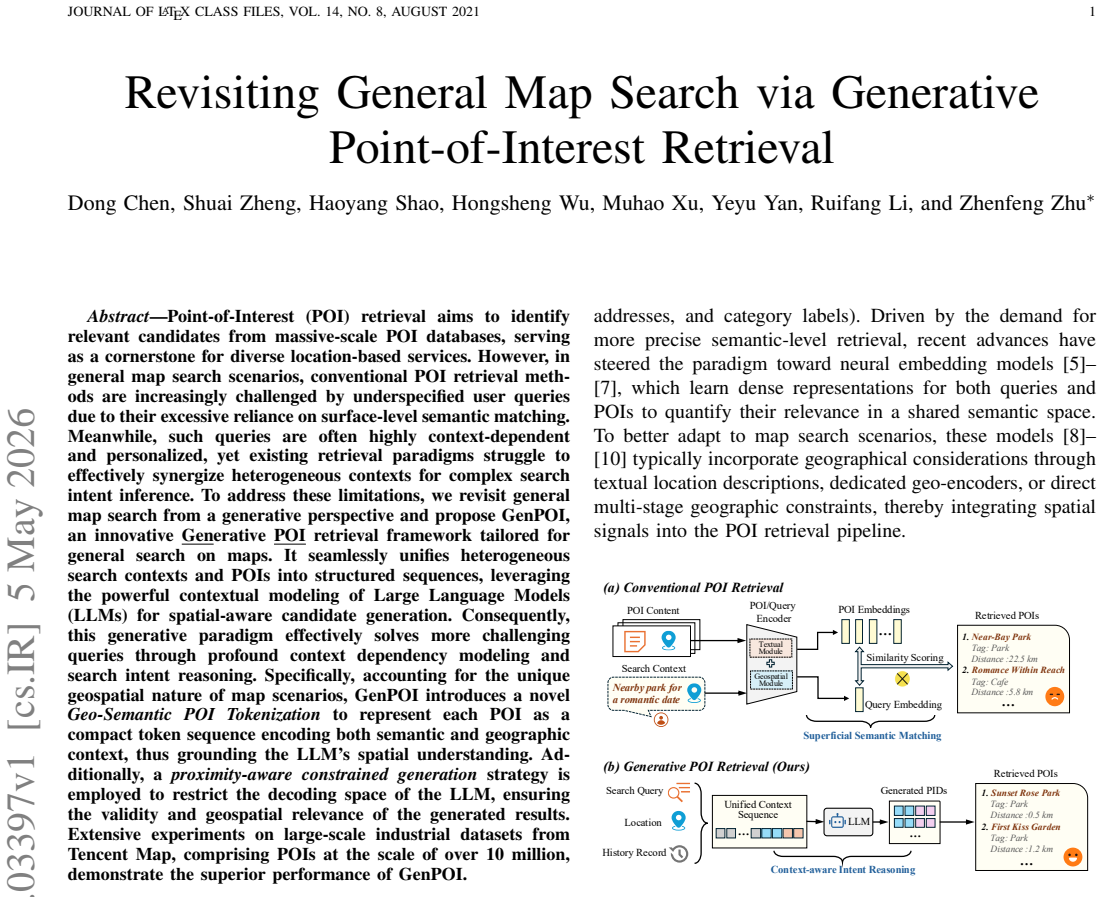
GenPOI unifies search contexts and POIs into structured sequences and applies large language models to generate candidates through context dependency modeling and intent reasoning; Geo-Semantic POI Tokenization encodes each POI as a compact token sequence that includes both semantic and geographic information, while proximity-aware constrained generation limits decoding to valid and relevant outputs, yielding superior results on large-scale map data.
What carries the argument
Geo-Semantic POI Tokenization, which turns each POI into a compact token sequence encoding semantic attributes and geographic context to ground the LLM, combined with proximity-aware constrained generation that restricts the output space for validity and relevance.
If this is right
- Challenging queries that depend on personal context or are underspecified can be resolved more reliably than with surface-level matching alone.
- Heterogeneous inputs such as user history, current location, and map constraints become jointly usable for candidate generation.
- The decoding space remains limited to valid POIs, reducing invalid or distant results at the scale of ten million entries.
- Search intent reasoning emerges directly from the LLM's contextual modeling rather than separate ranking stages.
Where Pith is reading between the lines
- Map services could shift from static indexes toward on-the-fly generation that adapts to evolving user routines.
- The same sequence approach might support related tasks such as suggesting sequences of locations for itineraries.
- Evaluation would need to move beyond precision at fixed ranks to check whether generated sets satisfy implicit spatial and intent constraints.
Load-bearing premise
That tokenizing POIs with both semantic and geographic details and constraining the language model's generation will preserve spatial accuracy and avoid systematic loss of location information or biased candidates.
What would settle it
A collection of test queries on the Tencent Map dataset where the generated POIs fall outside the stated proximity range or fail to match the inferred user intent even after applying the tokenization and constraints.
Figures



read the original abstract
Point-of-Interest (POI) retrieval aims to identify relevant candidates from massive-scale POI databases, serving as a cornerstone for diverse location-based services. However, in general map search scenarios, conventional POI retrieval methods are increasingly challenged by underspecified user queries due to their excessive reliance on surface-level semantic matching. Meanwhile, such queries are often highly context-dependent and personalized, yet existing retrieval paradigms struggle to effectively synergize heterogeneous contexts for complex search intent inference. To address these limitations, we revisit general map search from a generative perspective and propose GenPOI, an innovative Generative POI retrieval framework tailored for general search on maps. It seamlessly unifies heterogeneous search contexts and POIs into structured sequences, leveraging the powerful contextual modeling of Large Language Models (LLMs) for spatial-aware candidate generation. Consequently, this generative paradigm effectively solves more challenging queries through profound context dependency modeling and search intent reasoning. Specifically, accounting for the unique geospatial nature of map scenarios, GenPOI introduces a novel Geo-Semantic POI Tokenization to represent each POI as a compact token sequence encoding both semantic and geographic context, thus grounding the LLM's spatial understanding. Additionally, a proximity-aware constrained generation strategy is employed to restrict the decoding space of the LLM, ensuring the validity and geospatial relevance of the generated results. Extensive experiments on large-scale industrial datasets from Tencent Map, comprising POIs at the scale of over 10 million, demonstrate the superior performance of GenPOI.
Editorial analysis
A structured set of objections, weighed in public.
Referee Report
Summary. The paper proposes GenPOI, a generative framework for point-of-interest (POI) retrieval in general map search. It unifies heterogeneous search contexts and POIs into structured sequences, employs a novel Geo-Semantic POI Tokenization to encode both semantic and geographic information for each POI, and applies proximity-aware constrained generation to restrict LLM decoding for valid, relevant outputs. The central claim is that this approach better handles underspecified, context-dependent queries via LLM-based intent reasoning and demonstrates superior performance on large-scale industrial datasets from Tencent Map containing over 10 million POIs.
Significance. If the experimental claims hold after addressing validation gaps, the work offers a potentially significant shift from traditional semantic-matching retrieval to an LLM-driven generative paradigm for location-based services. The scale of the Tencent Map dataset (>10M POIs) is a notable strength for industrial relevance, and the integration of geospatial constraints with LLMs could influence future map search systems if the tokenization and constraint mechanisms prove robust.
major comments (2)
- [Abstract] Abstract: the assertion of 'superior performance' and effective solving of 'more challenging queries' is not supported by any reported baselines, metrics, ablation studies, or error analysis in the provided text. Without these, it is impossible to assess whether the generative approach outperforms conventional methods or if the claimed context-dependency modeling is load-bearing.
- [Abstract] Geo-Semantic POI Tokenization (described in the abstract): converting each of >10M POIs into a 'compact token sequence' necessarily discretizes or compresses coordinates and proximity relations. The manuscript provides no analysis, ablation, or proof that this encoding is lossless for fine-grained spatial details (e.g., exact distances or boundary cases), which directly undermines the claim that it 'grounds the LLM's spatial understanding' and enables reliable candidate generation on underspecified queries.
Simulated Author's Rebuttal
We thank the referee for the constructive feedback. We provide point-by-point responses to the major comments and indicate planned revisions to strengthen the manuscript.
read point-by-point responses
-
Referee: [Abstract] Abstract: the assertion of 'superior performance' and effective solving of 'more challenging queries' is not supported by any reported baselines, metrics, ablation studies, or error analysis in the provided text. Without these, it is impossible to assess whether the generative approach outperforms conventional methods or if the claimed context-dependency modeling is load-bearing.
Authors: The abstract is intended as a high-level summary of the paper's contributions and findings. The full manuscript details the experimental validation in Sections 4 and 5, which include multiple baselines, quantitative metrics (e.g., Recall, Precision), ablation studies on the generative components and context modeling, and analysis of performance on challenging, underspecified queries using the Tencent Map dataset with over 10M POIs. These results support the claims of superior performance. We will update the abstract to reference specific performance improvements and key findings to make the assertions more directly supported by the text. revision: partial
-
Referee: [Abstract] Geo-Semantic POI Tokenization (described in the abstract): converting each of >10M POIs into a 'compact token sequence' necessarily discretizes or compresses coordinates and proximity relations. The manuscript provides no analysis, ablation, or proof that this encoding is lossless for fine-grained spatial details (e.g., exact distances or boundary cases), which directly undermines the claim that it 'grounds the LLM's spatial understanding' and enables reliable candidate generation on underspecified queries.
Authors: We acknowledge that discretization in tokenization involves trade-offs in spatial precision. The Geo-Semantic POI Tokenization uses a combination of semantic tokens and geo-hierarchical encoding to capture both aspects. The manuscript includes ablation studies in Section 5.3 that compare different tokenization strategies and show improved performance attributable to the spatial grounding. While we do not claim perfect losslessness, the design prioritizes task-relevant spatial information. To address the concern, we will add an analysis subsection discussing the encoding's impact on spatial fidelity, including examples and any available metrics on distance preservation. revision: yes
Circularity Check
No circularity: new generative framework with external evaluation
full rationale
The paper introduces GenPOI as a novel framework that tokenizes POIs into geo-semantic sequences and applies proximity-aware constrained LLM generation for map search. No equations, fitted parameters, or derivations are shown reducing to self-defined inputs or prior self-citations. The central claims rest on the proposed architecture and its performance on independent large-scale Tencent Map data (>10M POIs), not on renaming or tautological reuse of the authors' own fitted results. This is a standard proposal-plus-evaluation structure with no load-bearing self-referential steps.
Axiom & Free-Parameter Ledger
Reference graph
Works this paper leans on
-
[1]
Schiller and A
J. Schiller and A. V oisard,Location-based services. Elsevier, 2004
2004
-
[2]
The probabilistic relevance frame- work: Bm25 and beyond,
S. Robertson, H. Zaragozaet al., “The probabilistic relevance frame- work: Bm25 and beyond,”Foundations and Trends® in Information Retrieval, vol. 3, no. 4, pp. 333–389, 2009
2009
-
[3]
Some simple effective approximations to the 2-poisson model for probabilistic weighted retrieval,
S. E. Robertson and S. Walker, “Some simple effective approximations to the 2-poisson model for probabilistic weighted retrieval,” inPro- ceedings of the 17th Annual International ACM SIGIR Conference on Research and Development in Information Retrieval, 1994, pp. 232–241
1994
-
[4]
Word embedding based generalized language model for information retrieval,
D. Ganguly, D. Roy, M. Mitra, and G. J. Jones, “Word embedding based generalized language model for information retrieval,” inProceedings of the 38th International ACM SIGIR Conference on Research and Development in Information Retrieval, 2015, pp. 795–798
2015
-
[5]
Learning deep structured semantic models for web search using clickthrough data,
P.-S. Huang, X. He, J. Gao, L. Deng, A. Acero, and L. Heck, “Learning deep structured semantic models for web search using clickthrough data,” inProceedings of the 22nd ACM International Conference on Information & Knowledge Management, 2013, pp. 2333–2338
2013
-
[6]
Deeper text understanding for ir with contextual neural language modeling,
Z. Dai and J. Callan, “Deeper text understanding for ir with contextual neural language modeling,” inProceedings of the 42nd International ACM SIGIR Conference on Research and Development in Information Retrieval, 2019, pp. 985–988
2019
-
[7]
Colbert: Efficient and effective passage search via contextualized late interaction over bert,
O. Khattab and M. Zaharia, “Colbert: Efficient and effective passage search via contextualized late interaction over bert,” inProceedings of the 43rd International ACM SIGIR Conference on Research and Development in Information Retrieval, 2020, pp. 39–48
2020
-
[8]
Incorporating semantic similarity with geographic correlation for query-poi relevance learning,
J. Zhao, D. Peng, C. Wu, H. Chen, M. Yu, W. Zheng, L. Ma, H. Chai, J. Ye, and X. Qie, “Incorporating semantic similarity with geographic correlation for query-poi relevance learning,” inProceedings of the AAAI Conference on Artificial Intelligence, vol. 33, no. 01, 2019, pp. 1270– 1277
2019
-
[9]
Poi semantic model with a deep convolutional structure,
J. Zhao, M. Yu, H. Chen, B. Li, L. Zhang, Q. Song, L. Ma, H. Chai, and J. Ye, “Poi semantic model with a deep convolutional structure,” arXiv:1903.07279, 2019
-
[10]
Text vs. space: efficient geo-search query processing,
M. Christoforaki, J. He, C. Dimopoulos, A. Markowetz, and T. Suel, “Text vs. space: efficient geo-search query processing,” inProceedings of the 20th ACM International Conference on Information and Knowledge Management, 2011, pp. 423–432
2011
-
[11]
A comprehensive overview of large language models,
H. Naveed, A. U. Khan, S. Qiu, M. Saqib, S. Anwar, M. Usman, N. Akhtar, N. Barnes, and A. Mian, “A comprehensive overview of large language models,”ACM Transactions on Intelligent Systems and Technology, vol. 16, no. 5, pp. 1–72, 2025
2025
-
[12]
Large Language Models: A Survey
S. Minaee, T. Mikolov, N. Nikzad, M. Chenaghlu, R. Socher, X. Amatri- ain, and J. Gao, “Large language models: A survey,”arXiv:2402.06196, 2024
work page internal anchor Pith review arXiv 2024
-
[13]
From matching to generation: A survey on generative information retrieval,
X. Li, J. Jin, Y . Zhou, Y . Zhang, P. Zhang, Y . Zhu, and Z. Dou, “From matching to generation: A survey on generative information retrieval,” ACM Transactions on Information Systems, vol. 43, no. 3, pp. 1–62, 2025
2025
-
[14]
Recommender systems with generative retrieval,
S. Rajput, N. Mehta, A. Singh, R. Hulikal Keshavan, T. Vu, L. Heldt, L. Hong, Y . Tay, V . Tran, J. Samostet al., “Recommender systems with generative retrieval,”Advances in Neural Information Processing Systems, vol. 36, pp. 10 299–10 315, 2023
2023
-
[15]
OneRec: Unifying Retrieve and Rank with Generative Recommender and Iterative Preference Alignment
J. Deng, S. Wang, K. Cai, L. Ren, Q. Hu, W. Ding, Q. Luo, and G. Zhou, “Onerec: Unifying retrieve and rank with generative recommender and iterative preference alignment,”arXiv:2502.18965, 2025
work page internal anchor Pith review arXiv 2025
-
[16]
A survey on point-of-interest recommendation: Models, architectures, and security,
Q. Zhang, P. Yang, J. Yu, H. Wang, X. He, S.-M. Yiu, and H. Yin, “A survey on point-of-interest recommendation: Models, architectures, and security,”IEEE Transactions on Knowledge and Data Engineering, 2025
2025
-
[17]
Learning to tokenize for generative retrieval,
W. Sun, L. Yan, Z. Chen, S. Wang, H. Zhu, P. Ren, Z. Chen, D. Yin, M. Rijke, and Z. Ren, “Learning to tokenize for generative retrieval,”Ad- vances in Neural Information Processing Systems, vol. 36, pp. 46 345– 46 361, 2023
2023
-
[18]
How does generative retrieval scale to millions of passages?
R. Pradeep, K. Hui, J. Gupta, A. Lelkes, H. Zhuang, J. Lin, D. Metzler, and V . Tran, “How does generative retrieval scale to millions of passages?” inProceedings of the 2023 Conference on Empirical Methods in Natural Language Processing, 2023, pp. 1305–1321
2023
-
[19]
Semantic modelling with long-short-term memory for information retrieval,
H. Palangi, L. Deng, Y . Shen, J. Gao, X. He, J. Chen, X. Song, and R. Ward, “Semantic modelling with long-short-term memory for information retrieval,”arXiv:1412.6629, 2014
-
[20]
Pre-trained language models and their applications,
H. Wang, J. Li, H. Wu, E. Hovy, and Y . Sun, “Pre-trained language models and their applications,”Engineering, vol. 25, pp. 51–65, 2023
2023
-
[21]
Improving local identifiability in probabilistic box embeddings,
S. Dasgupta, M. Boratko, D. Zhang, L. Vilnis, X. Li, and A. McCal- lum, “Improving local identifiability in probabilistic box embeddings,” Advances in Neural Information Processing Systems, vol. 33, pp. 182– 192, 2020
2020
-
[22]
M3-embedding: Multi-linguality, multi- functionality, multi-granularity text embeddings through self-knowledge distillation,
M.-L. M.-F. Multi-Granularity, “M3-embedding: Multi-linguality, multi- functionality, multi-granularity text embeddings through self-knowledge distillation,” 2024
2024
-
[23]
Hgamn: Heterogeneous graph attention matching network for multi- lingual poi retrieval at baidu maps,
J. Huang, H. Wang, Y . Sun, M. Fan, Z. Huang, C. Yuan, and Y . Li, “Hgamn: Heterogeneous graph attention matching network for multi- lingual poi retrieval at baidu maps,” inProceedings of the 27th ACM SIGKDD Conference on Knowledge Discovery & Data Mining, 2021, pp. 3032–3040
2021
-
[24]
Meta-learned spatial- temporal poi auto-completion for the search engine at baidu maps,
M. Fan, Y . Sun, J. Huang, H. Wang, and Y . Li, “Meta-learned spatial- temporal poi auto-completion for the search engine at baidu maps,” inProceedings of the 27th ACM SIGKDD Conference on Knowledge Discovery & Data Mining, 2021, pp. 2822–2830
2021
-
[25]
Personalized prefix embedding for poi auto-completion in the search engine of baidu maps,
J. Huang, H. Wang, M. Fan, A. Zhuo, and Y . Li, “Personalized prefix embedding for poi auto-completion in the search engine of baidu maps,” inProceedings of the 26th ACM SIGKDD International Conference on Knowledge Discovery & Data Mining, 2020, pp. 2677–2685
2020
-
[26]
Generative retrieval and alignment model: A new paradigm for e-commerce retrieval,
M. Pang, C. Yuan, X. He, Z. Fang, D. Xie, F. Qu, X. Jiang, C. Peng, Z. Lin, Z. Luoet al., “Generative retrieval and alignment model: A new paradigm for e-commerce retrieval,” inCompanion Proceedings of the ACM on Web Conference 2025, 2025, pp. 413–421
2025
-
[27]
arXiv preprint arXiv:2509.03236 , year=
B. Chen, X. Guo, S. Wang, Z. Liang, Y . Lv, Y . Ma, X. Xiao, B. Xue, X. Zhang, Y . Yanget al., “Onesearch: A preliminary exploration of the unified end-to-end generative framework for e-commerce search,” arXiv:2509.03236, 2025
-
[28]
A survey on large language models for recommendation,
L. Wu, Z. Zheng, Z. Qiu, H. Wang, H. Gu, T. Shen, C. Qin, C. Zhu, H. Zhu, Q. Liuet al., “A survey on large language models for recommendation,”World Wide Web, vol. 27, no. 5, p. 60, 2024
2024
-
[29]
arXiv preprint arXiv:2505.13526 , year=
Z. Liu, W. Liu, H. Zhu, J. Yu, J. Yin, W.-C. Lee, and S. Wang, “Geography-aware large language models for next poi recommendation,” arXiv:2505.13526, 2025. JOURNAL OF LATEX CLASS FILES, VOL. 14, NO. 8, AUGUST 2021 11
-
[30]
Onesug: The unified end-to-end generative framework for e-commerce query suggestion,
X. Guo, B. Chen, S. Wang, Y . Yang, C. Lei, Y . Ding, and H. Li, “Onesug: The unified end-to-end generative framework for e-commerce query suggestion,”arXiv:2506.06913, 2025
-
[31]
Generating long semantic ids in parallel for recommendation,
Y . Hou, J. Li, A. Shin, J. Jeon, A. Santhanam, W. Shao, K. Hassani, N. Yao, and J. McAuley, “Generating long semantic ids in parallel for recommendation,” inProceedings of the 31st ACM SIGKDD Conference on Knowledge Discovery & Data Mining, 2025, pp. 956–966
2025
-
[32]
Semantic ids for joint generative search and recommendation,
G. Penha, E. D’Amico, M. De Nadai, E. Palumbo, A. Tamborrino, A. Vardasbi, M. Lefarov, S. Lin, T. Heathet al., “Semantic ids for joint generative search and recommendation,” inProceedings of the Nineteenth ACM Conference on Recommender Systems, 2025, pp. 1296– 1301
2025
-
[33]
Qarm: Quantitative alignment multi-modal recommen- dation at kuaishou,
X. Luo, J. Cao, T. Sun, J. Yu, R. Huang, W. Yuan, H. Lin, Y . Zheng, S. Wanget al., “Qarm: Quantitative alignment multi-modal recommen- dation at kuaishou,” inProceedings of the 34th ACM International Conference on Information & Knowledge Management, 2025, pp. 5915– 5922
2025
-
[34]
Autoregressive image generation using residual quantization,
D. Lee, C. Kim, S. Kim, M. Cho, and W.-S. Han, “Autoregressive image generation using residual quantization,” inProceedings of the IEEE/CVF Conference on Computer Vision and Pattern Recognition, 2022, pp. 11 523–11 532
2022
-
[35]
Generative next poi recommendation with semantic id,
D. Wang, Y . Huang, S. Gao, Y . Wang, C. Huang, and S. Shang, “Generative next poi recommendation with semantic id,” inProceedings of the 31st ACM SIGKDD Conference on Knowledge Discovery & Data Mining, 2025, pp. 2904–2914
2025
-
[36]
A geohash-based index for spatial data management in distributed memory,
J. Liu, H. Li, Y . Gao, H. Yu, and D. Jiang, “A geohash-based index for spatial data management in distributed memory,” inProceedings of the 22nd International Conference on Geoinformatics, 2014, pp. 1–4
2014
-
[37]
Roformer: En- hanced transformer with rotary position embedding,
J. Su, M. Ahmed, Y . Lu, S. Pan, W. Bo, and Y . Liu, “Roformer: En- hanced transformer with rotary position embedding,”Neurocomputing, vol. 568, p. 127063, 2024
2024
-
[38]
Neural discrete representation learning,
A. Van Den Oord, O. Vinyalset al., “Neural discrete representation learning,”Advances in Neural Information Processing Systems, vol. 30, 2017
2017
-
[39]
Learning optimal tree models under beam search,
J. Zhuo, Z. Xu, W. Dai, H. Zhu, H. Li, J. Xu, and K. Gai, “Learning optimal tree models under beam search,” inInternational Conference on Machine Learning. PMLR, 2020, pp. 11 650–11 659
2020
-
[40]
Avoid recommending out-of-domain items: Constrained generative recommendation with llms,
H. Liao, W. Lu, J. Lian, M. Wu, S. Wang, Y . Zhang, Y . Huang, M. Zhou, and X. Xie, “Avoid recommending out-of-domain items: Constrained generative recommendation with llms,”arXiv:2505.03336, 2025
-
[41]
A. Yang, A. Li, B. Yang, B. Zhang, B. Hui, B. Zheng, B. Yu, C. Gao, C. Huang, C. Lvet al., “Qwen3 technical report,”arXiv:2505.09388, 2025
work page internal anchor Pith review arXiv 2025
-
[42]
Pytorch: An imperative style, high-performance deep learning library,
A. Paszke, S. Gross, F. Massa, A. Lerer, J. Bradbury, G. Chanan, T. Killeen, Z. Lin, N. Gimelshein, L. Antigaet al., “Pytorch: An imperative style, high-performance deep learning library,”Advances in Neural Information Processing Systems, vol. 32, 2019
2019
-
[43]
Visualizing data using t-sne,
L. v. d. Maaten and G. Hinton, “Visualizing data using t-sne,”Journal of Machine Learning Research, vol. 9, no. Nov, pp. 2579–2605, 2008
2008
discussion (0)
Sign in with ORCID, Apple, or X to comment. Anyone can read and Pith papers without signing in.