Recognition: unknown
Critical study of A. Eswari and S. Sarvana kumar, "Chronoamperometric response of electrochemical reaction diffusion system: a new theoretical and numerical investigation for EC2 scheme", in J. Iran. Chem. Soc. 21(8), (2024), 2183-2199
Pith reviewed 2026-05-07 12:35 UTC · model grok-4.3
The pith
The 2024 paper on chronoamperometric responses for the EC2 scheme contains incorrect statements, citations, and mathematics leading to wrong results.
A machine-rendered reading of the paper's core claim, the machinery that carries it, and where it could break.
Core claim
The examined paper suffers from major problems with incorrect statements, irrelevant citations, incorrect mathematics leading to incorrect results, which are compared with independent simulations.
What carries the argument
Direct comparison of the paper's mathematical derivations and numerical results against independent finite difference simulations of the reaction-diffusion equations for the EC2 mechanism.
If this is right
- The published results for the chronoamperometric response of the EC2 scheme cannot be relied upon.
- Revised theoretical expressions are required to correctly describe the system.
- Numerical methods must be validated against independent computations to ensure accuracy.
- Citations and further work building on the original findings need re-evaluation.
Where Pith is reading between the lines
- This example shows how replication with independent code can reveal flaws in published computational work on reaction-diffusion systems.
- Similar papers in the area may benefit from explicit verification steps against known limiting cases.
- The incident points to the general value of open comparison of numerical outputs in electrochemistry modeling.
Load-bearing premise
The observed discrepancies between the published results and the new simulations arise from errors in the original mathematics rather than unstated differences in boundary conditions, numerical schemes, or parameter choices.
What would settle it
Running standard finite difference simulations of the EC2 reaction-diffusion system using the exact parameters and conditions from the original paper and checking whether the resulting current-time curves match the published figures.
Figures
read the original abstract
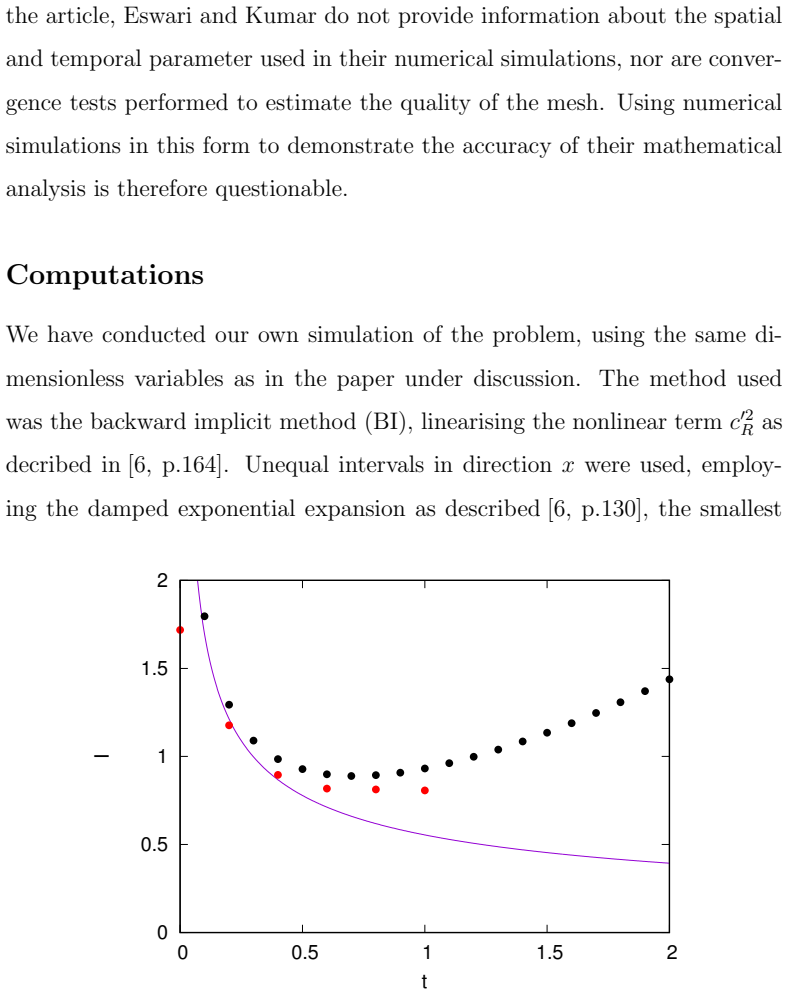
The title paper is discussed critically. There are major problems with incorrect statements, irrelevant citations, incorrect mathematics leading to incorrect results, which are compared with our own simulations.
Editorial analysis
A structured set of objections, weighed in public.
Referee Report
Summary. The manuscript critically examines the 2024 paper by Eswari and Sarvanakumar on the chronoamperometric response of an EC2 electrochemical reaction-diffusion system. It identifies issues including incorrect statements, irrelevant citations, and mathematical errors that produce incorrect results, which are demonstrated via comparisons to the critiquing authors' own numerical simulations.
Significance. If the identified discrepancies are confirmed to arise from errors in the original derivations rather than implementation differences, the critique could help refine theoretical and numerical approaches to EC2 schemes in electrochemistry. However, the low-confidence assessment and lack of explicit verification of simulation equivalence limit the immediate impact.
major comments (2)
- [Abstract] Abstract: The central claim that 'incorrect mathematics leading to incorrect results' is asserted but not supported by pinpointing specific erroneous equations, derivations, or steps from the Eswari & Sarvanakumar paper; the evidence rests entirely on simulation mismatches without ruling out alternative explanations.
- [Simulation comparison] Simulation comparison section: No details are provided on the boundary conditions at the electrode, initial conditions, dimensionless parameters, or discretization method employed in the new simulations. This omission is load-bearing because, per the stress-test note, even minor variations in these elements could explain the reported discrepancies without implying mathematical errors in the original work.
minor comments (1)
- [Abstract] The abstract would be strengthened by citing the specific problematic statements or equations from the 2024 paper rather than using general phrasing.
Simulated Author's Rebuttal
We thank the referee for their constructive comments on our manuscript. We address each major point below and will revise the manuscript to improve clarity and reproducibility while maintaining the integrity of our critique.
read point-by-point responses
-
Referee: [Abstract] Abstract: The central claim that 'incorrect mathematics leading to incorrect results' is asserted but not supported by pinpointing specific erroneous equations, derivations, or steps from the Eswari & Sarvanakumar paper; the evidence rests entirely on simulation mismatches without ruling out alternative explanations.
Authors: The manuscript body explicitly identifies specific incorrect statements, irrelevant citations, and mathematical errors in the Eswari & Sarvanakumar paper, including flawed derivations for the EC2 scheme that lead to incorrect analytical expressions. These are contrasted with our corrected forms, and the simulation discrepancies are presented as corroborating evidence rather than the sole support. However, we agree that the abstract could more directly reference key erroneous equations or steps from the original work to strengthen the central claim upfront. We will revise the abstract and add cross-references in the introduction to pinpoint these issues explicitly. revision: yes
-
Referee: [Simulation comparison] Simulation comparison section: No details are provided on the boundary conditions at the electrode, initial conditions, dimensionless parameters, or discretization method employed in the new simulations. This omission is load-bearing because, per the stress-test note, even minor variations in these elements could explain the reported discrepancies without implying mathematical errors in the original work.
Authors: We acknowledge that the current manuscript lacks sufficient detail on our simulation setup, which is necessary for full reproducibility and to exclude implementation differences as the source of discrepancies. In the revised version, we will add a new subsection (or appendix) specifying the electrode boundary conditions for the EC2 mechanism, initial conditions, all dimensionless parameters, and the finite-difference discretization scheme used. This will enable direct verification that the observed mismatches originate from the mathematical errors identified in the original derivations. revision: yes
Circularity Check
Critique grounded in independent simulations with no self-referential derivation chain
full rationale
The paper identifies errors in the target work through direct comparison of mathematical statements and numerical outcomes against the critiquing authors' simulations. No load-bearing step reduces by construction to fitted parameters, self-citations, or renamed inputs; the central claims rest on external verification rather than internal redefinition. This is the expected non-finding for a simulation-based critique that does not advance a new closed-form derivation.
Axiom & Free-Parameter Ledger
Reference graph
Works this paper leans on
-
[1]
A. J. Bard and L. R. Faulkner. Electrochemical Methods 2nd Ed. John Wiley, New York, 2001
2001
-
[2]
K. B. Oldham. The short-time chronoamperometric behaviour of an electrode of arbitrary shape . J. Electroanal. Chem., 297: 0 317--348, 1991
1991
-
[3]
Eswari and L
A. Eswari and L. Rajendran. Mathematical Modeling of Cyclic Voltammetry for EC _2 Reaction . Russ. J. Electrochem., 47: 0 191--199, 2011
2011
-
[4]
Link checked 25/09/25
|http://www.mathworks/help/pde/ug/pde.pdemodel.solvepde.html|. Link checked 25/09/25
-
[5]
Britz and J
D. Britz and J. Strutwolf. Digital Simulation in Electrochemistry, 4th Ed. Springer, Berlin, 2016. ISBN 978-3-319-30292-8, 978-3-319-30290-4
2016
discussion (0)
Sign in with ORCID, Apple, or X to comment. Anyone can read and Pith papers without signing in.