Recognition: unknown
Demonstration of a compact optical resonator-based displacement sensing technique with sub-femtometer precision
Pith reviewed 2026-05-07 12:29 UTC · model grok-4.3
The pith
A compact optical cavity with heterodyne readout measures displacements at sub-femtometer precision over ten orders of magnitude in dynamic range.
A machine-rendered reading of the paper's core claim, the machinery that carries it, and where it could break.
Core claim
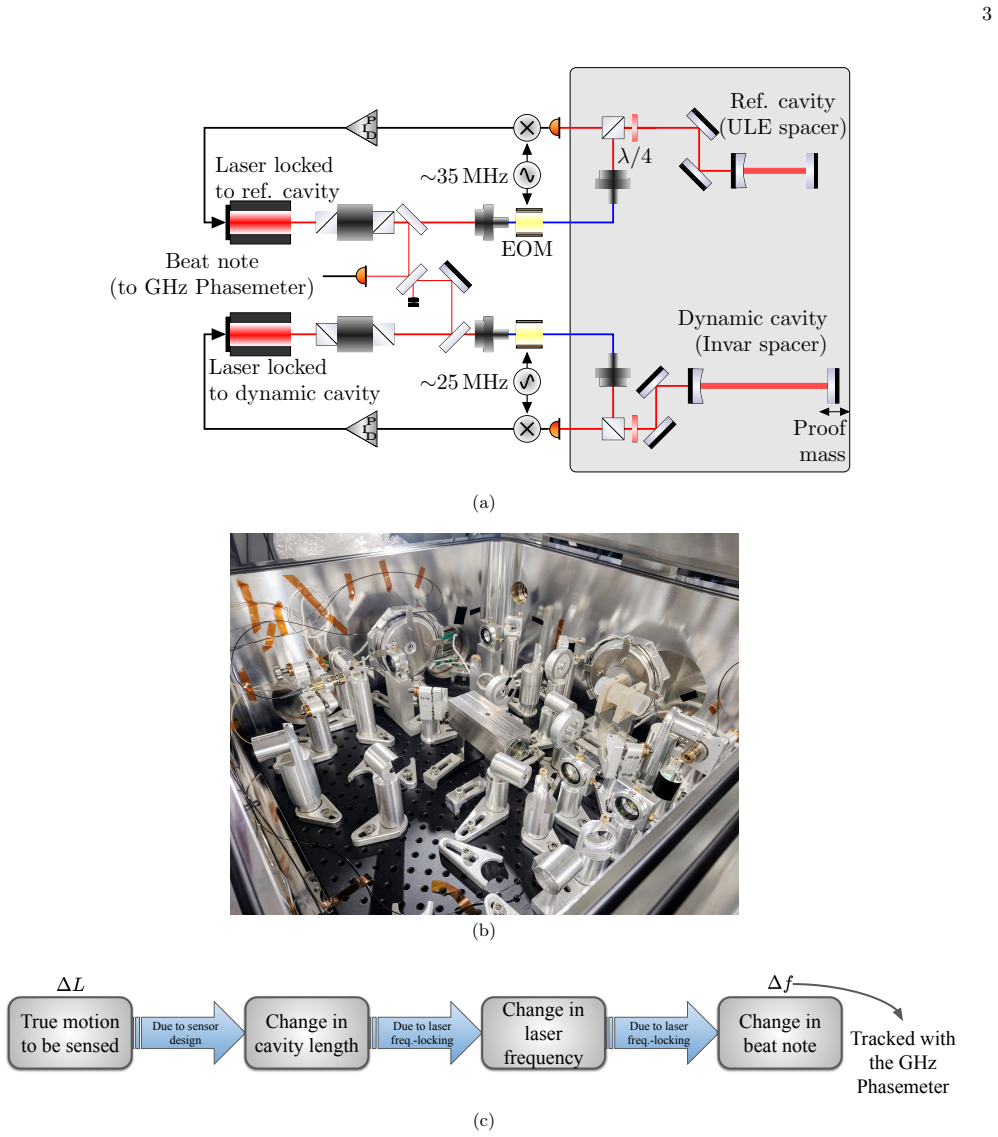
We demonstrate sub-femtometer displacement-sensing results achieved with a compact optical resonator-based laser interferometry technique called heterodyne cavity-tracking. The optical topology employs a centimeter-scale dynamic cavity incorporating a proof mass, and the relative length fluctuations of this cavity are measured using a heterodyne readout. In our experimental demonstration, we achieve a sub-femtometer per Hz^{1/2} displacement sensitivity for Fourier frequencies above 8 Hz and a sub-picometer per Hz^{1/2} sensitivity above 3 mHz. When the length of the dynamic cavity was intentionally actuated, the technique could track a maximum motion of about 0.6 μm, thereby achieving a aig
What carries the argument
Heterodyne cavity-tracking: measurement of relative length fluctuations inside a centimeter-scale dynamic cavity that contains a proof mass, performed via heterodyne laser readout.
If this is right
- The technique supports ambitious upgrades to existing gravitational-wave detectors.
- It supplies the sensitivity needed for future ground- and space-based observatories.
- Fundamental performance is ultimately limited by coating thermal noise of the cavity mirrors, well below the femtometer level.
- The demonstrated ten-order dynamic range is preserved across the full operating band once low-frequency noise is addressed.
Where Pith is reading between the lines
- Miniaturization into a fully integrated package could open precision inertial sensing for space missions where mass and volume are constrained.
- The same readout architecture might extend to other length-metrology tasks such as monitoring mirror positions in large-scale interferometers.
- Successful suppression of mechanical and thermal noise would move the practical floor to the coating-thermal-noise limit across a wider frequency band.
Load-bearing premise
The dominant noise sources at low frequencies are mechanical and temperature-induced and can be mitigated in an integrated system without degrading the sub-femtometer performance.
What would settle it
A noise spectral-density measurement in the same cavity setup that shows the displacement noise exceeding 1 fm/√Hz for Fourier frequencies above 8 Hz would falsify the sub-femtometer claim.
Figures


read the original abstract
We demonstrate sub-femtometer displacement-sensing results achieved with a compact optical resonator-based laser interferometry technique called heterodyne cavity-tracking, intended for local displacement or inertial sensing with ultra-high sensitivity. Displacement sensing at this sensitivity is required for ambitious improvements to current gravitational-wave detectors and to enable future ground- and space-based observatories. The optical topology employs a centimeter-scale dynamic cavity incorporating a proof mass, and the relative length fluctuations of this cavity are measured using a heterodyne readout. The fundamental limits of the technique lie significantly below the femtometer level and are ultimately defined by the coating thermal noise of the cavity mirrors. In our experimental demonstration, we achieve a sub-femtometer per Hz$^{1/2}$ displacement sensitivity for Fourier frequencies above 8 Hz and a sub-picometer per Hz$^{1/2}$ sensitivity above 3 mHz, with the sensitivity at lower frequencies limited by mechanical and temperature-induced noise sources. When the length of the dynamic cavity was intentionally actuated, the technique could track a maximum motion of about 0.6 $\mu$m, thereby achieving a dynamic range of roughly ten orders of magnitude in displacement sensing. We thus demonstrate the key features of this scheme - sub-femtometer performance and a dynamic range spanning ten orders of magnitude - in a laboratory setting, paving the way for development of an integrated system. Such a system is a currently unrealized technology that is necessary for precision physics experiments in the coming decades.
Editorial analysis
A structured set of objections, weighed in public.
Referee Report
Summary. The manuscript presents an experimental demonstration of a compact centimeter-scale optical resonator using heterodyne cavity-tracking for displacement sensing. It reports measured sensitivities of sub-femtometer per Hz^{1/2} above 8 Hz and sub-picometer per Hz^{1/2} above 3 mHz, with low-frequency performance limited by mechanical and temperature-induced noise, and a dynamic range of roughly ten orders of magnitude based on tracking up to 0.6 μm of actuated motion. The fundamental limit is identified as coating thermal noise, and the work positions the result as a laboratory validation of key features for future integrated systems in gravitational-wave and precision physics applications.
Significance. If the reported experimental sensitivities and dynamic range hold under scrutiny, the result is significant for advancing local displacement and inertial sensing technologies. It provides a concrete laboratory benchmark for a technique whose ultimate performance is set by coating thermal noise well below the demonstrated level, directly addressing needs in gravitational-wave detector upgrades and future observatories. The direct experimental measurement approach, rather than simulation or fitting, strengthens the demonstration of combined high sensitivity and large dynamic range in a compact form.
major comments (2)
- [Results section (noise spectrum and low-frequency analysis)] Results section (noise spectrum and low-frequency analysis): The attribution of the noise roll-up below 8 Hz specifically to mechanical and temperature-induced sources is load-bearing for the claim that the sub-femtometer performance represents the technique's capability rather than a technical limit. No auxiliary sensor data, vacuum enclosure tests, active thermal control results, or cross-correlation measurements are described to isolate these sources from other potential technical noise.
- [Dynamic range subsection] Dynamic range subsection: The ten-order dynamic range claim rests on the ratio between the 0.6 μm maximum tracked motion (from intentional actuation) and the reported noise floor. Details on linearity, tracking fidelity, and any degradation in sensitivity across the full actuation range are not provided, which is necessary to confirm the range is not limited by other factors such as cavity locking bandwidth or readout saturation.
minor comments (2)
- Ensure consistent use of units and notation for sensitivity (e.g., fm/√Hz vs. per Hz^{1/2}) between the abstract, main text, and figure captions.
- The description of the optical topology and heterodyne readout would benefit from a labeled schematic or block diagram to clarify the proof-mass cavity configuration.
Simulated Author's Rebuttal
We thank the referee for their positive evaluation of the significance of our work and for the constructive comments on the results and dynamic-range sections. We have revised the manuscript to provide additional clarification and supporting discussion for both points raised.
read point-by-point responses
-
Referee: Results section (noise spectrum and low-frequency analysis): The attribution of the noise roll-up below 8 Hz specifically to mechanical and temperature-induced sources is load-bearing for the claim that the sub-femtometer performance represents the technique's capability rather than a technical limit. No auxiliary sensor data, vacuum enclosure tests, active thermal control results, or cross-correlation measurements are described to isolate these sources from other potential technical noise.
Authors: We agree that direct isolation measurements would further strengthen the attribution. In the revised manuscript we have added a dedicated paragraph in the results section that correlates the observed roll-up with the known mechanical resonances of the suspension and the measured laboratory temperature fluctuations recorded during the data runs. The spectral shape and amplitude match expectations for these sources, and we have clarified that the sub-femtometer floor above 8 Hz is not limited by them. While dedicated auxiliary-sensor or active-control tests were outside the scope of this initial demonstration, the revised text now makes the inference explicit and notes the absence of other identifiable technical contributions in that band. revision: yes
-
Referee: Dynamic range subsection: The ten-order dynamic range claim rests on the ratio between the 0.6 μm maximum tracked motion (from intentional actuation) and the reported noise floor. Details on linearity, tracking fidelity, and any degradation in sensitivity across the full actuation range are not provided, which is necessary to confirm the range is not limited by other factors such as cavity locking bandwidth or readout saturation.
Authors: We appreciate the referee highlighting the need for these supporting details. The revised dynamic-range subsection now includes a plot of residual tracking error versus actuation amplitude up to 0.6 μm together with a statement that the displacement sensitivity remains unchanged across the range. We confirm that the cavity remains locked and the heterodyne readout shows no saturation or bandwidth roll-off within the demonstrated actuation; the ten-order dynamic range is therefore set by the ratio of the maximum tracked displacement to the measured noise floor rather than by instrumental limits. revision: yes
Circularity Check
No circularity: purely experimental demonstration with measured results
full rationale
The paper reports direct laboratory measurements of displacement noise floors and dynamic range using a heterodyne cavity-tracking setup. No mathematical derivation, parameter fitting, or predictive modeling is described that could reduce claims to inputs by construction. Noise attributions are interpretive statements about observed spectra rather than self-referential definitions or fitted predictions. Central claims rest on empirical data (sub-fm/√Hz above 8 Hz, sub-pm/√Hz above 3 mHz, ~0.6 μm trackable range) without load-bearing self-citations or ansatz smuggling. This is a standard experimental report with self-contained evidence.
Axiom & Free-Parameter Ledger
Reference graph
Works this paper leans on
-
[1]
part 1: Design and production overview.Precision Engineering40, 273–286 (2015)
Matichard, F.et al.Advanced LIGO two-stage twelve-axis vibration isolation and positioning platform. part 1: Design and production overview.Precision Engineering40, 273–286 (2015)
2015
-
[2]
part 2: Experi- mental investigation and tests results.Precision Engineering40, 287–297 (2015)
Matichard, F.et al.Advanced LIGO two-stage twelve-axis vibration isolation and positioning platform. part 2: Experi- mental investigation and tests results.Precision Engineering40, 287–297 (2015)
2015
-
[3]
Capote, E.et al.Advanced ligo detector performance in the fourth observing run.Physical Review D111(2025). URL http://dx.doi.org/10.1103/PhysRevD.111.062002
-
[4]
Acernese, F.et al.Advanced virgo: a second-generation interferometric gravitational wave detector.Classical and Quantum Gravity32, 024001 (2014)
2014
-
[5]
Progress of Theoretical and Experimental Physics , keywords =
Akutsu, T.et al.Overview of kagra: Detector design and construction history.Progress of Theoretical and Experimental Physics2021(2020). URLhttp://dx.doi.org/10.1093/ptep/ptaa125
-
[6]
Dooley, K. L.et al.Geo 600 and the geo-hf upgrade program: successes and challenges.Classical and Quantum Gravity 33, 075009 (2016). URLhttp://dx.doi.org/10.1088/0264-9381/33/7/075009
-
[7]
Punturo, M.et al.The einstein telescope: a third-generation gravitational wave observatory.Classical and Quantum Gravity27, 194002 (2010)
2010
-
[8]
Exploring the Sensitivity of Next Generation Gravitational Wave Detectors
Abbott, B. P.et al.Exploring the sensitivity of next generation gravitational wave detectors.Classical and Quantum Gravity34, 044001 (2017). URLhttp://dx.doi.org/10.1088/1361-6382/aa51f4
-
[9]
Cooper, S. J.et al.Sensors and actuators for the advanced ligo a+ upgrade.Review of Scientific Instruments94(2023). URLhttp://dx.doi.org/10.1063/5.0117605
-
[10]
APL Photonics 6(7), 070804 (2021) https://doi.org/10.1063/5
Akutsu, T.et al.Compact integrated optical sensors and electromagnetic actuators for vibration isolation systems in the gravitational-wave detector kagra.Review of Scientific Instruments91(2020). URLhttp://dx.doi.org/10.1063/5. 0022242
work page doi:10.1063/5 2020
-
[11]
Classical and Quantum Gravity , keywords =
Cooper, S. J.et al.A compact, large-range interferometer for precision measurement and inertial sensing.Classical and Quantum Gravity35, 095007 (2018). URLhttp://dx.doi.org/10.1088/1361-6382/aab2e9
-
[12]
Carter, J. J.et al.Testing compact, fused silica resonator based inertial sensors in a gravitational wave detector prototype facility.Classical and Quantum Gravity42, 185001 (2025). URLhttp://dx.doi.org/10.1088/1361-6382/adff34
-
[13]
& Gerberding, O
Isleif, K.-S., Heinzel, G., Mehmet, M. & Gerberding, O. Compact multifringe interferometry with subpicometer precision. Physical Review Applied12, 034025 (2019)
2019
-
[14]
Smetana, J.et al.Compact michelson interferometers with subpicometer sensitivity.Physical Review Applied18, 034040 (2022)
2022
-
[15]
Eckhardt, T. & Gerberding, O. An analytic, efficient and optimal readout algorithm for compact interferometers based on deep frequency modulation.Scientific Reports14(2024). URLhttp://dx.doi.org/10.1038/s41598-024-70392-9
-
[16]
Fundamental Limitations of Absolute Ranging via Deep Frequency Modulation Interferometry
Dovale-Álvarez, M. Fundamental limitations of absolute ranging via deep frequency modulation interferometry.arXiv (2025). URLhttps://arxiv.org/abs/2507.23183. 2507.23183
work page internal anchor Pith review Pith/arXiv arXiv 2025
-
[17]
URLhttp://dx.doi.org/10.1063/5.0144865
van Dongen, J.et al.Reducing control noise in gravitational wave detectors with interferometric local damping of suspended optics.Review of Scientific Instruments94(2023). URLhttp://dx.doi.org/10.1063/5.0144865
-
[18]
Black Hole Shadow as a Test of General Relativity: Quadratic Gravity.Class
Weickhardt, N. L., Basalaev, A. & Gerberding, O. Reducing suspension control noise with interferometric sensors—an experimental concept.Classical and Quantum Gravity42, 225014 (2025). URLhttp://dx.doi.org/10.1088/1361-6382/ ae1a2d
-
[19]
Danzmann, K. & R diger, A. Lisa technology concept, status, prospects.Classical and Quantum Gravity20, S1–S9 (2003). URLhttp://dx.doi.org/10.1088/0264-9381/20/10/301
-
[20]
2021, ApJ, 910, 1, doi:10.3847/1538-4357/abe5a7
Harms, J.et al.Lunar gravitational-wave antenna.The Astrophysical Journal910, 1 (2021). URLhttp://dx.doi.org/ 10.3847/1538-4357/abe5a7
-
[21]
V.et al.The payload of the lunar gravitational-wave antenna.Journal of Applied Physics133(2023)
van Heijningen, J. V.et al.The payload of the lunar gravitational-wave antenna.Journal of Applied Physics133(2023). URLhttp://dx.doi.org/10.1063/5.0144687
-
[22]
Barbour, N. & Schmidt, G. Inertial sensor technology trends.IEEE Sensors Journal1, 332–339 (2001). URLhttp: //dx.doi.org/10.1109/7361.983473
-
[23]
Hambric, S. High sensitivity accelerometers for monitoring semiconductor manufacturing.INTER-NOISE and NOISE- CON Congress and Conference Proceedings272, 723–732 (2025). URLhttp://dx.doi.org/10.3397/IN_2025_1073637
-
[24]
Tonoy, A. A. R., Ahmed, M. & Khan, M. R. Precision mechanical systems in semiconductor lithography equipment design and development.American Journal of Advanced Technology and Engineering Solutions1, 71–97 (2025). URL http://dx.doi.org/10.63125/j6tn8727
-
[25]
URLhttp://dx.doi.org/10.1103/PhysRevAccelBeams.20.083501
Caiazza, D.et al.New solution for the high accuracy alignment of accelerator components.Physical Review Accelerators and Beams20(2017). URLhttp://dx.doi.org/10.1103/PhysRevAccelBeams.20.083501
-
[26]
URLhttp://dx.doi.org/10.1107/S1600577522006300
Reinhard, C.et al.Flexible positioning of a large area detector using an industrial robot.Journal of Synchrotron Radiation 29, 1004–1013 (2022). URLhttp://dx.doi.org/10.1107/S1600577522006300. 14
-
[27]
URL http://dx.doi.org/10.1103/PhysRevApplied.23.024013
Smetana, J.et al.Sensitivity and control of a six-axis fused-silica seismometer.Physical Review Applied23(2025). URL http://dx.doi.org/10.1103/PhysRevApplied.23.024013
-
[28]
Eichholz, J., Tanner, D. B. & Mueller, G. Heterodyne laser frequency stabilization for long baseline optical interferometry in space-based gravitational wave detectors.Physical Review D92(2015). URLhttp://dx.doi.org/10.1103/PhysRevD. 92.022004
-
[29]
Chalathadka Subrahmanya, S., Darsow-Fromm, C. & Gerberding, O. Integrating high-precision and fringe-scale displace- ment sensing using heterodyne cavity-tracking.Optics Express33, 4044 (2025). URLhttp://dx.doi.org/10.1364/oe. 540189
work page doi:10.1364/oe 2025
-
[30]
Drever, R. W. P.et al.Laser phase and frequency stabilization using an optical resonator.Applied Physics B Photophysics and Laser Chemistry31, 97–105 (1983). URLhttp://dx.doi.org/10.1007/BF00702605
-
[31]
Black, E. D. An introduction to pound–drever–hall laser frequency stabilization.American Journal of Physics69, 79–87 (2001). URLhttp://dx.doi.org/10.1119/1.1286663
-
[32]
& Gerberding, O
Beck, M., Chalathadka Subrahmanya, S. & Gerberding, O. Adjustable picometer-stable interferometers for testing space- based gravitational wave detectors.Classical and Quantum Gravity42, 135001 (2025). URLhttp://dx.doi.org/10. 1088/1361-6382/ade1c7
2025
-
[33]
Chalathadka Subrahmanya, S.Femtometer-precision displacement sensing via heterodyne cavity-tracking for use in gravitational-wave detectors. Ph.D. thesis, University of Hamburg (2025). URLhttps://ediss.sub.uni-hamburg.de/ handle/ediss/11613
2025
-
[34]
Chalathadka Subrahmanya, S., Darsow-Fromm, C. & Gerberding, O. On the development of an rfsoc-based ultra-fast phasemeter with ghz bandwidth.IEEE Transactions on Instrumentation and Measurement74, 1–8 (2025). URLhttp: //dx.doi.org/10.1109/tim.2024.3509586
-
[35]
Tröbs, M. & Heinzel, G. Improved spectrum estimation from digitized time series on a logarithmic frequency axis. Measurement39, 120–129 (2006). URLhttp://dx.doi.org/10.1016/j.measurement.2005.10.010
-
[36]
URLhttps://zenodo.org/doi/10.5281/zenodo.10033637
Basalaev, A.et al.Spicypy (2025). URLhttps://zenodo.org/doi/10.5281/zenodo.10033637
-
[37]
Welch, P. The use of fast fourier transform for the estimation of power spectra: A method based on time averaging over short, modified periodograms.IEEE Transactions on Audio and Electroacoustics15, 70–73 (1967). URLhttp: //dx.doi.org/10.1109/TAU.1967.1161901
-
[38]
J., Birckigt, P., Gerberding, O
Carter, J. J., Birckigt, P., Gerberding, O. & Koehlenbeck, S. M. Compact inertial sensors for measuring external distur- bances of physics experiments.Sci. Rep.14, 17775 (2024)
2024
-
[39]
In2020 IEEE International Symposium on Inertial Sensors and Systems (INERTIAL)(IEEE, 2020)
Carter, J.et al.A high q, quasi-monolithic optomechanical inertial sensor. In2020 IEEE International Symposium on Inertial Sensors and Systems (INERTIAL)(IEEE, 2020)
2020
-
[40]
Allen, B., Hua, W. & Ottewill, A. Automatic cross-talk removal from multi-channel data.arXiv(1999). URLhttps: //arxiv.org/abs/gr-qc/9909083
work page internal anchor Pith review arXiv 1999
-
[41]
Kirchhoff, R.et al.Huddle test measurement of a near johnson noise limited geophone.Review of Scientific Instruments 88, 115008 (2017)
2017
-
[42]
Álvarez, M. D.Optical Cavities for Optical Atomic Clocks, Atom Interferometry and Gravitational-Wave Detection (Springer International Publishing, 2019). URLhttp://dx.doi.org/10.1007/978-3-030-20863-9
-
[43]
& Martynov, D
Smetana, J., Di Fronzo, C., Amorosi, A. & Martynov, D. Nonlinearities in fringe-counting compact michelson interferom- eters.Sensors23, 7526 (2023)
2023
-
[44]
URL https://doi.org/10.48550/arXiv.2511.04386
Lehmann, J.et al.Mitigating effects of nonlinearities in homodyne quadrature interferometers.arXiv(2025). URL https://doi.org/10.48550/arXiv.2511.04386. 2511.04386
-
[45]
URLhttp://dx.doi.org/10.3389/fphy.2022.1093179
Zhang, A.et al.Study on external cavity diode laser with a wide mode-hopping free tuning range.Frontiers in Physics 10(2022). URLhttp://dx.doi.org/10.3389/fphy.2022.1093179
-
[46]
URLhttp://dx.doi.org/10.1063/5.0097880
Palmer, S.et al.Highbandwidthfrequencymodulationofanexternalcavitydiodelaserusinganintracavitylithiumniobate electro-optic modulator as output coupler.APL Photonics7(2022). URLhttp://dx.doi.org/10.1063/5.0097880
-
[47]
Stone, J. A. & Howard, L. P. A simple technique for observing periodic nonlinearities in michelson interferometers. Precision Engineering22, 220–232 (1998). URLhttp://dx.doi.org/10.1016/S0141-6359(98)00016-6
-
[48]
& Wilkening, G
Hou, W. & Wilkening, G. Investigation and compensation of the nonlinearity of heterodyne interferometers.Precision Engineering14, 91–98 (1992)
1992
-
[49]
URLhttp://dx.doi.org/10.1103/PhysRevLett.126.131103
Armano, M.et al.Sensor noise in lisa pathfinder : In-flight performance of the optical test mass readout.Physical Review Letters126(2021). URLhttp://dx.doi.org/10.1103/PhysRevLett.126.131103
-
[50]
Andric, T.et al.Gemini: the first underground testbed for seismic isolation and inter-platform control in next-generation gravitational-wave detectors.The European Physical Journal Plus141(2026). URLhttp://dx.doi.org/10.1140/epjp/ s13360-026-07372-7
-
[51]
Laser Interferometer Space Antenna
Amaro-Seoane, P.et al.Laser interferometer space antenna.arXiv(2017). URLhttps://arxiv.org/abs/1702.00786. 1702.00786
work page internal anchor Pith review arXiv 2017
-
[52]
URLhttps://arxiv.org/abs/ 1907.11305
Baker, J.et al.Space based gravitational wave astronomy beyond lisa.arXiv(2019). URLhttps://arxiv.org/abs/ 1907.11305
-
[53]
Cooper, S. J.et al.Interferometric sensing of a commercial geophone.Classical and Quantum Gravity39, 075023 (2022). URLhttp://dx.doi.org/10.1088/1361-6382/ac595c
-
[54]
URLhttp://dx.doi.org/10.1103/PhysRevLett.134
Voigt, D.et al.Tunable coherence laser interferometry: Demonstrating 40 db of stray light suppression and compatibility with resonant optical cavities.Physical Review Letters134(2025). URLhttp://dx.doi.org/10.1103/PhysRevLett.134. 213802. 15
-
[55]
URLhttp://dx.doi.org/10.1364/OE.25.015599
Jennings, J.et al.Frequency stability characterization of a broadband fiber fabry-pérot interferometer.Optics Express 25, 15599 (2017). URLhttp://dx.doi.org/10.1364/OE.25.015599
discussion (0)
Sign in with ORCID, Apple, or X to comment. Anyone can read and Pith papers without signing in.