Recognition: 3 theorem links
· Lean TheoremLearning Discriminative Signed Distance Functions from Multi-scale Level-of-detail Features for 3D Anomaly Detection
Pith reviewed 2026-05-08 19:15 UTC · model grok-4.3
The pith
A signed distance function learned from multi-scale level-of-detail features distinguishes anomalous from normal points in 3D point clouds.
A machine-rendered reading of the paper's core claim, the machinery that carries it, and where it could break.
Core claim
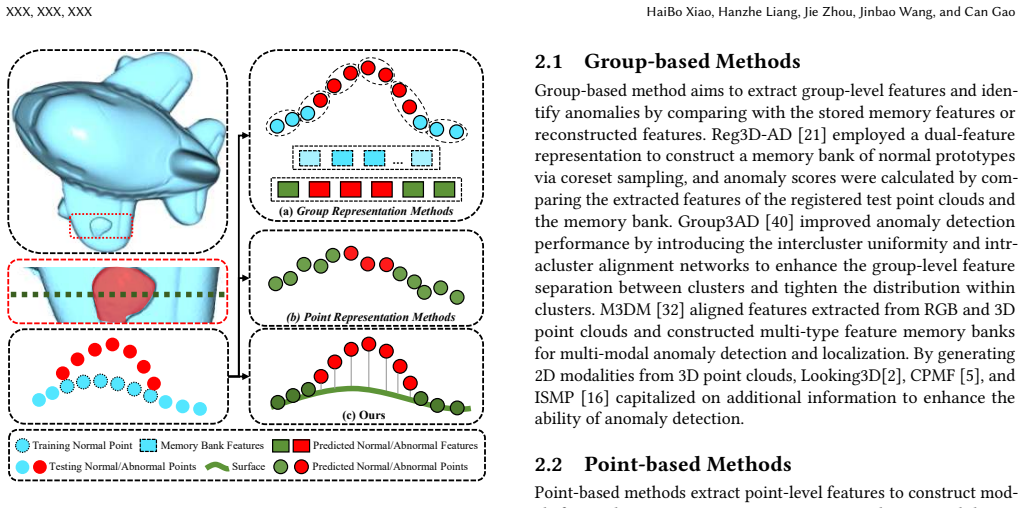
The proposed method learns a discriminative signed distance function from multi-scale level-of-detail features extracted after generating synthetic noisy points. This implicit surface representation effectively trains the function to distinguish abnormal from normal points in 3D point clouds, leading to improved anomaly detection performance.
What carries the argument
The Implicit Surface Discrimination module, which uses multi-scale level-of-detail features to train a signed distance function that separates anomalous points from normal ones on the learned implicit surface.
If this is right
- The signed distance function supplies a continuous per-point anomaly score based on distance to the implicit surface rather than discrete point classification.
- Multi-scale level-of-detail features supply both fine-grained local geometry and coarse-grained global shape, enabling discrimination on sparse data.
- Training with synthetic noise allows the model to learn separation without requiring real abnormal samples during optimization.
- The surface-based formulation outperforms prior point-based and group-based detectors on the two evaluated benchmarks by 2.1 and 3.6 percent AUROC respectively.
Where Pith is reading between the lines
- The same multi-scale feature extraction and implicit-surface training could be reused for 3D surface reconstruction or completion tasks that also require reliable surface-point separation.
- The noise-augmented training strategy may transfer to anomaly detection on other sparse 3D modalities such as LiDAR scans collected in outdoor environments.
- Replacing the current noise-generation rules with learned perturbations could test whether the performance gain comes from the specific noise distribution or from the general exposure to outliers.
Load-bearing premise
Synthetic noisy points generated by the Noisy Points Generation module sufficiently represent real-world anomalies so the signed distance function generalizes to unseen sparse point clouds.
What would settle it
Evaluating the trained model on a new point-cloud dataset whose anomalies consist of structural deformations or material defects outside the noise types used in training and finding that object-level AUROC falls below 80 percent.
Figures


read the original abstract
Detecting anomalies from 3D point clouds has received increasing attention in the field of computer vision, with some group-based or point-based methods achieving impressive results in recent years. However, learning accurate point-wise representations for 3D anomaly detection faces great challenges due to the large scale and sparsity of point clouds. In this study, a surface-based method is proposed for 3D anomaly detection, which learns a discriminative signed distance function using multi-scale level-of-detail features. We first present a Noisy Points Generation (NPG) module to generate different types of noise, thereby facilitating the learning of discriminative features by exposing abnormal points. Then, we introduce a Multi-scale Level-of-detail Feature (MLF) module to capture multi-scale information from a point cloud, which provides both fine-grained local and coarse-grained global feature information. Finally, we design an Implicit Surface Discrimination (ISD) module that leverages the extracted multi-scale features to learn an implicit surface representation of point clouds, which effectively trains a signed distance function to distinguish between abnormal and normal points. Experimental results demonstrate that the proposed method achieves an average object-level AUROC of 92.1\% and 85.9\% on the Anomaly-ShapeNet and Real3D-AD datasets, outperforming the current best approach by 2.1\% and 3.6\%, respectively. Codes are available at https://anonymous.4open.science/r/DLF-3AD-DA61.
Editorial analysis
A structured set of objections, weighed in public.
Referee Report
Summary. The manuscript proposes a surface-based 3D anomaly detection method for point clouds. It introduces a Noisy Points Generation (NPG) module to synthesize abnormal points via multiple noise types, a Multi-scale Level-of-detail Feature (MLF) module to extract local and global features, and an Implicit Surface Discrimination (ISD) module to train a signed distance function that separates normal from abnormal points. The central empirical claim is an average object-level AUROC of 92.1% on Anomaly-ShapeNet and 85.9% on Real3D-AD, outperforming the prior best method by 2.1% and 3.6%, respectively, with code released at an anonymous link.
Significance. If the reported gains hold under rigorous verification, the work advances 3D anomaly detection by showing how implicit SDFs trained on multi-scale features can address sparsity and scale challenges better than point- or group-based baselines. The code release supports reproducibility, which is a clear strength for an empirical CV paper.
major comments (2)
- [Abstract and Section 4] Abstract and experimental results: The reported AUROC improvements (92.1% and 85.9%) are presented without any details on training procedures, hyperparameter choices, number of runs, error bars, or statistical significance tests. This omission is load-bearing because the central claim rests entirely on these benchmark numbers; without them the gains cannot be assessed or reproduced.
- [Section 3.1] Section 3.1 (NPG module): The method relies on NPG to generate synthetic noise for labeling abnormal points and training the discriminative SDF. No analysis is provided showing that the chosen noise types match the geometric distribution of real anomalies in Anomaly-ShapeNet or Real3D-AD. This is load-bearing for the generalization claim, as the MLF+ISD pipeline could overfit the synthetic supervision rather than learn intrinsic surface deviations on unseen sparse clouds.
minor comments (1)
- The anonymous code link is appropriate for review but should be replaced with a permanent repository and clear reproducibility instructions (e.g., environment, seed settings) in the final version.
Simulated Author's Rebuttal
We thank the referee for the constructive feedback. The comments highlight important areas for improving the rigor and reproducibility of our empirical results and method design. We address each major comment point-by-point below.
read point-by-point responses
-
Referee: [Abstract and Section 4] Abstract and experimental results: The reported AUROC improvements (92.1% and 85.9%) are presented without any details on training procedures, hyperparameter choices, number of runs, error bars, or statistical significance tests. This omission is load-bearing because the central claim rests entirely on these benchmark numbers; without them the gains cannot be assessed or reproduced.
Authors: We agree that the manuscript lacks sufficient experimental details to fully substantiate the reported AUROC gains. In the revised version, we will expand Section 4 to provide: a complete description of the training procedures, the full set of hyperparameter values along with how they were selected, the number of independent runs (e.g., five), mean performance with standard deviation error bars, and statistical significance tests (such as paired t-tests) against the strongest baseline. We will also briefly reference these details in the abstract. These additions will directly address the reproducibility and verifiability concerns. revision: yes
-
Referee: [Section 3.1] Section 3.1 (NPG module): The method relies on NPG to generate synthetic noise for labeling abnormal points and training the discriminative SDF. No analysis is provided showing that the chosen noise types match the geometric distribution of real anomalies in Anomaly-ShapeNet or Real3D-AD. This is load-bearing for the generalization claim, as the MLF+ISD pipeline could overfit the synthetic supervision rather than learn intrinsic surface deviations on unseen sparse clouds.
Authors: We acknowledge the absence of explicit distributional analysis in the current Section 3.1. To strengthen the justification for the NPG module, the revised manuscript will include additional analysis comparing the geometric properties (e.g., local point density deviations, distance histograms, and variance statistics) of the synthesized noisy points against the actual anomalies present in both Anomaly-ShapeNet and Real3D-AD. This will help demonstrate that the chosen noise types provide reasonable coverage of real anomaly distributions and reduce concerns about overfitting to synthetic supervision. revision: yes
Circularity Check
No significant circularity in derivation chain
full rationale
The paper presents an empirical CV pipeline (NPG module generates synthetic noise to label abnormal points, MLF extracts multi-scale features, ISD learns an SDF from those features) and reports AUROC on public external datasets (Anomaly-ShapeNet, Real3D-AD) against baselines. No equations or claims reduce a prediction or central result to its own inputs by construction, no load-bearing self-citations are invoked, and no ansatz or uniqueness theorem is smuggled in. The method is self-contained against external benchmarks, making this the normal non-circular outcome for an applied ML paper.
Axiom & Free-Parameter Ledger
free parameters (1)
- Multi-scale level-of-detail parameters
axioms (1)
- domain assumption Signed distance functions can accurately represent and discriminate surfaces in sparse point clouds
Lean theorems connected to this paper
-
IndisputableMonolith.Cost (Jcost = ½(x + x⁻¹) − 1)washburn_uniqueness_aczel unclear?
unclearRelation between the paper passage and the cited Recognition theorem.
we design an Implicit Surface Discrimination (ISD) module that leverages the extracted multi-scale features to learn an implicit surface representation of point clouds, which effectively trains a signed distance function to distinguish between abnormal and normal points.
-
IndisputableMonolith.Foundation.LogicAsFunctionalEquationderivedCost / Aczél classification unclear?
unclearRelation between the paper passage and the cited Recognition theorem.
L_SDF = (1/Card(P~)) Σ (d~_i − d*_i)^2 ... The absolute value of d~ ... directly serves as the anomaly score
-
IndisputableMonolith.Constants (φ-ladder)phi_fixed_point unclear?
unclearRelation between the paper passage and the cited Recognition theorem.
L levels of learnable 3D feature volumes ... resolution s_l = 2^(l+base_lod) ... L = 5
What do these tags mean?
- matches
- The paper's claim is directly supported by a theorem in the formal canon.
- supports
- The theorem supports part of the paper's argument, but the paper may add assumptions or extra steps.
- extends
- The paper goes beyond the formal theorem; the theorem is a base layer rather than the whole result.
- uses
- The paper appears to rely on the theorem as machinery.
- contradicts
- The paper's claim conflicts with a theorem or certificate in the canon.
- unclear
- Pith found a possible connection, but the passage is too broad, indirect, or ambiguous to say the theorem truly supports the claim.
Reference graph
Works this paper leans on
-
[1]
Paul Bergmann and David Sattlegger. 2023. Anomaly Detection in 3D Point Clouds using Deep Geometric Descriptors. InIEEE/CVF Winter Conference on Applications of Computer Vision (W ACV). IEEE, 2613–2623
2023
-
[2]
Ankan Bhunia, Changjian Li, and Hakan Bilen. 2024. Looking 3D: Anomaly Detection with 2D-3D Alignment. InProceedings of the IEEE/CVF Conference on Computer Vision and Pattern Recognition (CVPR). 17263–17272
2024
-
[3]
Ankan Bhunia, Changjian Li, and Hakan Bilen. 2025. Odd-one-out: Anomaly Detection by Comparing with Neighbors. InProceedings of the Computer Vision and Pattern Recognition Conference. 20395–20404
2025
-
[4]
Robert C Bolles and Martin A Fischler. 1981. A Ransac-based Approach to Model Fitting and Its Application to Finding Cylinders in Range Data. InIjcai, Vol. 1981. 637–643
1981
-
[5]
Yunkang Cao, Xiaohao Xu, and Weiming Shen. 2024. Complementary Pseudo Multimodal Feature for Point Cloud Anomaly Detection.Pattern Recognition156 (2024), 110761
2024
-
[6]
Lequn Chen, Xiling Yao, Peng Xu, Seung Ki Moon, and Guijun Bi. 2021. Rapid Surface Defect Identification for Additive Manufacturing with In-situ Point Cloud Processing and Machine Learning.Virtual and Physical Prototyping16, 1 (2021), 50–67
2021
- [7]
-
[8]
Yuqi Cheng, Yihan Sun, Hui Zhang, Weiming Shen, and Yunkang Cao. 2026. To- wards High-resolution 3d Anomaly Detection: A Scalable Dataset and Real-time Framework for Subtle Industrial Defects. InProceedings of the AAAI Conference on Artificial Intelligence, Vol. 40. 3327–3334
2026
-
[9]
Joseph Cohen and Jun Ni. 2022. Semi-supervised Learning for Anomaly Classi- fication Using Partially Labeled Subsets.Journal of Manufacturing Science and Engineering144, 6 (2022), 061008
2022
-
[10]
Zehao Deng, An Liu, and Yan Wang. 2026. GS-CLIP: Zero-shot 3D Anomaly Detection by Geometry-Aware Prompt and Synergistic View Representation Learning. InProceedings of the IEEE/CVF Conference on Computer Vision and Pattern Recognition (CVPR)
2026
-
[11]
Juan Du, Hao Yan, Tzyy-Shuh Chang, and Jianjun Shi. 2022. A Tensor Voting- based Surface Anomaly Classification Approach by Using 3D Point Cloud Data. Journal of Manufacturing Science and Engineering144, 5 (2022), 051005
2022
-
[12]
Eliahu Horwitz and Yedid Hoshen. 2023. Back to The Feature: Classical 3D Features are (Almost) All You Need for 3D Anomaly Detection. InProceedings of the IEEE/CVF Conference on Computer Vision and Pattern Recognition. 2968–2977
2023
-
[13]
Mathis Kruse, Marco Rudolph, Dominik Woiwode, and Bodo Rosenhahn. 2024. SplatPose & Detect: Pose-Agnostic 3D Anomaly Detection. InProceedings of the IEEE/CVF Conference on Computer Vision and Pattern Recognition (CVPR) Workshops. 3950–3960
2024
- [14]
-
[15]
Hanzhe Liang, Bingyang Guo, Yawen Huang, Jiayi Lyu, Can Gao, Yunkang Cao, Jinbao Wang, Ruiyun Yu, Linlin Shen, and Pan Li. 2025. 3D Anomaly Detection: A Survey.arXiv preprint(2025). doi:10.13140/RG.2.2.21218.39361
- [16]
-
[17]
Hanzhe Liang, Jie Zhang, Tao Dai, Linlin Shen, Jinbao Wang, and Can Gao
-
[18]
InProceedings of the 33rd ACM International Conference on Multimedia
Taming Anomalies With Down-up Sampling Networks: Group Center Preserving Reconstruction for 3D Anomaly Detection. InProceedings of the 33rd ACM International Conference on Multimedia. 7133–7141
-
[19]
Hanzhe Liang, Jie Zhou, Can Gao, Bingyang Guo, Jinbao Wang, and Linlin Shen
-
[20]
A Lightweight 3D Anomaly Detection Method with Rotationally Invariant Features.Pattern Recognition(2025), 112924
2025
-
[21]
Yuxuan Lin, Yang Chang, Xuan Tong, Jiawen Yu, Antonio Liotta, Guofan Huang, Wei Song, Deyu Zeng, Zongze Wu, Yan Wang, et al. 2025. A Survey on RGB, 3D, and Multimodal Approaches for Unsupervised Industrial Image Anomaly Detection.Information Fusion121 (2025), 103139
2025
-
[22]
Fuyang Liu, Jilin Mei, Fangyuan Mao, Chen Min, Yan Xing, and Yu Hu. 2025. CORENet: Cross-Modal 4D Radar Denoising Network with LiDAR Supervision for Autonomous Driving. In2025 IEEE/RSJ International Conference on Intelligent Robots and Systems (IROS). IEEE, 3084–3091
2025
-
[23]
Jiaqi Liu, Guoyang Xie, Ruitao Chen, Xinpeng Li, Jinbao Wang, Yong Liu, Chengjie Wang, and Feng Zheng. 2023. Real3d-ad: A Dataset of Point Cloud Anomaly Detection. 30402–30415 pages
2023
- [24]
-
[25]
Haoquan Lu, Hanzhe Liang, Jie Zhang, Chenxi Hu, Jinbao Wang, and Can Gao
-
[26]
arXiv:2508.01311 [cs.CV] https://arxiv.org/abs/2508
C3D-AD: Toward Continual 3D Anomaly Detection via Kernel Attention with Learnable Advisor. arXiv:2508.01311 [cs.CV] https://arxiv.org/abs/2508. 01311
-
[27]
Gregory M. Nielson. 2003. On Marching Cubes.IEEE Transactions on visualization and computer graphics9, 3 (2003), 283–297
2003
-
[28]
Yatian Pang, Wenxiao Wang, Francis EH Tay, Wei Liu, Yonghong Tian, and Li Yuan. 2022. Masked Autoencoders for Point Cloud self-supervised Learning. In In European Conference on Computer Vision. Springer, 604–621
2022
-
[29]
Jeong Joon Park, Peter Florence, Julian Straub, Richard Newcombe, and Steven Lovegrove. 2019. Deepsdf: Learning continuous signed distance functions for shape representation. InProceedings of the IEEE/CVF conference on computer vision and pattern recognition. 165–174
2019
-
[30]
Anju Rani, Daniel Ortiz-Arroyo, and Petar Durdevic. 2024. Advancements in Point Cloud-based 3D Defect Classification and Segmentation for Industrial Systems: A Comprehensive Survey.Information Fusion112 (Dec. 2024), 102575. doi:10.1016/j.inffus.2024.102575
- [31]
- [32]
-
[33]
Chengyu Tao, Juan Du, and Tzyy-Shuh Chang. 2023. Anomaly Detection for Fabricated Artifact by Using Unstructured 3D Point Cloud Data.IISE Transactions 55, 11 (2023), 1174–1186
2023
-
[34]
Chin-Chia Tsai, Tsung-Hsuan Wu, and Shang-Hong Lai. 2022. Multi-scale Patch- based Representation Learning for Image Anomaly Detection and Segmentation. InProceedings of the IEEE/CVF winter conference on applications of computer vision. 3992–4000
2022
-
[35]
Yue Wang, Jinlong Peng, Jiangning Zhang, Ran Yi, Yabiao Wang, and Chengjie Wang. 2023. Multimodal Industrial Anomaly Detection via Hybrid Fusion. In Proceedings of the IEEE/CVF conference on computer vision and pattern recognition. 8032–8041
2023
-
[36]
Yizhou Wang, Kuan-Chuan Peng, and Yun Raymond Fu. 2025. Towards Zero-shot 3D Anomaly Localization. InProceedings of the IEEE/CVF Winter Conference on Applications of Computer Vision (W ACV)
2025
-
[37]
Jiacong Xu, Shao-Yuan Lo, Bardia Safaei, Vishal M. Patel, and Isht Dwivedi. 2025. Towards Zero-Shot Anomaly Detection and Reasoning with Multimodal Large Language Models. arXiv:2502.07601 [cs.CV] https://arxiv.org/abs/2502.07601
-
[38]
Jianan Ye, Weiguang Zhao, Xi Yang, Guangliang Cheng, and Kaizhu Huang
-
[39]
InProceedings of the IEEE/CVF Conference on Computer Vision and Pattern Recognition (CVPR)
PO3AD: Predicting Point Offsets toward Better 3D Point Cloud Anomaly Detection. InProceedings of the IEEE/CVF Conference on Computer Vision and Pattern Recognition (CVPR). 1353–1362
-
[40]
Yaohua Zha, Xue Yuerong, Chunlin Fan, Yuansong Wang, Tao Dai, Ke Chen, and Shu-Tao Xia. 2026. Casl: Curvature-augmented Self-supervised Learning for 3D Anomaly Detection. InProceedings of the AAAI Conference on Artificial Intelligence, Vol. 40. 12340–12348
2026
-
[41]
Bozhong Zheng, Jinye Gan, Xiaohao Xu, Xintao Chen, Wenqiao Li, Xiaonan Huang, Na Ni, and Yingna Wu. 2025. Bridging 3D Anomaly Localization and XXX, XXX, XXX HaiBo Xiao, Hanzhe Liang, Jie Zhou, Jinbao Wang, and Can Gao Repair via High-Quality Continuous Geometric Representation. InProceedings of the IEEE/CVF International Conference on Computer Vision. 27063–27072
2025
-
[42]
Qihang Zhou, Jiangtao Yan, Shibo He, Wenchao Meng, and Jiming Chen
-
[43]
InAdvances in Neural Infor- mation Processing Systems, A
PointAD: Comprehending 3D Anomalies from Points and Pix- els for Zero-shot 3D Anomaly Detection. InAdvances in Neural Infor- mation Processing Systems, A. Globerson, L. Mackey, D. Belgrave, A. Fan, U. Paquet, J. Tomczak, and C. Zhang (Eds.), Vol. 37. Curran Associates, Inc., 84866–84896. https://proceedings.neurips.cc/paper_files/paper/2024/file/ 9a263e23...
2024
- [44]
-
[45]
Hongze Zhu, Guoyang Xie, Chengbin Hou, Tao Dai, Can Gao, Jinbao Wang, and Linlin Shen. 2024. Towards High-resolution 3D Anomaly Detection via Group-Level Feature Contrastive Learning. InProceedings of the 32nd ACM In- ternational Conference on Multimedia (MM ’24). ACM, 4680–4689. doi:10.1145/ 3664647.3680919
discussion (0)
Sign in with ORCID, Apple, or X to comment. Anyone can read and Pith papers without signing in.