Recognition: 3 theorem links
· Lean TheoremEstimating noise for airborne electromagnetic data from repeat flight lines or inversion residuals
Pith reviewed 2026-05-08 18:26 UTC · model grok-4.3
The pith
Repeat flight lines over the same ground separate multiplicative and additive noise in AEM data and support a diagonal covariance matrix for regularised inversions.
A machine-rendered reading of the paper's core claim, the machinery that carries it, and where it could break.
Core claim
Repeat flight lines provide a way for geophysicists to calculate the statistical variability in AEM data acquired over the same ground and therefore estimate the levels of noise to propagate into the inversion. The total noise can be separated into multiplicative and additive components. The multiplicative noise is derived by repeat lines at survey altitude with a non-linear altitude correction. The paper details a methodology to Gaussianise the data noise and provide a statistically valid Gaussian data misfit or likelihood function, along with methods for estimating off-diagonal elements in the data covariance matrix that account for time-channel correlation. For regularised time-domain AEM
What carries the argument
Non-linear altitude correction applied to repeat-line data to isolate multiplicative noise, combined with Gaussianisation of the resulting distribution to produce a valid likelihood and covariance for the inversion misfit function.
If this is right
- Estimated noise levels from repeat lines can be used directly to set stopping criteria in deterministic inversions or to define model likelihoods in probabilistic ones.
- Separation of multiplicative and additive noise components improves the accuracy of propagating system noise into subsurface conductivity models.
- Gaussianisation allows standard least-squares or Bayesian inversion algorithms to be applied to AEM data with a statistically justified misfit function.
- The finding that a diagonal covariance matrix suffices reduces the computational cost of large-scale AEM inversions while retaining statistical rigor.
Where Pith is reading between the lines
- The same repeat-line protocol could be adapted to other airborne or marine geophysical methods where multiple passes over identical ground are feasible.
- In operational surveys, adopting a diagonal covariance would simplify software implementation and speed up inversion of very large datasets without major loss of accuracy.
- If geological heterogeneity contributes to differences between repeat passes, the resulting noise estimate becomes an upper bound, leading to more conservative but still valid inversion results.
Load-bearing premise
Repeat flight lines over the same ground capture only system noise without significant contributions from unaccounted geological or operational variations, and the Gaussianisation step produces a statistically valid likelihood for the specific data distribution encountered.
What would settle it
Perform independent repeat-line noise estimates on new survey data, run regularised inversions, and test whether the observed data residuals are statistically consistent with the estimated diagonal covariance or show significant unaccounted time-channel correlations.
Figures


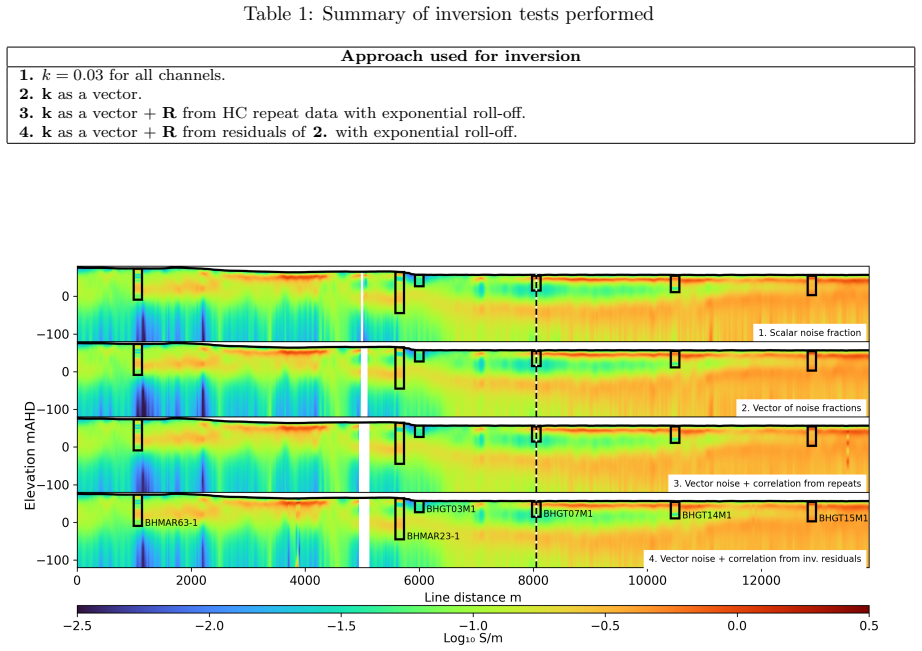


read the original abstract
Characterising the noise of an airborne electromagnetic (AEM) system is critical in correctly imaging the earth's subsurface conductivity. Deterministic and probabilistic geophysical inversion algorithms require foreknowledge of the system noise to specify stopping criteria or a valid model likelihood. Repeat flight lines provide a way for geophysicists to calculate the statistical variability in AEM data acquired over the same ground, and therefore estimate the levels of noise to propagate into the inversion. The total noise can be separated into multiplicative and additive components. The multiplicative noise is derived by repeat lines at survey altitude. The method to calculate the multiplicative noise is scarcely documented and usual methods for height correcting acquired data require a linear trend removal. This study will outline the algorithm used to estimate multiplicative noise of an AEM system, and non-linearly correct for varying altitudes during repeat flights. Additionally, this paper details a methodology to Gaussianise the data noise and provide a statistically valid Gaussian data misfit or likelihood function. Significantly, we provide methods for estimating the off-diagonal elements in the data covariance matrix used within the misfit function, taking into account the time-channel data correlation that is usually neglected. While our methodology is general, our study of a rotary-wing system leads us to conclude that for regularised time-domain AEM imaging, a diagonal data covariance suffices -- an important implication for rigorous yet practical AEM inversion.
Editorial analysis
A structured set of objections, weighed in public.
Referee Report
Summary. The manuscript presents methods to estimate multiplicative noise in AEM data from repeat flight lines at survey altitude, including a non-linear altitude correction to account for height variations. It separates total noise into multiplicative and additive components, details a Gaussianisation procedure to produce a statistically valid Gaussian likelihood for the data misfit, and provides an approach to estimate the full data covariance matrix including off-diagonal time-channel correlations. Based on analysis of data from one rotary-wing AEM system, the authors conclude that a diagonal covariance matrix suffices for regularised time-domain AEM imaging.
Significance. If the empirical result holds, the work has practical significance for AEM inversion by enabling simpler yet statistically grounded data misfit functions that neglect time-channel correlations without material loss of accuracy. The manuscript earns credit for supplying the explicit algorithm for multiplicative noise estimation, the Gaussianisation transform, and the direct test of the diagonal approximation on the reported dataset, all of which support reproducibility and falsifiability of the central claim.
major comments (2)
- [Abstract and conclusion] Abstract and conclusion: the claim that a diagonal data covariance suffices for regularised time-domain AEM imaging rests on results from a single rotary-wing system. Because this is the load-bearing empirical finding, the manuscript should include a brief discussion of the conditions (e.g., system type, survey geometry, or geological variability) under which the off-diagonal terms remain negligible, to clarify the scope of the implication.
- [Results] The weakest assumption—that repeat lines isolate system noise without significant unaccounted geological or operational contributions—is addressed by the workflow, but the results section should report a quantitative check (e.g., comparison of noise estimates against independent measures or across multiple repeat pairs) to confirm the Gaussianised residuals yield a valid likelihood for the encountered data distribution.
minor comments (2)
- [Abstract] The abstract uses future tense ('this study will outline') in a completed manuscript; rephrase to present tense for consistency.
- [Methods] Notation for the multiplicative and additive noise components should be defined explicitly at first use (e.g., in the methods section) to aid readers unfamiliar with AEM processing conventions.
Simulated Author's Rebuttal
We thank the referee for the constructive review and the recommendation for minor revision. We address each major comment point by point below, agreeing where revisions will strengthen the manuscript and providing the strongest honest defense of our approach.
read point-by-point responses
-
Referee: [Abstract and conclusion] Abstract and conclusion: the claim that a diagonal data covariance suffices for regularised time-domain AEM imaging rests on results from a single rotary-wing system. Because this is the load-bearing empirical finding, the manuscript should include a brief discussion of the conditions (e.g., system type, survey geometry, or geological variability) under which the off-diagonal terms remain negligible, to clarify the scope of the implication.
Authors: We agree that the empirical finding is based on a single rotary-wing system and that clarifying its scope strengthens the manuscript. We will revise the abstract and conclusion to include a concise discussion noting that the diagonal covariance approximation holds for the studied rotary-wing AEM system under the encountered survey geometry and geological conditions. We will further indicate that the result may extend to similar systems but caution against generalisation without additional validation, thereby delineating the implication without overstatement. revision: yes
-
Referee: [Results] The weakest assumption—that repeat lines isolate system noise without significant unaccounted geological or operational contributions—is addressed by the workflow, but the results section should report a quantitative check (e.g., comparison of noise estimates against independent measures or across multiple repeat pairs) to confirm the Gaussianised residuals yield a valid likelihood for the encountered data distribution.
Authors: The referee correctly notes the importance of validating the isolation of system noise. While the repeat-line workflow and Gaussianisation procedure are designed to minimise geological contributions, we will augment the results section with a quantitative check. This will comprise a comparison of multiplicative noise estimates across multiple repeat pairs and an evaluation of the Gaussianised residuals (including distributional diagnostics) to confirm that the transformed data support a valid Gaussian likelihood for the reported dataset. revision: yes
Circularity Check
No significant circularity detected
full rationale
The paper defines noise estimates directly from observed statistical variability across repeat flight lines, separating multiplicative and additive components via explicit algorithmic steps including non-linear altitude correction and Gaussianisation. These are data-driven computations rather than parameters fitted to a subset and then renamed as predictions. The conclusion that a diagonal covariance matrix suffices is an empirical observation drawn from the specific rotary-wing dataset and full covariance computation described in the workflow, not a reduction by construction or via load-bearing self-citation. No equations or steps equate outputs to inputs tautologically; the methods remain externally falsifiable against the repeat-line data.
Axiom & Free-Parameter Ledger
axioms (2)
- domain assumption Total noise separates into multiplicative and additive components
- domain assumption Repeat flight lines provide a statistically valid sample of system noise
Lean theorems connected to this paper
-
IndisputableMonolith/Cost (J(x)=½(x+x⁻¹)−1)washburn_uniqueness_aczel unclear?
unclearRelation between the paper passage and the cited Recognition theorem.
σ_j = √((kd_j)² + a_j²) ... k is the multiplicative noise factor
What do these tags mean?
- matches
- The paper's claim is directly supported by a theorem in the formal canon.
- supports
- The theorem supports part of the paper's argument, but the paper may add assumptions or extra steps.
- extends
- The paper goes beyond the formal theorem; the theorem is a base layer rather than the whole result.
- uses
- The paper appears to rely on the theorem as machinery.
- contradicts
- The paper's claim conflicts with a theorem or certificate in the canon.
- unclear
- Pith found a possible connection, but the passage is too broad, indirect, or ambiguous to say the theorem truly supports the claim.
Reference graph
Works this paper leans on
-
[1]
doi: 10.1111/j.1365-246X.2010.04530.x
ISSN 0956-540X. doi: 10.1111/j.1365-246X.2010.04530.x. URLhttps://doi.org/10.1111/j.1365-246X.2010.04530.x. Esben Auken, Anders Vest Christiansen, Casper Kirkegaard, Gianluca Fiandaca, Cyril Schamper, Ahmad Ali Behroozmand, Andrew Binley, Emil Nielsen, Flemming Effersø, Niels Bøie Christensen, Kurt Sørensen, Nikolaj Foged, and Giulio Vignoli. An overview ...
-
[2]
doi: 10.1071/EG13097. URLhttps://doi.org/10. 1071/EG13097. Jeff Bezanson, Alan Edelman, Stefan Karpinski, and Viral B. Shah. Julia: A fresh approach to numerical computing.SIAM Review, 59(1):65–98,
-
[3]
doi: 10.1137/141000671. URLhttps: //doi.org/10.1137/141000671. Daniel Blatter, Kerry Key, Anandaroop Ray, Neil Foley, Slawek Tulaczyk, and Esben Auken. Trans- dimensional bayesian inversion of airborne transient em data from taylor glacier, antarctica.Geophys- ical Journal International, 214(3):1919–1936, 06
-
[4]
ISSN 0956-540X. doi: 10.1093/gji/ggy255. URLhttps://doi.org/10.1093/gji/ggy255. T. Bodin, M. Sambridge, K. Gallagher, and N. Rawlinson. Transdimensional inversion of receiver functions and surface wave dispersion.Journal of Geophysical Research: Solid Earth, 117(B2),
-
[5]
URLhttps://agupubs.onlinelibrary.wiley.com/ doi/abs/10.1029/2011JB008560
doi: https://doi.org/10.1029/2011JB008560. URLhttps://agupubs.onlinelibrary.wiley.com/ doi/abs/10.1029/2011JB008560. R. C. Brodie. Galeisbstdem: A deterministic algorithm for 1d sample by sample inversion of time- domain aem data – theoretical details,
-
[6]
A. Davis. Estimating noise in aem data.AEM 2023: Short abstracts, 2023(225):52–66,
2023
-
[7]
URLhttps://doi.org/10.1080/14432471.2023.2236352
doi: 10.1080/14432471.2023.2236352. URLhttps://doi.org/10.1080/14432471.2023.2236352. Jan Dettmer and Stan E Dosso. Trans-dimensional matched-field geoacoustic inversion with hierarchi- cal error models and interacting Markov chains.The Journal of the Acoustical Society of America, 132(4):2239–2250, October
-
[8]
ISSN 1520-8524. doi: 10.1121/1.4746016. Jan Dettmer, Sheri Molnar, Gavin Steininger, Stan E. Dosso, and John F. Cassidy. Trans- dimensional inversion of microtremor array dispersion data with hierarchical autoregressive error models.Geophysical Journal International, 188(2):719–734, February
-
[9]
doi: 10.1111/j.1365-246X.2011.05302.x
ISSN 0956540X. doi: 10.1111/j.1365-246X.2011.05302.x. Wilmut MJ Dosso, Nielsen PL. Data error covariance in matched-field geoacoustic inversion.J Acoust Soc Am, 119(1):208–19, Jan
-
[10]
Romina A S Gehrmann, Amir Haroon, McKinley Morton, Axel T Djanni, and Timothy A Minshull
doi: 10.1121/1.2139625. Romina A S Gehrmann, Amir Haroon, McKinley Morton, Axel T Djanni, and Timothy A Minshull. Seafloor massive sulphide exploration using deep-towed controlled source electromagnetics: Naviga- tional uncertainties.Geophysical Journal International, 220(2):1215–1227, November
-
[11]
ISSN 0956-540X. doi: 10.1093/gji/ggz513. Wences P. Gouveia and John A Scales. Bayesian seismic waveform inversion: Parameter estimation and uncertainty analysis.Journal of Geophysical Research: Solid Earth, 103(B2):2759–2779,
-
[12]
ISSN 21699356. doi: 10.1029/97jb02933. Andrew Green and Richard Lane. Estimating noise levels in aem data.ASEG Extended Abstracts, 2003, 08
-
[13]
doi: 10.1071/ASEG2003ab093. S. Kang, R. Knight, and M. Goebel. Improved imaging of the large-scale structure of a groundwater system with airborne electromagnetic data.Water Resources Research, 58:e2021WR031439,
-
[14]
doi: 10.1029/2021WR031439. Kerry Key. Mare2dem: a 2-d inversion code for controlled-source electromagnetic and magnetotelluric data.Geophysical Journal International, 207(1):571–588, 08
-
[15]
ISSN 0956-540X. doi: 10.1093/ gji/ggw290. URLhttps://doi.org/10.1093/gji/ggw290. Reinhard Kirsch. Groundwater geophysics: A tool for hydrogeology.Groundwater Geophysics: A Tool for Hydrogeology, Edited by Reinhard Kirsch. 2006 XVII, 493 p, 300 illus. 3-540-29383-3. Berlin: Springer, 2006., 01
-
[16]
doi: 10.1111/1365-2478.70021. Alan Yusen Ley-Cooper, Ross C. Brodie, and Murray Richardson and. Ausaem: Australia’s airborne electromagnetic continental-scale acquisition program.Exploration Geophysics, 51(1):193–202,
-
[17]
URLhttps://doi.org/10.1080/08123985.2019.1694393
doi: 10.1080/08123985.2019.1694393. URLhttps://doi.org/10.1080/08123985.2019.1694393. Alberto Malinverno. Parsimonious bayesian markov chain monte carlo inversion in a nonlinear geo- physical problem.Geophysical Journal International, 151(3):675–688, 12
-
[18]
doi: 10.1046/j.1365-246X.2002.01847.x
ISSN 0956-540X. doi: 10.1046/j.1365-246X.2002.01847.x. URLhttps://doi.org/10.1046/j.1365-246X.2002.01847.x. William Menke. Copyright. InGeophysical Data Analysis: Discrete Inverse Theory (Third Edition), page iv. Academic Press, Boston, third edition edition,
-
[19]
doi: https:// doi.org/10.1016/B978-0-12-397160-9.00018-7
ISBN 978-0-12-397160-9. doi: https:// doi.org/10.1016/B978-0-12-397160-9.00018-7. URLhttps://www.sciencedirect.com/science/ article/pii/B9780123971609000187. Burke J. Minsley, Nathan Leon Foks, and Paul A. Bedrosian. Quantifying model structural uncertainty using airborne electromagnetic data.Geophysical Journal International, 224(1):590–607, 2021a. ISSN ...
-
[20]
S Mule, Camilla Soerensen, and Tim Munday and
doi: 10.1029/94JB03097. S Mule, Camilla Soerensen, and Tim Munday and. Handling noise in aem inversion – implications for subsurface characterisation.ASEG Extended Abstracts, 2019(1):1–4,
-
[21]
doi: 10.1080/22020586. 2019.12073183. URLhttps://doi.org/10.1080/22020586.2019.12073183. James Murr, Roger Skirrow, Anthony Schofield, James Goodwin, R. Coghlan, Lindsay Highet, Michael Doublier, Jingjie Duan, and K. Czarnota. Tennant creek -mount isa iocg mineral potential assess- ment.Exploring for the Future: Extended Abstracts, 06
-
[22]
Jorge Nocedal and Stephen Wright
doi: 10.26186/5d6c90ebb0ae9. Jorge Nocedal and Stephen Wright. Numerical optimization,
-
[23]
doi: 10.1190/1.1826719. R. L. Parker.Geophysical Inverse Theory. Princeton series in Geophysics. Princeton University Press, Princeton,
-
[24]
ISSN 1742-2132. doi: 10.1093/jge/gxad043. URL https://doi.org/10.1093/jge/gxad043. V.A. Profillidis and G.N. Botzoris. Chapter 5 - statistical methods for transport demand modeling. In V.A. Profillidis and G.N. Botzoris, editors,Modeling of Transport Demand, pages 163–224. Elsevier,
-
[25]
doi: https://doi.org/10.1016/B978-0-12-811513-8.00005-4
ISBN 978-0-12-811513-8. doi: https://doi.org/10.1016/B978-0-12-811513-8.00005-4. A. Ray, T. Bodin, and K. Key. Hierarchical bayesian inversion of marine csem data over the scarborough gas field - a lesson in correlated noise,
-
[26]
URLhttps://perso.ens-lyon.fr/thomas.bodin/ Publi/Ray_etal_SEG2013.pdf. Anandaroop Ray, Yusen Ley-Cooper, Ross C Brodie, Richard Taylor, Neil Symington, and Negin F Moghaddam. An information theoretic bayesian uncertainty analysis of aem systems over menindee lake, australia.Geophysical Journal International, 235(2):1888–1911, 09 2023a. ISSN 0956-540X. doi...
-
[27]
Malcolm Sambridge and Klaus Mosegaard
URLhttp://dx.doi.org/10.11636/Record.2015.029. Malcolm Sambridge and Klaus Mosegaard. Monte carlo methods in geophysical inverse problems. Reviews of Geophysics, 40(3):3–1,
-
[28]
ISSN 0956-540X. doi: 10.1093/gji/ggz520. URLhttps://doi.org/10.1093/gji/ggz520. Marc A. Vallee and Richard S. Smith. Application of occam’s inversion to airborne time-domain electromagnetics.The Leading Edge, 28(3):284–287, 03
-
[29]
ISSN 1070-485X. doi: 10.1190/1. 3104071. URLhttps://doi.org/10.1190/1.3104071. K. Vozoff. Electromagnetic methods in applied geophysics.Geophysical surveys, 4(1):9–29,
-
[30]
ISSN 1573-0956. doi: 10.1007/BF01452955. URLhttps://doi.org/10.1007/BF01452955. Brent Wheelock, Steven Constable, and Kerry Key. The advantages of logarithmically scaled data for electromagnetic inversion.Geophysical Journal International, 201(3):1765–1780,
-
[31]
ISSN 1365246X. doi: 10.1093/gji/ggv107. Sebastian Wong, Ian Roach, M Nicoll, P English, Marie-Aude Bonnardot, R Brodie, N Rollet, and Alan Ley-Cooper. Interpretation of the ausaem1: insights from the world’s largest airborne electro- magnetic survey.Exploring for the Future: Extended Abstracts, 06
-
[32]
Sihong Wu, Qinghua Huang, and Li Zhao
doi: 10.11636/134283. Sihong Wu, Qinghua Huang, and Li Zhao. Physics-guided deep learning-based inversion for airborne electromagnetic data.Geophysical Journal International, 238, 07
-
[33]
Xin Wu, Guo-qiang Xue, He Yiming, and Junjie Xue
doi: 10.1093/gji/ggae244. Xin Wu, Guo-qiang Xue, He Yiming, and Junjie Xue. Removal of the multi-source noise in airborne electromagnetic data based on deep learning.GEOPHYSICS, 85:1–72, 08
-
[34]
As expected, the empirical CDF ofx∼ N(0,( 1 3)2), matches CDF N(0,1) (3x), as demonstrated in Figure
The estimate from a standard Broyden-Fanno-Goldfarb-Shanno gradient descent algorithm [Nocedal and Wright, 2006] is shown with the blue triangle. As expected, the empirical CDF ofx∼ N(0,( 1 3)2), matches CDF N(0,1) (3x), as demonstrated in Figure
2006
discussion (0)
Sign in with ORCID, Apple, or X to comment. Anyone can read and Pith papers without signing in.