Recognition: unknown
Identification and characterization of 15265 super-Nyquist frequencies in 1309 {δ} Scuti stars from Kepler photometry
Pith reviewed 2026-05-07 13:53 UTC · model grok-4.3
The pith
A sliding Lomb-Scargle periodogram identifies 15265 super-Nyquist frequencies in 1309 Kepler delta Scuti stars.
A machine-rendered reading of the paper's core claim, the machinery that carries it, and where it could break.
Core claim
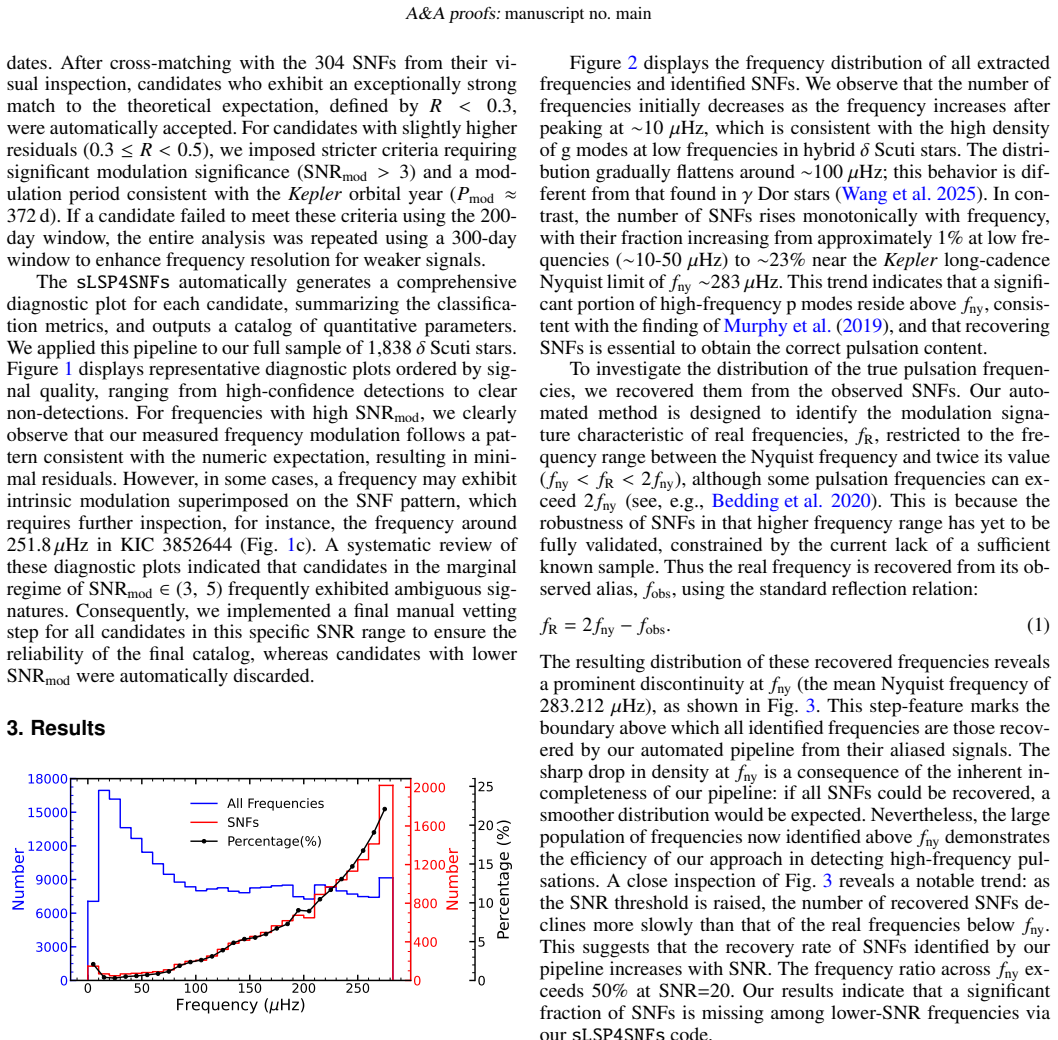
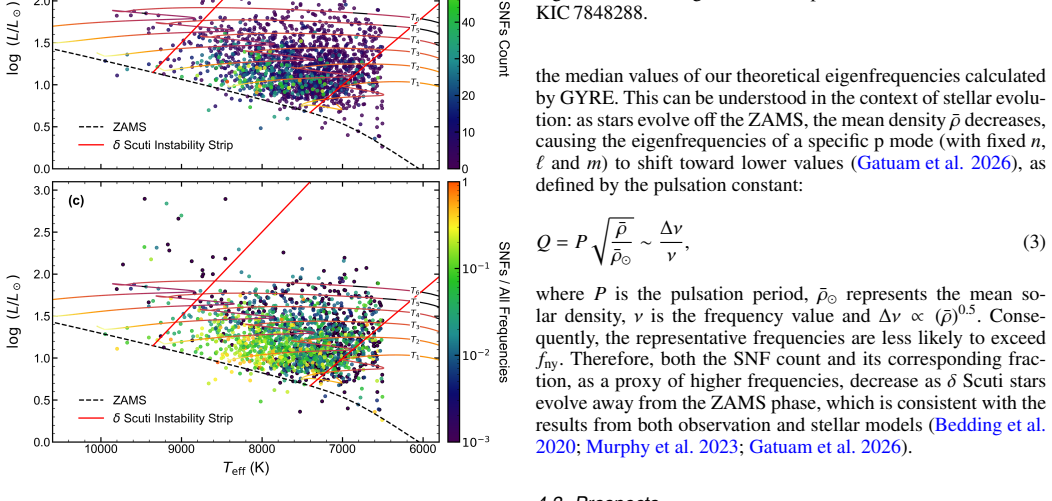
Through a systematic survey of 1838 Kepler delta Scuti stars using a sliding Lomb-Scargle periodogram technique, 15265 confirmed super-Nyquist frequencies are identified in 1309 stars out of a total of 259883 frequencies. The total number of detected frequencies per star shows no trend across the instability strip, yet younger stars display significantly more SNFs; both the number and rate of SNFs decline as stars evolve. The fraction of modes appearing as SNFs increases from roughly 1 percent at 20 microhertz to 23 percent near the Nyquist limit, with the highest underdetection rate among low-amplitude modes. SNF patterns are distinguishable from phase modulations caused by binarity or non-
What carries the argument
sliding Lomb-Scargle periodogram, a technique that tracks frequency modulation patterns to isolate true super-Nyquist aliases from other effects
If this is right
- Asteroseismic frequency lists for delta Scuti stars must now treat a substantial fraction of detected peaks as aliases rather than intrinsic modes.
- Evolutionary models should predict fewer high-frequency modes in more evolved delta Scuti stars to match the observed decline in SNF rates.
- The supplied catalog enables direct searches for regular spacing patterns among the real (non-aliased) pulsation frequencies.
- Low-amplitude modes remain the most prone to misclassification, limiting completeness at the faint end of the amplitude distribution.
Where Pith is reading between the lines
- Applying the same sliding periodogram approach to other long-cadence surveys could systematically correct aliasing in additional classes of pulsating stars.
- Accounting for the higher SNF incidence in young stars may tighten constraints on the location of the red edge of the delta Scuti instability strip in theoretical models.
Load-bearing premise
The sliding Lomb-Scargle periodogram technique reliably distinguishes true super-Nyquist aliases from modulation effects such as binarity or nonlinear interactions, with low false-positive rates.
What would settle it
High-cadence photometry of a subset of the same stars that shows many catalogued SNFs to be genuine low-frequency modes or instrumental artifacts would falsify the identifications.
Figures




read the original abstract
The frequency of pressure (p) mode in $\delta$~Scuti stars can exceed the Nyquist limit of \textit{Kepler} long-cadence photometry. {These 'super-Nyquist frequencies' (SNFs) are observed as 'reflected' peaks at lower frequencies, i.e., they are Nyquist aliases that pose} a threat to asteroseismic diagnostics. Their impact on $\delta$~Scuti p modes has yet to be comprehensively explored. We performed a systematic survey to search for SNFs in 1,838 \textit{Kepler} $\delta$~Scuti stars through a novel technique based on sliding Lomb-Scargle periodogram, identifying 15,265 confirmed SNFs in 1,309 stars, from a total of 259,883 frequencies. We observe that the total number of detected frequencies per star remains featureless across the $\delta$~Scuti instability strip; however, young stars pulsate in higher frequencies and so have significantly more SNFs on average. Both the number and the rate of SNFs diminishes accordingly as $\delta$~Scuti stars become more evolved, which is consistent with both observation and stellar models. Furthermore, our method detects a greater fraction of modes as SNFs at higher frequencies, rising from approximately 1\% at 20 \(\mu \)Hz to 23\% at the Nyquist limit. The rate of underdetection is highest amongst low-amplitude modes. The SNF modulation patterns can be well distinguished from phase modulations induced by binarity or nonlinear mode interactions. We provide a frequency catalog for future asteroseismic studies of $\delta$~Scuti stars, wherein we identify each peak as being real or an alias, enabling further investigations into regular patterns of pulsation modes, linear combination frequencies, and theoretical modeling.
Editorial analysis
A structured set of objections, weighed in public.
Referee Report
Summary. The paper reports a systematic survey of super-Nyquist frequencies (SNFs) in 1,838 Kepler δ Scuti stars using a novel sliding Lomb-Scargle periodogram technique on long-cadence photometry. It identifies 15,265 confirmed SNFs in 1,309 stars from 259,883 total frequencies, documents trends showing higher SNF occurrence in younger stars that decreases with evolution, notes the SNF fraction rising from ~1% at 20 μHz to 23% near the Nyquist limit, and supplies a frequency catalog labeling peaks as real or aliases while claiming the method distinguishes SNF patterns from binarity or nonlinear interactions.
Significance. If the identifications prove reliable, the work provides a substantial catalog and statistical characterization of SNFs that could improve asteroseismic modeling of δ Scuti p-modes by mitigating aliasing effects in Kepler data. The large sample size, the reported consistency of evolutionary trends with stellar models, and the public catalog represent clear strengths for future studies.
major comments (1)
- The central claim of 15,265 'confirmed' SNFs and the frequency-dependent detection fractions (1% to 23%) rests on the sliding Lomb-Scargle method's ability to separate true SNFs from other modulation effects. No quantitative validation metrics—such as recovery fractions, false-positive rates from controlled injections, or cross-checks against the short-cadence subset—are reported, leaving the false-positive risk unquantified despite the abstract's assertion that patterns 'can be well distinguished' from binarity or nonlinear interactions.
minor comments (1)
- The abstract and introduction could more explicitly state the fraction of the 1,838 stars that yielded no SNFs and the total number of stars with short-cadence data available for potential validation.
Simulated Author's Rebuttal
We thank the referee for their constructive review and for recognizing the potential value of the catalog and statistical trends for asteroseismology. We address the major comment below.
read point-by-point responses
-
Referee: The central claim of 15,265 'confirmed' SNFs and the frequency-dependent detection fractions (1% to 23%) rests on the sliding Lomb-Scargle method's ability to separate true SNFs from other modulation effects. No quantitative validation metrics—such as recovery fractions, false-positive rates from controlled injections, or cross-checks against the short-cadence subset—are reported, leaving the false-positive risk unquantified despite the abstract's assertion that patterns 'can be well distinguished' from binarity or nonlinear interactions.
Authors: We agree that the manuscript does not report quantitative validation metrics such as injection-recovery fractions or false-positive rates, and that this leaves the reliability of the identifications less rigorously quantified than the abstract's phrasing suggests. The identifications rest on the distinct 'reflection' signatures produced by the sliding Lomb-Scargle periodogram when a frequency exceeds the Nyquist limit; these signatures differ in both shape and phase behavior from the orbital-phase modulations of binaries and from the specific amplitude and phase relations of nonlinear combination frequencies. Multiple examples of each class are shown in the figures and discussed in the methods. Nevertheless, we acknowledge that visual pattern recognition alone does not constitute a quantitative false-positive assessment. In the revised manuscript we will add a dedicated validation subsection that (i) cross-matches a subset of stars possessing short-cadence data against the long-cadence results and (ii) reports recovery statistics from controlled injections of synthetic SNFs into representative light curves. These additions will directly address the referee's concern and supply the requested metrics. revision: yes
Circularity Check
No circularity: direct observational counts from algorithmic application to public data
full rationale
The paper reports counts of super-Nyquist frequencies obtained by applying a sliding Lomb-Scargle periodogram to Kepler long-cadence photometry of 1838 δ Scuti stars. The 15265 confirmed SNFs and associated statistics (frequency-dependent fractions, evolutionary trends) are direct outputs of this data-processing pipeline, not quantities derived from or equivalent to any fitted parameters, self-referential definitions, or prior results by the same authors. No equations, uniqueness theorems, or ansatzes are presented that reduce the reported identifications to inputs by construction. Distinctions from binarity or nonlinear interactions are asserted on the basis of observed modulation patterns in the data, without circular reduction to the detection method itself. This is a standard observational cataloguing exercise whose central claims remain independent of the listed circularity patterns.
Axiom & Free-Parameter Ledger
axioms (2)
- standard math Kepler long-cadence photometry has a well-defined Nyquist frequency that causes high-frequency modes to appear as lower-frequency aliases.
- domain assumption The sliding Lomb-Scargle periodogram can separate SNFs from true low-frequency modes and other effects such as binarity.
Reference graph
Works this paper leans on
-
[1]
2021, Reviews of Modern Physics, 93, 015001
Aerts, C. 2021, Reviews of Modern Physics, 93, 015001
2021
-
[2]
S., Bowman, D
Antoci, V ., Cunha, M. S., Bowman, D. M., et al. 2019, MNRAS, 490, 4040
2019
-
[3]
L., et al
Antoci, V ., Handler, G., Campante, T. L., et al. 2011, Nature, 477, 570
2011
-
[4]
Balona, L. A. 2014, MNRAS, 437, 1476
2014
-
[5]
Balona, L. A. & Dziembowski, W. A. 2011, MNRAS, 417, 591
2011
-
[6]
Balona, L. A. & Evers, E. A. 1999, MNRAS, 302, 349
1999
-
[7]
R., Murphy, S
Barac, N., Bedding, T. R., Murphy, S. J., & Hey, D. R. 2022, MNRAS, 516, 2080
2022
-
[8]
H., Bedding, T
Barbara, N. H., Bedding, T. R., Fulcher, B. D., Murphy, S. J., & Van Reeth, T. 2022, MNRAS, 514, 2793 Barceló Forteza, S., Michel, E., Roca Cortés, T., & García, R. A. 2015, A&A, 579, A133 Barceló Forteza, S., Roca Cortés, T., & García, R. A. 2018, A&A, 614, A46
2022
-
[9]
R., Murphy, S
Bedding, T. R., Murphy, S. J., Crawford, C., et al. 2023, ApJ, 946, L10
2023
-
[10]
R., Murphy, S
Bedding, T. R., Murphy, S. J., Hey, D. R., et al. 2020, Nature, 581, 147
2020
-
[11]
J., Koch, D., Basri, G., et al
Borucki, W. J., Koch, D., Basri, G., et al. 2010, Science, 327, 977
2010
-
[12]
Bowman, D. M. & Kurtz, D. W. 2018, MNRAS, 476, 3169
2018
-
[13]
M., Kurtz, D
Bowman, D. M., Kurtz, D. W., Breger, M., Murphy, S. J., & Holdsworth, D. L. 2016, MNRAS, 460, 1970
2016
-
[14]
2000, in Astronomical Society of the Pacific Conference Series, V ol
Breger, M. 2000, in Astronomical Society of the Pacific Conference Series, V ol. 210, Delta Scuti and Related Stars, ed. M. Breger & M. Montgomery, 3
2000
-
[15]
2005, A&A, 435, 955
Breger, M., Lenz, P., Antoci, V ., et al. 2005, A&A, 435, 955
2005
-
[16]
& Montgomery, M
Breger, M. & Montgomery, M. H. 2014, ApJ, 783, 89
2014
-
[17]
& Pamyatnykh, A
Breger, M. & Pamyatnykh, A. A. 1998, A&A, 332, 958
1998
-
[18]
M., Baglin, A., et al
Charpinet, S., Green, E. M., Baglin, A., et al. 2010, A&A, 516, L6
2010
-
[19]
2022, ApJS, 263, 34
Chen, X., Ding, X., Cheng, L., et al. 2022, ApJS, 263, 34
2022
-
[20]
J., & Bedding, T
Gatuam, A., Murphy, S. J., & Bedding, T. R. 2026, MNRAS, 545, staf2001
2026
-
[21]
2024, ApJ, 972, 137
Gootkin, K., Hon, M., Huber, D., et al. 2024, ApJ, 972, 137
2024
-
[22]
R., Matson, R
Guo, Z., Gies, D. R., Matson, R. A., et al. 2017, ApJ, 837, 114
2017
-
[23]
R., et al
Handler, G., Arentoft, T., Shobbrook, R. R., et al. 2000, MNRAS, 318, 511
2000
-
[24]
W., Rappaport, S
Handler, G., Kurtz, D. W., Rappaport, S. A., et al. 2020, Nature Astronomy, 4, 684
2020
-
[25]
J., Mulders, G
Hippke, M., David, T. J., Mulders, G. D., & Heller, R. 2019, AJ, 158, 143
2019
-
[26]
M., Caldwell, D
Jenkins, J. M., Caldwell, D. A., Chandrasekaran, H., et al. 2010, ApJ, 713, L87
2010
-
[27]
Kurtz, D. W. 2022, ARA&A, 60, 31
2022
-
[28]
W., Handler, G., Rappaport, S
Kurtz, D. W., Handler, G., Rappaport, S. A., et al. 2020, MNRAS, 494, 5118 Lightkurve Collaboration, Cardoso, J. V . d. M., Hedges, C., et al. 2018, Lightkurve: Kepler and TESS time series analysis in Python, Astrophysics Source Code Library, record ascl:1812.013
2020
-
[29]
2023, A&A, 680, A11
Ma, X.-Y ., Zong, W., Fu, J.-N., et al. 2023, A&A, 680, A11
2023
-
[30]
M., Angelou, G
Mirouh, G. M., Angelou, G. C., Reese, D. R., & Costa, G. 2019, MNRAS, 483, L28 Article number, page 8 Mo et al.: Super-Nyquist frequencies inδSct stars
2019
-
[31]
J., Bedding, T
Murphy, S. J., Bedding, T. R., Gautam, A., & Joyce, M. 2023, MNRAS, 526, 3779
2023
-
[32]
J., Bedding, T
Murphy, S. J., Bedding, T. R., Shibahashi, H., Kurtz, D. W., & Kjeldsen, H. 2014, MNRAS, 441, 2515
2014
-
[33]
J., Hey, D., Van Reeth, T., & Bedding, T
Murphy, S. J., Hey, D., Van Reeth, T., & Bedding, T. R. 2019, MNRAS, 485, 2380
2019
-
[34]
J., Moe, M., Kurtz, D
Murphy, S. J., Moe, M., Kurtz, D. W., et al. 2018, MNRAS, 474, 4322
2018
-
[35]
J., Shibahashi, H., & Kurtz, D
Murphy, S. J., Shibahashi, H., & Kurtz, D. W. 2013, MNRAS, 430, 2986
2013
-
[36]
& Lampens, P
Neiner, C. & Lampens, P. 2015, MNRAS, 454, L86
2015
-
[37]
2023, AJ, 166, 43
Niu, J.-S., Liu, Y ., & Xue, H.-F. 2023, AJ, 166, 43
2023
-
[38]
1975, PASJ, 27, 237 Pamos Ortega, D., García Hernández, A., Suárez, J
Osaki, Y . 1975, PASJ, 27, 237 Pamos Ortega, D., García Hernández, A., Suárez, J. C., et al. 2022, MNRAS, 513, 374
1975
-
[39]
2019, ApJS, 243, 10
Paxton, B., Smolec, R., Schwab, J., et al. 2019, ApJS, 243, 10
2019
-
[40]
2009, A&A, 506, 85 Ramón-Ballesta, A., García Hernández, A., Suárez, J
Poretti, E., Michel, E., Garrido, R., et al. 2009, A&A, 506, 85 Ramón-Ballesta, A., García Hernández, A., Suárez, J. C., et al. 2021, MNRAS, 505, 6217
2009
-
[41]
A., Kurtz, D
Rappaport, S. A., Kurtz, D. W., Handler, G., et al. 2021, MNRAS, 503, 254
2021
-
[42]
R., Winn, J
Ricker, G. R., Winn, J. N., Vanderspek, R., et al. 2015, Journal of Astronomical
2015
-
[43]
& Breger, M
Telescopes, Instruments, and Systems, 1, 014003 Rodríguez, E. & Breger, M. 2001, A&A, 366, 178
2001
-
[44]
J., Murphy, S
Scutt, O. J., Murphy, S. J., Nielsen, M. B., et al. 2023, MNRAS, 525, 5235
2023
-
[45]
& Kurtz, D
Shibahashi, H. & Kurtz, D. W. 2012, MNRAS, 422, 738
2012
-
[46]
W., & Murphy, S
Shibahashi, H., Kurtz, D. W., & Murphy, S. J. 2015, MNRAS, 450, 3999
2015
-
[47]
C., Stumpe, M
Smith, J. C., Stumpe, M. C., Van Cleve, J. E., et al. 2012, PASP, 124, 1000
2012
-
[48]
C., Smith, J
Stumpe, M. C., Smith, J. C., Van Cleve, J. E., et al. 2012, PASP, 124, 985
2012
-
[49]
Townsend, R. H. D. & Teitler, S. A. 2013, MNRAS, 435, 3406
2013
-
[50]
2011, A&A, 534, A125
Uytterhoeven, K., Moya, A., Grigahcène, A., et al. 2011, A&A, 534, A125
2011
-
[51]
2025, A&A, 693, A63
Wang, X., Zong, W., Ma, X.-Y ., et al. 2025, A&A, 693, A63
2025
-
[52]
Watson, R. D. 1988, Ap&SS, 140, 255
1988
-
[53]
2024, ApJS, 271, 57
Xing, K., Zong, W., Silvotti, R., et al. 2024, ApJS, 271, 57
2024
-
[54]
2025, Universe, 11, 246
Yang, Z., Fu, J., Wang, X., Mo, Y ., & Zong, W. 2025, Universe, 11, 246
2025
-
[55]
2025, Universe, 11, 302
Zhou, A.-Y . 2025, Universe, 11, 302
2025
-
[56]
& Charpinet, S
Zong, W. & Charpinet, S. 2021, Research Notes of the American Astronomical Society, 5, 41
2021
-
[57]
2016, A&A, 585, A22
Zong, W., Charpinet, S., Vauclair, G., Giammichele, N., & Van Grootel, V . 2016, A&A, 585, A22
2016
-
[58]
2015, AJ, 149, 84
Zong, W., Fu, J.-N., Niu, J.-S., et al. 2015, AJ, 149, 84
2015
-
[59]
2020, A&A, 643, A110 Article number, page 9
Zwintz, K., Neiner, C., Kochukhov, O., et al. 2020, A&A, 643, A110 Article number, page 9
2020
discussion (0)
Sign in with ORCID, Apple, or X to comment. Anyone can read and Pith papers without signing in.