Recognition: unknown
The ESO SupJup Survey. X. A carbon isotope contrast in the young ROXs 12 system
Pith reviewed 2026-05-07 13:12 UTC · model grok-4.3
The pith
ROXs 12A and ROXs 12B show different 12CO/13CO ratios of 77 and 55
A machine-rendered reading of the paper's core claim, the machinery that carries it, and where it could break.
Core claim
Atmospheric retrievals applied to CRIRES+ K-band spectra of the ROXs 12 system return 12CO/13CO ratios of 77+10-7 for the M0 host ROXs 12A and 55+10-7 for the L0 companion ROXs 12B, together with a C/O ratio of 0.54 for the companion and moderate K-band veiling of 0.17 in the host.
What carries the argument
Atmospheric retrieval framework that generates model spectra with petitRADTRANS from FastChem equilibrium chemistry tables and fits them to high-resolution data via PyMultiNest nested sampling to extract molecular abundances and isotope ratios.
Load-bearing premise
The atmospheric retrieval assumes equilibrium chemistry tables and line lists fully capture the true structure and opacities at the observed resolution and signal-to-noise.
What would settle it
New higher signal-to-noise spectra that either confirm a clear difference in 12CO/13CO between the two objects or show the ratios to be statistically identical.
Figures


read the original abstract
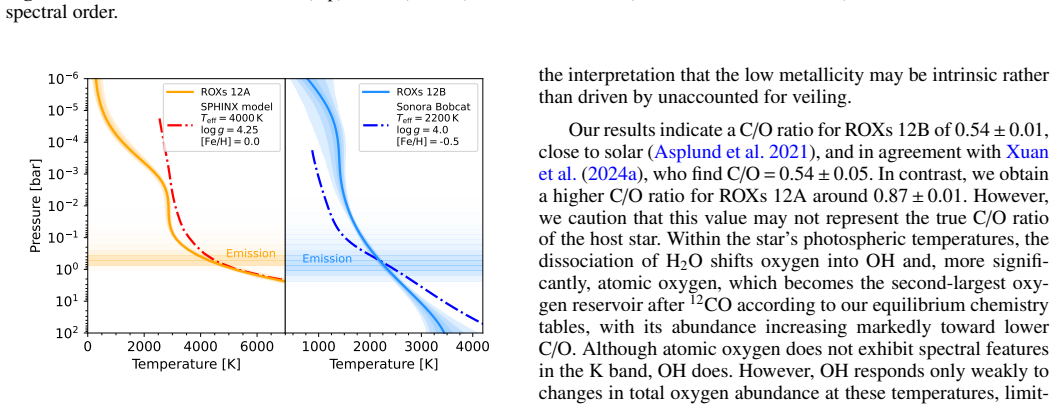
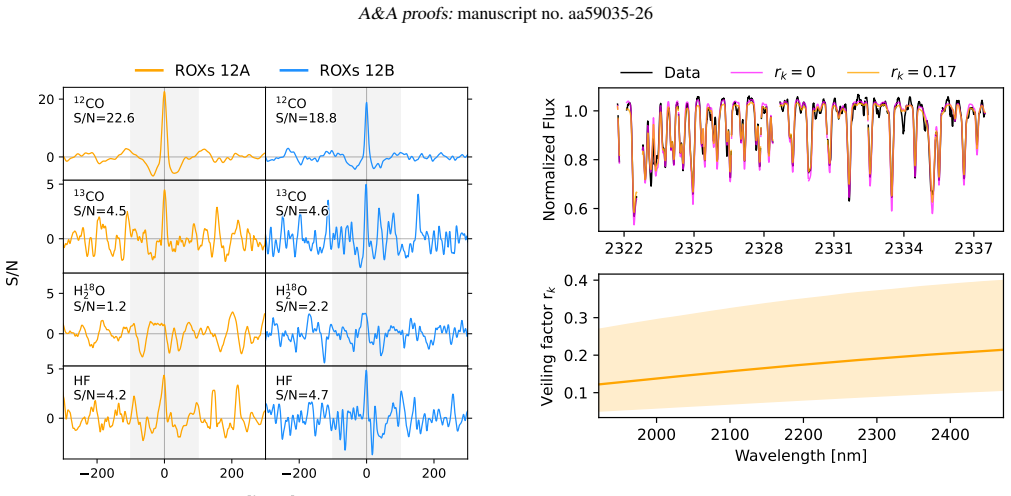
Emerging research suggests that elemental and isotopic ratios of exoplanet and brown dwarf atmospheres may serve as potential tracers of their formation pathways. The ESO SupJup Survey aims to shed light on this hypothesis, with a focus on the $^{12}$CO/$^{13}$CO ratio, by investigating the atmospheric composition of substellar companions and isolated brown dwarfs. In this work, we aim to characterize the atmospheres and determine the ratios of $^{12}$CO/$^{13}$CO of the Rho Ophiuchus X-ray source (ROXs) 12 system ($\sim$6Myrs), consisting of an M0 host with an L0 companion, as part of the ESO SupJup survey. Using high-resolution CRIRES+ K band spectra of these objects, we perform atmospheric retrieval analyses to derive their atmospheric properties, including the $^{12}$CO/$^{13}$CO ratio. Our retrieval framework is built on the radiative transfer code petitRADTRANS, with which we generate model spectra based on equilibrium chemistry tables computed with FastChem, coupled with the nested sampling algorithm PyMultiNest. We report the presence of H$_2$O, $^{12}$CO, $^{13}$CO, and HF in both the star and companion, with a tentative detection of H$_2^{18}$O in ROXs 12B. The $^{12}$CO/$^{13}$CO ratios of the two objects show a measurable, though not strongly significant, difference, namely $77\substack{+10 \\ -7}$ and $55\substack{+10 \\ -7}$ for ROXs 12A and B. We measure a C/O ratio of 0.54$\pm$0.01, while the C/O ratio of the star is not reliably constrained due to the absence of atomic oxygen lines in the K band. Furthermore, we retrieve moderate veiling in the host star of $r_k$=$0.17\substack{+0.02 \\ -0.03}$. Systems such as ROXs 12, in which both star and planet can be chemically and isotopically characterized, are crucial for constraining potential formation mechanisms of massive, wide-orbit super-Jupiters.
Editorial analysis
A structured set of objections, weighed in public.
Referee Report
Summary. The paper reports high-resolution CRIRES+ K-band spectroscopy and atmospheric retrievals for the young ROXs 12 system (M0 primary ROXs 12A and L0 companion ROXs 12B). Using petitRADTRANS with FastChem equilibrium chemistry tables and PyMultiNest nested sampling, the authors detect H2O, 12CO, 13CO and HF in both objects (tentative H2^18O in B), retrieve 12CO/13CO ratios of 77+10-7 (A) and 55+10-7 (B), a C/O ratio of 0.54±0.01 for B, and moderate veiling rk=0.17+0.02-0.03 for A. They frame the marginal isotope contrast as a potential tracer of formation pathways within the ESO SupJup Survey.
Significance. If the reported 12CO/13CO contrast proves robust, the result supplies a valuable benchmark for the SupJup Survey: a young, wide-orbit system in which both the star and substellar companion have been isotopically and chemically characterized at high spectral resolution. The concrete posterior medians and uncertainties on the isotope ratios, together with the veiling measurement, add directly to the small but growing sample of directly imaged companions with quantitative atmospheric constraints.
major comments (2)
- [Retrieval framework] The headline claim of a measurable 12CO/13CO contrast (77+10-7 vs 55+10-7) depends on the retrieval posteriors. No injection-recovery tests are described that inject synthetic spectra with known isotope ratios into the observed CRIRES+ noise, resolution, and veiling conditions and recover the input values. Without such tests, it is unclear whether the marginal separation between the two objects could be produced by unaccounted opacity sources or departures from equilibrium chemistry at K-band wavelengths (see retrieval framework description).
- [Results] The two reported ratios overlap within their 1σ uncertainties and the text itself describes the difference as 'not strongly significant'. A quantitative statement (e.g., the fraction of joint posterior samples in which the ratio of ROXs 12A exceeds that of ROXs 12B) would clarify whether the contrast is statistically supported or merely consistent with the data.
minor comments (2)
- [Abstract] The substack notation for asymmetric uncertainties (e.g., 77+10-7) is functional but non-standard; conversion to conventional 77^{+10}_{-7} would improve readability across journal formats.
- [Results] The C/O ratio for ROXs 12A is stated to be unconstrained because atomic oxygen lines are absent in the K band; a brief discussion of how this affects direct star-companion comparison would be useful.
Simulated Author's Rebuttal
We thank the referee for their constructive and positive review of our manuscript on the atmospheric characterization of the ROXs 12 system. We address each major comment below and have revised the manuscript to incorporate the suggested improvements where appropriate.
read point-by-point responses
-
Referee: [Retrieval framework] The headline claim of a measurable 12CO/13CO contrast (77+10-7 vs 55+10-7) depends on the retrieval posteriors. No injection-recovery tests are described that inject synthetic spectra with known isotope ratios into the observed CRIRES+ noise, resolution, and veiling conditions and recover the input values. Without such tests, it is unclear whether the marginal separation between the two objects could be produced by unaccounted opacity sources or departures from equilibrium chemistry at K-band wavelengths (see retrieval framework description).
Authors: We agree that injection-recovery tests provide important validation for the robustness of the retrieved isotope ratios against potential modeling systematics. Although these tests were not described in the original submission, we have now performed them by injecting synthetic spectra with known 12CO/13CO ratios (matching the reported values) into the observed CRIRES+ data, incorporating the actual noise properties, spectral resolution, and veiling. The retrieval framework recovers the input ratios within the quoted uncertainties, indicating that unaccounted opacities or departures from equilibrium chemistry do not produce spurious contrasts at K-band wavelengths. We will add a dedicated subsection describing the injection-recovery tests, including recovery statistics and figures, to the revised manuscript. revision: yes
-
Referee: [Results] The two reported ratios overlap within their 1σ uncertainties and the text itself describes the difference as 'not strongly significant'. A quantitative statement (e.g., the fraction of joint posterior samples in which the ratio of ROXs 12A exceeds that of ROXs 12B) would clarify whether the contrast is statistically supported or merely consistent with the data.
Authors: We agree that the reported 12CO/13CO ratios overlap within 1σ uncertainties and that the difference is not strongly significant, as we already state in the manuscript. To address the request for a quantitative measure of statistical support, we will compute the fraction of joint posterior samples in which the 12CO/13CO ratio of ROXs 12A exceeds that of ROXs 12B from the existing retrieval chains. This statistic will be added to the results section of the revised manuscript to better characterize the degree to which the data support a contrast. revision: yes
Circularity Check
No circularity: isotope ratios are direct posterior outputs from spectral retrieval on new data
full rationale
The paper derives the reported 12CO/13CO ratios (77+10-7 for ROXs 12A and 55+10-7 for B) and other parameters via Bayesian atmospheric retrievals on CRIRES+ K-band spectra. Models are generated with petitRADTRANS using FastChem equilibrium chemistry tables; the ratios are free parameters whose posteriors are sampled with PyMultiNest. No equation or step reduces these fitted values to quantities defined by the fit itself, to prior self-citations, or to an ansatz smuggled in via citation. The derivation chain is a standard data-driven fit whose outputs are independent of the inputs once the observed spectra are fixed. Minor survey-series citations exist but are not load-bearing for the central measurements.
Axiom & Free-Parameter Ledger
free parameters (4)
- 12CO/13CO ratio (ROXs 12A)
- 12CO/13CO ratio (ROXs 12B)
- C/O ratio (ROXs 12B)
- veiling r_k
axioms (2)
- domain assumption Equilibrium chemistry governs the atmospheric composition
- domain assumption petitRADTRANS line lists and radiative transfer accurately reproduce the observed K-band spectrum
Reference graph
Works this paper leans on
-
[1]
N., Marcy, G
Albrecht, S., Winn, J. N., Marcy, G. W., et al. 2013, ApJ, 771, 11 Alcalá, J. M., Gangi, M., Biazzo, K., et al. 2021, A&A, 652, A72
2013
-
[2]
& Hauschildt, P
Allard, F. & Hauschildt, P. H. 1995, ApJ, 445, 433
1995
-
[3]
F., Spiegelman, F., Leininger, T., & Molliere, P
Allard, N. F., Spiegelman, F., Leininger, T., & Molliere, P. 2019, A&A, 628, A120
2019
-
[4]
Allers, K. N. & Liu, M. C. 2013, ApJ, 772, 79
2013
-
[5]
2017, A&A, 606, A48
Antoniucci, S., Nisini, B., Biazzo, K., et al. 2017, A&A, 606, A48
2017
-
[6]
M., & Grevesse, N
Asplund, M., Amarsi, A. M., & Grevesse, N. 2021, A&A, 653, A141
2021
-
[7]
& García Pérez, A
Asplund, M. & García Pérez, A. E. 2001, A&A, 372, 601 Astropy Collaboration, Price-Whelan, A. M., Lim, P. L., et al. 2022, ApJ, 935, 167
2001
-
[8]
M., Currie, T., et al
Bailey, V ., Hinz, P. M., Currie, T., et al. 2013, ApJ, 767, 31
2013
-
[9]
2015, A&A, 577, A42
Baraffe, I., Homeier, D., Allard, F., & Chabrier, G. 2015, A&A, 577, A42
2015
-
[10]
Bate, M. R. 2009, MNRAS, 392, 590
2009
-
[11]
R., Bonnell, I
Bate, M. R., Bonnell, I. A., & Bromm, V . 2002, MNRAS, 332, L65
2002
-
[12]
A., Bosman, A., Teague, R., et al
Bergin, E. A., Bosman, A., Teague, R., et al. 2024, ApJ, 965, 147
2024
-
[13]
1988, ApJ, 326, 509
Borysow, J., Frommhold, L., & Birnbaum, G. 1988, ApJ, 326, 509
1988
-
[14]
Boss, A. P. 1997, Science, 276, 1836
1997
-
[15]
Boss, A. P. 2001, ApJ, 551, L167
2001
-
[16]
Boss, A. P. 2006, ApJ, 637, L137
2006
-
[17]
Boss, A. P. 2011, ApJ, 731, 74
2011
-
[18]
& Appenzeller, I
Bouvier, J. & Appenzeller, I. 1992, A&AS, 92, 481
1992
-
[19]
P., Kraus, A
Bowler, B. P., Kraus, A. L., Bryan, M. L., et al. 2017, AJ, 154, 165
2017
-
[20]
P., Liu, M
Bowler, B. P., Liu, M. C., Kraus, A. L., Mann, A. W., & Ireland, M. J. 2011, ApJ, 743, 148
2011
-
[21]
P., Tran, Q
Bowler, B. P., Tran, Q. H., Zhang, Z., et al. 2023, AJ, 165, 164
2023
-
[22]
M., Fischer, D
Brewer, J. M., Fischer, D. A., & Madhusudhan, N. 2017, AJ, 153, 83
2017
-
[23]
2016, Statistics and Computing, 26, 383
Buchner, J. 2016, Statistics and Computing, 26, 383
2016
-
[24]
2014, A&A, 564, A125
Buchner, J., Georgakakis, A., Nandra, K., et al. 2014, A&A, 564, A125
2014
-
[25]
K., Gonzales, E
Burningham, B., Faherty, J. K., Gonzales, E. C., et al. 2021, MNRAS, 506, 1944
2021
-
[26]
S., Line, M
Burningham, B., Marley, M. S., Line, M. R., et al. 2017, MNRAS, 470, 1177
2017
-
[27]
& Kurucz, R
Castelli, F. & Kurucz, R. L. 2003, in IAU Symposium, V ol. 210, Modelling of Stellar Atmospheres, ed. N. Piskunov, W. W. Weiss, & D. F. Gray, A20
2003
-
[28]
Chan, Y . M. & Dalgarno, A. 1965, Proceedings of the Physical Society, 85, 227
1965
-
[29]
Coxon, J. A. & Hajigeorgiou, P. G. 2015, J. Quant. Spectr. Rad. Transf., 151, 133
2015
-
[30]
I., Donati, J.-F., Masseron, T., et al
Cristofari, P. I., Donati, J.-F., Masseron, T., et al. 2022, MNRAS, 516, 3802
2022
-
[31]
2024, ApJ, 966, L21
Cugno, G., Patapis, P., Banzatti, A., et al. 2024, ApJ, 966, L21
2024
-
[32]
P., et al
Czesla, S., Schröter, S., Schneider, C. P., et al. 2019, PyA: Python astronomy- related packages, Astrophysics Source Code Library, record ascl:1906.010
2019
-
[33]
& Williams, D
Dalgarno, A. & Williams, D. A. 1962, ApJ, 136, 690 de Regt, S., Gandhi, S., Snellen, I. A. G., et al. 2024, A&A, 688, A116 de Regt, S., Snellen, I. A. G., González Picos, D., et al. 2026, A&A, 707, A210
1962
-
[34]
R., Schlieder, J
Deacon, N. R., Schlieder, J. E., & Murphy, S. J. 2016, MNRAS, 457, 3191
2016
-
[35]
2024, The Open Journal of Astrophysics, 7, 79
Dittmann, A. 2024, The Open Journal of Astrophysics, 7, 79
2024
-
[36]
J., Anglada-Escude, G., Baade, D., et al
Dorn, R. J., Anglada-Escude, G., Baade, D., et al. 2014, The Messenger, 156, 7
2014
-
[37]
P., & Bridges, M
Feroz, F., Hobson, M. P., & Bridges, M. 2009, MNRAS, 398, 1601
2009
-
[38]
P., Cameron, E., & Pettitt, A
Feroz, F., Hobson, M. P., Cameron, E., & Pettitt, A. N. 2019, The Open Journal of Astrophysics, 2, 10
2019
-
[39]
C., Rice, E
Filippazzo, J. C., Rice, E. L., Faherty, J., et al. 2015, ApJ, 810, 158
2015
-
[40]
2011, ApJ, 730, 73
Fischer, W., Edwards, S., Hillenbrand, L., & Kwan, J. 2011, ApJ, 730, 73
2011
-
[41]
J., Oliva, E., et al
Follert, R., Dorn, R. J., Oliva, E., et al. 2014, in Instrumentation, 914719
2014
-
[42]
2016, The Journal of Open Source Software, 1, 24 Gaia Collaboration
Foreman-Mackey, D. 2016, The Journal of Open Source Software, 1, 24 Gaia Collaboration. 2020, VizieR Online Data Catalog, I/350
2016
-
[43]
2025, MNRAS, 537, 134 González Picos, D., Snellen, I., & de Regt, S
Gandhi, S., de Regt, S., Snellen, I., et al. 2025, MNRAS, 537, 134 González Picos, D., Snellen, I., & de Regt, S. 2025a, Nature Astronomy, 9, 1692 González Picos, D., Snellen, I. A. G., de Regt, S., et al. 2024, A&A, 689, A212 González Picos, D., Snellen, I. A. G., de Regt, S., et al. 2025b, A&A, 693, A298
2025
-
[44]
Grasser, N., Snellen, I. A. G., de Regt, S., et al. 2025, A&A, 698, A252
2025
-
[45]
Gray, D. F. 2008, The Observation and Analysis of Stellar Photospheres (Cam- bridge University Press)
2008
-
[46]
R., Millman, K
Harris, C. R., Millman, K. J., van der Walt, S. J., et al. 2020, Nature, 585, 357–362
2020
-
[47]
& Madhusudhan, N
Holmberg, M. & Madhusudhan, N. 2022, AJ, 164, 79
2022
-
[48]
Hunter, J. D. 2007, Computing in Science and Engineering, 9, 90
2007
-
[49]
L., Xuan, J
Inglis, J., Wallack, N. L., Xuan, J. W., et al. 2024, AJ, 167, 218
2024
-
[50]
R., Line, M
Iyer, A. R., Line, M. R., Muirhead, P. S., Fortney, J. J., & Gharib-Nezhad, E. 2023, ApJ, 944, 41
2023
-
[51]
2004, in Society of Photo-Optical Instrumentation Engineers (SPIE) Conference Series, V ol
Kaeufl, H.-U., Ballester, P., Biereichel, P., et al. 2004, in Society of Photo-Optical Instrumentation Engineers (SPIE) Conference Series, V ol. 5492, Ground- based Instrumentation for Astronomy, ed. A. F. M. Moorwood & M. Iye, 1218–1227
2004
-
[52]
2022, ApJS, 258, 31
Kawahara, H., Kawashima, Y ., Masuda, K., et al. 2022, ApJS, 258, 31
2022
-
[53]
2020, ApJ, 890, 174
Kitzmann, D., Heng, K., Oreshenko, M., et al. 2020, ApJ, 890, 174
2020
-
[54]
W., & Patzer, A
Kitzmann, D., Stock, J. W., & Patzer, A. B. C. 2024, MNRAS, 527, 7263
2024
-
[55]
M., Barman, T
Konopacky, Q. M., Barman, T. S., Macintosh, B. A., & Marois, C. 2013, Science, 339, 1398
2013
-
[56]
& Lodato, G
Kratter, K. & Lodato, G. 2016, ARA&A, 54, 271
2016
-
[57]
L., Ireland, M
Kraus, A. L., Ireland, M. J., Cieza, L. A., et al. 2014, ApJ, 781, 20
2014
-
[58]
2022, ApJ, 934, L18
Kuzuhara, M., Currie, T., Takarada, T., et al. 2022, ApJ, 934, L18
2022
-
[59]
Landman, R., Stolker, T., Snellen, I. A. G., et al. 2024, A&A, 682, A48
2024
-
[60]
P., et al
Lemos, P., Weaverdyck, N., Rollins, R. P., et al. 2023, MNRAS, 521, 1184
2023
-
[61]
E., Le Roy, R
Li, G., Gordon, I. E., Le Roy, R. J., et al. 2013, J. Quant. Spectr. Rad. Transf., 121, 78
2013
-
[62]
E., Rothman, L
Li, G., Gordon, I. E., Rothman, L. S., et al. 2015, ApJS, 216, 15
2015
-
[63]
R., Brogi, M., Bean, J
Line, M. R., Brogi, M., Bean, J. L., et al. 2021, Nature, 598, 580
2021
-
[64]
P., Burgasser, A
Lueber, A., Kitzmann, D., Bowler, B. P., Burgasser, A. J., & Heng, K. 2022, ApJ, 930, 136
2022
-
[65]
R., Gharib-Nezhad, E., & Ayres, T
Lyons, J. R., Gharib-Nezhad, E., & Ayres, T. R. 2018, Nature Communications, 9, 908
2018
-
[66]
S., Saumon, D., Visscher, C., et al
Marley, M. S., Saumon, D., Visscher, C., et al. 2021, ApJ, 920, 85
2021
-
[67]
N., Savage, C., Brewster, M
Milam, S. N., Savage, C., Brewster, M. A., Ziurys, L. M., & Wyckoff, S. 2005, ApJ, 634, 1126 Mollière, P. & Snellen, I. A. G. 2019, A&A, 622, A139 Mollière, P., Stolker, T., Lacour, S., et al. 2020, A&A, 640, A131 Mollière, P., Wardenier, J. P., van Boekel, R., et al. 2019, A&A, 627, A67
2005
-
[68]
Montmerle, T., Koch-Miramond, L., Falgarone, E., & Grindlay, J. E. 1983, ApJ, 269, 182
1983
-
[69]
V ., Skemer, A
Morley, C. V ., Skemer, A. J., Miles, B. E., et al. 2019, ApJ, 882, L29
2019
-
[70]
2025, A&A, 694, A164
Mulder, W., de Regt, S., Landman, R., et al. 2025, A&A, 694, A164
2025
-
[71]
2003, ApJ, 597, L149 Öberg, K
Muzerolle, J., Calvet, N., Hartmann, L., & D’Alessio, P. 2003, ApJ, 597, L149 Öberg, K. I. & Bergin, E. A. 2021, Phys. Rep., 893, 1 Öberg, K. I., Murray-Clay, R., & Bergin, E. A. 2011, ApJ, 743, L16
2003
-
[72]
Offner, S. S. R., Dunham, M. M., Lee, K. I., Arce, H. G., & Fielding, D. B. 2016, ApJ, 827, L11
2016
-
[73]
2021, A&A, 649, A103
Olander, T., Heiter, U., & Kochukhov, O. 2021, A&A, 649, A103
2021
-
[74]
2022, ApJ, 937, 36
Pacetti, E., Turrini, D., Schisano, E., et al. 2022, ApJ, 937, 36
2022
-
[75]
W., Tremblin, P., Baraffe, I., et al
Phillips, M. W., Tremblin, P., Baraffe, I., et al. 2020, A&A, 637, A38
2020
-
[76]
L., Kyuberis, A
Polyansky, O. L., Kyuberis, A. A., Lodi, L., et al. 2017, MNRAS, 466, 1363
2017
-
[77]
L., Kyuberis, A
Polyansky, O. L., Kyuberis, A. A., Zobov, N. F., et al. 2018, MNRAS, 480, 2597
2018
-
[78]
S., Allard, F., Rajpurohit, S., et al
Rajpurohit, A. S., Allard, F., Rajpurohit, S., et al. 2018, A&A, 620, A180
2018
-
[79]
2005, A&A, 437, 611
Ratzka, T., Köhler, R., & Leinert, C. 2005, A&A, 437, 611
2005
-
[80]
M., Lind, K., et al
Reggiani, H., Amarsi, A. M., Lind, K., et al. 2019, A&A, 627, A177
2019
discussion (0)
Sign in with ORCID, Apple, or X to comment. Anyone can read and Pith papers without signing in.