Recognition: unknown
Spherical trigonometry before the modern era:The treatise of Nasir al-Din al-Tusi
Pith reviewed 2026-05-09 16:06 UTC · model grok-4.3
The pith
Nasir al-Din al-Tusi's 13th-century treatise presents a complete system of spherical trigonometric formulas with proofs.
A machine-rendered reading of the paper's core claim, the machinery that carries it, and where it could break.
Core claim
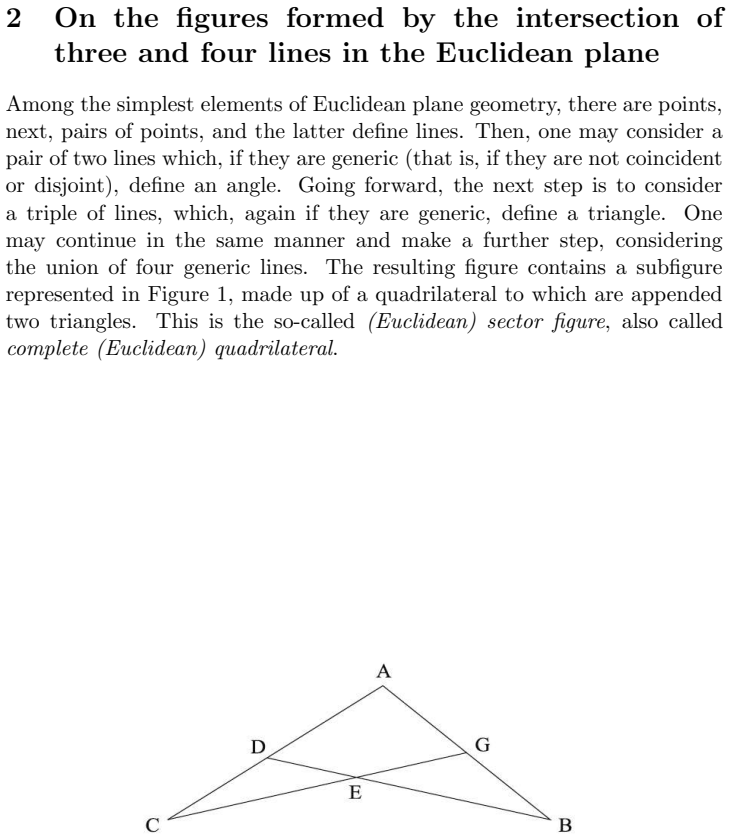
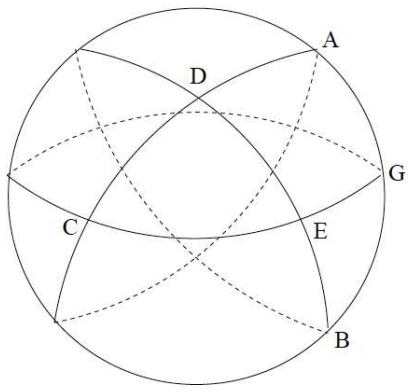
Al-Tusi's treatise on the secant figure, or complete spherical quadrilateral, contains much more than Menelaus' theorem. It sets out a full system of spherical trigonometric formulae together with their proofs. The work simultaneously supplies historical information on how Arab mathematicians of the Middle Ages discovered these formulae and how that discovery changed the practice of spherical trigonometry.
What carries the argument
The complete spherical quadrilateral, called the secant figure, which supplies the geometric configuration from which all spherical trigonometric relations are derived and proved.
If this is right
- Astronomers obtained direct formulae for solving spherical triangles instead of repeated applications of Menelaus' theorem.
- Spherical trigonometry acquired the status of a systematic discipline with established methods and results.
- Later mathematical developments could proceed from a body of proven identities rather than from isolated relations.
- Historical narratives of the subject must now place the decisive step in the 13th century within Islamic scholarship.
Where Pith is reading between the lines
- Contemporary courses could usefully present al-Tusi's geometric proofs alongside modern vector methods to illustrate the origins of the formulae.
- Parallel examination of other surviving medieval treatises might uncover additional identities or alternative derivations.
- Direct comparison of the treatise with Ptolemy's Almagest would isolate the precise advances introduced by al-Tusi and his predecessors.
Load-bearing premise
The 1891 French translation accurately renders the original Arabic text and the historical account of the discovery process rests on a reliable interpretation of the manuscript.
What would settle it
Examination of the original Arabic manuscript that shows the trigonometric formulae or their proofs are absent or incomplete would falsify the claim that the treatise contains a complete proved system.
Figures



read the original abstract
This is an overview of Nasir al-Din al-Tusi's Treatise of the quadrilateral, an invaluable 13th century document on spherical geometry which was translated into French in 1891. The title we are using here is the one given by the translator (Alexandre Carath{\'e}odory). A title which is closer to the original Arabic is ''Disclosing the secrets of the secant figure.'' The term ''secant figure'', to which the title refers, is the so-called ''complete (spherical) quadrilateral'', that is, the figure that underlies what we call today Menelaus' Theorem. This theorem gives a formula that was extensively used by astronomers in their computations and the establishment of their tables since the first century AD, notably by Ptolemy, in the absence of the spherical trigonometric formulae that were discovered later. Nasir's treatise contains much more than Menelaus' theorem, since we find there a complete system of spherical trigonometric formulae, with complete proofs. The treatise includes at the same time invaluable historical information on the discovery of the trigonometric formulae by the Arab mathematicians of the Middle-Ages and the transformation of the field of spherical trigonometry that this discovery led to. The final version of this paper will appear in the book Spherical geometry in the eighteenth century, I: Euler, Lagrange and Lambert, edited by Renzo Caddeo and Athanase Papadopoulos, Springer, 2026.
Editorial analysis
A structured set of objections, weighed in public.
Referee Report
Summary. The paper is a historical overview of Nasir al-Din al-Tusi's 13th-century Treatise of the Quadrilateral (Arabic title closer to 'Disclosing the secrets of the secant figure'), which treats the complete spherical quadrilateral underlying Menelaus' theorem. It argues that the treatise goes beyond Menelaus to present a complete system of spherical trigonometric formulae together with their proofs, while also supplying historical information on the discovery of these formulae by medieval Arab mathematicians and the resulting transformation of spherical trigonometry. The work is positioned as background for a forthcoming edited volume on 18th-century spherical geometry.
Significance. If the descriptive claims are accurate, the paper usefully draws attention to a key pre-modern Arabic source that bridges Ptolemaic methods and later trigonometric developments. It supplies contextual historical material that can inform studies of the evolution of spherical geometry, particularly in relation to the 18th-century figures treated in the companion volume.
major comments (2)
- [Abstract and main text] The central claim that al-Tusi's treatise contains 'a complete system of spherical trigonometric formulae, with complete proofs' is asserted in the abstract and main text but is not supported by any specific identities, proof outlines, or direct quotations from the Carathéodory translation. Without such concrete illustrations, the scope and rigor of the claimed system cannot be independently assessed.
- [Abstract and main text] The historical assertions about the discovery process and transformation of the field rest entirely on the 1891 French translation without any discussion of its fidelity to the original Arabic manuscript, potential interpretive liberties, or cross-checks against other sources. This dependency is load-bearing for the paper's strongest claims.
minor comments (2)
- [Abstract] The abstract contains a LaTeX artifact ('Carathéodory') that should be rendered as plain text or properly formatted for the final book chapter.
- The paper would benefit from a brief note on the manuscript's availability or modern editions to help readers locate the primary source.
Simulated Author's Rebuttal
We thank the referee for the constructive report and the recommendation of minor revision. The comments help clarify how to better support the paper's claims while preserving its role as an accessible historical overview for the forthcoming volume on 18th-century spherical geometry. We address each major comment below and have revised the manuscript accordingly.
read point-by-point responses
-
Referee: [Abstract and main text] The central claim that al-Tusi's treatise contains 'a complete system of spherical trigonometric formulae, with complete proofs' is asserted in the abstract and main text but is not supported by any specific identities, proof outlines, or direct quotations from the Carathéodory translation. Without such concrete illustrations, the scope and rigor of the claimed system cannot be independently assessed.
Authors: We agree that the current text asserts the existence of the system at a high level without concrete examples. As the paper is intended as background rather than a technical exposition, we have now added a short paragraph with specific illustrations drawn from the Carathéodory translation. These include the spherical law of sines and the cosine rule for sides, together with a brief outline of their derivation via the complete quadrilateral and Menelaus' theorem. Direct references to the relevant propositions in the translation are included so that readers can assess the scope and rigor of al-Tusi's treatment. revision: yes
-
Referee: [Abstract and main text] The historical assertions about the discovery process and transformation of the field rest entirely on the 1891 French translation without any discussion of its fidelity to the original Arabic manuscript, potential interpretive liberties, or cross-checks against other sources. This dependency is load-bearing for the paper's strongest claims.
Authors: This observation is well taken. We have inserted a brief discussion of the translation's status, noting that Carathéodory worked directly from the Arabic manuscript in the Topkapi Palace collection and that his rendering has been accepted as reliable by later historians of Arabic mathematics. We also reference subsequent scholarship that corroborates the mathematical content of the treatise. While a full philological analysis lies outside the scope of this overview, the added paragraph makes the evidential basis explicit and acknowledges the translation as the primary accessible source. revision: yes
Circularity Check
No significant circularity in historical overview
full rationale
The paper is a descriptive historical overview of a 13th-century treatise based on an external 1891 translation. It contains no equations, derivations, predictions, or self-referential claims that could create circular reasoning. All assertions rely on cited historical sources rather than internal reductions by construction.
Axiom & Free-Parameter Ledger
Reference graph
Works this paper leans on
-
[1]
Bellosta, Le trait´ e de Th¯ abit ibn Qurra sur la figure secteur, Arabic Sciences and Philosophy 14 (2004) No
H. Bellosta, Le trait´ e de Th¯ abit ibn Qurra sur la figure secteur, Arabic Sciences and Philosophy 14 (2004) No. 1, p.145–168
2004
-
[2]
Carra de Vaux, Les sph` eres c´ elestes selon Nas.¯ ır al-D¯ ın al-T
B. Carra de Vaux, Les sph` eres c´ elestes selon Nas.¯ ır al-D¯ ın al-T. ¯ us¯ ı. In: P. Tannery, Recherches sur l’histoire de l’astronomie ancienne, Gauthier- Villars, Paris, 1893, Appendice VI, p. 337-61
-
[3]
M. T. Debarnot, La trigonom´ etrie sph´ erique chez les Arabes de l’Est ` a la fin du Xe si` ecle, Damascus, 1985
1985
-
[4]
M. T. Debarnot, Trigonometry, In: Encyclopedia of the history of ara- bic science, 3 volumes, ed. R. Rashed, Routledge, London and New York, 1996, Vol. 2, p. 470-513
1996
-
[5]
Halma (ed.), Composition math´ ematique de Claude Ptol´ em´ ee, traduite par Nicolas Halma et suivie des notes de Jean Baptiste Delam- bre, 2 vols., Paris, Henri Grand, 1813
N. Halma (ed.), Composition math´ ematique de Claude Ptol´ em´ ee, traduite par Nicolas Halma et suivie des notes de Jean Baptiste Delam- bre, 2 vols., Paris, Henri Grand, 1813. Reprint, 1988, Librairie Blan- chard, Paris
1988
-
[6]
T. L. Heath, The thirteen books of Euclid’s Elements, 3 volumes, Cam- bridge University Press, 1908, Reprint, Dover
1908
-
[7]
T. L. Heath, A history of Greek mathematics, 2 volumes, Clarendon Press, Oxford, 1921, Reprint, Dover
1921
-
[8]
E. S. Kennedy, Two Persian astronomical treatises by Nas .¯ ır al-D¯ ın al- T. ¯ us¯ ı, Centaurus 27 (2) (1984), p. 109–120. 20
1984
-
[9]
Kubesov, The commentaries of Nas .¯ ır al-D¯ ın al-T
A. Kubesov, The commentaries of Nas .¯ ır al-D¯ ın al-T. ¯ us¯ ı on the treatise of Archimedes On the sphere and cylinder (Russian), Voprosy Istor. Estestvoznan. i Tehn. Vyp. 2 (1969), p. 23–28
1969
-
[10]
Papadopoulos and G
A. Papadopoulos and G. Th´ eret, Johann Heinrich Lambert’s memoir Theorie der Parallellinien : a review with commentary, this volume, Chapter 7
-
[11]
Rashed and A
R. Rashed and A. Papadopoulos, Menelaus’ Spherics: Early Transla- tion and al-M¯ ah¯ an¯ ı/al-Haraw¯ ı’s Version, (Critical edition of Menelaus’ Spherics from the Arabic manuscripts, with historical and mathemat- ical commentaries), De Gruyter, Series: Scientia Graeco-Arabica, 21, 2017, 890 pages
2017
-
[12]
Rashed (ed.) Encyclopedia of the history of Arabic science, 3 vol- umes, Routledge, 1996
R. Rashed (ed.) Encyclopedia of the history of Arabic science, 3 vol- umes, Routledge, 1996
1996
-
[13]
B. A. Rosenfeld, On the mathematical works of Nas .¯ ır al-D¯ ın al-T. ¯ us¯ ı (Russian), Istor.-Mat. Issled. 4 (1951), p. 489–512
1951
-
[14]
B. A. Rosenfeld et A. P. Youshkevich, Geometry. In Encyclopedia of the history of Arabic science, ed. R. Rashed et R. Morelon, Vol. 2, Routledge, London, 1996, p. 447-494
1996
-
[15]
F. J. Ragep, Nas .¯ ır al-D¯ ın al-T. ¯ us¯ ı’s Memoir on Astronomy, 2 volumes, Springer-Verlag New York, 1993
1993
-
[16]
B. A. Rosenfeld, A History of Non-Euclidean Geometry: Evolution of the Concept of a Geometric Space. Translated by A. Shenitzer, Springer-Verlag New York, 1988. First Russian edition, 1976
1988
-
[17]
B. A. Rosenfeld and A. P. Yushkevich, Notes on the treatise of Nas .¯ ır al-D¯ ın al-T. ¯ us¯ ı on parallel lines (Russian), Istor.-Mat. Issled. 13 (1960), p. 525–532
1960
-
[18]
Johann Strauss, Le livre fran¸ cais d’Istanbul (1730-1908), Revue des mondes musulmans et de la M´ editerrann´ ee, 87-88 (1999), p. 277-301
1908
-
[19]
Trait´ e du quadrilat` ere, attribu´ e ` a Nassiruddin-el-Toussy, d’apr` es un manuscrit tir´ e de la biblioth` eque de S. E. Edhem Pacha, ancien grand vizir, traduit par Alexandre Pacha Carath´ eodory, ancien ministre des affaires ´ etrang` eres, Constantinople, Typographie et Lithographie Os- mani´ e, 1891
-
[20]
¯ us¯ ı, Majmu‘al-ras¯ a’il, 2 vol., Hyderabad, Osmania Ori- ental Publication Bureau
Nas.¯ ır al-D¯ ın al-T. ¯ us¯ ı, Majmu‘al-ras¯ a’il, 2 vol., Hyderabad, Osmania Ori- ental Publication Bureau. 21 Author’s address: Athanase Papadopoulos, Institut de Recherche Math´ ematique Avanc´ ee, Universit´ e de Strasbourg et CNRS, 7 rue Ren´ e Descartes, 67084 Strasbourg Cedex, France. email: athanase.papadopoulos@math.unistra.fr 22
discussion (0)
Sign in with ORCID, Apple, or X to comment. Anyone can read and Pith papers without signing in.