Recognition: unknown
Unveiling hidden millihertz quasi-periodic oscillations in 1A 0535+262
Pith reviewed 2026-05-07 14:43 UTC · model grok-4.3
The pith
Weak millihertz quasi-periodic oscillations appear at low X-ray energies below 27 keV in the pulsar 1A 0535+262.
A machine-rendered reading of the paper's core claim, the machinery that carries it, and where it could break.
Core claim
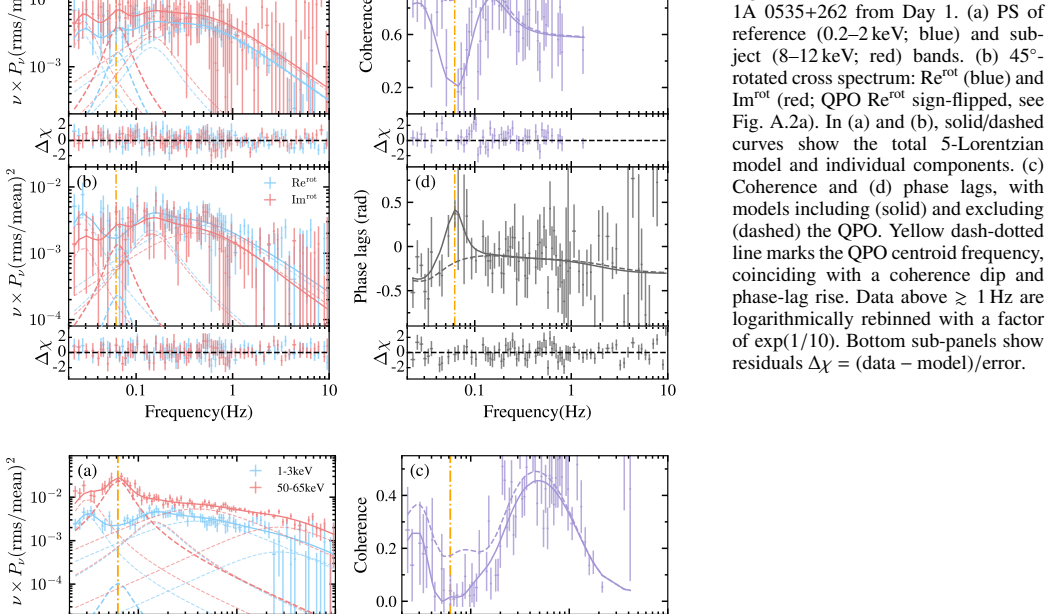
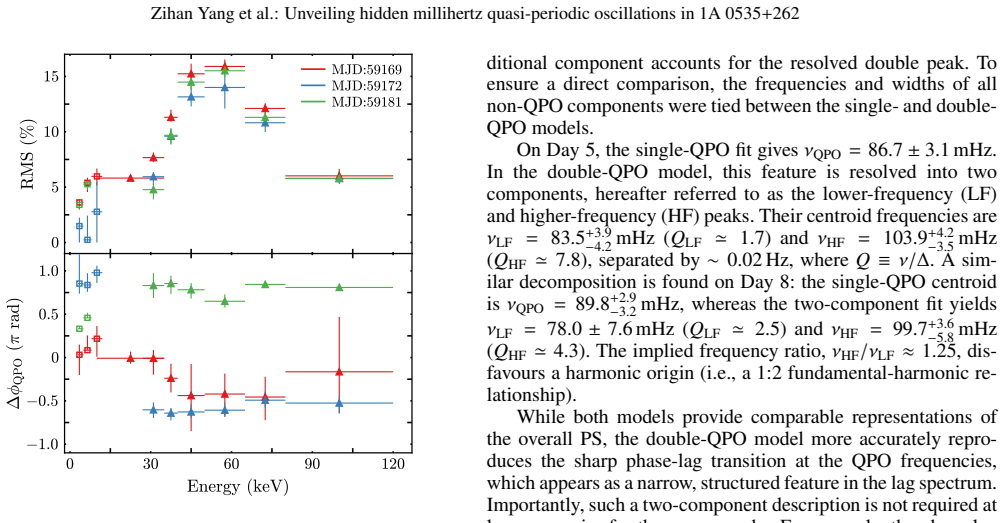
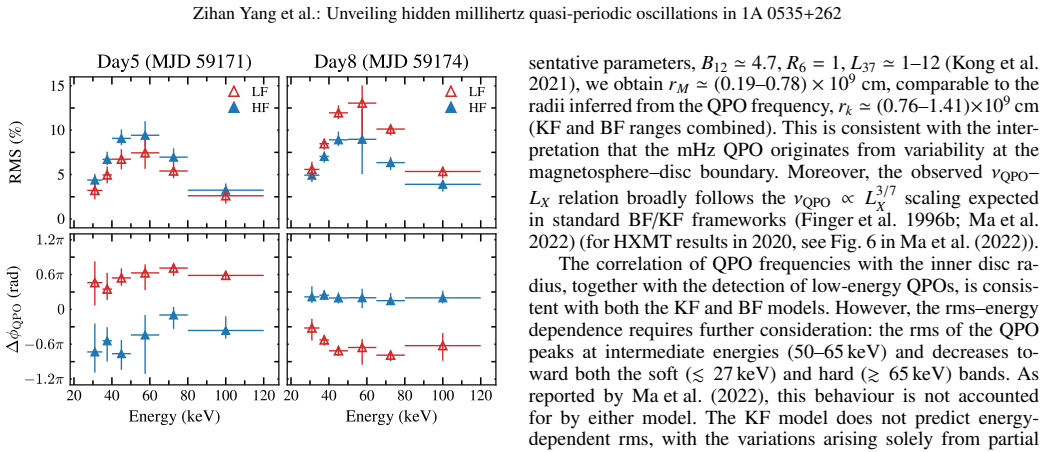
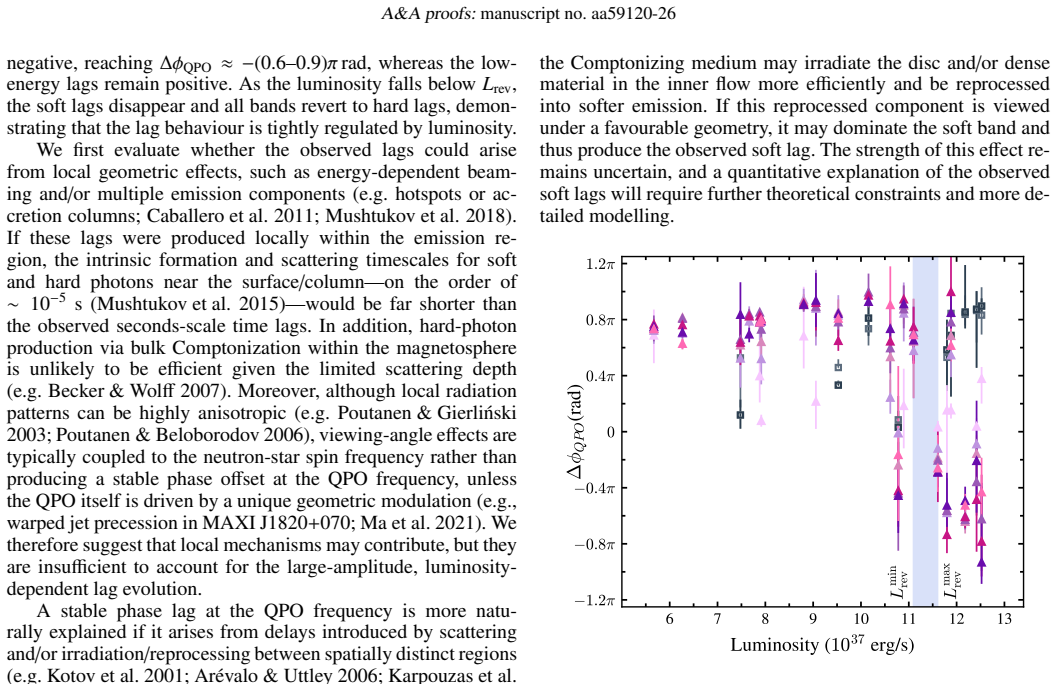
The authors detect weak but significant mHz QPOs for the first time below 27 keV, with centroid frequencies evolving from 41 to 93 mHz across the outburst. The QPOs exhibit hard lags of 0.12 to 0.9 pi rad in most cases, switching to soft lags up to -0.93 pi rad above 35 keV near peak luminosity, where a double-peaked structure appears with constant separation of twice the spin frequency and anti-correlated phase evolution. They interpret the behavior as arising from the coupled evolution of a soft-photon source and a Comptonizing outflow, with the joint multi-Lorentzian model of power and cross-spectra providing the key evidence beyond standard power-spectral analysis.
What carries the argument
The multi-Lorentzian fitting framework jointly applied to the power spectra and the real and imaginary parts of the cross-spectrum, which isolates the QPO signals, their rms amplitudes, and phase lags across energy bands from 0.2 to 120 keV.
If this is right
- The mHz QPOs are tied to the coupled evolution of soft seed photons and an extended outflow or corona outside the magnetosphere.
- Hard lags result from Comptonization of soft photons in this outflow, while soft lags at peak luminosity indicate a change in geometry or optical depth.
- A double-peaked QPO structure at energies above 35 keV near outburst peak maintains a fixed separation of 2 times the spin frequency, suggesting resonance with the pulsar's rotation.
- The joint cross-spectral approach reveals energy-dependent properties that power spectra alone miss, enabling detection in a new low-energy regime.
Where Pith is reading between the lines
- Similar low-energy mHz QPOs may be present but hidden in other Be/X-ray binaries if observed with sensitive soft X-ray instruments.
- The lag sign reversal could serve as a diagnostic for the location and extent of the Comptonizing region relative to the magnetosphere in future timing studies.
- If the double-peaked feature proves general, it may link mHz QPOs to beat-frequency or harmonic interactions with the neutron star spin.
Load-bearing premise
The multi-Lorentzian fits to the power and cross-spectra reliably isolate genuine QPO signals without introducing artifacts from noise, energy-band selection, or model choice.
What would settle it
Re-processing the same NICER and Insight-HXMT data with alternative single-component models or without joint cross-spectral fitting yields no significant QPO power below 27 keV at the reported frequencies and significance levels.
Figures



read the original abstract
Be/X-ray binary pulsars show transient outbursts and complex timing behaviour, including millihertz quasi-periodic oscillations (QPOs), whose physical origin and energy dependence remain poorly understood. We aim to characterise the temporal evolution and energy-dependent properties of the mHz QPO during the 2020 giant outburst of 1A 0535+262. We use the multi-Lorentzian fitting framework to jointly model the power spectra and the real and imaginary parts of the cross-spectrum, incorporating simultaneous broadband X-ray observations from NICER and Insight-HXMT (0.2-120 keV). We report the first detection of weak, but significant, mHz QPOs at low X-ray energies (below 27 keV), extending their detection to a new energy regime. The centroid frequency evolves from 41 to 93 mHz, with the peak root-mean-square (rms) amplitude detected in the 50-65 keV. Throughout the outburst, the QPOs generally exhibit a hard lag between 0.12 pi rad and 0.9 pi rad. However, at the outburst peak, the higher-energy bands (above 35 keV) display a soft lag of up to -0.93 pi rad. We propose that interactions between soft seed photons and an extended outflow located outside the magnetosphere can account for the observed hard lags. Furthermore, we detect a double-peaked mHz QPO only at high energies (E above 35 keV) near peak luminosity. The two peaks maintain an approximately constant separation of 2*nu_spin and exhibit anti-correlated phase evolution. Our results indicate that the mHz QPOs in 1A 0535+262 are closely linked to the coupled evolution of a soft-photon source and a Comptonizing outflow or corona. The joint cross-spectral framework provides a complementary probe of mHz QPOs beyond traditional power-spectral analyses.
Editorial analysis
A structured set of objections, weighed in public.
Referee Report
Summary. The paper analyzes NICER and Insight-HXMT observations of the 2020 outburst of the Be/X-ray binary pulsar 1A 0535+262. It reports the first detection of weak mHz QPOs below 27 keV using joint multi-Lorentzian modeling of power spectra together with the real and imaginary parts of the cross-spectrum. Centroid frequencies evolve from 41 to 93 mHz, rms amplitude peaks in the 50-65 keV band, lags are generally hard (0.12-0.9 pi rad) but become soft (up to -0.93 pi rad) above 35 keV near outburst peak, and a double-peaked QPO with ~2*nu_spin separation appears only at high energies. The authors propose that the lags arise from interactions between soft seed photons and an extended outflow outside the magnetosphere.
Significance. If the low-energy detections are robust, the work extends the observed energy range of mHz QPOs in accreting pulsars and supplies new constraints on the geometry of the Comptonizing region. The joint power-plus-cross-spectrum fitting framework is a methodological strength that improves sensitivity to weak signals compared with power spectra alone. The reported frequency evolution, energy-dependent rms, and double-peaked structure at high energies constitute concrete, falsifiable observables for future broadband timing studies.
major comments (3)
- [Abstract and §3] Abstract and §3 (low-energy results): the claim of the 'first detection of weak, but significant, mHz QPOs at low X-ray energies (below 27 keV)' is not accompanied by any reported detection significance (F-test probability, likelihood-ratio statistic, or posterior odds) comparing the multi-Lorentzian model to a pure continuum model in the NICER bands. For signals whose rms is described as weak, this quantification is load-bearing for the central claim.
- [§4.2] §4.2 (cross-spectrum modeling): the phase-lag values (0.12 pi rad to 0.9 pi rad, and the soft lag of -0.93 pi rad) are extracted from the fitted imaginary part of the cross-spectrum, yet no propagation of parameter uncertainties from the joint fit or tests against alternative continuum shapes (e.g., broken power-law plus broad Lorentzians) are presented. This leaves open the possibility that the reported lag sign changes are partly driven by model choice.
- [§3.3 and Table 2] §3.3 and Table 2 (energy-band selection): the specific division at 27 keV and the choice of the 50-65 keV band for peak rms are not justified by any systematic exploration of alternative band boundaries or checks for NICER-HXMT cross-calibration residuals. For a detection that hinges on extending to a 'new energy regime,' such tests are required to rule out instrumental artifacts.
minor comments (3)
- [Abstract] The abstract states '0.12 pi rad' without the proper mathematical symbol or explicit definition of the lag convention (e.g., hard lag positive).
- [Figure captions] Figure captions for the power and cross-spectra should explicitly state the frequency range, number of averaged segments, and whether Poisson noise has been subtracted.
- [Discussion] The manuscript would benefit from a short paragraph comparing the observed mHz QPO frequencies and lags with those previously reported in other Be/X-ray binaries (e.g., 4U 0115+63, V 0332+53).
Simulated Author's Rebuttal
We thank the referee for their constructive and positive review, which highlights both the strengths of our multi-instrument timing analysis and areas where additional quantification would strengthen the central claims. We address each major comment point-by-point below and have revised the manuscript to incorporate the requested tests and justifications.
read point-by-point responses
-
Referee: [Abstract and §3] Abstract and §3 (low-energy results): the claim of the 'first detection of weak, but significant, mHz QPOs at low X-ray energies (below 27 keV)' is not accompanied by any reported detection significance (F-test probability, likelihood-ratio statistic, or posterior odds) comparing the multi-Lorentzian model to a pure continuum model in the NICER bands. For signals whose rms is described as weak, this quantification is load-bearing for the central claim.
Authors: We agree that explicit statistical significance metrics are necessary to substantiate the low-energy detection claim. In the revised manuscript we will add F-test probabilities and likelihood-ratio statistics for the addition of the narrow QPO Lorentzian component versus a pure continuum model, specifically for the NICER bands below 27 keV. These values will be reported in §3 and referenced in the abstract. revision: yes
-
Referee: [§4.2] §4.2 (cross-spectrum modeling): the phase-lag values (0.12 pi rad to 0.9 pi rad, and the soft lag of -0.93 pi rad) are extracted from the fitted imaginary part of the cross-spectrum, yet no propagation of parameter uncertainties from the joint fit or tests against alternative continuum shapes (e.g., broken power-law plus broad Lorentzians) are presented. This leaves open the possibility that the reported lag sign changes are partly driven by model choice.
Authors: The reported lags are obtained directly from the best-fit parameters of the joint power-spectrum plus cross-spectrum model. To address the concern we will (i) propagate the full posterior uncertainties from the joint fit onto the derived phase lags and (ii) repeat the analysis with alternative continuum parametrizations (broken power-law plus broad Lorentzians) to verify that the lag sign reversal above 35 keV persists. These additional results and robustness checks will be included in the revised §4.2. revision: yes
-
Referee: [§3.3 and Table 2] §3.3 and Table 2 (energy-band selection): the specific division at 27 keV and the choice of the 50-65 keV band for peak rms are not justified by any systematic exploration of alternative band boundaries or checks for NICER-HXMT cross-calibration residuals. For a detection that hinges on extending to a 'new energy regime,' such tests are required to rule out instrumental artifacts.
Authors: The 27 keV threshold marks the practical upper energy limit of NICER where the QPO remains detectable above the noise; above this energy HXMT data are used. The 50-65 keV band was selected after inspecting rms values across a grid of trial bands. In the revision we will add an explicit justification paragraph in §3.3, present a systematic scan of alternative band boundaries, and include direct cross-calibration residual checks in the 10-20 keV overlap region between the two instruments. These additions will be reflected in the updated Table 2 and associated text. revision: yes
Circularity Check
No circularity: direct observational measurements from spectral fitting
full rationale
The paper reports empirical detections of mHz QPOs via joint multi-Lorentzian modeling of power spectra and cross-spectra from NICER/HXMT data during the 2020 outburst. Centroid frequencies, rms amplitudes, and lags are extracted quantities, not quantities predicted from the same fitted parameters or redefined by construction. The physical proposal for hard lags via soft-photon/outflow interactions is presented as an interpretation, not a closed-form derivation that reduces to the input fits. No load-bearing self-citation, uniqueness theorem, or ansatz smuggling is evident in the abstract or described methods; the analysis pipeline is standard timing analysis applied to new observations. The result is self-contained against external data.
Axiom & Free-Parameter Ledger
free parameters (1)
- Multi-Lorentzian parameters (centroid frequency, width, rms amplitude per energy band)
axioms (1)
- domain assumption Power spectra of X-ray variability can be decomposed into a sum of independent Lorentzian components
invented entities (1)
-
extended outflow located outside the magnetosphere
no independent evidence
Reference graph
Works this paper leans on
-
[1]
Timing analysis of the newly discovered black hole candidate Swift J1727.8-1613 with Insight-HXMT. , keywords =. doi:10.1093/mnras/stae835 , archivePrefix =. 2403.13127 , primaryClass =
-
[2]
NatAs , year = 2021, month = jan, volume =
Discovery of oscillations above 200 keV in a black hole X-ray binary with Insight-HXMT. NatAs , year = 2021, month = jan, volume =
2021
-
[3]
A Detailed View of Low-frequency Quasi-periodic Oscillation in the Broadband 0.2-200 keV with Insight-HXMT and NICER. , keywords =. doi:10.3847/1538-4357/acc4c3 , archivePrefix =. 2303.00481 , primaryClass =
-
[4]
Investigating the energy-dependent temporal nature of black hole binary system H 1743-322. , keywords =. doi:10.1093/mnras/stad2481 , archivePrefix =. 2308.07036 , primaryClass =
-
[5]
The Origin and Evolution of Neutron Stars , year = 1987, editor =
The Beat Frequency Model for QPOs. The Origin and Evolution of Neutron Stars , year = 1987, editor =
1987
-
[6]
Be/X-ray binaries. , keywords =. doi:10.1007/s10509-010-0575-8 , archivePrefix =. 1101.5036 , primaryClass =
-
[7]
Classical Be stars. Rapidly rotating B stars with viscous Keplerian decretion disks. , keywords =. doi:10.1007/s00159-013-0069-0 , archivePrefix =. 1310.3962 , primaryClass =
-
[8]
2007, MNRAS, 378, 910, doi: 10.1111/j.1365-2966.2007.11817.x
On the neutron star-disc interaction in Be/X-ray binaries. , keywords =. doi:10.1111/j.1365-2966.2007.11657.x , archivePrefix =. astro-ph/0703073 , primaryClass =
-
[9]
and Hayasaki, Kimitake and Moritani, Yuki , title =
Okazaki, Atsuo T. and Hayasaki, Kimitake and Moritani, Yuki , title =. , volume =. 2013 , month = apr, doi =
2013
-
[10]
Accretion flow dynamics during the evolution of timing and spectral properties of GX 339-4 during its 2010-11 outburst. , keywords =. doi:10.1051/0004-6361/201117844 , archivePrefix =. 1204.5044 , primaryClass =
-
[11]
Is GX5 - 1 a millisecond pulsar?. , keywords =. doi:10.1038/316239a0 , adsurl =
-
[12]
Intensity and Source State Dependence of the Quasi-periodic Oscillations in Scorpius X-1. , keywords =. doi:10.1086/165210 , adsurl =
-
[13]
The Be/X-ray transient 4U 0115+63/V635 Cassiopeiae. II. Outburst mechanisms. , keywords =. doi:10.1051/0004-6361:20010077 , archivePrefix =. astro-ph/0101208 , primaryClass =
-
[14]
Lense-Thirring Precession and Quasi-periodic Oscillations in Low-Mass X-Ray Binaries. , keywords =. doi:10.1086/311075 , archivePrefix =. astro-ph/9709085 , primaryClass =
-
[15]
2012, MNRAS, 420, 1825, doi: 10.1111/j.1365-2966.2011.19805.x
Timing and spectral studies of the transient X-ray pulsar GX 304-1 during an outburst. , keywords =. doi:10.1111/j.1365-2966.2011.19269.x , archivePrefix =. 1106.3251 , primaryClass =
-
[16]
Pulse Characteristics of the X-Ray Pulsar 4U 1907+09. , keywords =. doi:10.1086/318655 , adsurl =
-
[17]
, title =
van der Klis, M. , title =. Compact Stellar X-ray Sources , editor =. 2006 , pages =
2006
-
[18]
Unveiling hidden variability components in accreting X-ray binaries using both the Fourier power and cross-spectra. , keywords =. doi:10.1093/mnras/stad3786 , archivePrefix =. 2312.03476 , primaryClass =
-
[19]
and King, A
Frank, J. and King, A. and Raine, D. J. , title =
-
[20]
Observations of Accreting Pulsars , volume=. , author=. 1997 , month=dec, pages=. doi:10.1086/313060 , number=
-
[21]
Wilson, Colleen A. and Finger, Mark H. and Camero-Arranz, Ascensi. Outbursts Large and Small from EXO 2030+375 , journal =. doi:10.1086/587134 , year =
-
[22]
Discovery of Millihertz ULTRAVIOLET Quasi-periodic Oscillations in Hercules X-1. , keywords =. doi:10.1086/317786 , archivePrefix =. astro-ph/0008031 , primaryClass =
-
[23]
, volume=
Can disk-magnetosphere interaction models and beat frequency models for quasi-periodic oscillation in accreting X-ray pulsars be reconciled? , author=. , volume=
-
[24]
, volume=
Detection of a variable QPO at 41 mHz in the Be/X-ray transient pulsar 4U 0115+ 634 , author=. , volume=
-
[25]
, title =
van der Klis, M. , title =. Timing Neutron Stars , editor =. 1989 , doi =
1989
-
[26]
Are there three peaks in the power spectra of GX 339-4 and Cyg X-1?. , keywords =. doi:10.1046/j.1365-8711.2000.03668.x , archivePrefix =. astro-ph/0005232 , primaryClass =
-
[27]
Zhang, Liang and Wang, Yanan and M. The Evolution of the Phase Lags Associated with the Type-C Quasi-periodic Oscillation in GX 339--4 during the 2006/2007 Outburst , journal =. doi:10.3847/1538-4357/aa8138 , year =
-
[28]
, volume=
A systematic analysis of the phase lags associated with the type-C quasi-periodic oscillation in GRS 1915+ 105 , author=. , volume=
1915
-
[29]
X-Ray Variability Coherence: How to Compute It, What It Means, and How It Constrains Models of GX 339-4 and Cygnus X-1. , keywords =. doi:10.1086/310430 , archivePrefix =. astro-ph/9610257 , primaryClass =
-
[30]
Rossi X-ray timing explorer observation of Cygnus X-1. II. Timing analysis , author=. , volume=
-
[31]
Bendat, J. S. and Piersol, A. G. , title =
-
[32]
and Cackett, E
Uttley, P. and Cackett, E. M. and Fabian, A. C. and Kara, E. and Wilkins, D. R. , title =. , volume =. 2014 , month = aug, doi =
2014
-
[33]
2002, ApJ, 572, 392, doi: 10.1086/340290
A Unified Description of the Timing Features of Accreting X-Ray Binaries. , keywords =. doi:10.1086/340290 , archivePrefix =. astro-ph/0202213 , primaryClass =
-
[34]
A review of quasi-periodic oscillations from black hole X-ray binaries: Observation and theory. , keywords =. doi:10.1016/j.newar.2020.101524 , archivePrefix =. 2001.08758 , primaryClass =
-
[35]
Variability and phase lags of the type-C quasi-periodic oscillation of MAXI J1348-630 with NICER. , keywords =. doi:10.1093/mnras/stac1533 , archivePrefix =. 2205.11581 , primaryClass =
-
[36]
Disk, corona, jet connection in the intermediate state of MAXI J1820+070 revealed by NICER spectral-timing analysis , journal =
Wang, Jingyi and Mastroserio, Guglielmo and Kara, Erin and Garc. Disk, corona, jet connection in the intermediate state of MAXI J1820+070 revealed by NICER spectral-timing analysis , journal =
-
[37]
The NICER ``Reverberation Machine'': A Systematic Study of Time Lags in Black Hole X-Ray Binaries , journal =
Wang, Jingyi and Kara, Erin and Lucchini, Matteo and Ingram, Adam and van der Klis, Michiel and Mastroserio, Guglielmo and Garc. The NICER ``Reverberation Machine'': A Systematic Study of Time Lags in Black Hole X-Ray Binaries , journal =
-
[38]
Nature , volume=
Observations of a transient X-ray source with a period of 104 S , author=. Nature , volume=
-
[39]
Nature , volume=
Hard X-ray measurements of nova A0535+ 26 in Taurus , author=. Nature , volume=
-
[40]
Quasi-periodic Oscillations during a Giant Outburst of A0535+262. , keywords =. doi:10.1086/176892 , adsurl =
-
[41]
, year = 1996, month = may, volume =
Discovery of hard X-ray pulsations from the transient source GRO J1744 - 28. , year = 1996, month = may, volume =. doi:10.1038/381291a0 , adsurl =
-
[42]
Estimating distance from parallaxes. IV. Distances to 1.33 billion stars in Gaia data release 2 , author=. , volume=
-
[43]
A natural explanation for periodic X-ray outbursts in Be/X-ray binaries. , keywords =. doi:10.1051/0004-6361:20011083 , archivePrefix =. astro-ph/0108037 , primaryClass =
-
[44]
Cyclical behaviour and disc truncation in the Be/X-ray binary A0535+26. , keywords =. doi:10.1111/j.1365-2966.2004.07743.x , archivePrefix =. astro-ph/0305194 , primaryClass =
-
[45]
Coe, M. J. and Reig, P. and McBride, V. A. and Galache, J. L. and Fabregat, J. , title =. , volume =. 2006 , month = may, doi =
2006
-
[46]
, keywords =
Evidence for cyclotron line features in high energy spectra of A 0535+26 during the March/April 1989 outburst. , keywords =
1989
-
[47]
, volume =
Camero-Arranz, A and Finger, MH and Wilson-Hodge, CA and Jenke, P and Steele, I and Coe, MJ and Gutierrez-Soto, J and Kretschmar, P and Caballero, I and Yan, J and others , title =. , volume =
-
[48]
ATel , volume=
Swift/BAT detection of flaring activity from X-ray binary pulsar A 0535+ 262 , author=. ATel , volume=
-
[49]
ATel , volume=
X-ray pulsar A 0535+ 262 reached 3 Crab: update with Neil Gehrels Swift Observatory , author=. ATel , volume=
-
[50]
ATel , volume=
VLA detection of the radio counterpart of the BeXRB 1A 0535+ 262 , author=. ATel , volume=
-
[51]
ATel , volume=
Optical spectroscopic observations of A 0535+ 262 during its ongoing giant outburst , author=. ATel , volume=
-
[52]
ATel , volume=
NICER and NuSTAR observations of the Be/X-ray binary pulsar 1A 0535+ 262 during the 2020 November giant outburst , author=. ATel , volume=
2020
-
[53]
, volume=
High energy millihertz quasi-periodic oscillations in 1A 0535+ 262 with Insight-HXMT challenge current models , author=. , volume=
-
[54]
The Low Energy X-ray telescope (LE) onboard the Insight-HXMT astronomy satellite. Sci. China Phys. Mech. Astron. , keywords =. doi:10.1007/s11433-019-1469-5 , archivePrefix =. 1910.08319 , primaryClass =
-
[55]
The Medium Energy X-ray telescope (ME) onboard the Insight-HXMT astronomy satellite. Sci. China Phys. Mech. Astron. , keywords =. doi:10.1007/s11433-019-1506-1 , archivePrefix =. 1910.04451 , primaryClass =
-
[56]
The High Energy X-ray telescope (HE) onboard the Insight-HXMT astronomy satellite. Sci. China Phys. Mech. Astron. , keywords =. doi:10.1007/s11433-019-1486-x , archivePrefix =. 1910.04955 , primaryClass =
-
[57]
The background model of the medium energy X-ray telescope of Insight-HXMT. J. High Energy Astrophys. , keywords =. doi:10.1016/j.jheap.2020.02.008 , archivePrefix =. 2003.06260 , primaryClass =
-
[58]
Background model for the Low-Energy Telescope of Insight-HXMT. J. High Energy Astrophys. , keywords =. doi:10.1016/j.jheap.2020.02.010 , archivePrefix =. 2004.01432 , primaryClass =
-
[59]
Background model for the high-energy telescope of Insight-HXMT. J. High Energy Astrophys. , keywords =. doi:10.1016/j.jheap.2020.04.002 , archivePrefix =. 2005.01661 , primaryClass =
-
[60]
Space Telescopes and Instrumentation 2016: Ultraviolet to Gamma Ray , year = 2016, editor =
The Neutron star Interior Composition Explorer (NICER): design and development. Space Telescopes and Instrumentation 2016: Ultraviolet to Gamma Ray , year = 2016, editor =. doi:10.1117/12.2231304 , adsurl =
-
[61]
X-ray spectral-timing variability of 1A 0535+262 during the 2020 giant outburst. , keywords =. doi:10.1051/0004-6361/202142716 , archivePrefix =. 2112.12981 , primaryClass =
-
[62]
2009, A&A, 507, 1211, doi: 10.1051/0004-6361/200912317
Quenching of the strong aperiodic accretion disk variability at the magnetospheric boundary , volume=. , author=. 2009 , month=oct, pages=. doi:10.1051/0004-6361/200912317 , number=
-
[63]
Broad-band aperiodic variability in X-ray pulsars: accretion rate fluctuations propagating under the influence of viscous diffusion , journal =
Mushtukov, Alexander A and Lipunova, Galina V and Ingram, Adam and Tsygankov, Sergey S and M. Broad-band aperiodic variability in X-ray pulsars: accretion rate fluctuations propagating under the influence of viscous diffusion , journal =. 2019 , month = apr, doi =
2019
-
[64]
IAU Colloq
Kilohertz QPO in Low Mass X-ray Binaries: an overview. IAU Colloq. 163: Accretion Phenomena and Related Outflows , year = 1997, editor =
1997
-
[65]
Radio monitoring of transient Be/X-ray binaries and the inflow-outflow coupling of strongly magnetized accreting neutron stars. , keywords =. doi:10.1093/mnras/stac2518 , archivePrefix =. 2208.14903 , primaryClass =
-
[66]
and Done, C
Ingram, A. and Done, C. , title =. , volume =. 2009 , doi =
2009
-
[67]
A Model for Twin Kilohertz Quasi-periodic Oscillations in Neutron Star Low-Mass X-Ray Binaries. , keywords =. doi:10.1086/499204 , archivePrefix =. astro-ph/0510834 , primaryClass =
-
[68]
The Spectral-timing Properties of Upper and Lower kHz QPOs. , keywords =. doi:10.1088/0004-637X/811/2/109 , archivePrefix =. 1502.02615 , primaryClass =
-
[69]
New class of low frequency QPOs: Signature of nuclear burning or accretion disk instabilities? , volume=. , author=. 2001 , month=jun, pages=. doi:10.1051/0004-6361:20010434 , number=
-
[70]
Millihertz quasi-periodic oscillations in 4U 1636-53 associated with bursts with positive convexity only. , keywords =. doi:10.1093/mnras/stw2158 , archivePrefix =. 1608.06973 , primaryClass =
-
[71]
The Stochastic X-Ray Variability of the Accreting Millisecond Pulsar MAXI J0911-655. , keywords =. doi:10.3847/1538-4357/aa607f , archivePrefix =. 1702.04182 , primaryClass =
-
[72]
Constraining the size of the Comptonizing medium by modelling the energy-dependent time lags of kHz QPOs of neutron star system. , keywords =. doi:10.1093/mnras/stw1496 , archivePrefix =. 1602.08841 , primaryClass =
-
[73]
Radiation mechanism of twin kilohertz quasi-periodic oscillations in neutron star low-mass X-ray binaries. , keywords =. doi:10.1051/0004-6361/202449728 , archivePrefix =. 2411.13750 , primaryClass =
-
[74]
Incoherent fast variability of X-ray obscurers. The case of NGC 3783. , keywords =. doi:10.1051/0004-6361/201936470 , archivePrefix =. 1911.12772 , primaryClass =
-
[75]
Modelling correlated variability in accreting black holes: the effect of high density and variable ionization on reverberation lags. , keywords =. doi:10.1093/mnras/stab2056 , archivePrefix =. 2107.06893 , primaryClass =
-
[76]
Long term variability of Cygnus X-1. VI. Energy-resolved X-ray variability 1999-2011. , keywords =. doi:10.1051/0004-6361/201322969 , archivePrefix =. 1402.4485 , primaryClass =
-
[77]
Phase Lag and Coherence Function of X-Ray Emission from Black Hole Candidate XTE J1550-564. , keywords =. doi:10.1086/312520 , archivePrefix =. astro-ph/0001095 , primaryClass =
-
[78]
Phase Lags of Quasi-periodic Oscillations in Microquasar GRS 1915+105. , keywords =. doi:10.1086/312296 , adsurl =
-
[79]
Luminosity Dependence of the Cyclotron Line Energy in 1A 0535+262 Observed by Insight-HXMT during the 2020 Giant Outburst. , keywords =. doi:10.3847/2041-8213/ac1ad3 , archivePrefix =. 2108.02485 , primaryClass =
-
[80]
Searching for the Highest Energy of Pulsation and Critical Luminosity of Swift J0243.6+6124 Observed by Insight-HXMT. Res. Astron. Astrophys. , keywords =. doi:10.1088/1674-4527/ad3902 , archivePrefix =. 2405.17803 , primaryClass =
discussion (0)
Sign in with ORCID, Apple, or X to comment. Anyone can read and Pith papers without signing in.