Recognition: unknown
PerFlow: Physics-Embedded Rectified Flow for Efficient Reconstruction and Uncertainty Quantification of Spatiotemporal Dynamics
Pith reviewed 2026-05-07 16:56 UTC · model grok-4.3
The pith
PerFlow decouples observation conditioning from physics enforcement in rectified flows to enable fast sparse PDE reconstruction with invariance guarantees.
A machine-rendered reading of the paper's core claim, the machinery that carries it, and where it could break.
Core claim
PerFlow decouples observation conditioning from physics enforcement by incorporating measurements into the rectified-flow dynamics without guidance and embedding hard PDE constraints via a constraint-preserving projection operator. Theoretical analysis establishes invariance guarantees that keep trajectories on the physics-consistent manifold throughout sampling. Experiments across PDE systems confirm that the approach delivers competitive accuracy and physical consistency while enabling efficient conditional sampling and uncertainty quantification.
What carries the argument
The constraint-preserving projection operator embedded in the rectified flow sampling process, which enforces PDE constraints independently of the observation conditioning step.
If this is right
- Reconstruction accuracy stays competitive with guided methods while physical consistency is maintained by design.
- Uncertainty quantification becomes feasible because multiple conditional samples can be drawn in far fewer steps.
- The method applies to various PDE systems with sparse and irregular observations without requiring per-sample optimization.
- Inference speed improves dramatically, reaching 320 times faster than 2000-step guided diffusion baselines.
Where Pith is reading between the lines
- The decoupling of conditioning and projection could be tested on other flow-based generative models to reduce guidance overhead in constrained generation tasks.
- If efficient projections can be derived for additional PDE classes, the framework might support real-time physics-consistent forecasting from limited sensor data.
- Checking preservation of invariants after exactly 50 steps on unseen PDEs would provide a direct test of whether the finite-step guarantees transfer.
Load-bearing premise
An efficient constraint-preserving projection operator exists for the target PDEs that can be applied without distorting the learned distribution and that the invariance guarantees hold during finite-step sampling.
What would settle it
Generated samples after 50 steps that violate a hard constraint such as mass conservation or incompressibility on a tested PDE system would show that the projection and invariance guarantees fail to maintain physics consistency in practice.
Figures



read the original abstract
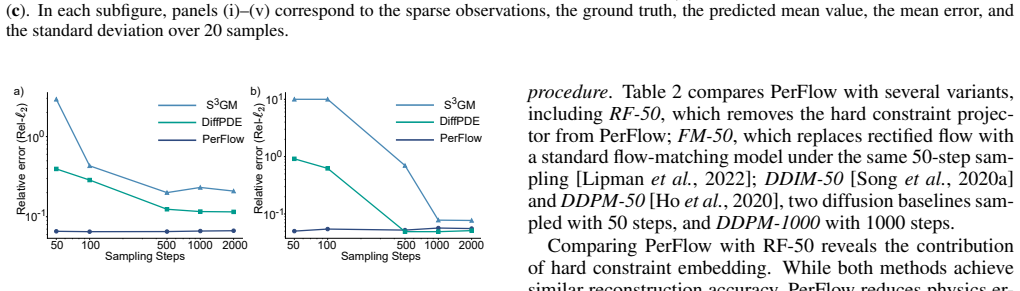
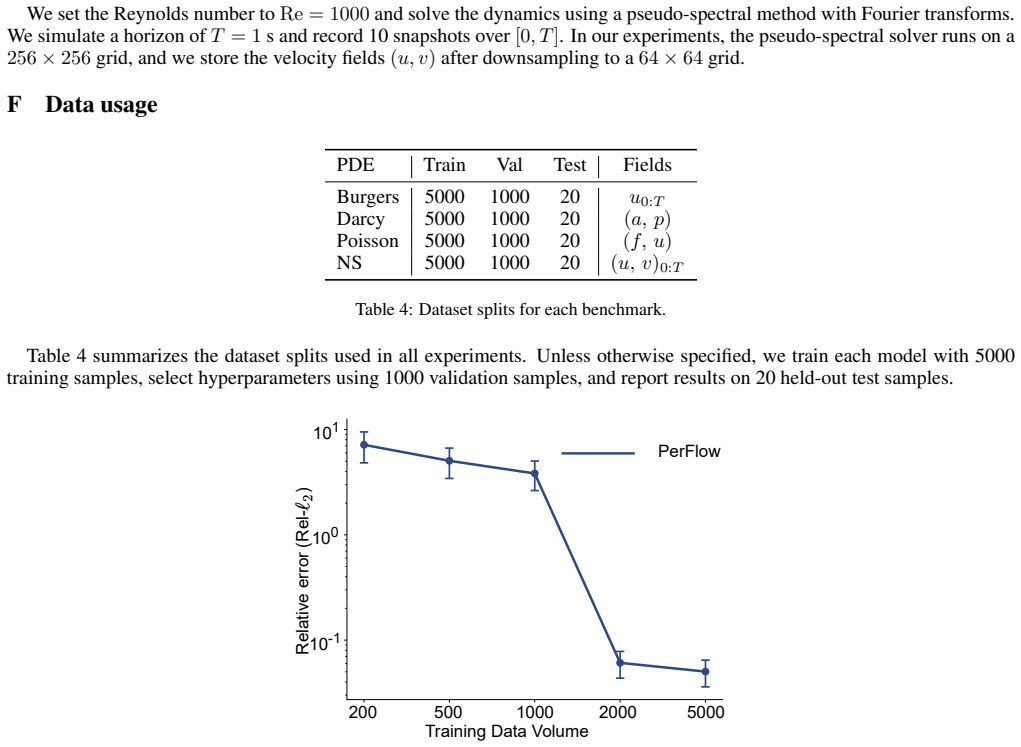
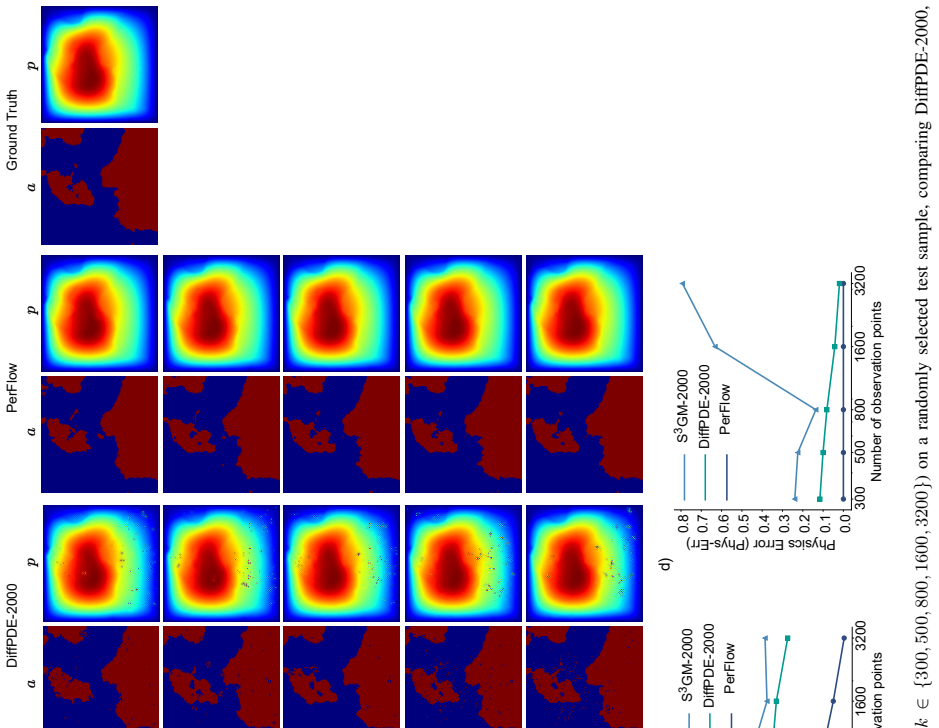
Reconstructing PDE-governed fields from sparse and irregular measurements is challenging due to their ill-posed nature. Deterministic surrogates are trained on dense fields that struggle with limited measurements and uncertainty quantification. Generative models, by learning distributions over spatiotemporal fields, can better handle sparsity and uncertainty. However, existing generative approaches enforce data consistency and PDE constraints simultaneously via sampling-time gradient guidance, resulting in slow and unstable inference. To this end, we propose PerFlow, a Physics-embedded rectified Flow for efficient sparse reconstruction and uncertainty quantification of spatiotemporal dynamics. PerFlow decouples observation conditioning from physics enforcement, performing guidance-free conditioning by feeding observations into rectified-flow dynamics while embedding hard physics via a constraint-preserving projection (e.g., incompressibility or conservation). Theoretically, we establish invariance guarantees to ensure that trajectories remain on the physics-consistent manifold throughout sampling. Experiments on various PDE systems demonstrate competitive reconstruction accuracy with sound physics consistency, while enabling efficient conditional sampling (e.g., 50 steps) and up to 320 faster inference than 2000-step guided diffusion baselines.
Editorial analysis
A structured set of objections, weighed in public.
Referee Report
Summary. The paper proposes PerFlow, a physics-embedded rectified flow model for reconstructing and quantifying uncertainty in spatiotemporal PDE-governed fields from sparse, irregular observations. It decouples observation conditioning (via guidance-free integration of observations into the rectified-flow dynamics) from physics enforcement (via insertion of a constraint-preserving projection operator, e.g., for incompressibility or conservation), while providing theoretical invariance guarantees that sampled trajectories remain on the physics-consistent manifold. Experiments across multiple PDE systems report competitive reconstruction accuracy, maintained physics consistency, efficient 50-step conditional sampling, and up to 320x faster inference relative to 2000-step guided diffusion baselines.
Significance. If the invariance guarantees and non-distorting projection hold under the finite-step discretizations used in practice, PerFlow would represent a meaningful advance in physics-informed generative modeling for inverse problems. By avoiding sampling-time gradient guidance, the method addresses documented issues of instability and computational cost in prior guided-diffusion approaches while enforcing hard constraints exactly (rather than softly). The combination of a theoretical invariance result with empirical demonstrations on diverse PDE systems and explicit speed/accuracy comparisons strengthens its potential impact in applications such as fluid dynamics and spatiotemporal forecasting.
major comments (2)
- [Theoretical Analysis] Theoretical section establishing invariance guarantees: the proof is stated for the continuous-time rectified-flow ODE with an exact constraint-preserving projection. The manuscript does not supply a discrete-time error analysis or bound on manifold drift for the 50-step Euler (or similar) discretization employed in all experiments; without this, the central claim that trajectories 'remain exactly on the physics-consistent manifold' is not yet load-bearing for the finite-step regime that delivers the reported speedups.
- [Method] Method section describing the projection operator and its insertion into the rectified-flow ODE: the assertion that the projection 'embeds hard physics without distorting the learned conditional distribution' requires explicit verification that the operator commutes with the learned velocity field at each discrete step. If the projection is only approximately divergence-free or mass-conserving (as is common on irregular grids), the decoupling between guidance-free conditioning and hard constraints may not be preserved, undermining the claimed advantage over guided baselines.
minor comments (2)
- Abstract and experiments: the speedup is reported as '320 faster' (presumably 320x); clarify the exact metric (wall-clock time, FLOPs, or steps) and include error bars or multiple random seeds for all quantitative tables comparing reconstruction error and physics residuals.
- Notation: the projection operator is introduced without a compact symbol or pseudocode; adding an explicit definition (e.g., P(·)) and a short algorithm box would improve readability when the operator is referenced in both the theory and sampling procedure.
Simulated Author's Rebuttal
We thank the referee for their thorough review and valuable feedback on our manuscript. We have carefully considered the major comments and provide detailed responses below, along with plans for revisions to address the concerns raised.
read point-by-point responses
-
Referee: [Theoretical Analysis] Theoretical section establishing invariance guarantees: the proof is stated for the continuous-time rectified-flow ODE with an exact constraint-preserving projection. The manuscript does not supply a discrete-time error analysis or bound on manifold drift for the 50-step Euler (or similar) discretization employed in all experiments; without this, the central claim that trajectories 'remain exactly on the physics-consistent manifold' is not yet load-bearing for the finite-step regime that delivers the reported speedups.
Authors: We agree with the referee that extending the theoretical analysis to the discrete-time setting is important for rigorously supporting the claims in the practical finite-step regime. In the revised manuscript, we will add a discrete-time error analysis that bounds the manifold drift for the Euler discretization used in our 50-step sampling. This analysis will rely on the Lipschitz properties of the velocity field and the projection operator. Furthermore, we will augment the experimental section with plots and metrics showing the evolution of constraint violations (such as divergence or conservation errors) over the sampling trajectory, demonstrating that the drift remains negligible in practice. These changes will strengthen the connection between the continuous guarantees and the observed efficiency and accuracy. revision: yes
-
Referee: [Method] Method section describing the projection operator and its insertion into the rectified-flow ODE: the assertion that the projection 'embeds hard physics without distorting the learned conditional distribution' requires explicit verification that the operator commutes with the learned velocity field at each discrete step. If the projection is only approximately divergence-free or mass-conserving (as is common on irregular grids), the decoupling between guidance-free conditioning and hard constraints may not be preserved, undermining the claimed advantage over guided baselines.
Authors: We appreciate this insightful comment on the methodological details. The projection operator is designed as an exact retraction onto the physics manifold (e.g., via orthogonal projection for linear constraints like divergence-free fields), ensuring it does not distort the distribution in the continuous sense. To provide the requested verification, we will include in the revised method section a proposition establishing that the projection commutes with the velocity field updates in a manner that preserves the learned conditional distribution. For irregular grids where approximations are necessary, we will discuss the discretization errors and include new ablation experiments that quantify any impact on the decoupling and compare against guided baselines. This will clarify and bolster the advantages of our approach. revision: yes
Circularity Check
No circularity; derivation builds independently on rectified flows and projections
full rationale
The paper claims a decoupling of conditioning and physics enforcement via guidance-free rectified-flow dynamics plus constraint-preserving projection, supported by invariance guarantees. No load-bearing step reduces by construction to fitted inputs, self-definitions, or self-citation chains; the theoretical guarantees and projection operator are presented as independent additions to existing rectified-flow frameworks. The approach remains self-contained against external benchmarks without renaming known results or smuggling ansatzes.
Axiom & Free-Parameter Ledger
axioms (2)
- domain assumption A constraint-preserving projection operator exists and can be computed efficiently for the PDE systems of interest.
- domain assumption Rectified flow dynamics remain stable when observations are injected directly without additional guidance.
Reference graph
Works this paper leans on
-
[1]
Neural operators for accelerating scientific simulations and design.Nature Reviews Physics, 6(5):320–328,
[Azizzadenesheliet al., 2024 ] Kamyar Azizzadenesheli, Nikola Kovachki, Zongyi Li, Miguel Liu-Schiaffini, Jean Kossaifi, and Anima Anandkumar. Neural operators for accelerating scientific simulations and design.Nature Reviews Physics, 6(5):320–328,
2024
-
[2]
Conditional neural field latent diffusion model for generating spatiotemporal turbulence.Nature Communications, 15(1):10416,
[Duet al., 2024 ] Pan Du, Meet Hemant Parikh, Xiantao Fan, Xin-Yang Liu, and Jian-Xun Wang. Conditional neural field latent diffusion model for generating spatiotemporal turbulence.Nature Communications, 15(1):10416,
2024
-
[3]
Pde-gcn: Novel architectures for graph neu- ral networks motivated by partial differential equa- tions.Advances in neural information processing systems, 34:3836–3849,
[Eliasofet al., 2021 ] Moshe Eliasof, Eldad Haber, and Eran Treister. Pde-gcn: Novel architectures for graph neu- ral networks motivated by partial differential equa- tions.Advances in neural information processing systems, 34:3836–3849,
2021
-
[4]
Gen- erative adversarial networks.Communications of the ACM, 63(11):139–144,
[Goodfellowet al., 2020 ] Ian Goodfellow, Jean Pouget- Abadie, Mehdi Mirza, Bing Xu, David Warde-Farley, Sherjil Ozair, Aaron Courville, and Yoshua Bengio. Gen- erative adversarial networks.Communications of the ACM, 63(11):139–144,
2020
-
[5]
Geom-deeponet: A point-cloud- based deep operator network for field predictions on 3d parameterized geometries.Computer Methods in Applied Mechanics and Engineering, 429:117130,
[Heet al., 2024 ] Junyan He, Seid Koric, Diab Abueidda, Ali Najafi, and Iwona Jasiuk. Geom-deeponet: A point-cloud- based deep operator network for field predictions on 3d parameterized geometries.Computer Methods in Applied Mechanics and Engineering, 429:117130,
2024
-
[6]
Denoising diffusion probabilistic models.Advances in neural information processing systems, 33:6840–6851,
[Hoet al., 2020 ] Jonathan Ho, Ajay Jain, and Pieter Abbeel. Denoising diffusion probabilistic models.Advances in neural information processing systems, 33:6840–6851,
2020
-
[7]
[Holton and Hakim, 2013] James R Holton and Gregory J Hakim.An introduction to dynamic meteorology, vol- ume
2013
-
[8]
Diffusionpde: Generative pde-solving under partial observation.Advances in Neu- ral Information Processing Systems, 37:130291–130323,
[Huanget al., 2024 ] Jiahe Huang, Guandao Yang, Zichen Wang, and Jeong Joon Park. Diffusionpde: Generative pde-solving under partial observation.Advances in Neu- ral Information Processing Systems, 37:130291–130323,
2024
-
[9]
Auto-Encoding Variational Bayes
[Kingma and Welling, 2013] Diederik P Kingma and Max Welling. Auto-encoding variational bayes.arXiv preprint arXiv:1312.6114,
work page internal anchor Pith review arXiv 2013
-
[10]
John Wiley & Sons,
[Lapidus and Pinder, 1999] Leon Lapidus and George F Pin- der.Numerical solution of partial differential equations in science and engineering. John Wiley & Sons,
1999
-
[11]
Fourier Neural Operator for Parametric Partial Differential Equations
[Liet al., 2020 ] Zongyi Li, Nikola Kovachki, Kamyar Az- izzadenesheli, Burigede Liu, Kaushik Bhattacharya, An- drew Stuart, and Anima Anandkumar. Fourier neural op- erator for parametric partial differential equations.arXiv preprint arXiv:2010.08895,
work page internal anchor Pith review arXiv 2020
-
[12]
Scalable transformer for pde surrogate model- ing.Advances in Neural Information Processing Systems, 36:28010–28039,
[Liet al., 2023 ] Zijie Li, Dule Shu, and Amir Barati Fa- rimani. Scalable transformer for pde surrogate model- ing.Advances in Neural Information Processing Systems, 36:28010–28039,
2023
-
[13]
Scal- able Transformer for PDE surrogate modeling
[Liet al., 2025 ] Zijie Li, Anthony Zhou, and Amir Barati Fa- rimani. Generative latent neural pde solver using flow matching.arXiv preprint arXiv:2503.22600,
-
[14]
Flow Matching for Generative Modeling
[Lipmanet al., 2022 ] Yaron Lipman, Ricky TQ Chen, Heli Ben-Hamu, Maximilian Nickel, and Matt Le. Flow matching for generative modeling.arXiv preprint arXiv:2210.02747,
work page internal anchor Pith review arXiv 2022
-
[15]
Pde-refiner: Achieving accurate long rollouts with neural pde solvers.Advances in Neural Information Processing Systems, 36:67398–67433,
[Lippeet al., 2023 ] Phillip Lippe, Bas Veeling, Paris Perdikaris, Richard Turner, and Johannes Brandstetter. Pde-refiner: Achieving accurate long rollouts with neural pde solvers.Advances in Neural Information Processing Systems, 36:67398–67433,
2023
-
[16]
Flow Straight and Fast: Learning to Generate and Transfer Data with Rectified Flow
[Liuet al., 2022 ] Xingchao Liu, Chengyue Gong, and Qiang Liu. Flow straight and fast: Learning to generate and transfer data with rectified flow.arXiv preprint arXiv:2209.03003,
work page internal anchor Pith review arXiv 2022
-
[17]
Learn- ing nonlinear operators via deeponet based on the univer- sal approximation theorem of operators.Nature machine intelligence, 3(3):218–229,
[Luet al., 2021 ] Lu Lu, Pengzhan Jin, Guofei Pang, Zhongqiang Zhang, and George Em Karniadakis. Learn- ing nonlinear operators via deeponet based on the univer- sal approximation theorem of operators.Nature machine intelligence, 3(3):218–229,
2021
-
[18]
[Maet al., 2025 ] Yuezhou Ma, Haixu Wu, Hang Zhou, Huikun Weng, Jianmin Wang, and Mingsheng Long. Phy- sense: Sensor placement optimization for accurate physics sensing.arXiv preprint arXiv:2505.18190,
-
[19]
U-no: U-shaped neural operators.arXiv preprint arXiv:2204.11127, 2022
[Rahmanet al., 2022 ] Md Ashiqur Rahman, Zachary E Ross, and Kamyar Azizzadenesheli. U-no: U-shaped neu- ral operators.arXiv preprint arXiv:2204.11127,
-
[20]
Variational inference with normalizing flows
[Rezende and Mohamed, 2015] Danilo Rezende and Shakir Mohamed. Variational inference with normalizing flows. InInternational conference on machine learning, pages 1530–1538. PMLR,
2015
-
[21]
U-net: Convolutional networks for biomedical image segmentation
[Ronnebergeret al., 2015 ] Olaf Ronneberger, Philipp Fis- cher, and Thomas Brox. U-net: Convolutional networks for biomedical image segmentation. InInternational Conference on Medical image computing and computer- assisted intervention, pages 234–241. Springer,
2015
-
[22]
On conditional diffusion models for pde simula- tions.Advances in Neural Information Processing Sys- tems, 37:23246–23300,
[Shysheyaet al., 2024 ] Aliaksandra Shysheya, Cristiana Di- aconu, Federico Bergamin, Paris Perdikaris, Jos ´e Miguel Hern´andez-Lobato, Richard Turner, and Emile Math- ieu. On conditional diffusion models for pde simula- tions.Advances in Neural Information Processing Sys- tems, 37:23246–23300,
2024
-
[23]
Denoising Diffusion Implicit Models
[Songet al., 2020a ] Jiaming Song, Chenlin Meng, and Ste- fano Ermon. Denoising diffusion implicit models.arXiv preprint arXiv:2010.02502,
work page internal anchor Pith review arXiv 2010
-
[24]
Score-Based Generative Modeling through Stochastic Differential Equations
[Songet al., 2020b ] Yang Song, Jascha Sohl-Dickstein, Diederik P Kingma, Abhishek Kumar, Stefano Er- mon, and Ben Poole. Score-based generative modeling through stochastic differential equations.arXiv preprint arXiv:2011.13456,
work page internal anchor Pith review arXiv 2011
-
[25]
Chapman and Hall/CRC,
[Strogatz, 2024] Steven H Strogatz.Nonlinear dynamics and chaos: with applications to physics, biology, chemistry, and engineering. Chapman and Hall/CRC,
2024
-
[26]
A review of numerical meth- ods for nonlinear partial differential equations.Bulletin of the American Mathematical Society, 49(4):507–554,
[Tadmor, 2012] Eitan Tadmor. A review of numerical meth- ods for nonlinear partial differential equations.Bulletin of the American Mathematical Society, 49(4):507–554,
2012
-
[27]
Factorized fourier neural operators
[Tranet al., 2023 ] Alasdair Tran, Alexander Mathews, Lex- ing Xie, and Cheng Soon Ong. Factorized fourier neural operators. InThe Eleventh International Conference on Learning Representations,
2023
-
[28]
Elsevier,
[Tuet al., 2023 ] Jiyuan Tu, Guan Heng Yeoh, Chaoqun Liu, and Yao Tao.Computational fluid dynamics: a practical approach. Elsevier,
2023
-
[29]
Pesanet: Physics-encoded spectral attention network for simulating pde-governed complex systems
[Wanet al., 2025 ] Han Wan, Rui Zhang, Qi Wang, Yang Liu, and Hao Sun. Pesanet: Physics-encoded spectral attention network for simulating pde-governed complex systems. In James Kwok, editor,Proceedings of the Thirty-Fourth International Joint Conference on Artificial Intelligence, IJCAI-25, pages 7751–7759. International Joint Conferences on Artificial In...
2025
-
[30]
Fundiff: Diffusion models over function spaces for physics-informed generative modeling
Main Track. [Wanget al., 2025 ] Sifan Wang, Zehao Dou, Siming Shan, Tong-Rui Liu, and Lu Lu. Fundiff: Diffusion models over function spaces for physics-informed generative modeling. arXiv preprint arXiv:2506.07902,
-
[31]
Diffphycon: A generative approach to control complex physical sys- tems.Advances in Neural Information Processing Sys- tems, 37:4090–4147,
[Weiet al., 2024 ] Long Wei, Peiyan Hu, Ruiqi Feng, Haodong Feng, Yixuan Du, Tao Zhang, Rui Wang, Yue Wang, Zhi-Ming Ma, and Tailin Wu. Diffphycon: A generative approach to control complex physical sys- tems.Advances in Neural Information Processing Sys- tems, 37:4090–4147,
2024
-
[32]
arXiv preprint arXiv:2402.02366 , year=
[Wuet al., 2024 ] Haixu Wu, Huakun Luo, Haowen Wang, Jianmin Wang, and Mingsheng Long. Transolver: A fast transformer solver for pdes on general geometries.arXiv preprint arXiv:2402.02366,
-
[33]
Koopman neural operator as a mesh-free solver of non-linear partial differential equations.Journal of Computational Physics, 513:113194,
[Xionget al., 2024 ] Wei Xiong, Xiaomeng Huang, Ziyang Zhang, Ruixuan Deng, Pei Sun, and Yang Tian. Koopman neural operator as a mesh-free solver of non-linear partial differential equations.Journal of Computational Physics, 513:113194,
2024
-
[34]
arXiv preprint arXiv:2203.02923 , year=
[Xuet al., 2022 ] Minkai Xu, Lantao Yu, Yang Song, Chence Shi, Stefano Ermon, and Jian Tang. Geodiff: A geometric diffusion model for molecular conformation generation. arXiv preprint arXiv:2203.02923,
-
[35]
[Zenget al., 2024 ] Bocheng Zeng, Qi Wang, Mengtao Yan, Yang Liu, Ruizhi Chengze, Yi Zhang, Hongsheng Liu, Zi- dong Wang, and Hao Sun. Phympgn: Physics-encoded message passing graph network for spatiotemporal pde systems.arXiv preprint arXiv:2410.01337,
-
[36]
A survey of sparse rep- resentation: algorithms and applications.IEEE access, 3:490–530,
[Zhanget al., 2015 ] Zheng Zhang, Yong Xu, Jian Yang, Xuelong Li, and David Zhang. A survey of sparse rep- resentation: algorithms and applications.IEEE access, 3:490–530,
2015
-
[37]
Deciphering and integrating invariants for neural operator learning with various physical mechanisms.National Sci- ence Review, 11(4):nwad336,
[Zhanget al., 2024 ] Rui Zhang, Qi Meng, and Zhi-Ming Ma. Deciphering and integrating invariants for neural operator learning with various physical mechanisms.National Sci- ence Review, 11(4):nwad336,
2024
-
[38]
Case Batch size Num
Table 3: Training hyperparameters for different cases. Case Batch size Num. epochs Learning rate 1D Burgers 24 3001×10 −4 2D Darcy 24 5001×10 −4 2D Poisson 24 5001×10 −4 2D NS 10 8001×10 −4 We optimize all models using AdamW with weight decay1×10 −4. We adopt a learning-rate schedule with 10-epoch warmup followed by cosine decay from1×10 −4 to6×10 −5. We ...
2020
-
[39]
Bothfanduhave resolution 128×128
to the resulting solution field, consistent with [Huanget al., 2024 ]. Bothfanduhave resolution 128×128. Burgers’ equation.We study the one-dimensional viscous Burgers’ equation onΩ = (0,1)with periodic boundary condi- tions and viscosityν= 0.01: ∂u(x, t) ∂t + ∂ ∂x u(x, t)2 2 =ν ∂2u(x, t) ∂x2 , x∈Ω, t∈(0, T].(23) The initial condition isu(x,0) =u 0(x). Fo...
2024
discussion (0)
Sign in with ORCID, Apple, or X to comment. Anyone can read and Pith papers without signing in.