Recognition: unknown
PDSL: Propagation Dynamics Aware Framework for Source Localization
Pith reviewed 2026-05-07 12:41 UTC · model grok-4.3
The pith
Modeling continuous diffusion dynamics with graph neural differential equations allows generative models to locate propagation sources despite random spreading.
A machine-rendered reading of the paper's core claim, the machinery that carries it, and where it could break.
Core claim
PDSL integrates a deep generative model with propagation dynamics to approximate the source distribution and explicitly mitigate uncertainty arising from diffusion stochasticity. Graph Neural Ordinary Differential Equations model the continuous dynamics of diffusion processes without relying on a predefined diffusion mechanism. A matching mechanism extracts relevant data blocks that enhance source generation reliability. Experiments on synthetic and real-world diffusion datasets show superior performance across diverse scenarios.
What carries the argument
Graph Neural Ordinary Differential Equations that evolve node states continuously over time, paired with a deep generative model that outputs a distribution over candidate sources and a matching mechanism that selects supporting data blocks.
If this is right
- Source localization becomes feasible in settings where the underlying spreading rule is unknown or changes over time.
- The framework produces a full distribution over possible sources instead of a single point estimate, quantifying remaining uncertainty.
- Performance gains appear on both synthetic graphs with controlled randomness and real diffusion traces from social or information networks.
- The matching mechanism increases consistency between generated sources and observed propagation patterns.
Where Pith is reading between the lines
- The same continuous modeling step could be reused for related inverse tasks such as identifying the start of an epidemic from partial case reports.
- If the ODE component generalizes, the approach might support online source tracking as new observations arrive incrementally.
- Applications in misinformation tracing on platforms could benefit from the reduced reliance on hand-crafted diffusion assumptions.
Load-bearing premise
Graph neural differential equations can capture the random fluctuations of spreading processes well enough to improve source estimates even when no fixed diffusion rule is supplied.
What would settle it
If the method shows no accuracy gain over topology-only generative baselines on multiple high-stochasticity datasets where spreading variance is independently measured and large, the benefit of adding continuous dynamics modeling would be refuted.
Figures



read the original abstract
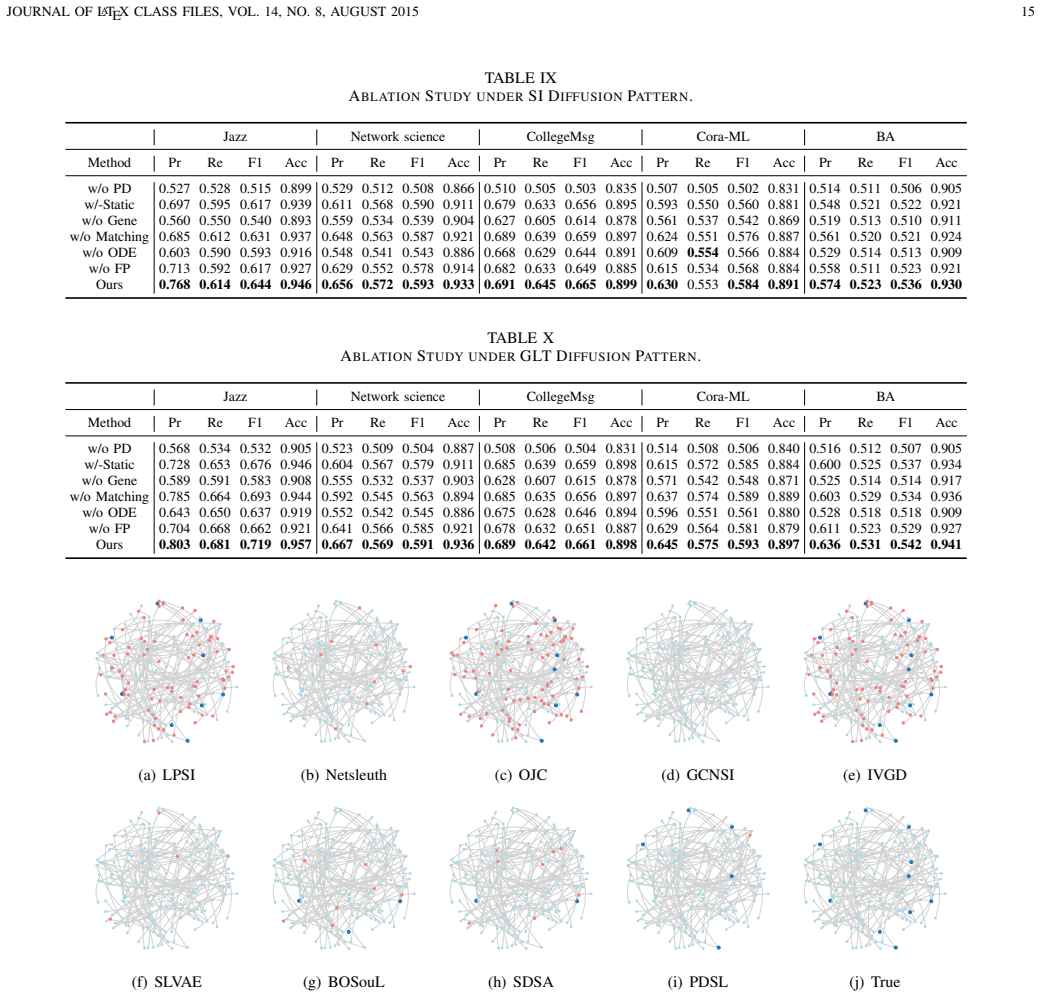
Source localization is a representative inverse inference task in information propagation, aiming to identify the source node or node set that triggers the propagation results based on the observed information. A primary challenge is quantifying the inherent uncertainty between observed outcomes and potential sources. Although deep generative models have partially mitigated this issue, most existing approaches primarily focus on uncertainty induced by network topology, attempting to learn a direct mapping from propagation outcomes to sources based on network structure, while overlooking the additional uncertainty stemming from the highly stochastic nature of the propagation process. To address this limitation, we propose a Propagation Dynamics aware framework for Source Localization (PDSL), a novel method that integrates a deep generative model with propagation dynamics to approximate the source distribution and explicitly mitigate uncertainty arising from diffusion stochasticity. Moreover, we employ Graph Neural Ordinary Differential Equations to model the continuous dynamics of diffusion processes without relying on a predefined diffusion mechanism. Additionally, a matching mechanism is designed to extract relevant data blocks that enhance source generation reliability. Comprehensive experiments on both synthetic and real-world diffusion datasets demonstrate the superior performance of the proposed framework across diverse application scenarios.
Editorial analysis
A structured set of objections, weighed in public.
Referee Report
Summary. The manuscript proposes PDSL, a Propagation Dynamics aware framework for Source Localization that integrates a deep generative model with Graph Neural Ordinary Differential Equations (GNN-ODEs) to model continuous diffusion dynamics without predefined mechanisms such as Independent Cascade or Linear Threshold. It introduces a matching mechanism to extract relevant data blocks and mitigate uncertainty arising from the stochastic nature of propagation, with the goal of better approximating the source distribution. Experiments on synthetic and real-world diffusion datasets are reported to demonstrate superior performance across application scenarios.
Significance. If the technical claims are substantiated, the work could advance source localization by explicitly incorporating propagation dynamics via continuous ODE modeling rather than relying solely on topology-based mappings, addressing a gap in prior deep generative approaches. The parameter-free modeling of dynamics and the matching mechanism offer potential for improved generalizability if they demonstrably capture stochastic effects.
major comments (2)
- [Proposed Method] The core claim that GNN-ODEs model continuous dynamics without a predefined diffusion mechanism while mitigating uncertainty from propagation stochasticity is load-bearing. Standard GNN-ODE formulations integrate deterministic vector fields via message passing, yielding a single trajectory for given initial conditions. The manuscript must specify (in the methods description of the GNN-ODE component and its integration with the generative model) how stochasticity is injected—e.g., via explicit noise, SDE extensions, or variational sampling over trajectories—otherwise the approach risks approximating only mean behavior rather than the required posterior over sources.
- [Proposed Method] The matching mechanism is described as enhancing source generation reliability by extracting relevant data blocks, but its interaction with the GNN-ODE dynamics and generative model is not shown to be sufficient for recovering variance in the source distribution. A concrete derivation or ablation showing how this block interacts with the ODE integration to address stochasticity (rather than just topology uncertainty) is needed to support the central claim.
minor comments (2)
- [Abstract] The abstract is dense and would benefit from explicit separation of the three main contributions (generative model + dynamics, GNN-ODE formulation, matching mechanism) for improved readability.
- [Experiments] Ensure that all performance claims in the experiments section are accompanied by quantitative metrics, baseline comparisons, and error bars or statistical tests, as these are referenced but not visible in the abstract.
Simulated Author's Rebuttal
We thank the referee for the constructive and detailed feedback, which highlights important aspects of our proposed framework that require further clarification. We address each major comment below and will revise the manuscript to strengthen the presentation of the technical details.
read point-by-point responses
-
Referee: [Proposed Method] The core claim that GNN-ODEs model continuous dynamics without a predefined diffusion mechanism while mitigating uncertainty from propagation stochasticity is load-bearing. Standard GNN-ODE formulations integrate deterministic vector fields via message passing, yielding a single trajectory for given initial conditions. The manuscript must specify (in the methods description of the GNN-ODE component and its integration with the generative model) how stochasticity is injected—e.g., via explicit noise, SDE extensions, or variational sampling over trajectories—otherwise the approach risks approximating only mean behavior rather than the required posterior over sources.
Authors: We agree that the integration of stochasticity requires more explicit specification in the manuscript. In PDSL, the deep generative model approximates the posterior over sources via variational sampling of initial conditions and latent variables, which are then fed into the GNN-ODE to evolve continuous trajectories. This ensemble of sampled trajectories captures the stochasticity of the diffusion process, while the GNN-ODE itself provides a deterministic but continuous evolution for each sample without assuming a discrete mechanism such as IC or LT. We will revise the methods section to include a precise description of this sampling-based integration, along with relevant equations and pseudocode, to clarify that the posterior approximation arises from the generative sampling rather than from stochasticity within the ODE solver. revision: yes
-
Referee: [Proposed Method] The matching mechanism is described as enhancing source generation reliability by extracting relevant data blocks, but its interaction with the GNN-ODE dynamics and generative model is not shown to be sufficient for recovering variance in the source distribution. A concrete derivation or ablation showing how this block interacts with the ODE integration to address stochasticity (rather than just topology uncertainty) is needed to support the central claim.
Authors: The matching mechanism selects and aligns observed data blocks with the continuous dynamics simulated by the GNN-ODE, providing dynamics-conditioned inputs to the generative model that help recover variance attributable to stochastic propagation paths. This goes beyond topology by focusing on temporal consistency with the ODE-evolved states. We acknowledge that the original manuscript does not include a dedicated derivation or ablation isolating this interaction. We will add an ablation study in the experiments section that quantifies the contribution to source distribution variance, and include a concise derivation in the methods section showing how the matching output modulates the ODE integration and generative sampling. revision: yes
Circularity Check
No circularity; claims introduce independent modeling components without reduction to inputs or self-citations.
full rationale
The provided abstract and text describe PDSL as integrating a deep generative model with Graph Neural ODEs to model continuous diffusion dynamics without predefined mechanisms, plus a matching mechanism for reliability. No equations, derivations, or self-citations are quoted that would make any 'prediction' equivalent to fitted inputs by construction, nor does the text invoke uniqueness theorems or ansatzes from prior self-work as load-bearing. The framework's central elements (GNN-ODE integration and matching) are presented as novel proposals rather than renamings or self-definitional reductions. The skeptic concern about deterministic ODEs vs. stochastic diffusion is a question of modeling adequacy, not circularity in the derivation chain. The paper's description remains self-contained against external benchmarks.
Axiom & Free-Parameter Ledger
axioms (1)
- domain assumption Deep generative models can approximate source distributions from observed propagation outcomes when combined with dynamics modeling.
Reference graph
Works this paper leans on
-
[1]
Spreading dynamics of information on online social networks,
F. Meng, J. Xie, J. Sun, C. Xu, Y . Zeng, X. Wang, T. Jia, S. Huang, Y . Deng, and Y . Hu, “Spreading dynamics of information on online social networks,”Proceedings of the National Academy of Sciences, vol. 122, no. 4, p. e2410227122, 2025
2025
-
[2]
The science of fake news,
D. M. Lazer, M. A. Baum, Y . Benkler, A. J. Berinsky, K. M. Greenhill, F. Menczer, M. J. Metzger, B. Nyhan, G. Pennycook, D. Rothschild et al., “The science of fake news,”Science, vol. 359, no. 6380, pp. 1094–1096, 2018
2018
-
[3]
The spread of true and false news online,
S. V osoughi, D. Roy, and S. Aral, “The spread of true and false news online,”science, vol. 359, no. 6380, pp. 1146–1151, 2018
2018
-
[4]
The so- cial media context interferes with truth discernment,
Z. Epstein, N. Sirlin, A. Arechar, G. Pennycook, and D. Rand, “The so- cial media context interferes with truth discernment,”Science Advances, vol. 9, no. 9, p. eabo6169, 2023
2023
-
[5]
Adam: an adaptive ddos attack mitigation scheme in software-defined cyber-physical system,
T. Cai, T. Jia, S. Adepu, Y . Li, and Z. Yang, “Adam: an adaptive ddos attack mitigation scheme in software-defined cyber-physical system,” IEEE Transactions on Industrial Informatics, vol. 19, no. 6, pp. 7802– 7813, 2023
2023
-
[6]
Modeling and analyzing malware propagation over wireless networks based on hypergraphs,
J. Chen, S. Sun, C. Xia, D. Shi, and G. Chen, “Modeling and analyzing malware propagation over wireless networks based on hypergraphs,” IEEE Transactions on Network Science and Engineering, vol. 10, no. 6, pp. 3767–3778, 2023
2023
-
[7]
Modeling and predicting malware propagation in double-layer computer networks,
D. Duan, X. Yang, C. Lv, and Z. Cai, “Modeling and predicting malware propagation in double-layer computer networks,”IEEE Transactions on Network Science and Engineering, 2025
2025
-
[8]
Modeling the uncer- tainty of information propagation for rumor detection: A neuro-fuzzy approach,
L. Wei, D. Hu, W. Zhou, X. Wang, and S. Hu, “Modeling the uncer- tainty of information propagation for rumor detection: A neuro-fuzzy approach,”IEEE transactions on neural networks and learning systems, vol. 35, no. 2, pp. 2522–2533, 2022
2022
-
[9]
Modality percep- tion learning-based determinative factor discovery for multimodal fake news detection,
B. Wang, G. Wu, X. Li, J. Gao, Y . Hu, and B. Yin, “Modality percep- tion learning-based determinative factor discovery for multimodal fake news detection,”IEEE Transactions on Neural Networks and Learning Systems, 2024
2024
-
[10]
Defense strategy for social network fake news under non-real-time data collection and disjointed decision making,
Z. Liu, H. Zhang, J. Sun, and L. Wang, “Defense strategy for social network fake news under non-real-time data collection and disjointed decision making,”IEEE Transactions on Network Science and Engi- neering, 2025
2025
-
[11]
Locating the source of diffusion in large-scale networks,
P. C. Pinto, P. Thiran, and M. Vetterli, “Locating the source of diffusion in large-scale networks,”Physical review letters, vol. 109, no. 6, p. 068702, 2012
2012
-
[12]
Mul- tiple rumor source detection with graph convolutional networks,
M. Dong, B. Zheng, N. Quoc Viet Hung, H. Su, and G. Li, “Mul- tiple rumor source detection with graph convolutional networks,” in Proceedings of the 28th ACM international conference on information and knowledge management, 2019, pp. 569–578
2019
-
[13]
Deciphering the overtaking phenomenon ini- tiated by low-centrality nodes in spreading processes,
W. He, C. Gao, and T. Jia, “Deciphering the overtaking phenomenon ini- tiated by low-centrality nodes in spreading processes,”Communications Physics, vol. 8, no. 1, p. 266, 2025
2025
-
[14]
Rumors in a network: Who’s the culprit?
D. Shah and T. Zaman, “Rumors in a network: Who’s the culprit?”IEEE Transactions on information theory, vol. 57, no. 8, pp. 5163–5181, 2011
2011
-
[15]
Estimating infection sources in a network with incomplete observations,
W. Luo and W. P. Tay, “Estimating infection sources in a network with incomplete observations,” in2013 IEEE Global Conference on Signal and Information Processing. IEEE, 2013, pp. 301–304
2013
-
[16]
K-center: An approach on the multi-source identification of information diffusion,
J. Jiang, S. Wen, S. Yu, Y . Xiang, and W. Zhou, “K-center: An approach on the multi-source identification of information diffusion,” IEEE Transactions on Information Forensics and Security, vol. 10, no. 12, pp. 2616–2626, 2015
2015
-
[17]
Information source detection in networks: Pos- sibility and impossibility results,
K. Zhu and L. Ying, “Information source detection in networks: Pos- sibility and impossibility results,” inIEEE INFOCOM 2016-The 35th Annual IEEE International Conference on Computer Communications. IEEE, 2016, pp. 1–9
2016
-
[18]
Maximum a posteriori estimation for information source detection,
B. Chang, E. Chen, F. Zhu, Q. Liu, T. Xu, and Z. Wang, “Maximum a posteriori estimation for information source detection,”IEEE Trans- actions on Systems, Man, and Cybernetics: Systems, vol. 50, no. 6, pp. 2242–2256, 2018
2018
-
[19]
Multiple-source localization from a single-snapshot observation using graph bayesian optimization,
Z. Zhang, Z. Zhang, and Z. Chen, “Multiple-source localization from a single-snapshot observation using graph bayesian optimization,” in Proceedings of the AAAI Conference on Artificial Intelligence, vol. 38, no. 20, 2024, pp. 22 538–22 546
2024
-
[20]
A general framework for sensor placement in source localization,
B. Spinelli, L. E. Celis, and P. Thiran, “A general framework for sensor placement in source localization,”IEEE Transactions on Network Science and Engineering, vol. 6, no. 2, pp. 86–102, 2017
2017
-
[21]
Rank-one semidefinite programming solutions for mobile source localization in sensor networks,
X. Wu, H. Qi, and N. Xiong, “Rank-one semidefinite programming solutions for mobile source localization in sensor networks,”IEEE Transactions on Network Science and Engineering, vol. 8, no. 1, pp. 638–650, 2020
2020
-
[22]
Lightweight source localization for large-scale social networks,
Z. Wang, D. Hou, C. Gao, X. Li, and X. Li, “Lightweight source localization for large-scale social networks,” inProceedings of the ACM Web Conference 2023, 2023, pp. 286–294
2023
-
[23]
A comprehensive survey on multi-view clustering,
U. Fang, M. Li, J. Li, L. Gao, T. Jia, and Y . Zhang, “A comprehensive survey on multi-view clustering,”IEEE Transactions on Knowledge and Data Engineering, vol. 35, no. 12, pp. 12 350–12 368, 2023
2023
-
[24]
Coata: Effective co-augmentation of topology and attribute for graph neural networks,
T. Liu, L. Lin, Y . Yu, X. Ou, Y . Zhang, Z. Ye, and T. Jia, “Coata: Effective co-augmentation of topology and attribute for graph neural networks,” inProceedings of the 2025 International Conference on Multimedia Retrieval, 2025, pp. 851–860. JOURNAL OF LATEX CLASS FILES, VOL. 14, NO. 8, AUGUST 2015 17
2025
-
[25]
Information source estimation with multi-channel graph neural network,
X. Shu, B. Yu, Z. Ruan, Q. Zhang, and Q. Xuan, “Information source estimation with multi-channel graph neural network,”Graph Data Mining: Algorithm, Security and Application, pp. 1–27, 2021
2021
-
[26]
Diffusion model for graph inverse problems: Towards effective source localization on complex networks,
X. Yan, H. Fang, and Q. He, “Diffusion model for graph inverse problems: Towards effective source localization on complex networks,” Advances in Neural Information Processing Systems, vol. 36, 2024
2024
-
[27]
Learning deep generative clustering via mutual information maximization,
X. Yang, J. Yan, Y . Cheng, and Y . Zhang, “Learning deep generative clustering via mutual information maximization,”IEEE Transactions on Neural Networks and Learning Systems, vol. 34, no. 9, pp. 6263–6275, 2022
2022
-
[28]
Gen-graphex: Generative in-distribution graph explanations for time-efficient model-level in- terpretability of gnns,
S. Saha, M. Das, and S. Bandyopadhyay, “Gen-graphex: Generative in-distribution graph explanations for time-efficient model-level in- terpretability of gnns,”IEEE Transactions on Neural Networks and Learning Systems, 2025
2025
-
[29]
Source localization of graph diffusion via variational autoencoders for graph inverse problems,
C. Ling, J. Jiang, J. Wang, and Z. Liang, “Source localization of graph diffusion via variational autoencoders for graph inverse problems,” inProceedings of the 28th ACM SIGKDD conference on knowledge discovery and data mining, 2022, pp. 1010–1020
2022
-
[30]
Pgsl: A probabilistic graph diffusion model for source localization,
X. Xu, T. Qian, Z. Xiao, N. Zhang, J. Wu, and F. Zhou, “Pgsl: A probabilistic graph diffusion model for source localization,”Expert Systems with Applications, vol. 238, p. 122028, 2024
2024
-
[31]
How to identify an infection source with limited observations,
W. Luo, W. P. Tay, and M. Leng, “How to identify an infection source with limited observations,”IEEE Journal of Selected Topics in Signal Processing, vol. 8, no. 4, pp. 586–597, 2014
2014
-
[32]
Rumor source localization in social networks based on infection potential energy,
W. Li, C. Guo, Y . Liu, X. Zhou, Q. Jin, and M. Xin, “Rumor source localization in social networks based on infection potential energy,” Information Sciences, vol. 634, pp. 172–188, 2023
2023
-
[33]
Dislpsi: A framework for source localization in signed social networks with structural balance,
Z.-W. Ma, H.-j. Wang, Z.-L. Hu, X.-B. Zhu, Y .-Z. Huang, and F. Huang, “Dislpsi: A framework for source localization in signed social networks with structural balance,”Physics Letters A, vol. 523, p. 129772, 2024
2024
-
[34]
Source localization in signed networks based on dynamic message passing algorithm,
Z.-X. Jiang, Z.-L. Hu, and F. Huang, “Source localization in signed networks based on dynamic message passing algorithm,”Chaos, Solitons & Fractals, vol. 188, p. 115532, 2024
2024
-
[35]
Diffusion source identification on networks with statistical confidence,
Q. E. Dawkins, T. Li, and H. Xu, “Diffusion source identification on networks with statistical confidence,” inInternational Conference on Machine Learning. PMLR, 2021, pp. 2500–2509
2021
-
[36]
Hmsl: Source localization based on higher-order markov propagation,
C. Gong, J. Li, L. Qian, S. Li, Z. Yang, and K. Yang, “Hmsl: Source localization based on higher-order markov propagation,”Chaos, Solitons & Fractals, vol. 182, p. 114765, 2024
2024
-
[37]
Multi-source localization based on graph representation learning and bayesian optimization,
Z. Zhou, Y . Wang, Q. Zhai, and J. Yan, “Multi-source localization based on graph representation learning and bayesian optimization,”IEEE Transactions on Network Science and Engineering, vol. 13, pp. 4815– 4832, 2025
2025
-
[38]
Two-stage denoising diffusion model for source localization in graph inverse problems,
B. Huang, W. Yu, R. Xie, J. Xiao, and J. Huang, “Two-stage denoising diffusion model for source localization in graph inverse problems,” inJoint European Conference on Machine Learning and Knowledge Discovery in Databases. Springer, 2023, pp. 325–340
2023
-
[39]
A generalized diffusion framework with learnable propagation dynamics for source localization,
D. Hou, Y . Wang, C. Gao, and X. Li, “A generalized diffusion framework with learnable propagation dynamics for source localization,” inPro- ceedings of the Thirty-Fourth International Joint Conference on Artificial Intelligence, 2025, pp. 2919–2927
2025
-
[40]
Structure-prior informed diffusion model for graph source localization with limited data,
H. Chen, J. Ding, X. Liang, Y . Li, and X.-P. Zhang, “Structure-prior informed diffusion model for graph source localization with limited data,” inProceedings of the 34th ACM International Conference on Information and Knowledge Management, 2025, pp. 250–259
2025
-
[41]
Path-based multi- sources localization in multiplex networks,
L. Cheng, X. Li, Z. Han, T. Luo, L. Ma, and P. Zhu, “Path-based multi- sources localization in multiplex networks,”Chaos, Solitons & Fractals, vol. 159, p. 112139, 2022
2022
-
[42]
Random full-order-coverage based rapid source localization with limited observations for large-scale networks,
D. Hou, C. Gao, Z. Wang, X. Li, and X. Li, “Random full-order-coverage based rapid source localization with limited observations for large-scale networks,”IEEE Transactions on Network Science and Engineering, vol. 11, no. 5, pp. 4213–4226, 2024
2024
-
[43]
Enhanced epidemic control: Community- based observer placement and source tracing,
J. Zhao and K. H. Cheong, “Enhanced epidemic control: Community- based observer placement and source tracing,”IEEE Transactions on Systems, Man, and Cybernetics: Systems, 2025
2025
-
[44]
Locating multi-sources in social networks with a low infection rate,
P. Zhu, L. Cheng, C. Gao, Z. Wang, and X. Li, “Locating multi-sources in social networks with a low infection rate,”IEEE Transactions on Network Science and Engineering, vol. 9, no. 3, pp. 1853–1865, 2022
2022
-
[45]
An invertible graph diffusion neural network for source localization,
J. Wang, J. Jiang, and L. Zhao, “An invertible graph diffusion neural network for source localization,” inProceedings of the ACM Web Conference 2022, 2022, pp. 1058–1069
2022
-
[46]
New localization frameworks: User-centric approaches to source localization in real-world propagation scenarios,
D. Hou, Y . Wang, C. Gao, X. Li, and Z. Wang, “New localization frameworks: User-centric approaches to source localization in real-world propagation scenarios,” inProceedings of the 33rd ACM International Conference on Information and Knowledge Management, 2024, pp. 839– 848
2024
-
[47]
Graph contrastive learn- ing for source localization in social networks,
Q. Bao, Y . Jiang, W. Zhang, P. Jiao, and J. Su, “Graph contrastive learn- ing for source localization in social networks,”Information Sciences, vol. 679, p. 121090, 2024
2024
-
[48]
Trace: Structural riemannian bridge matching for transferable source localization in information propagation,
L. Sun, S. Zhou, B. Fang, H. Zhang, J. Ye, Y . Ye, and P. S. Yu, “Trace: Structural riemannian bridge matching for transferable source localization in information propagation,” inProceedings of IJCAI, 2025
2025
-
[49]
Finding patient zero: Learning contagion source with graph neural networks,
C. Shah, N. Dehmamy, N. Perra, M. Chinazzi, A.-L. Barab ´asi, A. Vespignani, and R. Yu, “Finding patient zero: Learning contagion source with graph neural networks,”arXiv preprint arXiv:2006.11913, 2020
-
[50]
Inferring patient zero on temporal networks via graph neural networks,
X. Ru, J. M. Moore, X.-Y . Zhang, Y . Zeng, and G. Yan, “Inferring patient zero on temporal networks via graph neural networks,” inProceedings of the AAAI Conference on Artificial Intelligence, vol. 37, no. 8, 2023, pp. 9632–9640
2023
-
[51]
Multiple location profiling for users and relationships from social network and content,
R. Li, S. Wang, and K. Chen-Chuan, “Multiple location profiling for users and relationships from social network and content,”Proceedings of the VLDB Endowment, vol. 5, no. 11, 2012
2012
-
[52]
Topic-aware source locating in social networks,
W. Zang, C. Zhou, L. Guo, and P. Zhang, “Topic-aware source locating in social networks,” inProceedings of the 24th International Conference on World Wide Web, 2015, pp. 141–142
2015
-
[53]
Source localization in signed networks with effective distance,
Z.-W. Ma, L. Sun, Z.-G. Ding, Y .-Z. Huang, and Z.-L. Hu, “Source localization in signed networks with effective distance,”Chinese Physics B, vol. 33, no. 2, p. 028902, 2024
2024
-
[54]
Talk of the network: A complex systems look at the underlying process of word-of-mouth,
J. Goldenberg, B. Libai, and E. Muller, “Talk of the network: A complex systems look at the underlying process of word-of-mouth,”Marketing letters, vol. 12, pp. 211–223, 2001
2001
-
[55]
Information sources estimation in time- varying networks,
Y . Chai, Y . Wang, and L. Zhu, “Information sources estimation in time- varying networks,”IEEE Transactions on Information Forensics and Security, vol. 16, pp. 2621–2636, 2021
2021
-
[56]
Back to the source: an online approach for sensor placement and source localization,
B. Spinelli, L. E. Celis, and P. Thiran, “Back to the source: an online approach for sensor placement and source localization,” inProceedings of the 26th international conference on world wide web, 2017, pp. 1151– 1160
2017
-
[57]
Optimizing sensors placement in complex networks for localization of hidden signal source: A review,
R. Paluch, Ł. G. Gajewski, J. A. Hołyst, and B. K. Szymanski, “Optimizing sensors placement in complex networks for localization of hidden signal source: A review,”Future Generation Computer Systems, vol. 112, pp. 1070–1092, 2020
2020
-
[58]
Mase: Multi-attribute source estimator for epidemic transmission in complex networks,
J. Zhao and K. H. Cheong, “Mase: Multi-attribute source estimator for epidemic transmission in complex networks,”IEEE Transactions on Systems, Man, and Cybernetics: Systems, vol. 54, no. 6, pp. 3308–3320, 2024
2024
-
[59]
Community partition- based source localization with adaptive observers deployment,
J. Shi, Y . Fang, Z. Tan, X. Zhang, and X. Zhao, “Community partition- based source localization with adaptive observers deployment,” inPro- ceedings of the 34th ACM International Conference on Information and Knowledge Management, 2025, pp. 2663–2673
2025
-
[60]
A rapid source lo- calization method in the early stage of large-scale network propagation,
Z. Wang, D. Hou, C. Gao, J. Huang, and Q. Xuan, “A rapid source lo- calization method in the early stage of large-scale network propagation,” inProceedings of the ACM web conference 2022, 2022, pp. 1372–1380
2022
-
[61]
Diffusion source inference for large-scale complex networks based on network percola- tion,
Y . Liu, X. Wang, X. Wang, Z. Wang, and J. Kurths, “Diffusion source inference for large-scale complex networks based on network percola- tion,”IEEE Transactions on Neural Networks and Learning Systems, 2023
2023
-
[62]
Joint source localization in different platforms via implicit propagation characteristics of similar top- ics,
Z. Wang, D. Hou, S. Yin, C. Gao, and X. Li, “Joint source localization in different platforms via implicit propagation characteristics of similar top- ics,” inProceedings of the Thirty-Third International Joint Conference on Artificial Intelligence, IJCAI-24, Kate Larson (Ed.). International Joint Conferences on Artificial Intelligence Organization, 2024,...
2024
-
[63]
Fgssi: a feature-enhanced framework with transferability for sequential source identification,
D. Hou, C. Gao, Z. Wang, and X. Li, “Fgssi: a feature-enhanced framework with transferability for sequential source identification,” IEEE Transactions on Dependable and Secure Computing, 2025
2025
-
[64]
Rumor source localization in social networks based on the propagation direction of observers,
Z.-W. Ma, H.-J. Wang, Z.-L. Hu, X.-B. Zhu, H. Peng, L.-Y . L ¨u, Y .-Z. Huang, and M. Li, “Rumor source localization in social networks based on the propagation direction of observers,”Chaos: An Interdisciplinary Journal of Nonlinear Science, vol. 36, no. 1, 2026
2026
-
[65]
Dis- tinguishing simple and complex contagion processes on networks,
G. Cencetti, D. A. Contreras, M. Mancastroppa, and A. Barrat, “Dis- tinguishing simple and complex contagion processes on networks,” Physical Review Letters, vol. 130, no. 24, p. 247401, 2023
2023
-
[66]
The simple rules of social contagion,
N. O. Hodas and K. Lerman, “The simple rules of social contagion,” Scientific reports, vol. 4, no. 1, p. 4343, 2014
2014
-
[67]
Algorithmic aspects of inverse problems using generative models,
C. Hegde, “Algorithmic aspects of inverse problems using generative models,” in2018 56th Annual Allerton Conference on Communication, Control, and Computing (Allerton). IEEE, 2018, pp. 166–172
2018
-
[68]
Auto-Encoding Variational Bayes
D. P. Kingma and M. Welling, “Auto-encoding variational bayes,”arXiv preprint arXiv:1312.6114, 2013
work page internal anchor Pith review arXiv 2013
-
[69]
Generating diverse structure for image inpainting with hierarchical vq-vae,
J. Peng, D. Liu, S. Xu, and H. Li, “Generating diverse structure for image inpainting with hierarchical vq-vae,” inProceedings of the JOURNAL OF LATEX CLASS FILES, VOL. 14, NO. 8, AUGUST 2015 18 IEEE/CVF conference on computer vision and pattern recognition, 2021, pp. 10 775–10 784
2015
-
[70]
Qarv: Quantization-aware resnet vae for lossy image compression,
Z. Duan, M. Lu, J. Ma, Y . Huang, Z. Ma, and F. Zhu, “Qarv: Quantization-aware resnet vae for lossy image compression,”IEEE Transactions on Pattern Analysis and Machine Intelligence, 2023
2023
-
[71]
Learning structured output represen- tation using deep conditional generative models,
K. Sohn, H. Lee, and X. Yan, “Learning structured output represen- tation using deep conditional generative models,”Advances in neural information processing systems, vol. 28, 2015
2015
-
[72]
Neural ordinary differential equations,
R. T. Chen, Y . Rubanova, J. Bettencourt, and D. K. Duvenaud, “Neural ordinary differential equations,”Advances in neural information pro- cessing systems, vol. 31, 2018
2018
-
[73]
arXiv preprint arXiv:1911.07532 , year=
M. Poli, S. Massaroli, J. Park, A. Yamashita, H. Asama, and J. Park, “Graph neural ordinary differential equations,”arXiv preprint arXiv:1911.07532, 2019
-
[74]
Continuous graph neural net- works,
L.-P. Xhonneux, M. Qu, and J. Tang, “Continuous graph neural net- works,” inInternational conference on machine learning. PMLR, 2020, pp. 10 432–10 441
2020
-
[75]
Grand: Graph neural diffusion,
B. Chamberlain, J. Rowbottom, M. I. Gorinova, M. Bronstein, S. Webb, and E. Rossi, “Grand: Graph neural diffusion,” inInternational confer- ence on machine learning. PMLR, 2021, pp. 1407–1418
2021
-
[76]
¨Uber die numerische aufl¨osung von differentialgleichungen,
C. Runge, “ ¨Uber die numerische aufl¨osung von differentialgleichungen,” Mathematische Annalen, vol. 46, no. 2, pp. 167–178, 1895
-
[77]
The network data repository with interactive graph analytics and visualization,
R. Rossi and N. Ahmed, “The network data repository with interactive graph analytics and visualization,” inProceedings of the AAAI confer- ence on artificial intelligence, vol. 29, no. 1, 2015
2015
-
[78]
Patterns and dynamics of users’ behavior and interaction: Network analysis of an online community,
P. Panzarasa, T. Opsahl, and K. M. Carley, “Patterns and dynamics of users’ behavior and interaction: Network analysis of an online community,”Journal of the American Society for Information Science and Technology, vol. 60, no. 5, pp. 911–932, 2009
2009
-
[79]
Emergence of scaling in random net- works,
A.-L. Barab ´asi and R. Albert, “Emergence of scaling in random net- works,”science, vol. 286, no. 5439, pp. 509–512, 1999
1999
-
[80]
Comsoc: adaptive transfer of user behaviors over composite social network,
E. Zhong, W. Fan, J. Wang, L. Xiao, and Y . Li, “Comsoc: adaptive transfer of user behaviors over composite social network,” inProceed- ings of the 18th ACM SIGKDD international conference on Knowledge discovery and data mining, 2012, pp. 696–704
2012
discussion (0)
Sign in with ORCID, Apple, or X to comment. Anyone can read and Pith papers without signing in.