Recognition: unknown
Resource Allocation and AoI-Aware Detection for ISAC with Stacked Intelligent Metasurfaces
Pith reviewed 2026-05-09 15:53 UTC · model grok-4.3
The pith
Stacked intelligent metasurfaces enable up to 230 percent higher energy efficiency in integrated sensing and communication systems while using fewer transmit antennas.
A machine-rendered reading of the paper's core claim, the machinery that carries it, and where it could break.
Core claim
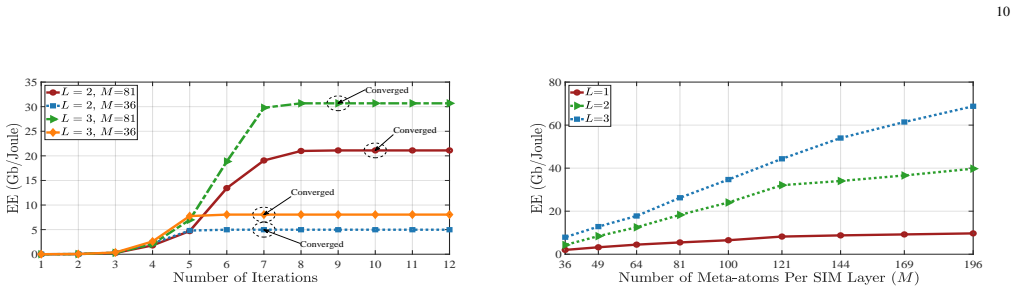
The authors claim that exploiting the two-timescale structure created by puncturing allows decomposition of the original non-convex EE maximization into an eMBB subproblem per time slot and a URLLC-plus-sensing subproblem per mini-slot. Each subproblem is solved iteratively by converting it into a sequence of convex resource and power updates together with low-complexity SIM phase shift updates. The resulting design satisfies communication and sensing QoS constraints, delivers up to 230 percent EE improvement over a no-SIM baseline, and operates with far fewer transmit antennas than standard base station architectures.
What carries the argument
The two-timescale decomposition induced by puncturing, which separates eMBB resource optimization from URLLC and sensing optimization, combined with iterative convex approximations for RB allocation, power control, and SIM phase shifts.
If this is right
- The design achieves up to 230 percent improvement in energy efficiency over a no-SIM baseline.
- It requires significantly fewer transmit antennas than conventional base station architectures while preserving the achieved energy efficiency and satisfying all communication and sensing QoS requirements.
- Fundamental trade-offs exist between energy efficiency and the heterogeneous QoS requirements across communication and sensing functionalities.
Where Pith is reading between the lines
- Such SIM-based systems could lower overall power consumption in future networks that combine sensing with both broadband and low-latency traffic.
- The puncturing decomposition technique may extend to other wireless problems that mix services with different latency and reliability demands.
- Reduced antenna counts could translate to lower hardware cost and simpler deployment for integrated sensing and communication.
Load-bearing premise
The two-timescale decomposition induced by puncturing allows independent optimization of the subproblems without significant loss of global optimality or violation of the original joint constraints.
What would settle it
Run the proposed iterative algorithm and a full joint non-convex solver on the same small-scale network instance and measure whether the decomposed solution achieves at least 200 percent of the no-SIM baseline EE without violating any QoS constraint.
Figures



read the original abstract
Stacked intelligent metasurfaces (SIMs) provide wave-domain degrees of freedom that can empower integrated sensing and communication (ISAC) through flexible beampattern synthesis and interference management, while reducing hardware cost. In this paper, we investigate energy-efficient resource allocation for a downlink SIM-aided multi-user ISAC system that supports the coexistence of enhanced mobile broadband (eMBB) and ultra-reliable and low-latency communication (URLLC) via puncturing, while simultaneously illuminating sensing targets. We formulate an energy efficiency (EE) maximization problem that jointly optimizes resource block (RB) allocation, transmit power control, and SIM phase shifts. The formulated problem is highly challenging due to the large number of variables optimized on different time scales. To overcome this, we leverage the intrinsic two-timescale structure induced by the puncturing approach to decompose the original problem into two tractable subproblems: EE maximization for eMBB users in each time slot and EE maximization for URLLC users and sensing targets in each mini-slot. To address each subproblem, we develop an iterative algorithm that transforms the original non-convex formulation into a sequence of tractable subproblems, yielding convex updates for RB allocation and power control, along with low-complexity updates for SIM phase shifts. Simulation results show that the proposed design achieves up to 230% improvement in EE over a No-SIM baseline. In addition, it requires significantly fewer transmit antennas than conventional BS architectures, while preserving the EE achieved and satisfying the communication and sensing quality of service (QoS) requirements. Moreover, the results reveal fundamental trade-offs between EE and heterogeneous QoS requirements across communication and sensing functionalities.
Editorial analysis
A structured set of objections, weighed in public.
Referee Report
Summary. The manuscript investigates energy-efficient resource allocation in a stacked intelligent metasurface (SIM)-aided integrated sensing and communication (ISAC) system supporting eMBB and URLLC via puncturing while illuminating sensing targets. It formulates a joint EE maximization problem over RB allocation, transmit power, and SIM phase shifts, decomposes it into two tractable subproblems exploiting the two-timescale structure induced by puncturing, and develops an iterative algorithm providing convex updates for RB/power and low-complexity updates for phases. Simulations claim up to 230% EE gain over a No-SIM baseline, fewer required transmit antennas, and satisfaction of heterogeneous QoS while revealing EE-QoS trade-offs.
Significance. If the decomposition is shown to preserve feasibility and incur bounded optimality loss, and if the simulation results are reproducible with full parameter disclosure, the work would usefully illustrate how SIMs enable hardware-efficient ISAC under mixed traffic, with concrete EE gains and antenna reduction. The two-timescale split is a natural and potentially impactful modeling choice for punctured systems.
major comments (3)
- [Algorithm section (iterative updates for subproblems)] The iterative algorithm is described as transforming the non-convex problem into a sequence of tractable (convex) subproblems, yet no convergence proof, monotonicity argument, or duality-gap bound is supplied for either subproblem. This is load-bearing because the reported 230% EE improvement rests on the quality of the obtained solutions.
- [Simulation results section] Simulation results report up to 230% EE improvement and antenna reduction, but provide neither error bars nor the number of Monte-Carlo realizations, nor any description of the channel models, noise variances, path-loss exponents, or exact configuration of the No-SIM baseline. Without these, the quantitative claims cannot be assessed or reproduced.
- [Problem formulation and decomposition (puncturing-induced split)] The two-timescale decomposition assumes that independent per-slot eMBB and per-mini-slot URLLC+sensing optimizations incur negligible loss of global optimality and do not violate the original joint constraints (total power, sensing illumination, cross-slot URLLC latency). No approximation ratio, small-instance comparison against a joint solver, or feasibility-recovery mechanism is given.
minor comments (2)
- [Title and abstract] The title refers to 'AoI-Aware Detection' but neither the abstract nor the described contributions mention Age of Information; this mismatch should be resolved or the title adjusted.
- [System model and problem formulation] Ensure every variable and parameter appearing in the optimization problems is defined at first use, including the precise definition of the puncturing pattern and the mini-slot duration.
Simulated Author's Rebuttal
We thank the referee for the constructive and detailed comments. We address each major comment below, indicating the revisions we will incorporate to strengthen the manuscript.
read point-by-point responses
-
Referee: [Algorithm section (iterative updates for subproblems)] The iterative algorithm is described as transforming the non-convex problem into a sequence of tractable (convex) subproblems, yet no convergence proof, monotonicity argument, or duality-gap bound is supplied for either subproblem. This is load-bearing because the reported 230% EE improvement rests on the quality of the obtained solutions.
Authors: We agree that a formal convergence analysis is necessary to support the reported performance gains. In the revised manuscript, we will add a new subsection in the algorithm section that proves convergence by establishing that each subproblem is solved to global optimality (via convex solvers for RB/power and closed-form phase updates), that the overall objective is monotonically non-decreasing after each iteration, and that it is upper-bounded, hence converges to a stationary point. We will also include duality-gap bounds for the convex relaxations and numerical convergence curves from the simulations. revision: yes
-
Referee: [Simulation results section] Simulation results report up to 230% EE improvement and antenna reduction, but provide neither error bars nor the number of Monte-Carlo realizations, nor any description of the channel models, noise variances, path-loss exponents, or exact configuration of the No-SIM baseline. Without these, the quantitative claims cannot be assessed or reproduced.
Authors: We acknowledge that the simulation section requires additional details for full reproducibility and assessment. In the revision, we will expand this section to specify: (i) the number of Monte-Carlo realizations (1000 independent runs), (ii) error bars representing one standard deviation in all figures, (iii) complete channel model parameters including path-loss exponents, noise variances, Rician factors, and spatial correlation models, and (iv) the precise No-SIM baseline configuration, including antenna count, power allocation method, and phase-shift handling. revision: yes
-
Referee: [Problem formulation and decomposition (puncturing-induced split)] The two-timescale decomposition assumes that independent per-slot eMBB and per-mini-slot URLLC+sensing optimizations incur negligible loss of global optimality and do not violate the original joint constraints (total power, sensing illumination, cross-slot URLLC latency). No approximation ratio, small-instance comparison against a joint solver, or feasibility-recovery mechanism is given.
Authors: The decomposition follows directly from the puncturing structure, where eMBB and URLLC+sensing operate on distinct time scales, allowing separate optimization while the total power budget is enforced per slot and sensing illumination is confined to the mini-slot subproblem; cross-slot URLLC latency is handled via the puncturing pattern itself. We recognize that a theoretical approximation ratio is difficult to derive analytically. In the revision, we will add a discussion of feasibility preservation and include numerical comparisons against a joint solver on small-scale instances to quantify any optimality gap, along with a simple feasibility-recovery step if needed. revision: partial
Circularity Check
No significant circularity; derivation is self-contained from standard models
full rationale
The paper formulates a standard EE maximization problem over RB allocation, power, and SIM phases for an ISAC system with puncturing-induced timescales. The decomposition into per-slot eMBB and per-mini-slot URLLC+sensing subproblems follows directly from the modeling choice of puncturing rather than from any fitted parameter or self-referential definition. The iterative convexification algorithm applies standard successive approximation techniques without load-bearing self-citations or uniqueness theorems imported from prior author work. Simulation-reported gains (e.g., 230% EE) are empirical outcomes, not quantities forced by construction to equal the inputs. No step reduces the claimed result to a tautology or renamed known pattern.
Axiom & Free-Parameter Ledger
axioms (2)
- domain assumption Standard far-field channel models and perfect CSI for SIM phase-shift design hold.
- ad hoc to paper Puncturing creates a clean two-timescale separation without cross-subproblem coupling that would invalidate independent optimization.
Reference graph
Works this paper leans on
-
[1]
Energy- efficient resource allocation for joint URLLC and sensing via SIM,
E. Ataeebojd, M. Rasti, M. Monemi, and M. Latva-aho, “Energy- efficient resource allocation for joint URLLC and sensing via SIM,” inEuropean Conference on Networks and Communications (EuCNC), 2026, pp. 1–6
2026
-
[2]
Enabling joint communication and radar sensing in mobile networks–A survey,
J. A. Zhanget al., “Enabling joint communication and radar sensing in mobile networks–A survey,”IEEE Commun. Surveys Tuts., vol. 24, no. 1, pp. 306–345, 2022. [3]Framework and overall objectives of the future development of IMT for 2030 and beyond, Recommendation ITU-R M.2160-0,
2022
-
[3]
Available: https://www.itu.int/dms pubrec/itu-r/rec/m/ R-REC-M.2160-0-202311-I!!PDF-E.pdf
[Online]. Available: https://www.itu.int/dms pubrec/itu-r/rec/m/ R-REC-M.2160-0-202311-I!!PDF-E.pdf
-
[4]
Integrated sensing and communications: Toward dual- functional wireless networks for 6G and beyond,
F. Liuet al., “Integrated sensing and communications: Toward dual- functional wireless networks for 6G and beyond,”IEEE J. Sel. Areas Commun., vol. 40, no. 6, pp. 1728–1767, June 2022
2022
-
[5]
Wymeerschet al.,Integrated Sensing and Communication
H. Wymeerschet al.,Integrated Sensing and Communication. John Wiley & Sons, Ltd, 2026, ch. 7, pp. 253–291
2026
-
[6]
Stacked intelligent metasurfaces for wireless communi- cations: Applications and challenges,
H. Liuet al., “Stacked intelligent metasurfaces for wireless communi- cations: Applications and challenges,”IEEE Wireless Commun., vol. 32, no. 4, pp. 46–53, August 2025
2025
-
[7]
Multi-user ISAC through stacked intelligent metasur- faces: New algorithms and experiments,
Z. Wanget al., “Multi-user ISAC through stacked intelligent metasur- faces: New algorithms and experiments,” inProc. IEEE Global Commun. Conf. (GLOBECOM), 2024, pp. 4442–4447
2024
-
[8]
Beamforming for STAR-RIS-aided integrated sensing and communication using meta DRL,
Y . Eghbali, S. Faramarzi, S. K. Taskou, M. R. Mili, M. Rasti, and E. Hossain, “Beamforming for STAR-RIS-aided integrated sensing and communication using meta DRL,”IEEE Wireless Commun. Lett., vol. 13, no. 4, pp. 919–923, 2024
2024
-
[9]
Stacked intelligent metasurfaces for efficient holographic MIMO communications in 6G,
J. Anet al., “Stacked intelligent metasurfaces for efficient holographic MIMO communications in 6G,”IEEE J. Sel. Areas Commun., vol. 41, no. 8, pp. 2380–2396, Aug. 2023
2023
-
[10]
Stacked-intelligent-surface- assisted MIMO integrated sensing and communication,
O. Abbas, L. Markley, and A. Chaaban, “Stacked-intelligent-surface- assisted MIMO integrated sensing and communication,”IEEE Netw., vol. 39, no. 1, pp. 56–62, Jan. 2025
2025
-
[11]
Stacked intelligent metasurface-aided MIMO transceiver design,
J. Anet al., “Stacked intelligent metasurface-aided MIMO transceiver design,”IEEE Wireless Commun., vol. 31, no. 4, pp. 123–131, Aug. 2024
2024
-
[12]
Evolution toward 6G multi-band wireless networks: A resource management perspective,
M. Rasti, S. K. Taskou, H. Tabassum, and E. Hossain, “Evolution toward 6G multi-band wireless networks: A resource management perspective,” IEEE Wireless Commun., vol. 29, no. 4, pp. 118–125, 2022. [13]NR; Physical Channels and Modulation, document TS 38.211 V19.2.0, 3GPP, 2025. [Online]. Available: https://www.3gpp.org/ftp/ Specs/archive/38 series/38.211...
2022
-
[13]
Intelligent resource slicing for eMBB and URLLC coexistence in 5G and beyond: A deep reinforcement learning based approach,
M. Alsenwi, N. H. Tran, M. Bennis, S. R. Pandey, A. K. Bairagi, and C. S. Hong, “Intelligent resource slicing for eMBB and URLLC coexistence in 5G and beyond: A deep reinforcement learning based approach,”IEEE Trans. Wireless Commun., vol. 20, no. 7, pp. 4585– 4600, Feb. 2021
2021
-
[14]
Coordinated resource allocations for eMBB and URLLC in 5G communication networks,
Y . Prathyusha and T.-L. Sheu, “Coordinated resource allocations for eMBB and URLLC in 5G communication networks,”IEEE Trans. Veh. Technol., vol. 71, no. 8, pp. 8717–8728, May 2022
2022
-
[15]
Achievable rate optimization for stacked intelligent metasurface-assisted holographic MIMO communications,
A. Papazafeiropoulos, J. An, P. Kourtessis, T. Ratnarajah, and S. Chatzinotas, “Achievable rate optimization for stacked intelligent metasurface-assisted holographic MIMO communications,”IEEE Trans. Wireless Commun., vol. 23, no. 10, pp. 13 173–13 186, Oct. 2024
2024
-
[16]
Achievable rate optimization for large stacked intel- ligent metasurfaces based on statistical CSI,
A. Papazafeiropoulos, P. Kourtessis, S. Chatzinotas, D. I. Kaklamani, and I. S. Venieris, “Achievable rate optimization for large stacked intel- ligent metasurfaces based on statistical CSI,”IEEE Wireless Commun. Lett., vol. 13, no. 9, pp. 2337–2341, Sept. 2024
2024
-
[17]
Stacked in- telligent metasurfaces for holographic MIMO-aided cell-free networks,
Q. Li, M. El-Hajjar, C. Xu, J. An, C. Yuen, and L. Hanzo, “Stacked in- telligent metasurfaces for holographic MIMO-aided cell-free networks,” IEEE Trans. Commun., vol. 72, no. 11, pp. 7139–7151, Nov. 2024
2024
-
[18]
Near-field beamforming for stacked intelligent metasurfaces-assisted MIMO networks,
A. Papazafeiropoulos, P. Kourtessis, S. Chatzinotas, D. I. Kaklamani, and I. S. Venieris, “Near-field beamforming for stacked intelligent metasurfaces-assisted MIMO networks,”IEEE Wireless Commun. Lett., vol. 13, no. 11, pp. 3035–3039, Nov. 2024
2024
-
[19]
Stacked intelligent metasurface-based transceiver design for near-field wideband systems,
Q. Li, M. El-Hajjar, C. Xu, J. An, C. Yuen, and L. Hanzo, “Stacked intelligent metasurface-based transceiver design for near-field wideband systems,”IEEE Trans. Commun., vol. 73, no. 9, pp. 8125–8139, Sept. 2025
2025
-
[20]
Performance of double-stacked intelligent metasurface-assisted multiuser massive MIMO communications in the wave domain,
A. Papazafeiropoulos, P. Kourtessis, S. Chatzinotas, D. I. Kakla- mani, and I. S. Venieris, “Performance of double-stacked intelligent metasurface-assisted multiuser massive MIMO communications in the wave domain,”IEEE Trans. Wireless Commun., vol. 24, no. 5, pp. 4205– 4218, May 2025
2025
-
[21]
Joint beamforming and power allocation design for stacked intelligent metasurfaces-aided cell-free massive MIMO systems,
Y . Huet al., “Joint beamforming and power allocation design for stacked intelligent metasurfaces-aided cell-free massive MIMO systems,”IEEE Trans. Veh. Technol., vol. 74, no. 3, pp. 5235–5240, March 2025
2025
-
[22]
Joint AP-UE association and precoding for SIM-aided cell- free massive MIMO systems,
E. Shiet al., “Joint AP-UE association and precoding for SIM-aided cell- free massive MIMO systems,”IEEE Trans. Wireless Commun., vol. 24, no. 6, pp. 5352–5367, June 2025
2025
-
[23]
Stacked intelligent metasurfaces for multiuser downlink beamforming in the wave domain,
J. An, M. Di Renzo, M. Debbah, H. Vincent Poor, and C. Yuen, “Stacked intelligent metasurfaces for multiuser downlink beamforming in the wave domain,”IEEE Trans. Wireless Commun., vol. 24, no. 7, pp. 5525– 5538, July 2025
2025
-
[24]
Stacked intelligent metasurfaces-aided rate splitting multiple access system,
Q. Huai, Y . Liang, and W. Yuan, “Stacked intelligent metasurfaces-aided rate splitting multiple access system,”IEEE Wireless Commun. Lett., vol. 14, no. 7, pp. 2224–2228, July 2025
2025
-
[25]
Stacked in- telligent metasurface-enhanced uplink finite blocklength transmissions,
Y . Zhang, X. Hu, J. Zhou, L. Yang, Y . Li, and X. Zhao, “Stacked in- telligent metasurface-enhanced uplink finite blocklength transmissions,” IEEE Trans. Commun., vol. 73, no. 11, pp. 12 803–12 819, Nov. 2025
2025
-
[26]
Uplink performance of stacked intelligent metasurface-enhanced cell-free massive MIMO systems,
E. Shi, J. Zhang, Y . Zhu, J. An, C. Yuen, and B. Ai, “Uplink performance of stacked intelligent metasurface-enhanced cell-free massive MIMO systems,”IEEE Trans. Wireless Commun., vol. 24, no. 5, pp. 3731– 3746, May 2025
2025
-
[27]
Energy-efficient designs for SIM-based broadcast MIMO systems,
N. S. Perovi ´c, E. E. Bahingayi, and L.-N. Tran, “Energy-efficient designs for SIM-based broadcast MIMO systems,”IEEE Trans. Commun., vol. 73, no. 12, pp. 15 881–15 894, Dec. 2025
2025
-
[28]
Stacked intelligent metasurfaces for integrated sensing and communications,
H. Niu, J. An, A. Papazafeiropoulos, L. Gan, S. Chatzinotas, and M. Debbah, “Stacked intelligent metasurfaces for integrated sensing and communications,”IEEE Wireless Commun. Lett., vol. 13, no. 10, pp. 2807–2811, Oct. 2024
2024
-
[29]
Transmit beamforming design for ISAC with stacked intelligent meta- surfaces,
S. Li, F. Zhang, T. Mao, R. Na, Z. Wang, and G. K. Karagiannidis, “Transmit beamforming design for ISAC with stacked intelligent meta- surfaces,”IEEE Trans. Veh. Technol., vol. 74, no. 4, pp. 6767–6772, April 2025
2025
-
[30]
Parametrized stacked intelligent metasurfaces for bistatic integrated sensing and communications,
K. R. R. Ranasinghe, I. A. M. Sandoval, G. T. F. de Abreu, and G. C. Alexandropoulos, “Parametrized stacked intelligent metasurfaces for bistatic integrated sensing and communications,”arXiv preprint arXiv:2504.20661, 2025
-
[31]
Stacked intelligent metasurfaces and STAR-RIS-enabled terahertz ISAC system,
K. Ebrahimi, Z. Mehrzad, S. Javadi, M. R. Mili, E. Jorswieck, and N. Al-Dhahir, “Stacked intelligent metasurfaces and STAR-RIS-enabled terahertz ISAC system,”IEEE Trans. Veh. Technol., vol. 74, no. 12, pp. 19 819–19 824, Dec. 2025. [35]Service Requirements for Cyber-Physical Control Applications in Vertical Domains, document TS 22.104 V19.2.0, 3GPP, 2024....
2025
-
[32]
A programmable diffractive deep neural network based on a digital-coding metasurface array,
C. Liuet al., “A programmable diffractive deep neural network based on a digital-coding metasurface array,”Nature Electronics, vol. 5, no. 2, pp. 113–122, 2022
2022
-
[33]
All-optical machine learning using diffractive deep neural networks,
X. Linet al., “All-optical machine learning using diffractive deep neural networks,”Science, vol. 361, no. 6406, pp. 1004–1008, Jul. 2018
2018
-
[34]
Two-dimensional direction-of-arrival estimation using stacked intelligent metasurfaces,
J. Anet al., “Two-dimensional direction-of-arrival estimation using stacked intelligent metasurfaces,”IEEE J. Sel. Areas Commun., vol. 42, no. 10, pp. 2786–2802, Oct. 2024
2024
-
[35]
Rayleigh fading modeling and channel hardening for reconfigurable intelligent surfaces,
E. Bj ¨ornson and L. Sanguinetti, “Rayleigh fading modeling and channel hardening for reconfigurable intelligent surfaces,”IEEE Wireless Com- mun. Lett., vol. 10, no. 4, pp. 830–834, 2021
2021
-
[36]
Channel coding rate in the finite blocklength regime,
Y . Polyanskiy, H. V . Poor, and S. Verdu, “Channel coding rate in the finite blocklength regime,”IEEE Trans. Inf. Theory, vol. 56, no. 5, pp. 2307–2359, May 2010
2010
-
[37]
URLLC-oriented joint power control and resource allocation in UA V-assisted networks,
K. Chen, Y . Wang, J. Zhao, X. Wang, and Z. Fei, “URLLC-oriented joint power control and resource allocation in UA V-assisted networks,” IEEE Internet Things J., vol. 8, no. 12, pp. 10 103–10 116, June 2021
2021
-
[38]
On nonlinear fractional programming,
W. Dinkelbach, “On nonlinear fractional programming,”Manage. Sci., vol. 13, no. 7, pp. 492–498, Mar. 1967
1967
-
[39]
Mosek optimization software,
“Mosek optimization software,” May 2019. [Online]. Available: https://mosek.com
2019
-
[40]
Boyd and L
S. Boyd and L. Vandenberghe,Convex Optimization. Cambridge, U.K.: Cambridge Univ. Press, 2004
2004
-
[41]
Coexistence mechanism between eMBB and uRLLC in 5G wireless networks,
A. K. Bairagiet al., “Coexistence mechanism between eMBB and uRLLC in 5G wireless networks,”IEEE Trans. Commun., vol. 69, no. 3, pp. 1736–1749, March 2021
2021
-
[42]
Neely,Stochastic network optimization with application to commu- nication and queueing systems
M. Neely,Stochastic network optimization with application to commu- nication and queueing systems. Morgan & Claypool Publishers, 2010
2010
discussion (0)
Sign in with ORCID, Apple, or X to comment. Anyone can read and Pith papers without signing in.