Recognition: unknown
The Significant Role of Hydrogen in the Formation of Silicon Carbide in Evolved Stars
Pith reviewed 2026-05-07 04:07 UTC · model grok-4.3
The pith
Molecular hydrogen initiates hydrocarbon formation that leads to SiC2, the key precursor for silicon carbide dust in carbon-rich stars.
A machine-rendered reading of the paper's core claim, the machinery that carries it, and where it could break.
Core claim
Through laboratory simulations starting from atomic C, atomic Si, and H2, we identify SiC2 as a key molecular precursor of silicon carbide nanodust analogues. The interaction of molecular hydrogen with atomic carbon initiates the formation of hydrocarbons, which then react with atomic silicon to produce gas-phase SiC2. In these experiments the silicon carbide nanodust analogues are partially hydrogenated. Chemical routes for SiC2 and organosilicon species are discussed on the basis of thermochemical calculations and chemical kinetics modelling. Our findings reveal the central role of molecular hydrogen in the formation of SiC2 and contribute to a deeper understanding of silicon carbide dust-
What carries the argument
SiC2 as the gas-phase molecular precursor formed when H2-driven hydrocarbons react with atomic silicon, leading to partially hydrogenated SiC nanodust.
If this is right
- SiC2 becomes the principal molecular intermediate that must be included in chemical networks for silicon carbide dust growth in stellar atmospheres.
- The presence of molecular hydrogen directly controls the rate at which hydrocarbons form and subsequently combine with silicon to produce SiC2.
- Silicon carbide grains in these environments carry residual hydrogen, altering their surface chemistry and optical properties compared with pure SiC.
- Models of dust formation must now trace the sequence from atoms to molecules to clusters to grains rather than assuming direct condensation.
- Thermochemical and kinetic calculations can be used to predict SiC2 abundances under varying stellar temperature and density conditions.
Where Pith is reading between the lines
- Hydrogen abundance in the stellar envelope could serve as a control knob on the efficiency of SiC versus amorphous-carbon dust production.
- Similar H2-initiated routes may operate for other refractory molecules observed in carbon stars, suggesting a common hydrogen-mediated chemistry.
- Spectral searches for SiC2 in circumstellar envelopes could pinpoint the radial zones where silicon carbide dust first condenses.
- The partial hydrogenation observed in the lab dust implies that infrared features of SiC grains in space may include C-H signatures that have not yet been systematically searched for.
Load-bearing premise
The laboratory conditions with atomic C, Si, and H2 accurately replicate the chemical environment and reaction pathways inside the atmospheres of evolved carbon-rich stars.
What would settle it
Failure to detect gas-phase SiC2 or partially hydrogenated silicon carbide signatures in the outflow regions of carbon-rich stars where dust is forming would contradict the proposed pathway.
Figures

read the original abstract
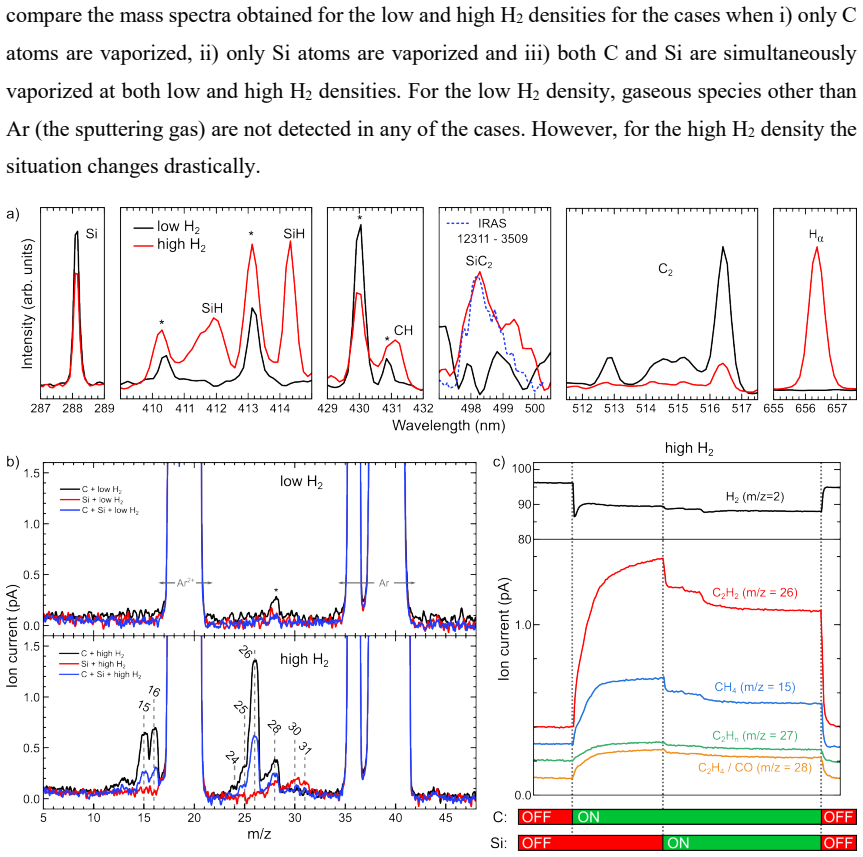
Cosmic dust is mainly formed in the atmospheres of evolved stars. In carbon rich stars, amorphous carbon along with silicon carbide are the main constituents of dust grains yet the mechanisms involved in the formation of these grains are still poorly understood. Several molecular precursors have been proposed to form silicon carbide grains. Here, we have simulated in the laboratory the formation of silicon carbide dust starting from atomic C, atomic Si and H$_2$ and we have clearly identified SiC$_2$ as a key molecular precursor of nanodust analogues. We show that the interaction of molecular hydrogen with atomic carbon initiates the formation of hydrocarbons, which then react with atomic silicon to produce gas-phase SiC$_2$. In our experiments, the silicon carbide nanodust analogues are partially hydrogenated. Chemical routes for the formation of SiC$_2$ and organosilicon species are discussed on the basis of thermochemical calculations and chemical kinetics modelling. Our findings reveal the central role of molecular hydrogen in the formation of SiC$_2$ and contribute to a deeper understanding of silicon carbide dust formation processes in evolved stars, from atoms to molecules, clusters, and ultimately dust grains.
Editorial analysis
A structured set of objections, weighed in public.
Referee Report
Summary. The manuscript presents laboratory experiments simulating silicon carbide nanodust formation from atomic C, atomic Si, and H2 reactants. It identifies gas-phase SiC2 as a key molecular precursor, with molecular hydrogen initiating hydrocarbon formation that subsequently reacts with atomic silicon; the resulting nanodust analogues are partially hydrogenated. Chemical routes are supported by thermochemical calculations and chemical kinetics modeling, with the goal of elucidating SiC dust formation in carbon-rich evolved stars.
Significance. If the laboratory pathways are shown to be relevant to stellar conditions, the work would provide valuable experimental constraints on SiC dust formation mechanisms, highlighting a previously under-emphasized role for H2 in producing SiC2 and partially hydrogenated grains. The approach combines direct observation of species with standard thermochemistry and kinetics, avoiding circular fitting to stellar spectra.
major comments (3)
- [§3 (Experimental Methods)] §3 (Experimental Methods): The manuscript provides no quantitative comparison of laboratory densities, pressures, and reaction timescales to those in carbon-rich stellar outflows (~10^8–10^10 cm^{-3}, non-LTE, outflow timescales). This comparison is load-bearing for the central claim that the observed SiC2 pathway operates in stars, because higher lab pressures can enable three-body stabilization channels absent in dilute outflows.
- [§5 (Chemical Kinetics Modelling)] §5 (Chemical Kinetics Modelling): The thermochemical and kinetics calculations do not include a sensitivity analysis or reduced model demonstrating that the SiC2 formation route remains dominant when three-body reaction terms are suppressed to match stellar densities. Without this, the extrapolation from lab observations to astrophysical environments cannot be verified.
- [§4 (Results)] §4 (Results): The identification of SiC2 and partially hydrogenated nanodust relies on specific spectroscopic or mass-spectrometric signatures; the paper must explicitly state detection limits, possible contaminants, and exclusion criteria for alternative carriers to support the claim that SiC2 is the dominant precursor.
minor comments (3)
- [Figure 2] Figure 2 (or equivalent): The mass spectrum or IR features assigned to SiC2 should include error bars or signal-to-noise estimates and a direct overlay with a reference spectrum for unambiguous identification.
- [Abstract and §1] Abstract and §1: The phrasing 'clearly identified' and 'significant role' should be tempered to 'identified under laboratory conditions' until the stellar applicability is demonstrated.
- [References] References: Add citations to prior laboratory studies on SiC cluster formation (e.g., laser ablation or discharge experiments) and to stellar atmosphere models that predict H2 abundances in C-rich outflows.
Simulated Author's Rebuttal
We thank the referee for their careful and constructive review, which has helped us strengthen the manuscript's discussion of experimental conditions, modeling robustness, and species identification. We have revised the paper to address each major comment directly, adding quantitative comparisons, sensitivity analyses, and explicit details on detection methods. Our responses below explain the changes and our reasoning on the relevance of the laboratory pathways to stellar environments.
read point-by-point responses
-
Referee: §3 (Experimental Methods): The manuscript provides no quantitative comparison of laboratory densities, pressures, and reaction timescales to those in carbon-rich stellar outflows (~10^8–10^10 cm^{-3}, non-LTE, outflow timescales). This comparison is load-bearing for the central claim that the observed SiC2 pathway operates in stars, because higher lab pressures can enable three-body stabilization channels absent in dilute outflows.
Authors: We agree that a direct comparison of conditions is essential for assessing astrophysical relevance. In the revised manuscript, we have added a new paragraph and Table 1 in §3 that quantitatively compares our experimental parameters (pressures of 0.05–0.5 mbar, corresponding to number densities of ~10^{15}–10^{16} cm^{-3}, and reaction timescales of 10–100 ms) to typical carbon-rich stellar outflow values. We explicitly acknowledge that three-body reactions are facilitated at laboratory pressures. However, our chemical kinetics modeling demonstrates that the primary SiC2 formation routes (initiated by H2 + C reactions followed by Si insertion) are bimolecular and remain dominant even when three-body terms are reduced. The observed product distribution does not rely on pressure-dependent stabilization of intermediates, supporting the applicability of the identified pathways to lower-density stellar regions where similar gas-phase chemistry occurs. revision: yes
-
Referee: §5 (Chemical Kinetics Modelling): The thermochemical and kinetics calculations do not include a sensitivity analysis or reduced model demonstrating that the SiC2 formation route remains dominant when three-body reaction terms are suppressed to match stellar densities. Without this, the extrapolation from lab observations to astrophysical environments cannot be verified.
Authors: We thank the referee for this suggestion to improve the robustness of the modeling. We have performed additional calculations and included a new sensitivity analysis subsection in the revised §5. This analysis suppresses three-body reaction rates to simulate stellar densities (10^8–10^10 cm^{-3}) and presents a reduced kinetic model. The results confirm that the SiC2 formation channel via hydrocarbon intermediates (e.g., C2H2 + Si) remains the dominant pathway, with branching ratios changing by less than 10% when pressure-dependent terms are removed. We have added a figure showing the time-dependent abundances under both laboratory and stellar conditions to support the extrapolation. revision: yes
-
Referee: §4 (Results): The identification of SiC2 and partially hydrogenated nanodust relies on specific spectroscopic or mass-spectrometric signatures; the paper must explicitly state detection limits, possible contaminants, and exclusion criteria for alternative carriers to support the claim that SiC2 is the dominant precursor.
Authors: We agree that greater transparency on the identification criteria is warranted. In the revised §4, we have added explicit statements on detection limits (SiC2 signals are detectable above ~0.5% relative abundance in the mass spectra, with signal-to-noise ratios >10 for the primary peaks), possible contaminants (including SiC, C3, and various organosilicon species), and exclusion criteria (distinct m/z patterns, isotopic ratios consistent with SiC2, absence of expected fragments from alternative carriers, and cross-validation with reference spectra). These details confirm that SiC2 is the dominant gas-phase precursor under our experimental conditions, with no evidence for significant contributions from other species. revision: yes
Circularity Check
No circularity: experimental identification of SiC2 rests on direct observations and standard thermochemistry
full rationale
The paper reports laboratory simulations starting from atomic C, Si, and H2, with direct spectroscopic identification of gas-phase SiC2 and partially hydrogenated nanodust analogues. Chemical routes are discussed via standard thermochemical calculations and chemical kinetics modeling without any equations that reduce outputs to fitted inputs by construction, without self-citation load-bearing premises, and without renaming known results as new derivations. The central claim is an empirical mapping from lab conditions to proposed stellar pathways; no derivation chain collapses to its own assumptions or prior author work by definition. This is the expected outcome for a primarily experimental study grounded in observable species rather than theoretical closure.
Axiom & Free-Parameter Ledger
axioms (1)
- domain assumption Laboratory conditions with atomic C, Si and H2 accurately represent the formation environment in evolved star atmospheres
Reference graph
Works this paper leans on
-
[1]
J. A. Hackwell. Long wavelength spectrometry and photometry of M, S and C-stars. Astron. Astrophys. 21, 239 (1972)
1972
-
[2]
R. Treffers and M. Cohen. High-resolution spectra of cool stars in the 10-and 20-micron regions. Astrophys. J. 188, 545 (1974). doi: 10.1086/152746
-
[3]
S. Massalkhi et al. Abundance of SiC2 in carbon star envelopes - Evidence that SiC2 is a gas-phase precursor of SiC dust. Astron. Astrophys. 611, A29 (2018). doi: 10.1051/0004- 6361/201732038
-
[5]
X. Yang, P. Chen and J. He. Molecular and dust features of 29 SiC carbon AGB stars. Astron. Astrophys. 414, 1049 (2004). doi: 10.1051/0004-6361:20031673
-
[6]
J. Cernicharo et al. Discovery of SiCSi in IRC+10216: a missing link between gas and dust carriers of Si–C bonds. Astrophys. J. Lett. 806, L3 (2015). doi: 10.1088/2041- 8205/806/1/L3
-
[7]
Agúndez, J
M. Agúndez, J. I. Martínez, P. L. de Andres, J. Cernicharo and J. A. Martín-Gago. Chemical equilibrium in AGB atmospheres: successes, failures, and prospects for small molecules, clusters, and condensates. Astron. Astrophys. 637, A59 (2020)
2020
-
[9]
L. Decin et al. Silicon in the dust formation zone of IRC +10216. Astron. Astrophys. 518, L143 (2010). doi: 10.1051/0004-6361/201014562
-
[10]
M. C. McCarthy, C. A. Gottlieb and J. Cernicharo. Building blocks of dust: A coordinated laboratory and astronomical study of the archtype AGB carbon star IRC+10216. J. Mol. Spec. 356, 7 (2019). doi: 10.1016/j.jms.2018.11.018
-
[11]
J. Cernicharo, C. A. Gottlieb, M. Guelin, P. Thaddeus and J. M. Vrtilek, Astronomical and Laboratory Detection of the SiC Radical. Astrophys. J. 341, L25 (1989). doi: 10.1086/185449
-
[12]
L. Martínez et al., Prevalence of non-aromatic carbonaceous molecules in the inner regions of circumstellar envelopes, Nature Astronomy, 4, 97 (2020). doi: 10.1038/s41550-019- 0899-4
-
[13]
J. Sobrado et al., The Stardust Machine Project, in European Conference on Laboratory Astrophysics ECLA2020, V. Mennella y C. Joblin, Eds., Cham: Springer International Publishing, 2023, pp. 101-110. doi: 10.1007/978-3-031-29003-9_12
-
[15]
Nature Communications , year = 2014, month = jan, volume =
P. Merino et al., Graphene etching on SiC grains as a path to interstellar polycyclic aromatic hydrocarbons formation, Nat. Commun. 5, 3054 (2014). doi: 10.1038/ncomms4054
-
[16]
C. Riedl, C. Coletti and Starke, U., Structural and electronic properties of epitaxial graphene on SiC(0 0 0 1): a review of growth, characterization, transfer doping and hydrogen intercalation. J. Phys. D: Appl. Phys. 43, 374009 (2010). doi: 10.1088/0022- 3727/43/37/374009 19
-
[17]
H. Sabbah, A. Bonnamy, D. Papanastasiou, J. Cernicharo, J.-A. Martín-Gago and C. Joblin, Identification of PAH Isomeric Structure in Cosmic Dust Analogs: The AROMA Setup, Astrophys. J. 843, 34 (2017). doi: 10.3847/1538-4357/aa73dd
-
[18]
G. Santoro et al. The Chemistry of Cosmic Dust Analogs from C, C2, and C2H2 in C-rich Circumstellar Envelopes. Astrophys. J. 895, 97 (2020). doi: 10.3847/1538-4357/ab9086
-
[19]
A. R. Striganov and N. S. Sventitskii, Tables of Spectral Lines of Neutral and Ionized Atoms. Boston, MA: Springer US, 1968. doi: 10.1007/978-1-4757-6610-3_1
-
[20]
J. Perrin and E. Delafosse. Emission spectroscopy of SiH in a silane glow-discharge. J. Phys. D: Appl. Phys. 13, 759 (1980). doi: 10.1088/0022-3727/13/5/009
-
[21]
M. Accolla et al. Silicon and Hydrogen Chemistry under Laboratory Conditions Mimicking the Atmosphere of Evolved Stars. Astrophys. J. 906, 44 (2021). doi: 10.3847/1538- 4357/abc703
-
[22]
T. J. Butenhoff and E. A. Rohlfing. Laser‐induced fluorescence spectroscopy of jet‐cooled SiC2. J. Chem. Phys. 95, 1 (1991). doi: 10.1063/1.461476
-
[23]
P. J. Sarre, M. E. Hurst and T. L. Evans. Optical Absorption and Emission Bands of SiC2 in Carbon Stars. Astrophys. J. 471, L107 (1996). doi: 10.1086/310336
-
[24]
T. Lloyd Evans, M. E. Hurst and P. J. Sarre. IRAS 12311-3509: a carbon star with SiC2 emission. Mon. Not. R. Astron. Soc. 319, 111 (2000). doi: 10.1046/j.1365- 8711.2000.03819.x
-
[25]
A. B. De Mello, S. Lorenz-Martins, F. X. de Araújo, C. B. Pereira and S. J. C. Landaberry, NSCC—A new scheme of classification of C-rich stars devised from optical and infrared observations. Astrophys. J. 705, 1298 (2009). doi: 10.1088/0004-637X/705/2/1298
-
[26]
B. Zhu, J. Gu, C. Yu, Z. Xiao, Y. Chen and D. Zhao. High-Resolution Laser Spectroscopic Survey of the H3Σu––X3Σg– Electronic Transition of Si2. J. Phys. Chem. A 124, 2972 (2020). doi: 10.1021/acs.jpca.0c00370
-
[27]
T. J. Butenhoff and E. A. Rohlfing. The C 3Π–X 3Π band system of the SiC radical. J. Chem. Phys. 95, 3939 (1991). doi: 10.1063/1.460800
-
[28]
N. J. Reilly, P. B. Changala, J. H. Baraban, D. L. Kokkin, J. F. Stanton and M. C. McCarthy. Communication: The ground electronic state of Si2C: Rovibrational level structure, quantum monodromy, and astrophysical implications. J. Chem. Phys. 142, 231101 (2015). doi: 10.1063/1.4922651
-
[29]
M. Grutter, P. Freivogel and J. P. Maier. Electronic Absorption Spectra of SiC- and SiC in Neon Matrices. J. Phys. Chem. A 101, 275 (1997). doi: 10.1021/jp962882n
-
[30]
B. Zhu, J. Gu, C. Yu, Z. Xiao, Y. Chen and D. Zhao. High-resolution laser spectroscopy of the linear SiC2Si molecule and its astrophysical implications. Astron. Astrophys. 637, A81 (2020). doi: 10.1051/0004-6361/202037448
-
[31]
M. Steglich and J. P. Maier. Electronic transitions of jet-cooled SiC2, Si2CN (n=1−3), Si3CN (n = 1,2), and SiC6H4 between 250 and 710 nm. Astrophys. J. 801, 119 (2015). doi: 10.1088/0004-637X/801/2/119
-
[32]
D. Talbi. An extensive ab initio study of the Si + C2H2 and Si + C2H4 reactions in relation to the silicon astrochemistry Chem. Phys. 313, 17 (2005). doi: 10.1016/j.chemphys.2004.12.010
-
[33]
R. I. Kaiser and X. Gu. Chemical dynamics of the formation of the ethynylsilylidyne radical (SiCCH(X2Π)) in the crossed beam reaction of ground state silicon atoms (Si(P3)) with acetylene (C2H2(X1∑g+)). J. Chem. Phys. 131, 104311 (2009). doi: 10.1063/1.3224150 20
-
[34]
A. Canosa, S. D. Le Picard, S. Gougeon, C. Rebrion-Rowe, D. Travers and B. R. Rowe. Rate coefficients for the reactions of Si(3PJ) with C2H2 and C2H4: Experimental results down to 15 K. J. Chem. Phys. 115, 6495 (2001). doi: 10.1063/1.1396855
-
[35]
L. Velilla-Prieto et al. Atmospheric molecular blobs shape up circumstellar envelopes of AGB stars Nature 617, 696 (2023). doi: 10.1038/s41586-023-05917-9
-
[36]
Y. Feng et al.. Photochemical origin of SiC2 in the circumstellar envelope of carbon-rich AGB stars revealed by ALMA. Front. Astron. Space Sci. 10, 1215642 (2023). doi: 10.3389/fspas.2023.1215642
-
[37]
J. Cernicharo et al.. A high-resolution line survey of IRC +10216 with Herschel/HIFI - First results: Detection of warm silicon dicarbide (SiC2). Astron. Astrophys. 521, L8 (2010). doi: 10.1051/0004-6361/201015150
-
[38]
M. Guélin et al. IRC +10 216 in 3D: morphology of a TP-AGB star envelope. Astron. Astrophys. 610, A4 (2018). doi: 10.1051/0004-6361/201731619
-
[39]
J. R. Pardo et al. Detection of SiC6 in IRC +10216 through Q -band lines Astron. Astrophys. 700, L6 (2025). doi: 10.1051/0004-6361/202555902
-
[40]
L. Martínez et al. Precisely controlled fabrication, manipulation and in-situ analysis of Cu based nanoparticles. Sci. Rep. 8, 1 (2018). doi: 10.1038/s41598-018-25472-y
-
[41]
G. Santoro et al. INFRA-ICE: An ultra-high vacuum experimental station for laboratory astrochemistry. Rev. Sci. Instrum. 91, 124101 (2020). doi: 10.1063/5.0027920
-
[42]
N. Matsunami et al. Energy dependence of the ion-induced sputtering yields of monatomic solids. At. Data Nucl. Data Tables 31, 1 (1984). doi: 10.1016/0092-640X(84)90016-0
-
[43]
Horcas, I. et al. WSXM: A software for scanning probe microscopy and a tool for nanotechnology. Rev. Sci. Instrum. 78, 13705 (2007). doi: 10.1063/1.2432410
-
[44]
Frisch, M. J. et al., Gaussian-16. (2016). Gaussian Inc. Wallingford CT
2016
-
[45]
A. D. Becke. Density‐functional thermochemistry. III. The role of exact exchange. J. Chem. Phys. 98, 5648 (1993). doi: 10.1063/1.464913
-
[46]
C. Lee, W. Yang and R. G. Parr. Development of the Colle-Salvetti correlation-energy formula into a functional of the electron density. Phys. Rev. B 37, 785 (1988). doi: 10.1103/PhysRevB.37.785
-
[47]
S. H. Vosko, L. Wilk and M. Nusair. Accurate spin-dependent electron liquid correlation energies for local spin density calculations: a critical analysis. Can. J. Phys. 58, 1200 (1980). doi: 10.1139/p80-159
-
[48]
D. E. Woon and T. H. Dunning Jr. Gaussian basis sets for use in correlated molecular calculations. III. The atoms aluminum through argon. J. Chem. Phys. 98, 1358 (1993). doi: 10.1063/1.464303
-
[49]
L. Cardelli. On process rate semantics. Theor. Comput. Sci. 391, 190 (2008). doi: 10.1016/j.tcs.2007.11.012
-
[50]
C. Priami, A. Regev, E. Shapiro and W. Silverman. Application of a stochastic name- passing calculus to representation and simulation of molecular processes. Inf. Process. Lett. 80, 25 (2001). doi: 10.1016/S0020-0190(01)00214-9
-
[51]
P. L. de Andres, L. de Andres-Bragado and L. Hoessly. Monitoring and Forecasting COVID-19: Heuristic Regression, Susceptible-Infected-Removed Model and, Spatial Stochastic, Front. Appl. Math. Stat. 7, 650716 (2021). doi: 10.3389/fams.2021.650716
-
[52]
Manion, J. A. et al. NIST Chemical Kinetics Database. (2015). National Institute of Standards and Technology, Gaithersburg, Maryland, 20899-8320. 21
2015
-
[53]
M. Agúndez, J. I. Martínez, P. L. de Andres, J. Cernicharo and J. A. Martín-Gago, Chemical equilibrium in AGB atmospheres: successes, failures, and prospects for small molecules, clusters, and condensates, Astron. Astrophys. 637, A59 (2020). doi: 10.1051/0004-6361/202037496
-
[54]
M. W. Chase, NIST-JANAF Thermochemical Tables Fourth Edition, 1998. doi: 10.18434/T42S31 22 Supplementary Information List of Contents Supplementary Section 1. Stardust configuration Supplementary Section 2. Additional characterization of the nanodust analogues by AFM, EELS and STEM Supplementary Section 3. Quantitative XPS results Supplementary Section 4...
-
[55]
Martínez et al., «Prevalence of non-aromatic carbonaceous molecules in the inner regions of circumstellar envelopes», Nat
L. Martínez et al., «Prevalence of non-aromatic carbonaceous molecules in the inner regions of circumstellar envelopes», Nat. Astro. 4, 97, (2020)
2020
-
[56]
Accolla et al., «Silicon and Hydrogen Chemistry under Laboratory Conditions Mimicking the Atmosphere of Evolved Stars», Astrophys
M. Accolla et al., «Silicon and Hydrogen Chemistry under Laboratory Conditions Mimicking the Atmosphere of Evolved Stars», Astrophys. J. 906, 44, (2021)
2021
-
[57]
Martínez et al., «Metal-catalyst-free gas-phase synthesis of long-chain hydrocarbons», Nat
L. Martínez et al., «Metal-catalyst-free gas-phase synthesis of long-chain hydrocarbons», Nat. Commun, 12, 5937 (2021)
2021
-
[58]
Askari et al., «Ultra-small photoluminescent silicon-carbide nanocrystals by atmospheric-pressure plasmas», Nanoscale 8, 39 (2016)
S. Askari et al., «Ultra-small photoluminescent silicon-carbide nanocrystals by atmospheric-pressure plasmas», Nanoscale 8, 39 (2016)
2016
-
[59]
A. R. Chourasia, «Core Level XPS Spectra of Silicon Carbide Using Zirconium and Magnesium Radiations», Surf. Sci. Spectra 8, 45 (2001)
2001
-
[60]
H. Lin, J. A. Gerbec, M. Sushchikh and E. W. McFarland, «Synthesis of amorphous silicon carbide nanoparticles in a low temperature low pressure plasma reactor», Nanotechnology19, 325601 (2008)
2008
-
[61]
Ferrah, J
D. Ferrah, J. Penuelas, C. Bottela, G. Grenet and A. Ouerghi, «X-ray photoelectron spectroscopy (XPS) and diffraction (XPD) study of a few layers of graphene on 6H-SiC(0001)», Surf. Sci. 615, 47 (2013)
2013
-
[62]
Santoro et al., «The chemistry of cosmic dust analogues from C, C2, and C2H2 in C-rich circumstellar envelopes», Astrophys
G. Santoro et al., «The chemistry of cosmic dust analogues from C, C2, and C2H2 in C-rich circumstellar envelopes», Astrophys. J. 895, 13 (2020)
2020
-
[63]
George Socrates, Infrared and Raman chraracteristic group frecuencies: tables and charts. J. Wiley and Sons, 2001
2001
-
[64]
A. A. Langford, M. L. Fleet, B. P. Nelson, W. A. Lanford and N. Maley, «Infrared absorption strength and hydrogen content of hydrogenated amorphous silicon», Phys. Rev. B 45, 13367 (1992)
1992
-
[65]
R. A. C. M. M. van Swaaij, A. J. M. Berntsen, W. G. J. H. M. van Sark, H. Herremans, J. Bezemer and W. F. van der Weg, «Local structure and bonding states in a‐Si1−xCx:H», J. Appl. Phys. 76, 251 (1994)
1994
-
[66]
N. B. Colthup, L. H. Daly and S. E. Wiberley, Eds., Introduction to Infrared and Raman Spectroscopy. San Diego: Academic Press, 1990
1990
-
[67]
Bullot and M
J. Bullot and M. P. Schmidt, «Physics of Amorphous Silicon–Carbon Alloys», Phys. Status Solidi B 143, 345 (1987)
1987
-
[68]
M. N. P. Carreño, I. Pereyra, M. C. A. Fantini, H. Takahashi and R. Landers, «Microvoids in diamond‐like amorphous silicon carbide», J. Appl. Phys., 75, 538 (1994)
1994
-
[69]
Agúndez, J
M. Agúndez, J. I. Martínez, P. L. de Andres, J. Cernicharo and J. A. Martín-Gago, «Chemical equilibrium in AGB atmospheres: successes, failures, and prospects for small molecules, clusters, and condensates», Astron. Astrophys. 637, A59 (2020)
2020
-
[70]
Kunz and P
A. Kunz and P. Roth, «High-temperature kinetics of some Si- and Cl-containing ceramic precursors», Int. J. Chem. Kinet. 33, 741 (2001)
2001
-
[71]
A. J. Dean, D. F. Davison and R. K. Hanson, «A shock tube study of reactions of C atoms with H2 and O2 using excimer photolysis of C3O2 and C atom atomic resonance absorption spectroscopy», J. Phys. Chem. 95, 183 (1991)
1991
-
[72]
R. A. Brownsword et al., «Kinetics over a wide range of temperature (13–744 K): Rate constants for the reactions of CH(ν=0) with H2 and D2 and for the removal of CH(ν=1) by H2 and D2», J. Chem. Phys. 106, 7662 (1997)
1997
-
[73]
B. K. D. Pearce, P. W. Ayers and R. E. Pudritz, «A Consistent Reduced Network for HCN Chemistry in Early Earth and Titan Atmospheres: Quantum Calculations of Reaction Rate Coefficients», J. Phys. Chem. A 123, 1861 (2019)
2019
-
[74]
V. D. Knyazev and I. R. Slagle, «Experimental and Theoretical Study of the C2H3 ⇄ H + C2H2 Reaction. Tunneling and the Shape of Falloff Curves», J. Phys. Chem. 100, 16899 (1996). 53
1996
-
[75]
Nuñez-Reyes and K
D. Nuñez-Reyes and K. M. Hickson, «Kinetic and Product Study of the Reactions of C(1D) with CH4 and C2H6 at Low Temperature», J. Phys. Chem. A 121, 3851 (2017)
2017
-
[76]
Varga et al., «Development of a Joint Hydrogen and Syngas Combustion Mechanism Based on an Optimization Approach», Int
T. Varga et al., «Development of a Joint Hydrogen and Syngas Combustion Mechanism Based on an Optimization Approach», Int. J. Chem. Kinet. 48, 407 (2016)
2016
-
[77]
D. L. Baulch et al., «Evaluated Kinetic Data for Combustion Modelling», J. Phys. Chem. Ref. Data, 21, 411 (1992)
1992
-
[78]
K. H. Becker, R. Kurtenbach and P. Wiesen, «Temperature and pressure dependence of the reaction methylidyne radical + hydrogen», J. Phys. Chem. 95, 2390 (1991)
1991
-
[79]
P. L. Andrés, (unpublished), 2022
2022
-
[80]
Bauerle, M
S. Bauerle, M. Klatt and H. G. G. Wagner, «Recombination and Decomposition of Methylene Radicals at high Temperatures», Ber. Bunsenges. Phys. Chem., 99, 870 (1995)
1995
-
[81]
L. B. Harding, Y. Georgievskii and S. J. Klippenstein, «Predictive Theory for Hydrogen Atom−Hydrocarbon Radical Association Kinetics», J. Phys. Chem. A 109, 4646 (2005)
2005
-
[82]
Tsang and R
W. Tsang and R. F. Hampson, «Chemical Kinetic Data Base for Combustion Chemistry. Part I. Methane and Related Compounds», J. Phys. Chem. Ref. Data 15, 1087 (1986)
1986
-
[83]
Raghunath, Y.-M
P. Raghunath, Y.-M. Lee, S.-Y. Wu, J.-S. Wu and M.-C. Lin, «Ab initio chemical kinetics for reactions of H atoms with SiHx (x = 1–3) radicals and related unimolecular decomposition processes», Int. J. Quantum Chem. 113, 1735 (2013)
2013
discussion (0)
Sign in with ORCID, Apple, or X to comment. Anyone can read and Pith papers without signing in.