Recognition: unknown
Quantum Spin Liquid State of a Dual-Species Atomic Array on Kagome Lattice
Pith reviewed 2026-05-07 17:13 UTC · model grok-4.3
The pith
Dual-species atoms on a Kagome lattice realize a quantum spin liquid with topological order.
A machine-rendered reading of the paper's core claim, the machinery that carries it, and where it could break.
Core claim
In a dual-species array on the Kagome lattice, Rydberg blockade together with the lattice geometry produces a quantum spin liquid when the system is prepared by a sweep-quench-sweep sequence that uses species-specific detunings. The resulting state exhibits a Rydberg excitation density consistent with the expected QSL filling fraction, a finite correlation length, and a non-zero Kitaev-Preskill topological entanglement entropy that demonstrates topological order even when interaction energies are non-uniform.
What carries the argument
The sweep-quench-sweep protocol with individually controlled detunings for each atomic species, which tunes the dual-species Rydberg-blockaded system on the Kagome lattice into the QSL phase.
Load-bearing premise
That geometric frustration of the Kagome lattice plus Rydberg blockade, when combined with the sweep-quench-sweep protocol and species-dependent detuning control, is sufficient to produce a state whose filling fraction, correlation length, and entanglement entropy reliably indicate topological order.
What would settle it
A numerical or experimental run in which the Kitaev-Preskill entanglement entropy extracted from the prepared state falls to zero or the Rydberg excitation density deviates from the filling fraction required for the QSL while the same detuning protocol is applied.
Figures




read the original abstract
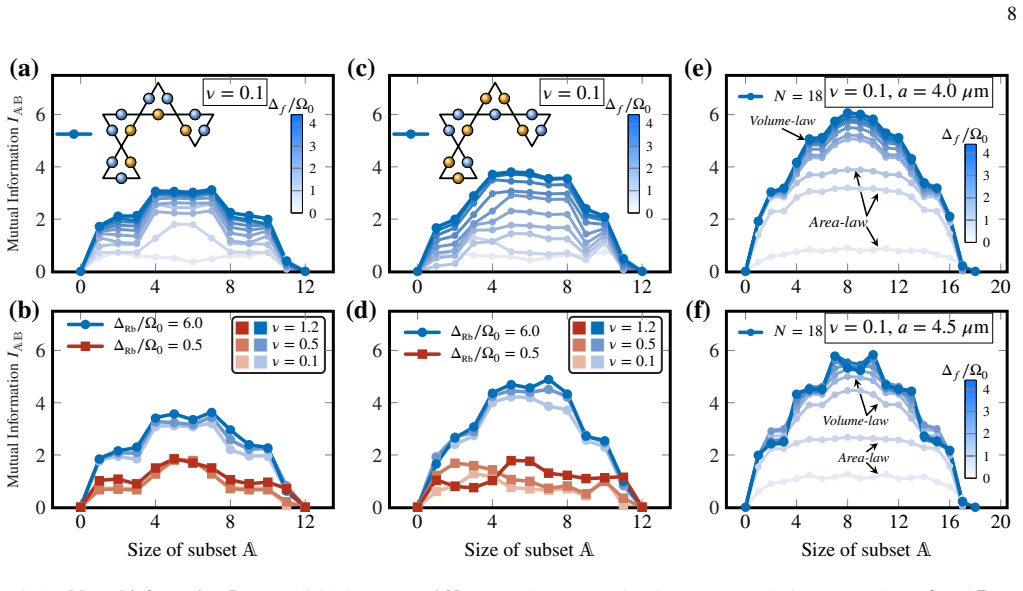
Dual-species arrays of ultracold neutral atoms have recently attracted increased interest due to the ability to independently control different atomic species and tune the interatomic interactions. This capability provides additional flexibility essential for both quantum computing and quantum simulation. In this work we theoretically investigate a quantum spin liquid (QSL) state to be simulated on a programmable quantum simulator based on a dual-species atomic array, arranged on a Kagome lattice. The Kagome lattice is formed by corner sharing triangles. This specific spatial arrangement enhances the competing interactions between atoms and is often considered as a model for realising QSL states. When the atoms are excited into Rydberg states, long-range interactions result in Rydberg blockade. The geometric frustration of the Kagome lattice, combined with the Rydberg blockade, drives the system into exotic phases with topological order and long-range entanglement. To drive an array into the QSL state, we use a sweep-quench-sweep protocol, when the atoms are quasiadiabatically excited into Rydberg state with individually controlled detuning from the resonance for each atomic species. The filling fraction, indicating emergence of a QSL state, is represented by a density of Rydberg excitations. We identified the conditions required for QSL state in a dual-species array with non-uniform interaction energies. We calculated the correlation length and studied the mutual information as a function of the size of the subset of the system. The existence of a topological order was proved by estimating the Kitaev-Preskill topological quantum entanglement entropy.
Editorial analysis
A structured set of objections, weighed in public.
Referee Report
Summary. The manuscript investigates the realization of a quantum spin liquid (QSL) state in a dual-species ultracold atomic array arranged on a Kagome lattice. Using Rydberg blockade and a sweep-quench-sweep protocol with individually controlled detunings for each species, the authors identify conditions for the QSL, compute the filling fraction as the density of Rydberg excitations, calculate the correlation length, study mutual information as a function of subset size, and estimate the Kitaev-Preskill topological entanglement entropy to demonstrate topological order.
Significance. If the central claims hold, this work would represent a significant advance in quantum simulation by providing a flexible platform for QSL states using dual-species control, which allows tuning of non-uniform interactions. This could enable better exploration of geometrically frustrated systems and topological phases in programmable quantum simulators.
major comments (2)
- [Abstract and entanglement entropy analysis] The proof of topological order via the Kitaev-Preskill topological quantum entanglement entropy estimation is load-bearing for the central claim, yet the manuscript does not demonstrate that the correlation length is short compared to the system size or that the mutual information versus subset size shows the required area-law scaling with proper subtraction of boundary contributions. Without such verification, the extracted constant term may be affected by finite-size effects or incomplete convergence of the sweep-quench-sweep protocol in the presence of non-uniform inter-species interactions.
- [Protocol and numerical results] The description of the sweep-quench-sweep protocol with species-specific detunings does not include sufficient details on how the effective Hamiltonian is derived or validated for the dual-species case, nor are error analyses or convergence checks provided for the reported filling fraction and correlation length, which are essential to confirm the system reaches the claimed QSL state rather than a metastable or artifactual configuration.
minor comments (2)
- [Abstract] The abstract mentions 'non-uniform interaction energies' but does not quantify the degree of non-uniformity or how it affects the QSL conditions.
- [Methods] Missing information on the numerical simulation method (e.g., exact diagonalization, tensor networks) and system sizes used for the mutual information calculations.
Simulated Author's Rebuttal
We thank the referee for the careful reading and constructive comments, which help improve the clarity and rigor of our manuscript. We address each major comment below and indicate the revisions planned.
read point-by-point responses
-
Referee: [Abstract and entanglement entropy analysis] The proof of topological order via the Kitaev-Preskill topological quantum entanglement entropy estimation is load-bearing for the central claim, yet the manuscript does not demonstrate that the correlation length is short compared to the system size or that the mutual information versus subset size shows the required area-law scaling with proper subtraction of boundary contributions. Without such verification, the extracted constant term may be affected by finite-size effects or incomplete convergence of the sweep-quench-sweep protocol in the presence of non-uniform inter-species interactions.
Authors: We thank the referee for this important observation. Our numerical results already show that the correlation length remains short compared to the simulated system sizes in the identified QSL parameter regime, and the mutual information plots versus subset size follow area-law scaling after boundary subtraction. However, these aspects are not presented with sufficient explicit verification. We will revise the manuscript by adding a dedicated discussion subsection with explicit comparisons of correlation length to system size, details on boundary subtraction, and additional convergence data for the sweep-quench-sweep protocol under non-uniform interactions to rule out finite-size artifacts. revision: partial
-
Referee: [Protocol and numerical results] The description of the sweep-quench-sweep protocol with species-specific detunings does not include sufficient details on how the effective Hamiltonian is derived or validated for the dual-species case, nor are error analyses or convergence checks provided for the reported filling fraction and correlation length, which are essential to confirm the system reaches the claimed QSL state rather than a metastable or artifactual configuration.
Authors: We agree that expanded details are needed for reproducibility and validation. In the revised manuscript, we will include an expanded section deriving the effective Hamiltonian for the dual-species Rydberg array, explicitly showing how species-specific detunings and non-uniform interactions enter the model, along with validation against limiting cases. We will also add error analyses (including statistical uncertainties from multiple trajectories) and convergence checks with respect to sweep rates, quench durations, and system sizes for both the filling fraction and correlation length to confirm robust convergence to the QSL state. revision: yes
Circularity Check
No significant circularity detected in derivation chain
full rationale
The paper describes a sweep-quench-sweep protocol with species-specific detuning to prepare the Rydberg-excited state on the Kagome lattice, followed by direct computation of filling fraction, correlation length, and mutual information versus subset size, from which the Kitaev-Preskill topological entanglement entropy is extracted. No self-definitional steps, fitted inputs renamed as predictions, or load-bearing self-citations appear in the abstract or described methods; the entropy estimation is a standard post-processing step applied to the numerically obtained state rather than a quantity forced by construction from the protocol parameters. The derivation remains self-contained against external benchmarks for the reported quantities.
Axiom & Free-Parameter Ledger
free parameters (1)
- species-specific detuning
axioms (2)
- domain assumption Rydberg blockade produces effective long-range interactions that, together with Kagome frustration, favor exotic phases with topological order.
- domain assumption The Kitaev-Preskill topological entanglement entropy can be estimated from finite subsystems to prove topological order.
Reference graph
Works this paper leans on
-
[1]
For the con- figuration with Distribution I the increase tolog(2)is a bit slower
For larger values γsharply increases to values larger thanlog(2), which is the optimum value for toric code implementation. For the con- figuration with Distribution I the increase tolog(2)is a bit slower. In Fig. 6, we compute the TQEE forN= 30atoms. In Fig. 6(a) we illustrate the subsetsA,B, andC. In Fig. 6(b) we show the evolution of the TQEE forν= 0.1...
-
[2]
Weimer, M
H. Weimer, M. M ¨uller, I. Lesanovsky, P. Zoller, and H. P. B¨uchler, A Rydberg quantum simulator, Nature Physics6, 382 (2010)
2010
-
[3]
Bernien, S
H. Bernien, S. Schwartz, A. Keesling, H. Levine, A. Omran, H. Pichler, S. Choi, A. S. Zibrov, M. Endres, M. Greiner,et al., Probing many-body dynamics on a 51-atom quantum simulator, Nature551, 579 (2017)
2017
-
[4]
Altman, K
E. Altman, K. R. Brown, G. Carleo, L. D. Carr, E. Demler, C. Chin, B. DeMarco, S. E. Economou, M. A. Eriksson, K.- M. C. Fu, M. Greiner, K. R. Hazzard, R. G. Hulet, A. J. Koll´ar, B. L. Lev, M. D. Lukin, R. Ma, X. Mi, S. Misra, C. Monroe, K. Murch, Z. Nazario, K.-K. Ni, A. C. Potter, P. Roushan, M. Saffman, M. Schleier-Smith, I. Siddiqi, R. Simmonds, M. S...
2021
-
[5]
Manovitz, S
T. Manovitz, S. H. Li, S. Ebadi, R. Samajdar, A. A. Geim, S. J. Evered, D. Bluvstein, H. Zhou, N. U. Koyluoglu, J. Feldmeier, et al., Quantum coarsening and collective dynamics on a pro- grammable simulator, Nature638, 86 (2025)
2025
-
[6]
Barredo, S
D. Barredo, S. De L ´es´eleuc, V . Lienhard, T. Lahaye, and A. Browaeys, An atom-by-atom assembler of defect-free arbi- trary two-dimensional atomic arrays, Science354, 1021 (2016)
2016
-
[7]
Saffman, T
M. Saffman, T. G. Walker, and K. Mølmer, Quantum informa- tion with rydberg atoms, Rev. Mod. Phys.82, 2313 (2010)
2010
-
[8]
Browaeys and T
A. Browaeys and T. Lahaye, Many-body physics with individu- ally controlled Rydberg atoms, Nature Physics16, 132 (2020)
2020
-
[9]
Ebadi, T
S. Ebadi, T. T. Wang, H. Levine, A. Keesling, G. Semeghini, A. Omran, D. Bluvstein, R. Samajdar, H. Pichler, W. W. Ho, et al., Quantum phases of matter on a 256-atom programmable quantum simulator, Nature595, 227 (2021)
2021
-
[10]
Gonz ´alez-Cuadra, M
D. Gonz ´alez-Cuadra, M. Hamdan, T. V . Zache, B. Braver- man, M. Kornja ˇca, A. Lukin, S. H. Cant ´u, F. Liu, S.-T. Wang, A. Keesling,et al., Observation of string breaking on a (2+ 1) D Rydberg quantum simulator, Nature , 1 (2025)
2025
-
[11]
One-to-one quantum simulation of a frustrated magnet with 256 qubits
L. Leclerc, S. Juli `a-Farr´e, G. S. Freitas, G. Villaret, B. Al- brecht, L. B ´eguin, L. Bourachot, C. Briosne-Frejaville, D. Claveau, A. Cornillot,et al., One-to-one quantum simula- tion of the low-dimensional frustrated quantum magnet Tm- MgGaO 4with 256 qubits, arXiv preprint arXiv:2603.20372 10.48550/arXiv.2603.20372 (2026)
work page internal anchor Pith review Pith/arXiv arXiv doi:10.48550/arxiv.2603.20372 2026
-
[12]
Sachdev,Quantum phases of matter(Cambridge University Press, 2023)
S. Sachdev,Quantum phases of matter(Cambridge University Press, 2023)
2023
-
[13]
Jaksch, J
D. Jaksch, J. I. Cirac, P. Zoller, S. L. Rolston, R. C ˆot´e, and M. D. Lukin, Fast Quantum Gates for Neutral Atoms, Physical Review Letters85, 2208 (2000)
2000
-
[14]
Isenhower, E
L. Isenhower, E. Urban, X. L. Zhang, A. T. Gill, T. Henage, T. A. Johnson, T. G. Walker, and M. Saffman, Demonstration of a Neutral Atom Controlled-NOT Quantum Gate, Physical Review Letters104, 010503 (2010)
2010
-
[15]
Levine, A
H. Levine, A. Keesling, G. Semeghini, A. Omran, T. T. Wang, S. Ebadi, H. Bernien, M. Greiner, V . Vuleti ´c, H. Pichler, and 11 M. D. Lukin, Parallel implementation of high-fidelity multi- qubit gates with neutral atoms, Phys. Rev. Lett.123, 170503 (2019)
2019
-
[16]
I. Cong, H. Levine, A. Keesling, D. Bluvstein, S.-T. Wang, and M. D. Lukin, Hardware-Efficient, Fault-Tolerant Quan- tum Computation with Rydberg Atoms, Physical Review X12, 021049 (2022)
2022
-
[17]
McDonnell, L
K. McDonnell, L. F. Keary, and J. D. Pritchard, Demonstration of a Quantum Gate Using Electromagnetically Induced Trans- parency, Physical Review Letters129, 200501 (2022)
2022
-
[18]
Samajdar, S
R. Samajdar, S. Choi, H. Pichler, M. D. Lukin, and S. Sachdev, Numerical study of the chiral Z 3 quantum phase transition in one spatial dimension, Physical Review A98, 023614 (2018)
2018
-
[19]
Keesling, A
A. Keesling, A. Omran, H. Levine, H. Bernien, H. Pichler, S. Choi, R. Samajdar, S. Schwartz, P. Silvi, S. Sachdev,et al., Quantum Kibble–Zurek mechanism and critical dynamics on a programmable Rydberg simulator, Nature568, 207 (2019)
2019
-
[20]
Samajdar, W
R. Samajdar, W. W. Ho, H. Pichler, M. D. Lukin, and S. Sachdev, Complex Density Wave Orders and Quantum Phase Transitions in a Model of Square-Lattice Rydberg Atom Arrays, Physical Review Letters124, 103601 (2020)
2020
-
[21]
Scholl, M
P. Scholl, M. Schuler, H. J. Williams, A. A. Eberharter, D. Barredo, K.-N. Schymik, V . Lienhard, L.-P. Henry, T. C. Lang, T. Lahaye,et al., Quantum simulation of 2D antifer- romagnets with hundreds of Rydberg atoms, Nature595, 233 (2021)
2021
-
[22]
F. Fang, K. Wang, V . S. Liu, Y . Wang, R. Cimmino, J. Wei, M. Bintz, A. Parr, J. Kemp, K.-K. Ni,et al., Probing critical phenomena in open quantum systems using atom arrays, Sci- ence390, 601 (2025)
2025
-
[23]
Homeier, S
L. Homeier, S. Hollerith, S. Geier, N.-C. Chiu, A. Browaeys, and L. Pollet, Supersolidity in rydberg tweezer arrays, Physical Review A111, L011305 (2025)
2025
-
[24]
A. Byun, M. Kim, and J. Ahn, Finding the Maximum Inde- pendent Sets of Platonic Graphs Using Rydberg Atoms, PRX Quantum3, 030305 (2022)
2022
-
[25]
M. Kim, K. Kim, J. Hwang, E.-G. Moon, and J. Ahn, Rydberg quantum wires for maximum independent set problems, Nature Physics18, 755 (2022)
2022
-
[26]
A. M. Farouk, I. Beterov, P. Xu, and I. Ryabtsev, Generation of quantum phases of matter and finding a maximum-weight inde- pendent set of unit-disk graphs using Rydberg atoms, Physical Review A110, 022442 (2024)
2024
-
[27]
M. Lanthaler, K. Ender, C. Dlaska, and W. Lechner, Quantum optimization with globally driven neutral atom arrays, arXiv preprint arXiv:2410.03902 10.48550/arXiv.2410.03902 (2024)
-
[28]
Bombieri, Z
L. Bombieri, Z. Zeng, R. Tricarico, R. Lin, S. Notarnicola, M. Cain, M. D. Lukin, and H. Pichler, Quantum Adiabatic Op- timization with Rydberg Arrays: Localization Phenomena and Encoding Strategies, PRX Quantum6, 020306 (2025)
2025
-
[29]
J. Kombe, G. Pelegr ´ı, A. J. Daley, and J. D. Pritchard, A quantum wire approach to weighted combinatorial graph optimisation problems, arXiv preprint arXiv:2503.17115 10.48550/arXiv.2503.17115 (2025)
-
[30]
T. Angkhanawin, A. Deger, J. D. Pritchard, and C. S. Adams, Graph Coloring via Quantum Optimization on a Rydberg-Qudit Atom Array, arXiv preprint arXiv:2504.08598 10.48550/arXiv.2504.08598 (2025)
-
[31]
Graham, Y
T. Graham, Y . Song, J. Scott, C. Poole, L. Phuttitarn, K. Jooya, P. Eichler, X. Jiang, A. Marra, B. Grinkemeyer,et al., Multi- qubit entanglement and algorithms on a neutral-atom quantum computer, Nature604, 457 (2022)
2022
-
[32]
N. Bauer, K. Yeter-Aydeniz, E. Kokkas, and G. Siopsis, Solving power grid optimization problems with rydberg atoms, arXiv preprint arXiv:2404.11440 10.48550/arXiv.2404.11440 (2024)
-
[33]
A. G. Barreto, F. F. Fanchini, J. P. Papa, and V . H. C. de Al- buquerque, Why consider quantum instead classical pattern recognition techniques?, Applied Soft Computing165, 112096 (2024)
2024
-
[34]
M. Grotti, S. Marzella, G. Bettonte, D. Ottaviani, and E. Ercolessi, Practical Use Cases of Neutral Atoms Quantum Computers, arXiv preprint arXiv:2510.18732 10.48550/arXiv.2510.18732 (2025)
-
[35]
Lewenstein, A
M. Lewenstein, A. Sanpera, V . Ahufinger, B. Damski, A. Sen, and U. Sen, Ultracold atomic gases in optical lattices: mimick- ing condensed matter physics and beyond, Advances in Physics 56, 243 (2007)
2007
-
[36]
Cheng and H
Y . Cheng and H. Zhai, Emergent U (1) lattice gauge theory in Rydberg atom arrays, Nature Reviews Physics6, 566 (2024)
2024
-
[37]
Savary and L
L. Savary and L. Balents, Quantum spin liquids: a review, Re- ports on Progress in Physics80, 016502 (2016)
2016
-
[38]
Lancaster, Quantum spin liquids, Contemporary Physics64, 127 (2023)
T. Lancaster, Quantum spin liquids, Contemporary Physics64, 127 (2023)
2023
-
[39]
Samajdar, W
R. Samajdar, W. W. Ho, H. Pichler, M. D. Lukin, and S. Sachdev, Quantum phases of Rydberg atoms on a Kagome lattice, Proceedings of the National Academy of Sciences118, e2015785118 (2021)
2021
-
[40]
Semeghini, H
G. Semeghini, H. Levine, A. Keesling, S. Ebadi, T. T. Wang, D. Bluvstein, R. Verresen, H. Pichler, M. Kalinowski, R. Sama- jdar,et al., Probing topological spin liquids on a programmable quantum simulator, Science374, 1242 (2021)
2021
-
[41]
Giudici, M
G. Giudici, M. D. Lukin, and H. Pichler, Dynamical prepara- tion of quantum spin liquids in Rydberg atom arrays, Physical Review Letters129, 090401 (2022)
2022
-
[42]
Verresen, M
R. Verresen, M. D. Lukin, and A. Vishwanath, Prediction of toric code topological order from Rydberg blockade, Physical Review X11, 031005 (2021)
2021
-
[43]
Mauron, Z
L. Mauron, Z. Denis, J. Nys, and G. Carleo, Predicting topo- logical entanglement entropy in a Rydberg analogue simulator, Nature physics21, 1332 (2025)
2025
-
[44]
D. Vu, D. S. Kufel, J. Kemp, L. Pollet, C. R. Laumann, and N. Y . Yao, Optimizing the dynamical preparation of quantum spin lakes on the ruby lattice, arXiv preprint arXiv:2512.09040 10.48550/arXiv.2512.09040 (2025)
-
[45]
Wang and L
Z. Wang and L. Pollet, Renormalized Classical Spin Liquid on the Ruby Lattice, Physical Review Letters134, 086601 (2025)
2025
-
[46]
T. F. Maier, H. P. B ¨uchler, and N. Lang, Topological Order in Symmetric Blockade Structures, PRX Quantum6, 030340 (2025)
2025
-
[47]
R. Sahay, A. Vishwanath, and R. Verresen, Quantum spin puddles and lakes: NISQ-era spin liquids from non-equilibrium dynamics, arXiv preprint arXiv:2211.01381 10.48550/arXiv.2211.01381 (2022)
-
[48]
Kornja ˇca, R
M. Kornja ˇca, R. Samajdar, T. Macr`ı, N. Gemelke, S.-T. Wang, and F. Liu, Trimer quantum spin liquid in a honeycomb array of Rydberg atoms, Communications Physics6, 358 (2023)
2023
-
[49]
Z. Zeng, G. Giudici, and H. Pichler, Quantum dimer models with Rydberg gadgets, Physical Review Research7, L012006 (2025)
2025
-
[50]
T.-H. Han, J. S. Helton, S. Chu, D. G. Nocera, J. A. Rodriguez- Rivera, C. Broholm, and Y . S. Lee, Fractionalized excitations in the spin-liquid state of a kagome-lattice antiferromagnet, Na- ture492, 406 (2012)
2012
-
[51]
R. Nath, M. Dalmonte, A. W. Glaetzle, P. Zoller, F. Schmidt- Kaler, and R. Gerritsma, Hexagonal plaquette spin–spin inter- actions and quantum magnetism in a two-dimensional ion crys- tal, New Journal of Physics17, 065018 (2015). 12
2015
-
[52]
N. M. Eassa, J. Gibbs, Z. Holmes, A. Sornborger, L. Cincio, G. Hester, P. Kairys, M. Motta, J. Cohn, and A. Banerjee, High-fidelity dimer excitations using quantum hardware, Phys- ical Review B110, 184414 (2024)
2024
-
[53]
X. Li, X. Qian, and M. Qin, Disentangling Kitaev Quantum Spin Liquid, arXiv preprint arXiv:2511.20261 10.48550/arXiv.2511.20261 (2025)
-
[54]
Dirac Spin Liquid Candidate in a Rydberg Quantum Simulator
G. Bornet, M. Bintz, C. Chen, G. Emperauger, D. Barredo, S. Chatterjee, V . S. Liu, T. Lahaye, M. P. Zaletel, N. Y . Yao,et al., Dirac Spin Liquid Candidate in a Ryd- berg Quantum Simulator, arXiv preprint arXiv:2602.14323 10.48550/arXiv.2602.14323 (2026)
work page internal anchor Pith review Pith/arXiv arXiv doi:10.48550/arxiv.2602.14323 2026
-
[55]
Beterov and M
I. Beterov and M. Saffman, Rydberg blockade, F ¨orster reso- nances, and quantum state measurements with different atomic species, Physical Review A92, 042710 (2015)
2015
-
[56]
Singh, S
K. Singh, S. Anand, A. Pocklington, J. T. Kemp, and H. Bernien, Dual-Element, Two-Dimensional Atom Array with Continuous-Mode Operation, Physical Review X12, 011040 (2022)
2022
-
[57]
A. M. Farouk, I. I. Beterov, P. Xu, S. Bergamini, and I. I. Ryabt- sev, Parallel implementation of CNOTN and C2NOT2 gates via homonuclear and heteronuclear F¨orster interactions of Rydberg atoms, Photonics10, 1280 (2023)
2023
-
[58]
Anand, C
S. Anand, C. E. Bradley, R. White, V . Ramesh, K. Singh, and H. Bernien, A dual-species Rydberg array, Nature Physics20, 1744 (2024)
2024
-
[59]
Petrosyan, S
D. Petrosyan, S. Norrell, C. Poole, and M. Saffman, Fast mea- surements and multiqubit gates in dual-species atomic arrays, Physical Review A110, 042404 (2024)
2024
-
[60]
J. Miles, M. Lichtman, A. Scott, J. Scott, S. Norrell, M. Bedalov, D. Belknap, D. Cole, S. Eubanks, M. Gillette, et al., Qubit syndrome measurements with a high fi- delity Rb-Cs Rydberg gate, arXiv preprint arXiv:2603.13492 10.48550/arXiv.2603.13492 (2026)
-
[61]
Quantum cellular automata on a dual-species rydberg processor,
R. White, V . Ramesh, A. Impertro, S. Anand, F. Cesa, G. Giu- dici, T. Iadecola, H. Pichler, and H. Bernien, Quantum cellular automata on a dual-species rydberg processor, arXiv preprint arXiv:2601.16257 10.48550/arXiv.2601.16257 (2026)
-
[62]
F. Cesa, A. Di Fini, D. A. Korbany, R. Tricarico, H. Bernien, H. Pichler, and L. Piroli, Engineering discrete local dynam- ics in globally driven dual-species atom arrays, arXiv preprint arXiv:2601.16961 10.48550/arXiv.2601.16961 (2026)
-
[63]
ˇSibali´c, J
N. ˇSibali´c, J. D. Pritchard, C. S. Adams, and K. J. Weatherill, ARC: An open-source library for calculating properties of al- kali Rydberg atoms, Computer Physics Communications220, 319 (2017)
2017
-
[64]
Bloqade.jl: Package for the quantum computation and quantum simulation based on the neutral-atom architecture. (2023)
2023
-
[65]
A. Lukin, B. F. Schiffer, B. Braverman, S. H. Cantu, F. Huber, A. Bylinskii, J. Amato-Grill, N. Maskara, M. Cain, D. S. Wild, et al., Quantum quench dynamics as a shortcut to adiabaticity, arXiv preprint arXiv:2405.21019 10.48550/arXiv.2405.21019 (2024)
-
[66]
K. Kozenko, V . Gromyko, I. Beterov, and I. Ryabtsev, Numer- ically optimized amplitude-robust controlled-Z gate for ultra- cold neutral atoms with individual addressing capability, arXiv preprint arXiv:2604.12279 10.48550/arXiv.2604.12279 (2026)
work page internal anchor Pith review Pith/arXiv arXiv doi:10.48550/arxiv.2604.12279 2026
-
[67]
Hooft, On the quantum structure of a black hole, Nuclear Physics B256, 727 (1985)
G. Hooft, On the quantum structure of a black hole, Nuclear Physics B256, 727 (1985)
1985
-
[68]
Lienhard, S
V . Lienhard, S. de L ´es´eleuc, D. Barredo, T. Lahaye, A. Browaeys, M. Schuler, L.-P. Henry, and A. M. L¨auchli, Ob- serving the space-and time-dependent growth of correlations in dynamically tuned synthetic Ising models with antiferromag- netic interactions, Physical Review X8, 021070 (2018)
2018
-
[69]
Zhang, S
J. Zhang, S. H. Cant ´u, F. Liu, A. Bylinskii, B. Braverman, F. Huber, J. Amato-Grill, A. Lukin, N. Gemelke, A. Keesling, et al., Probing quantum floating phases in Rydberg atom arrays, Nature Communications16, 712 (2025)
2025
-
[70]
It means that any atom in the system is interacting with a finite number of neighboring atoms over a short distance
-
[71]
Eisert, M
J. Eisert, M. Cramer, and M. B. Plenio, Colloquium: Area laws for the entanglement entropy, Reviews of modern physics82, 277 (2010)
2010
-
[72]
Islam, R
R. Islam, R. Ma, P. M. Preiss, M. Eric Tai, A. Lukin, M. Rispoli, and M. Greiner, Measuring entanglement entropy in a quantum many-body system, Nature528, 77 (2015)
2015
-
[73]
Bluvstein, H
D. Bluvstein, H. Levine, G. Semeghini, T. T. Wang, S. Ebadi, M. Kalinowski, A. Keesling, N. Maskara, H. Pich- ler, M. Greiner,et al., A quantum processor based on coherent transport of entangled atom arrays, Nature604, 451 (2022)
2022
-
[74]
A. M. Farouk, I. Beterov, P. Xu, and I. Ryabtsev, Scalable het- eronuclear architecture of neutral atoms based on EIT, Journal of Experimental and Theoretical Physics137, 202 (2023)
2023
-
[75]
Horodecki, P
R. Horodecki, P. Horodecki, M. Horodecki, and K. Horodecki, Quantum entanglement, Reviews of modern physics81, 865 (2009)
2009
-
[76]
Kitaev and J
A. Kitaev and J. Preskill, Topological entanglement entropy, Physical Review Letters96, 110404 (2006)
2006
-
[77]
Doultsinos and D
G. Doultsinos and D. Petrosyan, Quantum gates between dis- tant atoms mediated by a Rydberg excitation antiferromagnet, Physical Review Research7, 023246 (2025)
2025
-
[78]
A. Delakouras, G. Doultsinos, and D. Petrosyan, Multi- qubit Rydberg gates between distant atoms, arXiv preprint arXiv:2507.16602 10.48550/arXiv.2507.16602 (2025)
discussion (0)
Sign in with ORCID, Apple, or X to comment. Anyone can read and Pith papers without signing in.