Recognition: 1 theorem link
· Lean TheoremOne-to-one quantum simulation of a frustrated magnet with 256 qubits
Pith reviewed 2026-05-15 07:53 UTC · model grok-4.3
The pith
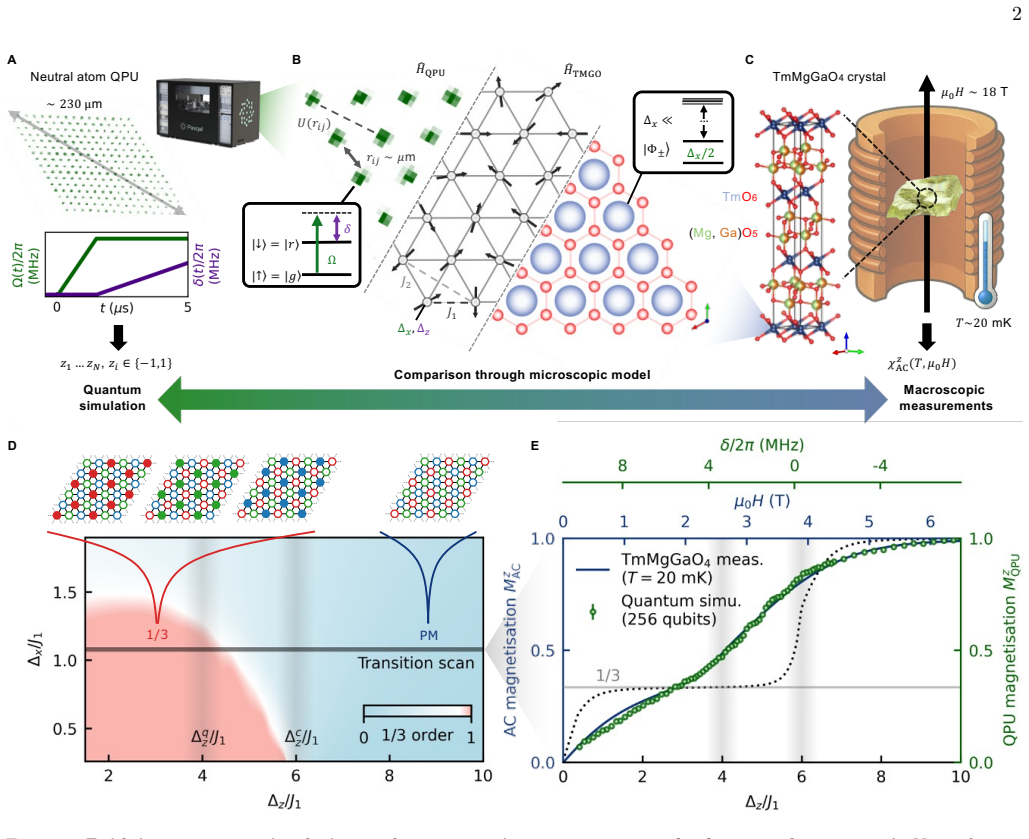
A 256-qubit Rydberg simulator implements the effective Hamiltonian of TmMgGaO4 and matches its experimental magnetization and phase transition.
A machine-rendered reading of the paper's core claim, the machinery that carries it, and where it could break.
Core claim
The 256-qubit Rydberg array faithfully realizes the effective Hamiltonian of TmMgGaO4, producing magnetization curves and an antiferromagnetic transition that match experimental results on single crystals, while quench dynamics demonstrate thermalization of local observables and thereby show that analog quantum simulation can both reproduce and extend the physics of a real material.
What carries the argument
The 256-qubit Rydberg-atom array tuned to realize the effective spin Hamiltonian of the frustrated triangular-lattice magnet TmMgGaO4.
If this is right
- Magnetization curves from the simulator agree quantitatively with susceptibility measurements on TmMgGaO4 crystals.
- Both the simulator and the real material locate the same antiferromagnetic phase transition.
- Snapshot-resolved analysis shows quantum fluctuations dominate the intermediate paramagnetic regime rather than disorder.
- After a sudden quench, local observables thermalize, giving access to non-equilibrium dynamics at picosecond material timescales.
Where Pith is reading between the lines
- The same tuning protocol could be applied to other frustrated magnets whose classical simulation is intractable due to entanglement growth.
- Validated analog simulators may serve as predictive platforms for material properties in regimes where neither experiment nor classical computation is feasible.
- Extending the approach to longer evolution times or larger arrays would allow direct mapping of full dynamical phase diagrams of quantum magnets.
Load-bearing premise
The Rydberg-atom array can be tuned with enough accuracy to implement the effective Hamiltonian of TmMgGaO4 so that quantitative comparisons to experiment remain valid.
What would settle it
Significant mismatch between the simulated magnetization curves and the measured susceptibility data on TmMgGaO4 single crystals would disprove the claim of faithful Hamiltonian implementation.
Figures


read the original abstract
Analog quantum simulators offer a powerful microscopic probe of quantum many-body systems, yet have largely been benchmarked against model Hamiltonians rather than real materials. Here, we use a 256-qubit Rydberg simulator to implement the effective Hamiltonian of the frustrated triangular-lattice magnet TmMgGaO$_4$. Simulated magnetization curves agree quantitatively with susceptibility measurements on single crystals, and both platforms consistently determine the antiferromagnetic phase transition. Snapshot-resolved analysis confirms that quantum fluctuations, rather than disorder, govern the intermediate paramagnetic regime. Having established this correspondence, we access non-equilibrium dynamics following a sudden quench, a regime at picosecond material timescales where entanglement growth places the problem beyond classical reach. The simulator reveals thermalization of local observables, demonstrating that analog quantum simulation can reproduce and extend the physics of a real material.
Editorial analysis
A structured set of objections, weighed in public.
Referee Report
Summary. The manuscript reports the use of a 256-qubit Rydberg-atom array to implement the effective Hamiltonian of the frustrated triangular-lattice magnet TmMgGaO4. Simulated magnetization curves are shown to agree quantitatively with susceptibility measurements on single crystals, both platforms identify the same antiferromagnetic transition temperature, snapshot analysis attributes the paramagnetic regime to quantum fluctuations, and a sudden-quench protocol reveals thermalization of local observables, extending the simulation into a non-equilibrium regime inaccessible to classical methods.
Significance. If the Rydberg-to-material Hamiltonian mapping holds with the claimed fidelity, the work would be significant for demonstrating that analog quantum simulators can reproduce quantitative features of real materials and access their non-equilibrium dynamics at scales where entanglement growth defeats classical simulation. The direct comparison to experimental crystal data and the quench results would strengthen the case for using such platforms to probe material-specific physics beyond model Hamiltonians.
major comments (3)
- [§3] §3 (Hamiltonian mapping): The procedure for tuning Rydberg parameters (Rabi frequency, detuning, van-der-Waals coefficients) to the effective couplings of TmMgGaO4 is not specified with sufficient detail or error analysis; quantitative agreement in magnetization curves (Fig. 4) can be achieved by small adjustments to a few effective parameters even if the microscopic mapping deviates, leaving the fidelity for subsequent dynamics unverified.
- [§5] §5 (quench dynamics): No separate fidelity metric, disorder characterization, or exact small-system benchmark is provided for the sudden-quench protocol; without these, the reported thermalization of local observables cannot be unambiguously attributed to the material's intrinsic physics rather than residual decoherence or calibration drift.
- [§4.1] §4.1 (magnetization data): Simulated magnetization curves lack reported error bars, data-exclusion criteria, or statistical details on the averaging procedure, while experimental susceptibility data include them; this asymmetry prevents a rigorous assessment of the claimed quantitative agreement.
minor comments (3)
- [Figure 3] Figure 3 caption: the definition of the local observable used for snapshot analysis should explicitly state the spatial averaging window and any post-selection criteria applied.
- [Eq. (2)] Eq. (2): the notation for the effective spin Hamiltonian could be clarified by explicitly listing the values of the fitted J and K parameters alongside the Rydberg-derived values.
- References: the manuscript omits citation to recent works on Rydberg-array calibration protocols that could strengthen the mapping discussion.
Simulated Author's Rebuttal
We thank the referee for their detailed and constructive comments on our manuscript. We have carefully considered each point and made revisions to the manuscript to address the concerns raised. Our point-by-point responses are provided below.
read point-by-point responses
-
Referee: [§3] §3 (Hamiltonian mapping): The procedure for tuning Rydberg parameters (Rabi frequency, detuning, van-der-Waals coefficients) to the effective couplings of TmMgGaO4 is not specified with sufficient detail or error analysis; quantitative agreement in magnetization curves (Fig. 4) can be achieved by small adjustments to a few effective parameters even if the microscopic mapping deviates, leaving the fidelity for subsequent dynamics unverified.
Authors: We agree that additional details on the Hamiltonian mapping would strengthen the manuscript. In the revised version, we have expanded Section 3 with a more detailed description of the tuning procedure, including the specific optimization method used to match the effective couplings, the values of Rabi frequency, detuning, and van der Waals coefficients, and an error propagation analysis from experimental calibration uncertainties. We also include a comparison showing that the magnetization curves are robust to small variations in parameters within the error bars. For the dynamics, we have added benchmarks using exact diagonalization on smaller lattices to verify the fidelity of the mapping in the quench protocol. revision: yes
-
Referee: [§5] §5 (quench dynamics): No separate fidelity metric, disorder characterization, or exact small-system benchmark is provided for the sudden-quench protocol; without these, the reported thermalization of local observables cannot be unambiguously attributed to the material's intrinsic physics rather than residual decoherence or calibration drift.
Authors: We acknowledge the need for additional validation of the quench dynamics. In the revision, we have included a fidelity metric calculated from the measured state preparation fidelity and coherence times. We characterize the disorder in the Rydberg array by reporting the measured variation in atom positions and interaction strengths. Furthermore, we provide exact small-system benchmarks (for systems up to 20 qubits) comparing the simulator results to numerical simulations of the effective Hamiltonian, demonstrating that the thermalization behavior is consistent with the intrinsic dynamics rather than artifacts from decoherence. revision: yes
-
Referee: [§4.1] §4.1 (magnetization data): Simulated magnetization curves lack reported error bars, data-exclusion criteria, or statistical details on the averaging procedure, while experimental susceptibility data include them; this asymmetry prevents a rigorous assessment of the claimed quantitative agreement.
Authors: We agree that the simulated data presentation should be improved for a fair comparison. In the revised manuscript, we now report error bars on the simulated magnetization curves, which are calculated from the standard error of the mean over 500 independent experimental realizations. We have added details on the data-exclusion criteria (shots with more than 2% atom loss are excluded) and the averaging procedure in the Methods section. These changes align the presentation with the experimental data and allow for a more rigorous assessment of the agreement. revision: yes
Circularity Check
No circularity: simulator outputs validated against independent crystal measurements
full rationale
The paper implements the effective spin Hamiltonian of TmMgGaO4 on the Rydberg array and directly compares the resulting equilibrium magnetization curves to independent susceptibility data taken on physical single crystals. This comparison is external validation rather than a fit or self-referential prediction. The subsequent quench dynamics and thermalization analysis are generated by the simulator itself and are not derived from the same fitted parameters or reduced to any self-citation chain. No self-definitional steps, fitted-input predictions, or ansatz smuggling appear in the derivation; the central claim rests on the physical correspondence between two distinct platforms.
Axiom & Free-Parameter Ledger
axioms (1)
- domain assumption The Rydberg atom array can be tuned to implement the effective spin Hamiltonian of TmMgGaO4
Lean theorems connected to this paper
-
IndisputableMonolith/Cost/FunctionalEquation.leanwashburn_uniqueness_aczel unclear?
unclearRelation between the paper passage and the cited Recognition theorem.
We simulate this Hamiltonian with a Rydberg-based QPU... ˆHTMGO/ℏ = J1 ∑⟨i,j⟩ σz_i σz_j + ...
What do these tags mean?
- matches
- The paper's claim is directly supported by a theorem in the formal canon.
- supports
- The theorem supports part of the paper's argument, but the paper may add assumptions or extra steps.
- extends
- The paper goes beyond the formal theorem; the theorem is a base layer rather than the whole result.
- uses
- The paper appears to rely on the theorem as machinery.
- contradicts
- The paper's claim conflicts with a theorem or certificate in the canon.
- unclear
- Pith found a possible connection, but the passage is too broad, indirect, or ambiguous to say the theorem truly supports the claim.
Forward citations
Cited by 5 Pith papers
-
Magnetic-field control of interactions in alkaline-earth Rydberg atoms and applications to {\it XXZ} models
Magnetic fields tune the XXZ anisotropy parameter in alkaline-earth Rydberg pairs, allowing a folded XXZ model in ytterbium without fine-tuning and a mean-field supersolid on the square lattice.
-
Benchmarking quantum simulation with neutron-scattering experiments
A 50-qubit quantum processor produces dynamical structure factors for KCuF3 that quantitatively match neutron-scattering measurements of its spinon spectrum.
-
QOuLiPo: What a quantum computer sees when it reads a book
Literary texts are turned into graphs for neutral-atom quantum processors, with a new rigidity metric distinguishing structural uniqueness and a QOuLiPo corpus of engineered texts created to match hardware-native graphs.
-
Quantum Spin Liquid State of a Dual-Species Atomic Array on Kagome Lattice
A dual-species Rydberg atom array on a Kagome lattice can be driven into a quantum spin liquid state with topological order using a controlled sweep-quench-sweep protocol.
-
Random-State Generation and Preparation Complexity in Rydberg Atom Arrays
Random global pulses in Rydberg chains generate states with Haar-like statistics at long times for weak interactions, while optimal control prepares generic symmetric states with infidelities from 10^{-5} to 3e-2 for ...
Reference graph
Works this paper leans on
-
[1]
S3 for a real-space visualisation)
(see Fig. S3 for a real-space visualisation). For moderately small systems (N= 49,100),S zz QPU(q1/3) already devel- ops a broad peak within the 1/3 phase, signalling the onset of this magnetic order. Larger-scale simulations (N= 169,256) reproduce this feature with improved convergence in system size. The QPU-derived critical point estimate ∆ q z/J1(N= 2...
-
[2]
Manin, Computable and non-computable., Sovetskoye Radio, Moscow128(1980)
Y. Manin, Computable and non-computable., Sovetskoye Radio, Moscow128(1980)
work page 1980
-
[3]
R. P. Feynman, Simulating physics with computers, Int. J. Theor. Phys.21, 467 (1982)
work page 1982
-
[4]
I. Georgescu, S. Ashhab, and F. Nori, Quantum simula- tion, Rev. Mod. Phys.86, 153 (2014)
work page 2014
-
[5]
A. J. Daley, Twenty-five years of analogue quantum sim- ulation, Nat. Rev. Phys.5, 702 (2023)
work page 2023
- [6]
- [7]
-
[8]
A. D. King, C. D. Batista, J. Raymond, T. Lanting, I. Oz- fidan, G. Poulin-Lamarre, H. Zhang, and M. H. Amin, Quantum Annealing Simulation of Out-of-Equilibrium Magnetization in a Spin-Chain Compound, PRX Quan- tum2, 030317 (2021)
work page 2021
-
[9]
P. Narasimhan, S. Humeniuk, A. Roy, and V. Drouin- Touchette, Simulating the Transverse Field Ising Model on the Kagome Lattice using a Programmable Quantum Annealer, Phys. Rev. B110, 054432 (2024)
work page 2024
- [10]
-
[11]
A. Mazurenko, C. S. Chiu, G. Ji, M. F. Parsons, M. Kan´ asz-Nagy, R. Schmidt, F. Grusdt, E. Demler, D. Greif, and M. Greiner, A cold-atom Fermi–Hubbard antiferromagnet, Nature545, 462 (2017)
work page 2017
-
[12]
G. Semeghini, H. Levine, A. Keesling, S. Ebadi, T. T. Wang, D. Bluvstein, R. Verresen, H. Pichler, M. Kali- nowski, R. Samajdar, A. Omran, S. Sachdev, A. Vish- wanath, M. Greiner, V. Vuleti´ c, and M. D. Lukin, Prob- ing topological spin liquids on a programmable quantum simulator, Science374, 1242 (2021)
work page 2021
-
[13]
T. Manovitz, S. H. Li, S. Ebadi, R. Samajdar, A. A. Geim, S. J. Evered, D. Bluvstein, H. Zhou, N. U. Koylu- oglu, J. Feldmeier, P. E. Dolgirev, N. Maskara, M. Kali- nowski, S. Sachdev, D. A. Huse, M. Greiner, V. Vuleti´ c, and M. D. Lukin, Quantum coarsening and collective dy- namics on a programmable simulator, Nature638, 86 (2025)
work page 2025
-
[14]
A. Ali, H. Xu, W. Bernoudy, A. Nocera, A. D. King, and A. Banerjee, Quantum quench dynamics of geometrically frustrated Ising models, Nat. Commun.15, 10756 (2024)
work page 2024
-
[15]
Tomonaga, Remarks on Bloch’s Method of Sound Waves applied to Many-Fermion Problems, Prog
S.-i. Tomonaga, Remarks on Bloch’s Method of Sound Waves applied to Many-Fermion Problems, Prog. Theor. Phys.5, 544 (1950)
work page 1950
-
[16]
P. W. Anderson, An Approximate Quantum Theory of the Antiferromagnetic Ground State, Phys. Rev.86, 694 (1952)
work page 1952
-
[17]
N. D. Mermin and H. Wagner, Absence of Ferro- magnetism or Antiferromagnetism in One- or Two- Dimensional Isotropic Heisenberg Models, Phys. Rev. Lett.17, 1133 (1966)
work page 1966
- [18]
-
[19]
G. Scappucci, P. Taylor, J. Williams, T. Ginley, and S. Law, Crystalline materials for quantum computing: Semiconductor heterostructures and topological insula- tors exemplars, MRS Bulletin46, 596 (2021)
work page 2021
-
[20]
P. V. Pham, S. C. Bodepudi, K. Shehzad, Y. Liu, Y. Xu, B. Yu, and X. Duan, 2D heterostructures for ubiquitous electronics and optoelectronics: principles, opportuni- ties, and challenges, Chemical Reviews122, 6514 (2022)
work page 2022
-
[21]
H. Li, Y. D. Liao, B.-B. Chen, X.-T. Zeng, X.-L. Sheng, Y. Qi, Z. Y. Meng, and W. Li, Kosterlitz-Thouless melt- ing of magnetic order in the triangular quantum Ising material TmMgGaO4, Nat. Commun.11, 1111 (2020)
work page 2020
-
[22]
F. A. Cevallos, K. Stolze, T. Kong, and R. J. Cava, Anisotropic magnetic properties of the triangular plane lattice material TmMgGaO4, Materials Research Bul- letin105, 154 (2018)
work page 2018
-
[23]
Z. L. Dun, M. Lee, E. S. Choi, A. M. Hallas, C. R. Wiebe, J. S. Gardner, E. Arrighi, R. S. Freitas, A. M. Arevalo- Lopez, J. P. Attfield, H. D. Zhou, and J. G. Cheng, Chemical pressure effects on magnetism in the quantum spin liquid candidates Yb2X2O7 (X=Sn, Ti, Ge), Phys. Rev. B89, 064401 (2014)
work page 2014
-
[24]
M. Saffman, T. G. Walker, and K. Mølmer, Quantum information with Rydberg atoms, Rev. Mod. Phys.82, 2313 (2010)
work page 2010
-
[25]
A. Browaeys and T. Lahaye, Many-body physics with individually controlled Rydberg atoms, Nat. Phys.16, 132 (2020)
work page 2020
-
[26]
L. Henriet, L. Beguin, A. Signoles, T. Lahaye, A. Browaeys, G.-O. Reymond, and C. Jurczak, Quantum computing with neutral atoms, Quantum4, 327 (2020)
work page 2020
-
[27]
Y. Li, S. Bachus, H. Deng, W. Schmidt, H. Thoma, V. Hutanu, Y. Tokiwa, A. A. Tsirlin, and P. Gegenwart, Partial Up-Up-Down Order with the Continuously Dis- tributed Order Parameter in the Triangular Antiferro- magnet TmMgGaO 4, Phys. Rev. X10, 011007 (2020)
work page 2020
-
[28]
Y. Shen, C. Liu, Y. Qin, S. Shen, Y.-D. Li, R. Bew- ley, A. Schneidewind, G. Chen, and J. Zhao, Intertwined dipolar and multipolar order in the triangular-lattice magnet TmMgGaO4, Nat. Commun.10, 4530 (2019)
work page 2019
- [29]
-
[30]
Y. Qin, Y. Shen, C. Liu, H. Wo, Y. Gao, Y. Feng, X. Zhang, G. Ding, Y. Gu, Q. Wang, S. Shen, H. C. Walker, R. Bewley, J. Xu, M. Boehm, P. Stef- fens, S. Ohira-Kawamura, N. Murai, A. Schneidewind, X. Tong, G. Chen, and J. Zhao, Field-Tuned Quantum Effects in a Triangular-Lattice Ising Magnet, Science Bul- letin67, 38 (2022)
work page 2022
-
[31]
J. Vovrosh, S. Juli` a-Farr´ e, W. Krinitsin, M. Kaicher, F. Hayes, E. Gottlob, A. Kshetrimayum, K. Bidzhiev, S. B. J¨ ager, M. Schmitt, J. Tindall, C. Dalyac, T. Mendes-Santos, and A. Dauphin, Simulating dynam- ics of the two-dimensional transverse-field Ising model: a comparative study of large-scale classical numerics (2025), arXiv:2511.19340 [quant-ph]
-
[32]
J. Vovrosh, T. Mendes-Santos, H. Mamann, K. Bidzhiev, F. Hayes, B. Ximenez, L. B´ eguin, C. Dalyac, and A. Dauphin, Resource assessment of classical and quantum hardware for post-quench dynamics (2025), arXiv:2511.20388 [quant-ph]
-
[33]
L. D’Alessio, Y. Kafri, A. Polkovnikov, and M. Rigol, From quantum chaos and eigenstate thermalization to statistical mechanics and thermodynamics, Advances in Physics65, 239 (2016)
work page 2016
-
[34]
Z. Hu, Z. Ma, Y.-D. Liao, H. Li, C. Ma, Y. Cui, Y. Shang- guan, Z. Huang, Y. Qi, W. Li, Z. Y. Meng, J. Wen, and W. Yu, Evidence of the Berezinskii-Kosterlitz-Thouless phase in a frustrated magnet, Nat. Commun.11, 5631 (2020)
work page 2020
-
[35]
Y. Da Liao, H. Li, Z. Yan, H.-T. Wei, W. Li, Y. Qi, and Z. Y. Meng, Phase diagram of the quantum Ising model on a triangular lattice under external field, Phys. Rev. B 103, 104416 (2021)
work page 2021
-
[36]
S. Guo, J. Huang, J. Hu, and Z.-X. Li, Order by disorder and an emergent Kosterlitz-Thouless phase in a triangu- lar Rydberg array, Phys. Rev. A108, 053314 (2023)
work page 2023
-
[37]
R. Trivedi, A. Franco Rubio, and J. I. Cirac, Quantum advantage and stability to errors in analogue quantum simulators, Nat. Commun.15, 6507 (2024)
work page 2024
- [38]
-
[39]
T´ oth, Multipartite entanglement and high-precision metrology, Phys
G. T´ oth, Multipartite entanglement and high-precision metrology, Phys. Rev. A85, 022322 (2012), publisher: American Physical Society
work page 2012
- [40]
-
[41]
H. Kim, Y. Park, K. Kim, H.-S. Sim, and J. Ahn, De- 9 tailed balance of thermalization dynamics in rydberg- atom quantum simulators, Phys. Rev. Lett.120, 180502 (2018)
work page 2018
-
[42]
L. B´ eguin, C. Dorian, S. Juli` a-Farr´ e, T. Mendes-Santos, G. Villaret, J. Vovrosh, A. Browaeys, A. Signoles, C. Dalyac, and A. Dauphin, Manuscript in preparation (2026), manuscript in preparation
work page 2026
-
[43]
A. W. Sandvik, Stochastic series expansion method for quantum ising models with arbitrary interactions, Phys. Rev. E68, 056701 (2003)
work page 2003
- [44]
-
[45]
S. Fey, S. C. Kapfer, and K. P. Schmidt, Quantum Criti- cality of Two-Dimensional Quantum Magnets with Long- Range Interactions, Phys. Rev. Lett.122, 017203 (2019), publisher: American Physical Society
work page 2019
-
[46]
R. Moessner and S. L. Sondhi, Ising models of quantum frustration, Phys. Rev. B63, 224401 (2001), publisher: American Physical Society
work page 2001
-
[47]
C. Chen, G. Bornet, M. Bintz, G. Emperauger, L. Leclerc, V. S. Liu, P. Scholl, D. Barredo, J. Hauschild, S. Chatterjee, M. Schuler, A. M. L¨ auchli, M. P. Zale- tel, T. Lahaye, N. Y. Yao, and A. Browaeys, Continuous symmetry breaking in a two-dimensional Rydberg array, Nature616, 691 (2023)
work page 2023
-
[48]
P. Scholl, H. J. Williams, G. Bornet, F. Wallner, D. Barredo, L. Henriet, A. Signoles, C. Hainaut, T. Franz, S. Geier, A. Tebben, A. Salzinger, G. Z¨ urn, T. Lahaye, M. Weidem¨ uller, and A. Browaeys, Microwave Engineering of Programmable X X Z Hamiltonians in Ar- rays of Rydberg Atoms, PRX Quantum3, 020303 (2022)
work page 2022
-
[49]
Scholl,Quantum simulation of spin models with large arrays of Rydberg atoms, Ph.D
P. Scholl,Quantum simulation of spin models with large arrays of Rydberg atoms, Ph.D. thesis, Universit´ e Paris- Saclay (2021)
work page 2021
-
[50]
H. Silv´ erio, S. Grijalva, C. Dalyac, L. Leclerc, P. J. Kar- alekas, N. Shammah, M. Beji, L.-P. Henry, and L. Hen- riet, Pulser: An open-source package for the design of pulse sequences in programmable neutral-atom arrays, Quantum6, 629 (2022)
work page 2022
-
[51]
S. De L´ es´ eleuc, D. Barredo, V. Lienhard, A. Browaeys, and T. Lahaye, Analysis of imperfections in the coher- ent optical excitation of single atoms to Rydberg states, Phys. Rev. A97, 053803 (2018)
work page 2018
-
[52]
K. Bidzhiev, S. Grava, P. l. Henaff, M. Mendizabal, E. Merhej, and A. Quelle, Efficient Emulation of Neu- tral Atom Quantum Hardware (2025), arXiv:2510.09813
-
[53]
J. Hauschild, J. Unfried, S. Anand, B. Andrews, M. Bintz, U. Borla, S. Divic, M. Drescher, J. Geiger, M. Hefel, K. H´ emery, W. Kadow, J. Kemp, N. Kirchner, V. S. Liu, G. M¨ oller, D. Parker, M. Rader, A. Romen, S. Scalet, L. Schoonderwoerd, M. Schulz, T. Soejima, P. Thoma, Y. Wu, P. Zechmann, L. Zweng, R. S. K. Mong, M. P. Zaletel, and F. Pollmann, Tenso...
work page 2024
-
[54]
Pasqal Team (2026), in preparation. DATA AND MATERIALS AVAILABILITY The data supporting the findings of this study are available on reasonable request. ACKNOWLEDGMENTS We thank Carleton Coffrin and Christophe Jurczak for the preliminary discussions that led to this work. We thank Mourad Beji and Louis-Paul Henry for carefully reading the manuscript and pr...
work page 2026
-
[55]
as the nearest-neighbour interaction,r 1 being the lattice spacing. We also identify ∆ x(t) = Ω(t) 2 , and ∆ z(t) = 1 2 [δU −δ(t)], withℏδ U = 1 2 P ij Uij/NandU ij =C 6/r6 ij. The last term ˆHdiff. accounts for the difference between ˆHQPU and ˆHTMGO, ˆHdiff. ℏ = X i ∆z,iˆσz i + X ⟨i,j⟩n>2 Uij 4ℏ ˆσz i ˆσz j − 1.3J1 100 X ⟨i,j⟩2 ˆσz i ˆσz j . (S5) On the...
discussion (0)
Sign in with ORCID, Apple, or X to comment. Anyone can read and Pith papers without signing in.