Recognition: unknown
Renormalization group analysis for bosonization coefficients in half-odd-integer Kitaev spin chains
Pith reviewed 2026-05-07 13:39 UTC · model grok-4.3
The pith
Renormalization group analysis shows symmetry-breaking effects in bosonization formulas for half-odd-integer Kitaev spin chains scale as 1/S in the large-S limit.
A machine-rendered reading of the paper's core claim, the machinery that carries it, and where it could break.
Core claim
Based on a renormalization group analysis, the effects associated with the breaking of emergent continuous symmetries in bosonization formulas scale as 1/S in the large-S limit, which is in qualitative agreement with DMRG numerical results for Kitaev-Gamma chains. In Kitaev-Heisenberg-Gamma chains, symmetry analysis reveals ten independent bosonization coefficients, five of which are predicted by the RG analysis to have no dependence on the Heisenberg coupling up to linear order. The work offers input for determining magnetic ordering tendencies in two-dimensional Kitaev spin models within a quasi-one-dimensional approach.
What carries the argument
Renormalization group analysis of the bosonized theory, which tracks the flow of coefficients under perturbations that break emergent continuous symmetries.
If this is right
- Bosonization formulas for these chains become systematically more accurate in the large-S limit as symmetry-breaking corrections vanish.
- Five of the ten independent bosonization coefficients in Kitaev-Heisenberg-Gamma chains remain independent of the Heisenberg coupling to linear order.
- The derived coefficients can be used directly in quasi-one-dimensional constructions to predict ordering patterns in two-dimensional Kitaev spin models.
- The 1/S scaling provides a concrete benchmark that existing DMRG data on Kitaev-Gamma chains already satisfy qualitatively.
Where Pith is reading between the lines
- For sufficiently large half-odd-integer S the standard bosonization without explicit symmetry-breaking terms may suffice for many observables.
- The predicted independence of five coefficients from the Heisenberg coupling could be checked by independent numerical methods such as exact diagonalization on small clusters.
- The same RG tracking of symmetry-breaking terms could be applied to other one-dimensional spin models that possess emergent U(1) symmetries at the continuum level.
- Testing the scaling in parameter regions outside K < 0, Gamma > 0, J > 0 would clarify whether the 1/S behavior is universal or specific to the chosen sign pattern.
Load-bearing premise
The renormalization group analysis accurately captures the leading effects of emergent symmetry breaking in the bosonized theory for the chosen parameter region without higher-order corrections dominating.
What would settle it
Numerical extraction of bosonization coefficients for successive half-odd-integer values of S in the Kitaev-Gamma chain that shows the symmetry-breaking corrections do not decrease proportionally to 1/S.
Figures


read the original abstract
Based on a renormalization group (RG) analysis, we study the bosonization formulas in spin-S Kitaev-Gamma and Kitaev-Heisenberg-Gamma chains in the (K < 0, Gamma > 0, J > 0) parameter region, where S is a half-odd integer. We find that the effects associated with the breaking of emergent continuous symmetries in bosonization formulas scale as 1/S in the large-S limit, which is in qualitative agreement with DMRG numerical results for Kitaev-Gamma chains. In Kitaev-Heisenberg-Gamma chains, symmetry analysis reveals ten independent bosonization coefficients, five of which are predicted by the RG analysis to have no dependence on the Heisenberg coupling up to linear order. Our work may offer valuable input for determining magnetic ordering tendencies in two-dimensional Kitaev spin models within a quasi-one-dimensional approach.
Editorial analysis
A structured set of objections, weighed in public.
Referee Report
Summary. The manuscript applies a renormalization group (RG) analysis to derive bosonization coefficients for half-odd-integer spin-S Kitaev-Gamma and Kitaev-Heisenberg-Gamma chains in the regime K < 0, Gamma > 0, J > 0. It reports that emergent continuous symmetry-breaking effects in the bosonization formulas scale as 1/S for large S, in qualitative agreement with DMRG numerics on Kitaev-Gamma chains, and that symmetry analysis identifies ten independent coefficients in the Kitaev-Heisenberg-Gamma case, five of which are independent of J to linear order in the RG treatment. The work positions these results as input for quasi-1D studies of 2D Kitaev models.
Significance. If the RG derivation holds, the 1/S scaling result and the predicted J-independence of half the coefficients would provide a controlled large-S limit for bosonization in these models, offering a concrete bridge between 1D analytic methods and 2D magnetic ordering tendencies. The explicit count of ten independent coefficients from symmetry analysis is a useful organizational contribution.
major comments (2)
- [RG analysis section (exact section number not specified in provided text)] The central 1/S scaling claim for symmetry-breaking effects (abstract and § on RG analysis) is presented without the explicit RG flow equations, cutoff scheme, or beta-function derivations. This omission makes it impossible to verify whether the leading-order treatment indeed isolates the 1/S term or whether higher-order 1/S corrections are systematically neglected, directly affecting the load-bearing prediction of J-independence to linear order.
- [Comparison with DMRG (abstract and results section)] The qualitative DMRG agreement is invoked to support the 1/S scaling, but no quantitative error estimates, fitting procedures, or direct comparison of extracted coefficients versus the RG predictions are supplied. Without these, the agreement remains unquantified and cannot confirm that higher-order or non-perturbative terms remain subdominant in the chosen parameter region.
minor comments (2)
- [Symmetry analysis paragraph] Notation for the ten independent bosonization coefficients should be introduced with an explicit table or equation listing their definitions and symmetry properties before the RG predictions are stated.
- [Introduction or model definition] The parameter region (K < 0, Gamma > 0, J > 0) is stated but the precise range of validity for the half-odd-integer S assumption and the large-S limit should be clarified with a brief statement on the perturbative regime.
Simulated Author's Rebuttal
We thank the referee for their thorough review and constructive feedback on our manuscript. We address each of the major comments below and have made revisions to the manuscript to improve clarity and provide the requested details.
read point-by-point responses
-
Referee: The central 1/S scaling claim for symmetry-breaking effects (abstract and § on RG analysis) is presented without the explicit RG flow equations, cutoff scheme, or beta-function derivations. This omission makes it impossible to verify whether the leading-order treatment indeed isolates the 1/S term or whether higher-order 1/S corrections are systematically neglected, directly affecting the load-bearing prediction of J-independence to linear order.
Authors: We acknowledge that the explicit RG flow equations, cutoff scheme, and beta-function derivations were not provided in the main text of the original manuscript. This was an oversight in presentation. In the revised version, we have added these details in a new subsection within the RG analysis section. The beta functions are derived from the operator product expansions in the bosonized theory, and the leading 1/S scaling arises from the scaling dimension of the symmetry-breaking perturbations being 2 + O(1/S). The cutoff is a standard momentum-shell RG with rescaling factor b = e^{dl}. This linear-order treatment systematically neglects higher 1/S corrections, thereby supporting the predicted J-independence of the five coefficients to this order. revision: yes
-
Referee: The qualitative DMRG agreement is invoked to support the 1/S scaling, but no quantitative error estimates, fitting procedures, or direct comparison of extracted coefficients versus the RG predictions are supplied. Without these, the agreement remains unquantified and cannot confirm that higher-order or non-perturbative terms remain subdominant in the chosen parameter region.
Authors: The DMRG comparison in the original manuscript was presented qualitatively to demonstrate consistency with the 1/S trend observed in the RG analysis. We agree that quantitative measures would strengthen the claim. Accordingly, in the revised manuscript, we have included additional details on the DMRG fitting procedure, which involves extracting the coefficients from the decay of correlation functions and performing finite-size scaling analysis. Error estimates are obtained from the variance across different system sizes. A direct comparison has been added, showing that the RG predictions are consistent with the DMRG results within the estimated uncertainties for the parameter region considered. revision: yes
Circularity Check
No circularity; RG analysis yields independent predictions for bosonization coefficients
full rationale
The paper's core derivation uses renormalization group flow to extract the leading 1/S scaling of emergent symmetry-breaking corrections to bosonization formulas and the J-independence of five out of ten coefficients in the Kitaev-Heisenberg-Gamma model. These outputs are generated from the RG equations applied to the microscopic spin Hamiltonian in the specified parameter regime; they are not obtained by fitting parameters to the same DMRG data later used for comparison, nor do they rest on self-citations whose content is itself defined by the present results. The subsequent qualitative agreement with DMRG is presented as an external check rather than an input. No self-definitional loops, fitted-input-as-prediction, or load-bearing self-citation chains appear in the derivation chain.
Axiom & Free-Parameter Ledger
axioms (2)
- domain assumption Bosonization mapping remains valid for half-odd-integer S in the Kitaev-Gamma and Kitaev-Heisenberg-Gamma models within the stated parameter region
- domain assumption Renormalization group flow equations capture the leading symmetry-breaking corrections without significant higher-order contributions
Reference graph
Works this paper leans on
-
[1]
≃” denotes “unitarily equivalent
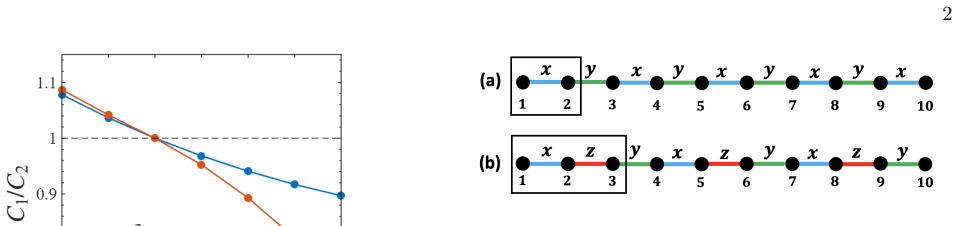
Spin-SKitaev-Gamma chain The spin-SKitaev-Gamma chain is defined as HKΓ = X ⟨ij⟩∈γ-bond KS γ i Sγ j + Γ(Sα i Sβ j +S β i Sα j ) ,(1) in whichγ∈ {x, y}denotes the spin direction associated with the bond connecting nearest-neighbor sitesiand jshown in Fig. 2 (a);α, βare the two spin directions other thanγ; and ⃗Si are spin-Soperators at sitei. It is conveni...
-
[2]
Spin-SKitaev-Heisenberg-Gamma chain The spin-SKitaev-Heisenberg-Gamma chain is defined as HKJΓ =H KΓ + X <ij>∈γbond J ⃗Si · ⃗Sj,(6) in which the pattern for bondγis shown in Fig. 2 (a). The six-sublattice rotation transforms the Hamiltonian to the following form H ′ KJΓ =H ′ KΓ− X <ij>∈γbond J(S ′γ i S′γ j +S ′α i S′β j +S ′β i S′α j ) ,(7) in which the p...
-
[3]
Kitaev-Gamma chains The bosonization formulas for spin-SKitaev-Gamma chains in the six-sublattice rotated frame take the follow- ing form (1≤j≤3) 1 a S′α j+3n =D α j J α L(x) +J α R(x) +(−1)j+n C α j 1√a itr g(x)σ α ,(10) in whichJ α L(x) andJ α R(x) (α∈ {x, y, z}) are left and right WZW currents,g(x) is the WZW primary field,a is the lattice constant,x= ...
-
[4]
Kitaev-Heisenberg-Gamma chains The bosonization formulas for spin-SKitaev- Heisenberg-Gamma chains in the six-sublattice rotated frame are given by (S′x i+3n S′y i+3n S′z i+3n) = (J x J y J z)FiO−1 + (−)i+n(N x N y N z)EiO−1,(14) in whichJ α, N α (α=x, y, z) are defined as J x = 1 a cos( √ 4πφ) cos(√πθ), J y = 1 a cos( √ 4πφ) sin(√πθ), J z =− 1√π ∇φ,(15) ...
-
[5]
T: (S x i , Sy i , Sz i )→(−S x i ,−S y i ,−S z i )
-
[6]
R I I: (S x i , Sy i , Sz i )→(−S z 10−i,−S y 10−i,−S x 10−i)
-
[7]
R aTa : (Sx i , Sy i , Sz i )→(S z i+1, Sx i+1, Sy i+1)
-
[8]
R(ˆx, π) : (S x i , Sy i , Sz i )→(S x i ,−S y i ,−S z i )
-
[9]
R(ˆy, π) : (S x i , Sy i , Sz i )→(−S x i , Sy i ,−S z i )
-
[10]
R(ˆz, π) : (S x i , Sy i , Sz i )→(−S x i ,−S y i , Sz i ).(35) We note that as discussed in Ref. 65,G′ KΓ is a nonsym- morphic group in the sense of the following short exact sequence 1→ ⟨T 3a⟩ →G ′ KΓ →O h →1,(36) in which⟨T 3a⟩is the translational group generated by spatial translation⟨T 3a⟩of three lattice sites, andO h is the full octahedra group whi...
-
[11]
4: Diagrams for the renormalizations of scaling fields
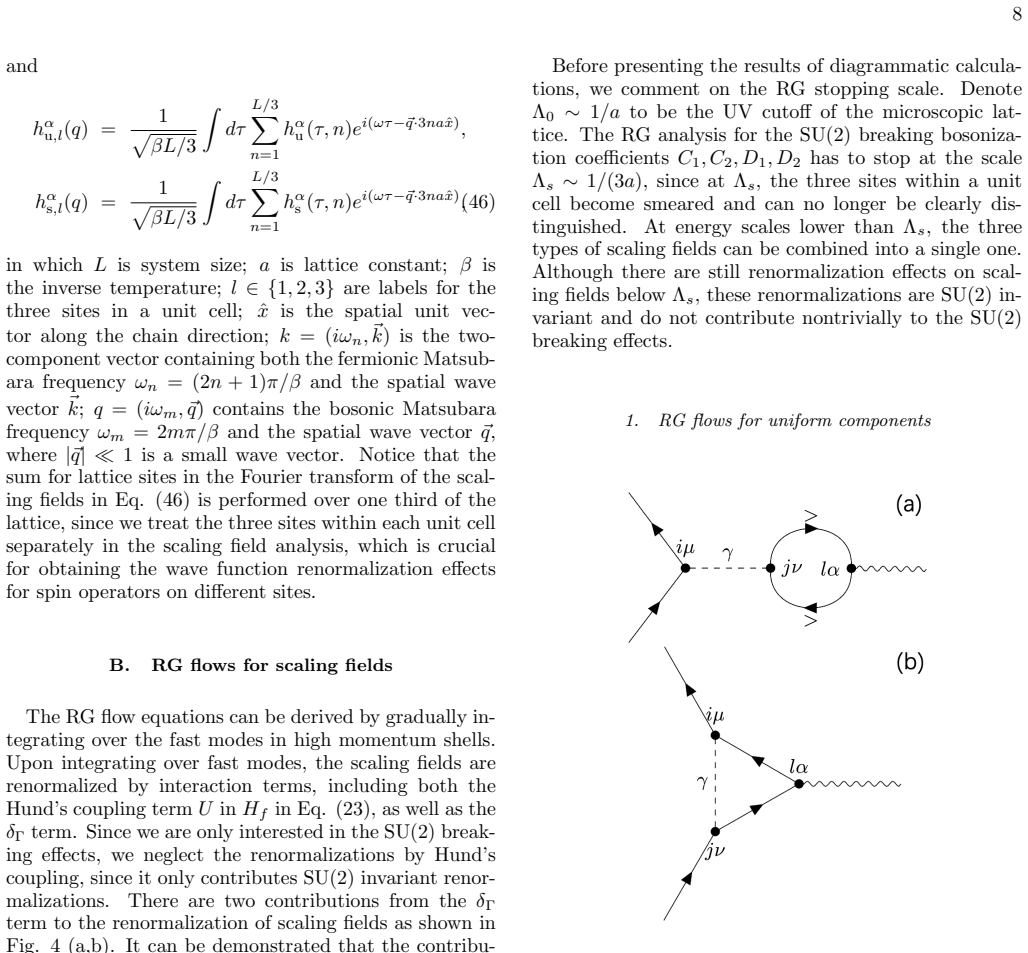
RG flows for uniform components FIG. 4: Diagrams for the renormalizations of scaling fields. We start with analyzing how the uniform components of the scaling fields get renormalized by the diagram in Fig. 4 (a) when the cutoff is lowered from Λ0/bto Λ 0/(b+ ∆b), whereb <Λ 0/Λs and ∆b≪1. Calculations show that Fig. 4 (a) contributes the following term δΓ ...
-
[12]
RG flows for staggered components For the staggered components of the scaling fields, Fig. 4 (a) contributes the following term δΓ 1 t λ(S) s,jlδαγ lnb· Z dτ X n hα s,l(τ, n)S γ s,i(τ, n),(57) in whichλ (S) s,jl is given by λ(S) s,jl =n cΛs jl.(58) The expression of Λ s jl in Eq. (58) is given by 1 t Λs jl lnb=− a 6 3X m=1 e−i 2π 3 (m+ 1 2 )(j−l) × Z Λ/b ...
-
[13]
|K| −Γ Γ +O |K| −Γ Γ 2 D1 D2 = 1 + πlnb s S+ 1 (λu 0 −λ u
-
[14]
(77) Using Eq
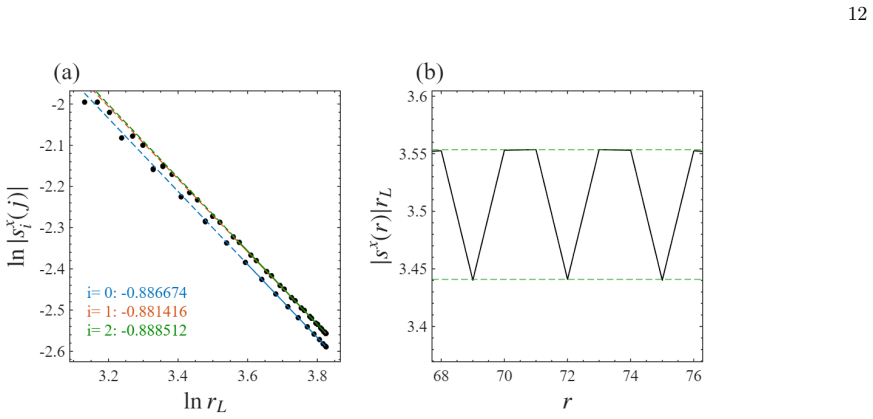
|K| −Γ Γ +O |K| −Γ Γ 2 . (77) Using Eq. (54,63) and retaining only the leading order terms, we obtain Eq. (12). In particular, notice from Eq. (77) that the deviations ofC 1/C2 andD 1/D2 away from 1 scale as 1/Sin the large-Slimit. Therefore, in the semiclassical limitS≫1, bothC 1/C2 andD 1/D2 approach 1. D. DMRG numerics Spin correlation functions in the...
-
[15]
Plugging Eqs
J Γ ση =−b πlnb s S √ 2 3 (λη 0 −λ η 1)∆Γ Γ δη =b πlnb s S 2 3(λη 0 −λ η 1)∆Γ −3J Γ νη =b 1 + πlnb s S (λη 0 + 2λη 1) 2 3 ∆Γ Γ −2 J Γ ρη =σ η,(117) in whichη=D, Con the left correspond toη= u,s on the right; andO( ∆2 Γ Γ2 ),O( ∆ΓJ Γ2 ),O( J2 Γ2 ) terms are ne- glected. Plugging Eqs. (54,63) into Eq. (117), we obtain Eqs. (21,22). It is worth noting that a...
-
[16]
The site with 2S−1 electrons likewise has maximal spinS− 1
-
[17]
(A7) becomes H(2) eff,ij = P H2 1,ijP −U 2S+ 1 2 .(A11) Because the hopping is diagonal in the color index, only virtual processes with the same coloracontribute
Thus the intermediate-state energy is E(ij) int =−2U S− 1 2 S+ 1 2 .(A9) Therefore, E(ij) 0 −E (ij) int =−U 2S+ 1 2 ,(A10) and Eq. (A7) becomes H(2) eff,ij = P H2 1,ijP −U 2S+ 1 2 .(A11) Because the hopping is diagonal in the color index, only virtual processes with the same coloracontribute. The two equivalent processesi→j→iandj→i→jgive the same contribu...
-
[18]
4 (a) In this appendix, we evaluate the diagram in Fig
Diagram in Fig. 4 (a) In this appendix, we evaluate the diagram in Fig. 4 (a). We focus on the uniform component of the scaling field, and the treatment for the staggered component is exactly similar. The calculation for RG flow equations of staggered components is exactly similar. We first rewrite the lattice interaction and the external-field coupling i...
-
[19]
4 (b) Next we consider the one-loop correction to the scaling field generated by theδ Γ term in Fig
Diagram in Fig. 4 (b) Next we consider the one-loop correction to the scaling field generated by theδ Γ term in Fig. 4 (b). We again focus on the uniform component of the scaling fields. The analysis for the staggered component is exactly similar. 21 The contributionF loop,b is given by Floop,b = δΓ 9Lβ X m,m′ X ⃗k,⃗ p,⃗ q,⃗k′,⃗ q′ X ω1,ω2,ω3,ω4,ω5,ω6,ω7 ...
-
[20]
Explicit RG flow equations The RG flow equations of the scaling fields for spin-SKitaev-Gamma chain are given by (η=u,s) dhx η,1 dlnb = (1−2Sδ Γλη 1)hx η,1 −2Sδ Γλη 0hx η,2 −2Sδ Γλη 1hx η,3, dhx η,2 dlnb = (1−2Sδ Γλη 1)hx η,2 −2Sδ Γλη 0hx η,1 −2Sδ Γλη 1hx η,3, dhx η,3 dlnb =h x η,3,(B26) dhz η,1 dlnb =h z η,1, dhz η,2 dlnb = (1−2Sδ Γλη 1)hz η,2 −2Sδ Γλη 0...
-
[21]
Explicit forms of bosonization formulas The nonsymmorphic bosonization formulas in theOU 6 frame are given by S′′x 1+3n = (λ D + 3 4 δD)J x + √ 3 4 δDJ y − 1 2 ρDJ z + (−)1+n (λC + 3 4 δC)N x + √ 3 4 δCN y − 1 2 ρCN z , S′′y 1+3n = √ 3 4 δDJ x + (λD + 1 4 δD)J y + √ 3 2 ρDJ z + (−)1+n √ 3 4 δCN x + (λC + 1 4 δC)N y + √ 3 2 ρCN z , S′′z 1+3n =− 1 2 σDJ x +...
-
[22]
Reducing to theJ= 0case Notice that the bosonization fieldsJ α,N α (α=x, y, z) are defined in theOU 6 frame. Let’s rotateJ α,N α to the U6 frame, by definingJ α, N α (α=x, y, z) as (J ′x J ′y J ′z) = (J x J y J z)O, (N ′x N ′y N ′z) = (N x N y N z)O,(C4) where the matrixOis defined in Eq. (20). Then we have (Sx 1+3n Sy 1+3n Sz 1+3n) = (J x J y J z)OD1O−1 ...
work page internal anchor Pith review Pith/arXiv arXiv 2006
discussion (0)
Sign in with ORCID, Apple, or X to comment. Anyone can read and Pith papers without signing in.