Recognition: unknown
Gr\"unwald--Letnikov Memory Truncation in a Fractional Duffing Oscillator: Coherence Loss and Effective Delay Complexity
Pith reviewed 2026-05-09 15:39 UTC · model grok-4.3
The pith
Truncating the Grünwald-Letnikov memory in a fractional Duffing oscillator produces effective delay dynamics whose spectral structure sets both coherence loss and delay complexity.
A machine-rendered reading of the paper's core claim, the machinery that carries it, and where it could break.
Core claim
The truncated GL kernel emerges as an intermediate object between distributed fractional memory and delay-type dynamics, with a local spectral structure that controls both coherence loss and effective delay complexity.
What carries the argument
The truncated Grünwald-Letnikov kernel, treated as a finite-memory modification whose local spectrum determines both the coherence-loss time and the minimal number of positive-delay modes (r_min) needed for spectral accuracy.
If this is right
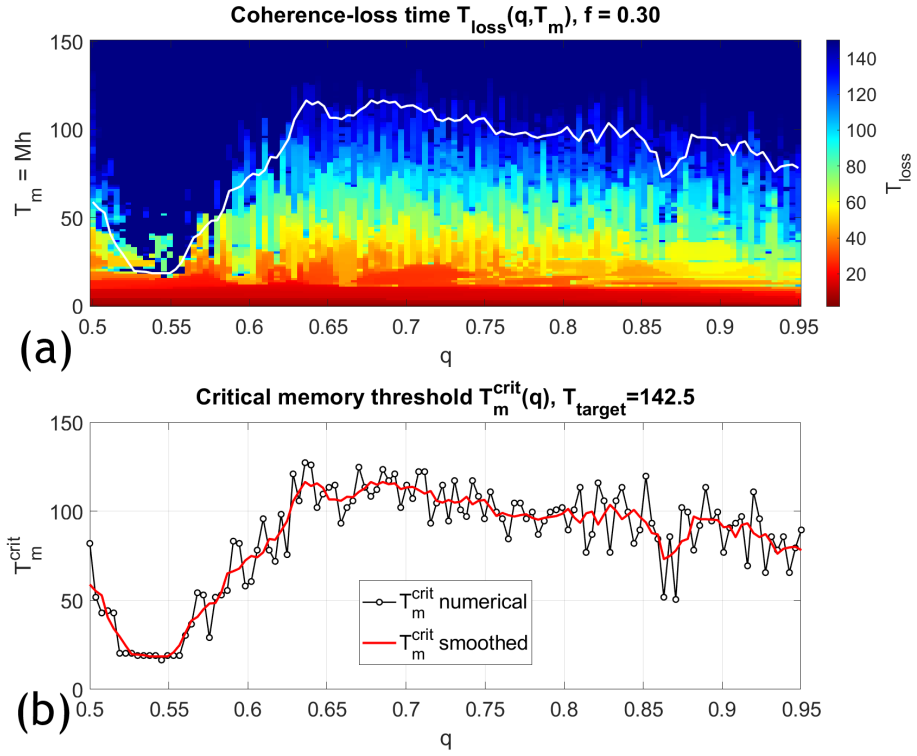
- The memory length required to preserve coherence depends non-monotonically on forcing amplitude, fractional order, and nonlinear sensitivity.
- A single causal delay cannot represent the truncated kernel, because the minimal one-delay fit produces a negative delay.
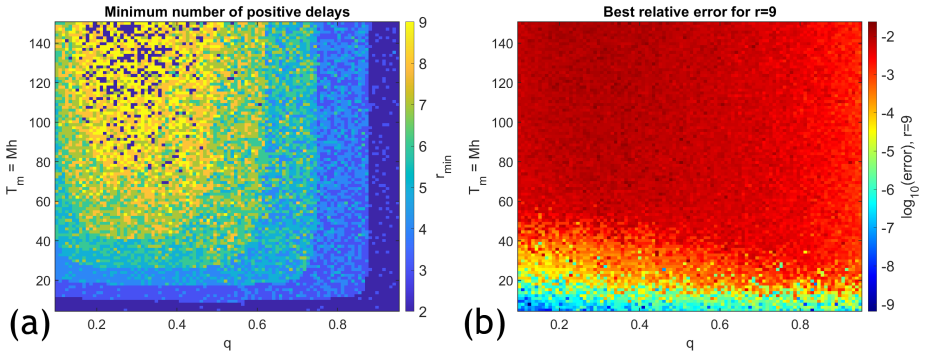
- A positive-delay exponential representation allows definition of r_min, the fewest modes needed to reach a prescribed spectral accuracy.
- The local spectrum of the finite-memory kernel governs both the onset of coherence loss and the complexity of its delay approximation.
Where Pith is reading between the lines
- If r_min can be computed cheaply for other fractional kernels, it could serve as a general diagnostic for when truncation is safe versus when it injects spurious delay-like behavior.
- The non-monotonic memory thresholds suggest that adaptive, state-dependent truncation lengths might reduce computational cost while preserving long-term coherence in simulations.
- Viewing truncation as a system modification rather than an error opens the possibility of designing finite-memory fractional controllers whose stability can be analyzed via the same local spectral tools.
Load-bearing premise
Direct trajectory comparisons produce a robust coherence-loss time that identifies critical truncation thresholds independently of numerical artifacts or initial conditions.
What would settle it
Repeating the coherence-loss extraction with a different integrator step size, a different history function, or a different numerical scheme for the same parameters and finding large shifts in the reported thresholds would falsify the robustness claim.
Figures



read the original abstract
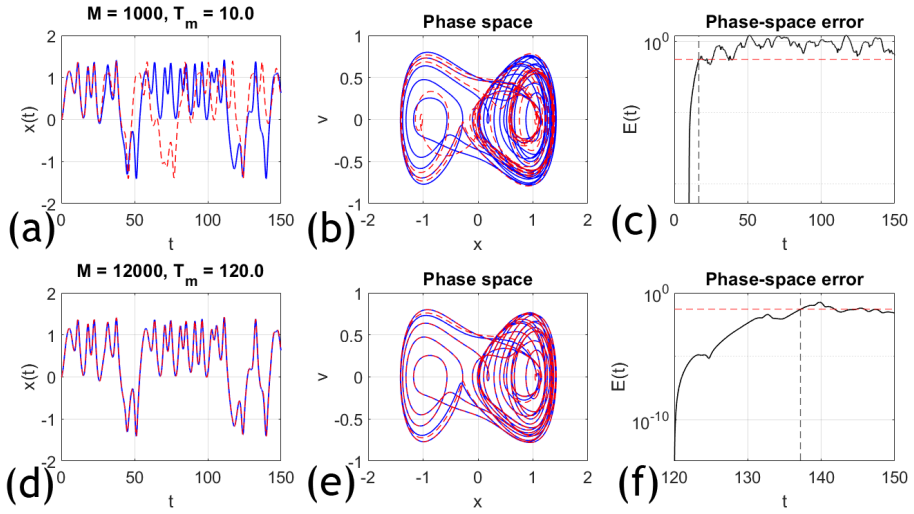
We investigate the dynamical and analytical consequences of truncating the Gr\"unwald--Letnikov memory term in a fractional Duffing oscillator. The truncated memory is treated not merely as a computational approximation, but as a finite-memory modification of the underlying dynamical system. We define a coherence-loss time from direct comparisons between full-memory and truncated-memory trajectories, and use it to extract critical truncation thresholds in parameter planes involving the forcing amplitude and the fractional order. The results reveal strongly non-monotonic memory thresholds, showing that the retained memory required to preserve coherence depends on the forcing regime, the fractional order, and the nonlinear sensitivity of the dynamics. We also derive a local characteristic equation for the truncated GL kernel. A minimal one-delay approximation produces a formal negative delay, indicating that a single causal delay is structurally insufficient. This motivates a positive-delay exponential representation of the finite-memory kernel. The minimum number of positive-delay modes required to reach a prescribed spectral accuracy defines an operational delay-complexity measure, $r_{\min}$. Overall, the truncated GL kernel emerges as an intermediate object between distributed fractional memory and delay-type dynamics, with a local spectral structure that controls both coherence loss and effective delay complexity.
Editorial analysis
A structured set of objections, weighed in public.
Referee Report
Summary. The manuscript investigates the effects of truncating the Grünwald-Letnikov memory term in a fractional Duffing oscillator, treating the truncation as a finite-memory dynamical modification rather than a mere approximation. It defines a coherence-loss time extracted from direct comparisons of full-memory versus truncated trajectories and uses this to map critical truncation thresholds in the (forcing amplitude, fractional order) plane, reporting strongly non-monotonic behavior. Analytically, it derives a local characteristic equation for the truncated kernel; a minimal one-delay fit yields a negative delay, motivating a positive-delay exponential representation whose minimum mode count r_min quantifies effective delay complexity. The truncated kernel is positioned as an intermediate object whose local spectral structure governs both coherence loss and delay complexity.
Significance. If the central claims are substantiated, the work provides a concrete bridge between distributed-order fractional memory and finite-delay representations in nonlinear oscillators. The non-monotonic thresholds and the operational r_min measure could inform both numerical practice (how much memory must be retained) and model-reduction strategies. The explicit derivation of the local characteristic equation and the demonstration that a single causal delay is structurally inadequate are potentially useful technical contributions, provided the supporting numerics are shown to be robust.
major comments (2)
- [Section defining and applying the coherence-loss time] The coherence-loss time is defined via direct full-vs-truncated trajectory comparisons and is then used to extract critical truncation thresholds (abstract and the section presenting the (forcing amplitude, fractional order) maps). No systematic tests are reported for invariance under integrator choice, step size, solver tolerances, or initial conditions. Because these thresholds are load-bearing for the claim that spectral structure controls coherence loss, any numerical dependence would render the reported non-monotonicity an artifact rather than an intrinsic property.
- [Section deriving the local characteristic equation and r_min] The local characteristic equation for the truncated GL kernel (analytical section) leads to the conclusion that a single causal delay is structurally insufficient because the minimal one-delay approximation produces a negative delay. The derivation steps, the truncation levels at which this occurs, and the quantitative spectral error incurred by the subsequent positive-delay exponential representation are not shown in sufficient detail to confirm that r_min is a stable, reproducible complexity measure independent of fitting procedure.
minor comments (2)
- [Definition of r_min] The operational definition of r_min (minimum number of positive-delay modes for prescribed spectral accuracy) would benefit from an explicit formula or pseudocode so that the measure can be reproduced without ambiguity.
- [Figures showing non-monotonic thresholds] Figure captions and axis labels for the threshold maps should explicitly state the numerical scheme, tolerances, and initial-condition protocol used to compute the coherence-loss time.
Simulated Author's Rebuttal
We thank the referee for the detailed and constructive report. The comments highlight important aspects of numerical robustness and analytical detail that we will address in the revision. Below we respond point by point.
read point-by-point responses
-
Referee: [Section defining and applying the coherence-loss time] The coherence-loss time is defined via direct full-vs-truncated trajectory comparisons and is then used to extract critical truncation thresholds (abstract and the section presenting the (forcing amplitude, fractional order) maps). No systematic tests are reported for invariance under integrator choice, step size, solver tolerances, or initial conditions. Because these thresholds are load-bearing for the claim that spectral structure controls coherence loss, any numerical dependence would render the reported non-monotonicity an artifact rather than an intrinsic property.
Authors: We agree that explicit tests for numerical invariance are essential to substantiate the robustness of the coherence-loss thresholds. In the revised manuscript, we will add a dedicated subsection or appendix presenting results from multiple integrators (e.g., explicit Runge-Kutta and linear multistep methods), varied step sizes and tolerances, and different initial conditions. These tests will demonstrate that the non-monotonic behavior in the (forcing amplitude, fractional order) plane persists across these variations, confirming it as an intrinsic dynamical feature rather than a numerical artifact. We will also discuss the specific choices used in the original computations. revision: yes
-
Referee: [Section deriving the local characteristic equation and r_min] The local characteristic equation for the truncated GL kernel (analytical section) leads to the conclusion that a single causal delay is structurally insufficient because the minimal one-delay approximation produces a negative delay. The derivation steps, the truncation levels at which this occurs, and the quantitative spectral error incurred by the subsequent positive-delay exponential representation are not shown in sufficient detail to confirm that r_min is a stable, reproducible complexity measure independent of fitting procedure.
Authors: We acknowledge that the analytical section would benefit from greater detail. In the revision, we will provide the complete step-by-step derivation of the local characteristic equation for the truncated kernel, explicitly state the truncation levels considered, and include quantitative plots or tables of the spectral error for the positive-delay exponential approximation. Additionally, we will test the stability of r_min by varying the fitting procedure (e.g., different optimization tolerances or basis functions) and report the resulting variations, thereby establishing r_min as a reproducible measure. This will strengthen the claim that the truncated kernel serves as an intermediate between fractional memory and delay dynamics. revision: yes
Circularity Check
No circularity detected; derivation remains self-contained
full rationale
The paper defines coherence-loss time directly via trajectory comparisons between full and truncated memory, then extracts thresholds from those comparisons. Separately, it derives a local characteristic equation for the truncated GL kernel, obtains a negative-delay result from one-delay approximation, and defines r_min as the count of positive-delay modes needed for a target spectral accuracy. None of these steps reduce by construction to their own inputs, invoke self-citations as load-bearing premises, smuggle ansatzes, or rename known results. The interpretive claim that the truncated kernel acts as an intermediate object follows from the independent constructions rather than presupposing them.
Axiom & Free-Parameter Ledger
axioms (2)
- standard math The Grünwald-Letnikov fractional derivative is well-defined for the Duffing equation under chosen conditions.
- domain assumption Trajectory divergence defines a scalar coherence-loss time independent of integrator details.
invented entities (2)
-
coherence-loss time
no independent evidence
-
r_min
no independent evidence
Reference graph
Works this paper leans on
-
[1]
Here, however,τ d is only an effective parameter obtained by matching the local expansion of the truncated GL kernel in the Laplace domain
A negative delay would correspond to an anticipatory, non-causal term only if it were introduced directly in the time-domain evolution equation. Here, however,τ d is only an effective parameter obtained by matching the local expansion of the truncated GL kernel in the Laplace domain. Thus, the resultτ d <0 should be read as a diagnostic statement: 11 the ...
-
[2]
the full fractional case, characterized by a distributed memory extending over the whole past
-
[3]
the truncated fractional case, characterized by a distributed memory with finite sup- port
-
[4]
a local delay-type representation, in which the finite-memory kernel is replaced by effective discrete delayed contributions. Third, the usefulness of Eq. (46) lies in the fact that it allows us to formulate simple local transition criteria. In the next sections we compare the numerical dynamics of the full-memory and truncated-memory systems, and later w...
-
[5]
K. B. Oldham and J. Spanier,The Fractional Calculus(Academic Press, New York, 1974)
1974
-
[6]
Podlubny,Fractional Differential Equations(Academic Press, San Diego, 1999)
I. Podlubny,Fractional Differential Equations(Academic Press, San Diego, 1999)
1999
-
[7]
A. A. Kilbas, H. M. Srivastava, and J. J. Trujillo,Theory and Applications of Fractional Differential Equations(Elsevier, Amsterdam, 2006). 30
2006
-
[8]
Nonlinear oscillations, transition to chaos and escape in the Duffing system with non-classical damping,
L. Ruzziconi, G. Litak, and S. Lenci, “Nonlinear oscillations, transition to chaos and escape in the Duffing system with non-classical damping,”Journal of Vibroengineering13, 22–38 (2011)
2011
-
[9]
Fractional damping induces resonant behavior in the Duffing oscillator,
M. Coccolo, J. M. Seoane, and M. A. F. Sanju´ an, “Fractional damping induces resonant behavior in the Duffing oscillator,”Communications in Nonlinear Science and Numerical Simulation133, 107965 (2024)
2024
-
[10]
Fractional damping effects on the transient dynamics of the Duffing oscillator,
M. Coccolo, J. M. Seoane, S. Lenci, and M. A. F. Sanju´ an, “Fractional damping effects on the transient dynamics of the Duffing oscillator,”Communications in Nonlinear Science and Numerical Simulation117, 106959 (2023)
2023
-
[11]
Short memory principle and a predictor–corrector approach for fractional differ- ential equations,
W. Deng, “Short memory principle and a predictor–corrector approach for fractional differ- ential equations,”Journal of Computational and Applied Mathematics206, 174–188 (2007)
2007
-
[12]
A piecewise memory principle for fractional derivatives,
C. Gong, W. Bao, and J. Liu, “A piecewise memory principle for fractional derivatives,” Fractional Calculus and Applied Analysis20, 1010–1022 (2017)
2017
-
[13]
Bifurcation analysis of the fractional Duffing system based on the improved short memory principle method,
R. Ma, B. Zhang, and J. Han, “Bifurcation analysis of the fractional Duffing system based on the improved short memory principle method,”Journal of Vibroengineering24, 1162–1173 (2022)
2022
-
[14]
Bellman and K
R. Bellman and K. L. Cooke,Differential-Difference Equations(Academic Press, New York, 1963)
1963
-
[15]
J. K. Hale and S. M. Verduyn Lunel,Introduction to Functional Differential Equations (Springer-Verlag, New York, 1993)
1993
-
[16]
Delay-Induced Resonance in the Time-Delayed Duffing Oscillator,
J. Cantis´ an, M. Coccolo, J. M. Seoane, and M. A. F. Sanju´ an, “Delay-Induced Resonance in the Time-Delayed Duffing Oscillator,”International Journal of Bifurcation and Chaos30, 2030007 (2020)
2020
-
[17]
Delay-induced resonance suppresses damping-induced unpredictability,
M. Coccolo, J. Cantis´ an, J. M. Seoane, S. Rajasekar, and M. A. F. Sanju´ an, “Delay-induced resonance suppresses damping-induced unpredictability,”Philosophical Transactions of the Royal Society A379, 20200232 (2021)
2021
-
[18]
Frequency-band complex noninteger differentiator: characterization and synthesis,
A. Oustaloup, F. Levron, B. Mathieu, and F. M. Nanot, “Frequency-band complex noninteger differentiator: characterization and synthesis,”IEEE Transactions on Circuits and Systems I: Fundamental Theory and Applications47, 25–39 (2000)
2000
-
[19]
Efficient implementation of rational approximations to fractional differential operators,
L. Aceto and P. Novati, “Efficient implementation of rational approximations to fractional differential operators,”Journal of Scientific Computing76, 651–671 (2018). 31
2018
discussion (0)
Sign in with ORCID, Apple, or X to comment. Anyone can read and Pith papers without signing in.