Recognition: unknown
Pressure-equilibrium-preserving and fully conservative discretization of compressible flow equations for real and thermally perfect gases
Pith reviewed 2026-05-07 14:14 UTC · model grok-4.3
The pith
A discretization for compressible flows preserves mass, momentum and total energy conservation while exactly enforcing pressure equilibrium for arbitrary equations of state.
A machine-rendered reading of the paper's core claim, the machinery that carries it, and where it could break.
Core claim
The central claim is that nonlinear numerical fluxes for mass and internal energy can be defined depending on the details of an arbitrary equation of state such that the discretization of the compressible Euler equations simultaneously preserves the full conservation of mass, momentum and total energy and exactly enforces the pressure equilibrium condition. The formulation applies to both thermally perfect gases and real gases, preserves kinetic energy conservation by convection, and admits a simplified approximate pressure-equilibrium-preserving version that performs well in practice.
What carries the argument
Nonlinear numerical fluxes for mass and internal energy defined to depend on the equation of state, which enforce both discrete conservation of the linear invariants and exact pressure equilibrium.
Load-bearing premise
That nonlinear fluxes for mass and internal energy can be constructed from an arbitrary equation of state to satisfy both exact discrete pressure equilibrium and full conservation of mass, momentum and total energy without inconsistencies.
What would settle it
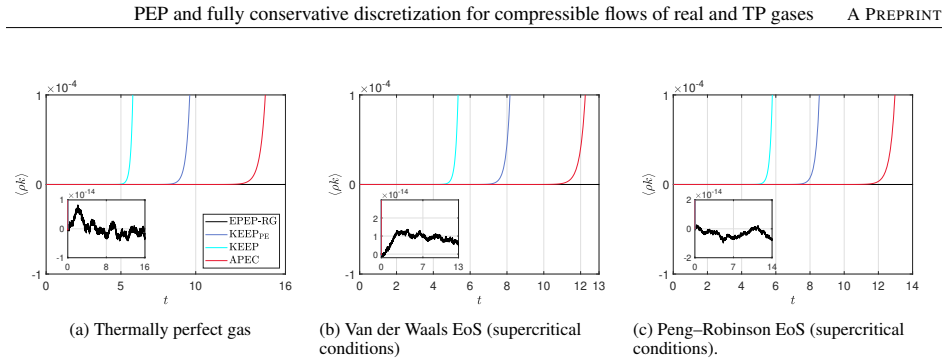
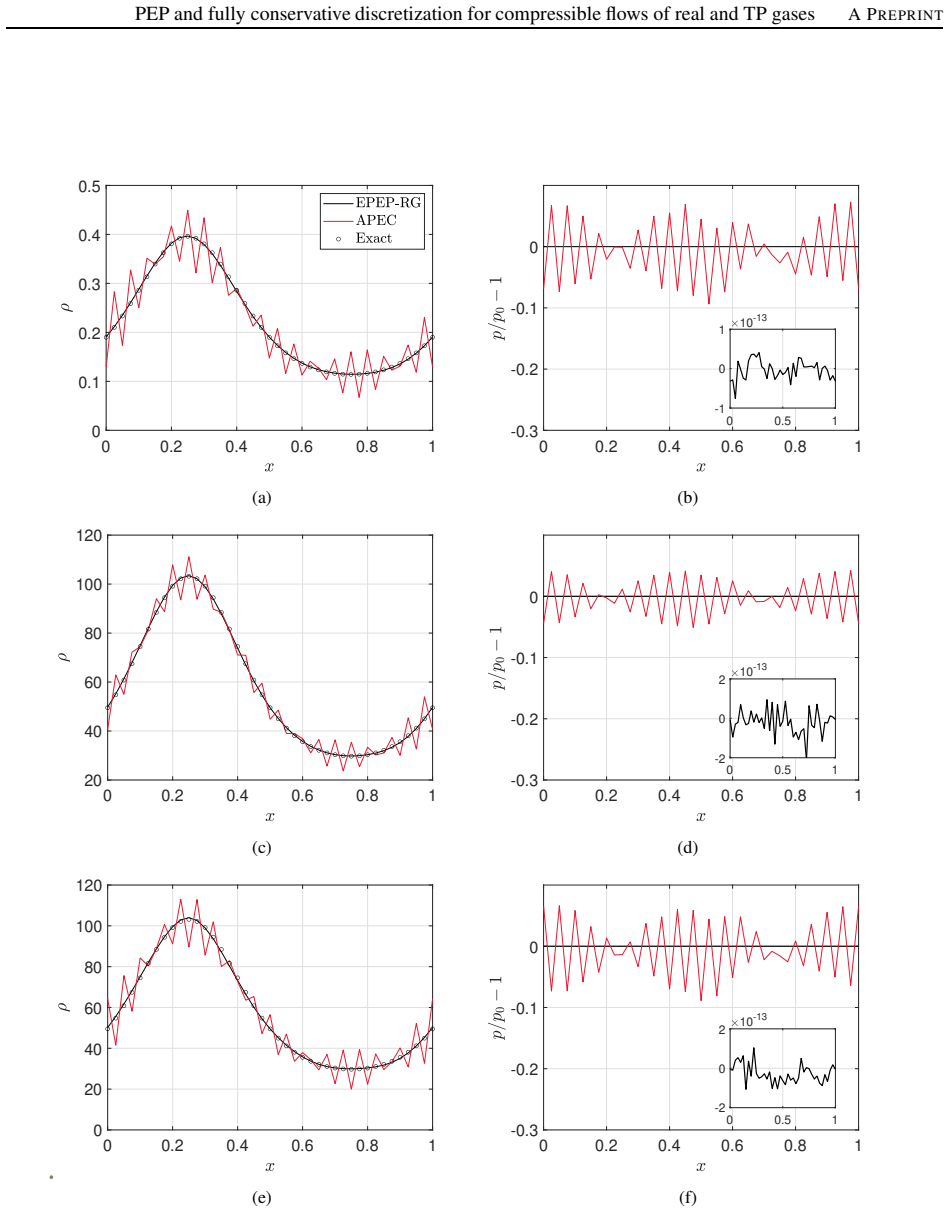
A one-dimensional advection test of a density discontinuity at constant velocity and pressure, checking whether the pressure field remains exactly uniform and total energy is conserved to machine precision under the proposed fluxes.
Figures




read the original abstract
Numerical simulations of compressible real-fluid flows are notoriously plagued by spurious pressure oscillations arising in regions of abrupt flow variations. As a possible remedy, several numerical formulations enforce the pressure equilibrium condition for the compressible Euler equations, typically at the cost of spoiling the correct conservation of total energy or by overspecifying the thermodynamical variables. This study proposes for the first time a numerical discretization procedure which is able to discretely preserve the full conservation of the linear invariants (mass, momentum and total energy) and to exactly enforce the pressure equilibrium condition. The method also preserves the conservation of kinetic energy by convection, and is based on the specification of nonlinear numerical fluxes for mass and internal energy which depend on the details of the equation of state. Both thermally perfect and real gases with an arbitrary equation of state are considered, and a simplified approximate pressure equilibrium preserving formulation with excellent performances is also proposed. The effectiveness of the novel formulations is assessed through a series of numerical simulations in supercritical and transcritical conditions with some of the most popular cubic equations of state.
Editorial analysis
A structured set of objections, weighed in public.
Referee Report
Summary. The manuscript proposes a discretization scheme for the compressible Euler equations (for both thermally perfect gases and real gases with arbitrary EOS) that uses nonlinear numerical fluxes for mass and internal energy (constructed to depend on the specific EOS) in order to simultaneously achieve discrete conservation of mass/momentum/total energy, exact enforcement of pressure equilibrium, and conservation of kinetic energy by convection. Explicit algebraic conditions and constructions are given for both an exact variant and a simplified approximate variant; the approach is verified on standard 1D/2D tests using cubic EOS (Peng-Robinson, Soave-Redlich-Kwong) in supercritical and transcritical regimes.
Significance. If the central derivations hold, the result would be significant because it resolves the tension between conservation and pressure-equilibrium preservation that has limited prior real-fluid simulations, without overspecifying thermodynamics or sacrificing total-energy conservation. The explicit flux constructions, derivation of the required algebraic conditions on the fluxes, and verification across relevant regimes constitute concrete strengths that could enable more reliable high-fidelity computations in propulsion and energy applications.
minor comments (3)
- The abstract and introduction state that the method 'exactly enforces the pressure equilibrium condition' and 'preserves the conservation of kinetic energy by convection,' but the precise discrete statements (e.g., which finite-volume or finite-difference operators are used and how the EOS-dependent fluxes enter the update) should be stated once in a single theorem-like box for clarity.
- Section describing the approximate variant: the claim of 'excellent performances' is supported by the reported tests, yet a short quantitative table comparing L2 errors or oscillation amplitudes between the exact and approximate formulations on the same 1D/2D cases would make the practical trade-off explicit.
- The manuscript tests only cubic EOS; a brief remark on whether the algebraic conditions derived in the general-EOS section remain well-posed for non-cubic forms (e.g., virial or tabulated EOS) would help readers assess generality.
Simulated Author's Rebuttal
We thank the referee for their positive summary of the manuscript, recognition of its significance for real-fluid simulations, and recommendation of minor revision. No specific major comments are listed in the report, so we have no points requiring point-by-point rebuttal or defense. We will prepare a revised manuscript addressing any minor editorial or typographical suggestions that may arise during the revision process.
Circularity Check
No significant circularity; derivation is constructive and self-contained
full rationale
The paper constructs explicit nonlinear numerical fluxes for mass and internal energy that depend on an arbitrary equation of state, then derives the algebraic conditions these fluxes must satisfy to enforce discrete conservation of mass/momentum/total energy, exact pressure equilibrium, and convective kinetic energy preservation. These conditions are solved directly from the target invariants without fitting parameters to data, without renaming prior results, and without load-bearing self-citations that reduce the central claim to an unverified premise. The approximate variant is presented transparently as a simplification. The derivation chain therefore remains independent of its own outputs and does not collapse by construction.
Axiom & Free-Parameter Ledger
axioms (2)
- domain assumption The compressible Euler equations govern the fluid motion under the considered conditions.
- domain assumption A discrete framework (e.g., finite-volume) exists in which fluxes can be designed to enforce exact algebraic properties.
Reference graph
Works this paper leans on
-
[1]
Pe ˇcnik, E
R. Pe ˇcnik, E. Rinaldi, P . Colonna, Computational fluid dynamics o f a radial compressor operating with supercritical CO 2, J. Eng. Gas Turbines Power 134 (2012)
2012
-
[2]
Jofre, J
L. Jofre, J. Urzay, Transcritical diffuse-interface hy drodynamics of propellants in high-pressure combustors of chemical propulsion Prog. Energy Combust. Sci. 82 (2021) 100877
2021
-
[3]
Guardone, P
A. Guardone, P . Colonna, M. Pini, A. Spinelli, Nonideal compressible fluid dynamics of dense vapors and supercritica l fluids, Annu. Rev. Fluid Mech. 56 (2024) 241–269
2024
-
[4]
Terashima, M
H. Terashima, M. Koshi, Approach for simulating gas–liq uid-like flows under supercritical pressures using a high-o rder central differencing J. Comput. Phys. 231 (2012) 6907–6923
2012
-
[5]
Abgrall, How to prevent pressure oscillations in mult icomponent flow calculations: A quasi conservative approac h, J
R. Abgrall, How to prevent pressure oscillations in mult icomponent flow calculations: A quasi conservative approac h, J. Comput. Phys. 125 (1996) 150–160
1996
-
[6]
T. Y . Hou, P . G. LeFloch, Why nonconservative schemes con verge to wrong solutions: error analysis, Math. Comput. 62 (1994) 497–530
1994
-
[7]
Karni, Multicomponent flow calculations by a consiste nt primitive algorithm, J
S. Karni, Multicomponent flow calculations by a consiste nt primitive algorithm, J. Comput. Phys. 112 (1994) 31–43
1994
-
[8]
Shyue, A fluid-mixture type algorithm for compress ible multicomponent flow with Mie–Grüneisen equation of sta te, J
K.-M. Shyue, A fluid-mixture type algorithm for compress ible multicomponent flow with Mie–Grüneisen equation of sta te, J. Comput. Phys. 171 (2001) 678–707
2001
-
[9]
Kawai, H
S. Kawai, H. Terashima, H. Negishi, A robust and accurate numerical method for transcritical turbulent flows at super critical pressure J. Comput. Phys. 300 (2015) 116–135
2015
-
[10]
Lacaze, T
G. Lacaze, T. Schmitt, A. Ruiz, J. C. Oefelein, Comparis on of energy-, pressure- and enthalpy-based approaches for modeling supercritical Comput. Fluids 181 (2019) 35–56
2019
-
[11]
Abgrall, S
R. Abgrall, S. Karni, Computations of compressible mul tifluids, J. Comput. Phys. 169 (2001) 594–623
2001
-
[12]
P . C. Ma, Y . Lv, M. Ihme, An entropy-stable hybrid scheme for simulations of transcritical real-fluid flows, J. Comput. Phys. 340 (2017) 330–357
2017
-
[13]
Fujiwara, Y
Y . Fujiwara, Y . Tamaki, S. Kawai, Fully conservative and pressure-equilibrium preserving scheme for compressibl e multi-component J. Comput. Phys. 478 (2023) 111973
2023
-
[14]
Terashima, N
H. Terashima, N. Ly, M. Ihme, Approximately pressure-e quilibrium-preserving scheme for fully conservative simu lations of compressible J. Comput Phys. 524 (2025) 113701
2025
-
[15]
W . J. Feiereisen, W . C. Reynolds, J. H. Ferziger, Numeri cal Simulation of Compressible, Homogeneous Turbu- lent Shear Flow, Technical Report TF-13, Stanford Universi ty, 1981
1981
-
[16]
Jameson, The construction of discretely conservati ve finite volume schemes that also globally conserve energy or entropy, J
A. Jameson, The construction of discretely conservati ve finite volume schemes that also globally conserve energy or entropy, J. Sci. Comput. 34 (2008) 152–187
2008
-
[17]
Pirozzoli, Generalized conservative approximatio ns of split convective derivative operators, J
S. Pirozzoli, Generalized conservative approximatio ns of split convective derivative operators, J. Comput. Phy s. 229 (2010) 7180–7190
2010
-
[18]
Shima, Y
N. Shima, Y . Kuya, Y . Tamaki, S. Kawai, Preventing spurious pressure oscillations in split convective form discret ization for compressible J. Comput. Phys. 427 (2021) 110060
2021
-
[19]
Ranocha, G
H. Ranocha, G. Gassner, Preventing pressure oscillati ons does not fix local linear stability issues of entropy-bas ed split-form high-order Commun. Appl. Math. Comput. 4 (2022) 880–903
2022
-
[20]
De Michele, G
C. De Michele, G. Coppola, Asymptotically entropy-con servative and kinetic-energy preserving numerical fluxes f or compressible J. Comput. Phys. 492 (2023) 112439
2023
-
[21]
De Michele, G
C. De Michele, G. Coppola, Novel pressure-equilibrium and kinetic-energy preserving fluxes for compressible flows based on the harmonic J. Comput. Phys. 518 (2024) 113338
2024
-
[22]
Kawai, S
S. Kawai, S. Kawai, Logarithmic mean approximation in i mproving entropy conservation in KEEP scheme with pressure equilibrium J. Comput. Phys. 530 (2025) 113897
2025
-
[23]
Bernades, L
M. Bernades, L. Jofre, F. Capuano, Kinetic-energy- and pressure-equilibrium-preserving schemes for real-gas tu rbulence in the transcritical J. Comput. Phys. 493 (2023) 112477
2023
-
[24]
Pirozzoli, Stabilized non-dissipative approximat ions of Euler equations in generalized curvilinear coordin ates, J
S. Pirozzoli, Stabilized non-dissipative approximat ions of Euler equations in generalized curvilinear coordin ates, J. Comput. Phys. 230 (2011) 2997–3014
2011
-
[25]
Y . Kuya, S. Kawai, High-order accurate kinetic-energy and entropy preserving (KEEP) schemes on curvilinear grids , J. Comput. Phys. 442 (2021) 110482. 19 PEP and fully conservative discretization for compressibl e flows of real and TP gases A P REPRINT
2021
-
[26]
LeFloch, J
P . LeFloch, J. Mercier, C. Rohde, Fully discrete, entro py conservative schemes of arbitrary order, SIAM J. Nu- mer. Anal. 40 (2002) 1968–1992
2002
-
[27]
T. C. Fisher, M. H. Carpenter, High-order entropy stabl e finite difference schemes for nonlinear conservation laws : Finite domains, J. Comput. Phys. 252 (2013) 518–557
2013
-
[28]
Ranocha, Comparison of some entropy conservative nu merical fluxes for the Euler equations, J
H. Ranocha, Comparison of some entropy conservative nu merical fluxes for the Euler equations, J. Sci. Comput. 76 (2018) 216–242
2018
-
[29]
Aiello, C
A. Aiello, C. De Michele, G. Coppola, Entropy conservat ive discretization of compressible Euler equations with an arbitrary equation J. Comput. Phys. 528 (2025) 113836
2025
-
[30]
Coppola, F
G. Coppola, F. Capuano, L. de Luca, Discrete energy-con servation properties in the numerical solution of the Navie r–Stokes equations Appl. Mech. Rev. 71 (2019) 010803–1 – 010803–19
2019
-
[31]
Coppola, F
G. Coppola, F. Capuano, S. Pirozzoli, L. de Luca, Numeri cally stable formulations of convective terms for turbulen t compressible flo J. Comput. Phys. 382 (2019) 86–104
2019
-
[32]
A. E. P . V eldman, A general condition for kinetic-energ y preserving discretization of flow transport equations, J. Comput. Phys. 398 (2019) 108894
2019
-
[33]
Coppola, A
G. Coppola, A. E. P . V eldman, Global and local conservation of mass, momentum and kinetic energy in the simulation of compressible J. Comput. Phys. 475 (2023) 111879
2023
-
[34]
De Michele, G
C. De Michele, G. Coppola, Numerical treatment of the en ergy equation in compressible flows simulations, Comput. Fluids 250 (2023) 105709
2023
-
[35]
Y . Kuya, K. Totani, S. Kawai, Kinetic energy and entropy preserving schemes for compressible flows by split convecti ve forms, J. Comput. Phys. 375 (2018) 823–853
2018
- [36]
-
[37]
Tadmor, The numerical viscosity of entropy stable sc hemes for systems of conservation laws
E. Tadmor, The numerical viscosity of entropy stable sc hemes for systems of conservation laws. I, Math. Com- put. 179 (1987) 91–103
1987
-
[38]
Tadmor, Entropy stability theory for difference app roximations of nonlinear conservation laws and related tim e-dependent problems Acta Numerica 12 (2003) 451–512
E. Tadmor, Entropy stability theory for difference app roximations of nonlinear conservation laws and related tim e-dependent problems Acta Numerica 12 (2003) 451–512
2003
-
[39]
H. Ranocha, Entropy conserving and kinetic energy pres erving numerical methods for the Euler equations using summ ation-by-parts in: S. J. Sherwin, D. Moxey, J. Peiró, P . E. Vincent, C. Schwab (Eds.), Spectral and High Order Methods for Partial Differential Equations ICOSAHOM 2018. Lecture Not es in Computational Science and Engineering, volume 134, Spr...
-
[40]
De Michele, A
C. De Michele, A. K. Edoh, G. Coppola, Finite-differenc e compatible entropy-conserving schemes for the compressi ble Euler equations J. Comput. Phys. (2025) 114262
2025
-
[41]
Ismail, P
F. Ismail, P . L. Roe, Affordable, entropy-consistent E uler flux functions II: Entropy production at shocks, J. Comput. Phys. 228 (2009) 5410–5436
2009
-
[42]
Klein, B
R. Klein, B. Sanderse, P . Costa, R. Pecnik, R. Henkes, Generalized Tadmor conditions and structure-preserving num erical fluxes for
-
[43]
doi:10.48550/arXiv.2603.15112. arXiv:2603.15112
-
[44]
M. A. Hansen, T. C. Fisher, Entropy Stable Discretizati on of Compressible Flows in Thermochemical Nonequi- librium, Technical Report, Sandia National Lab. (SNL-NM), Albuquerque, NM (United States), 2019. URL: https://www.osti.gov/biblio/1763209. doi:10.2172/1763209
-
[45]
Chase, NIST-JANAF Thermochemical Tables, 4th Editi on, American Institute of Physics, -1, 1998
M. Chase, NIST-JANAF Thermochemical Tables, 4th Editi on, American Institute of Physics, -1, 1998. URL: https://janaf.nist.gov/pdf/JANAF-FourthEd-1998-1Vol 1-Intro.pdf
1998
- [46]
-
[47]
Tosun, The Thermodynamics of Phase and Reaction Equi libria, second edition, Elsevier B.V ., 2021
I. Tosun, The Thermodynamics of Phase and Reaction Equi libria, second edition, Elsevier B.V ., 2021. 20
2021
discussion (0)
Sign in with ORCID, Apple, or X to comment. Anyone can read and Pith papers without signing in.