Recognition: unknown
Numerical evidence of a critical point in the (2+1)D SO(5) nonlinear sigma model with Wess-Zumino-Witten term
Pith reviewed 2026-05-07 04:08 UTC · model grok-4.3
The pith
Simulations identify a critical point in the SO(5) nonlinear sigma model with Wess-Zumino-Witten term separating ordered and symmetric disordered phases.
A machine-rendered reading of the paper's core claim, the machinery that carries it, and where it could break.
Core claim
We develop an optimized continuous-field quantum Monte Carlo algorithm to investigate the SO(5) nonlinear sigma model with a Wess-Zumino-Witten term, which describes half-filled Dirac fermions in 2+1 space-time dimensions. To regularize the theory, we project onto the lowest Landau level for both spherical and torus geometries. This advance enables simulations up to N_φ=140 on the torus and N_φ=49 on the sphere. Most notably, we identify and characterize a critical point that separates an SO(5)-broken ordered phase at small coupling from an SO(5)-symmetric disordered phase at large coupling. The critical point becomes multicritical upon the inclusion of terms that break the SO(5) symmetry to
What carries the argument
The optimized continuous-field quantum Monte Carlo algorithm with lowest Landau level projection, which reduces computational complexity to O(β N_q N_φ²) and enables mapping of the universal phase diagram at large system sizes.
If this is right
- The critical point becomes multicritical when SO(5) symmetry is broken down to U(1) × SU(2), providing a continuum description for the deconfined phase transition between Néel antiferromagnetic and valence-bond-solid orders.
- The disordered phase at large coupling is neither conformal nor trivially gapped, resembling a chiral quantum spin liquid with a small gap.
- The optimized QMC framework enables systematic studies of other projected Hamiltonians including correlated flat bands and fractional quantum Hall systems.
- The global structure of the phase diagram for the SO(5) nonlinear sigma model with Wess-Zumino-Witten term consists of an ordered phase, a critical point, and a symmetric disordered phase.
Where Pith is reading between the lines
- Confirmation of the multicritical point in the continuum limit could unify lattice deconfined criticality studies with field-theoretic descriptions.
- The suggested small gap in the disordered phase implies possible topological signatures such as fractional statistics or protected edge modes that larger-scale simulations could test.
- Adding further symmetry-breaking perturbations might reveal additional phases or lines of first-order transitions emanating from the multicritical point.
Load-bearing premise
Finite-size simulations up to N_φ=140 on the torus and N_φ=49 on the sphere suffice to determine the nature of the disordered phase in the thermodynamic limit as neither conformal nor trivially gapped without artifacts from the lowest Landau level projection.
What would settle it
A direct computation on larger systems demonstrating that the disordered phase either becomes conformal with power-law scaling or develops a gap that closes in the thermodynamic limit would falsify the identification of a stable multicritical point and the claimed character of the disordered phase.
Figures

read the original abstract
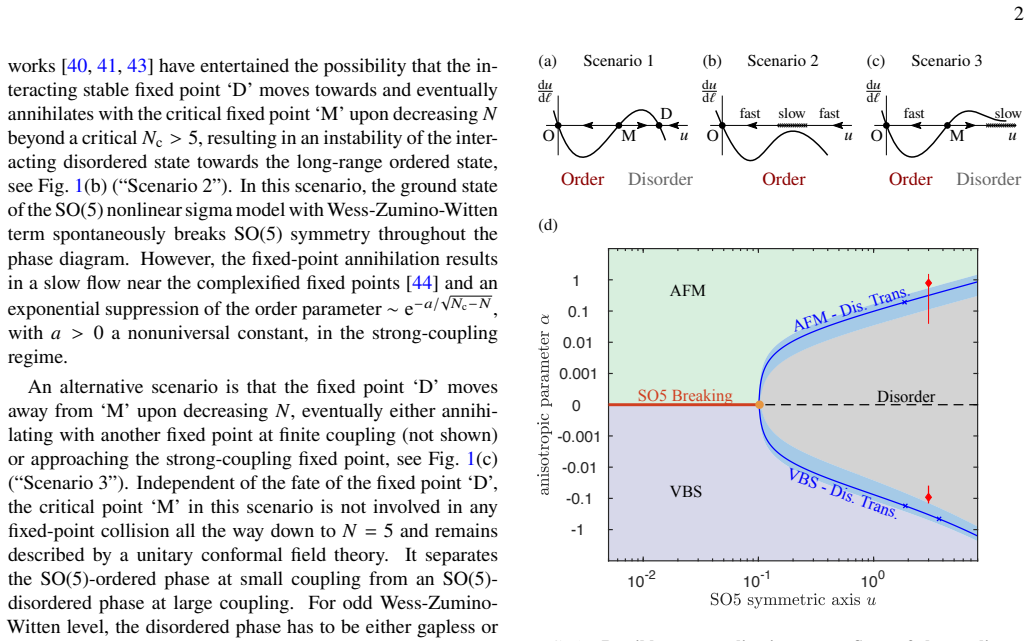
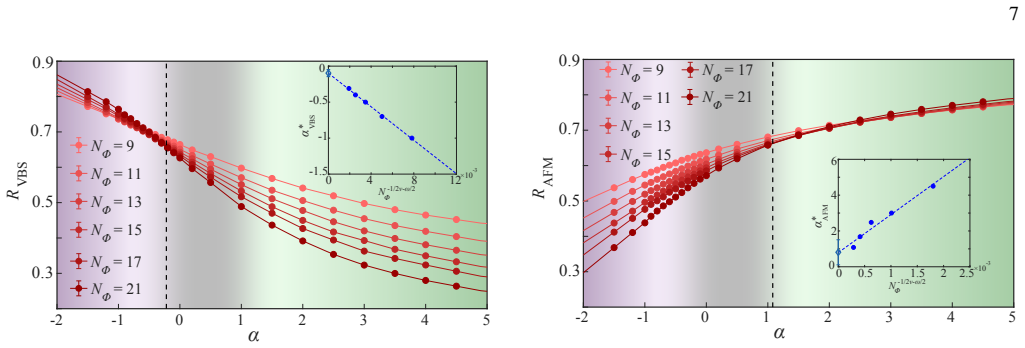
We develop an optimized continuous-field quantum Monte Carlo (QMC) algorithm to investigate the SO(5) nonlinear sigma model with a Wess-Zumino-Witten term, which describes half-filled Dirac fermions in 2+1 space-time dimensions akin to graphene and Yukawa coupled to a quintuplet of compatible mass terms. To regularize the theory, we project onto the lowest Landau level for both spherical and torus geometries. Our algorithm reduces the computational complexity to $O(\beta N_{\mathbf{q}} N_\phi^2)$, yielding a speedup of a factor of $N_\phi$ (the number of magnetic fluxes, i.e., system size) relative to prior works [1-3]. This advance enables us to simulate system sizes up to $N_\phi=140$ on torus and $N_\phi=49$ on sphere, far exceeding the maximum sizes accessed, and to map out the universal phase diagram of the model on both geometries. Most notably, we identify and characterize a critical point that separates an SO(5)-broken ordered phase at small coupling from an SO(5)-symmetric disordered phase at large coupling. The critical point becomes multicritical upon the inclusion of terms that break the SO(5) symmetry down to $\mathrm{U}(1) \times \mathrm{SU}(2)$, relevant for the deconfined phase transition between N\'eel antiferromagnetic and valence-bond-solid orders in quantum magnets. While the precise nature of the disordered phase in the thermodynamic limit remains to be determined, we argue that it is neither conformal nor trivially gapped, akin to a chiral quantum spin liquid with a small gap. Our finding of a multicritical point in the phase diagram of the SO(5) nonlinear sigma model with Wess-Zumino-Witten term resolves the long-standing open question of its global structure, and our QMC framework opens a new avenue for systematic studies of projected Hamiltonians, ranging from correlated flat bands to fractional quantum (anomalous) Hall systems.
Editorial analysis
A structured set of objections, weighed in public.
Referee Report
Summary. The manuscript develops an optimized continuous-field quantum Monte Carlo algorithm for the (2+1)D SO(5) nonlinear sigma model with Wess-Zumino-Witten term by projecting onto the lowest Landau level on torus and sphere geometries. This reduces complexity to O(β N_q N_φ²), enabling simulations up to N_φ=140 (torus) and N_φ=49 (sphere). The authors identify and characterize a critical point separating an SO(5)-broken ordered phase at small coupling from an SO(5)-symmetric disordered phase at large coupling. They show the critical point becomes multicritical when SO(5) is broken to U(1)×SU(2), relevant to deconfined Néel-VBS transitions, and argue the disordered phase is neither conformal nor trivially gapped, resembling a small-gap chiral quantum spin liquid.
Significance. If the numerical evidence holds, the work resolves the global phase diagram of the SO(5) NLSM with WZW term, addressing a long-standing question with implications for deconfined criticality in quantum magnets. The algorithmic advance (speedup by factor N_φ over prior works) is a clear strength, opening avenues for larger-scale studies of projected Hamiltonians in flat-band and fractional Hall systems. The multicritical point finding provides concrete numerical support for symmetry-breaking scenarios in 2D magnets.
major comments (3)
- [Abstract and results on disordered phase] Abstract and results section on the disordered phase: The claim that this phase is 'neither conformal nor trivially gapped' and 'akin to a chiral quantum spin liquid with a small gap' in the thermodynamic limit rests on data with maximum linear size ≈√140≈11.8. The abstract notes that the 'precise nature remains to be determined,' indicating the extrapolations (correlation lengths, gaps) may not yet rule out conformality or trivial gapping with controlled errors. Explicit finite-size scaling plots, order-parameter definitions, error bars, and convergence checks for the large-coupling regime are required to support the central phase-diagram conclusion.
- [Methods (LLL projection)] Methods section on regularization: The lowest-Landau-level projection is introduced to enable the efficient algorithm and larger N_φ, but no quantitative validation of its fidelity to the original continuum WZW term is provided (e.g., small-system comparisons without projection or estimates of higher-Landau-level corrections). This uncontrolled approximation is load-bearing for both the critical-point location and the disordered-phase characterization.
- [Results on symmetry-breaking terms] Results on multicriticality: The assertion that the critical point 'becomes multicritical' upon adding U(1)×SU(2)-breaking terms requires explicit simulation details, including the precise form of the added terms, the observables detecting the enlarged critical region, and scaling collapse or exponent estimates at the multicritical point.
minor comments (2)
- [Notation] Notation for system size (N_φ) and flux should be used consistently in text, equations, and figure captions.
- [References] The citations labeled [1-3] for prior algorithms should be expanded to full bibliographic entries.
Simulated Author's Rebuttal
We thank the referee for their careful reading of the manuscript and for providing constructive feedback. We address each of the major comments below and have updated the manuscript to incorporate additional details and clarifications where possible.
read point-by-point responses
-
Referee: [Abstract and results on disordered phase] Abstract and results section on the disordered phase: The claim that this phase is 'neither conformal nor trivially gapped' and 'akin to a chiral quantum spin liquid with a small gap' in the thermodynamic limit rests on data with maximum linear size ≈√140≈11.8. The abstract notes that the 'precise nature remains to be determined,' indicating the extrapolations (correlation lengths, gaps) may not yet rule out conformality or trivial gapping with controlled errors. Explicit finite-size scaling plots, order-parameter definitions, error bars, and convergence checks for the large-coupling regime are required to support the central phase-diagram conclusion.
Authors: We agree that the accessible system sizes remain modest (linear size ~11.8) and that the characterization of the disordered phase must be regarded as tentative, as already stated in the abstract. In the revised manuscript we have added explicit finite-size scaling plots of the correlation lengths and gaps for the large-coupling regime, together with the precise definitions of the order parameters employed, statistical error bars from the QMC runs, and convergence tests with respect to the projection cutoff. These additions make the supporting evidence more transparent. We continue to argue that the data are inconsistent with both a conformal fixed point and a trivially gapped phase, but we acknowledge that controlled extrapolation to the thermodynamic limit would require still larger sizes. revision: partial
-
Referee: [Methods (LLL projection)] Methods section on regularization: The lowest-Landau-level projection is introduced to enable the efficient algorithm and larger N_φ, but no quantitative validation of its fidelity to the original continuum WZW term is provided (e.g., small-system comparisons without projection or estimates of higher-Landau-level corrections). This uncontrolled approximation is load-bearing for both the critical-point location and the disordered-phase characterization.
Authors: The LLL projection is an essential regularization that makes the reported system sizes feasible. Direct unprojected simulations at the largest N_φ are computationally prohibitive, which motivated the projection in the first place. We have added a new subsection and accompanying figure in the Methods section that presents direct comparisons between projected and unprojected simulations for small systems (N_φ ≤ 20). These benchmarks show that the location of the critical point and the overall phase structure are preserved, with only small quantitative shifts. We also include perturbative estimates of higher-Landau-level corrections, which remain small throughout the coupling range studied. These additions provide the quantitative validation requested. revision: yes
-
Referee: [Results on symmetry-breaking terms] Results on multicriticality: The assertion that the critical point 'becomes multicritical' upon adding U(1)×SU(2)-breaking terms requires explicit simulation details, including the precise form of the added terms, the observables detecting the enlarged critical region, and scaling collapse or exponent estimates at the multicritical point.
Authors: We have substantially expanded the relevant subsection of the Results to supply the explicit functional form of the U(1)×SU(2)-breaking perturbations added to the Hamiltonian. We now detail the order-parameter observables (staggered magnetization and dimer correlations) used to detect the symmetry breaking and the resulting enlargement of the critical region. In addition, we present scaling-collapse plots and numerical estimates of the critical exponents obtained at the multicritical point from dedicated simulations with these perturbations. These revisions make the evidence for multicriticality fully explicit. revision: yes
Circularity Check
No circularity: direct numerical Monte Carlo evidence from regularized Hamiltonian sampling
full rationale
The paper is a computational study that develops an optimized QMC algorithm for the SO(5) NLSM with WZW term after LLL projection, then samples the resulting finite-size Hamiltonians on torus and sphere geometries up to N_φ=140 and 49. The central claims (location of a continuous critical point separating ordered and disordered phases, and the character of the large-coupling phase) are extracted from measured observables and finite-size scaling, not from any algebraic derivation or equation that reduces to its own inputs. Prior works [1-3] are cited only for algorithmic context and are not invoked as load-bearing uniqueness theorems or ansatzes that define the target result. No fitted parameters are relabeled as predictions, no self-citation chain substitutes for independent verification, and the LLL projection is presented explicitly as a regularization whose consequences are checked numerically rather than assumed by construction. The derivation chain is therefore self-contained against external benchmarks (Monte Carlo sampling of a well-defined lattice model) and receives score 0.
Axiom & Free-Parameter Ledger
free parameters (1)
- coupling strength
axioms (1)
- domain assumption Projection onto the lowest Landau level accurately regularizes the (2+1)D SO(5) nonlinear sigma model with WZW term for both spherical and toroidal geometries without introducing spurious artifacts.
Reference graph
Works this paper leans on
-
[1]
Continuum Hamiltonian Let’s consider a continuum Hamiltonian for interacting Dirac fermions in a magnetic field, projected onto the LLL. After integrating out high-energy fermionic degrees of free- dom, the system is described by a (2+1)D SO(5) nonlinear sigma model with a level-1 Wess-Zumino-Witten term[1, 8], with the microscopic Hamiltonian ˆH = ∫ 𝑑 𝒓 ...
-
[2]
Toric regularization For the toric geometry, we consider a 2D system of size 𝐿 𝑥 × 𝐿 𝑦 with periodic boundary conditions, subject to a uni- form perpendicular magnetic field in the Landau gauge. The LLL wave functions are plane-wave-like states with a Gaussian envelope, given by 𝜙𝑘 (𝒓) = 1√︃ 𝐿 𝑦𝑙𝐵 √𝜋 𝑒−(𝑟𝑥 /𝑙𝐵 −𝑙𝐵2 𝜋 𝑘/𝐿𝑦) 2/2𝑒𝑖2 𝜋 𝑘𝑟𝑦 /𝐿𝑦 , (14) where 𝑙𝐵...
-
[3]
Spherical regularization For the spherical geometry, we consider Dirac fermions on the surface of a sphere pierced by a magnetic monopole of charge 4 𝜋𝑠 (where 𝑠 is an integer or half-integer). The degeneracy of the LLL is 𝑁 𝜙 = 2𝑠 + 1, with wave functions given by monopole harmonics: 𝜙𝑘 (𝒓) = 𝑁𝑚𝑘 𝑒𝑖𝑚 𝑘 𝜙 cos𝑠+𝑚𝑘 𝜃 2 sin𝑠−𝑚𝑘 𝜃 2 , (16) where (𝜃, 𝜙) are th...
-
[4]
Ippoliti, R
M. Ippoliti, R. S. K. Mong, F. F. Assaad, and M. P. Zaletel, Physical Review B98, 235108 (2018)
2018
-
[5]
Z. Wang, M. P. Zaletel, R. S. K. Mong, and F. F. Assaad, Phys. Rev. Lett.126, 045701 (2021)
2021
-
[6]
B.-B. Chen, X. Zhang, Y. Wang, K. Sun, and Z. Y. Meng, Phys. Rev. Lett.132, 246503 (2024)
2024
-
[7]
Zheng and T
Y. Zheng and T. Ando, Phys. Rev. B65, 245420 (2002)
2002
-
[8]
K. S. Novoselov, A. K. Geim, S. V. Morozov, D. Jiang, M. I. Katsnelson, I. V. Grigorieva, S. V. Dubonos, and A. A. Firsov, Nature 438, 197 (2005)
2005
-
[9]
Zhang, Y.-W
Y. Zhang, Y.-W. Tan, H. L. Stormer, and P. Kim, Nature 438, 201 (2005)
2005
-
[10]
Li and E
G. Li and E. Y. Andrei, Nature Physics 3, 623 (2007)
2007
-
[11]
Lee and S
J. Lee and S. Sachdev, Phys. Rev. Lett. 114, 226801 (2015)
2015
-
[12]
F. D. M. Haldane, Phys. Rev. Lett. 51, 605 (1983)
1983
-
[13]
Affleck and F
I. Affleck and F. D. M. Haldane, Phys. Rev. B36, 5291 (1987)
1987
-
[14]
Abanov and P
A. Abanov and P. Wiegmann, Nuclear Physics B 570, 685 (2000)
2000
-
[15]
Tanaka and X
A. Tanaka and X. Hu, Phys. Rev. Lett. 95, 036402 (2005)
2005
-
[16]
Senthil and M
T. Senthil and M. P. A. Fisher, Phys. Rev. B74, 064405 (2006)
2006
-
[17]
Harada, N
K. Harada, N. Kawashima, and M. Troyer, Phys. Rev. Lett. 90, 117203 (2003)
2003
-
[18]
Senthil, L
T. Senthil, L. Balents, S. Sachdev, A. Vishwanath, and M. P. A. Fisher, Phys. Rev. B70, 144407 (2004)
2004
-
[19]
A. W. Sandvik, Phys. Rev. Lett. 98, 227202 (2007)
2007
-
[20]
Y. Q. Qin, Y.-Y. He, Y.-Z. You, Z.-Y. Lu, A. Sen, A. W. Sandvik, C. Xu, and Z. Y. Meng, Phys. Rev. X7, 031052 (2017)
2017
-
[21]
C. Wang, A. Nahum, M. A. Metlitski, C. Xu, and T. Senthil, Phys. Rev. X7, 031051 (2017). 14
2017
-
[22]
Ma, G.-Y
N. Ma, G.-Y. Sun, Y.-Z. You, C. Xu, A. Vishwanath, A. W. Sandvik, and Z. Y. Meng, Phys. Rev. B98, 174421 (2018)
2018
-
[23]
Y. Liu, Z. Wang, T. Sato, M. Hohenadler, C. Wang, W. Guo, and F. F. Assaad, Nature communications10, 1 (2019)
2019
-
[24]
Ma, Y.-Z
N. Ma, Y.-Z. You, and Z. Y. Meng, Phys. Rev. Lett.122, 175701 (2019)
2019
-
[25]
T. Senthil, Deconfined quantum critical points: a review (2023), arXiv:2306.12638 [cond-mat.str-el]
-
[26]
A. B. Kuklov, M. Matsumoto, N. V. Prokof’ev, B. V. Svistunov, and M. Troyer, Phys. Rev. Lett.101, 050405 (2008)
2008
-
[27]
Jiang, M
F.-J. Jiang, M. Nyfeler, S. Chandrasekharan, and U.-J. Wiese, J. Stat. Mech. 2008, P02009 (2008)
2008
-
[28]
K. Chen, Y. Huang, Y. Deng, A. B. Kuklov, N. V. Prokof’ev, and B. V. Svistunov, Phys. Rev. Lett.110, 185701 (2013)
2013
-
[29]
Nahum, J
A. Nahum, J. T. Chalker, P. Serna, M. Ortu ˜no, and A. M. So- moza, Phys. Rev. X5, 041048 (2015)
2015
-
[30]
M. S. Block, R. G. Melko, and R. K. Kaul, Phys. Rev. Lett.111, 137202 (2013)
2013
-
[31]
Harada, T
K. Harada, T. Suzuki, T. Okubo, H. Matsuo, J. Lou, H. Watan- abe, S. Todo, and N. Kawashima, Phys. Rev. B 88, 220408 (2013)
2013
-
[32]
J. Takahashi, H. Shao, B. Zhao, W. Guo, and A. W. Sand- vik, SO(5) multicriticality in two-dimensional quantum magnets (2024), arXiv:2405.06607 [cond-mat.str-el]
-
[33]
Zhao, Y.-C
J. Zhao, Y.-C. Wang, Z. Yan, M. Cheng, and Z. Y. Meng, Phys. Rev. Lett.128, 010601 (2022)
2022
-
[34]
Y.-C. Wang, N. Ma, M. Cheng, and Z. Y. Meng, SciPost Phys. 13, 123 (2022)
2022
-
[35]
Z. H. Liu, W. Jiang, B.-B. Chen, J. Rong, M. Cheng, K. Sun, Z. Y. Meng, and F. F. Assaad, Phys. Rev. Lett. 130, 266501 (2023)
2023
-
[36]
Y. Da Liao, G. Pan, W. Jiang, Y. Qi, and Z. Y. Meng, The teach- ing from entanglement: 2D SU(2) antiferromagnet to valence bond solid deconfined quantum critical points are not conformal (2023), arXiv:2302.11742 [cond-mat.str-el]
-
[38]
M. Song, J. Zhao, Z. Y. Meng, C. Xu, and M. Cheng, SciPost Phys. 17, 010 (2024)
2024
-
[39]
M. Song, J. Zhao, M. Cheng, C. Xu, M. Scherer, L. Janssen, and Z. Y. Meng, Science Advances11, eadr0634 (2025)
2025
-
[40]
D’Emidio and A
J. D’Emidio and A. W. Sandvik, Phys. Rev. Lett. 133, 166702 (2024)
2024
-
[41]
J. Zhao, Z. Y. Meng, Y.-C. Wang, and N. Ma, Phys. Rev. B112, 094416 (2025)
2025
-
[42]
Y. Zhu, Z. Liu, Z. Wang, Y.-C. Wang, and Z. Yan, Phys. Rev. Lett. 136, 046501 (2026)
2026
-
[43]
Nahum, Phys
A. Nahum, Phys. Rev. B 102, 201116 (2020)
2020
-
[44]
Ma and C
R. Ma and C. Wang, Phys. Rev. B 102, 020407 (2020)
2020
-
[45]
S. M. Chester and N. Su, Phys. Rev. Lett. 132, 111601 (2024)
2024
-
[46]
Zou, Y.-C
L. Zou, Y.-C. He, and C. Wang, Phys. Rev. X11, 031043 (2021)
2021
-
[47]
Rychkov, EPFL Lectures on Conformal Field Theory in D ≥3 Dimensions (Springer International Publishing, 2017)
S. Rychkov, EPFL Lectures on Conformal Field Theory in D ≥3 Dimensions (Springer International Publishing, 2017)
2017
-
[48]
Z. Zhou, L. Hu, W. Zhu, and Y.-C. He, Phys. Rev. X14, 021044 (2024)
2024
-
[49]
B.-B. Chen, X. Zhang, and Z. Y. Meng, Phys. Rev. B 110, 125153 (2024)
2024
-
[50]
W. Zhu, C. Han, E. Huffman, J. S. Hofmann, and Y.-C. He, Phys. Rev. X13, 021009 (2023)
2023
-
[51]
Huang, N
C. Huang, N. Parthenios, M. Ulybyshev, X. Zhang, F. F. Assaad, L. Classen, and Z. Y. Meng, Nature Communications 16, 7176 (2025)
2025
-
[52]
G. G. Batrouni, G. R. Katz, A. S. Kronfeld, G. P. Lepage, B. Svetitsky, and K. G. Wilson, Phys. Rev. D32, 2736 (1985)
1985
-
[53]
G. G. Batrouni and R. T. Scalettar, Phys. Rev. B 99, 035114 (2019)
2019
-
[54]
G ¨otz, S
A. G ¨otz, S. Beyl, M. Hohenadler, and F. F. Assaad, Phys. Rev. B 105, 085151 (2022)
2022
-
[55]
G. O. Roberts and J. S. Rosenthal, Journal of the Royal Statistical Society Series B: Statistical Methodology 60, 255 (1998)
1998
-
[56]
G. O. Roberts and J. S. Rosenthal, Statistical Science 16, 351 (2001)
2001
-
[57]
Nakayama and T
Y. Nakayama and T. Ohtsuki, Phys. Rev. Lett. 117, 131601 (2016)
2016
-
[58]
Poland, S
D. Poland, S. Rychkov, and A. Vichi, Rev. Mod. Phys.91, 015002 (2019)
2019
-
[59]
Z. Li, J. High Energy Phys. 2022 (11), 5
2022
-
[60]
R. G. Melko and R. K. Kaul, Phys. Rev. Lett. 100, 017203 (2008)
2008
-
[61]
See the Supplementary Information for additional results on phase boundaries away from the SO(5)-symmetric line on torus geometry, the measurements of the dynamical critical exponent, as well as improved DMRG data in AFM-Disorder transition
-
[62]
J. Lou, A. W. Sandvik, and N. Kawashima, Phys. Rev. B 80, 180414 (2009)
2009
-
[63]
R. K. Kaul and A. W. Sandvik, Phys. Rev. Lett. 108, 137201 (2012)
2012
-
[64]
Pujari, K
S. Pujari, K. Damle, and F. Alet, Phys. Rev. Lett. 111, 087203 (2013)
2013
-
[65]
Pujari, F
S. Pujari, F. Alet, and K. Damle, Phys. Rev. B91, 104411 (2015)
2015
-
[66]
Nahum, P
A. Nahum, P. Serna, J. T. Chalker, M. Ortu ˜no, and A. M. So- moza, Phys. Rev. Lett.115, 267203 (2015)
2015
-
[67]
E. Dyer, M. Mezei, S. S. Pufu, and S. Sachdev, J. High Energy Phys. 2015 (6), 37
2015
- [68]
-
[69]
J. Yang, A. W. Sandvik, and L. Wang, Phys. Rev. B105, L060409 (2022)
2022
-
[70]
L. L. Viteritti, R. Rende, A. Parola, S. Goldt, and F. Becca, Phys. Rev. B111, 134411 (2025)
2025
-
[71]
A. Maity, F. Ferrari, S. Capponi, K. Penc, J. Potten, T. M¨ uller, A. Feuerpfeil, R. Thomale, J. Y. Lee, R. Samajdar, and Y. Iqbal, arXiv preprint arXiv:2501.00096 10.48550/arXiv.2501.00096 (2024)
-
[72]
P. Corboz, Y. Zhang, B. Ponsioen, and F. Mila, arXiv e-prints , arXiv:2502.14091 (2025), arXiv:2502.14091 [cond-mat.str-el]
work page internal anchor Pith review arXiv 2025
-
[73]
J. Guo, G. Sun, B. Zhao, L. Wang, W. Hong, V. A. Sidorov, N. Ma, Q. Wu, S. Li, Z. Y. Meng, A. W. Sandvik, and L. Sun, Phys. Rev. Lett.124, 206602 (2020)
2020
-
[74]
Y. Cui, L. Liu, H. Lin, K.-H. Wu, W. Hong, X. Liu, C. Li, Z. Hu, N. Xi, S. Li, R. Yu, A. W. Sandvik, and W. Yu, Science 380, 1179 (2023)
2023
-
[75]
J. Guo, P. Wang, C. Huang, B.-B. Chen, W. Hong, S. Cai, J. Zhao, J. Han, X. Chen, Y. Zhou, S. Li, Q. Wu, Z. Y. Meng, and L. Sun, Communications Physics 8, 75 (2025)
2025
-
[76]
M. E. Zayed, C. R¨ uegg, J. Larrea J., A. M. L ¨auchli, C. Panagopoulos, S. S. Saxena, M. Ellerby, D. F. McMorrow, T. Str¨assle, S. Klotz, G. Hamel, R. A. Sadykov, V. Pomjakushin, M. Boehm, M. Jim ´enez–Ruiz, A. Schneidewind, E. Pom- jakushina, M. Stingaciu, K. Conder, and H. M. Rønnow, Nature Physics 13, 962 (2017). 15
2017
-
[77]
J. L. Jim ´enez, S. P. G. Crone, E. Fogh, M. E. Zayed, R. Lortz, E. Pomjakushina, K. Conder, A. M. L¨auchli, L. Weber, S. Wes- sel, A. Honecker, B. Normand, C. R¨ uegg, P. Corboz, H. M. Rønnow, and F. Mila, Nature592, 370 (2021)
2021
-
[78]
J. Guo, P. Wang, C. Huang, C. Zhou, M. Song, X. Chen, T.-T. Wang, W. Hong, S. Cai, J. Zhao, J. Han, Y. Zhou, Q. Wu, S. Li, Z. Y. Meng, and L. Sun, T-linear specific heat in pressurized and magnetized Shastry-Sutherland Mott insulator SrCu2(BO3)2 (2026), arXiv:2602.18229 [cond-mat.str-el]
-
[79]
X. Y. Xu, Y. Qi, L. Zhang, F. F. Assaad, C. Xu, and Z. Y. Meng, Phys. Rev. X9, 021022 (2019)
2019
-
[80]
C. Chen, U. F. P. Seifert, K. Feng, O. A. Starykh, L. Balents, and Z. Y. Meng, Emergent gauge flux in QED3 with flavor chemical potential: application to magnetized U(1) Dirac spin liquids (2025), arXiv:2508.08528 [cond-mat.str-el]
work page internal anchor Pith review arXiv 2025
-
[81]
K. Feng, C. Chen, and Z. Y. Meng, SciPost Phys.20, 060 (2026)
2026
discussion (0)
Sign in with ORCID, Apple, or X to comment. Anyone can read and Pith papers without signing in.