Recognition: unknown
Modeling the UV-photon irradiation of CS₂-bearing ices in the laboratory with the pyRate gas-grain astrochemical code. New insights into the missing sulfur problem
Pith reviewed 2026-05-07 04:13 UTC · model grok-4.3
The pith
Nondiffusive chemistry must be included to reproduce the sulfur-bearing species formed in UV-irradiated CO2:CS2 ices at 10 K.
A machine-rendered reading of the paper's core claim, the machinery that carries it, and where it could break.
Core claim
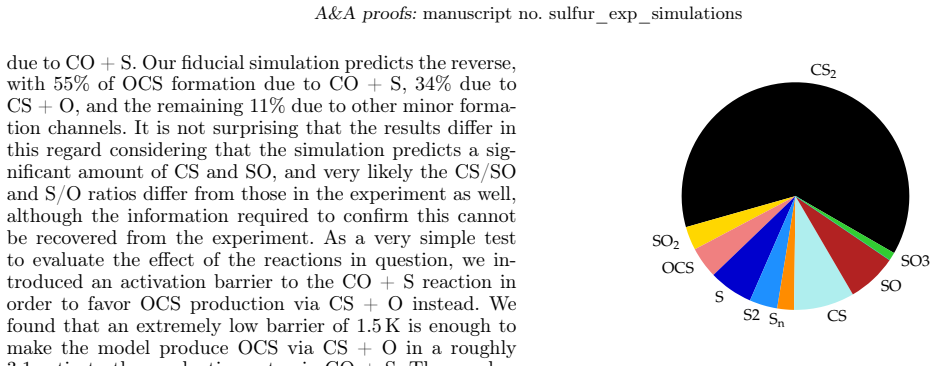
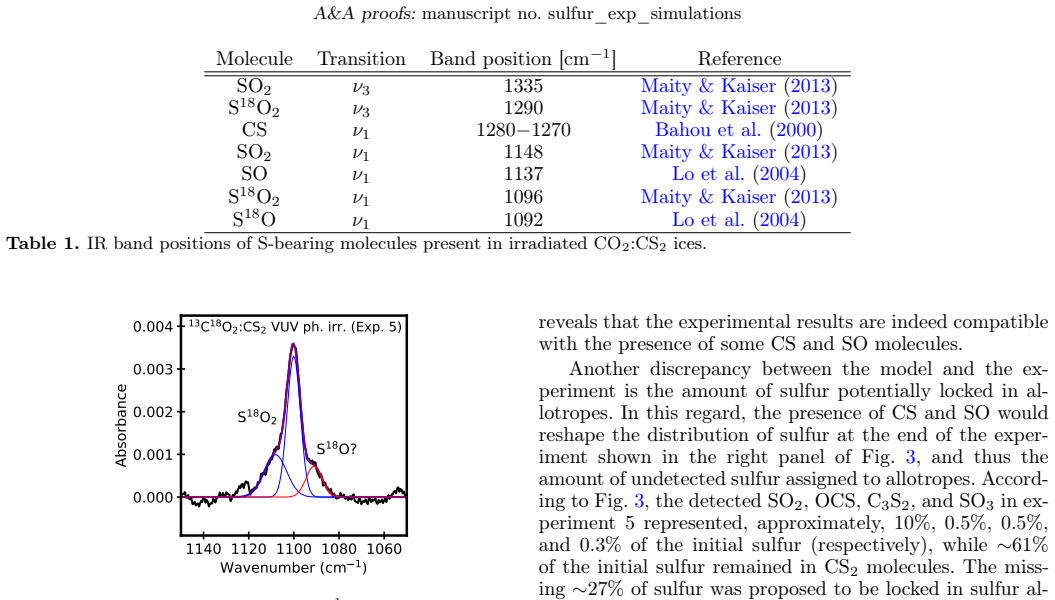
The central claim is that when the pyRate gas-grain astrochemical code is adapted to simulate VUV photon irradiation of a CO2:CS2 ice mixture at 10 K, nondiffusive chemistry on the ice surface is required to reproduce the formation of S-bearing species seen in the laboratory experiment. Even with this addition, the model overpredicts the abundances of OCS, CS, and SO while falling short for SO2 and sulfur allotropes. The authors attribute these mismatches to gaps in the known reaction set, uncertain energy barriers, and possible experimental uncertainties, and they note that the work marks the first rate-equation modeling of a multicomponent ice analog.
What carries the argument
The pyRate astrochemical code adapted to laboratory ice conditions and supplied with a compiled network of all known sulfur reactions, extended to include nondiffusive surface chemistry.
If this is right
- Models of interstellar ice chemistry must incorporate nondiffusive reactions to predict sulfur species correctly.
- Existing sulfur reaction networks for ices lack key pathways to SO2 and sulfur allotropes.
- Laboratory irradiation data supply direct constraints that can refine astrochemical networks for dense-cloud conditions.
- The same rate-equation modeling approach can be applied to other multicomponent ice mixtures to test elemental chemistry.
Where Pith is reading between the lines
- If nondiffusive processes dominate in cold ices, astronomical models of sulfur depletion onto grains may need to weight surface chemistry more heavily than gas-phase routes alone.
- Closing the abundance gaps could identify additional sulfur reservoirs in space that current observations have not yet detected.
- Systematic model-experiment comparisons of this type could be extended to other elements to map their partitioning between gas and ice in dense regions.
Load-bearing premise
The compiled chemical network contains every relevant sulfur reaction with accurate barriers, and the experimental identification and quantification of ice products contain no major systematic errors.
What would settle it
A new laboratory run that independently quantifies the abundances of OCS, CS, SO, SO2, and sulfur allotropes after identical UV irradiation and finds them in close agreement with the current model predictions without any added reactions would falsify the claim that the network is incomplete.
Figures





read the original abstract
Observations indicate that the total abundance of S-bearing species in dense clouds is orders of magnitude lower than the cosmic sulfur abundance. Addressing this "missing sulfur problem" requires a combination of astronomical observations, laboratory experiments, and theoretical models. In this work, we use the pyRate astrochemical model to simulate the VUV photon irradiation of a CO$_2$:CS$_2$ ice mixture at 10 K in the laboratory, with the goal of supporting the interpretation of the experimental results and testing our current understanding of the sulfur evolution in interstellar ices. For this purpose, the astrochemical model was adapted to the experimental conditions, and the chemical network was compiled from several sources to ensure that all known reactions involving sulfur species were included. The results indicate that nondiffusive chemistry is necessary to reproduce the formation of S-bearing species observed in the experiment. However, some discrepancies were found in the major S-bearing ice chemistry products predicted by the model and the experiment. The compounds OCS, CS, and SO are overpredicted by the model, while it falls short in accounting for $\rm SO_2$ and sulfur allotropes. These discrepancies are likely due to a combination of an incomplete knowledge of the chemical reactions at play (either because of missing reactions and/or because of unconstrained reaction barriers), and uncertainties in the experimental analysis. This work represents the first effort to model the chemistry of a multicomponent ice analog with a rate-equation based code, and highlights the complementary nature of theoretical and experimental astrochemistry to disentangle the chemical evolution of sulfur in the interstellar medium.
Editorial analysis
A structured set of objections, weighed in public.
Referee Report
Summary. The manuscript adapts the pyRate rate-equation astrochemical code to laboratory conditions and simulates VUV photon irradiation of a CO₂:CS₂ ice mixture at 10 K. A sulfur chemical network is compiled from multiple literature sources. Diffusive-only and nondiffusive model runs are compared to experimental abundances of S-bearing species. The authors conclude that nondiffusive chemistry is required to reproduce the observed formation of these species. Discrepancies remain, with the model overpredicting OCS, CS, and SO while underpredicting SO₂ and sulfur allotropes; these are ascribed to incomplete reaction knowledge or experimental uncertainties. The work is presented as the first rate-equation treatment of multicomponent CS₂ ice chemistry and offers insights relevant to the missing sulfur problem.
Significance. If the central claim holds after addressing network robustness, the paper advances understanding of sulfur evolution in interstellar ices by demonstrating that nondiffusive processes are needed in the model to match laboratory formation of S-bearing species. As the first rate-equation modeling of a multicomponent CS₂-bearing ice, it provides a reproducible framework for future gas-grain simulations and highlights gaps in sulfur reaction networks. The transparent discussion of model-experiment mismatches strengthens its value for guiding both laboratory and theoretical work on the missing sulfur problem in dense clouds.
major comments (2)
- [§4 (model-experiment comparison)] §4 (model-experiment comparison): The claim that nondiffusive chemistry is necessary rests on the diffusive-only run failing to produce the observed S-bearing species while the nondiffusive version succeeds. However, the reported overprediction of OCS/CS/SO and underprediction of SO₂ and allotropes indicate that the compiled network may omit key channels. If additional reactions (e.g., nondissociative routes to SO₂ or S₈ formation) were added to the diffusive network, the necessity of nondiffusive terms could be removed. A sensitivity test adding plausible missing reactions and re-running the diffusive case is needed to confirm the claim is robust.
- [§2.2 (chemical network compilation)] §2.2 (chemical network compilation): The network is assembled from several external compilations to include 'all known' sulfur reactions. No table enumerating the full set of included reactions, rate coefficients, activation barriers, or branching ratios is provided. This omission makes it impossible for readers to assess completeness or reproduce the exact setup, which is critical because the paper itself attributes product mismatches to missing reactions.
minor comments (2)
- [Discussion and conclusions] The connection between the laboratory results and the astronomical missing sulfur problem is stated in the abstract and introduction but remains qualitative. A short paragraph in the discussion quantifying how the modeled ice abundances would affect gas-phase sulfur depletion upon desorption would strengthen the broader context.
- [Figures] Figures comparing model and experimental abundances should include laboratory uncertainty estimates (e.g., error bars on measured column densities) to allow quantitative assessment of agreement or discrepancy.
Simulated Author's Rebuttal
We thank the referee for their constructive and detailed review, which has helped us improve the clarity and robustness of our manuscript. We have addressed the major comments point by point below, making revisions where feasible to strengthen the presentation of our results on the necessity of nondiffusive chemistry and the reproducibility of the chemical network.
read point-by-point responses
-
Referee: §4 (model-experiment comparison): The claim that nondiffusive chemistry is necessary rests on the diffusive-only run failing to produce the observed S-bearing species while the nondiffusive version succeeds. However, the reported overprediction of OCS/CS/SO and underprediction of SO₂ and allotropes indicate that the compiled network may omit key channels. If additional reactions (e.g., nondissociative routes to SO₂ or S₈ formation) were added to the diffusive network, the necessity of nondiffusive terms could be removed. A sensitivity test adding plausible missing reactions and re-running the diffusive case is needed to confirm the claim is robust.
Authors: We appreciate this thoughtful challenge to the robustness of our central claim. The diffusive-only simulation yields essentially zero abundances for the observed S-bearing species because, at 10 K, thermal hopping and diffusion are frozen out, preventing encounters between distinct molecular species. Nondiffusive processes (e.g., hot-atom reactions or in-place recombination of photodissociation fragments) provide the only viable formation routes under these conditions. While we agree that the network is incomplete—as indicated by the abundance mismatches—we note that adding unspecified reactions to the diffusive case would require arbitrary assumptions about rates, barriers, and branching ratios that are not constrained by existing data. Such a test would therefore not be physically meaningful and could not falsify the necessity of nondiffusive terms. We have expanded the discussion in §4 to explicitly address this point, clarifying that the requirement for nondiffusive chemistry stems from the physical regime rather than network gaps alone. This constitutes a partial revision. revision: partial
-
Referee: §2.2 (chemical network compilation): The network is assembled from several external compilations to include 'all known' sulfur reactions. No table enumerating the full set of included reactions, rate coefficients, activation barriers, or branching ratios is provided. This omission makes it impossible for readers to assess completeness or reproduce the exact setup, which is critical because the paper itself attributes product mismatches to missing reactions.
Authors: We agree that the absence of a tabulated network hinders reproducibility and evaluation of completeness. In the revised manuscript we have added a new Table 2 in §2.2 that enumerates every reaction in the sulfur network, including the literature source, rate coefficient (or expression), activation barrier, and branching ratio for each entry. This table consolidates the information previously distributed across the cited compilations and directly addresses the concern raised. revision: yes
- A quantitative sensitivity test that adds 'plausible' missing reactions to the diffusive-only network cannot be performed without introducing unconstrained assumptions about unknown channels, rates, and barriers; the specific omissions responsible for the observed mismatches are not known a priori.
Circularity Check
No significant circularity; model tested against independent lab benchmarks
full rationale
The paper compiles its sulfur chemical network from multiple external literature sources and adapts the pyRate code to laboratory conditions (10 K VUV irradiation of CO2:CS2 ice). Outputs are compared to independent experimental product abundances. The claim that nondiffusive chemistry is required follows from the diffusive-only run failing to form observed S-bearing species while the nondiffusive version reproduces them better. Discrepancies (overproduction of OCS/CS/SO, underproduction of SO2/allotropes) are explicitly ascribed to possible missing reactions or experimental uncertainties rather than tuned away. No parameters are fitted to the target data and then relabeled as predictions. The work is described as the first rate-equation treatment of a multicomponent CS2 ice, with no load-bearing self-citation chain or uniqueness theorem invoked to force the nondiffusive choice. The derivation therefore rests on external experimental benchmarks and literature reactions, not on any self-referential reduction.
Axiom & Free-Parameter Ledger
free parameters (1)
- nondiffusive reaction efficiencies
axioms (2)
- domain assumption Rate-equation treatment of surface chemistry is adequate when nondiffusive channels are included
- ad hoc to paper All important sulfur reactions are captured in the compiled network
Reference graph
Works this paper leans on
-
[1]
Ice origins of OCS and chemistry of CS _ 2 -bearing ice mantles. , keywords =. doi:10.1093/mnras/stae2345 , archivePrefix =. 2410.07736 , primaryClass =
-
[2]
Photoelectric heating of interstellar gas. , keywords =. doi:10.1086/190513 , adsurl =
-
[3]
Formation of Complex Organic Molecules in Hot Molecular Cores through Nondiffusive Grain-surface and Ice-mantle Chemistry. , keywords =. doi:10.3847/1538-4365/ac3131 , archivePrefix =. 2110.09743 , primaryClass =
-
[4]
, keywords =
Three-Phase Chemical Models of Dense Interstellar Clouds - Gas Dust Particle Mantles and Dust Particle Surfaces. , keywords =
-
[5]
Measurements and simulations of rate coefficients for the deuterated forms of the H _ 2 ^ + + H _ 2 and H _ 3 ^ + + H _ 2 reactive systems at low temperature. , keywords =. doi:10.1051/0004-6361/202451757 , archivePrefix =. 2412.02206 , primaryClass =
-
[6]
Formation of Complex Organic Molecules in Cold Interstellar Environments through Nondiffusive Grain-surface and Ice-mantle Chemistry. , keywords =. doi:10.3847/1538-4365/ab9ec8 , archivePrefix =. 2006.11127 , primaryClass =
-
[7]
, archivePrefix = "arXiv", eprint =
Photodesorption of ices I: CO, N _ 2 , and CO _ 2. , archivePrefix = "arXiv", eprint =. doi:10.1051/0004-6361/200810207 , adsurl =
-
[8]
2023, , 680, A87, 10.1051/0004-6361/202245367
Modelling deuterated isotopologues of methanol towards the pre-stellar core L1544. , keywords =. doi:10.1051/0004-6361/202245367 , archivePrefix =. 2310.08389 , primaryClass =
-
[9]
On Simulating the Proton-irradiation of O _ 2 and H _ 2 O Ices Using Astrochemical-type Models, with Implications for Bulk Reactivity. , keywords =. doi:10.3847/1538-4357/ab16d5 , archivePrefix =. 1904.04143 , primaryClass =
-
[10]
, archivePrefix = "arXiv", eprint =
Benchmarking spin-state chemistry in starless core models. , archivePrefix = "arXiv", eprint =. doi:10.1051/0004-6361/201424364 , adsurl =
-
[11]
The 2014 KIDA Network for Interstellar Chemistry. , keywords =. doi:10.1088/0067-0049/217/2/20 , archivePrefix =. 1503.01594 , primaryClass =
-
[12]
Electron Irradiation of Carbon Disulfide-Oxygen Ices: Toward the Formation of Sulfur-bearing Molecules in Interstellar Ices. , keywords =. doi:10.1088/0004-637X/773/2/184 , adsurl =
-
[13]
Sulphur chemistry in the L1544 pre-stellar core. , keywords =. doi:10.1093/mnras/sty1336 , archivePrefix =. 1806.01102 , primaryClass =
-
[14]
Sulfur Chemistry in Protoplanetary Disks: CS and H _ 2 CS. , keywords =. doi:10.3847/1538-4357/ab1416 , archivePrefix =. 1903.11105 , primaryClass =
-
[15]
Gas phase Elemental abundances in Molecular cloudS (GEMS). VII. Sulfur elemental abundance. , keywords =. doi:10.1051/0004-6361/202244843 , archivePrefix =. 2212.03742 , primaryClass =
-
[16]
Gas phase Elemental abundances in Molecular cloudS (GEMS). I. The prototypical dark cloud TMC 1. , keywords =. doi:10.1051/0004-6361/201834654 , archivePrefix =. 1809.04978 , primaryClass =
-
[17]
Modeling sulfur depletion in interstellar clouds. , keywords =. doi:10.1051/0004-6361/201834446 , archivePrefix =. 1903.01232 , primaryClass =
-
[18]
AB Aur, a Rosetta stone for studies of planet formation. I. Chemical study of a planet-forming disk. , keywords =. doi:10.1051/0004-6361/202038549 , archivePrefix =. 2008.00751 , primaryClass =
-
[19]
2016 , doi =
Photochemistry and Astrochemistry: Photochemical Pathways to Interstellar Complex Organic Molecules , journal =. 2016 , doi =
2016
-
[20]
Proceedings of the VIII Iberian Congress on Planetary Sciences and Solar System Exploration , year = 2025, month = jan, eid =
Mimicking Ice Processes in the Lab for the Interpretation of Jwst Observations of Solar System Ices. Proceedings of the VIII Iberian Congress on Planetary Sciences and Solar System Exploration , year = 2025, month = jan, eid =
2025
-
[21]
Sulfur depletion in dense clouds and circumstellar regions. I. H _ 2 S ice abundance and UV-photochemical reactions in the H _ 2 O-matrix. , keywords =. doi:10.1051/0004-6361/201014821 , archivePrefix =. 1112.3240 , primaryClass =
-
[22]
Soft X-Ray Irradiation of H _ 2 S Ice and the Presence of S _ 2 in Comets. , keywords =. doi:10.1088/2041-8205/751/2/L40 , adsurl =
-
[23]
Organic products made from UV photoprocessing of realistic ice analogs containing H _ 2 S
Sulphur depletion in dense clouds and circumstellar regions. Organic products made from UV photoprocessing of realistic ice analogs containing H _ 2 S. , keywords =. doi:10.1093/mnras/stu1100 , adsurl =
-
[24]
Formation and desorption of sulphur chains (H _ 2 S _ x and S _ x ) in cometary ice: effects of ice composition and temperature. , keywords =. doi:10.1093/mnras/stae1768 , archivePrefix =. 2407.14135 , primaryClass =
-
[25]
, year = 2008, month = jul, volume =
H-implantation in SO _ 2 and CO _ 2 ices. , year = 2008, month = jul, volume =. doi:10.1016/j.pss.2008.05.002 , adsurl =
-
[26]
The fate of S-bearing species after ion irradiation of interstellar icy grain mantles. , keywords =. doi:10.1051/0004-6361/200913040 , adsurl =
-
[27]
Chemical Pathways of SO _ 2 with Hydrogen Atoms on Interstellar Ice Analogues. , keywords =. doi:10.3847/1538-4357/ad88ec , archivePrefix =. 2411.09129 , primaryClass =
-
[28]
Building S chains in translucent clouds and comets
Photoprocessing of H _ 2 S on dust grains. Building S chains in translucent clouds and comets. , keywords =. doi:10.1051/0004-6361/202141861 , archivePrefix =. 2110.04230 , primaryClass =
-
[29]
Sulphur-bearing species in the coma of comet 67P/Churyumov-Gerasimenko. , keywords =. doi:10.1093/mnras/stw2601 , adsurl =
-
[30]
Ammonium hydrosulfide (NH _ 4 SH) as a potentially significant sulfur sink in interstellar ices. , keywords =. doi:10.1051/0004-6361/202451383 , archivePrefix =. 2410.02860 , primaryClass =
-
[31]
Spectroscopic sizing of interstellar icy grains with JWST. Nature Astronomy , year = 2024, month = mar, volume =. doi:10.1038/s41550-023-02155-x , adsurl =
-
[32]
Predicting the detectability of sulphur-bearing molecules in the solid phase with simulated spectra of JWST instruments. , keywords =. doi:10.1051/0004-6361/202452900 , archivePrefix =. 2502.09384 , primaryClass =
-
[33]
Why does ammonia not freeze out in the centre of pre-stellar cores?. , keywords =. 2019. doi:10.1093/mnras/stz1344 , archivePrefix =. 1905.02384 , primaryClass =
-
[34]
Forming deuterated methanol in pre-stellar core conditions. , keywords =. doi:10.1051/0004-6361/202554835 , adsurl =
-
[35]
A general method for the inclusion of radiation chemistry in astrochemical models. Physical Chemistry Chemical Physics (Incorporating Faraday Transactions) , year = 2018, month = feb, volume =. doi:10.1039/C7CP05901A , adsurl =
-
[36]
Efficient Production of S _ 8 in Interstellar Ices: The Effects of Cosmic-Ray-driven Radiation Chemistry and Nondiffusive Bulk Reactions. , keywords =. doi:10.3847/1538-4357/ab5360 , archivePrefix =. 1911.01239 , primaryClass =
-
[37]
Effect of grain size distribution and size-dependent grain heating on molecular abundances in starless and pre-stellar cores. , keywords =. doi:10.1051/0004-6361/202038353 , archivePrefix =. 2006.09741 , primaryClass =
-
[38]
Fine-tuning the complex organic molecule formation: Sulfur and CO ice as regulators of surface chemistry. , keywords =. doi:10.1051/0004-6361/202554678 , archivePrefix =. 2507.17595 , primaryClass =
-
[39]
Grain growth and its chemical impact in the first hydrostatic core phase. , keywords =. doi:10.1051/0004-6361/202347847 , archivePrefix =. 2403.01905 , primaryClass =
-
[40]
Grain size limits derived from 3.6 m and 4.5 m coreshine. , keywords =. doi:10.1051/0004-6361/201425434 , archivePrefix =. 1508.04691 , primaryClass =
-
[41]
Chemistry in disks. IV. Benchmarking gas-grain chemical models with surface reactions. , keywords =. doi:10.1051/0004-6361/201015149 , archivePrefix =. 1007.2302 , primaryClass =
-
[42]
Mark J. Loeffler and Reggie L. Hudson and Nancy J. Chanover and Amy A. Simon , keywords =. Giant-planet chemistry: Ammonium hydrosulfide (NH4SH), its IR spectra and thermal and radiolytic stabilities , journal =. 2015 , issn =. doi:https://doi.org/10.1016/j.icarus.2015.06.015 , url =
-
[43]
Mark J. Loeffler and Reggie L. Hudson and Nancy J. Chanover and Amy A. Simon , keywords =. The spectrum of Jupiter's Great Red Spot: The case for ammonium hydrosulfide (NH4SH) , journal =. 2016 , issn =. doi:https://doi.org/10.1016/j.icarus.2016.02.010 , url =
-
[44]
Mark J. Loeffler and Reggie L. Hudson , keywords =. Coloring Jupiter's clouds: Radiolysis of ammonium hydrosulfide (NH4SH) , journal =. 2018 , issn =. doi:https://doi.org/10.1016/j.icarus.2017.10.041 , url =
-
[45]
Formation of carbonyl sulfide (OCS) via SH radicals in interstellar CO-rich ice under dense cloud conditions , DOI= "10.1051/0004-6361/202451368", url= "https://doi.org/10.1051/0004-6361/202451368", journal =
-
[46]
Ferrante, Robert F. and Moore, Marla H. and Spiliotis, Morgan M. and Hudson, Reggie L. , title =. The Astrophysical Journal , abstract =. 2008 , month =. doi:10.1086/590362 , url =
-
[47]
Thermal and energetic processing of astrophysical ice analogues rich in SO2 , DOI= "10.1051/0004-6361/201730711", url= "https://doi.org/10.1051/0004-6361/201730711", journal =
-
[48]
Chemical Composition of Icy Satellite Surfaces , DOI= "10.1007/s11214-010-9665-8", journal =
-
[49]
Inventory of the volatiles on comet 67P/Churyumov-Gerasimenko from Rosetta/ROSINA , DOI= "10.1051/0004-6361/201526450", url= "https://doi.org/10.1051/0004-6361/201526450", journal =
-
[50]
Formation of c-C6H5CN Ice Using the SPACE TIGER Experimental Setup , journal =
-
[51]
CO DIFFUSION INTO AMORPHOUS H2O ICES , journal =
-
[52]
Grain Surface Models and Data for Astrochemistry , journal =
-
[53]
Modelling methanol and hydride formation in the JWST Ice Age era , DOI= "10.1051/0004-6361/202452389", url= "https://doi.org/10.1051/0004-6361/202452389", journal =
-
[54]
and Ioppolo, Sergio and Linnartz, Harold
Lamberts, Thanja and Cuppen, Herma M. and Ioppolo, Sergio and Linnartz, Harold. Water formation at low temperatures by surface O2 hydrogenation III: Monte Carlo simulation. Phys. Chem. Chem. Phys. 2013. doi:10.1039/C3CP00106G
-
[55]
Relevance of the H2 + O reaction pathway for the surface formation of interstellar water - Combined experimental and modeling study , DOI= "10.1051/0004-6361/201424252", url= "https://doi.org/10.1051/0004-6361/201424252", journal =
-
[56]
and Fedoseev, G
Ioppolo, S. and Fedoseev, G. and Chuang, K.J. and Cuppen, H.M. and Clements, A.R. and Jin, M. and Garrod, R.T. and Qasim, D. and Kofman, V. and van Dishoeck, E.F. and Linnarz, H. , title =
-
[57]
Cuppen, H. M. and Herbst, Eric , title =. The Astrophysical Journal , abstract =. 2007 , month =. doi:10.1086/521014 , url =
-
[58]
Vasyunin, A. I. and Caselli, P. and Dulieu, F. and Jiménez-Serra, I. , title =. The Astrophysical Journal , abstract =. 2017 , month =. doi:10.3847/1538-4357/aa72ec , url =
-
[59]
Monthly Notices of the Royal Astronomical Society , volume =
Gerasimenko, S and Carvalho, G A and Zanatto, F and Santana, F K and Pilling, S , title =. Monthly Notices of the Royal Astronomical Society , volume =. 2025 , month =. doi:10.1093/mnras/staf1738 , url =
-
[60]
Pilling, Sergio and Carvalho, Geanderson A. and Rocha, Will R. M. , title =. The Astrophysical Journal , abstract =. 2022 , month =. doi:10.3847/1538-4357/ac3d8a , url =
-
[61]
2026 , eprint=
Using astrochemical models to simulate reactivity experiments on cold surfaces , author=. 2026 , eprint=
2026
-
[62]
Gas and Grain Chemical Composition in Cold Cores as Predicted by the
Ruaud, Maxime and Wakelam, Valentine and Hersant, Franck , title =. Monthly Notices of the Royal Astronomical Society , volume =. 2016 , month =. doi:10.1093/mnras/stw887 , url =
-
[63]
Vacuum-UV spectroscopy of interstellar ice analogs - I. Absorption cross-sections of polar-ice molecules⋆ , DOI= "10.1051/0004-6361/201322140", url= "https://doi.org/10.1051/0004-6361/201322140", journal =
-
[64]
Production and IR Absorption of Cyclic CS _2 in Solid Ar , journal =
-
[65]
and Schutte W.A
Gerakines, P.A. and Schutte W.A. and Greenberg J.M. and van Dishoeck E.F. , title =
-
[66]
Yarnall, Yukiko Y. and Hudson, Reggie L. , title =. The Astrophysical Journal Letters , abstract =. 2022 , month =. doi:10.3847/2041-8213/ac6b32 , url =
-
[67]
A Unified Monte Carlo Treatment of Gas-Grain Chemistry for Large Reaction Networks. II. A Multiphase Gas-surface-layered Bulk Model. , keywords =. doi:10.1088/0004-637X/762/2/86 , archivePrefix =. 1211.3025 , primaryClass =
-
[68]
Multilayer Formation and Evaporation of Deuterated Ices in Prestellar and Protostellar Cores. , keywords =. doi:10.1088/0004-637X/791/1/1 , archivePrefix =. 1405.3268 , primaryClass =
-
[69]
Perrero, Jessica and Beitia-Antero, Leire and Fuente, Asunción and Ugliengo, Piero and Rimola, Albert , title =. The Astrophysical Journal , abstract =. 2024 , month =. doi:10.3847/1538-4357/ad5548 , url =
-
[70]
Vacuum ultraviolet photochemistry of CS2 isolated in H2/D2 matrices at 3.5 K , DOI= "10.1051/0004-6361/202557502", url= "https://doi.org/10.1051/0004-6361/202557502", journal =
-
[71]
Carolina H. Modeling the chemical evolution and kinetics of pure H2O Ices under various types of radiation employing the PROCODA code , journal =. 2024 , issn =. doi:https://doi.org/10.1016/j.asr.2023.10.027 , url =
-
[72]
Silva, J. R. C. and Queiroz, L. M. S. V. and Ferrão, L. F. A. and Pilling, S. , title =. The Astrophysical Journal , abstract =. 2025 , month =. doi:10.3847/1538-4357/adc924 , url =
-
[73]
Pilling, S. and Bergantini, A. , title =. The Astrophysical Journal , abstract =. 2015 , month =. doi:10.1088/0004-637X/811/2/151 , url =
-
[74]
de Souza Bonfim, Víctor and Barbosa de Castilho, Roberto and Baptista, Leonardo and Pilling, Sergio. SO3 formation from the X-ray photolysis of SO2 astrophysical ice analogues: FTIR spectroscopy and thermodynamic investigations. Phys. Chem. Chem. Phys. 2017. doi:10.1039/C7CP03679E
discussion (0)
Sign in with ORCID, Apple, or X to comment. Anyone can read and Pith papers without signing in.