Recognition: unknown
Effect of Adding Wave Diffractors Within Reverberation Chambers on the Frequency Spacing of Adjacent Resonant Modes
Pith reviewed 2026-05-09 15:58 UTC · model grok-4.3
The pith
Inserting curvilinear diffractors in a reverberation chamber does not alter the frequency spacing of adjacent resonant modes beyond measurement uncertainties.
A machine-rendered reading of the paper's core claim, the machinery that carries it, and where it could break.
Core claim
By comparing the frequency spacing of adjacent resonant modes in a reverberation chamber with added curvilinear diffracting objects against the same chamber with absorbers to match the quality factor, the differences observed are within measurement uncertainties. This indicates that the insertion of these objects does not measurably affect the modal spacing.
What carries the argument
A recent method for extracting the resonant mode frequencies and spacings from measurements, applied to two otherwise equivalent chamber configurations.
If this is right
- The frequency spacing between adjacent modes remains statistically indistinguishable in the two configurations.
- Adding the diffractors produces no measurable increase or decrease in how densely the resonant frequencies are packed.
- Any changes in overall chamber behavior from the diffractors are unrelated to shifts in this particular spacing metric.
- The resonant mode structure is robust to the geometric addition once energy loss is held constant.
Where Pith is reading between the lines
- The diffractors may primarily influence other chamber properties such as field uniformity rather than modal density.
- The same absorber-control comparison could be repeated with different object shapes or numbers to check whether spacing changes become detectable.
- Absorbers can serve as a baseline to isolate geometric effects when evaluating other modifications to reverberation chambers.
Load-bearing premise
The extraction of resonant frequencies from the measurements is accurate without systematic bias, and the absorbers compensate for quality factor loss without independently changing the mode spacing.
What would settle it
Extracting the resonant frequencies for both configurations and finding that the differences in adjacent mode spacings exceed the estimated measurement uncertainties.
Figures



read the original abstract
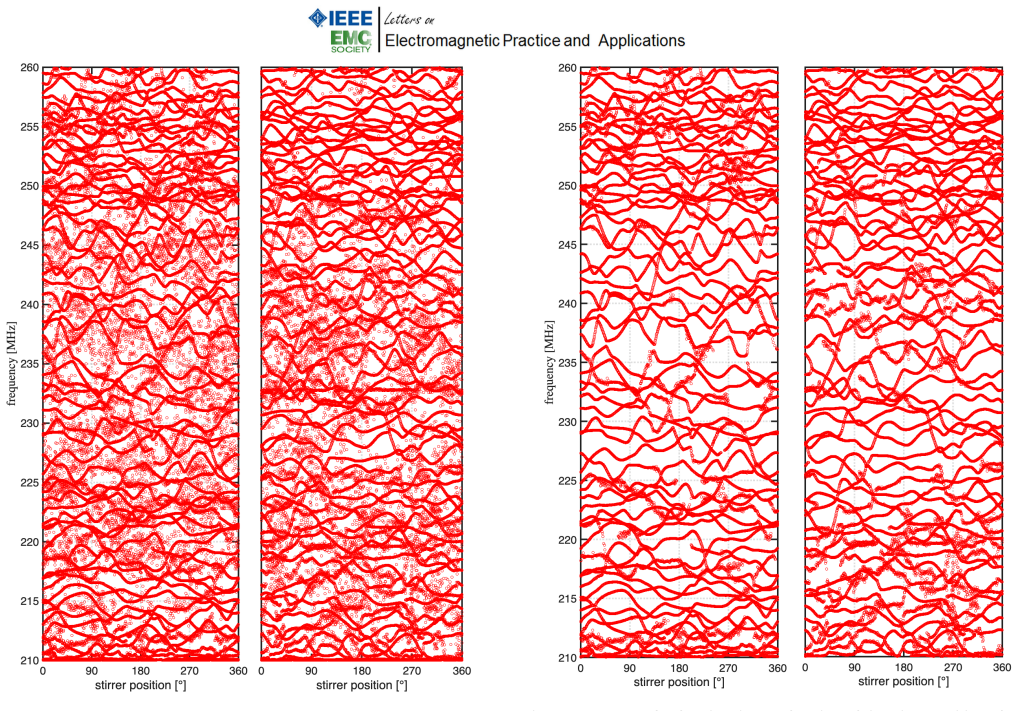
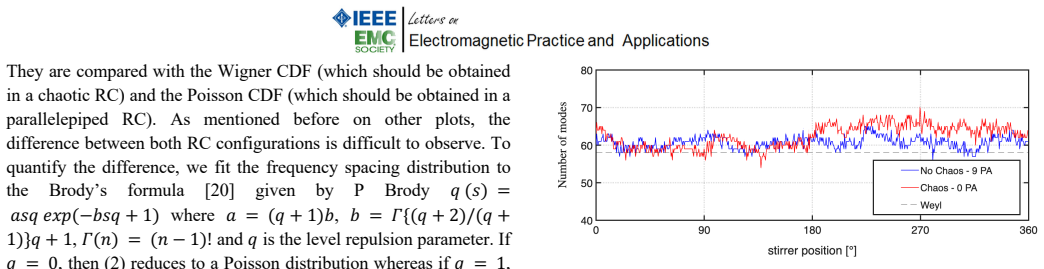
This paper takes advantage of a recent method able to extract the characteristics of resonant modes in a metallic enclosure such as a reverberation chamber (RC). The aim here is to analyze, the effect of inserting curvilinear objects within a parallelepiped RC on the chamber performances, particularly from the point of view of the frequency spacing of adjacent resonant modes. Two configurations are compared: one is a parallelepiped RC with added curvilinear diffracting objects, and the other is the same chamber without diffractors but with added absorbers to compensate the decrease of the quality factor. The obtained results exhibit differences that fall within the measurement uncertainties.
Editorial analysis
A structured set of objections, weighed in public.
Referee Report
Summary. The paper experimentally investigates the effect of inserting curvilinear diffracting objects into a parallelepiped reverberation chamber on the frequency spacing between adjacent resonant modes. It compares this configuration to an otherwise identical chamber without diffractors but with added absorbers to compensate for the resulting drop in quality factor, using a recent mode-extraction method to identify resonant frequencies. The central finding is that the observed differences in adjacent-mode spacing between the two setups fall within the measurement uncertainties.
Significance. If the null result is robustly supported, it would indicate that curvilinear diffractors do not produce a detectable change in modal frequency spacing beyond experimental error when quality-factor loss is compensated by absorbers. This could simplify design choices for reverberation chambers in applications such as EMC testing where controlled modal density is important. The comparison is data-driven and avoids circularity or parameter fitting.
major comments (1)
- Abstract: the claim that 'differences lie within the measurement uncertainties' is presented without any quantitative information on how uncertainties were estimated, the number of modes included in the comparison, the precise absorber compensation procedure, or the statistical criterion used to declare the differences insignificant. These details are required to assess whether the null result is load-bearing or merely consistent with large error bars.
minor comments (2)
- Methods section: provide the exact geometry, material, and placement coordinates of the curvilinear diffractors so that the experiment can be reproduced.
- Results: include error bars or uncertainty bands on any plots or tables of mode spacing to allow direct visual verification of the 'within uncertainties' statement.
Simulated Author's Rebuttal
We thank the referee for their constructive feedback and recommendation for major revision. We agree that the abstract requires additional quantitative context to properly support the central claim regarding measurement uncertainties, and we have revised the manuscript accordingly while preserving the integrity of the reported null result.
read point-by-point responses
-
Referee: [—] Abstract: the claim that 'differences lie within the measurement uncertainties' is presented without any quantitative information on how uncertainties were estimated, the number of modes included in the comparison, the precise absorber compensation procedure, or the statistical criterion used to declare the differences insignificant. These details are required to assess whether the null result is load-bearing or merely consistent with large error bars.
Authors: We acknowledge that the submitted abstract was too concise and omitted the requested quantitative details. In the revised version we have expanded the abstract to briefly state the number of modes analyzed, the basis for uncertainty estimation (derived from the mode-extraction algorithm applied across multiple independent measurements), the absorber compensation method used to restore the quality factor, and the criterion (differences remaining below the estimated uncertainty bounds) employed to conclude that the observed spacing changes are insignificant. These elements were already documented in the methods and results sections; the revision simply condenses them for the abstract so that the null finding can be evaluated on its merits. revision: yes
Circularity Check
No significant circularity
full rationale
The paper is an experimental comparison of two RC configurations (with diffractors vs. absorber-compensated) using a mode-extraction procedure. The central claim is that observed differences in adjacent-mode frequency spacing fall inside measurement uncertainties. No equations, derivations, or predictions are presented that reduce by construction to fitted parameters, self-definitions, or self-citation chains; the result is a direct data-driven null finding rather than a derived quantity.
Axiom & Free-Parameter Ledger
axioms (1)
- domain assumption The recent method for extracting resonant mode characteristics from a metallic enclosure is accurate and unbiased for the frequencies and chamber sizes used.
Reference graph
Works this paper leans on
-
[1]
Reverberation chambers at the edge of chaos: Discussion forum at emc europe 2020,
R. Serra et al., “Reverberation chambers at the edge of chaos: Discussion forum at emc europe 2020,” IEEE Electromagn. Compat. Mag., vol. 11, no. 1, pp. 73–88,
2020
-
[2]
Experimental analysis of the field homogeneity and isotropy inside a reverberation chamber with two hemispherical diffractors,
M. Magdowski, J. Immidisetti, and R. Vick, “Experimental analysis of the field homogeneity and isotropy inside a reverberation chamber with two hemispherical diffractors,” in Int. Symp. Electromagn. Compat. (EMC EUROPE), Aug 2018, pp. 683–688
2018
-
[3]
Criterion based on resonant frequencies distributions for reverberation chamber characterization,
E. Richalot et al., “Criterion based on resonant frequencies distributions for reverberation chamber characterization,” in 2015 Int. Conf. Electromagn. Advanced Appl. (ICEAA), 2015, pp. 1112–1115
2015
-
[4]
Various estimations of composite q-factor with antennas in a reverberation chamber,
P. Besnier, C. Lemoine, and J. Sol, “Various estimations of composite q-factor with antennas in a reverberation chamber,” in IEEE Int. Symp. Electromagn. Compat. (EMC), Aug 2015, pp. 1223–1227
2015
discussion (0)
Sign in with ORCID, Apple, or X to comment. Anyone can read and Pith papers without signing in.