Recognition: unknown
Gossamer Superconductivity in Moir\'e WSe₂ Bilayer
Pith reviewed 2026-05-07 13:42 UTC · model grok-4.3
The pith
Interplay of extended hoppings and antiferromagnetic superexchange stabilizes a gossamer chiral d+id superconducting phase in moiré WSe2 at half-filling.
A machine-rendered reading of the paper's core claim, the machinery that carries it, and where it could break.
Core claim
In the effective extended Hubbard model for twisted WSe2 at half-filling and zero displacement field, a moderate on-site repulsion partially quenches charge fluctuations while preserving mobile doublons and holes; the resulting interplay between extended hoppings and antiferromagnetic superexchange stabilizes a gossamer chiral d+id superconducting phase.
What carries the argument
The gossamer superconducting state in the half-filled extended Hubbard model on the triangular lattice, where partial charge fluctuations allow extended kinetic hoppings and antiferromagnetic superexchange to select chiral d+id pairing.
If this is right
- The superconducting phase occupies a window of twist angles between the Mott insulator and the correlated metal.
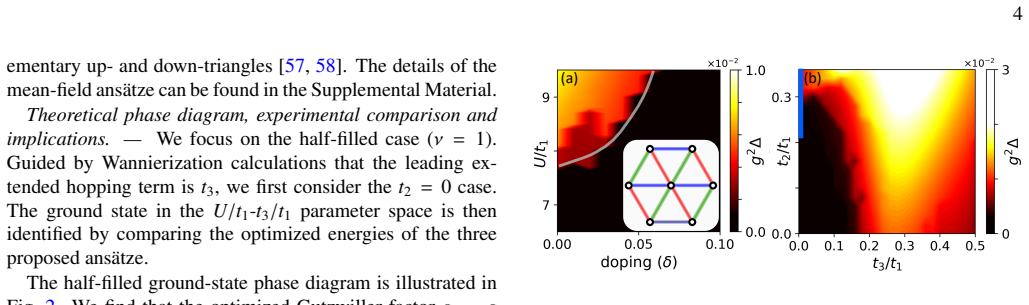
- The half-filled pairing state vanishes rapidly when the electron density is doped away from half-filling.
- Renormalized mean-field theory suffices to capture the strong-coupling competition between hoppings and superexchange.
Where Pith is reading between the lines
- Similar gossamer pairing may appear in other moiré TMDs whose continuum models reduce to extended Hubbard models on triangular lattices.
- Capacitance or compressibility measurements that detect finite double occupancy inside the superconducting regime would directly test the partial charge fluctuation premise.
- The chiral d+id symmetry implies possible spontaneous time-reversal breaking that could be probed by Kerr rotation or edge transport.
Load-bearing premise
The moiré continuum system can be accurately mapped to an effective extended single-orbital Hubbard model on the triangular lattice whose parameters capture the essential physics at half-filling and zero displacement field.
What would settle it
A direct measurement showing either complete suppression of double occupancy at half-filling or the absence of superconductivity precisely at half-filling for the relevant twist angles would falsify the gossamer d+id phase.
Figures



read the original abstract
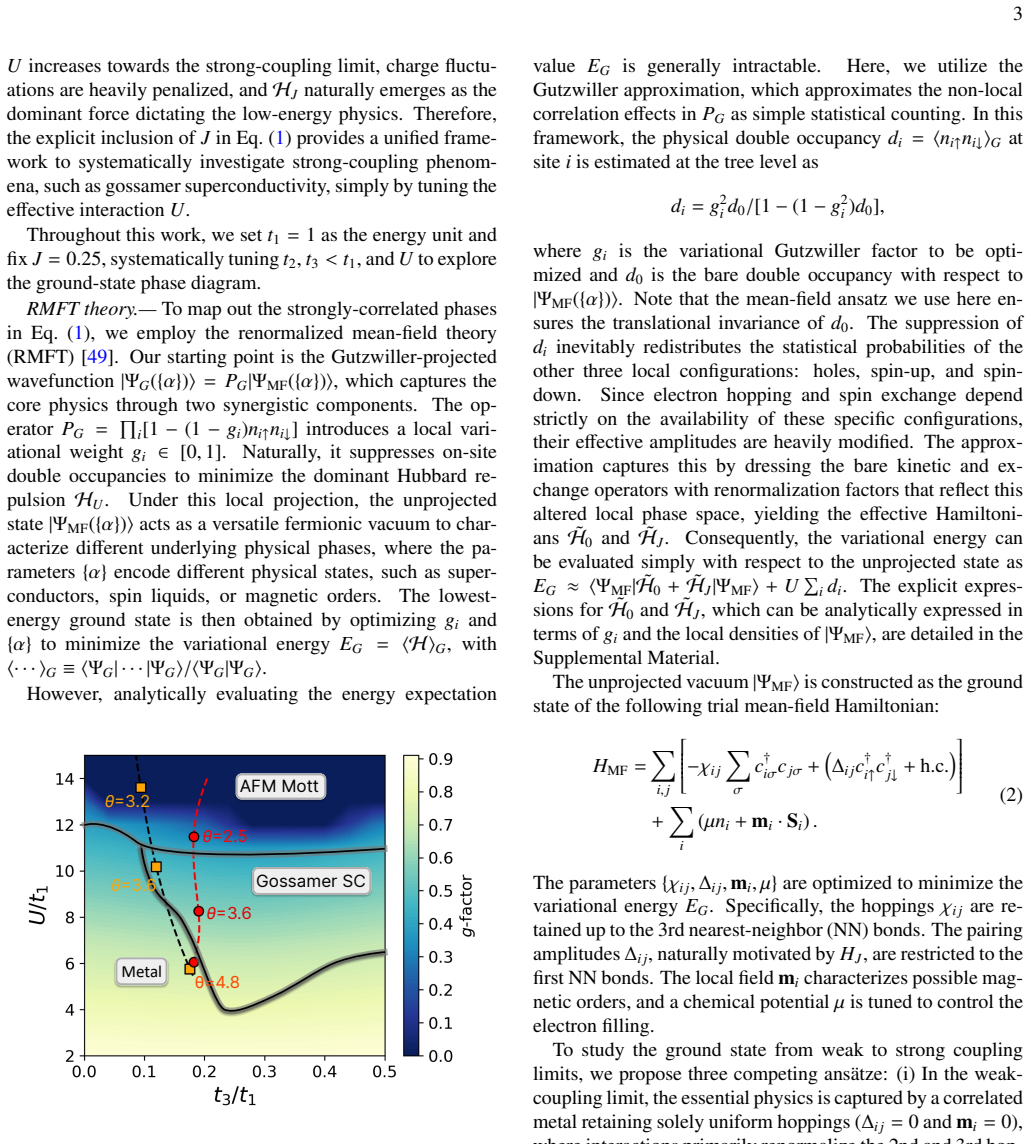
Moir\'e transition metal dichalcogenides have served as a versatile platform for simulating Hubbard physics. Recent experiments have identified robust superconductivity in moir\'e bilayer WSe$_2$ for certain twist angles. Here, we propose the gossamer nature of the superconductivity recently discovered at half-filling and zero displacement field in twisted WSe$_2$. By mapping the moir\'e continuum system to an effective extended single-orbital Hubbard model on the triangular lattice, we employ renormalized mean-field theory to investigate the strong-coupling phase diagram. We find that a moderate Coulomb repulsion partially suppresses charge fluctuations while preserving a finite density of mobile doublons and holes. In this regime, the interplay between extended kinetic hoppings and antiferromagnetic superexchange stabilizes a chiral $d+id$ superconducting phase. Our results naturally account for the twist-angle-dependent evolution from a Mott insulator to a superconductor and eventually to a correlated metal. Furthermore, the model demonstrates that this half-filled pairing state vanishes rapidly upon density doping, consistent with experimental observations.
Editorial analysis
A structured set of objections, weighed in public.
Referee Report
Summary. The manuscript claims that superconductivity recently observed in moiré bilayer WSe₂ at half-filling and zero displacement field is of gossamer character. Mapping the moiré continuum Hamiltonian to an effective extended single-orbital Hubbard model on the triangular lattice and applying renormalized mean-field theory (RMFT), the authors find that moderate Coulomb repulsion U partially suppresses charge fluctuations while retaining mobile doublons and holes; the resulting interplay between extended hoppings and antiferromagnetic superexchange stabilizes a chiral d+id superconducting phase. The model is said to reproduce the twist-angle evolution from Mott insulator to superconductor to correlated metal and the rapid suppression of pairing upon doping.
Significance. If the effective-model mapping is faithful, the work supplies a concrete microscopic mechanism for the observed half-filled superconductivity in twisted WSe₂, emphasizing the gossamer regime in which charge fluctuations are neither fully quenched nor dominant. It offers falsifiable predictions for pairing symmetry, doping dependence, and twist-angle trends that could be tested by STM, transport, or further continuum calculations, thereby contributing to the broader understanding of strongly correlated superconductivity in moiré platforms.
major comments (2)
- [Model construction / parameter derivation section] The load-bearing step is the mapping of the moiré continuum to the extended Hubbard parameters t, t', t'', U (and the implied doublon density). The manuscript must demonstrate, with explicit numerical comparison, that these parameters reproduce the continuum band structure, interaction strength, and twist-angle dependence at the experimentally relevant angles without uncontrolled approximations or omitted multi-orbital effects; otherwise the RMFT phase diagram does not establish the proposed mechanism in the real system.
- [RMFT equations and phase-diagram results] In the RMFT treatment, the choice of 'moderate' U and the resulting finite doublon/hole density at half-filling must be shown to emerge from the derived parameters rather than post-hoc adjustment. If the ratio of kinetic to superexchange scales is sensitive to small variations in U or the longer-range hoppings, the stability of the chiral d+id phase requires a quantitative sensitivity analysis.
minor comments (2)
- Define the precise form of the extended hopping terms and the superexchange J in the model Hamiltonian; the notation for t, t', t'' should be stated explicitly with numerical values for the twist angles considered.
- Figure captions for the phase diagram should include the precise range of U/t values and the criterion used to identify the gossamer regime (e.g., doublon density threshold).
Simulated Author's Rebuttal
We thank the referee for the careful and constructive review, as well as for recognizing the potential significance of our work. We address the two major comments point by point below. We agree that both points require strengthening and will revise the manuscript accordingly.
read point-by-point responses
-
Referee: [Model construction / parameter derivation section] The load-bearing step is the mapping of the moiré continuum to the extended Hubbard parameters t, t', t'', U (and the implied doublon density). The manuscript must demonstrate, with explicit numerical comparison, that these parameters reproduce the continuum band structure, interaction strength, and twist-angle dependence at the experimentally relevant angles without uncontrolled approximations or omitted multi-orbital effects; otherwise the RMFT phase diagram does not establish the proposed mechanism in the real system.
Authors: We agree that explicit validation of the mapping is necessary to establish the mechanism. In the revised manuscript we will add direct numerical comparisons (new figures and tables) between the low-energy dispersion and interaction matrix elements obtained from the full moiré continuum Hamiltonian and those of the effective extended Hubbard model, performed at the experimentally relevant twist angles. The mapping is obtained by Wannier projection onto the topmost valence band; we will include a concise justification that higher bands remain separated by an energy gap large compared with the bandwidth and U, consistent with existing continuum-model literature. No new uncontrolled approximations are introduced beyond those already stated in the original derivation. revision: yes
-
Referee: [RMFT equations and phase-diagram results] In the RMFT treatment, the choice of 'moderate' U and the resulting finite doublon/hole density at half-filling must be shown to emerge from the derived parameters rather than post-hoc adjustment. If the ratio of kinetic to superexchange scales is sensitive to small variations in U or the longer-range hoppings, the stability of the chiral d+id phase requires a quantitative sensitivity analysis.
Authors: We agree that the origin of the moderate-U regime and the resulting finite doublon density must be shown to follow directly from the derived parameters. In the revision we will explicitly tabulate the continuum-derived values of U/t, t'/t and t''/t at the relevant twist angles and display the self-consistent RMFT solution at half filling, confirming that the doublon/hole density is finite and determined by these parameters. We will also add a quantitative sensitivity analysis in which U is varied by ±20 % and the longer-range hoppings by ±10 % around their nominal values; the results will be presented in a new supplementary figure showing that the chiral d+id phase remains stable throughout this window. revision: yes
Circularity Check
No significant circularity; derivation applies standard RMFT to an independently motivated effective model
full rationale
The paper's chain consists of (1) mapping the moiré continuum Hamiltonian to an extended single-orbital Hubbard model on the triangular lattice at half-filling and (2) applying renormalized mean-field theory to that model to obtain the phase diagram. Neither step reduces to its own output by definition or by self-citation. The mapping is presented as a standard approximation whose parameters are determined from the microscopic moiré band structure; the subsequent RMFT calculation then produces the chiral d+id state as a derived result rather than an input. No fitted parameter is relabeled as a prediction, no uniqueness theorem is imported from the authors' prior work, and no ansatz is smuggled via citation. The derivation therefore remains self-contained against external benchmarks.
Axiom & Free-Parameter Ledger
free parameters (1)
- Coulomb repulsion strength U
axioms (2)
- domain assumption The moiré WSe2 bilayer at the relevant twist angles and zero displacement field is faithfully described by an extended single-orbital Hubbard model on the triangular lattice.
- domain assumption Renormalized mean-field theory captures the essential physics of the strong-coupling phase diagram.
Reference graph
Works this paper leans on
-
[1]
D. M. Kennes, M. Claassen, L. Xian, A. Georges, A. J. Mil- lis, J. Hone, C. R. Dean, D. N. Basov, A. N. Pasupathy, and A. Rubio, Moir ´eheterostructures as a condensed-matter quan- tum simulator, Nature Physics17, 155 (2021)
2021
-
[2]
K. F. Mak and J. Shan, Semiconductor moir ´e materials, Nature Nanotechnology17, 686 (2022)
2022
-
[3]
K. F. Mak and J. Shan, Simulating the hubbard model with moir ´e semiconductors, National Science Review13, nwag069 (2026), https://academic.oup.com/nsr/article- pdf/13/4/nwag069/66708486/nwag069.pdf
2026
-
[4]
D. Zhai, H. Yu, and W. Yao, Twistronics and moir ´e superlat- tice physics in 2d transition metal dichalcogenides, Reports on Progress in Physics88, 084501 (2025)
2025
-
[5]
K. P. Nuckolls and A. Yazdani, A microscopic perspective on moir´ematerials, Nature Reviews Materials9, 460 (2024)
2024
-
[6]
T. Cao, L. Fu, L. Ju, D. Xiao, and X. Xu, Fractional quan- tum anomalous hall effect, Annual Review of Condensed Mat- ter Physics17, 233 (2026)
2026
-
[7]
F. Wu, T. Lovorn, E. Tutuc, and A. H. MacDonald, Hubbard model physics in transition metal dichalcogenide moir ´e bands, Physical Review Letters121, 026402 (2018)
2018
-
[8]
Q. Tong, H. Yu, Q. Q. Zhu, Y . Wang, X. Xu, and W. Yao, Topo- logical mosaics in moir´e superlattices of van der Waals hetero- bilayers, Nature Physics13, 356 (2017)
2017
-
[9]
H. Pan, F. Wu, and S. Das Sarma, Band topology, hubbard model, heisenberg model, and dzyaloshinskii-moriya interac- tion in twisted bilayer wse2, Phys. Rev. Res.2, 033087 (2020)
2020
-
[10]
Wang, E.-M
L. Wang, E.-M. Shih, A. Ghiotto, L. Xian, D. A. Rhodes, C. Tan, M. Claassen, D. M. Kennes, Y . Bai, B. Kim,et al., Correlated electronic phases in twisted bilayer transition metal dichalcogenides, Nature Materials19, 861 (2020)
2020
-
[11]
Y . Tang, L. Li, T. Li, Y . Xu, S. Liu, K. Barmak, K. Watanabe, T. Taniguchi, A. H. MacDonald, J. Shan,et al., Simulation of hubbard model physics in WSe 2/WS2 moir´e superlattices, Na- ture579, 353 (2020)
2020
-
[12]
E. C. Regan, D. Wang, C. Jin, M. I. Bakti Utama, B. Gao, X. Wei, S. Zhao, W. Zhao, Z. Zhang, K. Yumigeta,et al., Mott and generalized wigner crystal states in WSe 2/WS2 moir´e su- perlattices, Nature579, 359 (2020)
2020
-
[13]
Y . Xu, S. Liu, D. A. Rhodes, K. Watanabe, T. Taniguchi, J. Hone, V . Elser, K. F. Mak, and J. Shan, Correlated insulating states at fractional fillings of moir ´e superlattices, Nature587, 214 (2020)
2020
-
[14]
Huang, T
X. Huang, T. Wang, S. Miao, C. Wang, Z. Li, Z. Lian, T. Taniguchi, K. Watanabe, S. Okamoto, D. Xiao, S.-F. Shi, and C. Weber, Correlated insulating states at fractional fillings of the WS2/WSe2 moir´e lattice, Nature Physics17, 715 (2021)
2021
-
[15]
Ghiotto, E.-M
A. Ghiotto, E.-M. Shih, G. S. S. Pereira, D. A. Rhodes, B. Kim, J. Zang, A. J. Millis, K. Watanabe, T. Taniguchi, J. C. Hone, L. Wang, C. R. Dean, and A. N. Pasupathy, Quantum criticality in twisted WSe2, Nature597, 345 (2021)
2021
-
[16]
T. Li, S. o. Jiang, L. Li, Y . Zhang, K. Kang, J. Zhu, K. Watan- abe, T. Taniguchi, D. Chowdhury, L. Fu, J. Shan, and K. F. Mak, Continuous Mott transition in semiconductor moir ´e su- perlattices, Nature597, 350 (2021)
2021
-
[17]
J. Zang, J. Wang, J. Cano, and A. J. Millis, Dynamical mean- field theory of moir ´e bilayer transition metal dichalcogenides: Phase diagram, charge transfer, and electrotuning, Physical Re- view X11, 011050 (2021)
2021
-
[18]
W. Zhao, B. Shen, Z. Tao, Z. Han, K. Kang, K. Watanabe, T. Taniguchi, K. F. Mak, and J. Shan, Gate-tunable heavy fermions in a moir´e kondo lattice, Nature616, 61 (2023)
2023
-
[19]
L. Kang, Z. Ye, C. Wen, R. Peng, Z. Wang, Y . Ye, J. Zhu, K. Watanabe, T. Taniguchi, J. Shan, and K. F. Mak, Observa- tion of heavy fermions and Kondo insulators in a moir ´e lattice, Nature628, 522 (2024)
2024
-
[20]
Coleman, Moir ´e sets the stage for heavy fermions, Nature 615, 600 (2023)
P. Coleman, Moir ´e sets the stage for heavy fermions, Nature 615, 600 (2023)
2023
-
[21]
Regnault and B
N. Regnault and B. A. Bernevig, Fractional chern insulator, Phys. Rev. X1, 021014 (2011)
2011
-
[22]
Z. Sun, F. Xu, J. Li, Y . Jiang, J. Gao, C. Xu, T. Jia, K. Cheng, J. Zhang, W. Tian, K. Watanabe, T. Taniguchi, J. Jia, S. Jiang, Y . Zhang, Y . Zhang, S. Lei, X. Liu, and T. Li, Twist-angle evolution from valley-polarized fractional topological phases to valley-degenerate superconductivity in twisted bilayer MoTe2, arXiv e-prints , arXiv:2603.16412 (2026...
-
[23]
Liu and E
Z. Liu and E. J. Bergholtz, Recent developments in fractional chern insulators, inEncyclopedia of Condensed Matter Physics (Second Edition), edited by T. Chakraborty (Academic Press, Oxford, 2024) second edition ed., pp. 515–538
2024
-
[24]
Y . Xia, Z. Han, K. Watanabe, T. Taniguchi, J. Shan, and K. F. Mak, Superconductivity in twisted bilayer wse2, Nature637, 6 833 (2025)
2025
-
[25]
Y . Xia, Z. Han, J. Zhu, Y . Zhang, P. Kn ¨uppel, K. Watanabe, T. Taniguchi, K. F. Mak, and J. Shan, Bandwidth-tuned mott transition and superconductivity in moir ´e wse2, Nature650, 585 (2026)
2026
-
[26]
Y . Guo, J. Pack, J. Swann, L. Holtzman, M. Cothrine, K. Watan- abe, T. Taniguchi, D. G. Mandrus, K. Barmak, J. Hone, A. J. Millis, A. Pasupathy, and C. R. Dean, Superconductivity in 5.0 ◦twisted bilayer wse2, Nature637, 839 (2025)
2025
-
[27]
Y . Guo, J. Cenker, A. Fischer, D. Mu ˜noz-Segovia, J. Pack, L. Holtzman, L. Klebl, K. Watanabe, T. Taniguchi, K. Barmak, J. Hone, A. Rubio, D. M. Kennes, A. J. Millis, A. Pasupathy, and C. R. Dean, Angle evolution of the superconducting phase diagram in twisted bilayer wse 2, Nature 10.1038/s41586-026- 10357-2 (2026)
-
[28]
P. W. Anderson, P. A. Lee, M. Randeria, T. M. Rice, N. Trivedi, and F.-C. Zhang, The physics behind high-temperature super- conducting cuprates: the ’plain vanilla’ version of RVB, Journal of Physics: Condensed Matter16, R755 (2004)
2004
-
[29]
P. A. Lee, N. Nagaosa, and X.-G. Wen, Doping a mott insula- tor: Physics of high-temperature superconductivity, Reviews of Modern Physics78, 17 (2006)
2006
-
[30]
B. J. Powell and R. H. McKenzie, Quantum frustration in or- ganic mott insulators: from spin liquids to unconventional superconductors, Reports on Progress in Physics74, 056501 (2011)
2011
-
[31]
F. Xie, L. Chen, S. Sur, Y . Fang, J. Cano, and Q. Si, Super- conductivity in twisted wse 2 from topology-induced quantum fluctuations, Phys. Rev. Lett.134, 136503 (2025)
2025
-
[32]
Qin, W.-X
W. Qin, W.-X. Qiu, and F. Wu, Topological chiral superconduc- tivity mediated by intervalley antiferromagnetic fluctuations in twisted bilayer wse2, Phys. Rev. Lett.135, 246002 (2025)
2025
- [33]
-
[34]
Christos, P
M. Christos, P. M. Bonetti, and M. S. Scheurer, Approx- imate symmetries, insulators, and superconductivity in the continuum-model description of twisted wse 2, Phys. Rev. Lett. 135, 046503 (2025)
2025
-
[35]
F. Wu, T. Lovorn, E. Tutuc, I. Martin, and A. H. MacDon- ald, Topological insulators in twisted transition metal dichalco- genide homobilayers, Phys. Rev. Lett.122, 086402 (2019)
2019
-
[36]
Devakul, V
T. Devakul, V . Cr´epel, Y . Zhang, and L. Fu, Magic in twisted transition metal dichalcogenide bilayers, Nature Communica- tions12, 6730 (2021)
2021
-
[37]
H. Yu, M. Chen, and W. Yao, Giant magnetic field from moir ´e induced berry phase in homobilayer semiconductors, National Science Review7, 12 (2020)
2020
- [38]
-
[39]
R. B. Laughlin, Gossamer superconductivity, Philosophical Magazine86, 1165 (2006)
2006
-
[40]
B. A. Bernevig, R. B. Laughlin, and D. I. Santiago, Magnetic instability in gossamer superconductors, Phys. Rev. Lett.91, 147003 (2003)
2003
-
[41]
F. C. Zhang, Gossamer superconductor, mott insulator, and res- onating valence bond state in correlated electron systems, Phys. Rev. Lett.90, 207002 (2003)
2003
-
[42]
Coleman, Condensed matter physics: Gossamer supercon- ductivity, Nature424, 625 (2003)
P. Coleman, Condensed matter physics: Gossamer supercon- ductivity, Nature424, 625 (2003)
2003
-
[43]
J. Y . Gan, F. C. Zhang, and Z. B. Su, Theory of gossamer and resonating valence bond superconductivity, Phys. Rev. B71, 014508 (2005)
2005
-
[44]
F. C. Zhang, C. Gros, T. M. Rice, and H. Shiba, A renormalised Hamiltonian approach to a resonant valence bond wavefunc- tion, Superconductor Science and Technology1, 36 (1988)
1988
-
[45]
J. Y . Gan, Y . Chen, Z. B. Su, and F. C. Zhang, Gossamer super- conductivity near antiferromagnetic mott insulator in layered organic conductors, Phys. Rev. Lett.94, 067005 (2005)
2005
-
[46]
Zhang, C
X.-W. Zhang, C. Wang, X. Liu, Y . Fan, T. Cao, and D. Xiao, Polarization-driven band topology evolution in twisted mote2 and wse2, Nature Communications15, 4223 (2024)
2024
-
[47]
Zhang, N
F. Zhang, N. Morales-Dur ´an, Y . Li, W. Yao, J.-J. Su, Y .-C. Lin, C. Dong, X. Liu, F.-X. R. Chen, H. Kim, K. Watanabe, T. Taniguchi, X. Li, J. A. Robinson, A. H. Macdonald, and C.-K. Shih, Experimental signature of layer skyrmions and im- plications for band topology in twisted wse2 bilayers, Nature Physics21, 1217 (2025)
2025
-
[48]
Marzari and D
N. Marzari and D. Vanderbilt, Maximally localized generalized wannier functions for composite energy bands, Phys. Rev. B56, 12847 (1997)
1997
-
[49]
Souza, N
I. Souza, N. Marzari, and D. Vanderbilt, Maximally localized wannier functions for entangled energy bands, Phys. Rev. B65, 035109 (2001)
2001
-
[50]
Pizzi, V
G. Pizzi, V . Vitale, R. Arita, S. Bl ¨ugel, F. Freimuth, G. G ´eranton, M. Gibertini, D. Gresch, C. Johnson, T. Koret- sune,et al., Wannier90 as a community code: new features and applications, Journal of Physics: Condensed Matter32, 165902 (2020)
2020
-
[51]
Y . Zhou and X.-G. Wen, Symmetricu(1) andsu(2) spin- liquid states on the triangular lattice, arXiv preprint cond- mat/0210662 (2002)
-
[52]
Lu, SymmetricZ 2 spin liquids on the triangular lattice, Phys
Y .-M. Lu, SymmetricZ 2 spin liquids on the triangular lattice, Phys. Rev. B93, 165113 (2016)
2016
-
[53]
Note that the 120 ◦ AFM Mott state breaks translational sym- metry in the spin sector but preserves it in charge sector, which also leads to uniformg i
-
[54]
Affleck, Z
I. Affleck, Z. Zou, T. Hsu, and P. W. Anderson, Su(2) gauge symmetry of the large-ulimit of the hubbard model, Phys. Rev. B38, 745 (1988)
1988
-
[55]
Wen, Quantum orders and symmetric spin liquids, Phys
X.-G. Wen, Quantum orders and symmetric spin liquids, Phys. Rev. B65, 165113 (2002)
2002
-
[56]
Edegger, V
B. Edegger, V . N. Muthukumar, and C. Gros, Gutzwiller–rvb theory of high-temperature superconductivity: Results from renormalized mean-field theory and variational monte carlo cal- culations, Advances in Physics56, 927 (2007)
2007
-
[57]
Huang, S.-S
Y . Huang, S.-S. Gong, and D. N. Sheng, Quantum phase dia- gram and spontaneously emergent topological chiral supercon- ductivity in doped triangular-lattice mott insulators, Phys. Rev. Lett.130, 136003 (2023)
2023
-
[58]
Zhu and Q
Z. Zhu and Q. Chen, Superconductivity in doped triangular mott insulators: The roles of parent spin backgrounds and charge kinetic energy, Phys. Rev. B107, L220502 (2023)
2023
-
[59]
Kapitulnik, J
A. Kapitulnik, J. Xia, E. Schemm, and A. Palevski, Polar Kerr effect as probe for time-reversal symmetry breaking in uncon- ventional superconductors, New Journal of Physics11, 055060 (2009)
2009
-
[60]
2π(m−1) 3 # ,(21) ∆(d2) r,r+am = ∆d sin
R. Nandkishore, L. Levitov, and A. V . Chubukov, Kerr rotation in the chirald-wave superconductor on a honeycomb lattice, Physical Review B89, 144501 (2014). 7 A. Continuum model and Wannierization A1. The continuum model of moir´e TMD The continuum kinetic Hamiltonian fortWSe 2 near theK + valley is given by H0,↑ = − ℏ2(−i∇−κ+)2 2m∗ + ∆+(r)∆ T (r...
2014
discussion (0)
Sign in with ORCID, Apple, or X to comment. Anyone can read and Pith papers without signing in.