Path integral quantization of the electromagnetic field in nonlinear dielectric materials
Pith reviewed 2026-05-07 16:37 UTC · model grok-4.3
The pith
A path-integral formalism quantizes electromagnetic fields in nonlinear dielectrics by integrating out matter and bath degrees of freedom to produce an effective action with Kerr nonlinearity.
A machine-rendered reading of the paper's core claim, the machinery that carries it, and where it could break.
Core claim
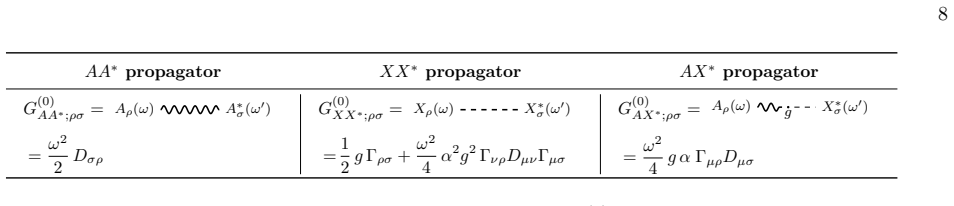
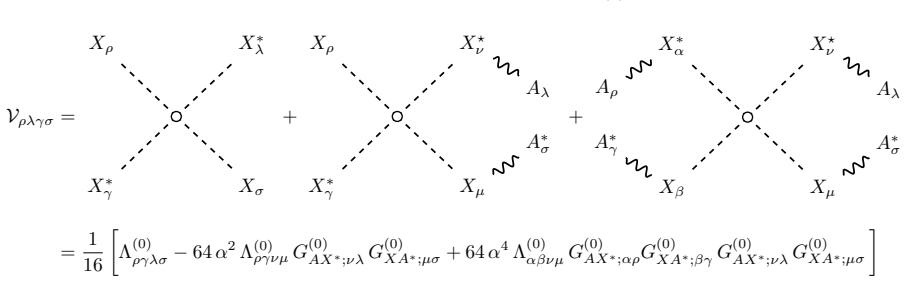
By constructing an effective action in a path-integral formalism through the integration of matter and bath degrees of freedom in a mesoscopic model that includes a fourth-order nonlinearity, the approach yields a nonlinear response function associated with Kerr nonlinearity; after full field quantization the Feynman rules of the theory are derived.
What carries the argument
The effective action obtained by integrating out matter and bath degrees of freedom in the path-integral formalism, which directly generates the nonlinear response function and the associated Feynman rules.
If this is right
- The theory supplies a consistent quantization of electromagnetic fields that simultaneously includes dispersion, absorption, and Kerr nonlinearity.
- Perturbative calculations of quantum processes in nonlinear media become feasible through the derived Feynman rules.
- The effective action provides a direct link between microscopic light-matter coupling and macroscopic nonlinear optical response functions.
- The framework permits systematic inclusion of quantum fluctuations and correlations in the propagation of light through real materials.
Where Pith is reading between the lines
- The same integration procedure could be repeated for higher-order nonlinearities to generate effective actions for other nonlinear optical effects.
- Numerical evaluation of the Feynman rules might enable first-principles simulations of quantum light propagation in integrated photonic devices.
- Comparison of the obtained response function with classical nonlinear optics limits could serve as an internal consistency check for the quantization method.
Load-bearing premise
The chosen mesoscopic model containing a fourth-order nonlinearity in the material response is sufficient to capture the essential physics once matter and bath degrees of freedom are integrated out.
What would settle it
A laboratory measurement of photon statistics or quantum correlations in a Kerr-nonlinear dielectric waveguide that deviates from the predictions obtained by applying the derived Feynman rules to the same geometry would falsify the central claim.
Figures


read the original abstract
We construct a quantum theory of light in nonlinear dielectric media with dispersion and absorption. We employ a mesoscopic model for the light-matter interaction that include a fourth-order nonlinearity in the material response. Quantization is performed by constructing an effective action in a path-integral formalism by integrating out matter and bath degrees of freedom. We show how a nonlinear response function associated with Kerr nonlinearity is obtained through the model and, after full field quantization, we derive the Feynman rules from this theory.
Editorial analysis
A structured set of objections, weighed in public.
Referee Report
Summary. The manuscript develops a path-integral quantization procedure for the electromagnetic field interacting with nonlinear dielectric media that exhibit dispersion and absorption. It employs a mesoscopic model incorporating a fourth-order term in the material polarization to capture nonlinearity, integrates out the matter and auxiliary bath degrees of freedom to derive an effective action for the EM field, extracts the associated nonlinear response function for Kerr effects, and obtains the Feynman rules for the quantized theory.
Significance. Should the derivation prove sound, the work would provide a valuable framework for quantizing nonlinear optical systems in realistic media, allowing for the calculation of quantum corrections and scattering processes via Feynman diagrams in the presence of dispersion and loss. This could have implications for quantum information processing and nonlinear quantum optics.
major comments (1)
- The presence of the fourth-order nonlinearity in the mesoscopic action makes the functional integral over matter and bath variables non-Gaussian. The manuscript does not clarify whether this integral is evaluated exactly (e.g., via some cancellation or special coupling) or approximated perturbatively to first order in the nonlinearity. This detail is crucial because a perturbative treatment would limit the validity of the derived Kerr response to the weak-nonlinearity regime, directly affecting the central claim that the model yields the nonlinear response after integration.
minor comments (1)
- The abstract is concise but could benefit from a brief mention of the explicit form of the mesoscopic action or the resulting effective action to give readers a clearer sense of the construction without needing to consult the body immediately.
Simulated Author's Rebuttal
We thank the referee for the careful reading of our manuscript and for the constructive comment. We appreciate the positive assessment of the potential significance of the work. We address the major comment below and will revise the manuscript accordingly.
read point-by-point responses
-
Referee: The presence of the fourth-order nonlinearity in the mesoscopic action makes the functional integral over matter and bath variables non-Gaussian. The manuscript does not clarify whether this integral is evaluated exactly (e.g., via some cancellation or special coupling) or approximated perturbatively to first order in the nonlinearity. This detail is crucial because a perturbative treatment would limit the validity of the derived Kerr response to the weak-nonlinearity regime, directly affecting the central claim that the model yields the nonlinear response after integration.
Authors: We agree that the fourth-order term renders the functional integral non-Gaussian, precluding an exact closed-form evaluation in general. In the derivation, the integral over matter and bath variables is performed perturbatively to first order in the nonlinearity by expanding the exponential of the quartic interaction term and retaining the leading correction. This yields the effective action for the electromagnetic field containing the Kerr-type response function. Such a perturbative treatment is standard for obtaining nonlinear response functions in mesoscopic models of this type. We will revise the manuscript to state this approximation explicitly, including its restriction to the weak-nonlinearity regime, and to clarify that the central claim holds within this perturbative framework for deriving the nonlinear response after integration. revision: yes
Circularity Check
No significant circularity in the derivation chain
full rationale
The paper starts from an explicit mesoscopic model that includes a fourth-order nonlinearity in the material response by construction. It then integrates out matter and bath degrees of freedom via path integral to obtain an effective action for the EM field, from which the Kerr-associated nonlinear response function and Feynman rules are derived. This does not reduce the output to the input by definition, nor does it involve fitting a parameter to data and relabeling the result as a prediction. No self-citations are invoked as load-bearing uniqueness theorems, no ansatze are smuggled via prior work, and no known empirical patterns are merely renamed. The integration step is presented as generating the effective theory rather than presupposing the final response; the central claim therefore retains independent content from the quantization procedure. No load-bearing steps reduce to self-definition or fitted inputs.
Axiom & Free-Parameter Ledger
axioms (1)
- domain assumption Mesoscopic model for light-matter interaction includes a fourth-order nonlinearity in the material response
Reference graph
Works this paper leans on
-
[1]
J. J. Hopfield, Physical Review112, 1555 (1958)
work page 1958
- [2]
-
[3]
L. G. Suttorp and M. Wubs, Phys. Rev. A70, 013816 (2004)
work page 2004
- [4]
-
[5]
R. Matloob, R. Loudon, S. M. Barnett, and J. Jeffers, Phys. Rev. A52, 4823 (1995)
work page 1995
- [6]
-
[7]
H. T. Dung, L. Kn¨ oll, and D.-G. Welsch, Phys. Rev. A 57, 3931 (1998)
work page 1998
- [8]
-
[9]
A. Tip, L. Kn¨ oll, S. Scheel, and D.-G. Welsch, Phys. Rev. A63, 043806 (2001)
work page 2001
- [10]
-
[11]
S. Y. Buhmann,Dispersion Forces I: Macroscopic quan- tum electrodynamics and ground-state Casimir, Casimir– Polder and van der Waals forces, Vol. 247 (Springer, 2013)
work page 2013
- [12]
-
[13]
Ornigotti,A Field Theory Approach to Photonics, 2053-2563 (IOP Publishing, 2025)
M. Ornigotti,A Field Theory Approach to Photonics, 2053-2563 (IOP Publishing, 2025)
work page 2053
- [14]
- [15]
-
[16]
S. Scheel and D.-G. Welsch, Journal of Physics B: Atomic, Molecular and Optical Physics39, S711 (2006)
work page 2006
- [17]
- [18]
-
[19]
A. Krsti´ c, F. Setzpfandt, and S. Saravi, Physical Review Research5, 043228 (2023)
work page 2023
-
[20]
L. Dal Negro, R. Franchi, and M. Ornigotti, Physical Review B112, 165433 (2025)
work page 2025
- [21]
-
[22]
L. Caspani, R. Kaipurath, M. Clerici, M. Ferrera, T. Roger, J. Kim, N. Kinsey, M. Pietrzyk, A. Di Falco, V. M. Shalaev,et al., Physical review letters116, 233901 (2016)
work page 2016
-
[23]
H. Wang, K. Du, C. Jiang, Z. Yang, L. Ren, W. Zhang, S. J. Chua, and T. Mei, Physical Review Applied11, 064062 (2019)
work page 2019
- [24]
-
[25]
Y. Tamashevich, T. Shubitidze, L. Dal Negro, and M. Ornigotti, APL Photonics9, 016105 (2024)
work page 2024
-
[26]
M. Scalora, J. Trull, C. Cojocaru, M. A. Vincenti, L. Car- letti, D. de Ceglia, N. Akozbek, and C. D. Angelis, J. Opt. Soc. Am. B36, 2346 (2019)
work page 2019
-
[27]
M. Scalora, M. A. Vincenti, D. de Ceglia, C. M. Cojo- caru, M. Grande, and J. W. Haus, J. Opt. Soc. Am. B 32, 2129 (2015)
work page 2015
-
[28]
L. Rodr´ ıguez-Sun´ e, M. Scalora, A. S. Johnson, C. Co- jocaru, N. Akozbek, Z. J. Coppens, D. Perez-Salinas, S. Wall, and J. Trull, APL Photonics5, 010801 (2020)
work page 2020
-
[29]
M. Difallah, A. Szameit, and M. Ornigotti, Phys. Rev. A 100, 053845 (2019)
work page 2019
-
[30]
E. Schmidt, J. Jeffers, S. M. Barnett, L. Kn¨ oll, and D.- G. Welsch, Journal of Modern Optics45, 377 (1998), https://doi.org/10.1080/09500349808231696
-
[31]
Bechler, Journal of Modern Optics46, 901 (1999)
A. Bechler, Journal of Modern Optics46, 901 (1999)
work page 1999
-
[32]
R. P. Feynman and F. L. Vernon, Annals of Physics24, 118 (1963)
work page 1963
-
[33]
J. S. Toll, Physical Review104, 1760 (1956)
work page 1956
-
[34]
Fermi, Reviews of Modern Physics4, 87 (1932)
E. Fermi, Reviews of Modern Physics4, 87 (1932)
work page 1932
-
[35]
H. Weyl, Zeitschrift f¨ ur Physik56, 330 (1929), introduces the modern concept of local gauge invariance (Eichinvar- ianz)
work page 1929
-
[36]
L. O’Raifeartaigh and N. Straumann, Reviews of Modern Physics72, 1 (2000)
work page 2000
-
[37]
Bloembergen,Nonlinear Optics(W
N. Bloembergen,Nonlinear Optics(W. A. Benjamin, Inc., New York, 1965) first edition
work page 1965
-
[38]
C. Itzykson and J.-B. Zuber,Quantum Field Theory 13 (McGraw-Hill, 1980)
work page 1980
-
[39]
R. W. Boyd,Nonlinear optics, fourth edition ed. (Else- vier, AP Academic Press, London, 2020)
work page 2020
-
[40]
R. C. Miller, Appl. Phys. Lett.5, 17 (1964)
work page 1964
discussion (0)
Sign in with ORCID, Apple, or X to comment. Anyone can read and Pith papers without signing in.