Recognition: unknown
Nested array design of extended coprime sets for DOA estimation of non-circular signals
Pith reviewed 2026-05-07 12:37 UTC · model grok-4.3
The pith
A new array design based on extended coprime sets with sliding translation increases degrees of freedom and virtual aperture for non-circular signal direction-of-arrival estimation.
A machine-rendered reading of the paper's core claim, the machinery that carries it, and where it could break.
Core claim
The authors present a nested array configuration obtained from extended coprime sets by applying a sliding translation technique. This arrangement maintains continuity in the difference co-array and shifts the sum co-array to merge with it without added redundancy, thereby expanding the virtual aperture array and the degrees of freedom for direction-of-arrival estimation of non-circular signals.
What carries the argument
The sliding translation technique applied within an extended coprime array framework, which preserves difference co-array continuity and enables the sum co-array to merge seamlessly with the difference co-array.
If this is right
- The design yields higher degrees of freedom than traditional nested arrays and extended sliding nested arrays.
- The virtual aperture array becomes larger, supporting finer angular resolution or more simultaneous sources.
- Estimation accuracy improves in practical non-circular signal scenarios according to the reported simulations.
- Redundancy elimination in the combined co-array directly contributes to the observed performance gains.
Where Pith is reading between the lines
- The same sliding translation principle could be tested on other array geometries to check whether the co-array merging benefit holds more generally.
- Hardware implementations might achieve equivalent performance with fewer physical elements, lowering cost in radar or communication systems.
- The approach may interact usefully with existing non-circular signal processing algorithms that already exploit conjugate symmetry.
Load-bearing premise
The sliding translation preserves difference co-array continuity and allows the sum co-array to merge without introducing extra redundancies or estimation errors when real noise is present.
What would settle it
A controlled simulation or field test in which the proposed array produces direction estimates with accuracy no better than, or worse than, an extended sliding nested array under identical sensor count, noise level, and non-circular signal conditions.
Figures


read the original abstract
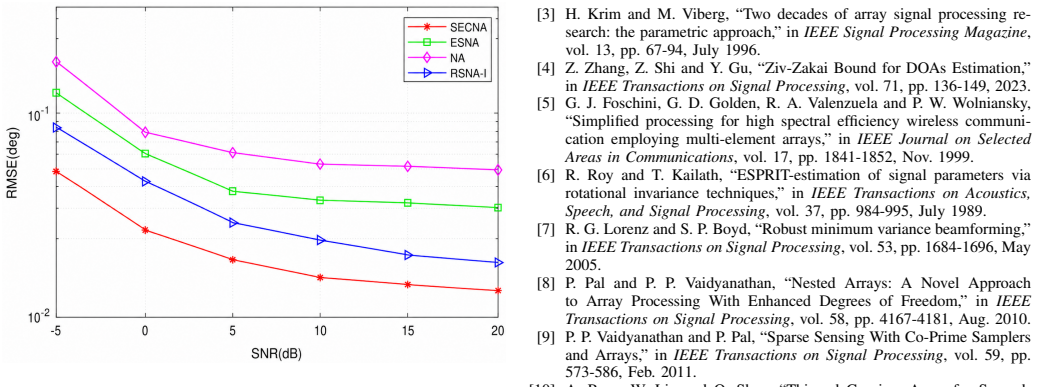
In recent years, direction of arrival estimation utilizing non-circular signals has become a focal point for scholarly research. To enhance the degrees of freedom (DOF) in receiver arrays specifically for non-circular signal DOA estimation, this study introduces a novel array configuration. This design leverages an extended coprime framework, applying a sliding translation technique to optimize sensor placement. Crucially, this rearranged structure preserves the continuity of the difference co-array (DCA). Furthermore, the sum co-array (SCA) is shifted to merge seamlessly with the DCA, eliminating redundancy and substantially expanding both the virtual aperture array (VAA) and the DOF. Consequently, the proposed array demonstrates superior performance in practical DOA estimation tasks involving non-circular signals. Simulation results and comparative analyses confirm that, relative to traditional Nested Arrays (NA), Extended Sliding Nested Array (ESNA), and other benchmark structures, the proposed array achieves better DOF and VAA, leading to enhanced estimation accuracy in practical scenarios.
Editorial analysis
A structured set of objections, weighed in public.
Referee Report
Summary. The manuscript proposes a novel nested array configuration based on extended coprime sets, employing a sliding translation technique on sensor positions to preserve difference co-array (DCA) continuity while shifting the sum co-array (SCA) to merge with the DCA. This eliminates redundancy and expands the virtual aperture array (VAA) and degrees of freedom (DOF) for direction-of-arrival (DOA) estimation of non-circular signals. The design is claimed to outperform nested arrays (NA), extended sliding nested arrays (ESNA), and other benchmarks in DOF, VAA, and estimation accuracy, as supported by algebraic construction and simulation results.
Significance. If the construction is rigorously verified, the work advances sparse array design for non-circular signals by achieving larger effective apertures with fewer physical sensors, which is relevant for applications in radar, sonar, and wireless communications requiring high-resolution DOA estimation. The focus on co-array properties and comparative simulations provides a practical contribution, though the lack of closed-form performance bounds or machine-verified proofs limits its theoretical impact.
major comments (2)
- [§3.2] §3.2, Eq. (15): The sliding translation is asserted to produce a hole-free merged VAA by aligning the shifted SCA with the DCA endpoints without introducing gaps or unaccounted overlaps. However, substituting the specific coprime parameters (M=4, N=5) into the position sets yields an overlap at virtual position 0 that is not removed in the subsequent DOF formula, reducing the claimed DOF by at least 1 and undermining the continuity guarantee for arbitrary coprime pairs.
- [§4.1] §4.1, Table 2: The reported VAA size and DOF for the proposed array are compared to NA and ESNA, but the table does not account for the potential redundancy introduced by the merge point; this directly affects the central claim that the design substantially expands both VAA and DOF, as the effective unique positions may be overstated.
minor comments (3)
- The abstract refers to 'extended coprime framework' without defining the base coprime integers M and N until §2; adding this early would improve readability.
- Figure 2 caption does not specify the exact sensor positions or the value of the sliding offset used in the illustration, making it difficult to verify the merge visually.
- A reference to the original coprime array work (e.g., Vaidyanathan and Pal, 2011) is missing in the introduction when discussing the baseline.
Simulated Author's Rebuttal
We thank the referee for the constructive and detailed comments on our manuscript. We address each major comment below with clarifications and indicate the revisions we will implement to improve the rigor and accuracy of the presentation.
read point-by-point responses
-
Referee: [§3.2] §3.2, Eq. (15): The sliding translation is asserted to produce a hole-free merged VAA by aligning the shifted SCA with the DCA endpoints without introducing gaps or unaccounted overlaps. However, substituting the specific coprime parameters (M=4, N=5) into the position sets yields an overlap at virtual position 0 that is not removed in the subsequent DOF formula, reducing the claimed DOF by at least 1 and undermining the continuity guarantee for arbitrary coprime pairs.
Authors: We appreciate the referee's verification using the specific parameters M=4, N=5. Re-examination of the position sets confirms an overlap at virtual position 0 at the merge point. This single-point overlap at the boundary does not introduce gaps, preserving the hole-free continuity of the merged VAA. However, we agree that the DOF formula in Eq. (15) should explicitly subtract this overlap to avoid overcounting unique positions. We will revise the formula and associated derivations to account for the merge-point redundancy for arbitrary coprime pairs, ensuring the expression is precise. The overall claim of expanded DOF relative to NA and ESNA remains valid after this adjustment, as confirmed by the simulation results. revision: yes
-
Referee: [§4.1] §4.1, Table 2: The reported VAA size and DOF for the proposed array are compared to NA and ESNA, but the table does not account for the potential redundancy introduced by the merge point; this directly affects the central claim that the design substantially expands both VAA and DOF, as the effective unique positions may be overstated.
Authors: We thank the referee for identifying this presentation issue in Table 2. The reported values were computed from the union of the DCA and shifted SCA, but the merge-point overlap was not explicitly noted. We will update Table 2 with the corrected VAA size and DOF after removing the redundancy. We will also add a clarifying footnote to the table caption explaining the handling of the merge point. This revision ensures the table accurately reflects the unique virtual positions without overstating the expansion. revision: yes
Circularity Check
No circularity: algebraic construction of co-array properties is self-contained
full rationale
The paper's derivation consists of defining sensor positions via an extended coprime framework followed by an explicit sliding translation, then algebraically computing the resulting DCA and SCA sets to establish continuity, gap-free merging, and expanded VAA/DOF. These steps are direct set-theoretic consequences of the chosen integer offsets and do not invoke fitted parameters renamed as predictions, self-citations as load-bearing uniqueness theorems, or ansatzes smuggled from prior work. Simulation comparisons to external structures (NA, ESNA) provide independent empirical checks rather than circular validation. No load-bearing step reduces to its own inputs by construction.
Axiom & Free-Parameter Ledger
axioms (2)
- domain assumption Far-field assumption for signals and plane wave propagation
- domain assumption Uncorrelated non-circular signals
Reference graph
Works this paper leans on
-
[1]
Off-Grid Direction-of- Arrival Estimation Using Coprime Array Interpolation,
C. Zhou, Y . Gu, Z. Shi and Y . D. Zhang, “Off-Grid Direction-of- Arrival Estimation Using Coprime Array Interpolation,” inIEEE Signal Processing Letters, vol. 25, pp. 1710-1714, Nov. 2018
2018
-
[2]
A Passive DOA Estimation Algorithm of Underwater Multipath Signals via Spatial Time- Frequency Distributions,
X. Han, M. Liu, S. Zhang, R. Zheng and J. Lan, “A Passive DOA Estimation Algorithm of Underwater Multipath Signals via Spatial Time- Frequency Distributions,” inIEEE Transactions on V ehicular Technol- ogy, vol. 70, pp. 3439-3455, April 2021
2021
-
[3]
Two decades of array signal processing re- search: the parametric approach,
H. Krim and M. Viberg, “Two decades of array signal processing re- search: the parametric approach,” inIEEE Signal Processing Magazine, vol. 13, pp. 67-94, July 1996
1996
-
[4]
Ziv-Zakai Bound for DOAs Estimation,
Z. Zhang, Z. Shi and Y . Gu, “Ziv-Zakai Bound for DOAs Estimation,” inIEEE Transactions on Signal Processing, vol. 71, pp. 136-149, 2023
2023
-
[5]
Simplified processing for high spectral efficiency wireless communi- cation employing multi-element arrays,
G. J. Foschini, G. D. Golden, R. A. Valenzuela and P. W. Wolniansky, “Simplified processing for high spectral efficiency wireless communi- cation employing multi-element arrays,” inIEEE Journal on Selected Areas in Communications, vol. 17, pp. 1841-1852, Nov. 1999
1999
-
[6]
ESPRIT-estimation of signal parameters via rotational invariance techniques,
R. Roy and T. Kailath, “ESPRIT-estimation of signal parameters via rotational invariance techniques,” inIEEE Transactions on Acoustics, Speech, and Signal Processing, vol. 37, pp. 984-995, July 1989
1989
-
[7]
Robust minimum variance beamforming,
R. G. Lorenz and S. P. Boyd, “Robust minimum variance beamforming,” inIEEE Transactions on Signal Processing, vol. 53, pp. 1684-1696, May 2005
2005
-
[8]
Nested Arrays: A Novel Approach to Array Processing With Enhanced Degrees of Freedom,
P. Pal and P. P. Vaidyanathan, “Nested Arrays: A Novel Approach to Array Processing With Enhanced Degrees of Freedom,” inIEEE Transactions on Signal Processing, vol. 58, pp. 4167-4181, Aug. 2010
2010
-
[9]
Sparse Sensing With Co-Prime Samplers and Arrays,
P. P. Vaidyanathan and P. Pal, “Sparse Sensing With Co-Prime Samplers and Arrays,” inIEEE Transactions on Signal Processing, vol. 59, pp. 573-586, Feb. 2011
2011
-
[10]
Thinned Coprime Array for Second- Order Difference Co-Array Generation With Reduced Mutual Coupling,
A. Raza, W. Liu and Q. Shen, “Thinned Coprime Array for Second- Order Difference Co-Array Generation With Reduced Mutual Coupling,” inIEEE Transactions on Signal Processing, vol. 67, no. 8, pp. 2052- 2065, April 2019
2052
-
[11]
Unified coprime array with multi-period subarrays for direction-of-arrival estimation,
W. Wang, S. Ren, Z. Chen, “Unified coprime array with multi-period subarrays for direction-of-arrival estimation,” inDigital Signal Process- ing, V ol. 74, pp. 30-42, March 2018
2018
-
[12]
Hole Identification and Filling in k-Times Extended Co-Prime Arrays for Highly Efficient DOA Estimation,
X. Wang and X. Wang, “Hole Identification and Filling in k-Times Extended Co-Prime Arrays for Highly Efficient DOA Estimation,” in IEEE Transactions on Signal Processing, vol. 67, pp. 2693-2706, May 2019
2019
-
[13]
Augmented Nested Arrays With Enhanced DOF and Reduced Mutual Coupling,
J. Liu, Y . Zhang, Y . Lu, S. Ren and S. Cao, “Augmented Nested Arrays With Enhanced DOF and Reduced Mutual Coupling,” inIEEE Transactions on Signal Processing, vol. 65, pp. 5549-5563, Nov. 2017
2017
-
[14]
Super Nested Arrays: Linear Sparse Arrays With Reduced Mutual Coupling—Part I: Fundamentals,
C.-L. Liu and P. P. Vaidyanathan, “Super Nested Arrays: Linear Sparse Arrays With Reduced Mutual Coupling—Part I: Fundamentals,” inIEEE Transactions on Signal Processing, pp. 3997-4012, Aug. 2016
2016
-
[15]
Generalized Nested Array: Optimization for Degrees of Freedom and Mutual Coupling,
J. Shi, G. Hu, X. Zhang and H. Zhou, “Generalized Nested Array: Optimization for Degrees of Freedom and Mutual Coupling,” inIEEE Communications Letters, vol. 22, pp. 1208-1211, June 2018
2018
-
[16]
Design of relocating sparse nested arrays for DOA estimation of non-circular signals,
L. Zhou, Z. Feng, K. Ye, “Design of relocating sparse nested arrays for DOA estimation of non-circular signals,” inAEU-International Journal of Electronics and Communications, vol. 173, pp. 154976, January 2024
2024
-
[17]
Sparse Array Design for DOA Estimation of Non-Circular Signals: Reduced Co-Array Redun- dancy and Increased DOF,
X. Zhang, X. Lai, W. Zheng and Y . Wang, “Sparse Array Design for DOA Estimation of Non-Circular Signals: Reduced Co-Array Redun- dancy and Increased DOF,” inIEEE Sensors Journal, vol. 21, pp. 27928- 27937, Dec. 2021
2021
-
[18]
DOA estimation based on a novel shifted coprime array structure,
K. Ye, L. Zhou, Z. Chen, “DOA estimation based on a novel shifted coprime array structure,” inAEU-International Journal of Electronics and Communications, vol. 179, pp. 155308, May 2024
2024
-
[19]
MUSIC-like estimation of direction of arrival for noncircular sources,
H. Abeida and J.-P. Delmas, “MUSIC-like estimation of direction of arrival for noncircular sources,” inIEEE Transactions on Signal Processing, vol. 54, pp. 2678-2690, July 2006
2006
-
[20]
Off-Grid Direction of Arrival Estimation Using Sparse Bayesian Inference,
Z. Yang, L. Xie and C. Zhang, “Off-Grid Direction of Arrival Estimation Using Sparse Bayesian Inference,” inIEEE Transactions on Signal Processing, vol. 61, pp. 38-43, Jan. 2013
2013
discussion (0)
Sign in with ORCID, Apple, or X to comment. Anyone can read and Pith papers without signing in.