Recognition: unknown
Phase-Corrected Near-Field Microwave Imaging via Inverse Source Reconstruction with Modulated Signals
Pith reviewed 2026-05-07 12:31 UTC · model grok-4.3
The pith
Normalizing near-field probe signals with a fixed reference antenna restores spatial coherence for single-frequency inverse source reconstruction of 3D microwave images from modulated signals.
A machine-rendered reading of the paper's core claim, the machinery that carries it, and where it could break.
Core claim
By dividing the near-field scanning probe measurements by the simultaneous reference antenna signals, spatial coherence is restored in the observations of modulated scattered fields, permitting the direct application of a single-frequency inverse source reconstruction algorithm to form three-dimensional near-field images. A phase correction procedure is derived to allow coherent addition of images obtained at different frequencies within the signal bandwidth, while for narrowband cases the incoherent approach suffices. The full scheme, including background subtraction, produces recognizable images of a human-sized mannequin placed inside a furnished office room when using orthogonal freqency
What carries the argument
Normalization of near-field probe signals by simultaneous fixed reference antenna measurements to restore spatial coherence for the inverse source solver.
If this is right
- Coherent superposition of multi-frequency images is enabled by the derived phase correction method.
- For realistic narrowband modulated signals, incoherent superposition of single-frequency images is sufficient.
- The approach works in typical indoor multipath environments without requiring a cooperative or phase-locked transmitter.
- Background subtraction combined with reference normalization is adequate to obtain usable images of large objects such as mannequins.
Where Pith is reading between the lines
- The reference-normalization step could be applied to other passive near-field sensing tasks where phase drift from propagation is the main obstacle.
- Imaging systems might be constructed that rely entirely on ambient communication signals without emitting dedicated probes.
- Resolution and contrast limits could be quantified by repeating the experiment with smaller or lower-contrast targets.
- Combining the coherence restoration with compressed-sensing or sparse-array techniques might shorten the required mechanical scan time.
Load-bearing premise
Normalizing the near-field probe signals with the fixed reference antenna measurements obtains sufficient spatial coherence for the single-frequency inverse source solver to produce accurate 3-D images, even in a realistic indoor multipath environment.
What would settle it
Placing the mannequin at a known position and size in the office and checking whether the reconstructed image volume places an object of matching dimensions at that location within the resolution limits of the scan aperture and operating frequencies.
Figures






read the original abstract
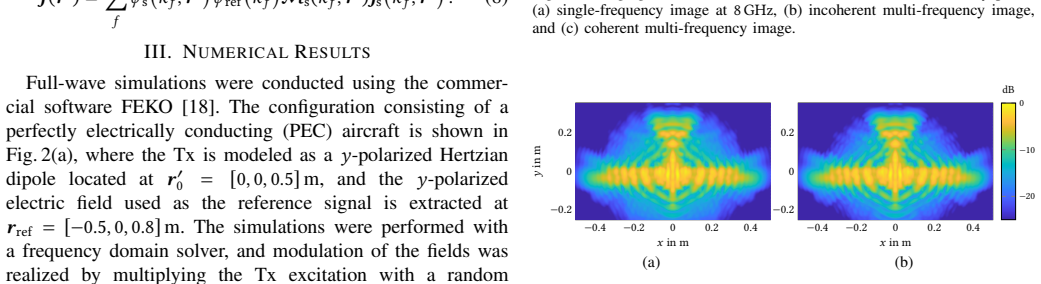
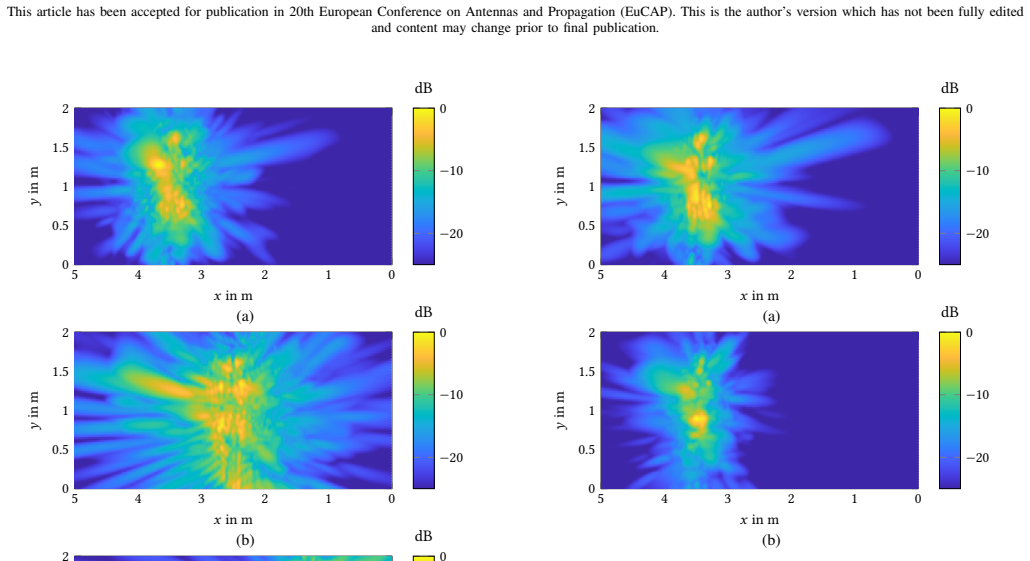
An inverse source reconstruction (ISR) based 3-D near-field (NF) passive radar microwave imaging method utilizing modulated signals is presented. The modulated signals from a non-cooperative transmitter are scattered by the targets of interest and captured by a fixed reference antenna together with an NF scanning probe at different positions. By normalizing with the reference signals, spatial coherence of the NF observations is obtained, and a single-frequency inverse source solver is subsequently utilized for ISR and image generation. A corresponding phase correction method is proposed for the coherent superposition of multi-frequency images and verified through simulations. In addition, it is shown that for realistic narrowband signals, an incoherent imaging approach is sufficient. The presented technical scheme is validated using a planar scanning system in a typical office room, where software-defined radios are employed for the transmitting and receiving of narrowband orthogonal frequency-division multiplexing signals at Wi-Fi operating frequencies. With the aid of background subtraction and reference signals, images of a mannequin placed in the office room are successfully obtained.
Editorial analysis
A structured set of objections, weighed in public.
Referee Report
Summary. The paper presents an inverse source reconstruction (ISR) method for 3-D near-field passive radar microwave imaging that uses modulated signals from a non-cooperative transmitter. Probe measurements are normalized by a fixed reference antenna to obtain spatial coherence, enabling a single-frequency ISR solver; a phase-correction technique is proposed for coherent multi-frequency superposition, with an incoherent alternative noted for narrowband signals. The approach is experimentally validated in an office room using SDRs transmitting narrowband OFDM signals at Wi-Fi frequencies, with background subtraction, yielding images of a mannequin.
Significance. If the normalization step reliably produces spatially coherent data despite indoor multipath, the method could enable practical passive 3-D near-field imaging in realistic environments without cooperative sources or wide bandwidth. The experimental demonstration with standard Wi-Fi hardware and SDRs in a furnished room is a practical strength that could support applications in security or surveillance; the explicit treatment of phase correction for multi-frequency stacking and the note on incoherent sufficiency for narrowband cases add value if substantiated.
major comments (3)
- [Normalization procedure and coherence assumption] The central claim that normalization by the fixed reference antenna yields sufficient spatial coherence for the single-frequency ISR solver (abstract and methods description) is load-bearing but unsupported by analysis: no analytic bound, simulation, or error propagation is provided showing that residual position-dependent phase terms from distinct multipath combinations (probe vs. reference) remain small enough to avoid ISR artifacts in a furnished indoor setting.
- [Experimental results and validation] Experimental validation (results section) reports successful mannequin imaging but provides no quantitative metrics such as localization RMSE, image fidelity (e.g., structural similarity or peak sidelobe level), or comparison against ground-truth positions; this leaves the accuracy of the 3-D reconstructions unquantified beyond qualitative visual assessment.
- [Phase correction method] The phase-correction method for coherent multi-frequency image superposition is stated to be verified through simulations, yet no derivation, explicit equations, or quantitative simulation results (e.g., before/after coherence metrics) are supplied to evaluate its effectiveness or to confirm it addresses the residual phase issue.
minor comments (2)
- [Abstract] The abstract would benefit from a brief statement of the achieved imaging resolution or error level to allow readers to gauge performance immediately.
- [Methods] Notation for the normalized field and the ISR formulation could be introduced with a short equation block to improve readability for readers unfamiliar with the specific inverse-source implementation.
Simulated Author's Rebuttal
We thank the referee for the thorough review and constructive feedback on our manuscript. We address each of the major comments below and have prepared revisions to strengthen the paper accordingly.
read point-by-point responses
-
Referee: The central claim that normalization by the fixed reference antenna yields sufficient spatial coherence for the single-frequency ISR solver (abstract and methods description) is load-bearing but unsupported by analysis: no analytic bound, simulation, or error propagation is provided showing that residual position-dependent phase terms from distinct multipath combinations (probe vs. reference) remain small enough to avoid ISR artifacts in a furnished indoor setting.
Authors: We appreciate the referee pointing out the need for supporting analysis on the normalization procedure. Although the experimental results demonstrate the effectiveness in practice, we agree that an analytic or simulation-based justification would enhance the manuscript. In the revised version, we will add a dedicated subsection with simulations of the multipath effects, including error propagation analysis to show that the residual phase terms are sufficiently small for the ISR solver in typical indoor environments. revision: yes
-
Referee: Experimental validation (results section) reports successful mannequin imaging but provides no quantitative metrics such as localization RMSE, image fidelity (e.g., structural similarity or peak sidelobe level), or comparison against ground-truth positions; this leaves the accuracy of the 3-D reconstructions unquantified beyond qualitative visual assessment.
Authors: We acknowledge that the current presentation of experimental results relies on qualitative assessment. To address this, we will include quantitative evaluations in the revised manuscript. This will comprise the localization RMSE of the mannequin's reconstructed position relative to its known ground-truth location, peak sidelobe levels in the images, and structural similarity measures where feasible. revision: yes
-
Referee: The phase-correction method for coherent multi-frequency image superposition is stated to be verified through simulations, yet no derivation, explicit equations, or quantitative simulation results (e.g., before/after coherence metrics) are supplied to evaluate its effectiveness or to confirm it addresses the residual phase issue.
Authors: We thank the referee for this observation. The phase-correction approach was indeed validated via simulations in our work, but we agree that the details should be expanded. In the revision, we will provide the full derivation with explicit equations for the phase correction. We will also include quantitative simulation results, such as coherence metrics (e.g., phase standard deviation and image contrast) before and after correction, to substantiate its effectiveness. revision: yes
Circularity Check
No circularity: standard normalization plus ISR applied to measured data
full rationale
The derivation consists of (1) capturing modulated signals at a fixed reference antenna and moving NF probe, (2) normalizing probe data by reference to obtain spatial coherence, (3) feeding the normalized single-frequency data into a conventional inverse-source solver, and (4) optional phase correction for multi-frequency superposition. None of these steps is defined in terms of its own output; normalization is a standard operation whose effect on multipath is an empirical assumption, not a tautology. No self-citations, fitted parameters renamed as predictions, or uniqueness theorems imported from prior author work appear in the provided text. The final images are obtained from real indoor measurements after background subtraction, not recovered by algebraic rearrangement of the input equations.
Axiom & Free-Parameter Ledger
axioms (2)
- domain assumption Normalizing near-field observations with reference-antenna signals yields spatial coherence sufficient for single-frequency inverse source reconstruction.
- domain assumption Phase correction permits coherent superposition of multi-frequency images without introducing artifacts.
Reference graph
Works this paper leans on
-
[1]
Klein Heidelberg—The first modern bistatic radar system,
H. Griffiths and N. Willis, “Klein Heidelberg—The first modern bistatic radar system,”IEEE Trans. Aerosp. Electron. Syst., vol. 46, no. 4, pp. 1571–1588, Oct. 2010. This article has been accepted for publication in 20th European Conference on Antennas and Propagation (EuCAP). This is the author’s version which has not been fully edited and content may cha...
2010
-
[2]
Tutorial: Passive radar tutorial,
H. Kuschel, D. Cristallini, and K. E. Olsen, “Tutorial: Passive radar tutorial,”IEEE Aerosp. Electron. Syst. Mag., vol. 34, no. 2, pp. 2–19, Feb. 2019
2019
-
[3]
Passive radar: Past, present, and future challenges,
F. Colone, F. Filippini, and D. Pastina, “Passive radar: Past, present, and future challenges,”IEEE Aerosp. Electron. Syst. Mag., vol. 38, no. 1, pp. 54–69, Jan. 2023
2023
-
[4]
Passive multistatic radar imaging of vessel target using GNSS satellites of opportunity,
C. Huang, Z. Li, H. An, Z. Sun, J. Wu, and J. Yang, “Passive multistatic radar imaging of vessel target using GNSS satellites of opportunity,” IEEE Trans. Geosci. Remote Sens., vol. 60, pp. 1–16, 2022
2022
-
[5]
5G network-based passive radar,
P. Samczy ´nski, K. Abratkiewicz, M. Płotka, T. P. Zieli ´nski, J. Wszołek, S. Hausman, P. Korbel, and A. Ksie ¸ ˙zyk, “5G network-based passive radar,”IEEE Trans. Geosci. Remote Sens., vol. 60, pp. 1–9, 2022
2022
-
[6]
Holography of Wi-Fi radiation,
P. M. Holl and F. Reinhard, “Holography of Wi-Fi radiation,”Phys. Rev. Lett., vol. 118, no. 18, p. 183901, May 2017
2017
-
[7]
Feasibility and limits of Wi-Fi imaging,
D. Huang, R. Nandakumar, and S. Gollakota, “Feasibility and limits of Wi-Fi imaging,” inProc. 12th ACM Conf. Embed. Netw. Sens. Syst., New York, NY , USA, Nov. 2014, pp. 266–279
2014
-
[8]
See through walls with WiFi!
F. Adib and D. Katabi, “See through walls with WiFi!” inProc. ACM SIGCOMM Conf. SIGCOMM, New York, NY , USA, Aug. 2013, pp. 75–86
2013
-
[9]
Imaging with WiFi,
S. Vakalis, L. Gong, and J. A. Nanzer, “Imaging with WiFi,”IEEE Access, vol. 7, pp. 28 616–28 624, 2019
2019
-
[10]
3-D near-field passive radar imaging utilizing phase-corrected frequency domain inverse source reconstructions,
Q. Wang, M. M. Saurer, and T. F. Eibert, “3-D near-field passive radar imaging utilizing phase-corrected frequency domain inverse source reconstructions,”IEEE Trans. Antennas Propag., vol. 73, no. 1, pp. 504– 516, Jan. 2025
2025
-
[11]
Microwave imaging of electromagnetic wave absorbers in an antenna measurement chamber,
Q. Wang and T. F. Eibert, “Microwave imaging of electromagnetic wave absorbers in an antenna measurement chamber,” inIEEE Int. Symp. Antennas Propag., Florence, Italy, Jul. 2024, pp. 1139–1140
2024
-
[12]
Electromagnetic field transformations for measure- ments and simulations (invited paper),
T. F. Eibert, E. Kilic, C. Lopez, R. A. M. Mauermayer, O. Neitz, and 0123450 0.5 1 1.5 2 /u1D465in m /u1D466in m −20 −10 0 dB (a) 0123450 0.5 1 1.5 2 /u1D465in m /u1D466in m −20 −10 0 dB (b) Fig. 8. Coherent multi-frequency images of the mannequin obtained by com- bining 21 subcarriers within a10 MHzbandwidth, with the Vivaldi antennas configured for (a) ...
2015
-
[13]
R. G. Newton,Scattering Theory of Waves and Particles: Second Edition, 2nd ed. Mineola, N.Y: Dover Publications Inc., Nov. 2002
2002
-
[14]
W. C. Chew, J.-M. Jin, E. Michielssen, and J. Song,Fast and Efficient Algorithms in Computational Electromagnetics. Boston: Artech House, 2001
2001
-
[15]
Solution to the full vectorial 3-D inverse source problem by multilevel fast multipole method inspired hierarchical disaggregation,
G. Schnattinger and T. F. Eibert, “Solution to the full vectorial 3-D inverse source problem by multilevel fast multipole method inspired hierarchical disaggregation,”IEEE Trans. Antennas Propag., vol. 60, no. 7, pp. 3325–3335, Jul. 2012
2012
-
[16]
Inverse source solutions with simultaneous localization in the spatial and spectral domains–sparse sampling for directive antennas,
T. F. Eibert, M. M. Saurer, A. H. Paulus, and J. Knapp, “Inverse source solutions with simultaneous localization in the spatial and spectral domains–sparse sampling for directive antennas,”IEEE Trans. Antennas Propag., vol. 1, pp. 779–790, Jan. 2023
2023
-
[17]
An automatic focusing technique for inverse source reconstructions based near-field passive radar imaging,
Q. Wang and T. F. Eibert, “An automatic focusing technique for inverse source reconstructions based near-field passive radar imaging,” in19th Eur. Conf. Antennas Propag. (EuCAP), Stockholm, Sweden, Mar. 2025, pp. 1–5
2025
-
[18]
(2025) FEKO
Altair. (2025) FEKO. [Online]. Available: https://altairhyperworks.com/product/FEKO
2025
-
[19]
3-D radar imaging using range migration techniques,
J. Lopez-Sanchez and J. Fortuny-Guasch, “3-D radar imaging using range migration techniques,”IEEE Trans. Antennas Propag., vol. 48, no. 5, pp. 728–737, May 2000
2000
-
[20]
S. S. Ahmed,Electronic Microwave Imaging with Planar Multistatic Arrays. Berlin: Logos Verlag Berlin GmbH, 2014
2014
-
[21]
(2025) ADALM-PLUTO
Analog Devices. (2025) ADALM-PLUTO. [Online]. Available: https://wiki.analog.com/university/tools/pluto
2025
-
[22]
(2013) AD9361 RF Transceiver
——. (2013) AD9361 RF Transceiver. [Online]. Available: https://www.analog.com/en/products/ad9361.html
2013
-
[23]
An indoor localization technique utilizing passive tags and 3-D microwave passive radar imaging,
Q. Wang, A. H. Paulus, M. S. Tong, and T. F. Eibert, “An indoor localization technique utilizing passive tags and 3-D microwave passive radar imaging,”Prog. Electromagn. Res., vol. 181, pp. 89–98, 2024
2024
-
[24]
Electromagnetic ray tracing simulation and imaging of complex indoor scenarios,
H. Na, M. Saurer, and T. F. Eibert, “Electromagnetic ray tracing simulation and imaging of complex indoor scenarios,” in25th Int. Conf. Electromagn. Adv. Appl. (ICEAA), Venice, Italy, October 2023, pp. 300– 304. This article has been accepted for publication in 20th European Conference on Antennas and Propagation (EuCAP). This is the author’s version whic...
2023
discussion (0)
Sign in with ORCID, Apple, or X to comment. Anyone can read and Pith papers without signing in.