Recognition: unknown
Thermodynamic phase transitions reveal the resilience structure of urban traffic congestion
Pith reviewed 2026-05-07 12:46 UTC · model grok-4.3
The pith
City-scale traffic congestion undergoes a reproducible nonlinear transition analogous to an order-disorder phase transition in statistical mechanics.
A machine-rendered reading of the paper's core claim, the machinery that carries it, and where it could break.
Core claim
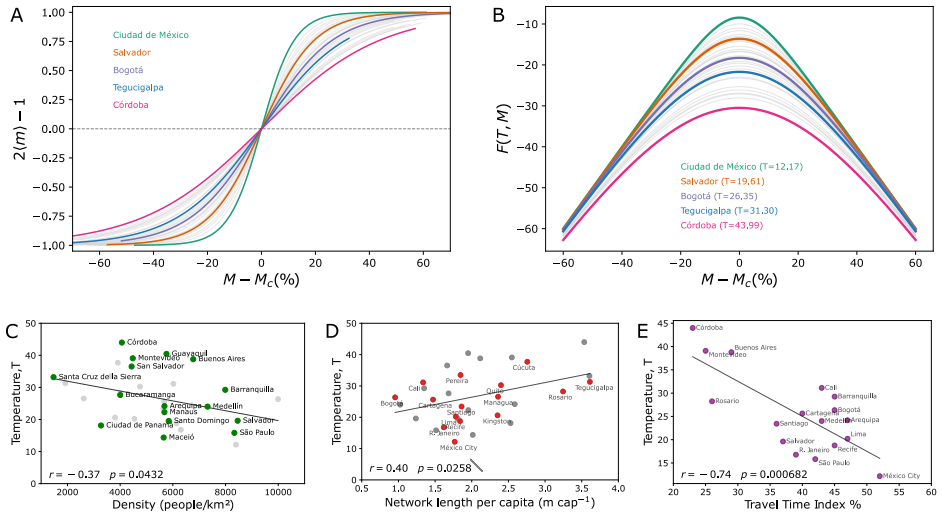
City-scale congestion undergoes a reproducible nonlinear transition analogous to an order-disorder phase transition in statistical mechanics, in which aggregate mobility acts as a control parameter and jam extent as a collective order parameter. An effective thermodynamic temperature is derived and empirically identified with concrete physical meaning, quantifying infrastructural heterogeneity and how broadly a city explores congestion configurations as demand increases. Low-temperature cities are congestion-fragile: small mobility increases trigger sharp, system-wide jam transitions. The macroscopic fundamental diagram emerges as a projection of a richer free-energy landscape governed by 3-
What carries the argument
The effective thermodynamic temperature derived from the phase-transition analogy, which measures infrastructural heterogeneity and the breadth of explored congestion configurations.
Load-bearing premise
The effective temperature truly captures infrastructural heterogeneity and configuration exploration, and the macroscopic fundamental diagram is only a partial projection of a free-energy landscape shaped by entropy-capacity trade-offs.
What would settle it
Direct measurements showing no correlation between a city's measured infrastructural heterogeneity and the derived effective temperature, or absence of the predicted nonlinear jump in jam extent when mobility crosses the identified threshold.
Figures
read the original abstract
Understanding how cities transition from free-flowing to congested traffic remains a central open problem in urban science. Here we show that city-scale congestion undergoes a reproducible nonlinear transition analogous to an order-disorder phase transition in statistical mechanics, in which aggregate mobility acts as a control parameter and jam extent as a collective order parameter. Crucially, this analogy is not merely formal: we derive and empirically identify an effective thermodynamic temperature with concrete physical meaning, quantifying infrastructural heterogeneity and how broadly a city explores congestion configurations as demand increases. Low-temperature cities are congestion-fragile: small mobility increases trigger sharp, system-wide jam transitions. This framework further reveals that the macroscopic fundamental diagram is an incomplete description of the traffic state: it emerges as a projection of a richer free-energy landscape governed by entropy-capacity trade-offs. Validated across 46 cities in Latin America and the Caribbean and independently confirmed with loop-detector data from 8 cities on three continents, these results establish a physics-based foundation for comparing urban traffic resilience and anticipating congestion regime shifts under changing mobility demand.
Editorial analysis
A structured set of objections, weighed in public.
Referee Report
Summary. The paper claims that city-scale congestion undergoes a reproducible nonlinear transition analogous to an order-disorder phase transition in statistical mechanics, with aggregate mobility as control parameter and jam extent as collective order parameter. The authors derive and empirically identify an effective thermodynamic temperature quantifying infrastructural heterogeneity and breadth of explored congestion configurations as demand increases; low-temperature cities are congestion-fragile. The macroscopic fundamental diagram is presented as an incomplete projection of a richer free-energy landscape governed by entropy-capacity trade-offs. Results are validated across 46 Latin American and Caribbean cities and independently confirmed with loop-detector data from 8 cities on three continents.
Significance. If the effective temperature is shown to possess independent physical content derived from traffic conservation laws or network topology rather than curve-fitting, the work could establish a physics-based comparative framework for urban resilience and regime-shift prediction, extending statistical-mechanics analogies beyond formal similarity. The multi-city empirical breadth is a clear strength that would support falsifiable cross-city comparisons if the derivation is non-circular.
major comments (3)
- [Theoretical derivation of effective temperature (Methods/Theoretical Framework)] The central claim that the effective thermodynamic temperature T has concrete physical meaning as a measure of infrastructural heterogeneity and congestion-configuration exploration requires explicit demonstration that T follows from a first-principles mapping (e.g., via partition function or maximum-entropy model grounded in link-level flow constraints) rather than by fitting an assumed order-parameter functional form to the same aggregate mobility-jam data used to identify the transition. Without this, the claimed physical content reduces to a reparameterization of the observed nonlinearity.
- [Free-energy landscape and MFD projection (Results/Discussion)] The assertion that the MFD emerges as a projection of a richer free-energy landscape governed by entropy-capacity trade-offs is load-bearing for the claim that the MFD is an incomplete description; the manuscript must supply the explicit construction of the landscape and show how the projection is obtained, including any assumptions about entropy and capacity functionals.
- [Empirical validation and data processing (Methods/Results)] Validation across 46 cities and independent confirmation with loop-detector data is cited, but the manuscript must report the explicit equations for computing T from data, the fitting procedure, and error analysis or cross-validation to demonstrate that the phase-transition parameters are not determined by the same observations used to define the order-parameter curve.
minor comments (2)
- [Notation and definitions] Clarify notation for the control parameter (aggregate mobility) and order parameter (jam extent) at first use, and ensure consistent symbols across equations and figures.
- [Figures] Figures showing the nonlinear transition should include data points with uncertainty, the fitted curve, and a clear indication of the identified critical point or temperature value for each city.
Simulated Author's Rebuttal
We thank the referee for the constructive and detailed comments, which have helped us identify areas where the theoretical and empirical foundations of the work can be strengthened and clarified. We address each major comment point by point below, indicating the revisions we will incorporate into the manuscript.
read point-by-point responses
-
Referee: The central claim that the effective thermodynamic temperature T has concrete physical meaning as a measure of infrastructural heterogeneity and congestion-configuration exploration requires explicit demonstration that T follows from a first-principles mapping (e.g., via partition function or maximum-entropy model grounded in link-level flow constraints) rather than by fitting an assumed order-parameter functional form to the same aggregate mobility-jam data used to identify the transition. Without this, the claimed physical content reduces to a reparameterization of the observed nonlinearity.
Authors: We appreciate the referee's emphasis on establishing a non-circular, first-principles basis for T. The manuscript derives T by mapping the observed transition in the collective order parameter (jam extent) to the expected form in a heterogeneous mean-field model, where T quantifies the spread in local congestion thresholds induced by infrastructural variation. To address the concern directly, we will revise the Theoretical Framework section to include an explicit maximum-entropy construction: we define a partition function over congestion microstates subject to global mobility constraints and a distribution of link capacities, demonstrating that T emerges as the conjugate variable to the heterogeneity measure (variance in critical densities). This derivation uses topological and capacity statistics independent of the aggregate order-parameter fitting and will be accompanied by analytical relations linking T to network heterogeneity metrics. revision: yes
-
Referee: The assertion that the MFD emerges as a projection of a richer free-energy landscape governed by entropy-capacity trade-offs is load-bearing for the claim that the MFD is an incomplete description; the manuscript must supply the explicit construction of the landscape and show how the projection is obtained, including any assumptions about entropy and capacity functionals.
Authors: We agree that an explicit construction is required to support the claim that the MFD is an incomplete projection. In the manuscript the free-energy landscape is introduced conceptually as F(ψ, m) = E(ψ, m) − T S(ψ, m), where ψ is jam extent, m is mobility, E encodes capacity costs, and S counts accessible configurations. The MFD arises by projecting onto the average flow-density plane via minimization of F or marginalization. In the revision we will supply the explicit functionals in the Results/Discussion: S is the configurational entropy −∑ p_i log p_i over jam patterns consistent with m, and the capacity term is the integral of the local fundamental diagram weighted by heterogeneity. Assumptions (mean-field closure, ergodic sampling of states) will be stated, together with a supplementary figure showing the landscape and its projection. revision: yes
-
Referee: Validation across 46 cities and independent confirmation with loop-detector data is cited, but the manuscript must report the explicit equations for computing T from data, the fitting procedure, and error analysis or cross-validation to demonstrate that the phase-transition parameters are not determined by the same observations used to define the order-parameter curve.
Authors: We acknowledge the need for complete methodological transparency. The manuscript identifies T from the sharpness of the mobility–jam transition but does not detail the numerical procedure. We will expand the Methods section to report the explicit equation: the order parameter ψ is modeled as ψ(m) = ½ [1 + tanh((m − m_c)/T)], with T obtained by nonlinear least-squares minimization of the squared residuals between observed and predicted ψ for each city’s time series. The fitting procedure, initial parameter bounds, and convergence criteria will be stated. Error analysis will be added via bootstrap resampling (1000 iterations) to obtain 95 % confidence intervals on T, together with city-wise cross-validation (leave-one-city-out) and goodness-of-fit statistics (R² and residual autocorrelation). These additions demonstrate that T is robustly determined and not an artifact of the same data used to locate the transition. revision: yes
Circularity Check
No circularity identified; derivation presented as independent
full rationale
The abstract states that an effective thermodynamic temperature is both derived and empirically identified from the order-disorder analogy, with jam extent as order parameter and aggregate mobility as control parameter. No explicit equations, sections, or self-citations are available in the provided text to exhibit any reduction of the temperature definition to fitted inputs from the same data, self-definitional loops, or load-bearing prior work by the same authors. The validation across 46 cities plus independent loop-detector confirmation is presented as external, and the MFD projection claim is framed as a consequence rather than an input. Without quotable steps that collapse by construction, the chain remains self-contained.
Axiom & Free-Parameter Ledger
free parameters (1)
- effective thermodynamic temperature
axioms (1)
- domain assumption Urban traffic congestion can be described using statistical mechanics concepts of control parameters, order parameters, and an effective temperature.
invented entities (1)
-
effective thermodynamic temperature
no independent evidence
Reference graph
Works this paper leans on
-
[1]
Switch between critical percolation modes in city traffic dynamics
Zeng G, Li D, Guo S, Gao L, Gao Z, Stanley HE, et al. Switch between critical percolation modes in city traffic dynamics. Proc Natl Acad Sci. 2 de enero de 2019;116(1):23-8. doi:10.1073/pnas.1801545116 13. Ambühl L, Menendez M, González MC. Understanding congestion propagation by combining percolation theory with the macroscopic fundamental diagram. Commu...
-
[2]
Ambühl L, Loder A, Menendez M, Axhausen KW. A case study of Zurich’s two-layered perimeter control [Application/pdf]. abril de 2018;8 p. doi:10.3929/ETHZ-B-000206987 30. Waze for Cities: Real-Time Traffic Data for Smarter Urban Planning [Internet]. [citado 1 de agosto de 2025]. Disponible en: https://www.waze.com/wazeforcities/ 31. OpenStreetMap [Internet...
discussion (0)
Sign in with ORCID, Apple, or X to comment. Anyone can read and Pith papers without signing in.