Recognition: unknown
Parameterized Families of Toric Code Phase: em-duality family and higher-order anyon pumping
Pith reviewed 2026-05-07 04:00 UTC · model grok-4.3
The pith
Parameterized families of toric code Hamiltonians exhibit non-trivial topology by pumping em-exchange defects and higher-order anyons.
A machine-rendered reading of the paper's core claim, the machinery that carries it, and where it could break.
Core claim
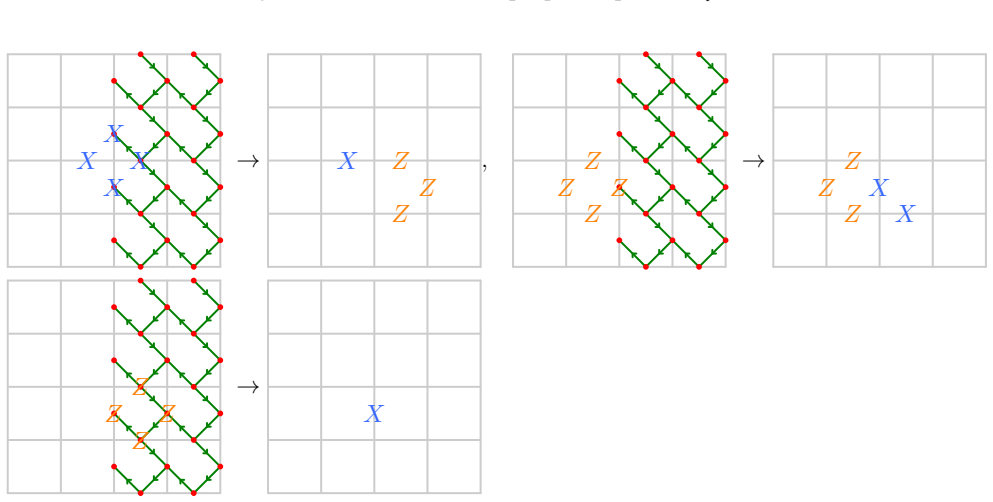
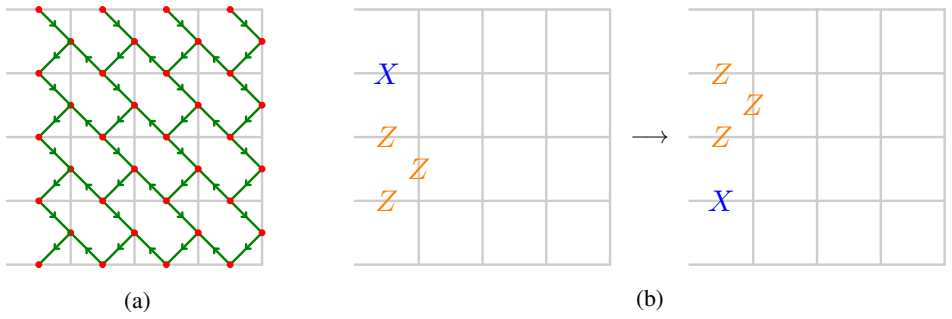
Within the toric-code phase, we study parameterized families of topologically ordered states by constructing 1- and 2-parameter families of local Hamiltonians and confirming their non-triviality via topological pumping. For the 1-parameter family, the em-exchange defect is pumped into the bond Hilbert space of a tensor-network representation. For the 2-parameter case, a pump of a pump is constructed that transports an S1-family of a system in one lower spatial dimension. Using similar methods, a 1-parameter family with a higher-order anyon pump that produces corner-localized anyon modes is presented. These constructions provide explicit lattice realizations and concrete diagnostics of family
What carries the argument
Topological pumping combined with tensor-network representations and boundary algebra methods to track the transport of em-exchange defects and higher-order anyons under continuous parameter variation.
Load-bearing premise
The Hamiltonians remain gapped and inside the toric code phase for every value of the continuous parameters, and the tensor-network plus boundary algebra analysis fully accounts for the pumped defects.
What would settle it
A calculation or simulation showing that the defect charge or anyon mode fails to appear in the expected location after the parameter is taken around a closed loop would falsify the non-triviality of the family.
Figures









read the original abstract
Within the toric-code phase, we study parameterized families of topologically ordered states. We construct $1$- and $2$-parameter families of local Hamiltonians and confirm their non-triviality via topological pumping. For the $1$-parameter family, we show that the $em$-exchange defect is pumped into the bond Hilbert space of a tensor-network representation. For the $2$-parameter case, we construct a ``pump of a pump'' that transports an $S^1$-family of a system in one lower spatial dimension. Using similar methods, we also present a $1$-parameter family with a higher-order anyon pump that produces corner-localized anyon modes. These constructions provide explicit lattice realizations and concrete diagnostics of family-level topology. We use recently developed boundary algebra methods to study the non-triviality of these families.
Editorial analysis
A structured set of objections, weighed in public.
Referee Report
Summary. The paper constructs explicit 1- and 2-parameter families of local Hamiltonians that remain inside the toric-code phase and uses topological pumping (including em-exchange defect pumping into tensor-network bond space, a 'pump of a pump' transporting an S¹-family to one lower dimension, and a higher-order anyon pump yielding corner-localized modes) together with recently developed boundary-algebra methods to diagnose their non-trivial family-level topology.
Significance. If the families are shown to remain gapped and topologically equivalent to the toric code for all real parameter values, the constructions supply concrete lattice realizations of parameterized topological phases and furnish falsifiable pumping diagnostics that could benchmark future analytic and numerical studies of family topology and anyon transport. The tensor-network plus boundary-algebra approach adds a reproducible computational layer to the non-triviality claims.
major comments (3)
- [§3] §3 (1-parameter family construction): the Hamiltonian is written as an interpolation between toric-code stabilizers and additional local terms; no spectral-gap lower bound or numerical gap-closing scan is provided for the full real line of the continuous parameter. The pumping argument in §4 presupposes a gapped toric-code bulk at every point, so absence of gap closure must be established before the em-exchange defect can be unambiguously pumped into the bond Hilbert space.
- [§5] §5 (2-parameter 'pump of a pump'): the transport of the S¹-family is defined via successive pumping protocols, but the text does not demonstrate that the intermediate 1-parameter family remains gapped and inside the toric-code phase for all values of both parameters simultaneously. If gap closure occurs at any interior point, the higher-dimensional family topology is no longer well-defined within the claimed phase.
- [§4, §6] §4 and §6 (boundary-algebra diagnostics): the mapping of pumped defects into tensor-network bond spaces and corner modes relies on specific choices of tensor-network representation and boundary conditions. It is not shown that the extracted invariants are independent of these choices or that the boundary algebra remains well-defined when the bulk gap is only assumed rather than proven.
minor comments (3)
- [§2] Notation for the continuous parameters (e.g., λ, μ) is introduced without an explicit table or equation summarizing their ranges and the precise form of each local term; a compact summary equation would improve readability.
- [Figures 2–4] Figure captions for the pumping diagrams do not state the system size, boundary conditions, or tensor-network bond dimension used in the numerical confirmation; these details are needed to assess reproducibility.
- [§2] The brief review of boundary-algebra methods in §2 cites the original references but does not restate the key commutation relations or the precise definition of the pumped charge used later; a short self-contained paragraph would help readers unfamiliar with the recent literature.
Simulated Author's Rebuttal
We thank the referee for the careful reading and constructive comments on our manuscript. The concerns about establishing the spectral gap throughout the parameter families and the robustness of the boundary-algebra diagnostics are well-taken and will strengthen the presentation. We respond to each major comment below and indicate the revisions we will incorporate.
read point-by-point responses
-
Referee: [§3] §3 (1-parameter family construction): the Hamiltonian is written as an interpolation between toric-code stabilizers and additional local terms; no spectral-gap lower bound or numerical gap-closing scan is provided for the full real line of the continuous parameter. The pumping argument in §4 presupposes a gapped toric-code bulk at every point, so absence of gap closure must be established before the em-exchange defect can be unambiguously pumped into the bond Hilbert space.
Authors: We agree that a demonstration of the spectral gap is essential to support the pumping arguments. The 1-parameter family is constructed via a local interpolation that preserves the toric-code stabilizers at the endpoints, but the original manuscript did not include explicit gap analysis across the full parameter range. In the revised version we will add numerical evidence obtained from exact diagonalization on small periodic lattices (4×4 and 6×6 tori) showing that the bulk gap remains open and positive for all real parameter values considered. This will confirm that the system stays inside the toric-code phase, thereby justifying the application of the em-exchange defect pumping into the tensor-network bond space. revision: yes
-
Referee: [§5] §5 (2-parameter 'pump of a pump'): the transport of the S¹-family is defined via successive pumping protocols, but the text does not demonstrate that the intermediate 1-parameter family remains gapped and inside the toric-code phase for all values of both parameters simultaneously. If gap closure occurs at any interior point, the higher-dimensional family topology is no longer well-defined within the claimed phase.
Authors: We appreciate the referee’s emphasis on this point. The 2-parameter family is obtained by applying the pumping protocol to the 1-parameter family, and we had assumed the gapped toric-code character carries over. The original text did not explicitly verify the absence of gap closure throughout the two-dimensional parameter space. In the revision we will include numerical gap scans (or a locality-based argument) demonstrating that the gap remains finite for all simultaneous values of the two parameters. This will ensure the higher-order family topology is rigorously defined inside the toric-code phase. revision: yes
-
Referee: [§4, §6] §4 and §6 (boundary-algebra diagnostics): the mapping of pumped defects into tensor-network bond spaces and corner modes relies on specific choices of tensor-network representation and boundary conditions. It is not shown that the extracted invariants are independent of these choices or that the boundary algebra remains well-defined when the bulk gap is only assumed rather than proven.
Authors: The boundary-algebra techniques we employ are formulated to be invariant under tensor-network gauge transformations and to depend only on the topological order of the bulk. Nevertheless, the manuscript did not explicitly verify independence from particular representations or boundary conditions. In the revised version we will add a dedicated subsection (or appendix) that recomputes the pumped invariants—the em-exchange defect in the bond space and the corner-localized modes—using alternative tensor-network gauges and open-boundary conditions, confirming consistency. Combined with the gap analysis added in response to the first two comments, this will establish that the boundary algebra is well-defined throughout the families. revision: yes
Circularity Check
No significant circularity; non-triviality established via independent pumping diagnostics
full rationale
The paper constructs explicit 1- and 2-parameter families of local Hamiltonians inside the toric-code phase and verifies their non-triviality through topological pumping (em-exchange defect into tensor-network bond space, pump-of-a-pump transporting an S1-family, and higher-order corner anyon modes). These pumping arguments and boundary-algebra diagnostics operate on the assumed gapped topological order but do not define the pumped defects or family topology in terms of the continuous parameters themselves, nor do they rename a fitted quantity as a prediction. No self-definitional steps, fitted-input predictions, uniqueness theorems imported from the authors' prior work, or ansatzes smuggled via self-citation appear in the derivation chain. The constructions remain self-contained against the external benchmark of topological pumping, with gappedness serving as a stated assumption rather than a circular reduction.
Axiom & Free-Parameter Ledger
axioms (2)
- domain assumption The toric code phase remains gapped and topologically ordered with e and m anyons for all parameter values in the constructed families
- domain assumption Topological pumping and boundary algebra methods provide faithful diagnostics of family-level non-triviality
Reference graph
Works this paper leans on
-
[1]
Thouless,Quantization of particle transport,Phys
D.J. Thouless,Quantization of particle transport,Phys. Rev. B27(1983) 6083. 2
1983
-
[2]
Niu and D
Q. Niu and D. Thouless,Quantised adiabatic charge transport in the presence of substrate disorder and many-body interaction,J. Phys. A: Math. Gen.17(1984) 2453. 2
1984
-
[3]
J.C.Y . Teo and C.L. Kane,Topological Defects and Gapless Modes in Insulators and Superconductors,Phys. Rev. B82(2010) 115120 [1006.0690]. 3
-
[4]
C. Córdova, D.S. Freed, H.T. Lam and N. Seiberg,Anomalies in the Space of Coupling Constants and Their Dynamical Applications I,SciPost Phys.8(2020) 001 [1905.09315]. 3
-
[5]
C. Córdova, D.S. Freed, H.T. Lam and N. Seiberg,Anomalies in the Space of Coupling Constants and Their Dynamical Applications II,SciPost Phys.8(2020) 002 [1905.13361]. 3
- [6]
-
[7]
N. Tantivasadakarn, R. Thorngren, A. Vishwanath and R. Verresen,Pivot Hamiltonians as generators of symmetry and entanglement,SciPost Phys.14(2023) 012 [2110.07599]. 3
- [8]
-
[9]
A. Prakash and S.A. Parameswaran,Charge pumps, boundary modes, and the necessity of unnecessary criticality,Phys. Rev. B112(2025) L241117 [2408.15351]. 3
- [10]
-
[11]
In search of diabolical critical points
N. Manjunath and D.V . Else,In search of diabolical critical points,2601.10783. 3
work page internal anchor Pith review Pith/arXiv arXiv
-
[12]
Homotopy-theoretic approach to SPT phases in action:Z 16 classification of three-dimensional superconductors
A. Kitaev, “Homotopy-theoretic approach to SPT phases in action:Z 16 classification of three-dimensional superconductors.” Talk at the Institute for Pure and Applied Mathematics (IPAM), UCLA, 2015. 3
2015
-
[13]
D.V . Else and C. Nayak,Classification of topological phases in periodically driven interacting systems,Phys. Rev. B93(2016) 201103 [1602.04804]. 3
- [14]
-
[15]
N. Tantivasadakarn and A. Vishwanath,Symmetric Finite-Time Preparation of Cluster States via Quantum Pumps,Phys. Rev. Lett.129(2022) 090501 [2107.04019]. 3
-
[16]
K. Inamura and S. Ohyama,Generalized cluster states in 2+1d: non-invertible symmetries, interfaces, and parameterized families,2601.08615. 3
-
[17]
A. Kapustin and L. Spodyneiko,Higher-dimensional generalizations of the Thouless charge pump,2003.09519. 3
-
[18]
Shiozaki,Adiabatic cycles of quantum spin systems,Phys
K. Shiozaki,Adiabatic cycles of quantum spin systems,Phys. Rev. B106(2022) 125108 [2110.10665]. 3, 25, 26
-
[19]
A. Artymowicz, A. Kapustin and N. Sopenko,Quantization of the Higher Berry Curvature and the Higher Thouless Pump,Commun. Math. Phys.405(2024) 191 [2305.06399]. 3
-
[20]
S. Ohyama and K. Inamura,Parameterized families of 2+1dG-cluster states, 2601.08616. 3
-
[21]
A.Y . Kitaev,Differential forms on the space of statistical mechanical lattice models,talk at Between Topology and Quantum Field Theory: a conference in celebration of Dan Freed’s 60th birthday(2019) . 3
2019
-
[22]
A. Kapustin and L. Spodyneiko,Higher-dimensional generalizations of Berry curvature, Phys. Rev. B101(2020) 235130 [2001.03454]. 3
- [23]
- [24]
-
[25]
S. Ohyama and S. Ryu,Higher structures in matrix product states,Phys. Rev. B109(2024) 115152 [2304.05356]. 3
- [26]
-
[27]
D.D. Spiegel,A C*-Algebraic Approach to Parametrized Quantum Spin Systems and Their Phases in One Spatial Dimension, Ph.D. thesis, Colorado U., PHYSICS, 2023. 2305.07951. 3
-
[28]
K. Shiozaki, N. Heinsdorf and S. Ohyama,Higher Berry curvature from matrix product states,Phys. Rev. B112(2025) 035154 [2305.08109]. 3
-
[29]
S. Ohyama and S. Ryu,Higher Berry connection for matrix product states,Phys. Rev. B 111(2025) 035121 [2405.05327]. 3 43
-
[30]
S. Ohyama and S. Ryu,Higher Berry phase from projected entangled pair states in (2+1) dimensions,Phys. Rev. B111(2025) 045112 [2405.05325]. 3
- [31]
- [32]
- [33]
-
[34]
Geiko,Parametrized topological phases in 1d and T-duality,2412.20905
R. Geiko,Parametrized topological phases in 1d and T-duality,2412.20905. 3
-
[35]
D.D. Spiegel, M. Qi, D.T. Stephen, M. Hermele, M.J. Pflaum and A. Beaudry,A Classifying Space for Phases of Matrix Product States,Commun. Math. Phys.407(2026) 17 [2501.14241]. 3
-
[36]
X. Wen,Space of conformal boundary conditions from the view of higher berry phase: Flow of berry curvature in parametrized bcfts,2507.12546. 3
-
[37]
K. Shiozaki,Equivariant parameter families of spin chains: A discrete MPS formulation, SciPost Phys.20(2026) 024 [2507.19932]. 3
-
[38]
Y . Choi and K. Ohmori,Higher Berry phase of fermions and index theorem,JHEP09 (2022) 022 [2205.02188]. 3
- [39]
-
[40]
A. Kapustin and N. Sopenko,Local Noether theorem for quantum lattice systems and topological invariants of gapped states,J. Math. Phys.63(2022) 091903 [2201.01327]. 3
-
[41]
Tsui, H.L
D.C. Tsui, H.L. Stormer and A.C. Gossard,Two-dimensional magnetotransport in the extreme quantum limit,Phys. Rev. Lett.48(1982) 1559. 3
1982
-
[42]
Wen,Topological Order in Rigid States,Int
X.G. Wen,Topological Order in Rigid States,Int. J. Mod. Phys. B4(1990) 239. 3
1990
-
[43]
Moore and N
G.W. Moore and N. Read,Nonabelions in the fractional quantum Hall effect,Nucl. Phys. B 360(1991) 362. 3
1991
-
[44]
M.H. Freedman, M. Larsen and Z. Wang,A Modular Functor Which is Universal for Quantum Computation,Commun. Math. Phys.227(2002) 605 [quant-ph/0001108]. 3 44
-
[45]
Fault-tolerant quantum computation by anyons
A. Kitaev,Fault-tolerant quantum computation by anyons,Annals of Physics303(2003) 2–30 [quant-ph/9707021]. 3, 7, 9, 40
work page Pith review arXiv 2003
-
[46]
M.H. Freedman, A. Kitaev, M.J. Larsen and Z. Wang,Topological quantum computation, quant-ph/0101025. 3
-
[47]
Bakalov and A
B. Bakalov and A. Kirillov,Lectures on tensor categories and modular functors,Amer. Math. Soc. Univ. Lect. Ser.21(2001) . 3
2001
-
[48]
Turaev,Quantum Invariants of Knots and 3-Manifolds, vol
V .G. Turaev,Quantum Invariants of Knots and 3-Manifolds, vol. 18 ofde Gruyter Studies in Mathematics, Walter de Gruyter, Berlin, 2nd ed. (2016). 3
2016
-
[49]
Anyons in an exactly solved model and beyond
A. Kitaev,Anyons in an exactly solved model and beyond,Annals of Physics321(2006) [cond-mat/0506438]. 3, 14, 35
work page Pith review arXiv 2006
- [50]
-
[51]
P.-S. Hsin and Z. Wang,On topology of the moduli space of gapped Hamiltonians for topological phases,J. Math. Phys.64(2023) 041901 [2211.16535]. 3, 18, 36
-
[52]
P. Etingof, D. Nikshych, V . Ostrik, with an appendix by E. Meir,Fusion categories and homotopy theory,Quantum topology1(2010) 209 [0909.3140]. 3, 18, 35
-
[53]
E. Dennis, A. Kitaev, A. Landahl and J. Preskill,Topological quantum memory,J. Math. Phys.43(2002) 4452–4505 [quant-ph/0110143]. 4, 7
work page Pith review arXiv 2002
- [54]
-
[55]
C. Heinrich, F. Burnell, L. Fidkowski and M. Levin,Symmetry enriched string-nets: Exactly solvable models for SET phases,Phys. Rev. B94(2016) 235136 [1606.07816]. 4, 38
- [56]
- [57]
-
[58]
M. Barkeshli, Y .-A. Chen, S.-J. Huang, R. Kobayashi, N. Tantivasadakarn and G. Zhu, Codimension-2 defects and higher symmetries in (3+1)D topological phases,SciPost Phys. 14(2023) 065 [2208.07367]. 4, 11
- [59]
-
[60]
2025.arXiv e-prints:arXiv:2507.21267
W. Shirley, C. Zhang, W. Ji and M. Levin,Anomaly-free symmetries with obstructions to gauging and onsiteability,2507.21267. 4, 9, 38
- [61]
-
[62]
An Index for Quantum Cellular Automata on Fusion Spin Chains,
C. Jones and J. Lim,An Index for Quantum Cellular Automata on Fusion Spin Chains, Annales Henri Poincare25(2024) 4399 [2309.10961]. 4, 5, 16
-
[63]
Jones,DHR bimodules of quasi-local algebras and symmetric quantum cellular automata,2304.00068
C. Jones,DHR bimodules of quasi-local algebras and symmetric quantum cellular automata,2304.00068. 5, 36
-
[64]
L. Hataishi, D. Jaklitsch, C. Jones and M. Yamashita,On the structure of DHR bimodules of abstract spin chains,2504.06094. 5
- [65]
-
[66]
On the structure of categorical duality operators,
C. Jones and X. Yang,On the structure of categorical duality operators,2603.09949. 5
-
[67]
M. Barkeshli, P. Bonderson, M. Cheng and Z. Wang,Symmetry Fractionalization, Defects, and Gauging of Topological Phases,Phys. Rev. B100(2019) 115147 [1410.4540]. 5, 17, 18, 38
-
[68]
Models for gapped boundaries and domain walls
A. Kitaev and L. Kong,Models for Gapped Boundaries and Domain Walls,Commun. Math. Phys.313(2012) 351 [1104.5047]. 11, 14, 37
work page Pith review arXiv 2012
-
[69]
Bombin,Topological order with a twist: Ising anyons from an abelian model,Phys
H. Bombin,Topological order with a twist: Ising anyons from an abelian model,Phys. Rev. Lett.105(2010) [1004.1838]. 11
-
[70]
J.C. Bridgeman, S.D. Bartlett and A.C. Doherty,Tensor networks with a twist: Anyon-permuting domain walls and defects in projected entangled pair states,Phys. Rev. B 96(2017) 245122 [1708.08930]. 11
-
[71]
N. Tantivasadakarn and X. Chen,String operators for Cheshire strings in topological phases,Phys. Rev. B109(2024) 165149 [2307.03180]. 11
-
[72]
R. Vanhove, V . Ravindran, D.T. Stephen, X.-G. Wen and X. Chen,Duality via sequential quantum circuit in the topological holography formalism,Phys. Rev. B112(2025) 035173 [2409.06647]. 11
- [73]
-
[74]
Quantum codes on a lattice with boundary
S.B. Bravyi and A.Y . Kitaev,Quantum codes on a lattice with boundary, quant-ph/9811052. 14
-
[75]
Symmetry as a shadow of topological order and a derivation of topological holographic principle,
A. Chatterjee and X.-G. Wen,Symmetry as a shadow of topological order and a derivation of topological holographic principle,Phys. Rev. B107(2023) 155136 [2203.03596]. 15 46
-
[76]
K. Inamura and X.-G. Wen,2+1D symmetry-topological-order from local symmetric operators in 1+1D,2310.05790. 15
-
[77]
2025.arXiv e-prints:arXiv:2512.02105
A.M. Czajka, R. Geiko and R. Thorngren,Anomalies on the Lattice, Homotopy of Quantum Cellular Automata, and a Spectrum of Invertible States,2512.02105. 24, 37
-
[78]
H. Song, S.-J. Huang, L. Fu and M. Hermele,Topological phases protected by point group symmetry,Physical Review X7(2017) [1604.08151]. 33
-
[79]
Higher-dimensional Algebra and Topological Quantum Field Theory
J.C. Baez and J. Dolan,Higher dimensional algebra and topological quantum field theory, J. Math. Phys.36(1995) 6073 [q-alg/9503002]. 36
work page Pith review arXiv 1995
-
[80]
Lurie,On the classification of topological field theories,0905.0465
J. Lurie,On the classification of topological field theories,0905.0465. 36
discussion (0)
Sign in with ORCID, Apple, or X to comment. Anyone can read and Pith papers without signing in.