Recognition: 2 theorem links
· Lean TheoremThe Multiplicative Quasi-Instrumental Variable Model
Pith reviewed 2026-05-13 01:49 UTC · model grok-4.3
The pith
Under a multiplicative treatment model with respect to a quasi-instrument and hidden confounder, the average treatment effect on the treated is nonparametrically identified despite violations of the instrumental variable exclusion condition
A machine-rendered reading of the paper's core claim, the machinery that carries it, and where it could break.
Core claim
The MQIV model establishes nonparametric identification of the ATT under a treatment model that is multiplicative with respect to the quasi-IV and the hidden confounder. Such a model permits a modified Wald ratio to recover the ATT even though the quasi-IV may directly affect the outcome and even though treatment effects may vary arbitrarily with the confounder. The identification is agnostic to both treatment-effect heterogeneity with respect to hidden confounders and violations of the exclusion restriction.
What carries the argument
The multiplicative treatment model, in which the conditional probability of treatment equals the product of a function of the quasi-IV and a function of the hidden confounder, which carries the argument by enabling a bias-corrected Wald ratio for the ATT.
Load-bearing premise
The probability of treatment equals the product of a term depending on the quasi-instrument and a term depending on the hidden confounder.
What would settle it
A simulated population in which treatment probability is additive rather than multiplicative in the quasi-IV and confounder, for which the modified Wald ratio fails to recover the known true ATT.
Figures


read the original abstract
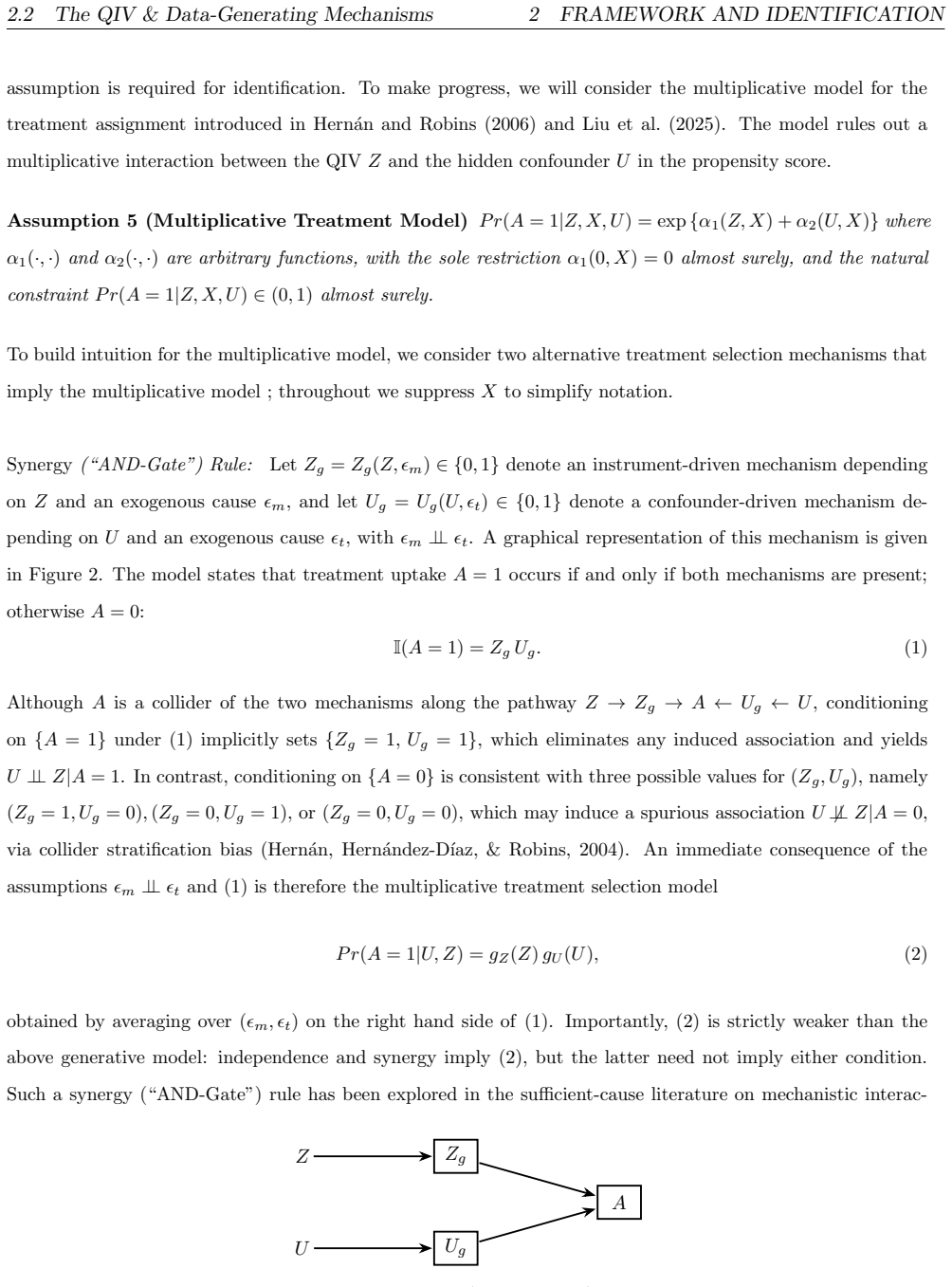
We introduce the Multiplicative Quasi-Instrumental Variable (MQIV) model, a framework for causal inference with unmeasured confounding that leverages an instrument that may be imperfectly exogenous. We allow the candidate quasi-instrument to have a direct effect on the outcome not mediated by the treatment, thus violating the standard IV exclusion restriction. We establish nonparametric identification of the population average treatment effect on the treated (ATT) under a treatment model that is multiplicative with respect to the quasi-IV and the hidden confounder (Hernan and Robins, 2006). Such a multiplicative treatment model may arise naturally either when treatment occurs only if two independent instrument-driven and confounder-driven causal mechanisms are present; or alternatively, when an instrument's effect on treatment uptake is inherently heterogeneous and scales with a person's latent propensity, best capturing settings in which it is challenging for a given instrument to overcome a person's inherent lack of preference for the treatment in view. Importantly, as we establish, the MQIV model is simultaneously agnostic to treatment-effect heterogeneity with respect to hidden confounders and violation of the core IV exclusion restriction condition. Identification is achieved via a modified Wald ratio estimand, which corrects the bias due to the exclusion restriction violation, and we propose a new class of estimators that are multiply robust and semiparametric efficient. Finally, we evaluate the approach in extensive simulations and an application to evaluate the causal effect of having three or more children on mothers' labor-market engagement.
Editorial analysis
A structured set of objections, weighed in public.
Referee Report
Summary. The paper introduces the Multiplicative Quasi-Instrumental Variable (MQIV) model for causal inference with unmeasured confounding, permitting a quasi-instrument that violates the exclusion restriction by having a direct effect on the outcome. Under a treatment model that is multiplicative in the quasi-IV and latent confounder, the authors establish nonparametric identification of the population average treatment effect on the treated (ATT) via a modified Wald ratio. They propose a class of multiply robust, semiparametrically efficient estimators and evaluate the method in simulations and an application to the effect of three or more children on mothers' labor-market participation.
Significance. If the identification result holds, the MQIV framework offers a targeted relaxation of standard IV assumptions that remains agnostic to treatment-effect heterogeneity and direct quasi-IV effects on the outcome. The multiplicative treatment model is motivated by plausible mechanisms (e.g., independent causal pathways or heterogeneous instrument strength), and the multiply robust estimators constitute a practical strength. The simulation study and empirical application provide concrete evidence of performance. This approach could be useful in settings where perfect instruments are unavailable but the multiplicative structure is defensible.
major comments (1)
- [§3.2] §3.2, identification result: the modified Wald ratio is derived under exact multiplicativity of the treatment probability; the manuscript should explicitly state the minimal conditions under which small departures from multiplicativity preserve identification or produce bounded bias, as this is load-bearing for the nonparametric claim.
minor comments (3)
- [§2] The notation for the quasi-IV and latent confounder should be introduced with a single consistent symbol set in the model section to avoid reader confusion when moving between the treatment and outcome equations.
- [Table 2] Table 2 (simulation results): the reported coverage probabilities for the multiply robust estimator under moderate confounding should include the Monte Carlo standard error to allow assessment of whether deviations from nominal 95% are statistically meaningful.
- [§6] The application section would benefit from a brief discussion of how the multiplicative assumption was assessed or justified in the context of the fertility instrument.
Simulated Author's Rebuttal
We thank the referee for their positive summary, recognition of the MQIV framework's contributions, and recommendation for minor revision. We address the single major comment below.
read point-by-point responses
-
Referee: [§3.2] §3.2, identification result: the modified Wald ratio is derived under exact multiplicativity of the treatment probability; the manuscript should explicitly state the minimal conditions under which small departures from multiplicativity preserve identification or produce bounded bias, as this is load-bearing for the nonparametric claim.
Authors: We agree that the identification result in §3.2 holds exactly under the multiplicative treatment model (Assumption 3.2). This assumption is definitional to the MQIV model and is what permits the modified Wald ratio to recover the ATT without invoking the exclusion restriction or homogeneity. The manuscript does not currently discuss robustness to departures from exact multiplicativity. In the revised manuscript we will add a dedicated paragraph to §3.2 that (i) reiterates that the nonparametric identification result requires exact multiplicativity, (ii) derives the first-order bias term that arises under a local perturbation of the treatment probability away from multiplicativity, and (iii) states sufficient conditions (bounded sup-norm departure together with standard regularity on the propensity scores) under which the resulting bias remains bounded by a constant times the size of the departure. These conditions will be presented as a sensitivity result rather than a relaxation that preserves exact identification. revision: yes
Circularity Check
Derivation self-contained under stated model assumptions
full rationale
The paper defines the MQIV model via the multiplicative treatment mechanism assumption (citing Hernan and Robins 2006 as external source) and derives nonparametric ATT identification from it via a modified Wald ratio that accounts for exclusion violation. This is a standard causal identification argument that follows directly from the model primitives without reducing any result to a fitted parameter by construction, without self-citation load-bearing on the central claim, and without smuggling ansatzes or uniqueness theorems from the authors' prior work. The proposed multiply-robust estimators are developed separately from the identification step. No circular steps are present.
Axiom & Free-Parameter Ledger
axioms (1)
- domain assumption Treatment model is multiplicative with respect to the quasi-IV and the hidden confounder
Lean theorems connected to this paper
-
IndisputableMonolith/Cost/FunctionalEquationwashburn_uniqueness_aczel unclear?
unclearRelation between the paper passage and the cited Recognition theorem.
We establish nonparametric identification of the population average treatment effect on the treated (ATT) under a treatment model that is multiplicative with respect to the quasi-IV and the hidden confounder (Hernán and Robins, 2006).
-
IndisputableMonolith/Foundation/ArithmeticFromLogicembed_add unclear?
unclearRelation between the paper passage and the cited Recognition theorem.
Identification is achieved via a modified Wald ratio estimand, which corrects the bias due to the exclusion restriction violation
What do these tags mean?
- matches
- The paper's claim is directly supported by a theorem in the formal canon.
- supports
- The theorem supports part of the paper's argument, but the paper may add assumptions or extra steps.
- extends
- The paper goes beyond the formal theorem; the theorem is a base layer rather than the whole result.
- uses
- The paper appears to rely on the theorem as machinery.
- contradicts
- The paper's claim conflicts with a theorem or certificate in the canon.
- unclear
- Pith found a possible connection, but the passage is too broad, indirect, or ambiguous to say the theorem truly supports the claim.
Reference graph
Works this paper leans on
-
[1]
Journal of the American statistical Association , volume=
Identification of causal effects using instrumental variables , author=. Journal of the American statistical Association , volume=. 1996 , publisher=
work page 1996
-
[2]
Communications in Statistics-Theory and methods , volume=
Correcting for non-compliance in randomized trials using structural nested mean models , author=. Communications in Statistics-Theory and methods , volume=. 1994 , publisher=
work page 1994
-
[3]
Journal of the Royal Statistical Society Series B: Statistical Methodology , volume=
Bounded, efficient and multiply robust estimation of average treatment effects using instrumental variables , author=. Journal of the Royal Statistical Society Series B: Statistical Methodology , volume=. 2018 , publisher=
work page 2018
-
[4]
Statistics & Probability Letters , volume=
On a necessary and sufficient identification condition of optimal treatment regimes with an instrumental variable , author=. Statistics & Probability Letters , volume=. 2021 , publisher=
work page 2021
-
[5]
arXiv preprint arXiv:1809.05422 , year=
Marginal structural models for time-varying endogenous treatments: A time-varying instrumental variable approach , author=. arXiv preprint arXiv:1809.05422 , year=
-
[6]
Journal of the American Statistical Association , volume=
Instrumental variable estimation of marginal structural mean models for time-varying treatment , author=. Journal of the American Statistical Association , volume=. 2024 , publisher=
work page 2024
-
[7]
Journal of business & economic statistics , volume=
Using heteroscedasticity to identify and estimate mismeasured and endogenous regressor models , author=. Journal of business & economic statistics , volume=. 2012 , publisher=
work page 2012
-
[8]
Semiparametric efficient G-estimation with invalid instrumental variables , author=. Biometrika , volume=. 2023 , publisher=
work page 2023
-
[9]
The GENIUS approach to robust Mendelian randomization inference , author=. Statistical Science , volume=. 2021 , publisher=
work page 2021
-
[10]
arXiv preprint arXiv:2508.16096 , year=
Quasi Instrumental Variable Methods for Stable Hidden Confounding and Binary Outcome , author=. arXiv preprint arXiv:2508.16096 , year=
-
[11]
Journal of Business & Economic Statistics , volume=
Identification and inference with many invalid instruments , author=. Journal of Business & Economic Statistics , volume=. 2015 , publisher=
work page 2015
-
[12]
Journal of the American statistical Association , volume=
Instrumental variables estimation with some invalid instruments and its application to Mendelian randomization , author=. Journal of the American statistical Association , volume=. 2016 , publisher=
work page 2016
-
[13]
Genetic epidemiology , volume=
Consistent estimation in Mendelian randomization with some invalid instruments using a weighted median estimator , author=. Genetic epidemiology , volume=. 2016 , publisher=
work page 2016
-
[14]
Journal of the Royal Statistical Society Series B: Statistical Methodology , volume=
Confidence intervals for causal effects with invalid instruments by using two-stage hard thresholding with voting , author=. Journal of the Royal Statistical Society Series B: Statistical Methodology , volume=. 2018 , publisher=
work page 2018
-
[15]
Annual review of statistics and its application , volume=
Identification and inference with invalid instruments , author=. Annual review of statistics and its application , volume=. 2025 , publisher=
work page 2025
-
[16]
Single world intervention graphs
Richardson, Thomas S and Robins, James M , journal=. Single world intervention graphs. 2013 , publisher=
work page 2013
-
[17]
The Multiplicative Instrumental Variable Model
The multiplicative instrumental variable model , author=. arXiv preprint arXiv:2507.09302 , year=
work page internal anchor Pith review Pith/arXiv arXiv
-
[18]
Instruments for causal inference: an epidemiologist's dream? , author=. Epidemiology , volume=. 2006 , publisher=
work page 2006
-
[19]
A structural approach to selection bias , author=. Epidemiology , volume=. 2004 , publisher=
work page 2004
-
[20]
Independence, monotonicity, and latent index models: An equivalence result , author=. Econometrica , volume=. 2002 , publisher=
work page 2002
-
[21]
Double/debiased machine learning for treatment and structural parameters , urldate =
Victor Chernozhukov and Denis Chetverikov and Mert Demirer and Esther Duflo and Christian Hansen and Whitney Newey and James Robins , journal =. Double/debiased machine learning for treatment and structural parameters , urldate =
-
[22]
Statistical Applications in Genetics and Molecular Biology , volume=
Super learner , author=. Statistical Applications in Genetics and Molecular Biology , volume=. 2007 , publisher=
work page 2007
-
[23]
arXiv preprint arXiv:2402.09332 , year=
Nonparametric identification and efficient estimation of causal effects with instrumental variables , author=. arXiv preprint arXiv:2402.09332 , year=
-
[24]
Mixed GAM Computation Vehicle with GCV/AIC/REML/NCV smoothness estimation and GAMMs by REML/PQL , author=
-
[25]
Journal of Statistical Software , volume=
Regularization paths for generalized linear models via coordinate descent , author=. Journal of Statistical Software , volume=. 2010 , publisher=
work page 2010
-
[26]
Random forests , author=. Machine Learning , volume=. 2001 , publisher=
work page 2001
-
[27]
Observational Studies , volume=
ivmte: An R Package for Extrapolating Instrumental Variable Estimates Away From Compliers , author=. Observational Studies , volume=. 2023 , publisher=
work page 2023
-
[28]
Children and their parents' labor supply: Evidence from exogenous variation in family size , author=. 1996 , publisher=
work page 1996
-
[29]
American Economic Review , volume=
Double/debiased/neyman machine learning of treatment effects , author=. American Economic Review , volume=. 2017 , publisher=
work page 2017
-
[30]
Electronic Journal of Statistics , volume=
Towards optimal doubly robust estimation of heterogeneous causal effects , author=. Electronic Journal of Statistics , volume=. 2023 , publisher=
work page 2023
-
[31]
arXiv preprint arXiv:2307.16798 , year=
Forster-warmuth counterfactual regression: A unified learning approach , author=. arXiv preprint arXiv:2307.16798 , year=
-
[32]
Simultaneous-equation estimation in a clinical trial of the effect of smoking on birth weight , author=. Biometrics , pages=. 1989 , publisher=
work page 1989
-
[33]
Statistics in medicine , volume=
The paired availability design: a proposal for evaluating epidural analgesia during labor , author=. Statistics in medicine , volume=. 1994 , publisher=
work page 1994
-
[34]
Semiparametric theory and missing data , author=. 2006 , publisher=
work page 2006
-
[35]
Journal of applied econometrics , volume=
Semiparametric efficiency bounds , author=. Journal of applied econometrics , volume=. 1990 , publisher=
work page 1990
-
[36]
Journal of the American Statistical Association , volume=
Partial identification of the average treatment effect using instrumental variables: review of methods for binary instruments, treatments, and outcomes , author=. Journal of the American Statistical Association , volume=. 2018 , publisher=
work page 2018
-
[37]
Xgboost: A scalable tree boosting system , author =. Proceedings of the 22nd ACM SIGKDD International Conference on Knowledge Discovery and Data Mining , pages=
-
[38]
Empirical and counterfactual conditions for sufficient cause interactions , author=. Biometrika , volume=. 2008 , publisher=
work page 2008
-
[39]
American journal of epidemiology , volume=
Marginal structural models for sufficient cause interactions , author=. American journal of epidemiology , volume=. 2010 , publisher=
work page 2010
-
[40]
International journal of epidemiology , volume=
Mendelian randomization with invalid instruments: effect estimation and bias detection through Egger regression , author=. International journal of epidemiology , volume=. 2015 , publisher=
work page 2015
-
[41]
American Journal of Epidemiology , volume=
Additive, multiplicative, and other models for disease risks , author=. American Journal of Epidemiology , volume=. 1978 , publisher=
work page 1978
discussion (0)
Sign in with ORCID, Apple, or X to comment. Anyone can read and Pith papers without signing in.