Recognition: unknown
Damping dynamics of the centroid oscillation of a relativistic laser pulse in a plasma channel
Pith reviewed 2026-05-07 04:00 UTC · model grok-4.3
The pith
Relativistic laser pulses in plasma channels experience rapid damping of their centroid oscillation due to an axial frequency chirp.
A machine-rendered reading of the paper's core claim, the machinery that carries it, and where it could break.
Core claim
For relativistic laser pulses the slice-based centroid oscillation frequency develops an axial chirp due to relativistic channel modification and photon deceleration; the resulting phase mixing across axial slices produces rapid damping of the overall centroid oscillation. In the non-relativistic regime the same oscillation decays more slowly through mode leakage of a finite channel and temporal walk-off between modes of a finite-duration pulse. An analytical model for the non-relativistic decay mechanisms is derived and confirmed by simulation.
What carries the argument
The axial chirp in slice-based centroid oscillation frequency, generated by relativistic plasma-channel modification together with photon deceleration, that drives phase mixing and net damping across the pulse length.
If this is right
- Rapid damping reduces electron-beam pointing jitter in channel-guided laser wakefield accelerators.
- Designs of plasma channels for high-energy accelerators must incorporate the relativistic frequency chirp to predict oscillation lifetime.
- The non-relativistic analytical model of mode leakage and walk-off decay provides a baseline that relativistic effects strongly modify.
- Controlling photon deceleration or channel density gradients offers a route to tune the damping rate.
Where Pith is reading between the lines
- If the chirp strength scales with laser intensity, experiments could deliberately vary pulse energy to control damping and test the phase-mixing picture.
- The same axial frequency variation may couple to other propagation instabilities such as self-focusing, suggesting a combined stability analysis for realistic channels.
- Extensions to non-ideal or evolving channel profiles could reveal additional damping channels that either reinforce or counteract the relativistic chirp effect.
- The damping timescale sets a practical limit on how far a laser pulse can be guided while preserving beam quality, linking directly to accelerator staging requirements.
Load-bearing premise
The analysis assumes an ideal preformed plasma channel whose density profile remains stable and in which higher-order effects such as self-focusing instabilities or non-paraxial propagation do not dominate the centroid dynamics.
What would settle it
A 3D simulation or experiment that records sustained, undamped centroid oscillation for a relativistic pulse propagating in a uniform, stable plasma channel over many oscillation periods would falsify the phase-mixing damping mechanism.
Figures



read the original abstract
The centroid oscillation of an offset laser pulse propagating in a preformed plasma channel is investigated through theoretical analysis and three-dimensional particle-in-cell simulations. For non-relativistic laser pulses, the mode leakage of a finite channel and the temporal walk-off between the fundamental and high order modes of a finite-duration laser induce a decay in the laser centroid oscillation. An analytical model characterizing these decay mechanisms is derived and validated by simulations. For relativistic laser pulses, the slice-based centroid oscillation frequency develops an axial chirp due to relativistic channel modification and photon deceleration. This chirp leads to phase mixing across different axial slices of the pulse, resulting in a rapid damping of the overall centroid oscillation. Understanding this oscillation damping is crucial for mitigating electron beam pointing jitter and maintaining beam quality in high-energy, channel-guided laser wakefield accelerators.
Editorial analysis
A structured set of objections, weighed in public.
Referee Report
Summary. The manuscript investigates the damping dynamics of the centroid oscillation of an offset laser pulse propagating in a preformed plasma channel, using theoretical analysis and 3D particle-in-cell simulations. For non-relativistic pulses, an analytical model is derived from mode leakage of a finite channel and temporal walk-off between fundamental and higher-order modes, and validated against simulations. For relativistic pulses, the authors attribute rapid damping to an axial chirp in the slice-based centroid oscillation frequency arising from relativistic channel modification and photon deceleration, which induces phase mixing across axial slices of the pulse. The work is motivated by applications to mitigating electron beam pointing jitter in channel-guided laser wakefield accelerators.
Significance. If the relativistic phase-mixing mechanism is robustly established, the paper offers a useful contribution to understanding laser pulse stability in plasma channels, with direct relevance to high-energy LWFA. The non-relativistic analytical model, derived from standard wave equations and validated by simulations, represents a clear, parameter-free strength. The relativistic extension builds on known relativistic plasma effects but would gain from explicit demarcation against competing processes. Overall, the combination of derivation and 3D PIC validation adds value to the field if the central attribution holds.
major comments (2)
- [§4] §4 (relativistic regime): The central claim that axial frequency chirp from relativistic channel modification and photon deceleration produces phase mixing and rapid damping is load-bearing. However, the analysis assumes a fixed parabolic channel profile under paraxial propagation; no quantitative comparison is provided showing that the dephasing timescale is shorter than the growth rates of instabilities such as hosing, self-focusing, or channel erosion for the simulated a0 and propagation lengths. This leaves open the possibility that competing effects dominate before phase mixing completes.
- [§3.2] §3.2 (non-relativistic model validation): While the analytical decay model is presented as independent, the simulation parameters (e.g., channel radius, pulse duration) are not explicitly shown to lie in the regime where mode leakage and walk-off dominate over other numerical or physical effects; a sensitivity test varying these would confirm the model's robustness.
minor comments (3)
- [Figure 3] Figure 3 (or equivalent simulation plots): Error bars or ensemble statistics from multiple runs are not shown, making it difficult to assess the statistical significance of the reported damping rates.
- [Relativistic analysis] Notation: The definition of the local slice centroid frequency (likely in Eq. (X) of the relativistic section) could be clarified with an explicit expression relating it to the relativistic index and photon deceleration.
- [Abstract] The abstract and introduction could more explicitly state the range of a0 separating the non-relativistic and relativistic regimes analyzed.
Simulated Author's Rebuttal
We thank the referee for their careful and constructive review of our manuscript on the damping dynamics of centroid oscillations of relativistic laser pulses in plasma channels. The comments raise valid points about strengthening the evidence for the relativistic phase-mixing mechanism and the robustness of the non-relativistic model validation. We address each major comment below, explaining our position and the revisions we will incorporate.
read point-by-point responses
-
Referee: §4 (relativistic regime): The central claim that axial frequency chirp from relativistic channel modification and photon deceleration produces phase mixing and rapid damping is load-bearing. However, the analysis assumes a fixed parabolic channel profile under paraxial propagation; no quantitative comparison is provided showing that the dephasing timescale is shorter than the growth rates of instabilities such as hosing, self-focusing, or channel erosion for the simulated a0 and propagation lengths. This leaves open the possibility that competing effects dominate before phase mixing completes.
Authors: We appreciate the referee highlighting the need for timescale comparisons to confirm the dominance of phase mixing. The 3D PIC simulations inherently include competing processes such as hosing, self-focusing, and channel evolution, yet exhibit the rapid damping that quantitatively matches the axial chirp predicted from relativistic channel modification and photon deceleration. The fixed parabolic profile is used only in the analytical derivation for tractability under paraxial approximation; the simulations do not impose this restriction. In the revised manuscript, we will add explicit estimates of the dephasing timescale (from the slice-dependent frequency variation) versus the growth rates of hosing, self-focusing, and channel erosion for the simulated a0 values and propagation lengths. This will show that phase mixing completes faster than significant instability growth, supporting our attribution while acknowledging the approximation in the theory. revision: partial
-
Referee: §3.2 (non-relativistic model validation): While the analytical decay model is presented as independent, the simulation parameters (e.g., channel radius, pulse duration) are not explicitly shown to lie in the regime where mode leakage and walk-off dominate over other numerical or physical effects; a sensitivity test varying these would confirm the model's robustness.
Authors: We agree that demonstrating the parameter regime more explicitly would strengthen the validation. The analytical model is derived from the standard paraxial wave equation for a finite-radius channel, yielding mode leakage and temporal walk-off as the decay mechanisms without reliance on simulation specifics. In the revised manuscript, we will expand §3.2 to include a discussion of the relevant regime (channel radius comparable to but larger than the laser spot size, pulse duration allowing significant walk-off) and add sensitivity tests by varying channel radius and pulse duration in additional simulations. These will confirm that the observed decay rates match the model predictions when mode leakage and walk-off dominate, while other effects (e.g., numerical dispersion) remain subdominant. revision: yes
Circularity Check
Derivation chain is self-contained; analytical models derived from standard effects and validated by independent simulations
full rationale
The paper derives its non-relativistic damping model directly from mode leakage of a finite channel and temporal walk-off between fundamental and higher-order modes, presenting an explicit analytical characterization that is then validated against 3D PIC simulations. The relativistic axial chirp is attributed to established relativistic modifications of the channel index and photon deceleration, producing phase mixing across slices; these are standard plasma-physics inputs rather than quantities fitted or defined within the paper itself. No equations reduce a claimed prediction to a fitted parameter by construction, no load-bearing self-citations are invoked to justify uniqueness, and no ansatz is smuggled via prior author work. The overall damping result therefore rests on independent derivation plus external numerical confirmation rather than circular re-labeling of inputs.
Axiom & Free-Parameter Ledger
axioms (2)
- domain assumption The plasma channel is preformed with a stable, guiding density profile that supports well-defined transverse modes.
- standard math The laser pulse can be decomposed into a fundamental mode plus higher-order modes whose leakage and walk-off govern non-relativistic decay.
Reference graph
Works this paper leans on
-
[1]
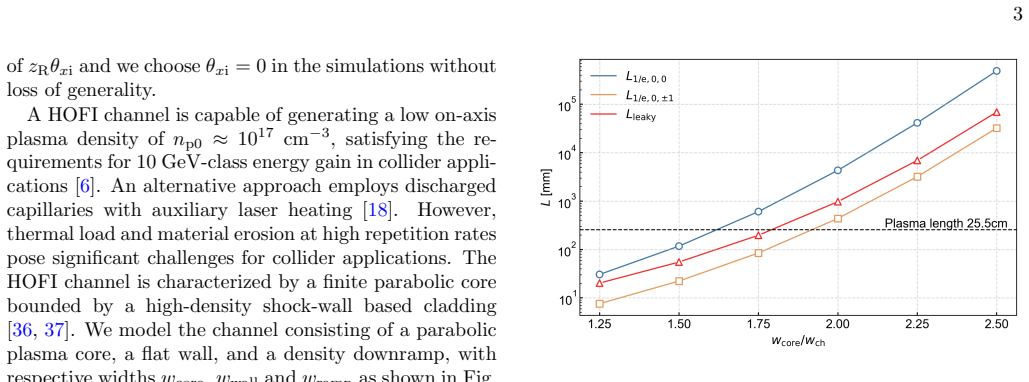
For LWFA, a channel with wcore wch ≳2 is essential to ensure that L1/e,0,0 Lp ≫1
They increase rapidly with increasingw core, consis- tent with the fact that a wider channel provides stronger confinement of the laser. For LWFA, a channel with wcore wch ≳2 is essential to ensure that L1/e,0,0 Lp ≫1. Since a laser pulse with a finite duration ofτ L = 42 fs is considered here, the temporal walk-off of these two modes can also lead to a d...
-
[2]
Tajima and J
T. Tajima and J. M. Dawson, Phys. Rev. Lett.43, 267 (1979)
1979
-
[3]
Faure, Y
J. Faure, Y. Glinec, A. Pukhov, S. Kiselev, S. Gordienko, E. Lefebvre, J.-P. Rousseau, F. Burgy, and V. Malka, Nature431, 541 (2004)
2004
-
[4]
Geddes, C
C. Geddes, C. Toth, J. Van Tilborg, E. Esarey, C. Schroeder, D. Bruhwiler, C. Nieter, J. Cary, and W. Leemans, Nature431, 538 (2004)
2004
-
[5]
S. P. Mangles, C. Murphy, Z. Najmudin, A. G. R. Thomas, J. Collier, A. E. Dangor, E. Divall, P. Foster, J. Gallacher, C. Hooker,et al., Nature431, 535 (2004)
2004
-
[6]
Aniculaesei, T
C. Aniculaesei, T. Ha, S. Yoffe, L. Labun, S. Milton, E. McCary, M. M. Spinks, H. J. Quevedo, O. Z. Labun, R. Sain,et al., Matter and Radiation at Extremes9 (2024)
2024
-
[7]
Picksley, J
A. Picksley, J. Stackhouse, C. Benedetti, K. Nakamura, H. Tsai, R. Li, B. Miao, J. Shrock, E. Rockafellow, H. Milchberg,et al., Physical Review Letters133, 255001 (2024)
2024
-
[8]
W. Wang, W. Li, J. Liu, Z. Zhang, R. Qi, C. Yu, J. Liu, M. Fang, Z. Qin, C. Wang,et al., Phys. Rev. Lett.117, 124801 (2016)
2016
-
[9]
L. Ke, K. Feng, W. Wang, Z. Qin, C. Yu, Y. Wu, Y. Chen, R. Qi, Z. Zhang, Y. Xu,et al., Phys. Rev. Lett.126, 214801 (2021)
2021
-
[10]
W. Wang, K. Feng, L. Ke, C. Yu, Y. Xu, R. Qi, Y. Chen, Z. Qin, Z. Zhang, M. Fang,et al., Nature595, 516 (2021)
2021
-
[11]
Labat, J
M. Labat, J. C. Cabada˘ g, A. Ghaith, A. Irman, A. Berlioux, P. Berteaud, F. Blache, S. Bock, F. Bou- vet, F. Briquez,et al., Nature Photonics17, 150 (2023)
2023
-
[12]
S. K. Barber, F. Kohrell, C. E. Doss, K. Jensen, C. Berger, F. Isono, Z. Eisentraut, S. Schr¨ oder, A. J. Gonsalves, K. Nakamura,et al., Phys. Rev. Lett.135, 055001 (2025)
2025
-
[13]
Z. Jin, M. Kando, Y.-J. Gu, K. Huang, N. Nakanii, I. Daito, Z. Lei, S. Sato, H. Sano, T. Muto, S. Yamamoto, and T. Hosokai, Phys. Rev. Res.8, 013207 (2026)
2026
-
[14]
Jiang, K
H. Jiang, K. Feng, R. Hu, Q. Zhan, W. Wang, and R. Li, Phys. Rev. Res.8, 013204 (2026)
2026
-
[15]
Schroeder, F
C. Schroeder, F. Albert, C. Benedetti, J. Bromage, D. Bruhwiler, S. Bulanov, E. Campbell, N. Cook, B. Cros, M. Downer,et al., Journal of Instrumentation 18, T06001 (2023)
2023
-
[16]
C. G. Durfee and H. M. Milchberg, Phys. Rev. Lett.71, 2409 (1993)
1993
-
[17]
W. P. Leemans, B. Nagler, A. J. Gonsalves, C. T´ oth, K. Nakamura, C. G. Geddes, E. Esarey, C. B. Schroeder, and S. M. Hooker, Nature physics2, 696 (2006)
2006
-
[18]
Leemans, A
W. Leemans, A. Gonsalves, H.-S. Mao, K. Nakamura, C. Benedetti, C. Schroeder, C. T´ oth, J. Daniels, D. Mit- telberger, S. Bulanov,et al., Physical Review Letters 113, 245002 (2014)
2014
-
[19]
A. J. Gonsalves, K. Nakamura, J. Daniels, C. Benedetti, C. Pieronek, T. C. H. de Raadt, S. Steinke, J. H. Bin, S. S. Bulanov, J. van Tilborg,et al., Phys. Rev. Lett. 122, 084801 (2019)
2019
-
[20]
B. Miao, J. E. Shrock, L. Feder, R. C. Hollinger, J. Mor- rison, R. Nedbailo, A. Picksley, H. Song, S. Wang, J. J. Rocca, and H. M. Milchberg, Phys. Rev. X12, 031038 (2022)
2022
-
[21]
Picksley, J
A. Picksley, J. Chappell, E. Archer, N. Bourgeois, J. Cowley, D. R. Emerson, L. Feder, X. J. Gu, O. Jakob- sson, A. J. Ross, W. Wang, R. Walczak, and S. M. Hooker, Phys. Rev. Lett.131, 245001 (2023)
2023
-
[22]
J. E. Shrock, E. Rockafellow, B. Miao, M. Le, R. C. Hollinger, S. Wang, A. J. Gonsalves, A. Picksley, J. J. Rocca, and H. M. Milchberg, Phys. Rev. Lett.133, 045002 (2024)
2024
-
[23]
Lahaye, K
R. Lahaye, K. Oubrerie, O. Kononenko, J. Gautier, I. A. Andriyash, and C. Thaury, Phys. Rev. Accel. Beams28, 091301 (2025)
2025
-
[24]
N. A. Hafz, T. M. Jeong, I. W. Choi, S. K. Lee, K. H. Pae, V. V. Kulagin, J. H. Sung, T. J. Yu, K.-H. Hong, T. Hosokai,et al., Nature Photonics2, 571 (2008). 9
2008
-
[25]
J. E. Ralph, K. A. Marsh, A. E. Pak, W. Lu, C. E. Clayton, F. Fang, W. B. Mori, and C. Joshi, Phys. Rev. Lett.102, 175003 (2009)
2009
-
[26]
J. E. Ralph, C. E. Clayton, F. Albert, B. B. Pollock, S. F. Martins, A. E. Pak, K. A. Marsh, J. L. Shaw, A. Till, J. P. Palastro, W. Lu, S. H. Glenzer, L. O. Silva, W. B. Mori, C. Joshi, and D. H. Froula, Physics of Plasmas 17, 056709 (2010)
2010
-
[27]
Kneip, S
S. Kneip, S. R. Nagel, S. F. Martins, S. P. D. Mangles, C. Bellei, O. Chekhlov, R. J. Clarke, N. Delerue, E. J. Divall, G. Doucas,et al., Phys. Rev. Lett.103, 035002 (2009)
2009
-
[28]
C. E. Clayton, J. E. Ralph, F. Albert, R. A. Fonseca, S. H. Glenzer, C. Joshi, W. Lu, K. A. Marsh, S. F. Mar- tins, W. B. Mori,et al., Phys. Rev. Lett.105, 105003 (2010)
2010
-
[29]
J. S. Liu, C. Q. Xia, W. T. Wang, H. Y. Lu, C. Wang, A. H. Deng, W. T. Li, H. Zhang, X. Y. Liang, Y. X. Leng,et al., Phys. Rev. Lett.107, 035001 (2011)
2011
-
[30]
B. B. Pollock, C. E. Clayton, J. E. Ralph, F. Albert, A. Davidson, L. Divol, C. Filip, S. H. Glenzer, K. Her- poldt, W. Lu,et al., Phys. Rev. Lett.107, 045001 (2011)
2011
-
[31]
X. Wang, R. Zgadzaj, N. Fazel, Z. Li, S. A. Yi, X. Zhang, W. Henderson, Y.-Y. Chang, R. Korzekwa, H.-E. Tsai, et al., Nature Communications4, 1988 (2013)
1988
-
[32]
H. T. Kim, K. H. Pae, H. J. Cha, I. J. Kim, T. J. Yu, J. H. Sung, S. K. Lee, T. M. Jeong, and J. Lee, Phys. Rev. Lett.111, 165002 (2013)
2013
-
[33]
Feder, B
L. Feder, B. Miao, J. E. Shrock, A. Goffin, and H. M. Milchberg, Phys. Rev. Res.2, 043173 (2020)
2020
-
[34]
Esarey and W
E. Esarey and W. P. Leemans, Phys. Rev. E59, 1082 (1999)
1999
-
[35]
Benedetti, C
C. Benedetti, C. B. Schroeder, E. Esarey, and W. P. Leemans, Physics of Plasmas19, 053101 (2012)
2012
-
[36]
Benedetti, F
C. Benedetti, F. Rossi, C. B. Schroeder, E. Esarey, and W. P. Leemans, Phys. Rev. E92, 023109 (2015)
2015
-
[37]
T. R. Clark and H. M. Milchberg, Phys. Rev. Lett.81, 357 (1998)
1998
-
[38]
T. R. Clark and H. M. Milchberg, Phys. Rev. E61, 1954 (2000)
1954
-
[39]
T. M. Antonsen, Jr. and P. Mora, Phys. Rev. Lett.74, 4440 (1995)
1995
-
[40]
A. J. Gonsalves, K. Nakamura, C. Lin, J. Osterhoff, S. Shiraishi, C. B. Schroeder, C. G. R. Geddes, C. T´ oth, E. Esarey, and W. P. Leemans, Physics of Plasmas17, 056706 (2010)
2010
-
[41]
S. G. Rykovanov, C. B. Schroeder, E. Esarey, C. G. R. Geddes, and W. P. Leemans, Phys. Rev. Lett.114, 145003 (2015)
2015
-
[42]
Rykovanov, J
S. Rykovanov, J. Wang, V. Y. Kharin, B. Lei, C. Schroeder, C. Geddes, E. Esarey, and W. Leemans, Physical Review Accelerators and Beams19, 090703 (2016)
2016
-
[43]
C. B. Schroeder, C. Benedetti, S. Bulanov, D. Terzani, S. Schroeder, and J. Osterhoff, presented at the International Workshop on Future Linear Colliders (LCWS/FLC 2025), ADEIT, Valencia, Spain (2025), oct. 20–24, 2025
2025
-
[44]
R. A. Fonseca, S. L. O., T. F. S., D. V. K., L. W., R. C., M. W. B., D. S., L. S., K. T.,et al., Lecture Notes in Computer Science2331, 342 (2002)
2002
-
[45]
P. Yu, X. Xu, V. K. Decyk, W. An, J. Vieira, F. S. Tsung, R. A. Fonseca, W. Lu, L. O. Silva, and W. B. Mori, Journal of Computational Physics266, 124 (2014)
2014
-
[46]
P. Yu, X. Xu, A. Davidson, A. Tableman, T. Dalichaouch, F. Li, M. D. Meyers, W. An, F. S. Tsung, V. K. Decyk,et al., Journal of Computational Physics316, 747 (2016)
2016
-
[47]
F. Li, P. Yu, X. Xu, F. Fiuza, V. K. Decyk, T. Dalichaouch, A. Davidson, A. Tableman, W. An, F. S. Tsung,et al., Computer Physics Communications214, 6 (2017)
2017
-
[48]
X. Xu, F. Li, F. S. Tsung, T. N. Dalichaouch, W. An, H. Wen, V. K. Decyk, R. A. Fonseca, M. J. Hogan, and W. B. Mori, Journal of Computational Physics413, 109451 (2020)
2020
-
[49]
X. Xu, P. Yu, S. F. Martins, F. S. Tsung, V. K. De- cyk, J. Vieira, R. A. Fonseca, W. Lu, L. O. Silva, and W. B. Mori, Computer Physics Communications184, 2503 (2013)
2013
-
[50]
Danson, D
C. Danson, D. Hillier, N. Hopps, and D. Neely, High Power Laser Science and Engineering3, e3 (2015)
2015
-
[51]
C. N. Danson, C. Haefner, J. Bromage, T. Butcher, J.- C. F. Chanteloup, E. A. Chowdhury, A. Galvanauskas, L. A. Gizzi, J. Hein, D. I. Hillier, and et al., High Power Laser Science and Engineering7, e54 (2019)
2019
-
[52]
Isono, J
F. Isono, J. van Tilborg, S. K. Barber, J. Natal, C. Berger, H.-E. Tsai, T. Ostermayr, A. Gonsalves, C. Geddes, and E. Esarey, High Power Laser Science and Engineering9, e25 (2021)
2021
-
[53]
Berger, S
C. Berger, S. Barber, F. Isono, K. Jensen, J. Natal, A. Gonsalves, and J. van Tilborg, Phys. Rev. Accel. Beams26, 032801 (2023)
2023
-
[54]
Amodio, D
A. Amodio, D. Wang, C. Berger, H.-E. Tsai, S. K. Bar- ber, J. van Tilborg, A. Picksley, Z. Eisentraut, N. R. Vora, M. Logantha, and et al., High Power Laser Sci- ence and Engineering13, e35 (2025)
2025
-
[55]
J. W. Wang, C. B. Schroeder, R. Li, M. Zepf, and S. G. Rykovanov, Scientific Reports7, 16884 (2017)
2017
-
[56]
B. Lei, T. Teter, J. W. Wang, V. Y. Kharin, C. B. Schroeder, M. Zepf, and S. G. Rykovanov, Phys. Rev. Accel. Beams22, 071302 (2019)
2019
-
[57]
Mori, IEEE Journal of Quantum Electronics33, 1942 (1997)
W. Mori, IEEE Journal of Quantum Electronics33, 1942 (1997)
1942
-
[58]
X. L. Xu, J. F. Hua, F. Li, C. J. Zhang, L. X. Yan, Y. C. Du, W. H. Huang, H. B. Chen, C. X. Tang, W. Lu, P. Yu, W. An, C. Joshi, and W. B. Mori, Phys. Rev. Lett.112, 035003 (2014)
2014
-
[59]
H. Lu, J. Liu, J. Cai, X. Wu, J. Zhang, Q. Ma, Z. Wang, Y. Xia, W. Ma, C. Lin, Z. Nie, J. Yu, X. Xu, and X. Yan, Physics of Plasmas32, 023104 (2025)
2025
-
[60]
H. Lu, Q. Ma, Y. Xia, Z. Wang, Y. Chen, L. Liu, Z. Yang, D. Cai, Z. Gong, X. Xu, and X. Yan, Physics of Plasmas 32, 073110 (2025)
2025
-
[61]
Sprangle, J
P. Sprangle, J. Krall, and E. Esarey, Phys. Rev. Lett. 73, 3544 (1994)
1994
-
[62]
F. Li, K. G. Miller, X. Xu, F. S. Tsung, V. K. Decyk, W. An, R. A. Fonseca, and W. B. Mori, Computer Physics Communications258, 107580 (2021)
2021
-
[63]
B. Miao, L. Feder, J. E. Shrock, A. Goffin, and H. M. Milchberg, Phys. Rev. Lett.125, 074801 (2020)
2020
discussion (0)
Sign in with ORCID, Apple, or X to comment. Anyone can read and Pith papers without signing in.