Recognition: unknown
Minimum lifetime of a black hole
Pith reviewed 2026-05-07 13:39 UTC · model grok-4.3
The pith
Black holes cannot evaporate completely until a purification time that scales at least as the fourth power of their initial mass.
A machine-rendered reading of the paper's core claim, the machinery that carries it, and where it could break.
Core claim
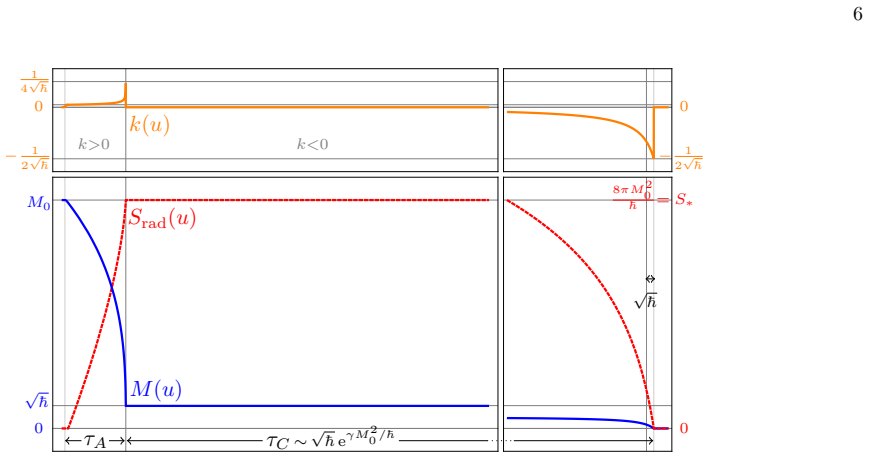
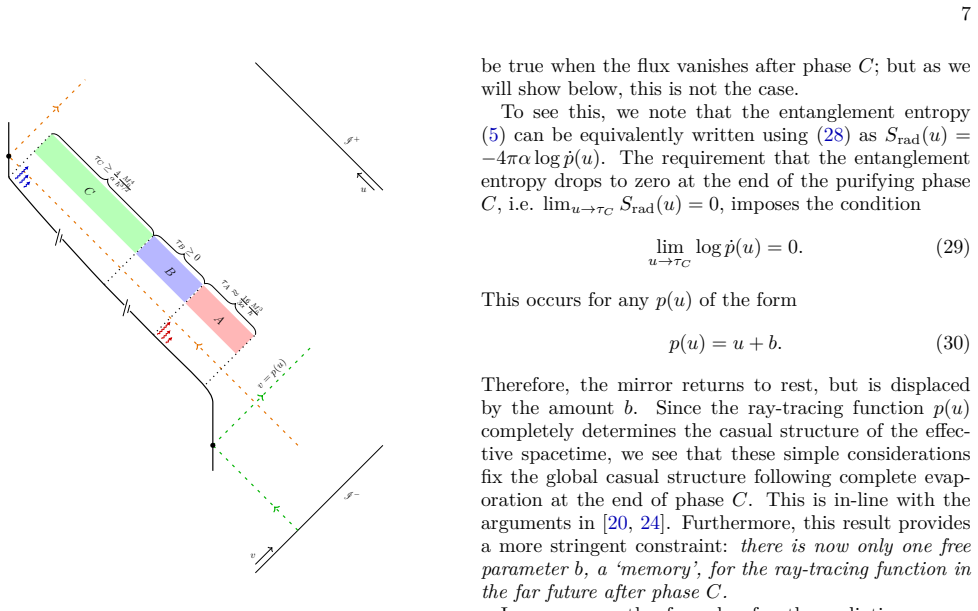
We derive a lower bound on the purification time of an evaporating black hole that scales as M_0^4 / ħ^{3/2} from energy conservation and the entanglement entropy of Hawking radiation at null infinity within asymptotically semiclassical spacetimes. Under the further assumption that a Planck-mass black hole is metastable, the bound becomes exponential in the initial area. The negative redshift exponent during purification signals the presence of a white-hole remnant that releases information slowly, with possible consequences for primordial black hole phenomenology.
What carries the argument
The energy cost of entanglement purification obtained by matching the Bondi flux of Hawking radiation to the growth of entanglement entropy at null infinity.
If this is right
- The total lifetime of the black hole is bounded below by the purification time scaling as M_0^4.
- Under the metastability assumption the lifetime becomes exponential in the initial horizon area.
- The negative redshift exponent implies the final remnant radiates like a white hole.
- Primordial black holes may leave behind slowly evaporating remnants detectable in cosmological observations.
Where Pith is reading between the lines
- The extended lifetime supplies a concrete mechanism for delaying information release until after the main evaporation phase, offering one route toward unitarity.
- Long-lived Planck-scale remnants could accumulate in the universe and contribute to dark-matter density or other late-time signals.
- The white-hole-like phase might be searched for in high-energy astrophysical transients or in analog gravity experiments.
Load-bearing premise
A Planck-mass black hole is assumed to be metastable rather than continuing to evaporate or disappearing at once.
What would settle it
A direct observation of a black hole whose radiation becomes pure in a time much shorter than its initial mass to the fourth power, or the complete absence of any long-lived remnants in searches for primordial black holes.
Figures


read the original abstract
We derive bounds on the lifetime of an evaporating black hole. The bound follows from energy conservation and purification, within the framework of `asymptotically semiclassical spacetimes'. We use the recently derived expression for the Bondi flux of Hawking radiation, together with the expression for the entanglement entropy of Hawking radiation at null infinity, to investigate the purification phase after the last semiclassical ray. We discuss the energy-cost of entanglement purification and we find a lower bound on the purification time of the black hole, which scales as $M_0^4/\hbar^{3/2}$, where $M_0$ is the initial black hole mass. Additionally, motivated by quantum gravity considerations, we include the additional assumption that a Planck mass black hole is metastable. With this assumption, we find that the the purification time is extended to be exponential in the square of the initial black hole mass, i.e. in its initial area. We find that the redshift exponent is negative in this purification phase, which indicates the existence of a white-hole remnant which releases information slowly. We comment on phenomenological implications for primordial black hole remnants.
Editorial analysis
A structured set of objections, weighed in public.
Referee Report
Summary. The paper derives a lower bound on the purification time (lifetime) of an evaporating black hole in asymptotically semiclassical spacetimes. From energy conservation, the Bondi flux of Hawking radiation, and the entanglement entropy at null infinity after the last semiclassical ray, it obtains a bound scaling as M_0^4 / ħ^{3/2}. With the additional assumption that a Planck-mass black hole is metastable (motivated by quantum gravity), this is extended to exponential scaling in the initial area M_0^2, interpreted via a negative redshift exponent as a white-hole remnant that releases information slowly. Phenomenological implications for primordial black hole remnants are discussed.
Significance. If the M_0^4 / ħ^{3/2} bound is rigorously established from the conservation laws and the cited flux and entropy expressions without hidden parameters or approximations, it would represent a useful semiclassical constraint on black hole evaporation. The exponential bound, however, depends on an external metastability assumption not internal to the framework, so its significance is conditional. The white-hole remnant interpretation offers an interesting perspective on information release but requires the assumption to hold.
major comments (3)
- [Abstract] The exponential scaling in the square of the initial black hole mass is presented as following from the metastability assumption for Planck-mass black holes. This assumption is introduced from quantum gravity considerations and is not derived from the energy conservation, Bondi flux, or entanglement entropy expressions used for the polynomial bound. The central claim of an exponentially long lifetime therefore rests on this additional input, which should be more explicitly separated from the semiclassical derivation.
- [Purification phase after the last semiclassical ray] The negative redshift exponent and the white-hole remnant interpretation are tied to the extended purification phase under the metastability assumption. Without this assumption, the redshift behavior and remnant picture may not apply, potentially weakening the phenomenological implications for primordial black holes.
- [Derivation of the bound] The manuscript should verify that the M_0^4 / ħ^{3/2} scaling is free of post-hoc choices or unstated approximations in the use of the recently derived flux and entropy expressions, as the abstract indicates it follows directly from conservation and purification.
minor comments (2)
- [Abstract] There is a typographical error: 'we find that the the purification time' should be 'we find that the purification time'.
- [Abstract] The term 'white-hole remnant' is introduced without prior definition in the abstract; a brief clarification or reference would aid readability.
Simulated Author's Rebuttal
We thank the referee for their careful reading and constructive comments on our manuscript. We have revised the paper to improve clarity on the separation of the semiclassical bound from the additional assumption and to verify the derivation explicitly. Below we respond point by point to the major comments.
read point-by-point responses
-
Referee: [Abstract] The exponential scaling in the square of the initial black hole mass is presented as following from the metastability assumption for Planck-mass black holes. This assumption is introduced from quantum gravity considerations and is not derived from the energy conservation, Bondi flux, or entanglement entropy expressions used for the polynomial bound. The central claim of an exponentially long lifetime therefore rests on this additional input, which should be more explicitly separated from the semiclassical derivation.
Authors: We agree that the abstract should distinguish more clearly between the semiclassical derivation of the M_0^4 / ħ^{3/2} bound and the additional metastability assumption leading to the exponential scaling. In the revised manuscript, we have restructured the abstract to first present the polynomial bound derived from energy conservation and purification, followed by a separate sentence introducing the metastability assumption and its implications. This separation ensures the central semiclassical result stands independently. revision: yes
-
Referee: [Purification phase after the last semiclassical ray] The negative redshift exponent and the white-hole remnant interpretation are tied to the extended purification phase under the metastability assumption. Without this assumption, the redshift behavior and remnant picture may not apply, potentially weakening the phenomenological implications for primordial black holes.
Authors: The referee is correct that the negative redshift exponent and white-hole remnant interpretation apply specifically under the metastability assumption for Planck-mass black holes. We have added explicit language in the relevant section to state that these features emerge only when the metastability assumption is adopted, and that the phenomenological implications for primordial black hole remnants are conditional on this assumption. Without it, the purification time remains bounded by the polynomial scaling. revision: yes
-
Referee: [Derivation of the bound] The manuscript should verify that the M_0^4 / ħ^{3/2} scaling is free of post-hoc choices or unstated approximations in the use of the recently derived flux and entropy expressions, as the abstract indicates it follows directly from conservation and purification.
Authors: The M_0^4 / ħ^{3/2} scaling follows directly from integrating the Bondi flux expression over the evaporation process and applying the entanglement entropy bound at null infinity after the last semiclassical ray, combined with energy conservation. No post-hoc adjustments were made. To address this, we have added a short paragraph in the derivation section explicitly tracing the scaling without approximations beyond those stated in the referenced flux and entropy formulas. We believe this confirms the bound is rigorous within the asymptotically semiclassical framework. revision: yes
Circularity Check
No circularity: bounds derived from conservation laws and cited external expressions
full rationale
The M_0^4/ℏ^{3/2} lower bound on purification time follows directly from energy conservation, the Bondi flux of Hawking radiation, and the entanglement entropy of Hawking radiation at null infinity within the asymptotically semiclassical spacetime framework after the last semiclassical ray. These are treated as independent inputs (recently derived expressions). The exponential-in-area extension is obtained only by adding an external assumption of metastability for Planck-mass black holes, introduced from quantum-gravity considerations and not derived from the paper's semiclassical equations or flux/entropy expressions. No step reduces by construction to a fitted parameter, self-definition, or load-bearing self-citation chain; the central claims remain independent of the paper's own outputs.
Axiom & Free-Parameter Ledger
axioms (3)
- domain assumption Asymptotically semiclassical spacetimes
- standard math Energy conservation for the Bondi flux of Hawking radiation
- domain assumption Purification of Hawking radiation entanglement entropy after the last semiclassical ray
invented entities (1)
-
White-hole remnant
no independent evidence
Reference graph
Works this paper leans on
-
[1]
discrepancy
where the expression for the radiative energy flux for a massless minimally-coupled scalar field was deter- mined, at the classical and at the quantum level, by iso- lating the piece of the stress-tensor flux that is invariant under the residual conformal transformations present in the intrinsic formulation ofI+ [40–47]. The Bondi mass M(u)is theninferred...
-
[2]
that investigated the entanglement entropy of 2d dilatonic black holes [89] using the ATV flux-proposal [90–92, 95]. However, since these black holes do not have the correct heat capacity (as their temperature does not change with the mass), there did not appear the correct mass-scaling in the entropy (in particular, it was found in [94] thatS(ulr)was lin...
-
[3]
S. W. Hawking, Black hole explosions, Nature248, 30 (1974)
1974
-
[4]
S. W. Hawking, Particle Creation by Black Holes, Com- mun. Math. Phys.43, 199 (1975), [Erratum: Com- mun.Math.Phys. 46, 206 (1976)]
1975
-
[5]
D. N. Page, Particle Emission Rates from a Black Hole: Massless Particles from an Uncharged, Nonrotating Hole, Phys. Rev. D13, 198 (1976)
1976
-
[6]
Wald, On particle creation by black holes, Commun
R. Wald, On particle creation by black holes, Commun. Math. Phys.45, 9–34 (1975)
1975
-
[7]
S. W. Hawking, Breakdown of predictability in gravita- tional collapse, Phys. Rev. D14, 2460 (1976)
1976
-
[8]
N.BirrellandP.Davies,Quantum Fields in Curved Space (Cambridge University Press, 1982)
1982
-
[9]
R. M. Wald,Quantum Field Theory in Curved Spacetime and Black Hole Thermodynamics(University of Chicago Press, 1994)
1994
-
[10]
Fabbri and J
A. Fabbri and J. Navarro-Salas,Modeling Black Hole Evaporation(Imperial College Press, 2005)
2005
-
[11]
S. Hossenfelder and L. Smolin, Conservative solutions to the black hole information problem, Physical Review D 81, 10.1103/physrevd.81.064009 (2010)
-
[12]
W. G. Unruh and R. M. Wald, Information loss, Reports on Progress in Physics80, 092002 (2017)
2017
-
[13]
Marolf, The black hole information problem: past, present, and future, Reports on Progress in Physics80, 092001 (2017)
D. Marolf, The black hole information problem: past, present, and future, Reports on Progress in Physics80, 092001 (2017)
2017
-
[14]
Ashtekar, Black hole evaporation: A perspective from loop quantum gravity, Universe6, 21 (2020)
A. Ashtekar, Black hole evaporation: A perspective from loop quantum gravity, Universe6, 21 (2020)
2020
-
[15]
E. Bianchi and D. E. Paraizo, On Radiative Fluxes and Coulombic Charges in the Balance Law for Black Hole Evaporation (2026), arXiv:2603.13120 [gr-qc]
-
[16]
E. Bianchi and M. Smerlak, Entanglement entropy and negative energy in two dimensions, Phys. Rev. D90, 041904 (2014), arXiv:1404.0602 [gr-qc]
-
[17]
E. Bianchi and M. Smerlak, Last gasp of a black hole: unitary evaporation implies non-monotonic mass loss, Gen. Rel. Grav.46, 1809 (2014), arXiv:1405.5235 [gr-qc]
-
[18]
E. Bianchi, T. De Lorenzo, and M. Smerlak, Entangle- ment entropy production in gravitational collapse: co- variant regularization and solvable models, JHEP06, 180, arXiv:1409.0144 [hep-th]
-
[19]
R. D. Carlitz and R. S. Willey, Lifetime of a black hole, Phys. Rev. D36, 2336 (1987)
1987
-
[20]
Preskill, Do black holes destroy information? (1992), arXiv:hep-th/9209058 [hep-th]
J. Preskill, Do black holes destroy information? (1992), arXiv:hep-th/9209058 [hep-th]
work page internal anchor Pith review arXiv 1992
-
[21]
De Lorenzo,Investigating static and dynamic non- singular black holes, Master’s thesis, Università di Pisa (2014)
T. De Lorenzo,Investigating static and dynamic non- singular black holes, Master’s thesis, Università di Pisa (2014)
2014
-
[22]
White Holes as Remnants: A Surprising Scenario for the End of a Black Hole,
E. Bianchi, M. Christodoulou, F. D’Ambrosio, H. M. Haggard, and C. Rovelli, White Holes as Remnants: A Surprising Scenario for the End of a Black Hole, Class. Quant. Grav.35, 225003 (2018), arXiv:1802.04264
-
[23]
S. A. Fulling and P. C. W. Davies, Radiation from a moving mirror in two dimensional space-time: Conformal anomaly, Proceedings of the Royal Society of London. Series A, Mathematical and Physical Sciences348, 393 (1976)
1976
-
[24]
Series A, Mathematical and Physical Sciences356, 237–57 (1977)
P.C.W.DaviesandS.A.Fulling,Radiationfrommoving mirrors and from black holes, Proceedings of the Royal Society of London. Series A, Mathematical and Physical Sciences356, 237–57 (1977)
1977
-
[25]
P. C. W. Davies and S. A. Fulling, Quantum vacuum energy in two dimensional space-times, Proceedings of the Royal Society of London. Series A, Mathematical and Physical Sciences354, 59 (1977)
1977
-
[26]
Varadarajan, Spherical collapse and black hole evap- oration, Phys
M. Varadarajan, Spherical collapse and black hole evap- oration, Phys. Rev. D111, 026005 (2025)
2025
-
[27]
D. N. Page, Average entropy of a subsystem, Physical Review Letters71, 1291–1294 (1993)
1993
-
[28]
D. N. Page, Information in black hole radiation, Physical Review Letters71, 3743–3746 (1993)
1993
-
[29]
D. N. Page, Time dependence of hawking radiation en- tropy, Journal of Cosmology and Astroparticle Physics 2013(09), 028–028
2013
-
[30]
Hotta, R
M. Hotta, R. Schützhold, and W. G. Unruh, Partner par- ticles for moving mirror radiation and black hole evapo- ration, Phys. Rev. D91, 124060 (2015)
2015
-
[31]
R. M. Wald, Particle and energy cost of entanglement of hawking radiation with the final vacuum state, Physical Review D100, 10.1103/physrevd.100.065019 (2019)
- [32]
-
[33]
Aharonov, A
Y. Aharonov, A. Casher, and S. Nussinov, The unitarity puzzle and planck mass stable particles, Physics Letters B191, 51 (1987)
1987
- [34]
- [35]
- [36]
-
[37]
Banks, Lectures on black holes and information loss, Nucl
T. Banks, Lectures on black holes and information loss, Nucl. Phys. B Proc. Suppl.41, 21 (1995), arXiv:hep- th/9412131
- [38]
-
[39]
P. Chen, Y. C. Ong, and D.-h. Yeom, Black Hole Rem- nants and the Information Loss Paradox, Phys. Rept. 603, 1 (2015), arXiv:1412.8366 [gr-qc]
work page Pith review arXiv 2015
-
[41]
Dierckx, S
A. Dierckx, S. Clesse, and F. Vidotto, Signatures of loop quantum gravity in primordial black hole cosmologies, (Dated: 2026, to appear)
2026
-
[42]
Geroch, Asymptotic structure of space-time, in Asymptotic Structure of Space-Time(Springer US, Boston, MA, 1977) pp
R. Geroch, Asymptotic structure of space-time, in Asymptotic Structure of Space-Time(Springer US, Boston, MA, 1977) pp. 1–105
1977
-
[43]
Ashtekar and M
A. Ashtekar and M. Streubel, Symplectic geometry of radiative modes and conserved quantities at null infinity, Proc. R. Soc. Lond A376, 585–607 (1981)
1981
-
[44]
Ashtekar, Asymptotic quantization of the gravita- tional field, Phys
A. Ashtekar, Asymptotic quantization of the gravita- tional field, Phys. Rev. Lett.46, 573 (1981)
1981
-
[45]
Ashtekar,Asymptotic Quantization: Based on 1984 Naples Lectures(Bibliopolis, Naples, Italy, 1987)
A. Ashtekar,Asymptotic Quantization: Based on 1984 Naples Lectures(Bibliopolis, Naples, Italy, 1987)
1984
-
[46]
Ashtekar, Geometry and physics of null infinity, Sur- veys Diff
A. Ashtekar, Geometry and physics of null infinity, Sur- veys Diff. Geom.20, 99 (2015), arXiv:1409.1800 [gr-qc]
-
[47]
Null infinity, the BMS group and infrared issues
A. Ashtekar, M. Campiglia, and A. Laddha, Null infinity, the BMS group and infrared issues, Gen. Rel. Grav.50, 140 (2018), arXiv:1808.07093 [gr-qc]
work page Pith review arXiv 2018
-
[48]
B. Bonga, A. M. Grant, and K. Prabhu, Angular momen- tum at null infinity in Einstein-Maxwell theory, Physical Review D101, 10.1103/physrevd.101.044013 (2020)
-
[49]
Null infinity and horizons: A new approach to fluxes and charges
A. Ashtekar and S. Speziale, Null infinity and horizons: A new approach to fluxes and charges, Physical Review D110, 10.1103/physrevd.110.044049 (2024)
- [50]
-
[51]
C. Barceló, S. Liberati, S. Sonego, and M. Visser, Hawking-like radiation from evolving black holes and compact horizonless objects, Journal of High Energy Physics2011, 10.1007/jhep02(2011)003 (2011)
-
[52]
C. Barceló, S. Liberati, S. Sonego, and M. Visser, Minimal conditions for the existence of a hawking-like flux, Physical Review D83, 10.1103/physrevd.83.041501 (2011)
-
[53]
I. Agullo, P. Calizaya Cabrera, and B. Elizaga Navas- cués, Entangled pairs in evaporating black holes without event horizons, Physical Review D110, 10.1103/phys- revd.110.085002 (2024)
-
[54]
J. D. Bekenstein, Black holes and entropy, Phys. Rev. D 7, 2333 (1973)
1973
-
[55]
S. W. Hawking, Black holes and thermodynamics, Phys. Rev. D13, 191 (1976)
1976
-
[56]
A. Ashtekar, D. E. Paraizo, and J. Shu, Thermody- namics of Black Holes, far from Equilibrium (2025), arXiv:2512.11659 [gr-qc]
-
[57]
Thermodynamics of dynamical black holes beyond perturbation theory
A. Ashtekar, D. E. Paraizo, and J. Shu, Thermodynam- ics of dynamical black holes beyond perturbation theory (2026), arXiv:2604.00170 [gr-qc]
work page internal anchor Pith review Pith/arXiv arXiv 2026
-
[58]
W. H. Zurek, Entropy Evaporated by a Black Hole, Phys. Rev. Lett.49, 1683 (1982)
1982
- [59]
- [60]
-
[61]
M. Christodoulou and F. D’Ambrosio, Characteristic time scales for the geometry transition of a black hole to a white hole from spinfoams, Class. Quant. Grav.41, 195030 (2024), arXiv:1801.03027 [gr-qc]
-
[62]
F. D’Ambrosio, M. Christodoulou, P. Martin-Dussaud, C. Rovelli, and F. Soltani, End of a black hole’s evapora- tion, Phys. Rev. D103, 106014 (2021), arXiv:2009.05016 [gr-qc]
-
[63]
F. Soltani, C. Rovelli, and P. Martin-Dussaud, End of a black hole’s evaporation. II., Phys. Rev. D104, 066015 (2021), arXiv:2105.06876 [gr-qc]
-
[64]
M. Christodoulou, F. D’Ambrosio, and C. Theofilis, Ge- ometry transition in spinfoams, Class. Quant. Grav.41, 195029 (2024), arXiv:2302.12622 [gr-qc]
-
[65]
Frisoni, Numerical approach to the black-to-white hole transition, Phys
P. Frisoni, Numerical approach to the black-to-white hole transition, Phys. Rev. D107, 126012 (2023), arXiv:2304.02691 [gr-qc]
- [66]
-
[67]
C. Rovelli and F. Vidotto, Planck stars, White Holes, Remnants and Planck-mass quasi-particles. The quan- tum gravity phase in black holes’ evolution and its man- ifestations (2024), arXiv:2407.09584 [gr-qc]
- [68]
- [69]
-
[70]
Black hole evaporation in loop quantum gravity
A. Ashtekar, Black hole evaporation in loop quan- tum gravity, General Relativity and Gravitation57, 10.1007/s10714-025-03380-7 (2025)
-
[71]
A. Ashtekar and J. Lewandowski, Background indepen- dent quantum gravity: A Status report, Class. Quant. Grav.21, R53 (2004), arXiv:gr-qc/0404018
-
[72]
A. Ashtekar and E. Bianchi, A short review of loop quantum gravity, Rept. Prog. Phys.84, 042001 (2021), arXiv:2104.04394 [gr-qc]
-
[73]
C. Rovelli and L. Smolin, Discreteness of area and vol- ume in quantum gravity, Nucl. Phys. B442, 593 (1995), [Erratum: Nucl.Phys.B 456, 753–754 (1995)], arXiv:gr- qc/9411005
-
[74]
C. Rovelli and L. Smolin, Spin networks and quan- tum gravity, Phys. Rev. D52, 5743 (1995), arXiv:gr- qc/9505006
-
[75]
A. Ashtekar and J. Lewandowski, Quantum theory of geometry. 1: Area operators, Class. Quant. Grav.14, A55 (1997), arXiv:gr-qc/9602046
-
[76]
W. R. Walker, Particle and energy creation by moving mirrors, Phys. Rev. D31, 767 (1985)
1985
-
[77]
R. D. Carlitz and R. S. Willey, Reflections on moving mirrors, Phys. Rev. D36, 2327 (1987)
1987
-
[78]
L. H. Ford and T. A. Roman, Moving mirrors, black holes, and cosmic censorship, Phys. Rev. D41, 3662 (1990)
1990
-
[79]
Wilczek, Quantum purity at a small price: Easing a black hole paradox (1993), arXiv:hep-th/9302096
F. Wilczek, Quantum purity at a small price: Easing a black hole paradox (1993), arXiv:hep-th/9302096
work page internal anchor Pith review arXiv 1993
-
[80]
L. H. Ford and T. A. Roman, Energy flux corre- lations and moving mirrors, Physical Review D70, 10.1103/physrevd.70.125008 (2004)
-
[81]
M. R. R. Good, P. R. Anderson, and C. R. Evans, Time dependence of particle creation from accelerating mir- rors, Physical Review D88, 10.1103/physrevd.88.025023 (2013)
discussion (0)
Sign in with ORCID, Apple, or X to comment. Anyone can read and Pith papers without signing in.