Recognition: unknown
Magic-Informed Quantum Architecture Search
Pith reviewed 2026-05-07 16:29 UTC · model grok-4.3
The pith
A graph neural network can bias Monte Carlo tree search to control nonstabilizerness in quantum circuits while improving solution quality.
A machine-rendered reading of the paper's core claim, the machinery that carries it, and where it could break.
Core claim
The magic-informed quantum architecture search technique uses a graph neural network to estimate the nonstabilizerness of candidate circuits and thereby biases Monte Carlo tree search toward high- or low-magic regimes; experiments demonstrate that this bias successfully modulates magic content throughout the search tree and in the final circuit, producing consistent gains in solution quality on both structured ground-state energy problems and general quantum state approximation tasks across different sizes and target magic values, including out-of-distribution cases.
What carries the argument
Graph Neural Network that estimates the magic of candidate quantum circuits and supplies a bias term to Monte Carlo Tree Search within the quantum architecture search loop.
If this is right
- The search tree and final circuit can be steered to either high- or low-magic regimes as desired.
- Solution quality improves on both ground-state energy minimization and quantum state approximation.
- The bias remains effective even when the GNN processes out-of-distribution circuit instances.
- The same framework applies across different problem sizes and target magic values.
Where Pith is reading between the lines
- Resource-aware biases grounded in fundamental quantum properties may improve heuristic search in circuit design more broadly.
- The method could be extended to bias searches according to other resources such as entanglement or coherence.
- If the GNN estimates remain reliable at larger scales, the technique might help automate discovery of circuits that achieve quantum advantage with controlled resource costs.
- Problem-agnostic resource estimates appear compatible with task-specific optimization rather than inherently limiting it.
Load-bearing premise
The graph neural network supplies sufficiently accurate magic estimates to guide the search productively without the added problem-agnostic bias restricting exploration enough to reduce solution quality on the target tasks.
What would settle it
If circuits found under high-magic bias do not show measurably higher nonstabilizerness than those found under low-magic bias, or if solution quality (energy error or approximation fidelity) is no better than standard unbiased search on the same problems, the central claim fails.
Figures



read the original abstract
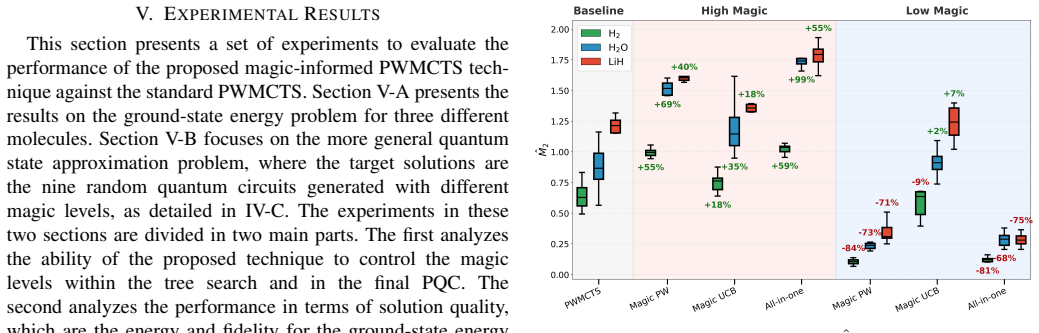
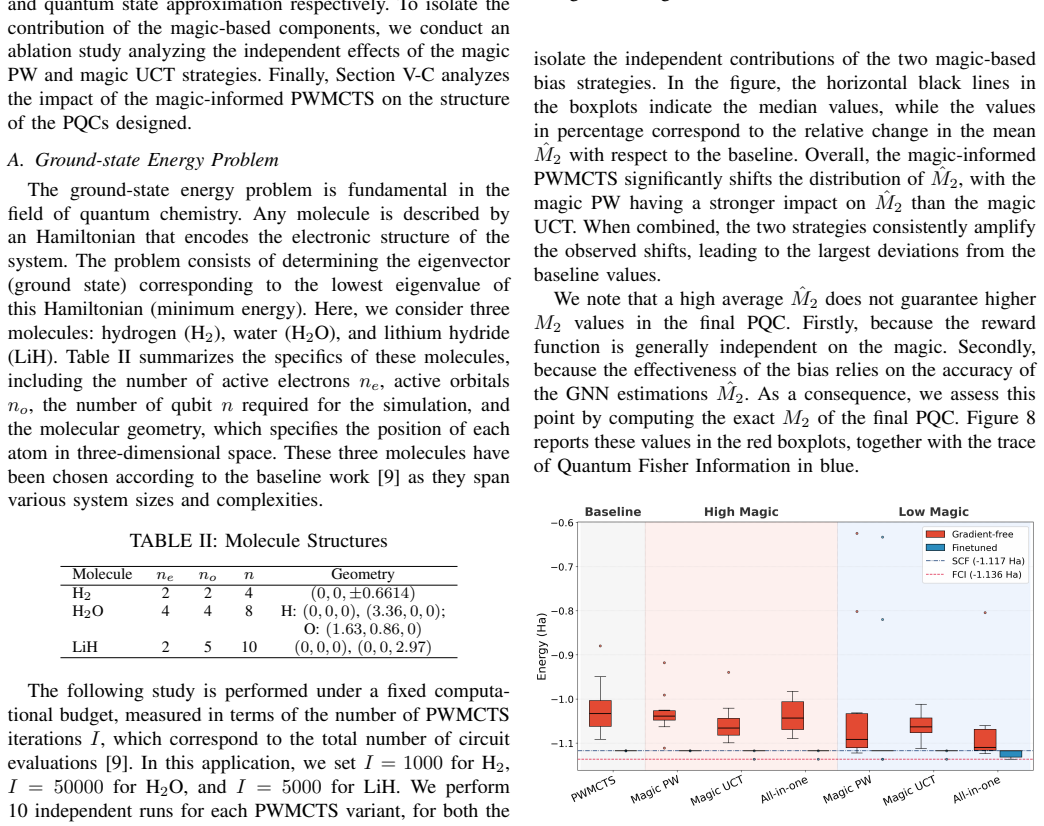
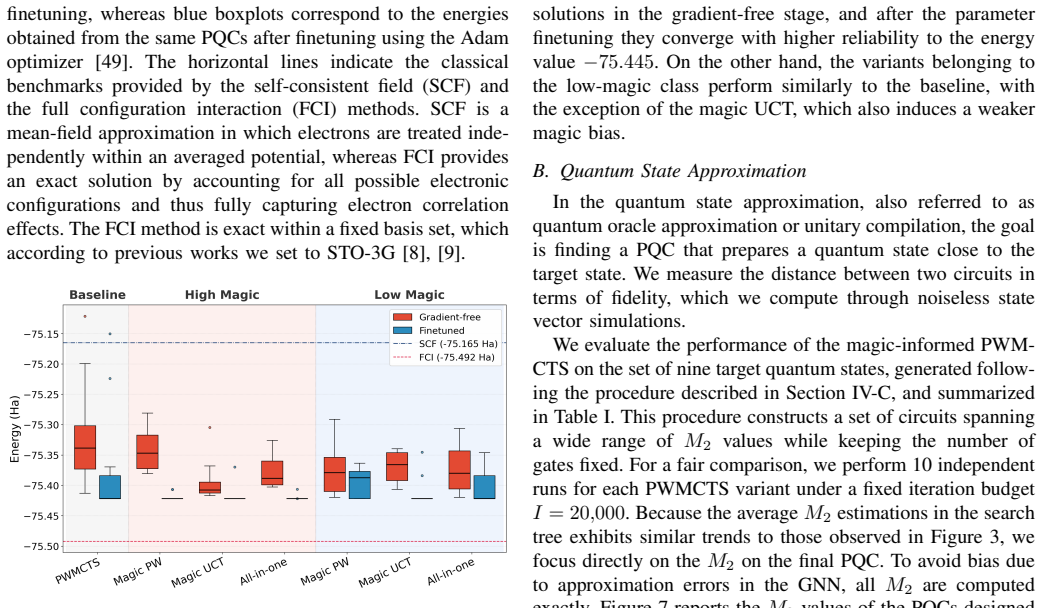
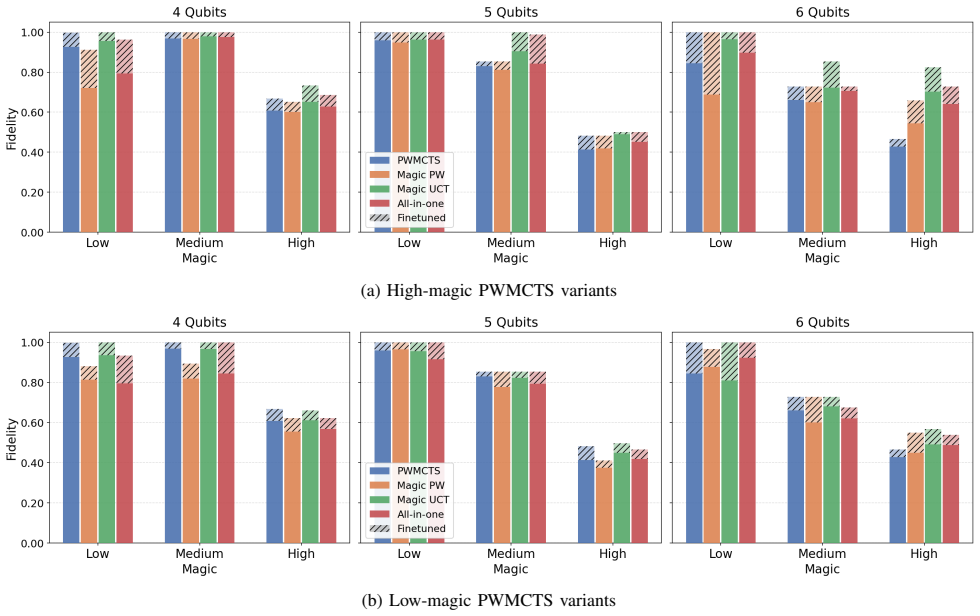
Nonstabilizerness, commonly referred to as magic, is a fundamental resource underpinning quantum advantage. In this paper, we propose a magic-informed quantum architecture search (QAS) technique that enables control over a quantum resource within the general framework of circuit design. Inspired by the AlphaGo approach, we tackle the problem with a Monte Carlo Tree Search technique equipped with a Graph Neural Network (GNN) that estimates the magic of candidate quantum circuits. The GNN model induces a magic-based bias that steers the search toward either high- or low-magic regimes, depending on the target objective. We benchmark the proposed magic-informed QAS technique on both the structured ground-state energy problem and on the more general quantum state approximation problem, spanning different sizes and target magic levels. Experimental results show that the proposed technique effectively influences the magic across the search tree and notably also on the resulting final circuit, even in regimes where the GNN operates on out-of-distribution instances. Although introducing a problem-agnostic magic bias could, in principle, constrain the search dynamics, we observe consistent improvements in solution quality across all problems tested.
Editorial analysis
A structured set of objections, weighed in public.
Referee Report
Summary. The paper proposes a magic-informed quantum architecture search (QAS) technique that augments Monte Carlo Tree Search (MCTS) with a Graph Neural Network (GNN) to estimate nonstabilizerness (magic) of candidate circuits. The GNN induces a bias that steers the search toward user-specified high- or low-magic regimes. The method is benchmarked on structured ground-state energy minimization and general quantum state approximation tasks across varying system sizes and target magic levels, with claims that it successfully modulates magic both in the search tree and final circuits—even for out-of-distribution instances—while yielding consistent improvements in solution quality.
Significance. If the central claims are substantiated, the work would represent a meaningful step toward resource-aware automated quantum circuit design. By treating magic as an explicit, controllable bias within MCTS, it extends existing QAS frameworks to incorporate a key nonstabilizerness resource that underpins quantum advantage. The combination of GNN-based estimation with tree search is technically interesting and could generalize to other quantum resources if the accuracy and transferability issues are resolved.
major comments (3)
- [Abstract and experimental results] Abstract and experimental results section: The central claim that the GNN supplies sufficiently accurate magic estimates to steer MCTS and produce better final circuits rests on unverified correlation between GNN outputs and true magic on circuits sampled from the MCTS search tree. No MAE, rank correlation, or other accuracy metrics are reported against exact magic values for held-out OOD nodes, leaving open the possibility that observed effects arise from proxy features (depth, gate count) rather than magic itself.
- [Experimental results] Experimental results section: The assertion of 'consistent improvements in solution quality across all problems tested' is not supported by reported baselines (e.g., standard MCTS without magic bias), exact performance metrics, statistical tests, or variance across runs. Without these, it is impossible to determine whether the magic bias is load-bearing or incidental to the observed gains.
- [Method] Method section on GNN training: The paper does not specify how the GNN training distribution relates to the distribution of circuits encountered during MCTS rollouts. If the training set does not cover the relevant circuit topologies and depths, the out-of-distribution performance claims cannot be rigorously evaluated.
minor comments (2)
- [Background/Method] Notation for magic estimation and target levels should be introduced with explicit definitions and units in the background or method section to improve readability for readers outside the immediate subfield.
- [Figures] Figure captions describing search-tree magic distributions should include the exact number of samples, error bars, and the precise definition of 'magic' used (e.g., which stabilizer Rényi entropy or other measure).
Simulated Author's Rebuttal
We thank the referee for the detailed and constructive feedback. We address each major comment below, providing clarifications based on the manuscript while agreeing to incorporate additional quantitative details and specifications in the revised version to strengthen the presentation.
read point-by-point responses
-
Referee: [Abstract and experimental results] Abstract and experimental results section: The central claim that the GNN supplies sufficiently accurate magic estimates to steer MCTS and produce better final circuits rests on unverified correlation between GNN outputs and true magic on circuits sampled from the MCTS search tree. No MAE, rank correlation, or other accuracy metrics are reported against exact magic values for held-out OOD nodes, leaving open the possibility that observed effects arise from proxy features (depth, gate count) rather than magic itself.
Authors: We appreciate this observation. The manuscript demonstrates the influence of the magic bias through direct measurements of nonstabilizerness in both the search tree nodes and the final selected circuits, including under out-of-distribution conditions. However, we agree that reporting explicit accuracy metrics, such as mean absolute error and Spearman rank correlation between GNN predictions and exact magic values on held-out circuits sampled from the MCTS process, would more rigorously substantiate that the steering effect is driven by magic estimation rather than proxy features. We will add these metrics, computed on a representative set of OOD circuits from the search, in the revised experimental results section. revision: yes
-
Referee: [Experimental results] Experimental results section: The assertion of 'consistent improvements in solution quality across all problems tested' is not supported by reported baselines (e.g., standard MCTS without magic bias), exact performance metrics, statistical tests, or variance across runs. Without these, it is impossible to determine whether the magic bias is load-bearing or incidental to the observed gains.
Authors: We acknowledge that the current presentation of results would benefit from more explicit baseline comparisons and statistical rigor. While the manuscript reports performance on the ground-state energy and state approximation tasks across system sizes and magic targets, it does not include a direct ablation against standard MCTS without the GNN-based magic bias, nor does it report run-to-run variance or statistical significance tests. We will revise the experimental results section to include these elements: direct comparisons to vanilla MCTS, mean and standard deviation over multiple independent runs, and appropriate statistical tests to confirm that the observed improvements are attributable to the magic-informed bias. revision: yes
-
Referee: [Method] Method section on GNN training: The paper does not specify how the GNN training distribution relates to the distribution of circuits encountered during MCTS rollouts. If the training set does not cover the relevant circuit topologies and depths, the out-of-distribution performance claims cannot be rigorously evaluated.
Authors: We agree that clarifying the training data distribution is necessary to support the OOD claims. The manuscript describes the GNN as trained on a dataset of quantum circuits but does not detail the generation procedure or its overlap with MCTS rollouts. In the revised Method section, we will specify the circuit sampling strategy used for training (including ranges of depths, gate sets, and topologies), the size of the training set, and a discussion of how this distribution relates to the circuits generated during MCTS search, thereby allowing readers to assess the degree of distribution shift. revision: yes
Circularity Check
No circularity: empirical QAS method is self-contained
full rationale
The paper describes an empirical technique combining MCTS with a GNN for estimating circuit magic to bias architecture search. No derivation chain, equations, or uniqueness theorems are presented that reduce by construction to fitted inputs, self-definitions, or author-overlapping citations. The GNN is trained separately, benchmarks use independent problem instances, and claims of influence on magic and solution quality rest on experimental outcomes rather than tautological renaming or imported ansatzes. This is the standard case of a non-circular applied ML paper.
Axiom & Free-Parameter Ledger
free parameters (2)
- Target magic levels
- GNN weights
axioms (2)
- domain assumption Magic (nonstabilizerness) of a quantum circuit can be estimated from its graph representation by a trained GNN.
- domain assumption Biasing MCTS with these estimates improves or at least does not degrade solution quality on the tested problems.
Reference graph
Works this paper leans on
-
[1]
Differentiable quantum architecture search,
S.-X. Zhang, C.-Y . Hsieh, S. Zhang, and H. Yao, “Differentiable quantum architecture search,”Quantum Science and Technology, vol. 7, no. 4, p. 045023, 2022
2022
-
[2]
Evolutionary-based searching method for quantum circuit architecture,
A. Zhang and S. Zhao, “Evolutionary-based searching method for quantum circuit architecture,”Quantum Information Processing, vol. 22, no. 7, p. 283, 2023
2023
-
[3]
Mog-vqe: Multiobjective genetic variational quantum eigensolver,
D. Chivilikhin, A. Y . Samarin, V . I. Ulyantsev, I. V . Iorsh, A. R. Oganov, and O. Kyriienko, “Mog-vqe: Multiobjective genetic variational quantum eigensolver,”arXiv preprint arXiv:2007.04424, 2020
-
[4]
Hierarchical quantum circuit representations for neural architecture search,
M. Lourens, I. Sinayskiy, D. K. Park, C. Blank, and F. Petruccione, “Hierarchical quantum circuit representations for neural architecture search,”npj Quantum Information, vol. 9, no. 1, p. 79, 2023
2023
- [5]
-
[6]
Reinforcement learning for optimization of variational quan- tum circuit architectures,
M. Ostaszewski, L. M. Trenkwalder, W. Masarczyk, E. Scerri, and V . Dunjko, “Reinforcement learning for optimization of variational quan- tum circuit architectures,”Advances in Neural Information Processing Systems, vol. 34, pp. 18182–18194, 2021
2021
-
[7]
Curriculum reinforcement learning for quantum architecture search under hardware errors,
Y . J. Patel, A. Kundu, M. Ostaszewski, X. Bonet-Monroig, V . Dun- jko, and O. Danaci, “Curriculum reinforcement learning for quantum architecture search under hardware errors,” inThe Twelfth International Conference on Learning Representations, 2024
2024
-
[8]
Automated quantum circuit design with Nested Monte Carlo Tree Search,
P. Wang, M. Usman, U. Parampalli, L. C. Hollenberg, and C. R. Myers, “Automated quantum circuit design with Nested Monte Carlo Tree Search,”IEEE Transactions on Quantum Engineering, 2023
2023
-
[9]
Quantum circuit design using a progressive widening enhanced monte carlo tree search,
V . Lipardi, D. Dibenedetto, G. Stamoulis, and M. H. M. Winands, “Quantum circuit design using a progressive widening enhanced monte carlo tree search,”Advanced Quantum Technologies, vol. 8, no. 10, p. e2500093, 2025
2025
-
[10]
Quantum architecture search with meta-learning,
Z. He, C. Chen, L. Li, S. Zheng, and H. Situ, “Quantum architecture search with meta-learning,”Advanced Quantum Technologies, vol. 5, no. 8, p. 2100134, 2022
2022
-
[11]
Self-supervised rep- resentation learning for bayesian quantum architecture search,
Z. He, H. Chen, Y . Zhou, H. Situ, Y . Li, and L. Li, “Self-supervised rep- resentation learning for bayesian quantum architecture search,”Physical Review A, vol. 111, no. 3, p. 032403, 2025
2025
-
[12]
Barren plateaus in variational quantum computing,
M. Larocca, S. Thanasilp, S. Wang, K. Sharma, J. Biamonte, P. J. Coles, L. Cincio, J. R. McClean, Z. Holmes, and M. Cerezo, “Barren plateaus in variational quantum computing,”Nature Reviews Physics, vol. 7, no. 4, pp. 174–189, 2025
2025
-
[13]
Variational quantum algorithms,
M. Cerezo, A. Arrasmith, R. Babbush, S. C. Benjamin, S. Endo, K. Fujii, J. R. McClean, K. Mitarai, X. Yuan, L. Cincio,et al., “Variational quantum algorithms,”Nature Reviews Physics, vol. 3, no. 9, pp. 625– 644, 2021
2021
-
[14]
Exponential con- centration in quantum kernel methods,
S. Thanasilp, S. Wang, M. Cerezo, and Z. Holmes, “Exponential con- centration in quantum kernel methods,”Nature communications, vol. 15, no. 1, p. 5200, 2024
2024
-
[15]
An adaptive variational algorithm for exact molecular simulations on a quantum computer,
H. R. Grimsley, S. E. Economou, E. Barnes, and N. J. Mayhall, “An adaptive variational algorithm for exact molecular simulations on a quantum computer,”Nature communications, vol. 10, no. 1, p. 3007, 2019
2019
-
[16]
Progressive strategies for Monte-Carlo Tree Search,
G. M. J.-B. Chaslot, M. H. M. Winands, H. J. van den Herik, J. W. H. M. Uiterwijk, and B. Bouzy, “Progressive strategies for Monte-Carlo Tree Search,”New Mathematics and Natural Computation, vol. 4, no. 3, pp. 343–357, 2008
2008
-
[17]
The Heisenberg Representation of Quantum Computers
D. Gottesman, “The heisenberg representation of quantum computers,” arXiv preprint quant-ph/9807006, 1998
work page internal anchor Pith review arXiv 1998
-
[18]
Stabilizer r ´enyi entropy,
L. Leone, S. F. Oliviero, and A. Hamma, “Stabilizer r ´enyi entropy,” Physical Review Letters, vol. 128, no. 5, p. 050402, 2022
2022
-
[19]
Nonstabilizerness estimation using graph neural networks,
V . Lipardi, D. Dibenedetto, G. Stamoulis, E. van Nieuwenburg, and M. H. M. Winands, “Nonstabilizerness estimation using graph neural networks,”Machine Learning: Science and Technology, 2026
2026
-
[20]
Mastering the game of Go with deep neural networks and tree search,
D. Silver, A. Huang, C. J. Maddison, A. Guez, L. Sifre, G. Van Den Driessche, J. Schrittwieser, I. Antonoglou, V . Panneershelvam, M. Lanctot,et al., “Mastering the game of Go with deep neural networks and tree search,”nature, vol. 529, no. 7587, pp. 484–489, 2016
2016
-
[21]
Many-body quantum magic,
Z.-W. Liu and A. Winter, “Many-body quantum magic,”PRX Quantum, vol. 3, no. 2, p. 020333, 2022
2022
-
[22]
Many-body magic via pauli-markov chains—from criticality to gauge theories,
P. S. Tarabunga, E. Tirrito, T. Chanda, and M. Dalmonte, “Many-body magic via pauli-markov chains—from criticality to gauge theories,”PRX Quantum, vol. 4, no. 4, p. 040317, 2023
2023
-
[23]
Quantum resources of quantum and classical variational methods,
T. Spriggs, A. Ahmadi, B. Chen, and E. Greplova, “Quantum resources of quantum and classical variational methods,”Machine Learning: Science and Technology, vol. 6, no. 1, p. 015042, 2025
2025
-
[24]
C. Capecci, G. C. Santra, A. Bottarelli, E. Tirrito, and P. Hauke, “Role of nonstabilizerness in quantum optimization,”arXiv preprint arXiv:2505.17185, 2025
-
[25]
Improved simulation of stabilizer circuits,
S. Aaronson and D. Gottesman, “Improved simulation of stabilizer circuits,”Physical Review A—Atomic, Molecular, and Optical Physics, vol. 70, no. 5, p. 052328, 2004
2004
-
[26]
Robustness of magic and symmetries of the stabiliser polytope,
M. Heinrich and D. Gross, “Robustness of magic and symmetries of the stabiliser polytope,”Quantum, vol. 3, p. 132, 2019
2019
-
[27]
Stabilizer entropies and nonstabilizerness mono- tones,
T. Haug and L. Piroli, “Stabilizer entropies and nonstabilizerness mono- tones,”Quantum, vol. 7, p. 1092, 2023
2023
-
[28]
A nonstabilizerness monotone from stabilizerness asymmetry,
P. Sonya Tarabunga, M. Frau, T. Haug, E. Tirrito, and L. Piroli, “A nonstabilizerness monotone from stabilizerness asymmetry,”Quantum Science and Technology, vol. 10, no. 4, p. 045026, 2025
2025
-
[29]
Efficient witnessing and testing of magic in mixed quantum states,
T. Haug and P. S. Tarabunga, “Efficient witnessing and testing of magic in mixed quantum states,”npj Quantum Information, 2026
2026
-
[30]
Quantifying nonstabilizerness of matrix product states,
T. Haug and L. Piroli, “Quantifying nonstabilizerness of matrix product states,”Physical Review B, vol. 107, no. 3, p. 035148, 2023
2023
-
[31]
Nonstabilizerness via perfect pauli sampling of matrix product states,
G. Lami and M. Collura, “Nonstabilizerness via perfect pauli sampling of matrix product states,”Physical Review Letters, vol. 131, no. 18, p. 180401, 2023
2023
-
[32]
Nonstabi- lizerness via matrix product states in the pauli basis,
P. S. Tarabunga, E. Tirrito, M. C. Ba ˜nuls, and M. Dalmonte, “Nonstabi- lizerness via matrix product states in the pauli basis,”Physical Review Letters, vol. 133, no. 1, p. 010601, 2024
2024
-
[33]
Nonstabilizerness of neural quantum states,
A. Sinibaldi, A. F. Mello, M. Collura, and G. Carleo, “Nonstabilizerness of neural quantum states,”Physical Review Research, vol. 7, no. 4, p. 043289, 2025
2025
-
[34]
Magic-induced computational separation in entanglement theory,
A. Gu, S. F. Oliviero, and L. Leone, “Magic-induced computational separation in entanglement theory,”PRX Quantum, vol. 6, no. 2, p. 020324, 2025
2025
-
[35]
Entanglement – nonstabilizerness separation in hybrid quantum circuits,
G. E. Fux, E. Tirrito, M. Dalmonte, and R. Fazio, “Entanglement – nonstabilizerness separation in hybrid quantum circuits,”Phys. Rev. Res., vol. 6, p. L042030, Oct 2024
2024
-
[36]
Nonstabilizerness determining the hardness of direct fidelity estimation,
L. Leone, S. F. Oliviero, and A. Hamma, “Nonstabilizerness determining the hardness of direct fidelity estimation,”Physical Review A, vol. 107, no. 2, p. 022429, 2023
2023
-
[37]
Stabilizer entropies are monotones for magic- state resource theory,
L. Leone and L. Bittel, “Stabilizer entropies are monotones for magic- state resource theory,”Physical Review A, vol. 110, no. 4, p. L040403, 2024
2024
-
[38]
Unveiling the stabilizer group of a matrix product state,
G. Lami and M. Collura, “Unveiling the stabilizer group of a matrix product state,”Physical Review Letters, vol. 133, no. 1, p. 010602, 2024
2024
-
[39]
Retrieving nonstabilizerness with neural networks,
A. F. Mello, G. Lami, and M. Collura, “Retrieving nonstabilizerness with neural networks,”Physical Review A, vol. 111, no. 1, p. 012440, 2025
2025
-
[40]
A study on stabilizer r ´enyi entropy estimation using machine learning,
V . Lipardi, D. Dibenedetto, G. Stamoulis, and M. H. M. Winands, “A study on stabilizer r ´enyi entropy estimation using machine learning,” in 2025 IEEE International Conference on Quantum Artificial Intelligence (QAI), pp. 159–164, IEEE, 2025
2025
-
[41]
Efficient selectivity and backup operators in Monte-Carlo Tree Search,
R. Coulom, “Efficient selectivity and backup operators in Monte-Carlo Tree Search,” inInternational Conference on Computers and Games, pp. 72–83, Springer, 2007
2007
-
[42]
Finite-time analysis of the multiarmed bandit problem,
P. Auer, N. Cesa-Bianchi, and P. Fischer, “Finite-time analysis of the multiarmed bandit problem,”Machine learning, vol. 47, pp. 235–256, 2002
2002
-
[43]
Bandit based Monte-Carlo planning,
L. Kocsis and C. Szepesv ´ari, “Bandit based Monte-Carlo planning,” in Machine Learning: ECML 2006: 17th European Conference on Machine Learning Berlin, Germany, September 18-22, 2006 Proceedings 17, pp. 282–293, Springer, 2006
2006
-
[44]
Quantum circuit evolution on NISQ devices,
L. Franken, B. Georgiev, S. Mucke, M. Wolter, R. Heese, C. Bauckhage, and N. Piatkowski, “Quantum circuit evolution on NISQ devices,” in 2022 IEEE Congress on Evolutionary Computation (CEC), pp. 1–8, IEEE, 2022
2022
-
[45]
Nested Monte-Carlo Tree Search for Online Planning in Large MDPs,
H. Baier and M. H. M. Winands, “Nested Monte-Carlo Tree Search for Online Planning in Large MDPs,” inECAI, vol. 242, pp. 109–114, 2012
2012
-
[46]
Single-player monte-carlo tree search for SameGame,
M. P. D. Schadd, M. H. M. Winands, M. J. W. Tak, and J. W. H. M. Uiterwijk, “Single-player monte-carlo tree search for SameGame,” Knowledge-Based Systems, vol. 34, pp. 3–11, 2012
2012
-
[47]
Multi-armed bandits with episode context,
C. D. Rosin, “Multi-armed bandits with episode context,”Annals of Mathematics and Artificial Intelligence, vol. 61, no. 3, pp. 203–230, 2011
2011
-
[48]
The proof and measurement of association between two things.,
C. Spearman, “The proof and measurement of association between two things.,” 1961
1961
-
[49]
Adam: A Method for Stochastic Optimization
D. P. Kingma and J. Ba, “Adam: A method for stochastic optimization,” arXiv preprint arXiv:1412.6980, 2014
work page internal anchor Pith review arXiv 2014
-
[50]
Statistical analysis of quantum state learning process in quantum neural networks,
H.-k. Zhang, C. Zhu, M. Jing, and X. Wang, “Statistical analysis of quantum state learning process in quantum neural networks,”Advances in Neural Information Processing Systems, vol. 36, pp. 33133–33160, 2023
2023
-
[51]
Does provable absence of barren plateaus imply classical simulability?,
M. Cerezo, M. Larocca, D. Garc ´ıa-Mart´ın, N. L. Diaz, P. Braccia, E. Fontana, M. S. Rudolph, P. Bermejo, A. Ijaz, S. Thanasilp,et al., “Does provable absence of barren plateaus imply classical simulability?,” Nature Communications, vol. 16, no. 1, p. 7907, 2025
2025
-
[52]
Quantum convolutional neural networks are effectively classically simulable,
P. Bermejo, P. Braccia, M. S. Rudolph, Z. Holmes, L. Cincio, and M. Cerezo, “Quantum convolutional neural networks are effectively classically simulable,”PRX Quantum, vol. 7, p. 020304, Apr 2026
2026
-
[53]
C. Y . Kesiku and B. Garcia-Zapirain, “How quantum circuits actually learn: A causal identification of genuine quantum contributions,”arXiv preprint arXiv:2603.16321, 2026
-
[54]
Generalized unitary coupled cluster wave functions for quantum computation,
J. Lee, W. J. Huggins, M. Head-Gordon, and K. B. Whaley, “Generalized unitary coupled cluster wave functions for quantum computation,” Journal of Chemical Theory and Computation, vol. 15, no. 1, pp. 311– 324, 2018
2018
discussion (0)
Sign in with ORCID, Apple, or X to comment. Anyone can read and Pith papers without signing in.