Recognition: 2 theorem links
· Lean TheoremReentrant value fields as delayed coupled reaction-diffusion systems on finite graphs
Pith reviewed 2026-05-12 00:54 UTC · model grok-4.3
The pith
Reentrant value fields on finite graphs form well-posed delayed reaction-diffusion systems that admit compact global attractors and delay-independent stability of principal components.
A machine-rendered reading of the paper's core claim, the machinery that carries it, and where it could break.
Core claim
Reentrant value fields are realized as delayed coupled reaction-diffusion systems on finite graphs. The model yields a well-posed retarded functional differential equation on the history space, a compact global attractor arising from compact viability and eventual compactness of solution segments, delay-independent global stability of the symbolic field, geometric field and production variable in the regime where the squared coupling norm is less than the product of decay rates, invariance of scalar geometric feature dynamics under the special Euclidean group, and an order-one-over-kappa fast relaxation for the valuative variable.
What carries the argument
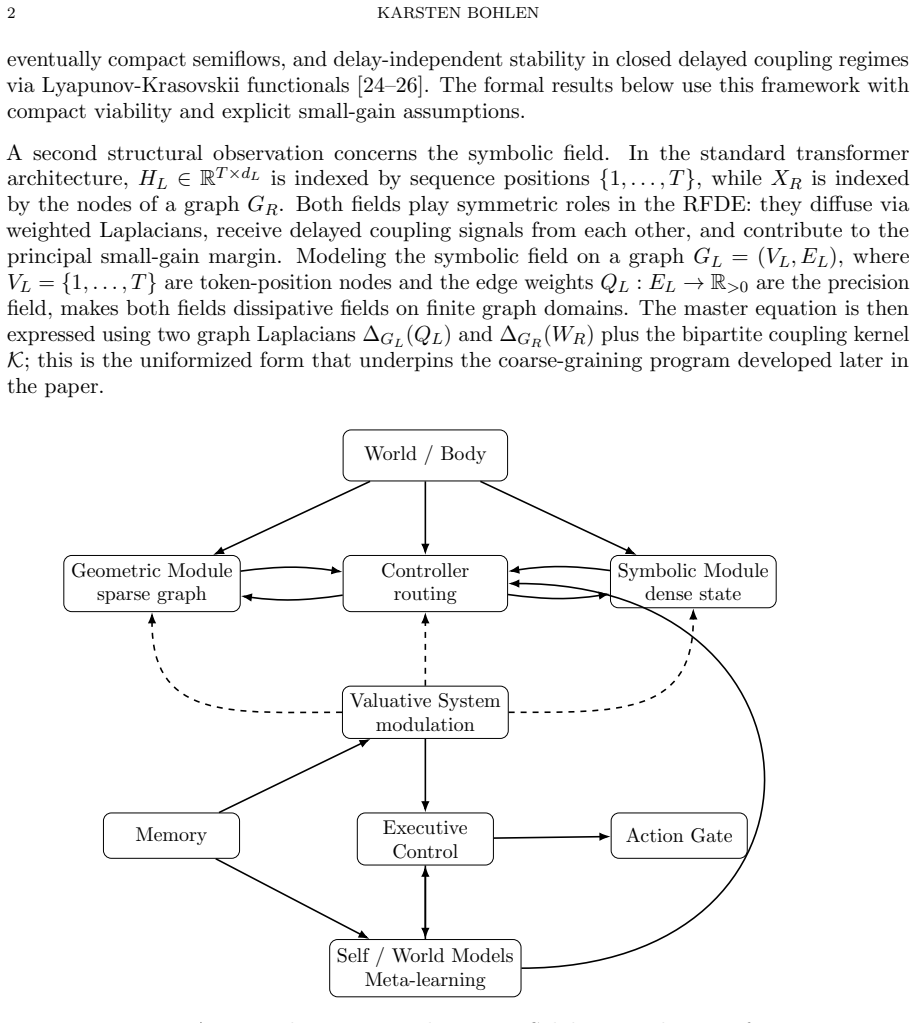
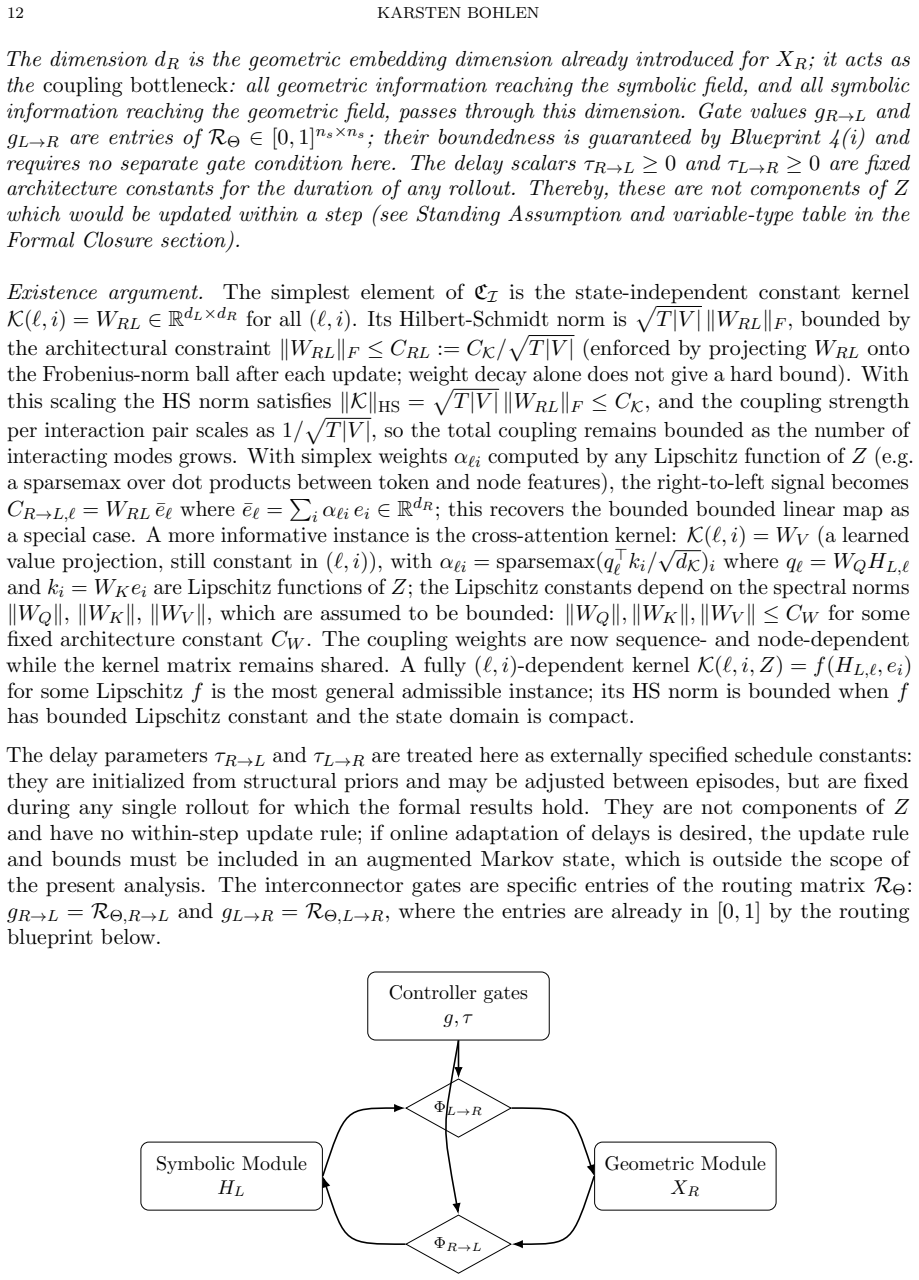
The retarded functional differential equation (RFDE) on the history space, serving as the operative equation for the reaction-diffusion dynamics of the coupled symbolic field H_L and geometric field X_R through a bipartite Hilbert-Schmidt operator with propagation delays.
If this is right
- Well-posedness of the RFDE continues to hold when the attention operators are allowed to be state-dependent and Lipschitz.
- Existence of the compact global attractor follows from compact viability together with eventual compactness of solution segments.
- Global stability of the principal subsystem (H_L, X_R, P) holds independently of delay length whenever the fixed interfield coupling satisfies C_K squared less than mu_L times mu_R.
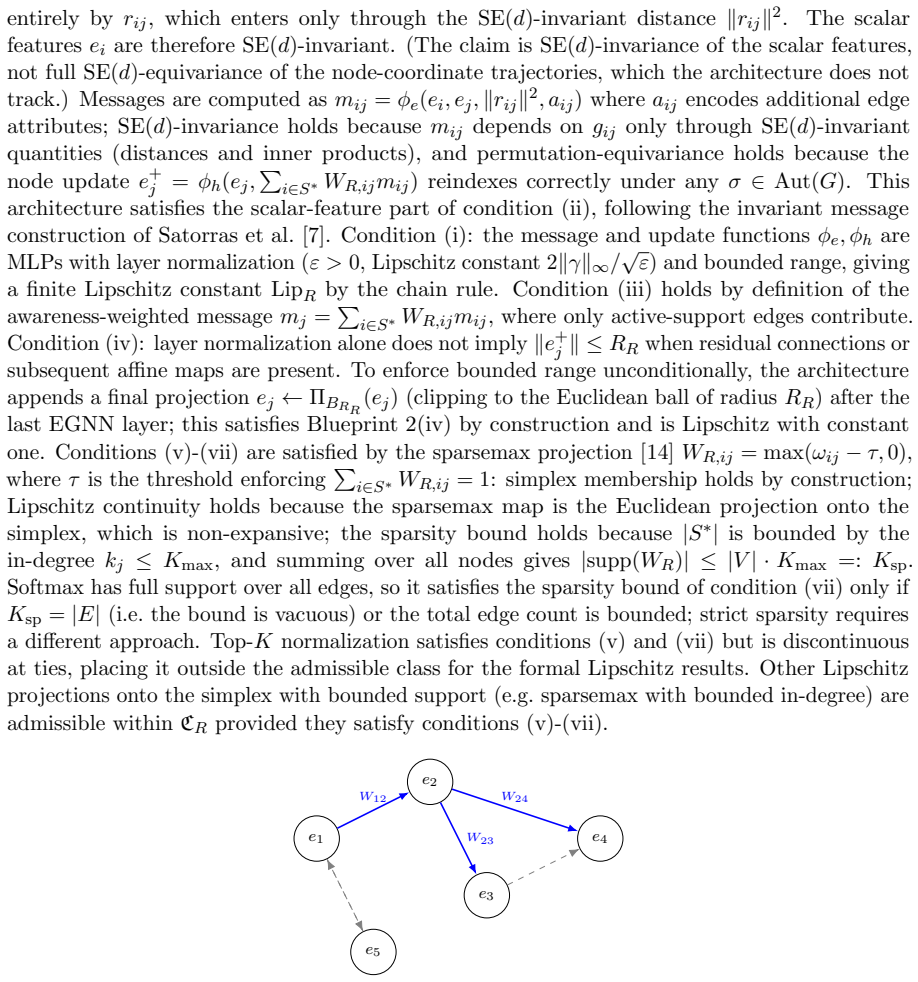
- The scalar geometric feature dynamics remain invariant under the full action of the special Euclidean group SE(d).
- The valuative variable relaxes at the explicit fast rate O(1 over kappa_Y).
Where Pith is reading between the lines
- The delay-independent stability result suggests that variations in propagation timing between the symbolic and geometric fields will not destabilize the principal components under the stated coupling bound.
- The explicit identification of extra small-gain terms for state-dependent coupling indicates how the stability theorem can be extended beyond the fixed-coupling case.
- SE(d)-invariance of the geometric features implies that the model preserves robustness of geometric processing under arbitrary rigid motions of the underlying space.
- The fast relaxation estimate for the valuative variable provides a quantitative basis for separating slow symbolic-geometric evolution from rapid valuation updates.
Load-bearing premise
Joint non-emptiness of all admissible classes for the nine synthetic design blueprints is assumed.
What would settle it
An admissible choice of parameters and initial history for which the RFDE lacks a unique solution, or for which solutions escape to infinity in finite time, or for which the principal components lose stability while the coupling still satisfies the inequality C_K squared less than mu_L times mu_R.
Figures


read the original abstract
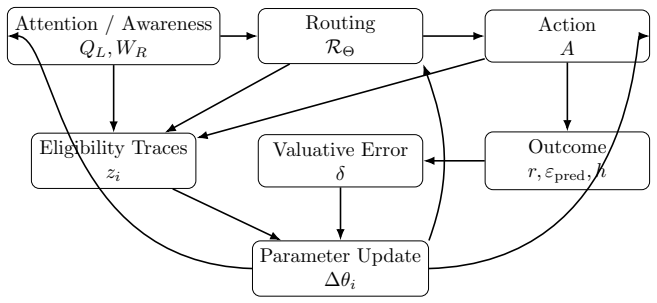
This article develops a field theory of synthetic cognition in which a symbolic field $H_L$ and a geometric field $X_R$, each a section of a vertex bundle over a finite graph, are coupled through a bipartite Hilbert-Schmidt operator with propagation delays. The central object is a retarded functional differential equation (RFDE) on the history space: the reaction-diffusion equation is the operative equation of the theory. Nine synthetic design blueprints specify admissibility conditions for each architectural component; each condition carries a dynamical consequence. The main formal results are: (1) well-posedness of the full deterministic RFDE under constant input $u^*$, (2) existence of a compact global attractor from compact viability and eventual compactness of solution segments, (3) delay-independent global stability of the principal components $(H_L,X_R,P)$ in the closed stability regime with fixed interfield coupling operators satisfying $C_{\mathcal{K}}^2<\mu_L\mu_R$, (4) $\mathrm{SE}(d)$-invariance of the scalar geometric feature dynamics, and (5) an $O(1/\kappa_Y)$ fast relaxation estimate for the valuative variable. Joint non-emptiness of all admissible classes is assumed. The well-posedness and attractor results allow Lipschitz state-dependent attention operators. The stability theorem is stated for the fixed-coupling principal subsystem, with the extra small-gain terms for state-dependent coupling identified explicitly.
Editorial analysis
A structured set of objections, weighed in public.
Referee Report
Summary. The paper develops a field theory of synthetic cognition in which a symbolic field H_L and a geometric field X_R, each a section of a vertex bundle over a finite graph, are coupled through a bipartite Hilbert-Schmidt operator with propagation delays. The central object is formulated as a retarded functional differential equation (RFDE) on the history space. Nine synthetic design blueprints specify admissibility conditions for each architectural component. The main formal results are: (1) well-posedness of the full deterministic RFDE under constant input u*, (2) existence of a compact global attractor from compact viability and eventual compactness of solution segments, (3) delay-independent global stability of the principal components (H_L, X_R, P) in the closed stability regime with fixed interfield coupling operators satisfying C_K^2 < μ_L μ_R, (4) SE(d)-invariance of the scalar geometric feature dynamics, and (5) an O(1/κ_Y) fast relaxation estimate for the valuative variable. All results assume joint non-emptiness of the admissible classes. The well-posedness and attractor results allow Lipschitz state-dependent attention operators.
Significance. If the joint non-emptiness assumption can be substantiated with explicit constructions, the work would provide a structured way to apply standard RFDE theory (well-posedness, attractors) to coupled symbolic-geometric dynamics on graphs, with explicit small-gain conditions for stability and invariance results for geometric features. The explicit identification of extra small-gain terms for state-dependent coupling is a constructive strength. Without such constructions, the framework remains formal and its applicability to concrete systems is unclear.
major comments (2)
- [Abstract] Abstract (and standing assumption throughout): All five formal results are conditioned on the joint non-emptiness of the nine admissible classes. The manuscript states this assumption explicitly but supplies neither a proof that the intersection is non-empty nor a single concrete example (finite graph, bundles, bipartite Hilbert-Schmidt operator, delay kernel, and parameter values) satisfying every admissibility condition simultaneously. If the intersection is empty, the theorems apply to no system; this is load-bearing for the central claims.
- [Stability theorem] Section on stability theorem (presumably §4 or equivalent): The delay-independent global stability of (H_L, X_R, P) is stated for fixed interfield coupling under C_K^2 < μ_L μ_R, with extra small-gain terms identified for the state-dependent case. However, without verification that the admissibility conditions permit a non-empty regime where this inequality holds simultaneously with the other eight classes, the stability result cannot be assessed for applicability.
minor comments (1)
- [Introduction] Notation for invented entities (H_L, X_R, P, κ_Y): These are introduced without immediate cross-reference to their bundle or operator definitions in the opening paragraphs; a brief table or diagram linking each to its admissibility class would improve readability.
Simulated Author's Rebuttal
We thank the referee for the thorough review and for highlighting the importance of substantiating the joint non-emptiness assumption. We agree that the lack of an explicit example leaves the applicability of the results formal. We will revise the manuscript to include a concrete construction that satisfies all admissibility conditions simultaneously, including the stability regime, thereby addressing both major comments.
read point-by-point responses
-
Referee: [Abstract] Abstract (and standing assumption throughout): All five formal results are conditioned on the joint non-emptiness of the nine admissible classes. The manuscript states this assumption explicitly but supplies neither a proof that the intersection is non-empty nor a single concrete example (finite graph, bundles, bipartite Hilbert-Schmidt operator, delay kernel, and parameter values) satisfying every admissibility condition simultaneously. If the intersection is empty, the theorems apply to no system; this is load-bearing for the central claims.
Authors: We agree that the joint non-emptiness assumption is load-bearing and that the manuscript currently provides neither a general proof nor a concrete example. In the revised manuscript we will add an explicit construction: a small finite graph with two vertices, trivial line bundles for H_L and X_R, a specific bipartite Hilbert-Schmidt operator with finite-rank kernel, a delay kernel satisfying the required integrability and positivity conditions, and numerical parameter values (including μ_L, μ_R, C_K) that simultaneously meet all nine admissibility conditions. We will verify that this example lies in the regime C_K² < μ_L μ_R and that the remaining dynamical consequences (compact viability, eventual compactness, SE(d)-invariance, etc.) hold. This will demonstrate that the admissible classes have non-empty intersection and make the theorems applicable to at least one concrete system. revision: yes
-
Referee: [Stability theorem] Section on stability theorem (presumably §4 or equivalent): The delay-independent global stability of (H_L, X_R, P) is stated for fixed interfield coupling under C_K² < μ_L μ_R, with extra small-gain terms identified for the state-dependent case. However, without verification that the admissibility conditions permit a non-empty regime where this inequality holds simultaneously with the other eight classes, the stability result cannot be assessed for applicability.
Authors: The stability theorem is stated under the standing joint non-emptiness assumption, which is intended to include the closed stability regime. The concrete example we will add in revision will be chosen so that all nine admissibility conditions hold and, additionally, C_K² < μ_L μ_R is satisfied with room to spare. The same example will also accommodate the extra small-gain terms that appear when the coupling operators are allowed to be state-dependent (Lipschitz). By exhibiting explicit parameter values and verifying the inequality inside the admissible set, the revised manuscript will make the applicability of the delay-independent stability result directly assessable. revision: yes
Circularity Check
No circularity: results are conditional consequences of standard RFDE theory plus explicit admissibility assumptions
full rationale
The paper states its five main formal results explicitly as consequences of standard retarded functional differential equation (RFDE) theory, compact viability, eventual compactness, and the listed admissibility conditions on the nine synthetic design blueprints. No equations, derivations, or self-citations are supplied that reduce any theorem to a fitted parameter, self-referential definition, or load-bearing prior result by the same authors. The standing assumption of joint non-emptiness of the admissible classes is declared openly and does not enter the derivation chain as a hidden tautology; the theorems are simply conditioned on it. This is a normal, self-contained application of external mathematical theory rather than a circular reduction.
Axiom & Free-Parameter Ledger
axioms (1)
- ad hoc to paper Joint non-emptiness of all admissible classes
invented entities (2)
-
Symbolic field H_L
no independent evidence
-
Geometric field X_R
no independent evidence
Lean theorems connected to this paper
-
IndisputableMonolith/Foundation/RealityFromDistinction.leanreality_from_one_distinction unclearThe central object is a retarded functional differential equation (RFDE) on the history space... main formal results are: (1) well-posedness... (3) delay-independent global stability... under C_K² < μ_L μ_R
-
IndisputableMonolith/Cost/FunctionalEquation.leanwashburn_uniqueness_aczel unclearLyapunov-Krasovskii functional... V(φ̃) = ½∥φ̃_L(0)∥²_F + ... + integrals of delayed norms
Reference graph
Works this paper leans on
-
[1]
F. H. Clarke.Optimization and Nonsmooth Analysis. SIAM Classics in Applied Mathematics. SIAM, Philadelphia, 1990
work page 1990
-
[2]
W. Ambrose and I. M. Singer.A theorem on holonomy.Transactions of the American Mathematical Society, 75(3):428–443, 1953
work page 1953
-
[3]
J. L. Ba, J. R. Kiros, and G. E. Hinton.Layer normalization.stat, 1050. Jg., S. 21., 2016
work page 2016
-
[4]
P. W. Battaglia et al.Relational inductive biases, deep learning, and graph networks.arXiv preprint arXiv:1806.01261, 2018
work page internal anchor Pith review arXiv 2018
-
[5]
M. M. Bronstein, J. Bruna, T. Cohen, and P. Veliˇ ckovi´ c.Geometric deep learning: Grids, groups, graphs, geodesics, and gauges.arXiv preprint arXiv:2104.13478, 2021
work page internal anchor Pith review arXiv 2021
-
[6]
R. Brown.From groups to groupoids: A brief survey.Bulletin of the London Mathematical Society, 19(2):113–134, 1987
work page 1987
-
[7]
V. G. Satorras, E. Hoogeboom, and M. Welling.E(n) equivariant graph neural networks. In ICML 2021, pp. 9323–9332, 2021. 32 KARSTEN BOHLEN
work page 2021
- [8]
- [9]
-
[10]
E. R. Kandel, J. D. Koester, S. H. Mack, and S. A. Siegelbaum, editors.Principles of Neural Science, sixth edition. McGraw-Hill, New York, 2021
work page 2021
-
[11]
T. N. Kipf and M. Welling.Semi-supervised classification with graph convolutional networks. InICLR 2017, 2017
work page 2017
-
[12]
S. Kobayashi and K. Nomizu.Foundations of Differential Geometry, volume 1. Wiley- Interscience, 1963
work page 1963
-
[13]
Locatello et al.Object-centric learning with slot attention
F. Locatello et al.Object-centric learning with slot attention. InNeurIPS 2020, 2020
work page 2020
-
[14]
A. F. T. Martins and R. F. Astudillo.From softmax to sparsemax: A sparse model of attention and multi-label classification. InICML 2016, pp. 1614–1623, 2016
work page 2016
- [15]
-
[16]
Mnih et al.Human-level control through deep reinforcement learning.Nature, 518(7540):529–533, 2015
V. Mnih et al.Human-level control through deep reinforcement learning.Nature, 518(7540):529–533, 2015
work page 2015
-
[17]
Petitot.The neurogeometry of pinwheels as a sub-Riemannian contact structure
J. Petitot.The neurogeometry of pinwheels as a sub-Riemannian contact structure. Journal of Physiology-Paris 97.2-3 (2003): 265-309
work page 2003
-
[18]
G. W. Pugh.The Biological Origin of Human Values. Basic Books, New York, 1977
work page 1977
-
[19]
B. Sch¨ olkopf et al.Toward causal representation learning.Proceedings of the IEEE, 109(5):612–634, 2021
work page 2021
-
[20]
E. S. Spelke and K. D. Kinzler.Core knowledge.Developmental Science, 10(1):89–96, 2007
work page 2007
-
[21]
Vaswani et al.Attention is all you need
A. Vaswani et al.Attention is all you need. InNeurIPS 2017, 2017
work page 2017
-
[22]
P. Veliˇ ckovi´ c, G. Cucurull, A. Casanova, A. Romero, P. Li` o, and Y. Bengio.Graph attention networks. InICLR 2018, 2018
work page 2018
-
[23]
R. J. Williams.Simple statistical gradient-following algorithms for connectionist reinforce- ment learning.Machine Learning, 8(3-4):229–256, 1992
work page 1992
-
[24]
J. K. Hale.Asymptotic Behavior of Dissipative Systems. Mathematical Surveys and Monographs, Vol. 25. American Mathematical Society, Providence, RI, 1988
work page 1988
-
[25]
J. K. Hale and S. M. Verduyn Lunel.Introduction to Functional Differential Equations. Applied Mathematical Sciences, Vol. 99. Springer, New York, 1993
work page 1993
-
[26]
O. Diekmann, S. A. van Gils, S. M. Verduyn Lunel, and H.-O. Walther.Delay Equations: Functional-, Complex-, and Nonlinear Analysis. Applied Mathematical Sciences, Vol. 110. Springer, New York, 1995
work page 1995
-
[27]
Wu.Theory and Applications of Partial Functional Differential Equations
J. Wu.Theory and Applications of Partial Functional Differential Equations. Applied Mathematical Sciences, Vol. 119. Springer, New York, 1996
work page 1996
-
[28]
Mao.Stochastic Differential Equations and Applications, 2nd edition
X. Mao.Stochastic Differential Equations and Applications, 2nd edition. Woodhead Publishing, Cambridge, 2007
work page 2007
-
[29]
J. C. Robinson.Dimensions, Embeddings, and Attractors. Cambridge Tracts in Mathematics, Vol. 186. Cambridge University Press, 2011
work page 2011
discussion (0)
Sign in with ORCID, Apple, or X to comment. Anyone can read and Pith papers without signing in.