Recognition: unknown
Effects of magnetically driven shocks on nucleosynthesis and kilonovae from neutron star mergers
Pith reviewed 2026-05-07 13:59 UTC · model grok-4.3
The pith
Magnetically driven shocks from long-lived neutron star merger remnants can reheat ejecta to nuclear statistical equilibrium, raise electron fractions, and alter r-process yields with visible effects on kilonova colors and late-time light.
A machine-rendered reading of the paper's core claim, the machinery that carries it, and where it could break.
Core claim
Magnetically powered blasts injected into pre-existing merger ejecta can drive portions of the material back to nuclear statistical equilibrium, increase the electron fraction in the shocked gas, and deposit additional entropy, thereby producing systematic changes in r-process abundance patterns that appear as modifications to kilonova color curves and late-time luminosity.
What carries the argument
Parametric injection of magnetized blast waves into expanding ejecta within two-dimensional special-relativistic MHD simulations, followed by post-processing of Lagrangian tracers with the WinNet nuclear network and SuperNu radiative transfer using realistic opacities.
If this is right
- Strong shocks raise the electron fraction enough to suppress the heaviest r-process nuclei in the affected ejecta layers.
- Entropy addition alters the temperature-density trajectory and therefore changes the final abundance pattern even in regions that do not reach full equilibrium.
- The altered composition produces measurable shifts in kilonova color at early to intermediate times and in the slope of the light curve at late times.
- Remnant magnetic variability offers one physical mechanism that can contribute to the observed diversity among kilonova events.
Where Pith is reading between the lines
- Kilonova modeling pipelines that ignore post-merger magnetic activity will systematically misestimate both the total r-process yield and the inferred ejecta mass from a given light curve.
- Multi-messenger observations that combine gravitational-wave signals with detailed kilonova spectroscopy could place limits on the strength and timing of remnant magnetic outbursts.
- The 2D results motivate targeted 3D simulations that self-consistently evolve both the remnant and the ejecta to test whether the reported changes survive full geometry and neutrino transport.
Load-bearing premise
Parametric insertion of magnetized blast waves into already expanding two-dimensional ejecta accurately reproduces the thermodynamic and compositional evolution that would occur in a fully self-consistent three-dimensional merger remnant.
What would settle it
Kilonova light curves from mergers whose remnants show clear long-lived magnetic activity that nevertheless match the color evolution and late-time decay of prompt-collapse events with no detectable difference would falsify the claimed systematic imprint.
Figures



read the original abstract
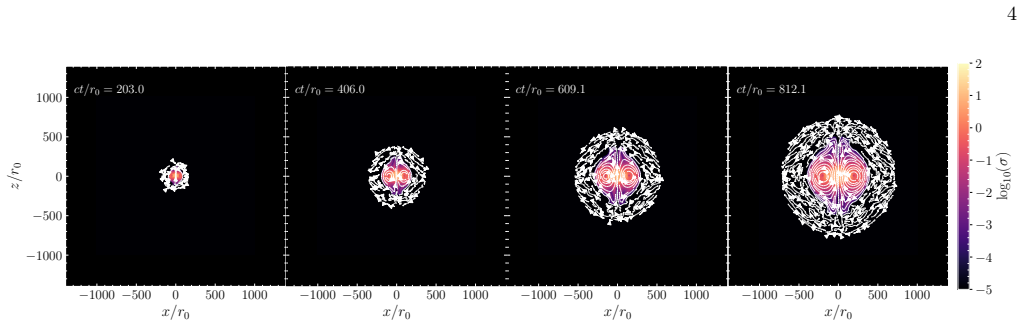
Neutron-star mergers can launch mildly relativistic to moderately relativistic outflows whose interaction with the ejecta can reshape kilonova emission. We parametrically study magnetically powered outbursts from long-lived merger remnants, such as flare-like eruptions and collapse-driven shocks, and quantify their impact on ejecta dynamics, composition, and observables. Using two-dimensional special-relativistic magnetohydrodynamic simulations, we follow magnetized blast waves injected into expanding merger ejecta for early- and late-launch scenarios across a range of shock strengths. We then post-process Lagrangian tracer histories with the nuclear reaction network WinNet and the radiative-transfer code SuperNu with realistic opacities, to connect shock heating directly to nucleosynthesis and kilonova light curves. We find that sufficiently strong shocks can reheat portions of the ejecta to nuclear statistical equilibrium, increase the electron fraction in the shocked material, and deposit entropy, leading to systematic changes in $r$-process yields. These thermodynamic and compositional changes can leave observable imprints on kilonova emission -- especially in color evolution and late-time light-curve behavior -- indicating that magnetically driven remnant variability can potentially contribute to kilonova diversity.
Editorial analysis
A structured set of objections, weighed in public.
Referee Report
Summary. The manuscript uses 2D special-relativistic MHD simulations to inject parametrically magnetized blast waves into pre-expanded neutron-star merger ejecta for early and late launch times across a range of shock strengths. Lagrangian tracers are post-processed with the WinNet nuclear reaction network to compute r-process yields and with the SuperNu radiative-transfer code (using realistic opacities) to generate kilonova light curves. The central claim is that sufficiently strong shocks reheat portions of the ejecta to nuclear statistical equilibrium, raise the electron fraction, and deposit entropy, producing systematic shifts in r-process abundances that imprint on kilonova color evolution and late-time luminosity.
Significance. If the modeled thermodynamic and compositional changes are representative, the work identifies remnant-driven magnetic variability as a plausible contributor to kilonova diversity, with direct implications for interpreting multi-messenger observations. The pipeline that couples hydrodynamics to nucleosynthesis and radiative transfer is a methodological strength, though the parametric 2D setup limits quantitative applicability to real events.
major comments (2)
- [§2] §2 (Simulation setup): The parametric injection of magnetized blast waves into fixed pre-expansion ejecta profiles in 2D SR-MHD does not incorporate self-consistent magnetic driving from the remnant, 3D turbulent mixing, or back-reaction of evolving composition on the EOS and hydrodynamics; this directly affects whether the reported reheating to NSE, Ye increase, and entropy deposition (results section) can be taken as representative of merger dynamics.
- [§3] §3 (Post-processing): Tracer T-ρ histories extracted from the hydro run are fed to WinNet without iteration; because nuclear heating and Ye changes can alter the expansion timescale and freeze-out, the nucleosynthesis yields and subsequent kilonova predictions may not remain valid for the strongest shocks examined.
minor comments (2)
- The abstract and methods should state the exact range of shock strengths, launch times, and initial ejecta parameters used, together with any resolution or convergence tests performed.
- Figure captions and text should clarify whether the reported changes in r-process yields are mass-weighted averages or for specific tracer subsets.
Simulated Author's Rebuttal
We thank the referee for their constructive and detailed review of our manuscript. We address each major comment below and have revised the text to better articulate the scope and limitations of our parametric study.
read point-by-point responses
-
Referee: [§2] §2 (Simulation setup): The parametric injection of magnetized blast waves into fixed pre-expansion ejecta profiles in 2D SR-MHD does not incorporate self-consistent magnetic driving from the remnant, 3D turbulent mixing, or back-reaction of evolving composition on the EOS and hydrodynamics; this directly affects whether the reported reheating to NSE, Ye increase, and entropy deposition (results section) can be taken as representative of merger dynamics.
Authors: We agree that the setup is parametric and omits self-consistent remnant driving, 3D mixing, and EOS back-reaction. This design choice enables a controlled exploration of shock strength and timing across a broad parameter space that remains computationally inaccessible in fully coupled 3D simulations. We have expanded the discussion in §2 and the conclusions to state explicitly that the reported thermodynamic and compositional changes are indicative of possible effects within this simplified framework rather than direct quantitative predictions for observed events. We also note that while 3D turbulence could redistribute material, the primary reheating and Ye shifts occur in the shocked regions tracked by our tracers. revision: partial
-
Referee: [§3] §3 (Post-processing): Tracer T-ρ histories extracted from the hydro run are fed to WinNet without iteration; because nuclear heating and Ye changes can alter the expansion timescale and freeze-out, the nucleosynthesis yields and subsequent kilonova predictions may not remain valid for the strongest shocks examined.
Authors: We acknowledge that a non-iterative post-processing approach neglects possible feedback from nuclear heating on the expansion dynamics, particularly for the strongest shocks. This approximation is standard in the field and allows us to connect hydrodynamics to nucleosynthesis and radiative transfer for a wide range of cases. We have added explicit caveats in the methods and results sections noting that yields for the most energetic shocks should be interpreted with caution, as they may represent upper bounds on the r-process modifications. A fully coupled treatment would be a valuable follow-up but lies beyond the present scope. revision: partial
Circularity Check
No circularity: results from forward numerical simulations and post-processing
full rationale
The paper's claims derive from 2D SR-MHD simulations of parametrically injected magnetized blast waves into pre-existing ejecta profiles, followed by tracer post-processing with WinNet for nucleosynthesis and SuperNu for radiative transfer. No mathematical derivation chain exists that reduces predictions to inputs by construction. There are no self-definitional steps, fitted parameters renamed as predictions, load-bearing self-citations, uniqueness theorems, or ansatzes smuggled via citation. The thermodynamic and compositional changes (reheating to NSE, Ye increase, entropy deposition) and their kilonova imprints are direct outputs of the chosen numerical setup, which remains independent of the target results. This is the standard case of self-contained computational modeling.
Axiom & Free-Parameter Ledger
free parameters (3)
- shock strength
- launch time
- ejecta initial conditions
axioms (3)
- standard math Ideal special-relativistic magnetohydrodynamics accurately describes the blast-wave propagation in the ejecta
- domain assumption Nuclear statistical equilibrium is achieved in sufficiently reheated shocked material
- domain assumption WinNet and SuperNu with realistic opacities correctly compute nucleosynthesis and radiative transfer
Reference graph
Works this paper leans on
-
[1]
B. P. Abbottet al.(LIGO Scientific, Virgo), Phys. Rev. Lett.119, 161101 (2017), arXiv:1710.05832 [gr-qc]
work page internal anchor Pith review arXiv 2017
-
[2]
B. P. Abbottet al.(LIGO Scientific, Virgo, Fermi GBM, INTEGRAL, IceCube, AstroSat Cadmium Zinc Telluride Imager Team, IPN, Insight-Hxmt, ANTARES, Swift, AGILE Team, 1M2H Team, Dark Energy Camera GW-EM, DES, DLT40, GRAWITA, Fermi-LAT, ATCA, ASKAP, Las Cumbres Observatory Group, OzGrav, DWF (Deeper Wider Faster Program), AST3, CAAS- TRO, VINROUGE, MASTER, J...
work page Pith review arXiv 2017
-
[3]
B. P. Abbottet al.(LIGO Scientific, Virgo, Fermi-GBM, INTEGRAL), Astrophys. J. Lett.848, L13 (2017), arXiv:1710.05834 [astro-ph.HE]
work page Pith review arXiv 2017
-
[4]
V. Savchenkoet al., Astrophys. J. Lett.848, L15 (2017), arXiv:1710.05449 [astro-ph.HE]
- [5]
-
[6]
M. Nichollet al., Astrophys. J. Lett.848, L18 (2017), arXiv:1710.05456 [astro-ph.HE]
-
[7]
R. Chornocket al., Astrophys. J. Lett.848, L19 (2017), arXiv:1710.05454 [astro-ph.HE]
- [8]
-
[9]
V. A. Villaret al., Astrophys. J. Lett.851, L21 (2017), arXiv:1710.11576 [astro-ph.HE]
work page Pith review arXiv 2017
- [10]
-
[11]
S. J. Smartt, T.-W. Chen, A. Jerkstrand, M. Cough- lin, E. Kankare, S. A. Sim, M. Fraser, C. Inserra, K. Maguire, K. C. Chambers, M. E. Huber, T. Kr¨ uhler, G. Leloudas, M. Magee, L. J. Shingles, K. W. Smith, D. R. Young, J. Tonry, R. Kotak, A. Gal-Yam, J. D. Ly- man, D. S. Homan, C. Agliozzo, J. P. Anderson, C. R. Angus, C. Ashall, C. Barbarino, F. E. Ba...
-
[12]
E. Pian, P. D’Avanzo, S. Benetti, M. Branchesi, E. Bro- cato, S. Campana, E. Cappellaro, S. Covino, V. D’Elia, J. P. U. Fynbo, F. Getman, G. Ghirlanda, G. Ghis- ellini, A. Grado, G. Greco, J. Hjorth, C. Kouveliotou, A. Levan, L. Limatola, D. Malesani, P. A. Mazzali, A. Melandri, P. Møller, L. Nicastro, E. Palazzi, S. Pira- nomonte, A. Rossi, O. S. Salafia...
-
[13]
R. Marguttiet al., Astrophys. J. Lett.848, L20 (2017), arXiv:1710.05431 [astro-ph.HE]
-
[14]
A Radio Counterpart to a Neutron Star Merger
G. Hallinanet al., Science358, 1579 (2017), arXiv:1710.05435 [astro-ph.HE]
work page Pith review arXiv 2017
- [15]
-
[16]
K. P. Mooley, A. T. Deller, O. Gottlieb, E. Nakar, G. Hallinan, S. Bourke, D. A. Frail, A. Horesh, A. Corsi, and K. Hotokezaka, Nature561, 355 (2018), arXiv:1806.09693 [astro-ph.HE]
work page Pith review arXiv 2018
-
[17]
A. Hajelaet al., Astrophys. J. Lett.886, L17 (2019), arXiv:1909.06393 [astro-ph.HE]
-
[18]
Transient Events from Neutron Star Mergers
L.-X. Li and B. Paczynski, Astrophys. J. Lett.507, L59 (1998), arXiv:astro-ph/9807272
work page Pith review arXiv 1998
- [19]
- [20]
- [21]
- [22]
-
[23]
G. Ricigliano, A. Perego, S. Borhanian, E. Loffredo, K. Kawaguchi, S. Bernuzzi, and L. C. Lippold, Mon. Not. Roy. Astron. Soc.529, 647 (2024), arXiv:2311.15709 [astro-ph.HE]
- [24]
- [25]
- [26]
-
[27]
The outflow structure of GW170817 from late time broadband observations
E. Troja, L. Piro, G. Ryan, H. van Eerten, R. Ricci, M. Wieringa, S. Lotti, T. Sakamoto, and S. B. Cenko, Mon. Not. Roy. Astron. Soc.478, L18 (2018), arXiv:1801.06516 [astro-ph.HE]
work page Pith review arXiv 2018
- [28]
- [29]
- [30]
- [31]
- [32]
- [33]
- [34]
-
[35]
S. Dall’Osso, B. Giacomazzo, R. Perna, and L. Stella, Astrophys. J.798, 25 (2015), arXiv:1408.0013 [astro- ph.HE]
- [36]
- [37]
- [38]
- [39]
- [40]
-
[41]
L. Baiotti and L. Rezzolla, Rept. Prog. Phys.80, 096901 (2017), arXiv:1607.03540 [gr-qc]
- [42]
-
[43]
P. M¨ osta, D. Radice, R. Haas, E. Schnetter, and S. Bernuzzi, Astrophys. J. Lett.901, L37 (2020), arXiv:2003.06043 [astro-ph.HE]
-
[44]
B. Giacomazzo and R. Perna, Astrophys. J. Lett.771, L26 (2013), arXiv:1306.1608 [astro-ph.HE]
-
[45]
B. Giacomazzo, J. Zrake, P. Duffell, A. I. Mac- Fadyen, and R. Perna, Astrophys. J.809, 39 (2015), 17 arXiv:1410.0013 [astro-ph.HE]
-
[46]
A cocoon shock breakout as the origin of the $ \gamma $-ray emission in GW170817
O. Gottlieb, E. Nakar, T. Piran, and K. Ho- tokezaka, Mon. Not. Roy. Astron. Soc.479, 588 (2018), arXiv:1710.05896 [astro-ph.HE]
work page Pith review arXiv 2018
- [47]
-
[48]
A. Nathanail, O. Porth, and L. Rezzolla, Astrophys. J. Lett.870, L20 (2019), arXiv:1812.04526 [astro-ph.HE]
-
[49]
M. DuPont and A. MacFadyen, Astrophys. J. Lett.971, L24 (2024), arXiv:2405.20329 [astro-ph.HE]
-
[50]
M. Reichertet al., Astrophys. J. Suppl.268, 66 (2023), arXiv:2305.07048 [astro-ph.IM]
- [51]
-
[52]
R. T. Wollaeger, O. Korobkin, C. J. Fontes, S. K. Ross- wog, W. P. Even, C. L. Fryer, J. Sollerman, A. L. Hunger- ford, D. R. van Rossum, and A. B. Wollaber, Mon. Not. Roy. Astron. Soc.478, 3298 (2018), arXiv:1705.07084 [astro-ph.HE]
work page Pith review arXiv 2018
-
[53]
Wollaeger and D
R. Wollaeger and D. van Rossum, SUPERNU: Radia- tive transfer code for explosive outflows using Monte Carlo methods, Astrophysics Source Code Library, record ascl:2103.019 (2021), ascl:2103.019
2021
- [54]
- [55]
-
[56]
Ralchenko, K
Yu. Ralchenko, K. Olsen, C. J. Fontes, C. L. Fryer, A. L. Hungerford, R. T. Wollaeger, and O. Korobkin, NIST-LANL Opacity Database (ver. 1.2), [Online]. Avail- able:https://nlte.nist.gov/OPAC. National Institute of Standards and Technology, Gaithersburg, MD. (2026)
2026
-
[57]
M. Shibata, Y. Suwa, K. Kiuchi, and K. Ioka, Astrophys. J. Lett.734, L36 (2011), arXiv:1105.3302 [astro-ph.HE]
-
[58]
Murguia-Berthieret al., Astrophys
A. Murguia-Berthieret al., Astrophys. J. Lett.848, L34 (2017), arXiv:1710.05453 [astro-ph.HE]
- [59]
- [60]
-
[61]
Colella and P
P. Colella and P. R. Woodward, Journal of Computa- tional Physics54, 174 (1984)
1984
-
[62]
Einfeldt, SIAM Journal on Numerical Analysis25, 294 (1988)
B. Einfeldt, SIAM Journal on Numerical Analysis25, 294 (1988)
1988
-
[63]
J. C. Butcher,Numerical Methods for Ordinary Differ- ential Equations, 2nd ed. (Wiley, 2008)
2008
- [64]
-
[65]
C. Palenzuela, S. L. Liebling, D. Neilsen, L. Lehner, O. L. Caballero, E. O’Connor, and M. Anderson, Phys. Rev. D 92, 044045 (2015), arXiv:1505.01607 [gr-qc]
-
[66]
S. Rosswog and O. Korobkin, Annalen der Physik536, 2200306 (2024), arXiv:2208.14026 [astro-ph.HE]
- [67]
-
[68]
S. Fujibayashi, K. Kiuchi, S. Wanajo, K. Kyutoku, Y. Sekiguchi, and M. Shibata, Astrophys. J.942, 39 (2023), arXiv:2205.05557 [astro-ph.HE]
-
[69]
K. Kawaguchi, S. Fujibayashi, N. Domoto, K. Kiuchi, M. Shibata, and S. Wanajo, arXiv e-prints (2023), arXiv:2306.06961 [astro-ph.HE]
-
[70]
J. Lippuner, R. Fern´ andez, L. F. Roberts, F. Foucart, D. Kasen, B. D. Metzger, and C. D. Ott, Mon. Not. Roy. Astron. Soc.472, 904 (2017), arXiv:1703.06216 [astro- ph.HE]
-
[71]
R. Fern´ andez, A. Tchekhovskoy, E. Quataert, F. Foucart, and D. Kasen, Mon. Not. Roy. Astron. Soc.482, 3373 (2019), arXiv:1808.00461 [astro-ph.HE]
- [72]
- [73]
-
[74]
L. Bovard and L. Rezzolla, Class. Quant. Grav.34, 215005 (2017), arXiv:1705.07882 [gr-qc]
-
[75]
S. Rosswog and M. Liebendoerfer, Mon. Not. Roy. As- tron. Soc.342, 673 (2003), arXiv:astro-ph/0302301
- [76]
- [77]
-
[78]
Eichler, M
D. Eichler, M. Livio, T. Piran, and D. N. Schramm, Na- ture340, 126 (1989)
1989
- [79]
- [80]
discussion (0)
Sign in with ORCID, Apple, or X to comment. Anyone can read and Pith papers without signing in.