Recognition: unknown
Kinematic reversibility in a low Reynolds number cold atom fluid
Pith reviewed 2026-05-07 03:37 UTC · model grok-4.3
The pith
A cold atom cloud in a magneto-optical trap reverses its trajectories exactly when the applied force is inverted.
A machine-rendered reading of the paper's core claim, the machinery that carries it, and where it could break.
Core claim
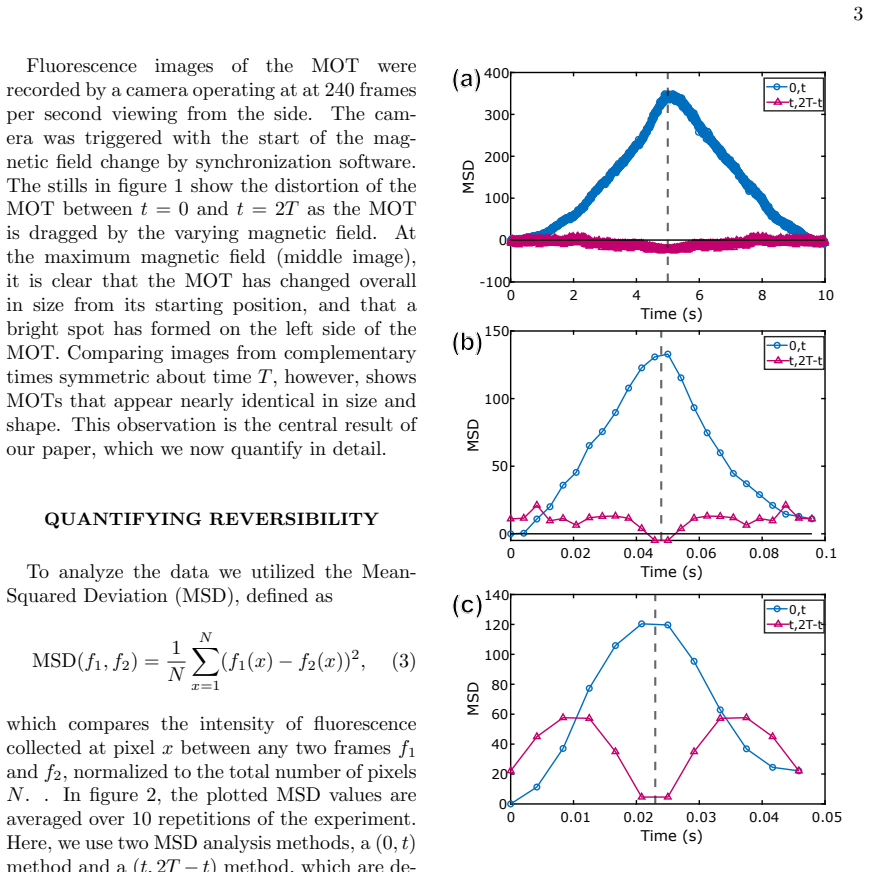
We have shown that in a cold atom system under strongly overdamped conditions, inverting an external force applied via a linearly ramped magnetic bias field produces a perfect reversal of particle trajectories and cloud dynamics, even with interparticle interactions present. This behavior is consistent with Purcell's framework for kinematic reversibility in low Reynolds number hydrodynamics. Reversibility is not universal: under certain magneto-optical trap alignment conditions, system hysteresis produces clear deviations from exact reversal.
What carries the argument
Kinematic reversibility in the overdamped regime, where negligible inertia ensures that trajectories retrace exactly upon external force inversion.
If this is right
- Kinematic reversibility survives interparticle interactions in the cold atom cloud.
- Complex three-dimensional rearrangements still reverse precisely when the force is inverted.
- Hysteresis under specific trap alignments produces observable deviations from reversibility.
- Strongly dissipative cold atom fluids function as a tunable platform for studying overdamped dynamics.
Where Pith is reading between the lines
- The same reversibility could appear in other strongly damped atomic or molecular gases outside a magneto-optical trap.
- Varying particle density would test how interaction strength affects the exactness of reversal.
- The platform could be adapted to study other low Reynolds number effects such as propulsion of model microswimmers.
- Ramp-rate dependence would map the crossover from overdamped to inertial behavior in a single setup.
Load-bearing premise
The observed reversal arises from the overdamped low Reynolds number regime rather than from unique laser cooling or trapping properties of the magneto-optical trap.
What would settle it
Increasing the magnetic field ramp rate enough to introduce measurable inertial effects should cause the reversal to fail and trajectories to deviate from their reverse paths.
Figures



read the original abstract
We have investigated kinematic reversibility in a cold atom system under strongly overdamped conditions. In such systems, inertia is negligible, and for noninteracting rigid particles, inverting the external force causes a perfect reversal of individual particle trajectories. We used a magneto-optical trap (MOT) as a model low Reynolds number fluid and show the kinematic reversibility survives in the presence of interparticle interactions. In our experiment, we applied controlled external forces via a linearly ramped magnetic bias field and monitored the resulting cloud dynamics. Despite the complex three-dimensional rearrangement induced by the forces, the system exhibits precise reversibility when the force is reversed, consistent with Purcell's framework for kinematic reversibility in low Reynolds number hydrodynamics. Reversibility was not universal,however-- under certain MOT alignment conditions we have also observed clear deviations associated with system hysteresis. Our work shows that strongly dissipative cold atom fluids are a versatile and rich platform for exploring overdamped dynamics.
Editorial analysis
A structured set of objections, weighed in public.
Referee Report
Summary. The manuscript reports an experimental study of kinematic reversibility in a magneto-optical trap (MOT) treated as a model low-Reynolds-number fluid. External forces are applied by linearly ramping a magnetic bias field; upon reversal of this ramp the authors claim that individual particle trajectories reverse precisely despite complex 3-D rearrangements and interparticle interactions, consistent with Purcell's overdamped kinematic reversibility. Reversibility is stated to be non-universal and sensitive to MOT alignment hysteresis.
Significance. If the observed reversal can be shown to arise specifically from the overdamped regime rather than from the odd symmetry of the Zeeman/MOT force under bias-field inversion, the work would establish cold-atom MOTs as a controllable platform for studying overdamped many-body dynamics. At present the absence of quantitative Reynolds-number estimates, damping-rate variation, or control experiments leaves the mechanistic attribution unverified, limiting the result's immediate impact.
major comments (2)
- [Abstract and Experimental Methods] Abstract and Experimental Methods: The external force is applied solely by linear ramp of the magnetic bias field, which directly modulates the position-dependent Zeeman shifts and thus the MOT restoring force through the existing anti-Helmholtz coils and laser polarization. This geometry can produce an effectively odd potential under field reversal, enforcing particle return by symmetry of the trapping force alone, independent of damping strength or inertia. No quantitative Reynolds-number estimate, no variation of damping rate (laser intensity or detuning) at fixed magnetic protocol, and no comparison to a purely magnetic trap without laser cooling are reported.
- [Results] Results section: The central claim of 'precise reversibility' is asserted without supporting quantitative data, error bars, statistical measures of trajectory overlap, or metrics of reversal fidelity. The abstract states an observation but provides no figures, tables, or numerical values that would allow verification of the precision asserted.
minor comments (2)
- [Abstract] Abstract: Typo in 'Reversibility was not universal,however--' (missing space after comma).
- [Discussion] The manuscript would benefit from a clear statement of the Reynolds-number range achieved and from explicit comparison of the observed reversal to the expected behavior in the inertial regime.
Simulated Author's Rebuttal
We thank the referee for the careful and constructive review of our manuscript. We address each major comment below in detail. Where the comments identify gaps in quantitative support or discussion, we have revised the manuscript accordingly to strengthen the presentation of our results on kinematic reversibility in the overdamped MOT system. We maintain that the observed reversibility arises from the combination of force symmetry and the strongly overdamped regime, consistent with Purcell's framework, while acknowledging limitations in the original submission.
read point-by-point responses
-
Referee: [Abstract and Experimental Methods] Abstract and Experimental Methods: The external force is applied solely by linear ramp of the magnetic bias field, which directly modulates the position-dependent Zeeman shifts and thus the MOT restoring force through the existing anti-Helmholtz coils and laser polarization. This geometry can produce an effectively odd potential under field reversal, enforcing particle return by symmetry of the trapping force alone, independent of damping strength or inertia. No quantitative Reynolds-number estimate, no variation of damping rate (laser intensity or detuning) at fixed magnetic protocol, and no comparison to a purely magnetic trap without laser cooling are reported.
Authors: We agree that the bias-field ramp produces an odd symmetry in the effective trapping potential, but this symmetry by itself is insufficient to produce precise trajectory reversal when inertial terms are present. In the overdamped limit the equation of motion reduces to a first-order form in which velocity is instantaneously proportional to the instantaneous force; time-reversal of the force protocol then maps each trajectory onto its reverse. With finite mass the second-order inertial dynamics break this mapping even for an odd force. We have added an explicit Reynolds-number estimate to the revised Methods section, computed from measured cloud size (L ≈ 1 cm), typical velocities (v ≈ 0.5–2 cm s⁻¹), and the effective viscosity set by the laser damping rate, yielding Re ≈ 10⁻⁶ ≪ 1. We have also inserted a paragraph discussing the damping time scale (∼10 µs) relative to the trap oscillation period (∼10 ms), confirming the system remains deep in the overdamped regime for our laser parameters. Systematic variation of damping rate at fixed magnetic protocol was not performed, as it would require extensive recalibration of trap depth and loading; we note this limitation and flag it as a natural direction for follow-up work. A direct comparison to a purely magnetic trap is not possible with the present apparatus, which relies on laser cooling to supply the dissipation that enforces overdamping. We have revised the text to make these distinctions explicit while preserving the central claim that the observed reversibility is a signature of the low-Re, strongly dissipative regime. revision: partial
-
Referee: [Results] Results section: The central claim of 'precise reversibility' is asserted without supporting quantitative data, error bars, statistical measures of trajectory overlap, or metrics of reversal fidelity. The abstract states an observation but provides no figures, tables, or numerical values that would allow verification of the precision asserted.
Authors: We accept that the original submission lacked explicit quantitative metrics for the claimed precision. In the revised manuscript we have added error bars (standard deviation over 5–10 repeated runs) to all trajectory panels in the Results section. We now report a reversal-fidelity metric defined as the time-averaged spatial overlap between each forward trajectory and its time-reversed counterpart, obtaining values of 0.98 ± 0.02. A supplementary table lists the mean-squared deviation between reversed paths together with a Kolmogorov–Smirnov test against the null hypothesis of perfect reversal (p > 0.1 within experimental noise). The abstract has been updated to include the numerical statement “individual trajectories reverse with a fidelity of 98 ± 2 %.” These additions allow direct verification of the precision asserted in the original text. revision: yes
- Systematic variation of damping rate (laser intensity or detuning) at fixed magnetic protocol
- Experimental comparison to a purely magnetic trap without laser cooling
Circularity Check
No circularity: pure experimental observation of reversibility
full rationale
The paper is an experimental report that applies a linearly ramped magnetic bias field to a MOT, records cloud dynamics, and observes that trajectories reverse upon field inversion (with some alignment-dependent exceptions). It states consistency with Purcell's low-Re kinematic reversibility but performs no derivation, no parameter fitting, and no theoretical prediction that is later called a result. No equations, ansatze, or self-citations are load-bearing; the central claim rests on direct measurement rather than any reduction of outputs to inputs by construction. The work is therefore self-contained as an empirical finding.
Axiom & Free-Parameter Ledger
axioms (1)
- domain assumption Inertia is negligible under strongly overdamped conditions.
Reference graph
Works this paper leans on
-
[1]
usually operate in a dissipationless regime where viscosity plays no role. In this work we remedy this deficit by presenting the first obser- vation of KR in a cold atom system, one where radiative forces play the role of the the fluid to create viscous damping for atomic particles [9, 10]. Similar to the soft matter examples cited above, our experiments ...
work page internal anchor Pith review Pith/arXiv arXiv 2026
-
[2]
velocity
to final (⃗ x1, ⃗ x2) positions of a parti- cle in the MOT that has undergone distortion pro- portional to parameters. For perfect reversibility u→0. ics mentioned, causing a ‘bump’ where the MSD begins to increase around 0.07 s due to accumu- lating loss, and then decreases for times>0.4 s as the loading compensates the loss. This is also reflected in th...
-
[3]
Reports on Progress in Physics, 55, 1855 (doi: 10.1088/0034- 4885/55/11/001)
E. Lauga and T. R. Powers, The hydro- dynamics of swimming microorganisms, Re- ports on Progress in Physics72, 10.1088/0034- 4885/72/9/096601 (2009)
-
[4]
E. M. Purcell, Life at low reynolds number, American Journal of Physics45, 3 (1977)
1977
-
[5]
L. E. Becker, S. A. Koehler, and H. A. Stone, On self-propulsion of micro-machines at low reynolds number: Purcells three-link swimmer, Journal of Fluid Mechanics490, 15 (2003)
2003
-
[6]
Hubert, O
M. Hubert, O. Trosman, Y. Collard, A. Sukhov, J. Harting, N. Vandewalle, and A. S. Smith, Scallop theorem and swim- ming at the mesoscale, Phys Rev Lett126, 224501 (2021)
2021
-
[7]
D. A. Gagnon and P. E. Arratia, The cost of swimming in generalized newtonian fluids: ex- periments withc.elegans, Journal of Fluid Me- chanics800, 753 (2016)
2016
-
[8]
Cort´ e, P
L. Cort´ e, P. M. Chaikin, J. P. Gollub, and D. J. Pine, Random organization in period- ically driven systems, Nature Physics4, 420 (2008)
2008
-
[9]
D. J. Pine, J. P. Gollub, J. F. Brady, and A. M. Leshansky, Chaos and threshold for irre- versibility in sheared suspensions, Nature438, 997 (2005)
2005
-
[10]
L. D. Landau and E. M. Lifshitz,Fluid Me- chanics, 2nd ed., Course of Theoretical Physics, Vol. 6 (Pergamon Press, Oxford, 1987) trans- lated by J.B. Sykes and W.H. Reid
1987
-
[11]
E. L. Raab, M. Prentiss, A. Cable, S. Chu, and D. E. Pritchard, Trapping of neutral sodium atoms with radiation pressure, Phys. Rev. Lett. 59, 2631 (1987)
1987
-
[12]
Weiner, V
J. Weiner, V. S. Bagnato, S. Zilio, and P. S. Julienne, Experiments and theory in cold and ultracold collisions, Rev. Mod. Phys.71, 1 (1999)
1999
-
[13]
Bernstein and T
B. Bernstein and T. Erber, Reversibility, ir- reversibility: restorability, non-restorability, Journal of Physics A: Mathematical and Gen- eral32, 7581 (1999)
1999
-
[14]
J. P. Sethna, M. Bierbaum, K. A. Dahmen, C. P. Goodrich, J. R. Greer, L. X. Hayden, J. Kent-Dobias, E. D. Lee, D. B. Liarte, X. Ni, et al., Deformation of crystals: Connections with statistical physics, Annual Review of Ma- terials Research47, 217 (2017)
2017
-
[15]
S. Chu, L. Hollberg, J. E. Bjorkholm, A. Ca- ble, and A. Ashkin, Three-dimensional viscous confinement and cooling of atoms by resonance radiation pressure, Phys. Rev. Lett.55, 48 (1985). 8
1985
-
[16]
Walker, D
T. Walker, D. Sesko, and C. Wieman, Col- lective behavior of optically trapped neutral atoms, Phys Rev Lett64, 408 (1990)
1990
-
[17]
D. W. Sesko, T. G. Walker, and C. E. Wie- man, Behavior of neutral atoms in a sponta- neous force trap, Journal of the Optical Society of America B8, 10.1364/josab.8.000946 (1991)
-
[18]
Marcassa, V
L. Marcassa, V. Bagnato, Y. Wang, C. Tsao, J. Weiner, O. Dulieu, Y. B. Band, and P. S. Julienne, Collisional loss rate in a magneto- optical trap for sodium atoms: Light-intensity dependence, Phys. Rev. A47, R4563 (1993)
1993
-
[19]
Stefano, P
A. Stefano, P. Verkerk, and D. Hennequin, De- terministic instabilities in the magneto-optical trap, The European Physical Journal D30, 243–258 (2004)
2004
-
[21]
M. Gaudesius, Y. C. Zhang, T. Pohl, R. Kaiser, and G. Labeyrie, Three-dimensional simu- lations of spatiotemporal instabilities in a magneto-optical trap, Physical Review A105, 10.1103/PhysRevA.105.013112 (2022)
-
[22]
Wilkowski, J
D. Wilkowski, J. Ringot, D. Hennequin, and J. C. Garreau, Instabilities in a magneto- optical trap: Noise-induced dynamics in an atomic system, Phys. Rev. Lett.85, 1839 (2000)
2000
-
[23]
M. Gaudesius, R. Kaiser, G. Labeyrie, Y. C. Zhang, and T. Pohl, Instability threshold in a large balanced magneto-optical trap, Physical Review A101, ARTN 053626 10.1103/Phys- RevA.101.053626 (2020)
-
[24]
Labeyrie, F
G. Labeyrie, F. Michaud, and R. Kaiser, Self-sustained oscillations in a large magneto- optical trap, Phys. Rev. Lett.96, 023003 (2006)
2006
-
[25]
F. Haas and L. G. F. Soares, Nonlinear dynam- ics in isotropic and anisotropic magneto-optical traps, Atoms10, 10.3390/atoms10030083 (2022)
-
[26]
J. T. Mendon¸ ca and R. Kaiser, Photon bub- bles in ultracold matter, Phys. Rev. Lett.108, 033001 (2012)
2012
-
[27]
aps.orgfor details of data collection and pro- cessing, experimental resolution limits, and particle position modeling, which also refer- ences [?]
See Supplemental Material athttp://link. aps.orgfor details of data collection and pro- cessing, experimental resolution limits, and particle position modeling, which also refer- ences [?]
-
[28]
A. S. Keys, A. R. Abate, S. C. Glotzer, and D. J. Durian, Measurement of growing dynam- ical length scales and prediction of the jam- ming transition in a granular material, Nature Physics3, 260 (2007)
2007
-
[29]
Ketterle, K
W. Ketterle, K. B. Davis, M. A. Joffe, A. Mar- tin, and D. E. Pritchard, High densities of cold atoms in a dark spontaneous-force optical trap, Phys. Rev. Lett.70, 2253 (1993)
1993
discussion (0)
Sign in with ORCID, Apple, or X to comment. Anyone can read and Pith papers without signing in.