Recognition: unknown
On metric properties of self-affine polygonal dendrites
Pith reviewed 2026-05-08 17:30 UTC · model grok-4.3
The pith
For self-affine dendrites generated by polygonal systems, the diameter of any connecting Jordan arc is bounded by C times the endpoint distance to the power λ for some λ in (0,1).
A machine-rendered reading of the paper's core claim, the machinery that carries it, and where it could break.
Core claim
The central result is that for any self-affine dendrite K generated by a polygonal system, there exist constants C > 0 and λ ∈ (0,1) such that for any x, y in K, if γ is the Jordan arc in K with endpoints x and y, then diam(γ) ≤ C |x-y|^λ.
What carries the argument
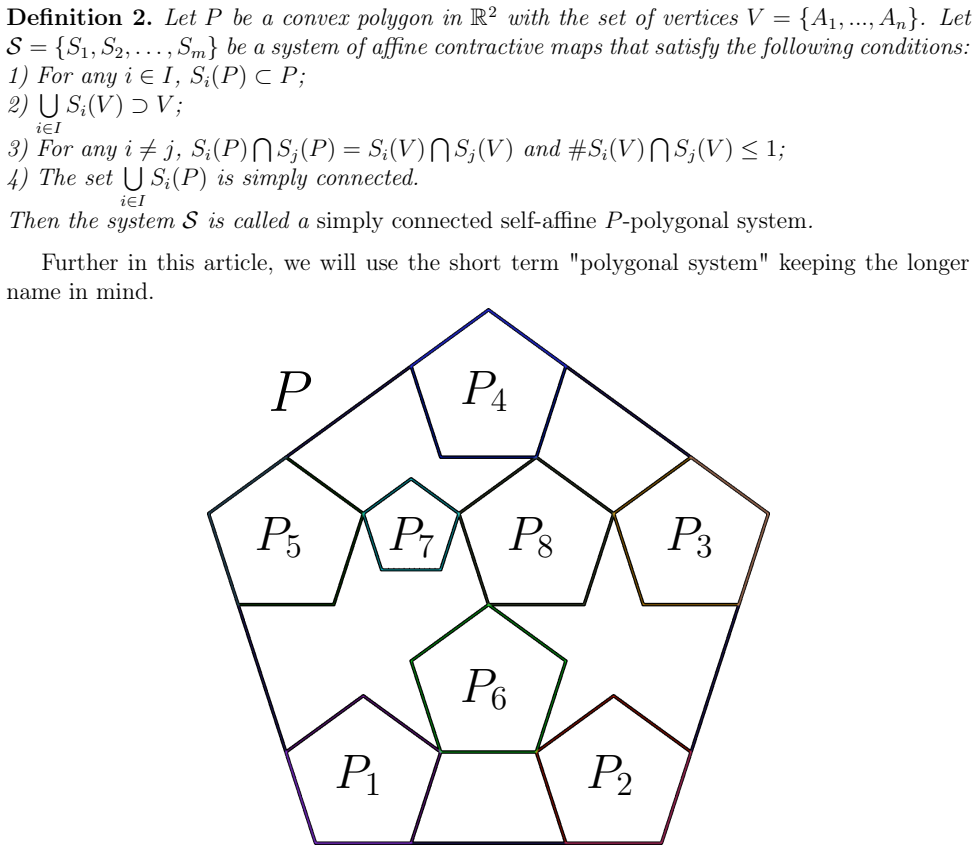
A polygonal system, which is an iterated function system of affine maps producing a dendrite whose structure allows control over arc diameters.
Load-bearing premise
The self-affine dendrite must be generated by a polygonal system of affine maps that preserve polygonal structure and yield a cycle-free connected attractor.
What would settle it
Identify a self-affine dendrite from a polygonal system together with points x and y where diam(γ) exceeds C |x-y|^λ for every choice of C and λ in (0,1).
Figures

read the original abstract
We prove that for any self-affine dendrite K generated by a polygonal system, there are constants C>0 and $\lambda\in(0, 1)$ such that for any x, y in K, the Jordan arc $\gamma$ in K with endpoints x, y satisfies the inequality $diam({\gamma})\le C |x-y|^\lambda$.
Editorial analysis
A structured set of objections, weighed in public.
Referee Report
Summary. The manuscript proves that any self-affine dendrite K arising from a polygonal iterated function system admits constants C>0 and λ∈(0,1) such that diam(γ)≤C|x−y|^λ for the unique Jordan arc γ connecting arbitrary x,y∈K. The argument constructs λ from the supremum of the operator norms of the linear parts of the IFS maps and proceeds by induction on the levels of the IFS, using the polygonal assumption to ensure that connecting arcs remain inside the convex hull of a single cylinder at each scale.
Significance. If correct, the result supplies a uniform Hölder bound on arc diameters that is derived directly from the IFS data (via the operator-norm supremum) without additional fitting parameters. This is a useful metric regularity statement for self-affine dendrites and could support subsequent work on their Hausdorff measures or quasi-symmetric embeddings. The inductive control via convex hulls and the explicit construction of λ are clear strengths of the approach.
minor comments (2)
- [§2] The precise statement of the polygonal IFS assumption (that the images of the initial polygon under the affine maps remain polygons whose edges align in a way that prevents arc escape) would benefit from a short formal definition in §2 before the induction begins.
- [§3] In the induction step, the passage from level n to n+1 could include one additional sentence clarifying why the polygonal structure rules out arcs that traverse multiple cylinders at the same scale.
Simulated Author's Rebuttal
We thank the referee for their positive assessment of the manuscript, including the recognition that the result provides a uniform Hölder bound on arc diameters derived directly from the IFS data. We appreciate the recommendation to accept.
Circularity Check
No significant circularity; derivation is self-contained
full rationale
The central result is an existence proof for constants C and λ satisfying the arc-diameter bound in any self-affine polygonal dendrite. λ is constructed explicitly as a function of the supremum of the operator norms of the linear parts of the IFS maps, and the bound is obtained by induction on cylinder levels, using the polygonal structure to guarantee that connecting arcs remain inside the convex hull of a single level-n set. No equation or step equates the target inequality to a fitted quantity, renames an input, or reduces the claim to a self-citation whose content is unverified; the geometric estimates at each scale are independent of the final statement.
Axiom & Free-Parameter Ledger
axioms (1)
- domain assumption A self-affine dendrite generated by a polygonal system is a compact connected locally connected set without cycles, obtained as the attractor of an IFS consisting of affine contractions that map a polygon into sub-polygons.
Reference graph
Works this paper leans on
-
[1]
Allabergenova,K., Samuel,M., Tetenov,A.(2024). Intersections of the pieces of self-similar den- dritesinthe plane,Chaos, Solitons and Fractals182:114805https://doi.org/10.1016/j.chaos. 2024.114805
-
[2]
Aseev, V.V., Tetenov, A.V., Kravchenko, A.S. (2003). On Self-similar Jordan Curves on the Plane. Siberian Mathematical Journal44: 379–386 .https://doi.org/10.1023/A:10238483278984
-
[3]
Hata, M. (1985). On the structure of self-similar sets.Japan Journal of Applied Mathematics2(2): 381–414.https://doi.org/10.1007/bf03167083
-
[4]
Hutchinson, J. (1981). Fractals and Self-Similarity.Indiana University Mathematics Journal 30(5): 713–747.https://doi.org/10.1512/iumj.1981.30.300552
-
[6]
Samuel M., Tetenov A., Vaulin D. (2017). Self-Similar Dendrites Generated by Polygonal Systems in the Plane.Siberian Electronic Mathematical Reports14: 737–751.https://doi.org/10.17377/ semi.2017.14.0631, 2, 3, 4
2017
-
[7]
Tetenov, A., Yudin, I., Kadirova, M. (2025). Finiteness properties for self-similar continua.Dis- crete and Continuous Dynamical Systems – Series S.2025057: 1–13.https://doi.org/10.3934/ dcdss.20250572
2025
-
[8]
V¨ ais¨ al¨ a, J.(1991) Bounded turning and quasiconformal maps.Monatshefte f¨ ur Mathematik111: 233–244https://doi.org/10.1007/BF012942691, 4
-
[9]
Wen, Zhi-Ying, and Li-Feng Xi. (2003). Relations among Whitney sets, self-similar arcs and quasi- arcs.Israel Journal of Mathematics136.1: 251–267.https://doi.org/10.1007/BF028072004 7
discussion (0)
Sign in with ORCID, Apple, or X to comment. Anyone can read and Pith papers without signing in.