Recognition: unknown
Aerosol memory in stratocumulus clouds leads to noise-induced patterns and non-ergodic sampling
Pith reviewed 2026-05-07 03:37 UTC · model grok-4.3
The pith
Aerosol memory in stratocumulus clouds produces noise-induced patterns and prevents ergodic satellite sampling.
A machine-rendered reading of the paper's core claim, the machinery that carries it, and where it could break.
Core claim
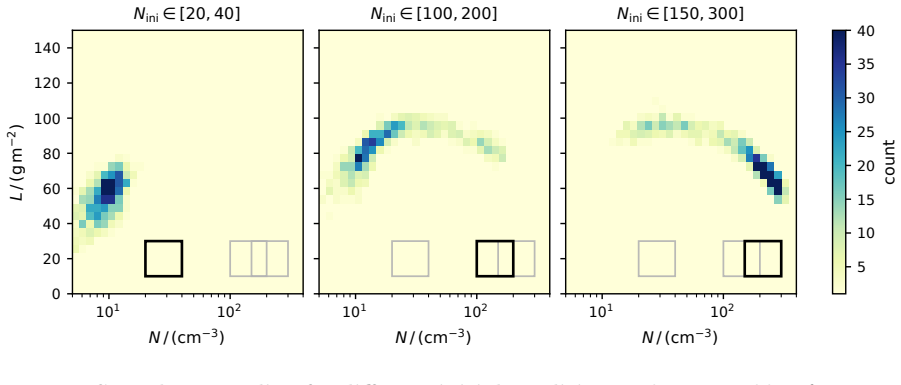
Stratocumulus cloud decks exhibit bistability between patterns of high (closed cells) and low (open cells) cloud fraction. Localized transitions between these two states result from noise-induced transitions in a data-driven and physics-informed stochastic dynamical system with time-dependent parameters. Comparable timescales for these transitions, mesoscale self-organization into patterns, and the evolution of large-scale parameters correspond to an aerosol memory in cloud evolution. This memory means that the sampling of stratocumulus states by polar-orbiting satellites lacks the encoding of process information that would be present for an asymptotic and ergodic sampling.
What carries the argument
A data-driven and physics-informed stochastic dynamical system with time-dependent parameters that produces noise-induced transitions between bistable high- and low-cloud-fraction states.
If this is right
- Pockets of open cells form through noise-induced transitions between closed and open cell states.
- Aerosol memory arises because transition, mesoscale organization, and large-scale parameter timescales are comparable.
- Satellite sampling of stratocumulus states is non-ergodic and therefore misses information about the underlying processes.
- Large-scale parameters such as aerosol levels influence pattern formation on the same timescales as the patterns themselves.
Where Pith is reading between the lines
- Climate models that assume timescale separation between aerosol changes and cloud organization may underestimate memory effects in stratocumulus decks.
- Continuous time series from geostationary satellites could test whether real cloud fields exhibit the non-ergodic behavior predicted by the model.
- Short-lived aerosol perturbations could leave lasting imprints on the spatial organization of entire cloud decks.
Load-bearing premise
The data-driven stochastic dynamical system with time-dependent parameters faithfully represents real aerosol-cloud interactions and noise-induced transitions are the main cause of observed pockets of open cells.
What would settle it
Observations that demonstrate a clear separation between the timescale of aerosol changes and the timescale of cloud-pattern transitions, or that show pockets of open cells forming through deterministic forcing rather than random noise.
Figures


read the original abstract
Stratocumulus cloud decks exhibit bistability between patterns of high (closed cells) and low (open cells) cloud fraction. Localized transitions between these two states (pockets of open cells) have been observed but their underlying mechanism remains unclear. We model stratocumulus and their interaction with atmospheric aerosol as a data-driven and physics-informed stochastic dynamical system with time-dependent parameters. This allows us to show that pockets of open cells result from noise-induced transitions between the stratocumulus patterns. We find comparable timescales for these transitions, mesoscale self-organization into patterns and the evolution of large-scale parameters. This lack of timescale separation corresponds to an aerosol memory in cloud evolution and means that the sampling of stratocumulus states by polar-orbiting satellites lacks the encoding of process information that would be present for an asymptotic and ergodic sampling.
Editorial analysis
A structured set of objections, weighed in public.
Referee Report
Summary. The manuscript constructs a data-driven physics-informed stochastic dynamical system with time-dependent parameters to represent stratocumulus cloud bistability between closed-cell and open-cell patterns and their interaction with atmospheric aerosols. It concludes that observed pockets of open cells arise via noise-induced transitions, that the timescales for these transitions, mesoscale self-organization, and large-scale parameter evolution are comparable (implying an 'aerosol memory'), and that this lack of timescale separation renders sampling of stratocumulus states by polar-orbiting satellites non-ergodic.
Significance. If the stochastic model is shown to reproduce observed bistability and transitions as emergent features with independent validation, the work would supply a mechanistic stochastic explanation for cloud pattern formation and memory effects, with direct implications for interpreting satellite observations of aerosol-cloud interactions and for assessing ergodicity assumptions in climate data analysis.
major comments (2)
- [Model construction and results sections] The central claim that pockets of open cells result from noise-induced transitions and that timescales are comparable (leading to aerosol memory and non-ergodic sampling) rests on the fidelity of the fitted stochastic model. However, the manuscript provides no details on the training datasets (satellite scenes or in-situ measurements), the regularization or fitting procedure for time-dependent parameters, or quantitative out-of-sample validation metrics (e.g., reproduction of held-out transition statistics or bistability). Without these, it is impossible to determine whether the reported timescale overlap is an independent prediction or an artifact of the data-driven construction.
- [Discussion and conclusions] The interpretation that the lack of timescale separation corresponds to 'aerosol memory' and non-ergodic satellite sampling assumes that the stochastic dynamics with time-dependent parameters faithfully capture real aerosol-cloud interactions and that noise-induced transitions dominate over other mechanisms. The manuscript does not report independent tests (e.g., comparison against in-situ aerosol measurements or alternative deterministic models) to rule out circularity between the fitting data and the timescale analysis.
minor comments (2)
- [Abstract and Methods] The abstract states the model is 'data-driven and physics-informed' but supplies no equations, parameter estimation details, or validation metrics; the full manuscript should include these in a dedicated methods subsection with explicit SDEs and fitting equations.
- [Model description] Notation for the time-dependent parameters and noise terms should be clarified with a table of symbols and their physical meanings to aid reproducibility.
Simulated Author's Rebuttal
We thank the referee for their careful reading and constructive comments, which highlight important aspects of model transparency and validation. We agree that additional details on data sources, fitting procedures, and validation metrics will strengthen the manuscript. We respond point-by-point to the major comments below and will incorporate clarifications and new material in a revised version.
read point-by-point responses
-
Referee: [Model construction and results sections] The central claim that pockets of open cells result from noise-induced transitions and that timescales are comparable (leading to aerosol memory and non-ergodic sampling) rests on the fidelity of the fitted stochastic model. However, the manuscript provides no details on the training datasets (satellite scenes or in-situ measurements), the regularization or fitting procedure for time-dependent parameters, or quantitative out-of-sample validation metrics (e.g., reproduction of held-out transition statistics or bistability). Without these, it is impossible to determine whether the reported timescale overlap is an independent prediction or an artifact of the data-driven construction.
Authors: We appreciate this observation and acknowledge that the original manuscript could have been clearer on these points. The training data consist of MODIS satellite scenes of stratocumulus fields over the southeast Pacific, with time series of cloud fraction and aerosol optical depth extracted from identified closed- and open-cell regions. The stochastic model is a physics-informed SDE whose drift and diffusion terms incorporate known aerosol-cloud mechanisms; time-dependent parameters are fitted via a regularized maximum-likelihood procedure that penalizes rapid parameter changes to reflect physical timescales. Out-of-sample validation was performed via temporal cross-validation on held-out scenes, confirming reproduction of transition frequencies. To fully address the concern, the revised manuscript will add an explicit Methods subsection describing the exact dataset, regularization scheme, and quantitative metrics (including held-out transition statistics and bistability persistence times). These additions will demonstrate that the comparable timescales emerge from the fitted dynamics rather than being imposed by construction. revision: yes
-
Referee: [Discussion and conclusions] The interpretation that the lack of timescale separation corresponds to 'aerosol memory' and non-ergodic satellite sampling assumes that the stochastic dynamics with time-dependent parameters faithfully capture real aerosol-cloud interactions and that noise-induced transitions dominate over other mechanisms. The manuscript does not report independent tests (e.g., comparison against in-situ aerosol measurements or alternative deterministic models) to rule out circularity between the fitting data and the timescale analysis.
Authors: We agree that ruling out circularity requires explicit checks. The model is constrained by physical aerosol-cloud interaction terms (e.g., aerosol-induced suppression of precipitation), and the time-dependent parameters evolve according to large-scale advection and source/sink processes rather than being freely fitted without physical bounds. Nevertheless, we did not include direct comparisons to in-situ aerosol profiles or side-by-side tests against purely deterministic mean-field models in the submitted version. In the revision we will add (i) a comparison showing that a deterministic counterpart without stochastic forcing fails to produce the observed pocket transitions and (ii) a limitations paragraph discussing the absence of in-situ aerosol validation and the reliance on satellite-derived proxies. These changes will clarify that the aerosol-memory interpretation is supported by the physics-informed structure and the necessity of noise, while honestly noting the scope limitations. revision: partial
Circularity Check
No significant circularity in derivation chain
full rationale
The abstract describes a data-driven stochastic model with time-dependent parameters used to show noise-induced transitions and comparable timescales, but provides no equations, fitting procedure details, or explicit reduction showing that reported timescales or the aerosol memory conclusion are constructed from the inputs by definition. No self-citations, uniqueness theorems, or ansatzes are referenced in the given text. The central claims are presented as emergent from the model rather than tautological renamings or fitted outputs relabeled as predictions. Without specific equations or sections exhibiting Eq. X = Eq. Y by construction, the derivation remains self-contained against external benchmarks for the purpose of this analysis.
Axiom & Free-Parameter Ledger
axioms (1)
- domain assumption Stratocumulus cloud decks can be modeled as a stochastic dynamical system whose parameters evolve in time.
Reference graph
Works this paper leans on
-
[1]
Bellouin, J
N. Bellouin, J. Quaas, E. Gryspeerdt, S. Kinne, P. Stier, D. Watson-Parris, O. Boucher, K. S. Carslaw, M. Christensen, A.-L. Daniau, J.-L. Dufresne, G. Feingold, S. Fiedler, P. Forster, A. Gettelman, J. M. Haywood, U. Lohmann, F. Malavelle, T. Mauritsen, D. T. McCoy, G. Myhre, J. M¨ ulmenst¨ adt, D. Neubauer, A. Possner, M. Rugenstein, Y. Sato, M. Schulz,...
2020
-
[2]
S. C. Sherwood, M. J. Webb, J. D. Annan, K. C. Armour, P. M. Forster, J. C. Harg- reaves, G. Hegerl, S. A. Klein, K. D. Marvel, E. J. Rohling, M. Watanabe, T. Andrews, P. Braconnot, C. S. Bretherton, G. L. Foster, Z. Hausfather, A. S. von der Heydt, R. Knutti, T. Mauritsen, J. R. Norris, C. Proistosescu, M. Rugenstein, G. A. Schmidt, K. B. Tokarska, and M...
2020
-
[3]
Stratocumulus Clouds.Monthly Weather Review, 140(8):2373–2423, 2012
Robert Wood. Stratocumulus Clouds.Monthly Weather Review, 140(8):2373–2423, 2012
2012
-
[4]
L’Ecuyer, Yun Hang, Alexander V
Tristan S. L’Ecuyer, Yun Hang, Alexander V. Matus, and Zhien Wang. Reassessing the Effect of Cloud Type on Earth’s Energy Balance in the Age of Active Spaceborne Obser- vations. Part I: Top of Atmosphere and Surface.Journal of Climate, 32(19):6197–6217, 2019
2019
-
[5]
Baker and Robert J
Marcia B. Baker and Robert J. Charlson. Bistability of CCN concentrations and thermo- dynamics in the cloud-topped boundary layer.Nature, 345(6271):142–145, 1990
1990
-
[6]
Ackerman, Christopher S
Bjorn Stevens, Chin-Hoh Moeng, Andrew S. Ackerman, Christopher S. Bretherton, An- dreas Chlond, Stephan de Roode, James Edwards, Jean-Christophe Golaz, Hongli Jiang, Marat Khairoutdinov, Michael P. Kirkpatrick, David C. Lewellen, Adrian Lock, Frank M¨ uller, David E. Stevens, Eoin Whelan, and Ping Zhu. Evaluation of Large-Eddy Sim- ulations via Observatio...
2005
-
[7]
Petters, Jefferson R
Markus D. Petters, Jefferson R. Snider, Bjorn Stevens, Gabor Vali, Ian Faloona, and Lynn M. Russell. Accumulation mode aerosol, pockets of open cells, and particle nucleation in the remote subtropical pacific marine boundary layer.Journal of Geophysical Research: Atmospheres, 111(D2), 2006
2006
-
[8]
Sharon, Bruce A
Tarah M. Sharon, Bruce A. Albrecht, Haflidi H. Jonsson, Patrick Minnis, Mandana M. Khaiyer, Timothy M. Van Reken, John Seinfeld, and Rick Flagan. Aerosol and Cloud Microphysical Characteristics of Rifts and Gradients in Maritime Stratocumulus Clouds. Journal of the Atmospheric Sciences, 63(3):983–997, 2006
2006
-
[9]
The Structure and Mesoscale Organization of Pre- cipitating Stratocumulus.Journal of the Atmospheric Sciences, 65(5):1587–1605, 2008
Verica Savic-Jovcic and Bjorn Stevens. The Structure and Mesoscale Organization of Pre- cipitating Stratocumulus.Journal of the Atmospheric Sciences, 65(5):1587–1605, 2008
2008
-
[10]
Aerosol Effects on Clouds, Precipita- tion, and the Organization of Shallow Cumulus Convection.Journal of the Atmospheric Sciences, 65(2):392–406, 2008
Huiwen Xue, Graham Feingold, and Bjorn Stevens. Aerosol Effects on Clouds, Precipita- tion, and the Organization of Shallow Cumulus Convection.Journal of the Atmospheric Sciences, 65(2):392–406, 2008
2008
-
[11]
Kazil, H
J. Kazil, H. Wang, G. Feingold, A. D. Clarke, J. R. Snider, and A. R. Bandy. Modeling chemical and aerosol processes in the transition from closed to open cells during VOCALS- REx.Atmos. Chem. Phys., 11(15):7491–7514, 2011. 15
2011
-
[12]
R. Wood, C. S. Bretherton, D. Leon, A. D. Clarke, P. Zuidema, G. Allen, and H. Coe. An aircraft case study of the spatial transition from closed to open mesoscale cellular convection over the southeast pacific.Atmospheric Chemistry and Physics, 11(5):2341–2370, 2011
2011
-
[13]
A. H. Berner, C. S. Bretherton, R. Wood, and A. Muhlbauer. Marine boundary layer cloud regimes and POC formation in a CRM coupled to a bulk aerosol scheme.Atmos. Chem. Phys., 13:12549–12572, 2013
2013
-
[14]
Feingold, I
G. Feingold, I. Koren, T. Yamaguchi, and J. Kazil. On the reversibility of transi- tions between closed and open cellular convection.Atmospheric Chemistry and Physics, 15(13):7351–7367, 2015
2015
-
[15]
Stratocumulus to Cumulus Tran- sition by Drizzle.Journal of Advances in Modeling Earth Systems, 9(6):2333–2349, 2017
Takanobu Yamaguchi, Graham Feingold, and Jan Kazil. Stratocumulus to Cumulus Tran- sition by Drizzle.Journal of Advances in Modeling Earth Systems, 9(6):2333–2349, 2017
2017
-
[16]
Liq- uid Water Path Steady States in Stratocumulus: Insights from Process-Level Emulation and Mixed-Layer Theory.Journal of the Atmospheric Sciences, 77(6):2203–2215, 2020
Fabian Hoffmann, Franziska Glassmeier, Takanobu Yamaguchi, and Graham Feingold. Liq- uid Water Path Steady States in Stratocumulus: Insights from Process-Level Emulation and Mixed-Layer Theory.Journal of the Atmospheric Sciences, 77(6):2203–2215, 2020
2020
-
[17]
Hartmann
Robert Wood and Dennis L. Hartmann. Spatial Variability of Liquid Water Path in Ma- rine Low Cloud: The Importance of Mesoscale Cellular Convection.Journal of Climate, 19(9):1748–1764, 2006
2006
-
[18]
McCoy, Robert Wood, and Jennifer K
Isabel L. McCoy, Robert Wood, and Jennifer K. Fletcher. Identifying meteorological con- trols on open and closed mesoscale cellular convection associated with marine cold air outbreaks.Journal of Geophysical Research: Atmospheres, 122(21), 2017
2017
-
[19]
Murray-Watson
Edward Gryspeerdt, Franziska Glassmeier, Graham Feingold, Fabian Hoffmann, and Re- becca J. Murray-Watson. Observing short-timescale cloud development to constrain aerosol–cloud interactions.Atmospheric Chemistry and Physics, 22(17):11727–11738, 2022
2022
-
[20]
Muhlbauer, I
A. Muhlbauer, I. L. McCoy, and R. Wood. Climatology of stratocumulus cloud morpholo- gies: microphysical properties and radiative effects.Atmos. Chem. Phys., 14(13):6695– 6716, 2014
2014
-
[21]
Sutherland, Matt Christensen, Ryan Eastman, and Philip Stier
Duncan Watson-Parris, S. Sutherland, Matt Christensen, Ryan Eastman, and Philip Stier. A Large-Scale Analysis of Pockets of Open Cells and Their Radiative Impact.Geophysical Research Letters, 48, 2021
2021
-
[22]
C. S. Bretherton, T. Uttal, C. W. Fairall, R. A. Weller S. E. Yuter, D. Baumgardner, K. Comstock, R. Wood, and G. B. Raga. The EPIC 2001 stratocumulus study.B. Am. Meteorol. Soc., 85(7):967—978, 2004
2001
-
[23]
Smalley, Matthew D
Kevin M. Smalley, Matthew D. Lebsock, Ryan Eastman, Mark Smalley, and Mikael K. Witte. A Lagrangian analysis of pockets of open cells over the southeastern Pacific.At- mospheric Chemistry and Physics, 22(12):8197–8219, 2022
2022
-
[24]
Opinion: Inferring process from snapshots of cloud systems.Atmospheric Chemistry and Physics, 25(18):10869–10885, 2025
Graham Feingold, Franziska Glassmeier, Jianhao Zhang, and Fabian Hoffmann. Opinion: Inferring process from snapshots of cloud systems.Atmospheric Chemistry and Physics, 25(18):10869–10885, 2025
2025
-
[25]
Johnson, Takanobu Yamaguchi, Ken S
Franziska Glassmeier, Fabian Hoffmann, Jill S. Johnson, Takanobu Yamaguchi, Ken S. Carslaw, and Graham Feingold. Aerosol-cloud-climate cooling overestimated by ship-track data.Science, 371(6528):485–489, 2021. 16
2021
-
[26]
Glassmeier, F
F. Glassmeier, F. Hoffmann, J. S. Johnson, T. Yamaguchi, K. S. Carslaw, and G. Fein- gold. An emulator approach to stratocumulus susceptibility.Atmospheric Chemistry and Physics, 19(15):10191–10203, 2019
2019
-
[27]
Yao-Sheng Chen, Prasanth Prabhakaran, Fabian Hoffmann, Jan Kazil, Takanobu Yam- aguchi, and Graham Feingold. Magnitude and timescale of liquid water path adjustments to cloud droplet number concentration perturbations for nocturnal non-precipitating ma- rine stratocumulus.Atmospheric Chemistry and Physics, 25(12):6141–6159, 2025
2025
-
[28]
On the processes determin- ing the slope of cloud water adjustments in weakly and non-precipitating stratocumulus
Fabian Hoffmann, Yao-Sheng Chen, and Graham Feingold. On the processes determin- ing the slope of cloud water adjustments in weakly and non-precipitating stratocumulus. Atmospheric Chemistry and Physics, 25(15):8657–8670, 2025
2025
-
[29]
The impact of aerosol on cloud water: a heuristic perspective.Atmospheric Chemistry and Physics, 24(23):13403– 13412, 2024
Fabian Hoffmann, Franziska Glassmeier, and Graham Feingold. The impact of aerosol on cloud water: a heuristic perspective.Atmospheric Chemistry and Physics, 24(23):13403– 13412, 2024
2024
-
[30]
Freidlin and Alexander D
Mark I. Freidlin and Alexander D. Wentzell.Random Perturbations of Dynamical Sys- tems, volume 260 ofGrundlehren der mathematischen Wissenschaften. Springer, Berlin, Heidelberg, 2012
2012
-
[31]
Tipping points in open systems: bifurcation, noise-induced and rate-dependent examples in the climate system
Peter Ashwin, Sebastian Wieczorek, Renato Vitolo, and Peter Cox. Tipping points in open systems: bifurcation, noise-induced and rate-dependent examples in the climate system. Philosophical Transactions of the Royal Society A: Mathematical, Physical and Engineering Sciences, 370(1962):1166–1184, 2012
1962
-
[32]
Modeling Mesoscale Cellular Structures and Drizzle in Marine Stratocumulus
Hailong Wang and Graham Feingold. Modeling Mesoscale Cellular Structures and Drizzle in Marine Stratocumulus. Part I: Impact of Drizzle on the Formation and Evolution of Open Cells.Journal of the Atmospheric Sciences, 66(11):3237–3256, 2009
2009
-
[33]
Yamaguchi and G
T. Yamaguchi and G. Feingold. On the relationship between open cellular convective cloud patterns and the spatial distribution of precipitation.Atmospheric Chemistry and Physics, 15(3):1237–1251, 2015
2015
-
[34]
D. K. Lilly. Models of cloud-topped mixed layers under a strong inversion.Quarterly Journal of the Royal Meteorological Society, 94(401):292–309, 1968
1968
-
[35]
Schubert, Joseph S
Wayne H. Schubert, Joseph S. Wakefield, Ellen J. Steiner, and Stephen K. Cox. Marine Stratocumulus Convection. Part I: Governing Equations and Horizontally Homogeneous Solutions.Journal of the Atmospheric Sciences, 36(7):1286–1307, 1979
1979
-
[36]
Slow Manifolds and Multiple Equilibria in Stratocumulus-Capped Boundary Layers.Journal of Advances in Modeling Earth Systems, 2(4), 2010
Christopher S Bretherton, Junya Uchida, and Peter N Blossey. Slow Manifolds and Multiple Equilibria in Stratocumulus-Capped Boundary Layers.Journal of Advances in Modeling Earth Systems, 2(4), 2010
2010
-
[37]
Aerosol–cloud–precipitation system as a predator-prey problem.Proceedings of the National Academy of Sciences, 108(30):12227–12232, 2011
Ilan Koren and Graham Feingold. Aerosol–cloud–precipitation system as a predator-prey problem.Proceedings of the National Academy of Sciences, 108(30):12227–12232, 2011
2011
-
[38]
Paul D. L. Ritchie, Hassan Alkhayuon, Peter M. Cox, and Sebastian Wieczorek. Rate- induced tipping in natural and human systems.Earth System Dynamics, 14(3):669–683, 2023
2023
-
[39]
Hernandez, M
B. Hernandez, M. S. Singh, T. Yamaguchi, G. Feingold, and F. Glassmeier. The remarkable inefficiency of stratocumulus.EGUsphere, 2026
2026
-
[40]
Network approach to patterns in stratocumu- lus clouds.Proceedings of the National Academy of Sciences, 114(40):10578–10583, 2017
Franziska Glassmeier and Graham Feingold. Network approach to patterns in stratocumu- lus clouds.Proceedings of the National Academy of Sciences, 114(40):10578–10583, 2017. 17
2017
-
[41]
A. J. Illingworth, H. W. Barker, A. Beljaars, M. Ceccaldi, H. Chepfer, N. Clerbaux, J. Cole, J. Delano¨ e, C. Domenech, and D. P. Donovan et al. The EarthCARE satellite: The next step forward in global measurements of clouds, aerosols, precipitation, and radiation.Bull. Am. Meteorol. Soc., 96(8):1311–1332, 2015
2015
-
[42]
Joseph Xu Zhou, M. D. S. Aliyu, Erik Aurell, and Sui Huang. Quasi-potential landscape in complex multi-stable systems.Journal of The Royal Society Interface, 9(77):3539–3553, 2012
2012
-
[43]
Lukas Kikuchi, Rajesh Singh, M. E. Cates, and R. Adhikari. Ritz method for transition paths and quasipotentials of rare diffusive events.Physical Review Research, 2(3):033208, 2020
2020
-
[44]
Steven G. Johnson. The NLopt nonlinear-optimization package, 2007. 18
2007
discussion (0)
Sign in with ORCID, Apple, or X to comment. Anyone can read and Pith papers without signing in.