Recognition: unknown
Real and Complex Singlet-Scalar Benchmarks with a Vector-Like Down Quark for Bto X_sγ and B_s-bar B_s Mixing
Pith reviewed 2026-05-07 15:09 UTC · model grok-4.3
The pith
New physics from a vector-like down quark and singlet scalar shifts the B to Xs gamma coefficient by only 0.4 percent of the SM value.
A machine-rendered reading of the paper's core claim, the machinery that carries it, and where it could break.
Core claim
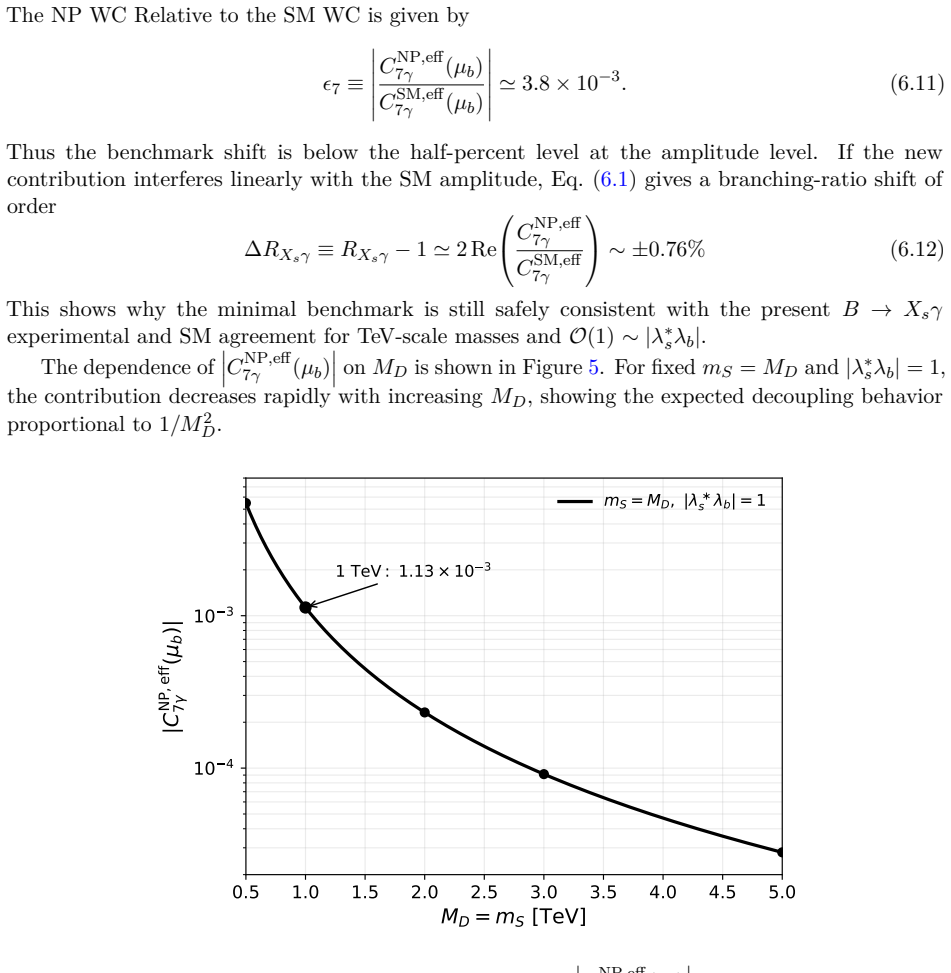
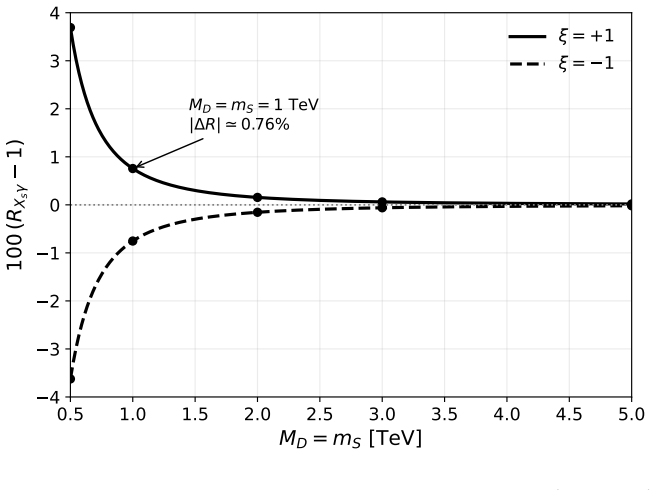
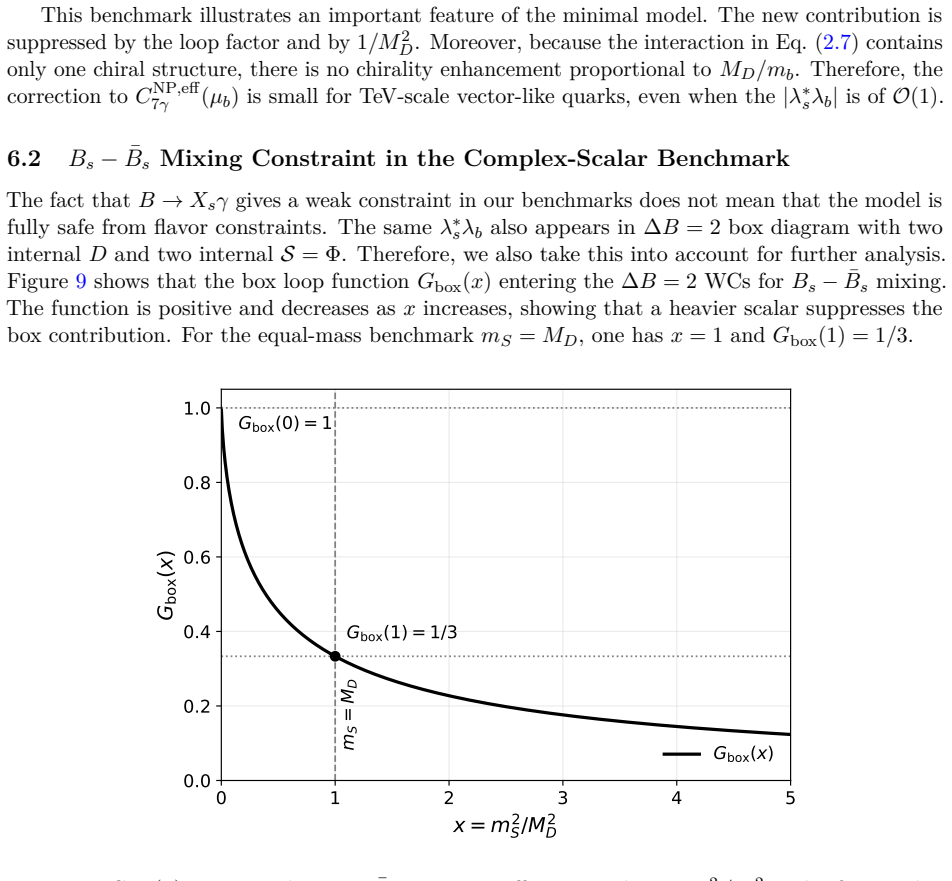
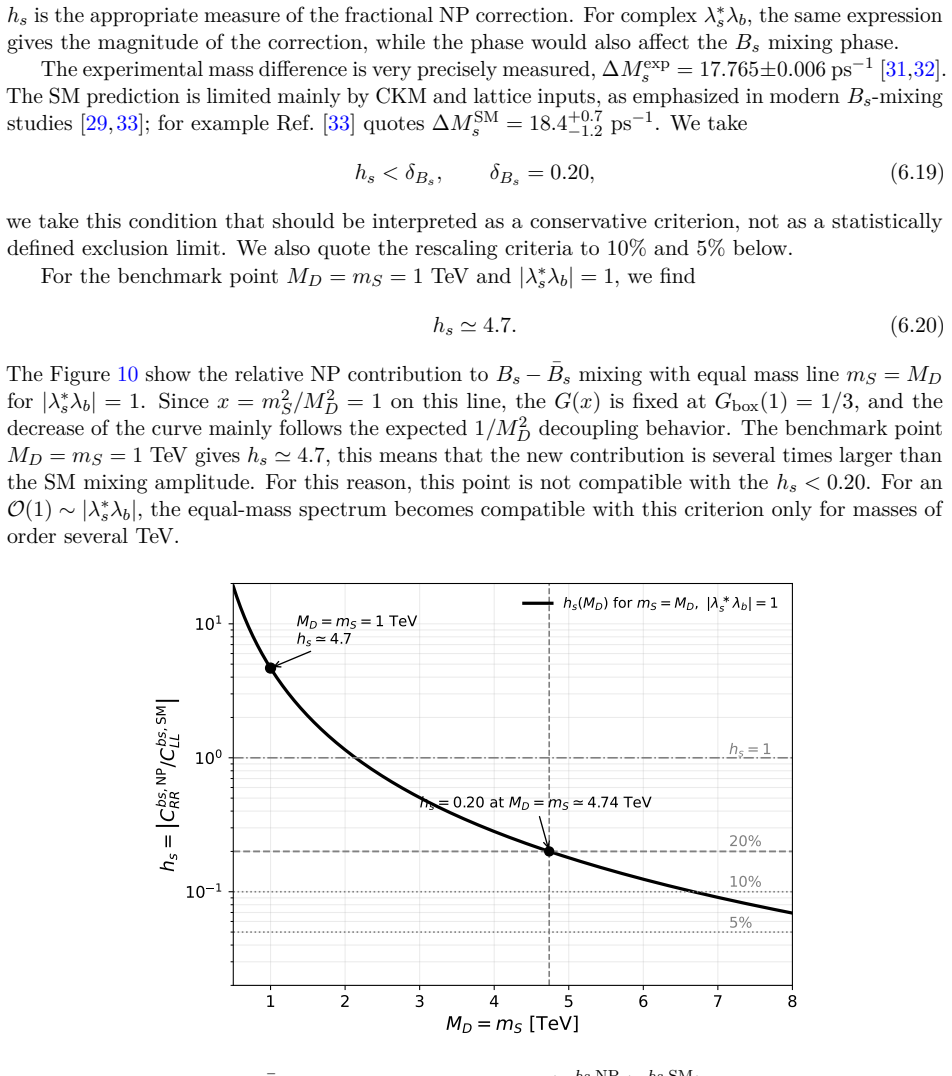
In these benchmarks the new-physics contribution to the dipole operator for b to s gamma is |C7 gamma NP,eff| approximately 1.1 times 10 to the minus 3, or 0.4 percent of the SM value, at 1 TeV masses with absolute value of lambda s star lambda b equal to 1; B s mixing is unaffected in the real scalar case due to exact cancellation of direct and crossed box diagrams but provides the dominant constraint in the complex scalar case, limiting the flavor coupling product to a few tenths.
What carries the argument
The one-loop diagram in which the neutral singlet scalar couples the vector-like quark D to a right-handed down quark, with the gauge boson radiated from the D line, which fixes the dipole operator ratio C7 gamma NP over C8G NP equal to minus one-third at the matching scale.
Load-bearing premise
The scalar carries neither electric charge nor color so the emitted gauge boson must come from the internal D line, together with the exact minimal limit in which direct and crossed box diagrams cancel for the real scalar.
What would settle it
A precision measurement of the B to Xs gamma branching ratio that deviates by more than one percent from the Standard Model prediction, or the absence of any constraint on the coupling product from Bs mixing data when the complex scalar mass is near 1 TeV.
Figures






read the original abstract
We study a simple extension of the Standard Model with a vector-like down-type quark $D$ and a neutral singlet scalar ${\cal S}=S_R,\Phi$. The scalar is considered in two forms, a real field $S_R=S_R^\dagger$ and a complex field $\Phi\neq\Phi^\dagger$. The interaction $-\lambda_i{\cal S}\bar D_L d_{Ri}+{\rm h.c.}$ generates the radiative transitions $b\to s\gamma$ and $b\to sg$ at one loop. Since ${\cal S}$ has no electric charge or color, the gauge boson is emitted from the internal $D$ line, giving $C_{7\gamma}^{\rm NP}/C_{8G}^{\rm NP}=Q_D=-1/3$ at the matching scale for $\Delta B=1$ dipole transitions. For $M_D=m_{\cal S}=1~{\rm TeV}$ and $|\lambda_s^\ast\lambda_b|=1$, the low scale contribution is $|C_{7\gamma}^{\rm NP,eff}(\mu_b)|\simeq 1.1\times10^{-3}$, This is about $0.4\%$ of the Standard Model value $|C_{7\gamma}^{\rm SM,eff}(\mu_b)|\simeq 0.30$. We also discuss \(B_s-\bar B_s\) mixing. In the real-scalar case, the direct and crossed box diagrams cancel in the exact minimal limit. In the complex-scalar case, the direct box contribution remains and gives a bound on the flavor $|\lambda_s^\ast\lambda_b|$ at the level of a few tenths for TeV-scale masses. Thus, in these minimal benchmarks, $B\to X_s\gamma$ is radiatively safe, while $B_s-\bar B_s$ mixing gives the stronger constraint in the complex-scalar $\Phi$ benchmark.
Editorial analysis
A structured set of objections, weighed in public.
Referee Report
Summary. The manuscript studies a minimal SM extension with a vector-like down-type quark D and a neutral singlet scalar (real S_R or complex Φ). The Yukawa interaction generates one-loop contributions to b→sγ and b→sg, with the gauge boson emitted from the internal D line due to the scalar's neutrality, fixing C_{7γ}^{NP}/C_{8G}^{NP} = Q_D = -1/3 at the matching scale. For the benchmark M_D = m_S = 1 TeV and |λ_s^* λ_b| = 1, the low-scale |C_{7γ}^{NP,eff}(μ_b)| ≃ 1.1×10^{-3} (∼0.4% of SM), so B→X_sγ is radiatively safe. For B_s−B¯s mixing, direct and crossed boxes cancel exactly in the real-scalar minimal limit, while the complex-Φ case yields a non-vanishing contribution that constrains |λ_s^* λ_b| at the level of a few tenths.
Significance. If the one-loop results hold, the paper supplies well-defined, reproducible benchmark points that cleanly separate the dipole and mixing constraints in this class of models. The explicit charge-assignment argument for the dipole ratio and the cancellation mechanism for real scalars are model-defining strengths that make the small NP effect in B→X_sγ and the stronger mixing bound in the complex case falsifiable and useful for future phenomenology.
minor comments (3)
- [Abstract] Abstract and the numerical claim |C_{7γ}^{NP,eff}(μ_b)| ≃ 1.1×10^{-3}: the result is presented without an accompanying equation, table of Passarino-Veltman integrals, or error estimate, even though the benchmark parameters are fully specified. Adding the explicit loop expression or a short numerical table would allow independent verification.
- [B_s mixing discussion] The phrase 'exact minimal limit' in which direct and crossed boxes cancel for the real scalar is stated but not defined by an equation; a brief condition on the mass or coupling relations that enforce exact cancellation would remove ambiguity.
- [One-loop matching section] The manuscript refers to 'standard one-loop Passarino-Veltman reduction' without citing the specific reduction formulas or software used; a short appendix or reference to the employed loop library would improve reproducibility.
Simulated Author's Rebuttal
We thank the referee for the positive and accurate summary of our manuscript. The description correctly captures the central results: the fixed ratio C_{7γ}^{NP}/C_{8G}^{NP} = -1/3 arising from the neutral scalar, the small ~0.4% NP contribution to B→X_sγ at TeV scales, the exact cancellation of box diagrams in the real-scalar minimal limit, and the non-vanishing direct-box contribution that yields stronger constraints in the complex-Φ case. We are pleased that the benchmark points are regarded as useful and falsifiable for future phenomenology.
Circularity Check
No significant circularity identified
full rationale
The paper defines an SM extension via the Lagrangian term −λi S D̄L dRi + h.c. with neutral color-singlet scalar, then computes one-loop dipole operators and box diagrams using standard Passarino-Veltman reduction for chosen benchmark values MD = mS = 1 TeV and |λs∗λb| = 1. The ratio C7NP/C8NP = QD = −1/3 follows directly from the scalar being electrically neutral (photon emitted only from the D line). The quoted 0.4 % correction to |C7γeff(μb)| is the explicit numerical output of that calculation, not a fit to B→Xsγ data. Cancellation of direct and crossed boxes for the real scalar is stated as a property of the minimal limit (only the given interaction present), and the complex-scalar case supplies an independent bound on |λs∗λb|. No parameters are adjusted to the observables being constrained, no load-bearing self-citations appear, and the derivation remains self-contained against the model Lagrangian and standard loop integrals.
Axiom & Free-Parameter Ledger
free parameters (2)
- M_D = m_S = 1 TeV
- |lambda_s^* lambda_b| = 1
axioms (2)
- domain assumption The scalar has no electric charge or color
- standard math One-loop matching for Delta B=1 dipole operators
invented entities (2)
-
Vector-like down-type quark D
no independent evidence
-
Neutral singlet scalar S_R or Phi
no independent evidence
Reference graph
Works this paper leans on
-
[1]
D. London and J. Matias,BFlavour Anomalies: 2021 Theoretical Status Report,Ann. Rev. Nucl. Part. Sci.72(2022) 37 [arXiv:2110.13270]
-
[2]
J. Albrecht, D. van Dyk and C. Langenbruch,Flavour anomalies in heavy quark decays,Prog. Part. Nucl. Phys.120(2021) 103885 [arXiv:2107.04822]
- [3]
-
[4]
Z. Aarfi, Q.M.U. Salam, I. Ahmed, F.M. Bhutta, R. Khalid and M.A. Paracha,Investigating New Physics through the Observables of SemileptonicBs→K∗(→Kπ)µ+µ−Decay,PTEP 2025(2025) 123 [arXiv:2506.20446]
work page internal anchor Pith review arXiv 2025
-
[5]
Z. Aarfi, Q.M.U. Salam, I. Ahmed, F.M. Bhutta and M.A. Paracha,Weak Annihilation Contribution to Angular Observables inB+ c →D∗+ℓ+ℓ−Decays,arXiv:2602.10903
work page internal anchor Pith review Pith/arXiv arXiv
-
[6]
Haisch, ¯B→Xsγ: Standard Model and Beyond,arXiv:0805.2141
U. Haisch, ¯B→Xsγ: Standard Model and Beyond,arXiv:0805.2141
-
[7]
F. Borzumati, C. Greub and Y. Yamada,Beyond leading-order corrections to¯B→Xsγat largetanβ: The charged-Higgs-boson contribution,Phys. Rev. D69(2004) 055005 [hep-ph/0311151]
- [8]
-
[9]
N. Adhikary, T. Biswas, J. Chakrabortty, C. Englert and M. Spannowsky,Electroweak scalar effects beyond dimension-six in SMEFT,Phys. Rev. D113(2026) 036003 [arXiv:2501.12160]
-
[10]
T. Hermann, M. Misiak and M. Steinhauser,¯B→Xsγin the Two Higgs Doublet Model up to Next-to-Next-to-Leading Order in QCD,JHEP11(2012) 036 [arXiv:1208.2788]
-
[11]
Weak Decays Beyond Leading Logarithms
G. Buchalla, A.J. Buras and M.E. Lautenbacher,Weak Decays beyond Leading Logarithms, Rev. Mod. Phys.68(1996) 1125 [hep-ph/9512380]
work page Pith review arXiv 1996
-
[12]
Weak Hamiltonian, CP Violation and Rare Decays
A.J. Buras,Weak Hamiltonian, CP violation and rare decays, inLes Houches Summer School in Theoretical Physics, Session 68: Probing the Standard Model of Particle Interactions, p. 281, 6, 1998 [hep-ph/9806471]
work page internal anchor Pith review arXiv 1998
-
[13]
J.M. Alves, G.C. Branco, A.L. Cherchiglia, C.C. Nishi, J.T. Penedo, P.M.F. Pereira et al., Vector-like singlet quarks: A roadmap,Phys. Rept.1057(2024) 1 [arXiv:2304.10561]. 28
-
[14]
A. Banerjee, E. Bergeaas Kuutmann, V. Ellajosyula, R. Enberg, G. Ferretti and L. Panizzi, Vector-like quarks: Status and new directions at the LHC,SciPost Phys. Core7(2024) 079 [arXiv:2406.09193]
-
[15]
V. Barger, N.G. Deshpande, J. Jiang, P. Langacker and T. Li,Implications of Canonical Gauge Coupling Unification in High-Scale Supersymmetry Breaking,Nucl. Phys. B793(2008) 307 [hep-ph/0701136]
-
[16]
Phenomenology of 2HDM with VLQs
A. Arhrib, R. Benbrik, S.J.D. King, B. Manaut, S. Moretti and C.S. Un,Phenomenology of 2HDM with vectorlike quarks,Phys. Rev. D97(2018) 095015 [arXiv:1607.08517]
work page Pith review arXiv 2018
-
[17]
Benbriket al., JHEP05, 028, arXiv:1907.05929 [hep- ph]
R. Benbrik et al.,Signatures of vector-like top partners decaying into new neutral scalar or pseudoscalar bosons,JHEP05(2020) 028 [arXiv:1907.05929]
-
[18]
X. Cid Vidal et al.,Report from Working Group 3: Beyond the Standard Model physics at the HL-LHC and HE-LHC,CERN Yellow Rep. Monogr.7(2019) 585 [arXiv:1812.07831]
- [19]
-
[20]
B. Grinstein, S. Pokorski and G.G. Ross,Lepton non-universality inBdecays and fermion mass structure,JHEP12(2018) 079 [arXiv:1809.01766]
- [21]
-
[22]
A. Banerjee et al.,Phenomenological aspects of composite Higgs scenarios: exotic scalars and vector-like quarks,arXiv:2203.07270
-
[23]
Model Independent Framework for Searches of Top Partners
M. Buchkremer, G. Cacciapaglia, A. Deandrea and L. Panizzi,Model Independent Framework for Searches of Top Partners,Nucl. Phys. B876(2013) 376 [arXiv:1305.4172]. [24]ATLAScollaboration,ATLAS searches for additional scalars and exotic Higgs boson decays with the LHC Run 2 dataset,Phys. Rept.1116(2025) 184 [arXiv:2405.04914]
work page Pith review arXiv 2013
-
[24]
Grinstein, R.P
B. Grinstein, R.P. Springer and M.B. Wise,Strong Interaction Effects in Weak Radiative¯B Meson Decay,Nucl. Phys. B339(1990) 269
1990
-
[25]
Misiak,Theb→se+e−andb→sγdecays with next-to-leading logarithmic QCD corrections,Nucl
M. Misiak,Theb→se+e−andb→sγdecays with next-to-leading logarithmic QCD corrections,Nucl. Phys. B393(1993) 23
1993
-
[26]
K.G. Chetyrkin, M. Misiak and M. Munz,Weak radiative B meson decay beyond leading logarithms,Phys. Lett. B400(1997) 206 [hep-ph/9612313]
- [27]
-
[28]
A. Lenz and U. Nierste,Theoretical update ofBs−¯Bs mixing,JHEP06(2007) 072 [hep-ph/0612167]
-
[29]
Inami and C.S
T. Inami and C.S. Lim,Effects of Superheavy Quarks and Leptons in Low-Energy Weak ProcessesKL→µ¯µ,K+→π+ν¯νandK0↔¯K0,Prog. Theor. Phys.65(1981) 297. 29
1981
- [30]
-
[31]
L. Di Luzio, M. Kirk, A. Lenz and T. Rauh,∆Ms theory precision confronts flavour anomalies, JHEP12(2019) 009 [arXiv:1909.11087]. [34]LHCbcollaboration,First measurement of theCP-violating phase inB 0 s→J/ψ(→e+e−)ϕ decays,Eur. Phys. J. C81(2021) 1026 [arXiv:2105.14738]. 30
discussion (0)
Sign in with ORCID, Apple, or X to comment. Anyone can read and Pith papers without signing in.