Recognition: 2 theorem links
· Lean TheoremWeak Annihilation Contribution to Angular Observables in B_{c}^+to D^{ast+}ell⁺ell⁻ Decays
Pith reviewed 2026-05-16 02:49 UTC · model grok-4.3
The pith
Weak annihilation contributions significantly alter angular observables in B_c^+ to D^{*+} lepton pair decays.
A machine-rendered reading of the paper's core claim, the machinery that carries it, and where it could break.
Core claim
Using the effective Hamiltonian for b to d ℓ^+ ℓ^- transitions and B_c to D* form factors from the covariant confined quark model, weak annihilation contributions prove sizable at low q^2, modifying differential branching ratios, forward-backward asymmetry, longitudinal helicity fraction, and angular coefficients while shifting zero crossings in B_c^+ → D^{*+} ℓ^+ ℓ^- decays.
What carries the argument
Weak annihilation contributions within the effective Hamiltonian for b → d ℓ^+ ℓ^- transitions, together with B_c → D* transition form factors obtained from the covariant confined quark model.
If this is right
- Weak annihilation effects are sizable particularly at low q^2.
- Several observables including branching ratios and asymmetries are significantly modified with shifted zero crossings.
- Resonance effects dominate at high q^2 and restrict reliable analysis windows.
- Inclusion of weak annihilation is required for precise Standard Model predictions and to isolate possible new physics signals.
Where Pith is reading between the lines
- Omitting weak annihilation would produce incomplete predictions that could be misread as new physics signals at low q^2.
- The same weak annihilation treatment could be applied to related rare decays such as B to K* ℓℓ for cross-checks.
- Updated form factor calculations from lattice QCD would allow direct comparison to test the size of the weak annihilation shift.
Load-bearing premise
The form factors from the covariant confined quark model accurately capture the B_c to D* transition matrix elements while the effective Hamiltonian and resonance modeling account for all relevant long-distance contributions.
What would settle it
Experimental measurements of angular observables such as the forward-backward asymmetry or helicity fraction at low q^2 that match calculations without weak annihilation but deviate from those including it would show the contribution is not essential.
Figures




read the original abstract
We analyze the rare semileptonic decays $B_{c}^+ \to D^{\ast+}(\to P_1 P_2)\ell^{+}\ell^{-}$, with $P_1 P_2 = D^+ \pi^0$ or $D^0 \pi^+$, and $\ell=\mu, \tau$. We focus on the impact of weak annihilation contributions alongside penguin, box, and long-distance effects. Using the effective Hamiltonian for $b \to d \ell^+ \ell^-$ transitions and $B_c \to D^{*}$ form factors from covariant confined quark model inputs, we compute the differential branching ratios, forward-backward asymmetry, longitudinal helicity fraction of the $D^{\ast}$, and various normalized angular coefficients. The results of the observables show that weak annihilation effects are sizable, particularly at low $q^2$, significantly modifying several observables and shifting zero-crossings. Resonance effects dominate at high $q^2$, restricting reliable analysis windows. We conclude that the inclusion of weak annihilation is essential for precise Standard Model predictions and for isolating possible New Physics effects in $B_c^+ \to D^{*+} \ell^+ \ell^-$ decays.
Editorial analysis
A structured set of objections, weighed in public.
Referee Report
Summary. The manuscript analyzes the rare semileptonic decays B_c^+ → D^{*+} ℓ^+ ℓ^- (ℓ=μ,τ), emphasizing the role of weak annihilation (WA) alongside penguin, box, and resonance contributions. Employing the standard effective Hamiltonian for b→d ℓℓ transitions and B_c→D^* form factors from the covariant confined quark model, the authors compute differential branching fractions, forward-backward asymmetry A_FB, longitudinal helicity fraction F_L, and normalized angular coefficients. They report that WA effects are sizable at low q², shifting zero-crossings and altering several observables, while resonances dominate at high q²; the conclusion is that WA inclusion is required for accurate SM predictions and NP isolation.
Significance. If the results hold after addressing form-factor validation, the work would establish that weak annihilation provides non-negligible corrections to angular observables in B_c→D^* ℓℓ decays at low dilepton mass, improving the precision of SM benchmarks and sharpening the sensitivity to possible New Physics in these channels.
major comments (1)
- [Form-factor inputs and WA amplitude construction] The central claim that WA contributions are sizable enough to modify observables and shift zero-crossings rests on B_c→D^* transition matrix elements supplied by the covariant confined quark model. No comparison of these form factors to lattice QCD results or light-cone sum-rule parametrizations is presented, and no model uncertainties are propagated into the final angular coefficients or branching ratios. This directly affects the relative weight of WA versus penguin/box terms and therefore the assertion that WA inclusion is essential.
minor comments (1)
- [Resonance modeling] The abstract notes that resonance effects dominate at high q² and restrict reliable windows, but the main text should explicitly define the resonance modeling (e.g., which charmonium states are included and with what widths) and the precise q² intervals retained for analysis.
Simulated Author's Rebuttal
We thank the referee for the careful reading of our manuscript and the constructive feedback. We address the major comment below and have revised the manuscript to strengthen the discussion of form-factor inputs and their impact.
read point-by-point responses
-
Referee: [Form-factor inputs and WA amplitude construction] The central claim that WA contributions are sizable enough to modify observables and shift zero-crossings rests on B_c→D^* transition matrix elements supplied by the covariant confined quark model. No comparison of these form factors to lattice QCD results or light-cone sum-rule parametrizations is presented, and no model uncertainties are propagated into the final angular coefficients or branching ratios. This directly affects the relative weight of WA versus penguin/box terms and therefore the assertion that WA inclusion is essential.
Authors: We agree that an explicit validation and uncertainty analysis would improve the manuscript. The covariant confined quark model (CCQM) is a well-established approach that has been applied consistently to B_c decays in the literature, with parameters fixed from meson spectroscopy and decay constants. Direct lattice QCD results for the full set of B_c → D^* form factors across the relevant q² range are not currently available. In the revised version we will add a new subsection that (i) compares the CCQM form factors to other available quark-model and sum-rule parametrizations where they exist, (ii) estimates the model-parameter uncertainties and propagates them to the differential branching ratios and angular observables, and (iii) quantifies how these uncertainties affect the relative size of the weak-annihilation contribution versus the penguin/box terms. These additions will make the robustness of our conclusions clearer while preserving the central finding that WA effects are sizable at low q². revision: yes
Circularity Check
No circularity; observables computed from external form factors and standard Hamiltonian
full rationale
The derivation combines the standard effective Hamiltonian for b→dℓ⁺ℓ⁻ transitions with B_c→D* form factors taken as external inputs from the covariant confined quark model. No equation reduces the computed branching ratios, forward-backward asymmetry, helicity fractions or angular coefficients to a fitted parameter or self-defined quantity; the weak-annihilation terms are obtained by direct substitution of those independent matrix elements. Resonance modeling at high q² is likewise external. The conclusion that weak annihilation is essential follows from the numerical output rather than by construction, rendering the chain self-contained against external benchmarks.
Axiom & Free-Parameter Ledger
axioms (2)
- domain assumption Effective Hamiltonian for b → d ℓ⁺ℓ⁻ transitions captures all short-distance physics
- domain assumption Covariant confined quark model form factors for B_c → D* are sufficiently accurate
Lean theorems connected to this paper
-
IndisputableMonolith/Cost/FunctionalEquation.leanwashburn_uniqueness_aczel unclear?
unclearRelation between the paper passage and the cited Recognition theorem.
Using the effective Hamiltonian for b → d ℓ+ℓ− transitions and Bc → D∗ form factors from covariant confined quark model inputs, we compute the differential branching ratios, forward-backward asymmetry...
-
IndisputableMonolith/Foundation/RealityFromDistinction.leanreality_from_one_distinction unclear?
unclearRelation between the paper passage and the cited Recognition theorem.
The results of the observables show that weak annihilation effects are sizable, particularly at low q2...
What do these tags mean?
- matches
- The paper's claim is directly supported by a theorem in the formal canon.
- supports
- The theorem supports part of the paper's argument, but the paper may add assumptions or extra steps.
- extends
- The paper goes beyond the formal theorem; the theorem is a base layer rather than the whole result.
- uses
- The paper appears to rely on the theorem as machinery.
- contradicts
- The paper's claim conflicts with a theorem or certificate in the canon.
- unclear
- Pith found a possible connection, but the passage is too broad, indirect, or ambiguous to say the theorem truly supports the claim.
Forward citations
Cited by 1 Pith paper
-
Real and Complex Singlet-Scalar Benchmarks with a Vector-Like Down Quark for $B\to X_s\gamma$ and $B_s-\bar B_s$ Mixing
In minimal benchmarks with a vector-like down quark D and singlet scalar, the new-physics contribution to B to X_s gamma is only 0.4 percent of the Standard Model value at TeV scales, while B_s mixing imposes stronger...
Reference graph
Works this paper leans on
-
[1]
Forward-backward asymmetry and Helicity fraction 11
-
[2]
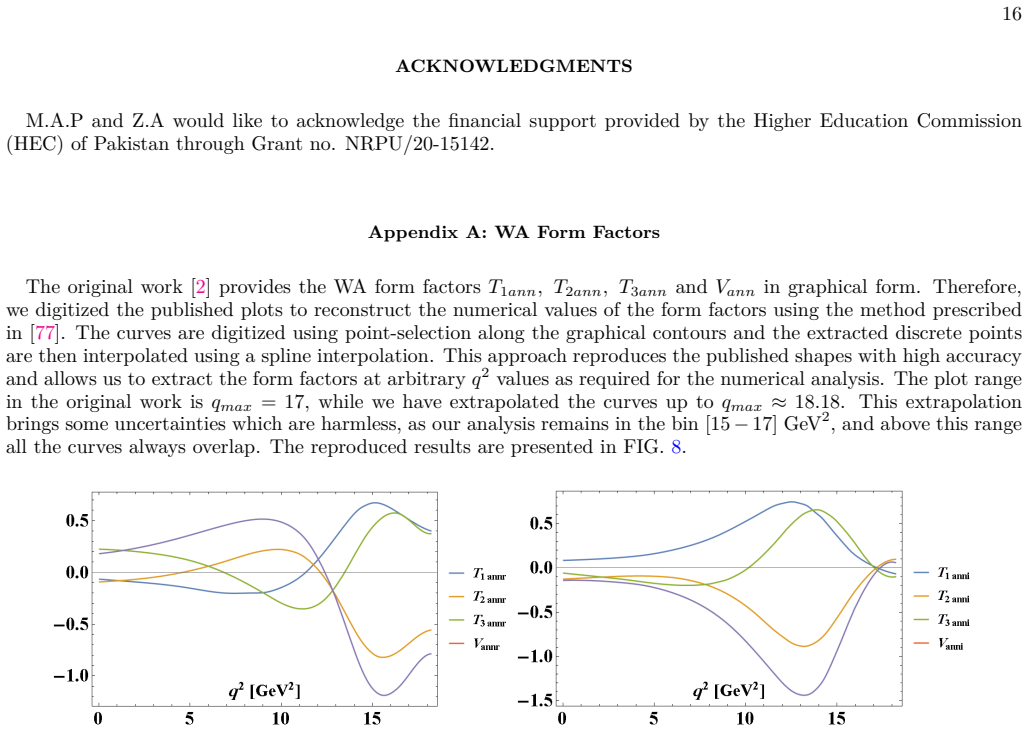
Phenomenological analysis of Angular coefficients in Bc → D∗ℓ+ℓ− Decays 12 IV. Conclusion 15 Acknowledgments 16 A. W A Form Factors 16 B. Wilson Coefficients Expressions 16 C. Kinematics 17 References 18 ∗ zohaib.phdphy22sns@student.nust.edu.pk † qazimaaz92@gmail.com ‡ ishtiaq.ahmed@ncp.edu.pk § faisal.munir@sns.nust.edu.pk ¶ aliparacha@sns.nust.edu.pk (cor...
work page internal anchor Pith review Pith/arXiv arXiv 2026
-
[3]
Branching Ratio The upper and lower plots in first column in FIG. 3 present the differential branching ratios for the decay channels Bc → D∗(→ D+π0)µ+µ− and Bc → D∗(→ D0π+)µ+µ−, respectively, at low q2 bin. Although light vector resonances such as ρ, ω, and ϕ manifest as a small structure in the low- q2 region, their overall impact on the decay spectrum i...
-
[4]
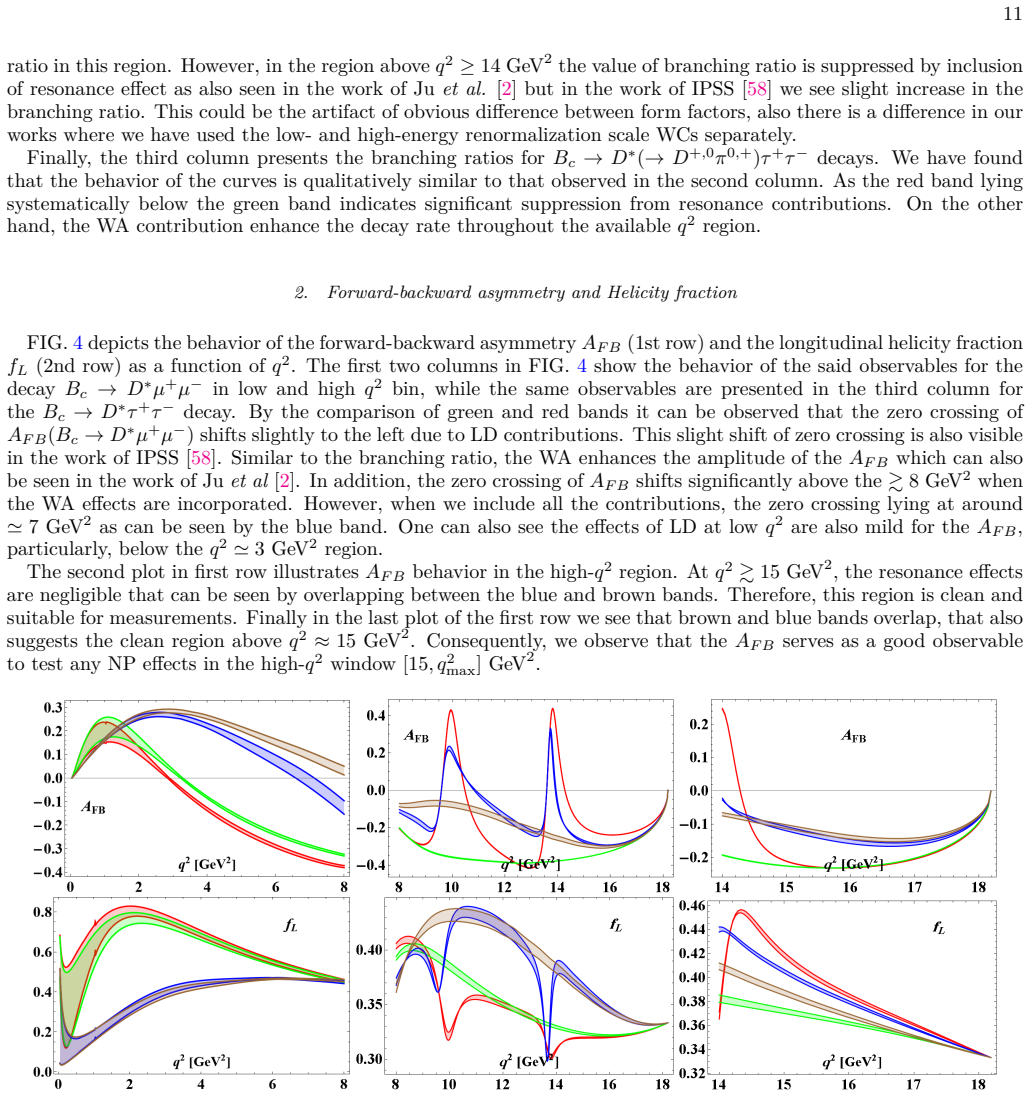
Forward-backward asymmetry and Helicity fraction FIG. 4 depicts the behavior of the forward-backward asymmetry AF B (1st row) and the longitudinal helicity fraction fL (2nd row) as a function of q2. The first two columns in FIG. 4 show the behavior of the said observables for the decay Bc → D∗µ+µ− in low and high q2 bin, while the same observables are pre...
-
[5]
Phenomenological analysis of Angular coefficients in Bc → D∗ℓ+ℓ− Decays In this section, we present the W A effects in the individual angular coefficients ⟨I1s⟩, ⟨I1c⟩, ⟨I2s⟩, ⟨I2c⟩, ⟨I3⟩, ⟨I4⟩, ⟨I5⟩ and ⟨I6s⟩. Numerical values of the SM predictions of the average angular coefficients with uncertainties due to the form factors in different q2 are presented i...
-
[6]
S. L. Glashow, J. Iliopoulos, and L. Maiani, Weak Interactions with Lepton-Hadron Symmetry , Phys. Rev. D 2 (1970) 1285–1292
work page 1970
-
[7]
The Study of Rare $B_c\rightarrow D^{(*)}_{s,d}l\bar{l}$ Decays
W.-L. Ju, G.-L. Wang, H.-F. Fu, T.-H. Wang, and Y. Jiang, The Study of Rare Bc → D(∗) s,dl¯l Decays, JHEP 04 (2014) 065, [ arXiv:1307.5492]
work page internal anchor Pith review Pith/arXiv arXiv 2014
-
[8]
LHCb Collaboration, R. Aaij et al., Search for B+ c → π+µ+µ− decays and measurement of the branching fraction ratio B(B+ c → ψ(2S)π+)/B(B+ c → J/ ψπ+), Eur. Phys. J. C 84 (2024), no. 5 468, [ arXiv:2312.12228]
-
[9]
First observation of the decay Bc+ to J/psi pi+pi-pi+
LHCb Collaboration, R. Aaij et al., First observation of the decay B+ c → J/ψπ +π−π+, Phys. Rev. Lett. 108 (2012) 251802, [ arXiv:1204.0079]
work page internal anchor Pith review Pith/arXiv arXiv 2012
-
[10]
First observation of the decay $B^{+} \rightarrow \pi^{+} \mu^{+} \mu^{-}$
LHCb Collaboration, R. Aaij et al., First observation of the decay B+ → π+µ+µ−, JHEP 12 (2012) 125, [arXiv:1210.2645]
work page internal anchor Pith review Pith/arXiv arXiv 2012
-
[11]
Evidence for the decay $B_{s}^0 \rightarrow \overline{K}{}^{*0}\mu^+\mu^-$
LHCb Collaboration, R. Aaij et al., Evidence for the decay B0 S → K ∗0 µ+µ−, JHEP 07 (2018) 020, [ arXiv:1804.07167]
work page internal anchor Pith review Pith/arXiv arXiv 2018
- [12]
-
[13]
D. London and J. Matias, B Flavour Anomalies: 2021 Theoretical Status Report , Ann. Rev. Nucl. Part. Sci. 72 (2022) 37–68, [ arXiv:2110.13270]
-
[14]
Aaij et al., A search for rare B → D µ+µ− decays, JHEP 02 (2024) 032, [ arXiv:2308.06162]
LHCb Collaboration, R. Aaij et al., A search for rare B → D µ+µ− decays, JHEP 02 (2024) 032, [ arXiv:2308.06162]
-
[15]
C. Q. Geng, C.-W. Hwang, and C. C. Liu, Study of rare B+ c → Dd,s + lepton anti-lepton decays , Phys. Rev. D 65 (2002) 094037, [ hep-ph/0110376]
work page internal anchor Pith review Pith/arXiv arXiv 2002
-
[16]
Analysis of the Rare $B_c \to D_{s,d}^{*} l^+ l^-$ Decays in QCD
K. Azizi, F. Falahati, V. Bashiry, and S. M. Zebarjad, Analysis of the Rare Bc → D∗ s,d ℓ+ℓ− Decays in QCD , Phys. Rev. D 77 (2008) 114024, [ arXiv:0806.0583]
work page internal anchor Pith review Pith/arXiv arXiv 2008
-
[17]
K. Azizi and R. Khosravi, Analysis of the rare semileptonic Bc → P (D, Ds)ℓ+ℓ−/ν ¯ν decays within QCD sum rules , Phys. Rev. D 78 (2008) 036005, [ arXiv:0806.0590]
work page internal anchor Pith review Pith/arXiv arXiv 2008
-
[18]
The exclusive rare decays B -> K l(bar) l and B_c -> D(D*) l(bar) l in a relativistic quark model
A. Faessler, T. Gutsche, M. A. Ivanov, J. G. Korner, and V. E. Lyubovitskij, The Exclusive rare decays B → K(K*) ¯ℓℓ and Bc → D(D*) ¯ℓℓ in a relativistic quark model , Eur. Phys. J. direct 4 (2002), no. 1 18, [ hep-ph/0205287]
work page internal anchor Pith review Pith/arXiv arXiv 2002
-
[19]
H.-M. Choi, Light-front quark model analysis of the exclusive rare Bc → D(s)(ℓ+ℓ−, νℓ ¯νℓ) decays, Phys. Rev. D 81 (2010) 054003, [ arXiv:1001.3432]
work page internal anchor Pith review Pith/arXiv arXiv 2010
-
[20]
W.-F. Wang, X. Yu, C.-D. Lü, and Z.-J. Xiao, Semileptonic decays B+ c → D(∗) (s) (l+νl, l+l−, ν¯ν) in the perturbative QCD approach, Phys. Rev. D 90 (2014), no. 9 094018, [ arXiv:1401.0391]
work page internal anchor Pith review Pith/arXiv arXiv 2014
-
[21]
U. O. Yilmaz, Study of Bc → D∗ s ℓ+ℓ− in Single Universal Extra Dimension , Phys. Rev. D 85 (2012) 115026, [arXiv:1204.1261]
work page internal anchor Pith review Pith/arXiv arXiv 2012
-
[22]
Rare semileptonic decays of B and B_c mesons in the relativistic quark model
D. Ebert, R. N. Faustov, and V. O. Galkin, Rare Semileptonic Decays of B and Bc Mesons in the Relativistic Quark Model, Phys. Rev. D 82 (2010) 034032, [ arXiv:1006.4231]
work page internal anchor Pith review Pith/arXiv arXiv 2010
- [23]
- [24]
-
[25]
R. Dutta, Model independent analysis of new physics effects on Bc → (Ds, D ∗ s ) µ+µ− decay observables, Phys. Rev. D 100 (2019), no. 7 075025, [ arXiv:1906.02412]
- [26]
- [27]
- [28]
-
[29]
Z. Aarfi, Q. M. U. Salam, I. Ahmed, F. M. Bhutta, R. Khalid, and M. A. Paracha, Investigating New Physics through the Observables of Semileptonic Bs → K ∗(→ Kπ ) µ+µ− Decay, PTEP 2025 (6, 2025) 123, [ arXiv:2506.20446]
work page internal anchor Pith review Pith/arXiv arXiv 2025
-
[30]
CDF Collaboration, T. Affolder et al., Search for the flavor-changing neutral current decays B+ → µ+µ−K + and B0 → µ+µ−K ∗0, Phys. Rev. Lett. 83 (1999) 3378–3383, [ hep-ex/9905004]
work page internal anchor Pith review Pith/arXiv arXiv 1999
-
[31]
Search for B^+ --> K^+l^+l^- and B^0 --> K^(*0)l^+l^-
BaBar Collaboration, B. Aubert et al., Search for B+ → K + ℓ+ℓ− and B0 → K ∗0 ℓ+ℓ−, in 30th International Conference on High-Energy Physics , 7, 2000. hep-ex/0008059
work page internal anchor Pith review Pith/arXiv arXiv 2000
-
[32]
Observation of the Decay $B \to K \ell^{+} \ell^{-}$
Belle Collaboration, K. Abe et al., Observation of the decay B → Kℓ +ℓ−, Phys. Rev. Lett. 88 (2002) 021801, [hep-ex/0109026]
work page internal anchor Pith review Pith/arXiv arXiv 2002
-
[33]
Evidence for the Rare Decay B -> K*ll and Measurement of the B -> Kll Branching Fraction
BaBar Collaboration, B. Aubert et al., Evidence for the rare decay B → K ∗ℓ+ℓ− and measurement of the B → Kℓ +ℓ− branching fraction, Phys. Rev. Lett. 91 (2003) 221802, [ hep-ex/0308042]
work page internal anchor Pith review Pith/arXiv arXiv 2003
-
[34]
Direct CP, Lepton Flavor and Isospin Asymmetries in the Decays B->K(*)l+l-
BaBar Collaboration, B. Aubert et al., Direct CP, Lepton Flavor and Isospin Asymmetries in the Decays B → K (∗)ℓ+ℓ−, Phys. Rev. Lett. 102 (2009) 091803, [ arXiv:0807.4119]. 19
work page internal anchor Pith review Pith/arXiv arXiv 2009
-
[35]
Observation of $B \to K^* \ell^+ \ell^-$
Belle Collaboration, A. Ishikawa et al., Observation of B → K ∗ ℓ+ℓ−, Phys. Rev. Lett. 91 (2003) 261601, [hep-ex/0308044]
work page internal anchor Pith review Pith/arXiv arXiv 2003
-
[36]
Lepton-Flavor-Dependent Angular Analysis of $B\to K^\ast \ell^+\ell^-$
Belle Collaboration, S. Wehle et al., Lepton-Flavor-Dependent Angular Analysis of B → K ∗ℓ+ℓ−, Phys. Rev. Lett. 118 (2017), no. 11 111801, [ arXiv:1612.05014]
work page internal anchor Pith review Pith/arXiv arXiv 2017
-
[37]
BELLE Collaboration, S. Choudhury et al., Test of lepton flavor universality and search for lepton flavor violation in B → Kℓℓ decays, JHEP 03 (2021) 105, [ arXiv:1908.01848]
- [38]
-
[39]
Belle Collaboration, J. T. Wei et al., Measurement of the Differential Branching Fraction and Forward-Backward Asymmetry for B → K (∗)ℓ+ℓ−, Phys. Rev. Lett. 103 (2009) 171801, [ arXiv:0904.0770]
work page internal anchor Pith review Pith/arXiv arXiv 2009
-
[40]
Abdesselam et al., Test of Lepton-Flavor Universality in B → K ∗ℓ+ℓ− Decays at Belle , Phys
Belle Collaboration, A. Abdesselam et al., Test of Lepton-Flavor Universality in B → K ∗ℓ+ℓ− Decays at Belle , Phys. Rev. Lett. 126 (2021), no. 16 161801, [ arXiv:1904.02440]
-
[41]
BaBar Collaboration, J. P. Lees et al., Measurement of Branching Fractions and Rate Asymmetries in the Rare Decays B → K (∗)l+l−, Phys. Rev. D 86 (2012) 032012, [ arXiv:1204.3933]
work page internal anchor Pith review Pith/arXiv arXiv 2012
-
[42]
Observation of the Baryonic Flavor-Changing Neutral Current Decay Lambda_b -> Lambda mu+ mu-
CDF Collaboration, T. Aaltonen et al., Observation of the Baryonic Flavor-Changing Neutral Current Decay Λb → Λµ+µ−, Phys. Rev. Lett. 107 (2011) 201802, [ arXiv:1107.3753]
work page internal anchor Pith review Pith/arXiv arXiv 2011
-
[43]
Angular analysis of the decay B0 to K*0 mu mu from pp collisions at sqrt(s) = 8 TeV
CMS Collaboration, V. Khachatryan et al., Angular analysis of the decay B0 → K ∗0µ+µ− from pp collisions at √s = 8 TeV, Phys. Lett. B 753 (2016) 424–448, [ arXiv:1507.08126]
work page internal anchor Pith review Pith/arXiv arXiv 2016
-
[44]
Test of lepton universality using $B^{+}\rightarrow K^{+}\ell^{+}\ell^{-}$ decays
LHCb Collaboration, R. Aaij et al., Test of lepton universality using B+ → K +ℓ+ℓ− decays, Phys. Rev. Lett. 113 (2014) 151601, [ arXiv:1406.6482]
work page internal anchor Pith review Pith/arXiv arXiv 2014
-
[45]
LHCb Collaboration, R. Aaij et al., Measurements of the S-wave fraction in B0 → K +π−µ+µ− decays and the B0 → K ∗(892)0µ+µ− differential branching fraction , JHEP 11 (2016) 047, [ arXiv:1606.04731]. [Erratum: JHEP 04, 142 (2017)]
work page internal anchor Pith review Pith/arXiv arXiv 2016
-
[46]
Test of lepton universality with $B^{0} \rightarrow K^{*0}\ell^{+}\ell^{-}$ decays
LHCb Collaboration, R. Aaij et al., Test of lepton universality with B0 → K ∗0ℓ+ℓ− decays, JHEP 08 (2017) 055, [arXiv:1705.05802]
work page internal anchor Pith review Pith/arXiv arXiv 2017
-
[47]
Measurement of form-factor independent observables in the decay $B^{0} \to K^{*0} \mu^+ \mu^-$
LHCb Collaboration, R. Aaij et al., Measurement of Form-Factor-Independent Observables in the Decay B0 → K ∗0µ+µ−, Phys. Rev. Lett. 111 (2013) 191801, [ arXiv:1308.1707]
work page internal anchor Pith review Pith/arXiv arXiv 2013
-
[48]
LHCb Collaboration, R. Aaij et al., Differential branching fraction and angular analysis of the B+ → K +µ+µ− decay, JHEP 02 (2013) 105, [ arXiv:1209.4284]
work page internal anchor Pith review Pith/arXiv arXiv 2013
-
[49]
A. Ahmed, I. Ahmed, M. A. Paracha, M. Junaid, A. Rehman, and M. J. Aslam, Comparative Study of Bc → D∗ s ℓ+ℓ− Decays in Standard Model and Supersymmetric Models , 8, 2011. arXiv:1108.1058
work page internal anchor Pith review Pith/arXiv arXiv 2011
-
[50]
Analysis of B_{C} --> D_{s}^{*}l^{+}l^{-} in the Standard Model Beyond Third Generation
I. Ahmed, M. A. Paracha, M. Junaid, A. Ahmed, A. Rehman, and M. J. Aslam, Analysis of Bc → D∗ s ℓ+ℓ− in the Standard Model Beyond Third Generation , [ arXiv:1107.5694]
work page internal anchor Pith review Pith/arXiv arXiv
-
[51]
B_c meson rare decays in the light-cone quark model
T. Wang, D.-X. Zhang, B.-Q. Ma, and T. Liu, Bc Meson Rare Decays in the Light-cone Quark Model , Eur. Phys. J. C 71 (2011) 1758, [ arXiv:1004.4274]
work page internal anchor Pith review Pith/arXiv arXiv 2011
-
[52]
G. Isidori, Z. Polonsky, and A. Tinari, Explicit estimate of charm rescattering in B0 → K 0 ℓ+ℓ−, Phys. Rev. D 111 (2025), no. 9 093007, [ arXiv:2405.17551]
-
[53]
LHCb Collaboration, R. Aaij et al., Comprehensive analysis of local and nonlocal amplitudes in the B 0→ K ∗0µ+µ− decay, JHEP 09 (2024) 026, [ arXiv:2405.17347]
-
[54]
M. Bordone, G. Isidori, S. Mächler, and A. Tinari, Short- vs. long-distance physics in B → K (∗)ℓ+ℓ−: a data-driven analysis, Eur. Phys. J. C 84 (2024), no. 5 547, [ arXiv:2401.18007]
-
[55]
F. Mahmoudi and Y. Monceaux, Overview of B→K (∗)ℓℓ Theoretical Calculations and Uncertainties , Symmetry 16 (2024), no. 8 1006, [ arXiv:2408.03235]
-
[56]
Hadronic uncertainties in $B\to K^*\mu^+\mu^-$: a state-of-the-art analysis
B. Capdevila, S. Descotes-Genon, L. Hofer, and J. Matias, Hadronic uncertainties in B → K ∗µ+µ−: a state-of-the-art analysis, JHEP 04 (2017) 016, [ arXiv:1701.08672]
work page internal anchor Pith review Pith/arXiv arXiv 2017
-
[57]
Weak Decays Beyond Leading Logarithms
G. Buchalla, A. J. Buras, and M. E. Lautenbacher, Weak Decays beyond Leading Logarithms , Rev. Mod. Phys. 68 (1996) 1125–1144, [ hep-ph/9512380]
work page internal anchor Pith review Pith/arXiv arXiv 1996
-
[58]
Three-loop matching of the dipole operators for b -> s gamma and b -> s g
M. Misiak and M. Steinhauser, Three loop matching of the dipole operators for b → sγ and b → sg, Nucl. Phys. B 683 (2004) 277–305, [ hep-ph/0401041]
work page internal anchor Pith review Pith/arXiv arXiv 2004
- [59]
- [60]
-
[61]
The two-body B_c {\to} D^{(*)}_{(s)}P, D^{(*)}_{(s)}V decays in the Perturbative QCD Approach
Z. Rui, Z.-T. Zou, and C.-D. Lu, The Two-Body Bc→D(∗) (s) P , D(∗) (s) V Decays in the Perturbative QCD Approach , Phys. Rev. D 86 (2012) 074008, [ arXiv:1112.1257]
work page internal anchor Pith review Pith/arXiv arXiv 2012
-
[62]
R. Khosravi, K. Azizi, and N. Ghahramany, Semileptonic Dq → K1 ℓν and nonleptonic D → K1π decays in three-point QCD sum rules and factorization approach , Phys. Rev. D 79 (2009) 036004, [ arXiv:0812.1352]
work page internal anchor Pith review Pith/arXiv arXiv 2009
- [63]
-
[64]
M. A. Ivanov, J. G. Körner, and C.-T. Tran, Analyzing new physics in the decays ¯B0 → D(∗)τ − ¯ντ with form factors obtained from the covariant quark model , Phys. Rev. D 94 (2016), no. 9 094028, [ arXiv:1607.02932]
work page internal anchor Pith review Pith/arXiv arXiv 2016
-
[65]
On the meson mass spectrum in the covariant confined quark model
G. Ganbold, T. Gutsche, M. A. Ivanov, and V. E. Lyubovitskij, On the meson mass spectrum in the covariant confined 20 quark model , J. Phys. G 42 (2015), no. 7 075002, [ arXiv:1410.3741]
work page internal anchor Pith review Pith/arXiv arXiv 2015
-
[66]
A. Issadykov, M. A. Ivanov, and G. Nurbakova, Semileptonic decays of B c mesons into charmonium states , EPJ Web Conf. 158 (2017) 03002, [ arXiv:1907.13210]
-
[67]
T. Gutsche, M. A. Ivanov, J. G. Körner, V. E. Lyubovitskij, and P. Santorelli, Heavy-to-light semileptonic decays of Λb and Λc baryons in the covariant confined quark model , Phys. Rev. D 90 (2014), no. 11 114033, [ arXiv:1410.6043]. [Erratum: Phys.Rev.D 94, 059902 (2016)]
work page internal anchor Pith review Pith/arXiv arXiv 2014
-
[68]
U. Dey and S. Nandi, Study of Form Factors and Observables in B− c → ¯D(∗)0ℓ− ¯νℓ and B− c → D(∗)−ℓ+ℓ− decays, [arXiv:2509.19445]
work page internal anchor Pith review Pith/arXiv arXiv
- [69]
-
[70]
Photonic penguins at two loops and m_t-dependence of BR[ B -> X_s l^+ l^-]
C. Bobeth, M. Misiak, and J. Urban, Photonic penguins at two loops and mt dependence of BR[B → Xsl+l−], Nucl. Phys. B 574 (2000) 291–330, [ hep-ph/9910220]
work page internal anchor Pith review Pith/arXiv arXiv 2000
-
[71]
Systematic approach to exclusive B ->V l^+l^-, V gamma decays
M. Beneke, T. Feldmann, and D. Seidel, Systematic approach to exclusive B → V l+l−, V γ decays, Nucl. Phys. B612 (2001) 25–58, [ hep-ph/0106067]
work page internal anchor Pith review Pith/arXiv arXiv 2001
-
[72]
H. H. Asatrian, H. M. Asatrian, C. Greub, and M. Walker, Two loop virtual corrections to B → Xsl+l− in the standard model, Phys. Lett. B 507 (2001) 162–172, [ hep-ph/0103087]
work page internal anchor Pith review Pith/arXiv arXiv 2001
-
[73]
H. H. Asatryan, H. M. Asatrian, C. Greub, and M. Walker, Calculation of two loop virtual corrections to b → sl+l− in the standard model , Phys. Rev. D65 (2002) 074004, [ hep-ph/0109140]
work page internal anchor Pith review Pith/arXiv arXiv 2002
-
[74]
Analytic calculation of two-loop QCD corrections to b\to s\ell^+\ell^- in the high q^2 region
C. Greub, V. Pilipp, and C. Schupbach, Analytic calculation of two-loop QCD corrections to b → sl+l− in the high q2 region, JHEP 12 (2008) 040, [ arXiv:0810.4077]
work page internal anchor Pith review Pith/arXiv arXiv 2008
-
[75]
D. Du, A. X. El-Khadra, S. Gottlieb, A. S. Kronfeld, J. Laiho, E. Lunghi, R. S. Van de Water, and R. Zhou, Phenomenology of semileptonic B-meson decays with form factors from lattice QCD , Phys. Rev. D 93 (2016), no. 3 034005, [ arXiv:1510.02349]
work page internal anchor Pith review Pith/arXiv arXiv 2016
-
[76]
LHCb Collaboration, R. Aaij et al., Angular moments of the decay Λ0 b → Λµ+µ− at low hadronic recoil , JHEP 09 (2018) 146, [ arXiv:1808.00264]
work page internal anchor Pith review Pith/arXiv arXiv 2018
-
[77]
J. Gratrex, M. Hopfer, and R. Zwicky, Generalised helicity formalism, higher moments and the B → KJK (→ Kπ )¯ℓ1ℓ2 angular distributions , Phys. Rev. D 93 (2016), no. 5 054008, [ arXiv:1506.03970]
-
[78]
James, Statistical Methods in Experimental Physics
F. James, Statistical Methods in Experimental Physics . World Scientific, Singapore, 2nd ed., 2006
work page 2006
-
[79]
Extracting Angular Observables without a Likelihood and Applications to Rare Decays
F. Beaujean, M. Chrzaszcz, N. Serra, and D. van Dyk, Extracting Angular Observables without a Likelihood and Applications to Rare Decays , Phys. Rev. D 91 (2015), no. 11 114012, [ arXiv:1503.04100]
work page internal anchor Pith review Pith/arXiv arXiv 2015
-
[80]
LHCb Collaboration, R. Aaij et al., Angular analysis of the B0 → K ∗0µ+µ− decay using 3 fb −1 of integrated luminosity , JHEP 02 (2016) 104, [ arXiv:1512.04442]
work page internal anchor Pith review Pith/arXiv arXiv 2016
discussion (0)
Sign in with ORCID, Apple, or X to comment. Anyone can read and Pith papers without signing in.