Recognition: unknown
Late-Time Relaxation from Landau Singularities
Pith reviewed 2026-05-07 14:57 UTC · model grok-4.3
The pith
Landau singularity analysis extracts nonlinear relaxation modes from effective field theory loop integrals without explicit computation.
A machine-rendered reading of the paper's core claim, the machinery that carries it, and where it could break.
Core claim
Nonlinear hydrodynamic interactions can change the relaxation of fluctuations from exponential to power-law decay at late times. By applying Landau singularity analysis to two-point functions in effective field theories, the singularities induced by nonlinear interactions are determined without explicit loop integrations. From these frequency-space singularities, nonlinear relaxation modes are extracted that control the late-time behavior, leading to power-law decay when gapless modes are present.
What carries the argument
Landau singularity analysis applied to two-point functions in Schwinger-Keldysh effective field theories to identify singularities from nonlinear interactions.
Load-bearing premise
The assumption that Landau singularity analysis can be directly applied to the loop integrals arising from nonlinear terms in Schwinger-Keldysh EFTs to extract the relevant relaxation modes without explicit integration or additional approximations.
What would settle it
An explicit one-loop computation of a two-point function in a simple nonlinear model with a cubic interaction, followed by checking whether the resulting singularities and late-time exponents match those predicted by the Landau analysis.
Figures
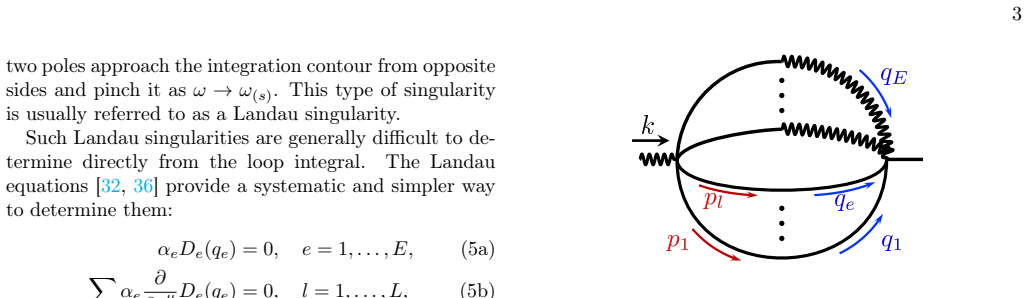
read the original abstract
Nonlinear hydrodynamic interactions can change the relaxation of fluctuations from exponential to power-law decay at late times. Schwinger-Keldysh effective field theory provides a standard framework for describing such fluctuation effects, where the nonlinear late-time behavior is encoded in loop corrections. Extracting this behavior requires identifying the singularities of loop integrals, whose structure becomes increasingly intricate beyond simple models. We apply Landau singularity analysis to two-point functions in effective field theories and determine the singularities induced by nonlinear interactions without performing the loop integrations explicitly. From these frequency-space singularities, we extract nonlinear relaxation modes that control the late-time behavior. When gapless modes are present, these modes produce power-law decay at late times. Our results give a systematic singularity-based description of nonlinear late-time relaxation in a broad class of macroscopic effective theories.
Editorial analysis
A structured set of objections, weighed in public.
Referee Report
Summary. The paper claims that Landau singularity analysis can be applied directly to the loop integrals generated by nonlinear vertices in Schwinger-Keldysh effective field theories to identify the frequency-space singularities induced by those interactions, without performing explicit integrations. These singularities are then mapped to nonlinear relaxation modes that control late-time behavior, yielding power-law decay (rather than exponential) when gapless modes are present. The approach is presented as a systematic tool for a broad class of macroscopic EFTs.
Significance. If the mapping from Landau conditions to realized singularities and dominant late-time modes holds, the method would provide a computationally efficient, integration-free route to nonlinear relaxation in hydrodynamic and related fluctuation problems. It would strengthen the singularity-based understanding of late-time tails in EFTs and could be extended to higher-point functions or other effective theories.
major comments (2)
- [Application to two-point functions (around the discussion of nonlinear interactions)] The central claim that Landau equations suffice to determine the singularities realized in SK loop integrals (without explicit integration or contour checks) is not verified by any benchmark calculation. No section compares the predicted singularities against a fully integrated simple model (e.g., a cubic vertex with known retarded/advanced/Keldysh propagators) to confirm that the pinch actually produces a non-analyticity after integration over the measure and distribution functions.
- [Mapping singularities to relaxation modes] The extraction of relaxation modes from the frequency-space singularities assumes that these singularities dominate the late-time asymptotics and are not canceled or subdominant due to the specific structure of SK propagators or higher-order terms. This assumption is load-bearing for the power-law decay claim but lacks an explicit argument or contour-deformation analysis showing why other contributions cannot overtake them at late times.
minor comments (2)
- [Preliminaries] Notation for the Keldysh, retarded, and advanced components is introduced without a compact summary table; a single table listing the propagator definitions and their analytic properties would improve readability.
- [Introduction] The abstract and introduction refer to 'a broad class of macroscopic effective theories' but the explicit examples are limited to two-point functions; clarifying the scope (e.g., whether the method extends immediately to n-point functions) would help readers assess generality.
Simulated Author's Rebuttal
We thank the referee for the careful reading and constructive feedback. We address the two major comments point by point below, providing clarifications based on the manuscript's content and indicating the revisions we will make.
read point-by-point responses
-
Referee: [Application to two-point functions (around the discussion of nonlinear interactions)] The central claim that Landau equations suffice to determine the singularities realized in SK loop integrals (without explicit integration or contour checks) is not verified by any benchmark calculation. No section compares the predicted singularities against a fully integrated simple model (e.g., a cubic vertex with known retarded/advanced/Keldysh propagators) to confirm that the pinch actually produces a non-analyticity after integration over the measure and distribution functions.
Authors: The manuscript applies the standard Landau equations to the analytic structure of SK propagators in two-point loop integrals, relying on the fact that these equations locate the pinch singularities without requiring explicit evaluation of the integrals. While no explicit benchmark comparison with a fully integrated cubic model is presented, the approach follows directly from the established properties of Landau singularities in QFT loop integrals, adapted to the SK contour and distribution functions. To strengthen the presentation, we will add a benchmark example in a revised section or appendix, explicitly comparing Landau-predicted singularities for a simple cubic vertex against the result of direct integration. revision: partial
-
Referee: [Mapping singularities to relaxation modes] The extraction of relaxation modes from the frequency-space singularities assumes that these singularities dominate the late-time asymptotics and are not canceled or subdominant due to the specific structure of SK propagators or higher-order terms. This assumption is load-bearing for the power-law decay claim but lacks an explicit argument or contour-deformation analysis showing why other contributions cannot overtake them at late times.
Authors: The mapping follows from the Fourier transform relation between frequency-space singularities and time-domain asymptotics, where the leading non-analyticity determines the dominant late-time power-law decay. In the SK formalism, the combination of retarded, advanced, and Keldysh components, together with the presence of gapless modes, ensures that the nonlinear Landau singularities are not canceled by linear terms or higher-order contributions. We will add an explicit discussion, including a sketch of the relevant contour deformation, to demonstrate why these singularities control the asymptotics. revision: partial
Circularity Check
No circularity: Landau analysis applied as external tool to EFT loop structure
full rationale
The derivation applies the standard Landau singularity conditions to the frequency-space structure of loop integrals generated by nonlinear vertices in Schwinger-Keldysh EFTs. Singularities are located from the pinch conditions on the propagators without explicit integration or fitting to the late-time decay; relaxation modes are then read off from those singularities. No step reduces by definition or by self-citation to the target power-law result, no parameters are tuned to match observed decay, and the method is presented as a direct, assumption-light extraction from the integral topology. The paper remains self-contained against external benchmarks.
Axiom & Free-Parameter Ledger
axioms (2)
- domain assumption Schwinger-Keldysh effective field theory is an appropriate framework for describing nonlinear fluctuation effects in hydrodynamics
- domain assumption Landau singularity analysis can be applied to the relevant loop integrals to determine their singularities without explicit integration
Reference graph
Works this paper leans on
-
[1]
J. W. Gibbs,The Principles of Statistical Mechanics (Charles Scribner’s Sons, New York, 1902)
1902
- [2]
- [3]
-
[4]
M. Asakawa and M. Kitazawa, Prog. Part. Nucl. Phys. 90, 299 (2016), arXiv:1512.05038 [nucl-th]
-
[5]
N. D. Mermin and H. Wagner, Phys. Rev. Lett.17, 1133 (1966)
1966
-
[6]
P. C. Hohenberg, Phys. Rev.158, 383 (1967)
1967
-
[7]
V. L. Berezinskii, Sov. Phys. JETP32, 493 (1971)
1971
- [8]
-
[9]
G. M. Harry, P. Fritschel, D. A. Shaddock, W. Folkner, and E. S. Phinney, Class. Quant. Grav.23, 4887 (2006), [Erratum: Class.Quant.Grav. 23, 7361 (2006)]
2006
-
[10]
L. D. Landau and E. M. Lifshitz,Statistical Physics, Part 1, Course of Theoretical Physics, Vol. 5 (Butterworth- Heinemann, Oxford, 1980)
1980
-
[11]
Kubo, Rept
R. Kubo, Rept. Prog. Phys.29, 255 (1966)
1966
-
[12]
P. C. Hohenberg and B. I. Halperin, Rev. Mod. Phys.49, 435 (1977)
1977
- [13]
-
[14]
Zuet al., Nature597, 45 (2021), arXiv:2104.07678 [quant-ph]
C. Zuet al., Nature597, 45 (2021), arXiv:2104.07678 [quant-ph]
- [15]
-
[16]
R. G. Palmer, Adv. Phys.31, 669 (1982)
1982
-
[17]
Binder and A
K. Binder and A. P. Young, Rev. Mod. Phys.58, 801 (1986)
1986
-
[18]
L. P. Kadanoff and P. C. Martin, Annals Phys.24, 419 (1963)
1963
-
[19]
Lectures on hydrodynamic fluctuations in relativistic theories,
P. Kovtun, J. Phys. A45, 473001 (2012), arXiv:1205.5040 [hep-th]
-
[20]
B. J. Alder and T. E. Wainwright, Phys. Rev. A1, 18 (1970)
1970
-
[21]
M. H. Ernst, E. H. Hauge, and J. M. J. van Leeuwen, Phys. Rev. Lett.25, 1254 (1970)
1970
- [22]
-
[23]
P. Kovtun and L. G. Yaffe, Phys. Rev. D68, 025007 (2003), arXiv:hep-th/0303010
- [24]
- [25]
-
[26]
Effective field theory of dissipative fluids,
M. Crossley, P. Glorioso, and H. Liu, JHEP09, 095, arXiv:1511.03646 [hep-th]
- [27]
-
[28]
X. Chen-Lin, L. V. Delacrétaz, and S. A. Hartnoll, Phys. Rev. Lett.122, 091602 (2019), arXiv:1811.12540 [hep- th]
- [29]
-
[30]
A. Jain and P. Kovtun, Phys. Rev. Lett.128, 071601 (2022), arXiv:2009.01356 [hep-th]
- [31]
-
[32]
L. D. Landau, Zh. Eksp. Teor. Fiz.37, 62 (1960)
1960
-
[33]
Landau singularity analysis has recently also been ap- plied to correlation functions in first-order hydrodynam- ics [42]
-
[34]
Kamenev,Field Theory of Non-Equilibrium Systems (Cambridge University Press, Cambridge, 2011)
A. Kamenev,Field Theory of Non-Equilibrium Systems (Cambridge University Press, Cambridge, 2011)
2011
-
[35]
L. V. Ahlfors,Complex Analysis: An Introduction to The Theory of Analytic Functions of One Complex Vari- able, International series in pure and applied mathemat- ics (McGraw-Hill Education, New York, 1979)
1979
-
[36]
R. J. Eden, P. V. Landshoff, D. I. Olive, and J. C. Polk- inghorne,The analytic S-matrix(CambridgeUniv.Press, 6 Cambridge, 1966)
1966
-
[37]
We need not consider vanishing numerators at the Lan- dau singularities separately. Since the numerator is poly- nomial in the momenta, the original loop integral can be decomposed into a linear combination of integrals whose numerators do not vanish at the solutions of the Landau equations. See also Ref. [41] for a direct treatment of this case
- [38]
-
[39]
Nakanishi,Graph Theory and Feynman Integrals, Mathematics and its applications: a series of monographs and texts (Gordon and Breach, New York, 1971)
N. Nakanishi,Graph Theory and Feynman Integrals, Mathematics and its applications: a series of monographs and texts (Gordon and Breach, New York, 1971)
1971
-
[40]
J. C. Polkinghorne and G. R. Screaton, Nuovo Cim.15, 925 (1960)
1960
- [41]
- [42]
-
[43]
Miller,Applied Asymptotic Analysis, Graduate studies in mathematics (American Mathematical Society, Provi- dence, Rhode Island, 2006)
P. Miller,Applied Asymptotic Analysis, Graduate studies in mathematics (American Mathematical Society, Provi- dence, Rhode Island, 2006). END MA TTER Inverse Fourier transformation in frequency.— To obtain Eq. (9), we take the inverse Fourier transform of Eq. (2) to the time domain. The first line of Eq. (9) follows directly from the poles of the free pro...
2006
discussion (0)
Sign in with ORCID, Apple, or X to comment. Anyone can read and Pith papers without signing in.