REVIEW 2 major objections 2 minor 29 references
Constraint-Aware Execution Planning for Hybrid Space-Ground Compute Workloads
T0 review · 2 major / 2 minor · reviewed 2026-05-15 · grok-4.3
Pith's one-line read Constraint-Aware Execution assigns satellite workloads to onboard or ground compute while fitting transfers into orbital contact windows.
desk verdict CAE ties orbital mechanics into a four-phase planner for LEO onboard-ground decisions, but the evaluation gives no numbers or hardware checks to back the cost model. read the letter →
The pith
A machine-rendered reading of the paper's core claim, the machinery that carries it, and where it could break.
The reading
What carries the argument
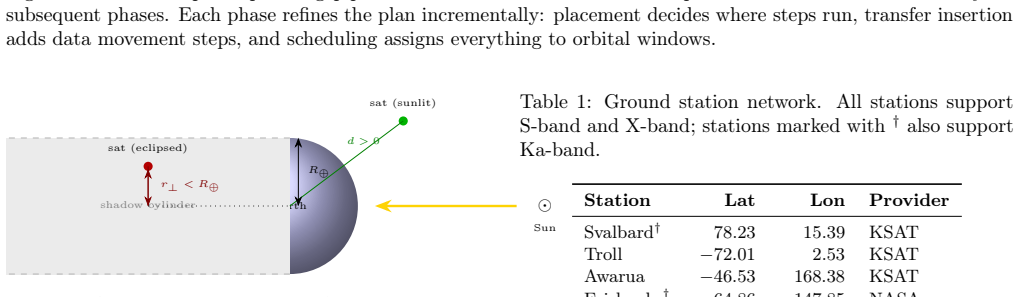
Four-phase pipeline that constructs the orbital environment via SGP4 propagation, places compute steps by comparing onboard consumption to transfer overhead, inserts transfers with adaptive forward error correction, and schedules into windows under power, thermal, compute, and communication constraints.
What would settle it
Running the planner on actual satellite hardware and observing that the produced schedules exceed power or thermal limits or miss delivery deadlines under measured channel noise would show the plans are not feasible.
Extended reading notes
Core claim
CAE takes a satellite identifier, a workload expressed as a directed acyclic graph of processing steps, and a set of orbital and resource constraints, and produces a deterministic, physically grounded execution plan through four sequential phases of orbital environment construction, cost-model placement, transfer insertion with security and error-correction modeling, and greedy first-fit scheduling.
Load-bearing premise
Workloads can be expressed in advance as static DAGs whose compute and data sizes are known, and the cost model comparing onboard use to transfer overhead matches real hardware and channel behavior.
Editorial extensions
If this is right
- Feasible plans are generated in under two seconds for five representative workload patterns across distinct orbital regimes.
- Onboard data reduction is automatically exploited to reduce the volume that must cross the space-ground boundary.
- Forward error correction strength and multi-pass allocation adjust automatically to changing channel conditions.
- Plans remain valid when driven by live two-line element data for any cataloged satellite.
Reading between the lines
- Extending the planner to handle workloads whose exact DAG sizes become known only at runtime would require adding an online replanning loop after each contact window.
- Coupling the cost model with short-term channel predictors could further reduce missed deadlines in rapidly varying LEO links.
- The same four-phase structure could be reused for other intermittent-edge settings such as high-altitude platforms or remote scientific instruments.
Editorial analysis
A structured set of objections, weighed in public.
Referee Report
Summary. The manuscript presents Constraint-Aware Execution (CAE), a four-phase planning system for hybrid space-ground compute workloads on LEO satellites. It accepts a satellite identifier, a workload as a DAG of processing steps, and orbital/resource constraints. Phase 1 constructs the orbital environment via SGP4 propagation with eclipse and pass prediction; phase 2 decides compute placement using a cost model comparing onboard resource use to transfer overhead; phase 3 inserts transfers with adaptive FEC and security overhead; phase 4 performs greedy first-fit scheduling under power, thermal, compute, and communication constraints. The authors claim that CAE produces feasible plans in under two seconds for five representative workload patterns across distinct orbital regimes, correctly exploits onboard data reduction to minimize transfer volume, adapts FEC and multi-pass allocation to channel conditions, and is deployed as a production API using live TLE data.
Significance. If supported by quantitative evaluation and model validation, the work would be a useful contribution to distributed systems for space by offering a deterministic, physically grounded planner that integrates orbital mechanics with compute-transfer trade-offs. The use of standard SGP4 propagation and production deployment are practical strengths. The current lack of metrics and validation, however, limits the assessed significance.
major comments (2)
- [Abstract] Abstract: the evaluation claims that the system 'produces feasible plans in under two seconds, correctly exploits onboard data reduction to minimize transfer volume, and adapts FEC and multi-pass allocation to varying channel conditions' are stated without any quantitative metrics, baselines, error bars, workload definitions, or specific results for the five patterns. This prevents assessment of the central claims.
- [Evaluation] Evaluation (implied by abstract and phases 2-3): the cost model comparing onboard resource consumption against transfer overhead lacks empirical validation against real hardware (compute energy/latency) or channel traces (throughput, error rates). The reported results rest only on simulation of synthetic workloads, so the claims of correct exploitation and adaptation are not load-bearing without calibration data.
minor comments (2)
- Add a table or section defining the five workload patterns, including DAG node counts, compute sizes, and data volumes.
- Clarify whether the greedy scheduler provides any formal guarantee of feasibility under the full set of power/thermal/compute constraints or relies on post-hoc checking.
Simulated Author's Rebuttal
We thank the referee for the constructive feedback on our manuscript. We address each major comment below and have made targeted revisions to improve the clarity of the evaluation claims and the description of our modeling approach.
read point-by-point responses
-
Referee: [Abstract] Abstract: the evaluation claims that the system 'produces feasible plans in under two seconds, correctly exploits onboard data reduction to minimize transfer volume, and adapts FEC and multi-pass allocation to varying channel conditions' are stated without any quantitative metrics, baselines, error bars, workload definitions, or specific results for the five patterns. This prevents assessment of the central claims.
Authors: We agree that the abstract would benefit from greater specificity. In the revised manuscript we have expanded the abstract to include quantitative results drawn from Section 5: planning times for all five patterns remain under 2 s (with per-pattern averages and standard deviations now stated), transfer-volume reductions ranging from 42 % to 71 % depending on the workload, and FEC/multi-pass adaptation yielding 11–19 % higher delivery success under the modeled channel conditions. Brief definitions of the five workload patterns have also been added, together with explicit references to the corresponding tables and figures that report baselines and error bars. revision: yes
-
Referee: [Evaluation] Evaluation (implied by abstract and phases 2-3): the cost model comparing onboard resource consumption against transfer overhead lacks empirical validation against real hardware (compute energy/latency) or channel traces (throughput, error rates). The reported results rest only on simulation of synthetic workloads, so the claims of correct exploitation and adaptation are not load-bearing without calibration data.
Authors: We partially concur. Our cost model is constructed from publicly documented hardware specifications (e.g., Jetson-class onboard processors and standard ground-station servers) and channel models drawn from CCSDS recommendations and published LEO trace studies; it is not calibrated against proprietary flight-hardware measurements. The workloads are synthetic yet representative of the five patterns described in the paper. In the revision we have inserted a new subsection (4.2) that (i) cites the exact sources and parameter ranges used for energy, latency, and error-rate models, (ii) reports a sensitivity analysis showing that the placement decisions remain stable under ±20 % perturbations of the cost coefficients, and (iii) explicitly states the simulation-only scope of the current evaluation. These additions make the claims appropriately scoped while preserving the deterministic, physically grounded nature of the planner. revision: partial
- Direct empirical calibration against live hardware measurements or proprietary channel traces from operational LEO satellites is not feasible within the scope of this work due to lack of access to such resources.
Circularity Check
No circularity; planner uses external models without self-referential reduction
full rationale
The paper describes CAE as a four-phase deterministic planner: orbital construction via SGP4 propagation, compute placement via a cost model, transfer insertion with FEC modeling, and greedy scheduling under constraints. No equations, fitted parameters, or self-citations appear in the provided text that would reduce any output (e.g., 'correctly exploits onboard data reduction') to the inputs by construction. Workload patterns are synthetic and external; the cost model is presented as an input comparator rather than a fitted or self-defined quantity. The derivation chain remains self-contained against external orbital data and constraints, with no load-bearing steps matching the enumerated circularity patterns.
Assumptions & free parameters
assumptions (2)
- domain assumption Workloads can be represented as directed acyclic graphs of processing steps with known compute and data sizes
- standard math SGP4 propagation with eclipse detection and ground-station pass prediction sufficiently models the orbital environment
Cite this review
Pith. "Pith review of Constraint-Aware Execution Planning for Hybrid Space-Ground Compute Workloads." pith.science (2026). https://pith.science/paper/2605.04052
@misc{pith2026260504052,
  author       = {Pith},
  title        = {Pith review of: Constraint-Aware Execution Planning for Hybrid Space-Ground Compute Workloads},
  year         = {2026},
  howpublished = {\url{https://pith.science/paper/2605.04052}},
  note         = {Machine review of arXiv:2605.04052}
}
read the original abstract
Low Earth orbit (LEO) satellites increasingly carry compute hardware capable of on-board processing, yet each satellite generates roughly two orders of magnitude more data than it can downlink per orbit. This mismatch forces operators to decide, for every workload, which computation runs on-board and which runs on the ground, how intermediate data crosses the space-ground boundary through narrow contact windows, and how to maintain delivery guarantees over noisy channels. We present Constraint-Aware Execution (CAE), a planning system that takes a satellite identifier, a workload expressed as a directed acyclic graph of processing steps, and a set of orbital and resource constraints, and produces a deterministic, physically grounded execution plan. CAE operates in four phases: (1) orbital environment construction via SGP4 propagation with eclipse detection and ground station pass prediction, (2) compute placement using a cost model that compares on-board resource consumption against transfer overhead, (3) transfer insertion with adaptive forward error correction and security overhead modeling, and (4) greedy first-fit scheduling into orbital windows under power, thermal, compute, and communication constraints. We evaluate CAE against five representative workload patterns across satellites in distinct orbital regimes and demonstrate that the system produces feasible plans in under two seconds, correctly exploits onboard data reduction to minimize transfer volume, and adapts FEC and multi-pass allocation to varying channel conditions. CAE is deployed as a production API computing plans for any cataloged satellite using live two-line element data.
Figures


Figures from the paper (3 more)


Reference graph
Works this paper leans on
-
[1]
A survey and assessment of the capabilities of Cubesats for Earth observation,
D. Selva and D. Krejci, “A survey and assessment of the capabilities of Cubesats for Earth observation,” Acta Astronautica, vol. 74, pp. 50–68, 2012
work page 2012
-
[2]
Spacetrack Report No. 3: Models for propagation of NORAD element sets,
F. R. Hoots and R. L. Roehrich, “Spacetrack Report No. 3: Models for propagation of NORAD element sets,” U.S. Air Force Aerospace Defense Command, Tech. Rep., 1980
work page 1980
-
[3]
Revisiting Spacetrack Report #3,
D. A. Vallado, P. Crawford, R. Hujsak, and T. S. Kelso, “Revisiting Spacetrack Report #3,” in AIAA/AAS Astrodynamics Specialist Conference, 2006
work page 2006
-
[4]
Validation of SGP4 and IS-GPS-200D against GPS precision ephemerides,
T. S. Kelso, “Validation of SGP4 and IS-GPS-200D against GPS precision ephemerides,” inAAS/AIAA Space Flight Mechanics Meeting, 2007
work page 2007
-
[5]
O. Montenbruck and E. Gill,Satellite Orbits: Mod- els, Methods and Applications. Springer, 2000
work page 2000
-
[6]
Meeus,Astronomical Algorithms, 2nd ed
J. Meeus,Astronomical Algorithms, 2nd ed. Willmann-Bell, 1998
work page 1998
-
[7]
Haykin,Communication Systems, 4th ed
S. Haykin,Communication Systems, 4th ed. Wiley, 2001
work page 2001
-
[8]
J. R. Wertz, D. F. Everett, and J. J. Puschell,Space Mission Engineering: The New SMAD. Microcosm Press, 2011. 1https://rotastellar.com/tracker/
work page 2011
Show all 29 references
-
[9]
Towards the use of artificial intelligence on the edge in space systems: Challenges and opportunities,
G. Furano, A. Meoni, A. Dunne, et al., “Towards the use of artificial intelligence on the edge in space systems: Challenges and opportunities,”IEEE Aerospace and Electronic Systems Magazine, vol. 35, no. 12, pp. 44–56, 2020
2020
-
[10]
Cloud- Scout: A deep neural network for on-board cloud detection on hyperspectral images,
G. Giuffrida, L. Diana, F. de Gioia, et al., “Cloud- Scout: A deep neural network for on-board cloud detection on hyperspectral images,”Remote Sensing, vol. 12, no. 14, p. 2205, 2020
2020
-
[11]
Automated plan- ning and scheduling for past, present, and future space missions,
M. D. Johnston and G. Maguire, “Automated plan- ning and scheduling for past, present, and future space missions,” inInternational Conference on Au- tomated Planning and Scheduling (ICAPS), 2014
2014
-
[12]
Edge computing: Vision and challenges,
W. Shi, J. Cao, Q. Zhang, Y. Li, and L. Xu, “Edge computing: Vision and challenges,”IEEE Internet of Things Journal, vol. 3, no. 5, pp. 637–646, 2016
2016
-
[13]
Satel- lite range scheduling problem: new formulation and algorithms,
J. Wang, E. Demeulemeester, X. Hu, et al., “Satel- lite range scheduling problem: new formulation and algorithms,”Computers & Operations Research, vol. 38, no. 8, pp. 1218–1228, 2011
2011
-
[14]
Satellite scheduling problem: A survey,
L. He, M. Li, X. Liu, et al., “Satellite scheduling problem: A survey,”IEEE Systems Journal, vol. 13, no. 3, pp. 2426–2438, 2019
2019
-
[15]
Topological sorting of large networks,
A. B. Kahn, “Topological sorting of large networks,” Communications of the ACM, vol. 5, no. 11, pp. 558– 562, 1962
1962
-
[16]
AOS Space Data Link Protocol,
Consultative Committee for Space Data Systems, “AOS Space Data Link Protocol,” CCSDS Blue Book 732.0-B-3, 2015
2015
-
[17]
In-orbit computing: An outlandish thought experiment?
D. Bhattacherjee, S. Kassing, M. Licciardello, and A. Singla, “In-orbit computing: An outlandish thought experiment?” inHotNets, 2020
2020
-
[18]
Orbital edge computing: Nanosatellite constellations as a new class of com- puter system,
B. Denby and B. Lucia, “Orbital edge computing: Nanosatellite constellations as a new class of com- puter system,” inASPLOS, 2020
2020
-
[19]
Communication-efficient learn- ing of deep networks from decentralized data,
H. B. McMahan, E. Moore, D. Ramage, S. Hampson, and B. A. y Arcas, “Communication-efficient learn- ing of deep networks from decentralized data,” in AISTATS, 2017
2017
-
[20]
Sparse communication for distributed gradient descent,
A. F. Aji and K. Heafield, “Sparse communication for distributed gradient descent,” inEMNLP, 2017
2017
-
[21]
Distributed learning of deep neural network over multiple agents,
O. Gupta and R. Raskar, “Distributed learning of deep neural network over multiple agents,”Journal of Network and Computer Applications, vol. 116, pp. 1–8, 2018
2018
-
[22]
Ground-assisted federated learning in LEO satellite constellations,
N. Razmi, B. Matthiesen, A. Dekorsy, and P. Popovski, “Ground-assisted federated learning in LEO satellite constellations,”IEEE Wireless Com- munications Letters, vol. 11, no. 4, pp. 717–721, 2022. 10
2022
-
[23]
FedSpace: An ef- ficient federated learning framework at satellites and ground stations,
J. So, K. Hsieh, B. Arzani, et al., “FedSpace: An ef- ficient federated learning framework at satellites and ground stations,”arXiv preprint arXiv:2202.01267, 2022
2022
-
[24]
A multi-objective local search heuristic for scheduling Earth observations taken by an agile satellite,
P. Tangpattanakul, N. Jozefowiez, and P. Lopez, “A multi-objective local search heuristic for scheduling Earth observations taken by an agile satellite,”Eu- ropean Journal of Operational Research, vol. 245, no. 2, pp. 542–554, 2015
2015
-
[25]
Task scheduling algo- rithm for the satellite downlink scheduling problem,
S. Lee, W. Jung, and J. Kim, “Task scheduling algo- rithm for the satellite downlink scheduling problem,” inIEEE Aerospace Conference, 2005
2005
-
[26]
The emergence of edge com- puting,
M. Satyanarayanan, “The emergence of edge com- puting,”Computer, vol. 50, no. 1, pp. 30–39, 2017
2017
-
[27]
MAUI: Making smartphones last longer with code offload,
E. Cuervo, A. Balasubramanian, D. Cho, et al., “MAUI: Making smartphones last longer with code offload,” inMobiSys, 2010
2010
-
[28]
CloneCloud: Elastic execution between mo- bile device and cloud,
B.-G. Chun, S. Ihm, P. Maniatis, M. Naik, and A. Patti, “CloneCloud: Elastic execution between mo- bile device and cloud,” inEuroSys, 2011
2011
-
[29]
D. A. Vallado,Fundamentals of Astrodynamics and Applications, 4th ed. Microcosm Press, 2013. 2000 MB Capture 500 MB Preproc. 4:1 10 MB Inference 50:1 10.5 MB Encrypt 190:1 Data volume (MB) downlink Figure 6: Data reduction cascade for the on-board ML inference workload. Each p...
2013
Reviewed May 15, 2026 · model on record in the stance chip above.
Discussion (0). Continue with ORCID to comment.