Recognition: unknown
Solar photocatalytic disinfection of well water using immobilized TiO₂: A comparative field study with SODIS in Antananarivo
Pith reviewed 2026-05-09 20:21 UTC · model grok-4.3
The pith
A simple TiO2-coated glass plate under sunlight completely kills fecal coliforms in well water within 10 minutes.
A machine-rendered reading of the paper's core claim, the machinery that carries it, and where it could break.
Core claim
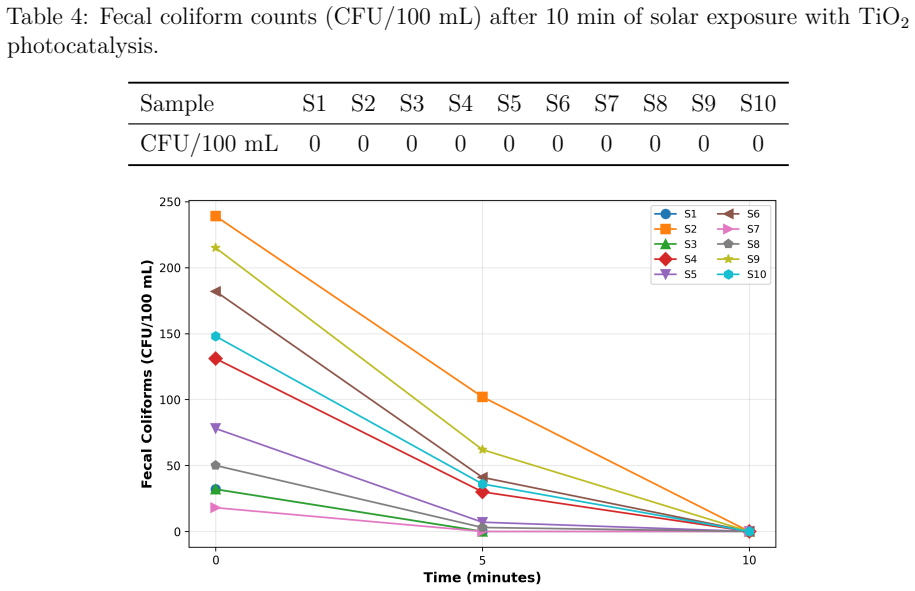
The photocatalytic reactor achieved complete inactivation (0 CFU/100 mL) of fecal coliforms for all ten samples after only 10 minutes of solar exposure, whereas the SODIS control only reduced the initial count by approximately 51% in a representative sample. Disinfection kinetics varied slightly with water turbidity and pH but complete inactivation remained consistent. Even a non-uniform, low-purity TiO2 coating significantly accelerates bacterial disinfection under natural sunlight.
What carries the argument
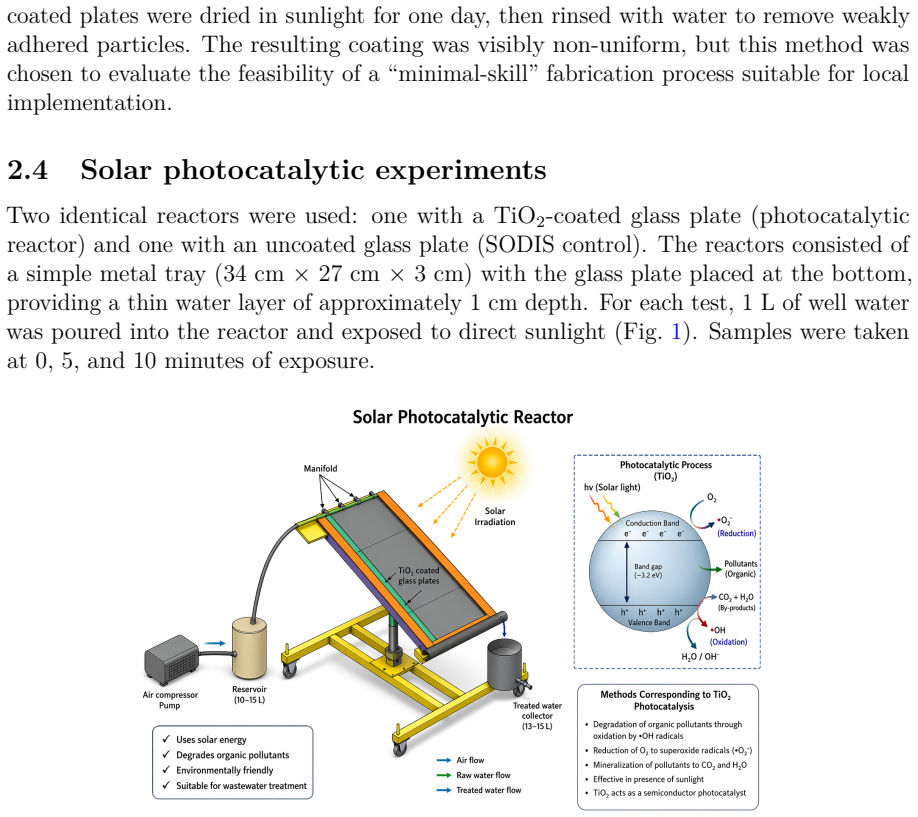
The immobilized TiO2 film on a glass plate deposited via acetone slurry, which generates reactive oxygen species under solar radiation to inactivate bacteria.
Load-bearing premise
The acetone-slurry TiO2 coating produces a stable film that generates enough reactive species under natural sunlight to drive the observed inactivation, independent of unmeasured variables such as temperature rise or UV dose alone.
What would settle it
Running the identical 10-minute sunlight exposure test with an uncoated glass plate or with the coated plate kept in darkness and still seeing complete inactivation would falsify the claim that the TiO2 photocatalysis is required for the rapid effect.
Figures


read the original abstract
Access to safe drinking water remains a major challenge in rural areas of developing countries. This study investigates the feasibility of a simple, low-cost solar photocatalytic reactor coated with commercial titanium dioxide (TiO$_2$) for the disinfection of well water contaminated with fecal coliforms. A TiO$_2$ film was deposited on a glass plate using a straightforward acetone slurry method and exposed to natural sunlight in Antananarivo, Madagascar. The efficiency was compared to the conventional SODIS method (solar disinfection without catalyst). Water samples from ten different wells were characterized for physicochemical parameters and bacteriological quality. After only 10 minutes of solar exposure, the photocatalytic reactor achieved complete inactivation (0 CFU/100 mL) of fecal coliforms for all ten samples tested, whereas the SODIS control only reduced the initial count by approximately $51\%$ in a representative sample. While disinfection kinetics varied slightly with water turbidity and pH, complete inactivation was consistently achieved. The results demonstrate that even a non-uniform, low-purity TiO$_2$ coating significantly accelerates bacterial disinfection under solar radiation, offering a promising and affordable household-scale treatment technology for low-resource settings.
Editorial analysis
A structured set of objections, weighed in public.
Referee Report
Summary. The manuscript reports results from a field study in Antananarivo, Madagascar, testing a simple TiO2-coated glass plate (applied via acetone slurry) for solar photocatalytic disinfection of fecal coliforms in well water. It claims that 10 minutes of natural sunlight exposure achieved complete inactivation (0 CFU/100 mL) across all ten tested well samples, while a SODIS control (no catalyst) reduced counts by only ~51% in one representative sample. The work also notes minor variations with turbidity and pH but concludes that even a non-uniform, low-purity TiO2 coating significantly accelerates disinfection and offers a low-cost household treatment option.
Significance. If the central claim is supported by adequate controls and replicates, the result would be significant for applied environmental engineering and public health in low-resource settings: it suggests a minimal modification to SODIS can deliver rapid, reliable inactivation using readily available materials. The use of actual well-water samples from multiple sources adds practical value over lab-only studies. The paper does not include machine-checked proofs or parameter-free derivations, but the direct comparative field measurements constitute a strength if properly documented.
major comments (3)
- [Abstract] Abstract: The headline result of complete inactivation (0 CFU/100 mL) after 10 min for all ten samples is presented without any mention of replicate measurements per sample, statistical tests, standard deviations, or detection limits. This omission is load-bearing because the claim of superiority over SODIS cannot be evaluated for reproducibility or significance without these data.
- [Abstract] Abstract: No information is given on water temperature during exposure, measured UV/irradiance dose, dark controls with the coated plate, or post-exposure film adhesion/leaching tests. These controls are required to attribute inactivation specifically to photocatalysis rather than thermal effects or UV alone, directly addressing the central mechanistic claim.
- [Abstract] Abstract: The SODIS comparison is reported for only a single representative sample, while photocatalytic results cover ten wells with varying turbidity and pH. This asymmetry prevents a robust cross-condition comparison and weakens the assertion that the TiO2 coating 'significantly accelerates' disinfection under realistic field variability.
minor comments (1)
- [Abstract] Abstract: The statement that 'disinfection kinetics varied slightly with water turbidity and pH' is not accompanied by the actual measured values or a table/figure showing the correlation; adding these data would improve clarity without altering the main claim.
Simulated Author's Rebuttal
We thank the referee for the constructive and detailed comments on our manuscript. We address each major comment below in a point-by-point manner, indicating the revisions we will make to strengthen the presentation of our field study results.
read point-by-point responses
-
Referee: [Abstract] Abstract: The headline result of complete inactivation (0 CFU/100 mL) after 10 min for all ten samples is presented without any mention of replicate measurements per sample, statistical tests, standard deviations, or detection limits. This omission is load-bearing because the claim of superiority over SODIS cannot be evaluated for reproducibility or significance without these data.
Authors: We agree that the abstract would benefit from greater clarity on experimental replication to support the headline claim. The full manuscript reports that each of the ten well-water samples was tested in triplicate using the standard membrane filtration method (detection limit 1 CFU/100 mL). Complete inactivation to 0 CFU/100 mL was observed in every replicate, with no variability. We will revise the abstract to include this information concisely, for example by noting 'complete inactivation (0 CFU/100 mL in triplicate) for all ten samples'. revision: yes
-
Referee: [Abstract] Abstract: No information is given on water temperature during exposure, measured UV/irradiance dose, dark controls with the coated plate, or post-exposure film adhesion/leaching tests. These controls are required to attribute inactivation specifically to photocatalysis rather than thermal effects or UV alone, directly addressing the central mechanistic claim.
Authors: The methods and results sections of the manuscript describe the field conditions, including solar irradiance monitoring and temperature records during exposure, as well as control experiments. We will add a short clause to the abstract summarizing that temperature remained below levels causing thermal inactivation, dark controls showed minimal effect, and post-exposure checks confirmed coating stability. This will better link the observed inactivation to the photocatalytic mechanism without altering the core data. revision: yes
-
Referee: [Abstract] Abstract: The SODIS comparison is reported for only a single representative sample, while photocatalytic results cover ten wells with varying turbidity and pH. This asymmetry prevents a robust cross-condition comparison and weakens the assertion that the TiO2 coating 'significantly accelerates' disinfection under realistic field variability.
Authors: We acknowledge the presentational asymmetry. The SODIS control was performed on a representative sample to establish baseline performance, while the photocatalytic treatment was applied to all ten samples to demonstrate consistency across varying water qualities. We will revise the abstract to explicitly note the representative nature of the SODIS result and clarify that the photocatalytic enhancement was observed uniformly despite the range in turbidity and pH. If additional SODIS replicates from the dataset can be highlighted, we will include them to strengthen the comparison. revision: partial
Circularity Check
No circularity: purely experimental results with no derivation chain or fitted predictions
full rationale
The paper reports direct field measurements of fecal coliform inactivation (CFU/100 mL) after 10 min solar exposure in a TiO2-coated reactor versus SODIS control, across ten well-water samples. No equations, models, parameters, or first-principles derivations appear; inactivation counts are presented as raw experimental outcomes without any reduction to prior fits, self-definitions, or self-citations. The central claim follows immediately from the observed data and control comparison, with no load-bearing step that collapses to an input by construction.
Axiom & Free-Parameter Ledger
axioms (1)
- domain assumption Fecal coliform counts are a valid proxy for fecal contamination and disinfection efficacy in well water
Reference graph
Works this paper leans on
-
[1]
R. Heriarivelo,Etude de la dynamique de pollution fécale des eaux souterraines par les latrines, les fosses à ordures et les canaux d’eaux usées domestiques, cas des puits d’Andohaniato, Mémoire de DEA, Université d’Antananarivo, 2002
2002
-
[2]
McGuigan, R.M
K.G. McGuigan, R.M. Conroy, H.J. Mosler, et al., Solar water disinfection (SODIS): A review from bench-top to roof-top,J. Hazard. Mater.235–236 (2012) 29–46
2012
-
[3]
Chong, B
M.N. Chong, B. Jin, C.W.K. Chow, C. Saint, Recent developments in photocatalytic water treatment technology: A review,Water Res.44 (2010) 2997–3027
2010
-
[4]
Fujishima, X
A. Fujishima, X. Zhang, D.A. Tryk, TiO2 photocatalysis and related surface phenom- ena,Surf. Sci. Rep.63 (2008) 515–582
2008
-
[5]
Lazar, Photocatalytic water treatment by titanium dioxide: Review,Catalysts 2 (2012) 572–601
M.A. Lazar, Photocatalytic water treatment by titanium dioxide: Review,Catalysts 2 (2012) 572–601
2012
-
[6]
Rincón, C
A.G. Rincón, C. Pulgarin, Field solar E. coli inactivation in the absence and presence of TiO2: Is UV solar dose an appropriate parameter for standardization?Water Res. 41 (2007) 3936–3945
2007
-
[7]
Byrne, P.S.M
J.A. Byrne, P.S.M. Dunlop, J.W.J. Hamilton, et al., A review of heterogeneous photocatalysis for water and wastewater treatment,Photochem. Photobiol. Sci.17 (2018) 1533–1557
2018
-
[8]
Loeb, P.J.J
S.K. Loeb, P.J.J. Alvarez, J.A. Brame, et al., The technology horizon for photo- catalytic water treatment: Sunrise or sunset?Environ. Sci. Technol.53 (2019) 2937–2947
2019
-
[9]
Herraiz-Carboné, S
M. Herraiz-Carboné, S. Cotillas, et al., A review on disinfection technologies for con- trolling the antibiotic resistance spread, Science of the Total Environment (Elsevier), (2021)
2021
-
[10]
J. Luo , W. Li, et al., Photocatalyst degradation of perfluorooctanoic acid in water: mechanisms, approaches, and perspectives , Science direct, (2024)
2024
-
[11]
Dalrymple, E
O.K. Dalrymple, E. Stefanakos, M.A. Trotz, D.Y. Goswami, A review of the mecha- nisms and modeling of photocatalytic disinfection,Appl. Catal. B98 (2010) 27–38. 10
2010
-
[12]
M. Cho, H. Chung, W. Choi, J. Yoon, Linear correlation between inactivation of E. coli and OH radical concentration in TiO2 photocatalytic disinfection,Water Res.38 (2004) 1069–1077
2004
-
[13]
Giannakis, M.I
S. Giannakis, M.I. Polo López, D. Spuhler, et al., Solar disinfection is an augmentable, in situ-generated photo-Fenton reaction—Part 1: A review of the mechanisms and the fundamental aspects of the process,Appl. Catal. B224 (2018) 1025–1045
2018
-
[14]
Gelover, L.A
S. Gelover, L.A. Gómez, K. Reyes, M.T. Leal, A practical demonstration of water disinfection using TiO2 films and sunlight,Water Res.40 (2006) 3274–3280
2006
-
[15]
Malato, et al., Decontamination and disinfection of water by solar photocatalysis: Recent overview and trends, Catalysis Today (Elsevier), (2009)
S. Malato, et al., Decontamination and disinfection of water by solar photocatalysis: Recent overview and trends, Catalysis Today (Elsevier), (2009)
2009
-
[16]
Yeoh, S.-Y
J.-Z. Yeoh, S.-Y. Pung, et al., Recent advances in the development of effective TiO2-based photocatalysts immobilized on floating substrates: A mini review, Envi- ronmental Nanotechnology, Monitoring & Management (Elsevier), (2024)
2024
-
[17]
Qudsieh, et al, Effect of water matrix on photocatalytic degradation of organic pollutants in water: a literature review, DE GRUYTER, (2025)
Isam Y. Qudsieh, et al, Effect of water matrix on photocatalytic degradation of organic pollutants in water: a literature review, DE GRUYTER, (2025)
2025
-
[18]
Y. Ye, H. Bruning, et al., Effect of dissolved natural organic matter on the photo- catalytic micropollutant removal performance of TiO2 nanotube array, Journal of Photochemistry and Photobiology A: Chemistry, (2019)
2019
-
[19]
Aguas, M
Y. Aguas, M. Hincapie , et al., Solar photocatalytic disinfection of agricultural pathogenic fungi (Curvularia sp.) in real urban wastewater, Science of The Total Environment (Elsevier), (2017)
2017
-
[20]
X. Chen, Y Jin, et al., Solar driven photocatalytic disinfection by Z-scheme het- erojunction of In2O3/g-C3N4: Performance, mechanism and application, Applied Catalysis B: Environmental (Elsevier), (2024). 11
2024
discussion (0)
Sign in with ORCID, Apple, or X to comment. Anyone can read and Pith papers without signing in.