Recognition: unknown
OpenCLAW-Nexus: A Self-Reinforcing Trust Framework for Byzantine-Resilient Decentralized Federated Learning
Pith reviewed 2026-05-09 20:07 UTC · model grok-4.3
The pith
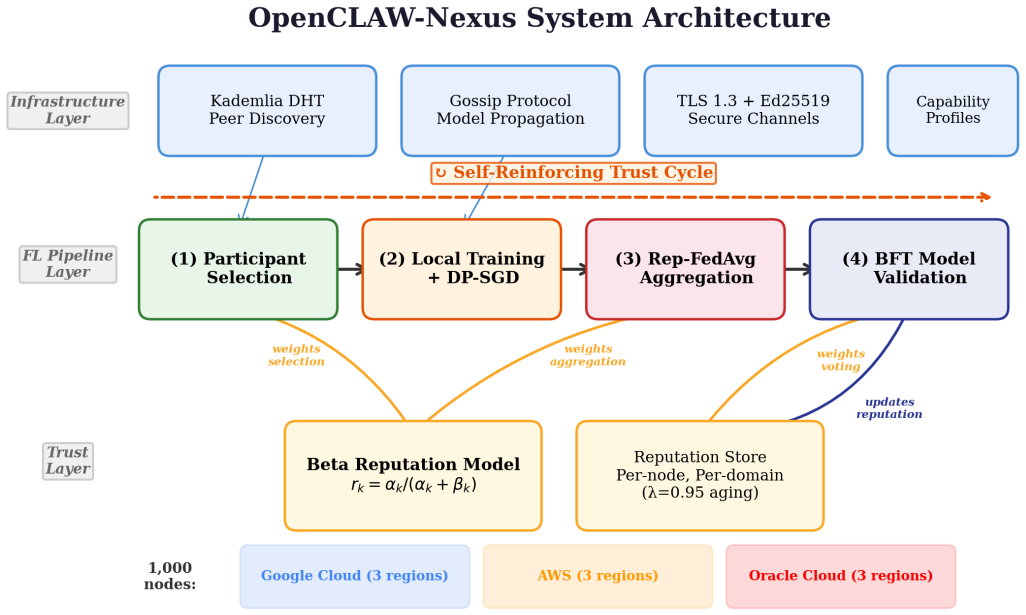
A discounted Beta-reputation model unifies node selection, aggregation, and consensus in decentralized federated learning to separate honest from Byzantine nodes without a trusted root dataset.
A machine-rendered reading of the paper's core claim, the machinery that carries it, and where it could break.
Core claim
OpenCLAW-Nexus uses a discounted Beta-reputation model as a unifying primitive that enables reputation-based node selection, Rep-FedAvg for aggregation without a trusted root dataset, and reputation-aware BFT consensus. The authors formally prove that this model separates the reputations of honest and Byzantine nodes under non-IID data with noisy evaluations. Experiments on a 1,000-node testbed show Rep-FedAvg reaching 72.6% accuracy on non-IID CIFAR-10 with 20% Byzantine nodes and differential privacy, nearly matching centralized FLTrust, while reputation-weighted consensus achieves 84.2% validation correctness under 300-node Sybil attack versus 62.8% for PoW and 47.6% for PoS.
What carries the argument
The discounted Beta-reputation model, a mechanism that updates and discounts node reputations over time to weight their influence in selection, aggregation via Rep-FedAvg, and consensus.
If this is right
- Rep-FedAvg maintains accuracy within 0.5 percentage points of centralized FLTrust on non-IID CIFAR-10 with 20% Byzantine nodes and differential privacy.
- Reputation-weighted consensus reaches 84.2% validation correctness under a 300-node Sybil attack, exceeding PoW at 62.8% and PoS at 47.6%.
- The framework eliminates any requirement for a trusted root dataset in truly decentralized settings.
- A single reputation primitive handles node selection, aggregation, and consensus together.
Where Pith is reading between the lines
- The same reputation separation might apply to other distributed learning setups that face similar non-IID and noisy conditions.
- Longer-running tests could show how the discount factor influences reputation stability over many rounds.
- The model could be combined with additional privacy methods to strengthen protection in larger networks.
- Adaptations might handle attack patterns beyond the 20% Byzantine and 300-node Sybil cases examined.
Load-bearing premise
The discounted Beta-reputation model continues to separate honest and Byzantine nodes reliably when data distributions are non-IID and evaluation results are noisy.
What would settle it
An experiment in which the reputation scores of honest and Byzantine nodes overlap significantly under particular non-IID data partitions or elevated noise levels in evaluations.
Figures


read the original abstract
Decentralized Federated Learning (DFL) eliminates the central aggregator but introduces a severe 'trust gap': without a trusted coordinator, the system becomes vulnerable to Byzantine and Sybil attacks, while existing solutions treat node selection, aggregation, and consensus as isolated modules, often relying on a trusted root dataset unavailable in truly decentralized settings.We propose OpenCLAW-Nexus, a self-reinforcing trust framework that bridges this gap through a single primitive, a discounted Beta-reputation model, that unifies reputation-based node selection, reputation-weighted aggregation Rep-FedAvg, and reputation-aware BFT consensus. Rep-FedAvg eliminates the trusted root dataset requirement; we formally prove reputation separation between honest and Byzantine nodes under non-IID data with noisy evaluations.On a 1,000-node global testbed spanning three cloud providers and nine regions, Rep-FedAvg achieves 72.6% accuracy on non-IID CIFAR-10 with 20% Byzantine nodes and record-level differential privacy, within 0.5,pp of centralized FLTrust.Under a 300-node Sybil attack, reputation-weighted consensus maintains 84.2% validation correctness versus 62.8% (PoW) and 47.6% (PoS).
Editorial analysis
A structured set of objections, weighed in public.
Referee Report
Summary. The paper proposes OpenCLAW-Nexus, a unified trust framework for decentralized federated learning (DFL) built around a single discounted Beta-reputation primitive. This primitive drives reputation-based node selection, reputation-weighted aggregation (Rep-FedAvg), and reputation-aware BFT consensus, eliminating the need for a trusted root dataset. The authors claim a formal proof of strict reputation separation between honest and Byzantine nodes under non-IID data distributions and noisy local evaluations, supported by 1,000-node experiments on non-IID CIFAR-10 (72.6% accuracy with 20% Byzantine nodes and record-level DP, within 0.5 pp of centralized FLTrust) and resilience under a 300-node Sybil attack (84.2% validation correctness).
Significance. If the separation theorem holds under the stated conditions and the 1,000-node results are reproducible with full code and parameter disclosure, the work would provide a concrete, self-reinforcing mechanism that integrates selection, aggregation, and consensus without external trust anchors. This addresses a central open problem in Byzantine-resilient DFL and could influence designs that currently rely on isolated modules or trusted coordinators.
major comments (2)
- [Reputation separation theorem] Reputation separation theorem (likely §4 or §5): the claim of strict ordering between honest and Byzantine nodes under arbitrary non-IID distributions and bounded-but-unknown noise requires explicit bounds on the discount factor, initialization/clipping of Beta parameters, and a Lipschitz or concentration condition on the noise. These are not stated in the abstract or experimental description; without them the separation margin can vanish, rendering both Rep-FedAvg weighting and the BFT consensus circular with respect to the model definition itself.
- [Experimental evaluation] Experimental section (1,000-node testbed): the headline accuracy (72.6%) and Sybil-attack numbers (84.2% vs. 62.8%/47.6%) are reported without error bars, without stating how the discount factor was chosen (free parameter listed in the axiom ledger), and without ablation on the noise model or non-IID degree. This makes it impossible to verify whether the results depend on post-hoc tuning or on the unstated assumptions of the proof.
minor comments (2)
- [Abstract] Abstract: '0.5,pp' should be '0.5 pp'.
- [Introduction / Related Work] Notation: the manuscript introduces 'Rep-FedAvg' and 'reputation-aware BFT consensus' as new entities; a short table comparing them to prior FedAvg variants and BFT protocols would improve readability.
Simulated Author's Rebuttal
We thank the referee for the insightful and constructive comments. We address the two major comments point by point below and commit to revisions that will enhance the clarity and reproducibility of the reputation separation theorem and the experimental results.
read point-by-point responses
-
Referee: Reputation separation theorem (likely §4 or §5): the claim of strict ordering between honest and Byzantine nodes under arbitrary non-IID distributions and bounded-but-unknown noise requires explicit bounds on the discount factor, initialization/clipping of Beta parameters, and a Lipschitz or concentration condition on the noise. These are not stated in the abstract or experimental description; without them the separation margin can vanish, rendering both Rep-FedAvg weighting and the BFT consensus circular with respect to the model definition itself.
Authors: We agree that the assumptions underlying the reputation separation theorem should be stated more explicitly to eliminate concerns about circularity. While the formal proof derives the strict separation using the discounted Beta-reputation model under non-IID data and noisy evaluations, the main text does not sufficiently isolate the necessary conditions. In the revised manuscript, we will add an explicit list of assumptions immediately following the theorem statement, including bounds on the discount factor, rules for Beta parameter initialization and clipping, and a concentration inequality for the noise. This will demonstrate that the separation margin is strictly positive and independent of the specific non-IID distribution, thereby supporting the correctness of Rep-FedAvg and the BFT consensus without circularity. revision: yes
-
Referee: Experimental section (1,000-node testbed): the headline accuracy (72.6%) and Sybil-attack numbers (84.2% vs. 62.8%/47.6%) are reported without error bars, without stating how the discount factor was chosen (free parameter listed in the axiom ledger), and without ablation on the noise model or non-IID degree. This makes it impossible to verify whether the results depend on post-hoc tuning or on the unstated assumptions of the proof.
Authors: We acknowledge that the experimental presentation lacks sufficient detail for independent verification. The reported figures are based on the 1,000-node testbed, but to address this, we will include error bars from repeated trials in the revised version. We will also specify the value and selection process for the discount factor, drawing from the axiom ledger and the separation theorem to justify the choice. Additionally, we will introduce ablation experiments that vary the noise model and the non-IID data degree, confirming that the performance remains consistent with the theoretical guarantees. These changes will make it clear that the results are not due to post-hoc tuning. revision: yes
Circularity Check
No significant circularity detected in derivation chain
full rationale
The paper presents a discounted Beta-reputation model as the core unifying primitive and asserts a formal proof of reputation separation under non-IID data and noisy evaluations. No equations, sections, or self-citations are exhibited in the provided text that reduce the separation theorem, Rep-FedAvg weighting, or BFT consensus to a fitted parameter, self-definition, or author-prior ansatz by construction. The Beta model is a standard statistical primitive with discounting applied; the proof is claimed to derive ordering properties from its update rules rather than presupposing the target separation. Experimental accuracy figures are reported as outcomes of the framework rather than predictions forced by parameter fitting. The derivation therefore remains self-contained against external benchmarks.
Axiom & Free-Parameter Ledger
free parameters (1)
- discount factor
axioms (1)
- domain assumption Reputation separation between honest and Byzantine nodes holds under non-IID data with noisy evaluations
invented entities (2)
-
Rep-FedAvg
no independent evidence
-
reputation-aware BFT consensus
no independent evidence
Reference graph
Works this paper leans on
-
[1]
Communication-Efficient Learning of Deep Net- works from Decentralized Data,
B. McMahanet al., “Communication-Efficient Learning of Deep Net- works from Decentralized Data,” inProc. AISTATS, pp. 1273–1282, 2017
2017
-
[2]
Federated Optimization in Heterogeneous Networks,
T. Liet al., “Federated Optimization in Heterogeneous Networks,” in Proc. MLSys, 2020
2020
-
[3]
Machine Learning with Adversaries: Byzantine Tolerant Gradient Descent,
P. Blanchardet al., “Machine Learning with Adversaries: Byzantine Tolerant Gradient Descent,” inProc. NeurIPS, pp. 119–129, 2017
2017
-
[4]
Byzantine-Robust Distributed Learning: Towards Optimal Statistical Rates,
D. Yinet al., “Byzantine-Robust Distributed Learning: Towards Optimal Statistical Rates,” inProc. ICML, pp. 5650–5659, 2018
2018
-
[5]
FLTrust: Byzantine-Robust Federated Learning via Trust Bootstrapping,
X. Caoet al., “FLTrust: Byzantine-Robust Federated Learning via Trust Bootstrapping,” inProc. NDSS, 2021
2021
-
[6]
FLAME: Taming Backdoors in Federated Learn- ing,
T. D. Nguyenet al., “FLAME: Taming Backdoors in Federated Learn- ing,” inProc. USENIX Security, pp. 1415–1432, 2022
2022
-
[7]
Byzantine-Robust Decentralized Federated Learning,
M. Fanget al., “Byzantine-Robust Decentralized Federated Learning,” inProc. ACM CCS, 2024
2024
-
[8]
Bridging Differential Privacy and Byzantine- Robustness via Model Aggregation,
H. Zhu and Q. Ling, “Bridging Differential Privacy and Byzantine- Robustness via Model Aggregation,” inProc. IJCAI-ECAI, 2022
2022
-
[9]
FLARE: Adaptive Multi-Dimensional Reputation for Robust Client Reliability in Federated Learning,
A. Younesiet al., “FLARE: Adaptive Multi-Dimensional Reputation for Robust Client Reliability in Federated Learning,”arXiv:2511.14715, 2025
work page internal anchor Pith review arXiv 2025
-
[10]
Fed-Credit: Robust Federated Learning with Credibility Management,
J. Chenet al., “Fed-Credit: Robust Federated Learning with Credibility Management,”arXiv:2405.11758, 2024
-
[11]
Evidential Trust-Aware Model Personalization in Decentralized Federated Learning for Wearable IoT,
M. Rangwalaet al., “Evidential Trust-Aware Model Personalization in Decentralized Federated Learning for Wearable IoT,”arXiv:2512.19131, 2025
-
[12]
Flower: A friendly federated learning research framework.arXiv preprint arXiv:2007.14390,
D. J. Beutelet al., “Flower: A Friendly Federated Learning Framework,” arXiv:2007.14390, 2020
-
[13]
Delta Sum Learning: an Approach for Fast and Global Convergence in Gossip Learning,
B. Goethalset al., “Delta Sum Learning: an Approach for Fast and Global Convergence in Gossip Learning,”arXiv:2512.01549, 2025
-
[14]
Kademlia: A Peer-to-Peer Informa- tion System Based on the XOR Metric,
P. Maymounkov and D. Mazi `eres, “Kademlia: A Peer-to-Peer Informa- tion System Based on the XOR Metric,” inProc. IPTPS, LNCS 2429, pp. 53–65, 2002
2002
-
[15]
Practical Byzantine Fault Tolerance,
M. Castro and B. Liskov, “Practical Byzantine Fault Tolerance,” inProc. OSDI, pp. 173–186, 1999
1999
-
[16]
HotStuff: BFT Consensus with Linearity and Respon- siveness,
M. Yinet al., “HotStuff: BFT Consensus with Linearity and Respon- siveness,” inProc. PODC, pp. 347–356, 2019
2019
-
[17]
Honeybee: Byzantine Tol- erant Decentralized Peer Sampling with Verifiable Random Walks,
Y . Zhang and S. B. Venkatakrishnan, “Honeybee: Byzantine Tol- erant Decentralized Peer Sampling with Verifiable Random Walks,” arXiv:2402.16201, 2024
-
[18]
The Sybil Attack,
J. R. Douceur, “The Sybil Attack,” inProc. IPTPS, LNCS 2429, pp. 251–260, 2002
2002
-
[19]
Edwards-Curve Digital Signature Algo- rithm (EdDSA),
S. Josefsson and I. Liusvaara, “Edwards-Curve Digital Signature Algo- rithm (EdDSA),” RFC 8032, 2017
2017
-
[20]
Epidemic Algorithms for Replicated Database Main- tenance,
A. Demerset al., “Epidemic Algorithms for Replicated Database Main- tenance,” inProc. PODC, pp. 1–12, 1987
1987
-
[21]
Dwork and A
C. Dwork and A. Roth,The Algorithmic Foundations of Differential Privacy, NOW Publishers, 2014
2014
-
[22]
Deep Learning with Differential Privacy,
M. Abadiet al., “Deep Learning with Differential Privacy,” inProc. ACM CCS, pp. 308–318, 2016
2016
-
[23]
R ´enyi Differential Privacy,
I. Mironov, “R ´enyi Differential Privacy,” inProc. IEEE CSF, pp. 263– 275, 2017
2017
-
[24]
OpenCLAW: Open-Source Personal AI Platform,
OpenCLAW Project, “OpenCLAW: Open-Source Personal AI Platform,” https://github.com/OpenCLAW, 2025
2025
-
[25]
Lamport,Specifying Systems: The TLA+ Language and Tools for Hardware and Software Engineers, Addison-Wesley, 2002
L. Lamport,Specifying Systems: The TLA+ Language and Tools for Hardware and Software Engineers, Addison-Wesley, 2002
2002
-
[26]
A Little Is Enough: Circumventing Defenses for Distributed Learning,
G. Baruchet al., “A Little Is Enough: Circumventing Defenses for Distributed Learning,” inProc. NeurIPS, 2019
2019
-
[27]
How to Back Door Federated Learning,
E. Bagdasaryanet al., “How to Back Door Federated Learning,” inProc. AISTATS, pp. 2938–2948, 2020
2020
-
[28]
Judging LLM-as-a-Judge with MT-Bench and Chatbot Arena,
L. Zhenget al., “Judging LLM-as-a-Judge with MT-Bench and Chatbot Arena,” inProc. NeurIPS Datasets and Benchmarks Track, 2023
2023
-
[29]
The Beta Reputation System,
A. Jøsang and R. Ismail, “The Beta Reputation System,” inProc. 15th Bled Electron. Commerce Conf., pp. 324–337, 2002
2002
-
[30]
BlockSDN: Towards a High-Performance Blockchain via Software-Defined Cross Networking Optimization,
W. Jia, J. Wang, Z. Yan, P. Xiangli, and G. Yuan, “BlockSDN: Towards a High-Performance Blockchain via Software-Defined Cross Networking Optimization,” inProc. 6th Int. Conf. Computer Engineering and Intelligent Control (ICCEIC), Guangzhou, China, pp. 288–293, 2025
2025
-
[31]
W. Jiaet al., “BlockSDN-VC: A SDN-Based Virtual Coordinate- Enhanced Transaction Broadcast Framework for High-Performance Blockchains,” in X. Wanget al.(eds)Network and Parallel Comput- ing (NPC 2025), LNCS, vol. 16305, pp. Springer, Cham, 2026. doi: 10.1007/978-3-032-10459-5 31
-
[32]
Toward Realistic AI-Generated Student Questions to Support Instructor Training
W. Jia, J. Wang, Z. Yan, T. Liu, and K. Lei, “LLM-Enhanced Het- erogeneous Graph Embedding Model for Multi-Task DNS Security,” in X. Wanget al.(eds)Network and Parallel Computing (NPC 2025), LNCS, vol. 16305, Springer, Cham, 2026. doi: 10.1007/978-3-032- 10459-5 32
-
[33]
SDN-SYN PoW: Adaptive Ingress-Aware Defense with Non-Interactive PoW Against Volumetric SYN Floods
W. Jia, “Adaptive Intent-Aware PoW Mechanism in SDN for Multi- Domain SYN Flood Mitigation,”arXiv:2603.06668 [cs.NI], 2026
work page internal anchor Pith review Pith/arXiv arXiv 2026
discussion (0)
Sign in with ORCID, Apple, or X to comment. Anyone can read and Pith papers without signing in.