Recognition: 3 theorem links
· Lean TheoremOptimally Covering Large Triangles with Homothetic Unit Triangles
Pith reviewed 2026-05-08 18:46 UTC · model grok-4.3
The pith
For any n and excess d in (0,1), a triangle of side n+d can be covered by n²+k homothetic unit triangles exactly when d stays below an explicit threshold that is now determined for every k from 4 to 2n.
A machine-rendered reading of the paper's core claim, the machinery that carries it, and where it could break.
Core claim
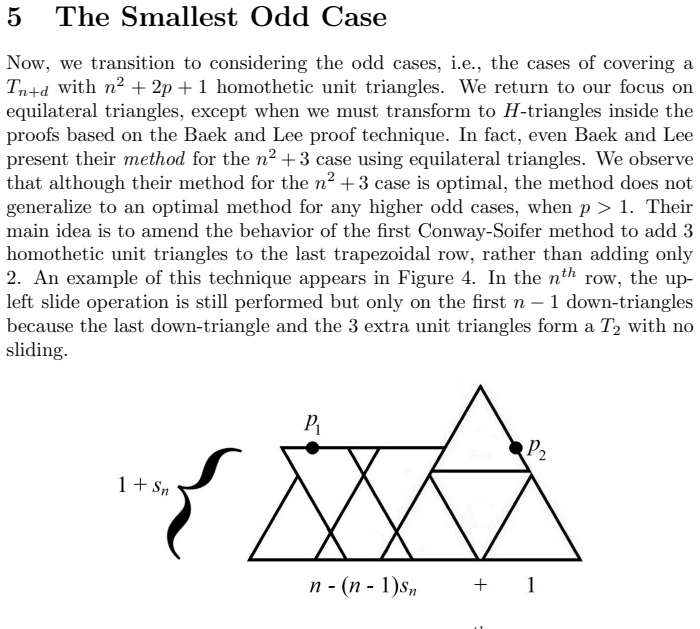
The prior impossibility argument is extended to produce upper bounds on d for which coverage with n²+k homothetic unit triangles is impossible when 4 ≤ k ≤ 2n. These bounds are shown to be tight by two new covering constructions, one for odd k and one for even k, each of which covers every T_{n+d} up to the bound, together with a consolidated method that chooses the construction requiring the smallest total number of unit triangles.
What carries the argument
Two new covering constructions—one specialized to odd values of k and one to even values—that achieve the derived upper bounds on excess side length d, together with the selector that picks the lower-count construction for any given k.
If this is right
- The exact minimal number of homothetic unit triangles needed to cover any T_{n+d} is now known for every d in (0,1) and every natural number n.
- For each fixed k the largest allowable d permitting coverage with exactly n²+k small triangles is given by an explicit expression derived from the extended impossibility argument.
- When k is odd the odd-case construction is optimal; when k is even the even-case construction is optimal, so the selector always returns the overall minimum count.
- The open question of locating tight upper bounds for the n²+k cases with 4 ≤ k ≤ 2n is resolved.
Where Pith is reading between the lines
- The sequence of thresholds as k increases may admit a single closed-form expression for the covering number as a function of d.
- The geometric constructions could be adapted to give analogous exact thresholds for covering problems involving other polygons or in three dimensions.
- For any fixed small n the constructions can be drawn or computed directly to confirm they meet the bound without gaps.
- The parity-based choice between constructions suggests that similar parity distinctions may appear in related covering or packing problems.
Load-bearing premise
The new covering constructions for odd and even k succeed in covering every T_{n+d} up to the stated upper bound on d without gaps or overlaps, and the extended impossibility argument holds uniformly for all 4 ≤ k ≤ 2n.
What would settle it
A concrete counterexample consisting of specific integers n and k together with a value of d at or below the claimed bound for which either construction leaves an uncovered region or a covering with n²+k triangles exists for a d strictly larger than the bound.
Figures



read the original abstract
We answer an open problem in the \emph{American Mathematical Monthly} about covering large triangles. Given a triangle $T$ of any triangular shape with a selected side length between $n \in \mathbb{N}$ and $n+1$, Baek and Lee proved that $T$ could not be covered with $n^2+1$ homothetic unit triangles (with the selected side of length 1). Letting $T_{n+d}$ denote a triangle with selected side length $n + d$ with $d \in (0, 1)$, Baek and Lee extended their proof to establish upper bounds for $d$ above which a $T_{n+d}$ cannot be covered with $n^2+2$ or $n^2+3$ homothetic unit triangles. Then, they showed that these bounds are tight based on analyses of a method by Conway and Soifer for the $n^2+2$ case and their own method for the $n^2+3$ case. Baek and Lee stated as an open problem the need to find tight upper bounds for the $n^2 + k$ cases for $4 \le k \le 2n$. We extend the Baek and Lee proof to establish upper bounds for those higher cases, and we show the upper bounds are tight by presenting two new triangle covering methods for the odd and even cases of $k$ that meet the upper bounds, as well as an optimal consolidated method that uses whichever of the two will cover a given $T_{n+d}$ with the fewest homothetic unit triangles.
Editorial analysis
A structured set of objections, weighed in public.
Referee Report
Summary. The manuscript extends Baek and Lee's impossibility argument to derive upper bounds on the fractional parameter d for which a triangle T_{n+d} cannot be covered by n² + k homothetic unit triangles, for each k with 4 ≤ k ≤ 2n. It then supplies explicit constructions (separate odd-k and even-k methods, plus a consolidated selector that chooses the cheaper of the two) that achieve these bounds for every n, thereby proving the bounds tight and resolving the open problem stated by Baek and Lee.
Significance. If the extension and constructions hold, the work completes the characterization of the minimal number of homothetic unit triangles needed to cover any triangle whose selected side lies between n and n+1. The explicit, parameter-free constructions for all admissible k constitute a concrete algorithmic contribution and permit direct verification; the consolidated selector further optimizes the covering count. The purely combinatorial-geometric setting contains no hidden parameters or fitted constants.
minor comments (3)
- [§3.2] §3.2 (proof extension): the inductive step that lifts the Baek-Lee base case to arbitrary k would benefit from an explicit statement of the induction hypothesis on the uncovered region after placing the first n² triangles.
- [Figure 5] Figure 5 (even-k construction): the caption does not indicate the value of n used in the illustration; adding this would help readers verify the general pattern.
- [§5] The consolidated selector algorithm in §5 is described only in prose; a short pseudocode block would clarify the decision rule between the odd-k and even-k methods.
Simulated Author's Rebuttal
We thank the referee for the positive summary, significance assessment, and recommendation of minor revision. The report accurately captures the extension of Baek and Lee's impossibility argument, the provision of explicit constructions for odd and even k, and the consolidated selector. Since no specific major comments were listed under the MAJOR COMMENTS heading, we have no point-by-point revisions to address.
Circularity Check
No significant circularity; derivation relies on independent constructions
full rationale
The paper extends the Baek-Lee impossibility argument to higher k and establishes tightness via two explicitly described new covering constructions (odd-k and even-k methods) plus a selector that chooses the better one for each T_{n+d}. These constructions are presented as original combinatorial methods that achieve the derived upper bounds on d without any reduction to fitted parameters, self-definitional equations, or load-bearing self-citations. The argument chain is self-contained once the constructions and proof extension are verified, with no step where a claimed bound or prediction is forced by re-using the same inputs or prior results by the same authors.
Axiom & Free-Parameter Ledger
axioms (2)
- domain assumption Homothetic copies preserve shape and orientation (parallel sides) and covering is possible only by translation and uniform scaling.
- domain assumption The impossibility proof technique of Baek and Lee extends verbatim to every k between 4 and 2n.
Reference graph
Works this paper leans on
-
[1]
Jineon Baek and Seewoo Lee. An equilateral triangle of side> ncannot be covered byn 2 + 1 unit equilateral triangles homothetic to it.The Ameri- can Mathematical Monthly, 132(2):113–121, 2025.doi:10.1080/00029890. 2024.2416882
-
[2]
John M. Boyer. Methods for always covering large triangles with similar unit triangles.Geombinatorics, 35(2):45–57, October 2025. URL:https: //geombina.uccs.edu/past-issues/volume-xxxv
2025
-
[3]
John M. Boyer. On the conway and soifer schemas and methods for covering non-equilateral triangles.Geombinatorics, 35(1):5–17, July 2025. URL: https://geombina.uccs.edu/past-issues/volume-xxxv
2025
-
[4]
Conway and Alexander Soifer
John H. Conway and Alexander Soifer. COVER-UP.Geombinatorics, 14(1):8–9, July 2004. URL:https://geombina.uccs.edu/past-issues/ volume-xiv
2004
-
[5]
John H. Conway and Alexander Soifer. Covering a triangle with triangles. The American Mathematical Monthly, 121(1):78, 2005. Available on the last page of https://doi.org/10.1080/00029890.2005.11920171
-
[6]
ON COVERING OF TRIGONS
Dmytro Karabash and Alexander Soifer. ON COVERING OF TRIGONS. Geombinatorics, 15(1):13–17, July 2005. URL:https://geombina.uccs. edu/past-issues/volume-xv
2005
-
[7]
Building a bridge III: from problems of mathematical olympiads to open problems of mathematics.Mathematics Competitions, 23(1):27–38, 2010
Alexander Soifer. Building a bridge III: from problems of mathematical olympiads to open problems of mathematics.Mathematics Competitions, 23(1):27–38, 2010. URL:http://www.wfnmc.org/Journal%202010%201. pdf#page=31. 24
2010
discussion (0)
Sign in with ORCID, Apple, or X to comment. Anyone can read and Pith papers without signing in.