Recognition: 3 theorem links
· Lean TheoremProton-Proton to Antinucleon Cross Sections for Cosmic Ray Applications
Pith reviewed 2026-05-08 18:01 UTC · model grok-4.3
The pith
QCD calculations predict only a mild excess of antineutrons over antiprotons in proton-proton collisions, unlike the large excess claimed by NA49.
A machine-rendered reading of the paper's core claim, the machinery that carries it, and where it could break.
Core claim
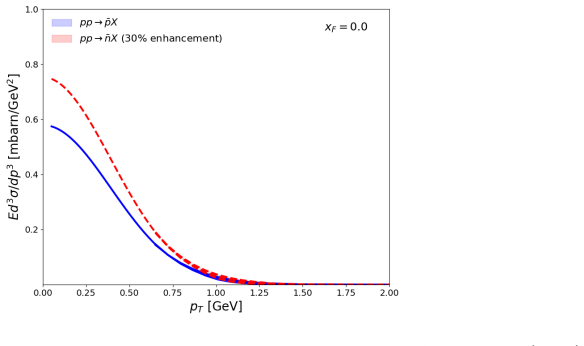
Using collinear factorization at next-to-leading order in QCD, the authors derive predictions for inclusive antiproton and antineutron cross sections. These do not support the NA49 experiment's preliminary finding of a ~30% excess of antineutrons over antiprotons. The results instead point to a mild excess of a few percent. The NA49 result could be reconciled only by invoking sizeable differences in the poorly constrained small transverse momentum region.
What carries the argument
Collinear factorization in perturbative QCD at next-to-leading order, employing parton distribution functions and fragmentation functions to calculate antinucleon production cross sections.
If this is right
- The predictions serve as inputs for calculating secondary antiproton fluxes in cosmic rays.
- Collider data from experiments like NA49 and ALICE are assessed for their applicability to cosmic ray kinematics.
- Characterized uncertainties allow for more reliable modeling of antinucleon production.
- A small excess of antineutrons is expected rather than a large one, affecting ratio measurements in cosmic rays.
Where Pith is reading between the lines
- If the mild excess holds, it would lower the expected background in searches for dark matter annihilation signals in cosmic antiprotons.
- Improved measurements at low transverse momenta could test the need for adjustments in the fragmentation functions.
- Extending the calculations to include nuclear effects could further refine applications to cosmic ray propagation in the galaxy.
Load-bearing premise
Collinear factorization remains valid and the input parton distribution and fragmentation functions are sufficiently accurate in the kinematic regions relevant to cosmic rays, especially at small transverse momenta.
What would settle it
A measurement of the antineutron-to-antiproton ratio in proton-proton collisions at small transverse momenta that confirms the ~30% excess reported by NA49 would falsify the paper's conclusion of only a mild excess.
Figures



read the original abstract
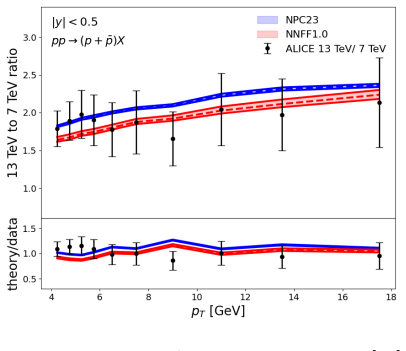
We present predictions of inclusive antiproton and antineutron production cross sections in proton-proton collisions relevant to primary and secondary antiproton production in cosmic ray interactions with interstellar matter. Our predictions are based on collinear factorisation in Quantum Chromodynamics and are accurate to next-to-leading order in the perturbative expansion of the strong coupling. We assess the relevance of cross sections measured at collider experiments, such as NA49 at the CERN SPS and ALICE at the LHC, to the kinetic energy ranges accessed by cosmic ray detectors. We characterise the associated uncertainties due to the input parton distribution and fragmentation functions, and to missing higher orders. We critically examine the ~30% excess of antineutron over antiproton production in proton-proton collisions preliminarily reported by the NA49 experiment by combining our predictions with a data-driven model. Our results do not support the NA49 finding, and point to a mild excess of a few percent. We finally show that the NA49 result could only be reconciled with our framework by invoking sizeable differences between antiproton and antineutron production in the poorly constrained region of small transverse momenta of the produced hadron.
Editorial analysis
A structured set of objections, weighed in public.
Referee Report
Summary. The manuscript presents next-to-leading-order predictions in collinear QCD factorization for inclusive antiproton and antineutron production cross sections in proton-proton collisions, with applications to cosmic-ray secondary production. It quantifies uncertainties from PDFs, fragmentation functions, and missing higher orders, assesses the relevance of NA49 and ALICE collider data to cosmic-ray kinematics, and critically compares against the preliminary NA49 report of a ~30% antineutron excess, concluding that the framework yields only a mild few-percent excess and that reconciliation with NA49 would require large differences at small transverse momenta.
Significance. If the central results hold, the work supplies improved, uncertainty-quantified inputs for modeling antiproton fluxes in cosmic rays, helping to clarify whether observed excesses arise from astrophysics or hadronic production. The explicit treatment of PDF/FF uncertainties and the data-driven reconciliation model constitute a useful bridge between collider measurements and astrophysical applications.
major comments (1)
- [Abstract] Abstract: the claim that the results 'do not support the NA49 finding' and indicate only a 'mild excess of a few percent' is load-bearing for the paper's main conclusion, yet it rests on the assumption that NLO collinear factorization plus existing PDFs/FFs remain reliable in the small-pT region that dominates both the NA49 data and the cosmic-ray kinematics. The abstract itself states that reconciliation would require 'sizeable differences ... in the poorly constrained region of small transverse momenta,' creating a circularity risk that needs explicit sensitivity tests or alternative low-pT modeling to substantiate.
minor comments (2)
- [Abstract] The abstract and introduction would benefit from a concise statement of the precise kinematic cuts (e.g., minimum pT or x ranges) adopted for the cosmic-ray-relevant predictions.
- Clarify in the text how the 'data-driven model' for reconciling NA49 is constructed and whether it introduces additional free parameters beyond the standard PDFs and FFs.
Simulated Author's Rebuttal
We thank the referee for the careful reading of our manuscript and for highlighting an important point regarding the assumptions in our abstract and conclusions. We address this comment below and outline revisions to strengthen the discussion of low-pT reliability.
read point-by-point responses
-
Referee: [Abstract] Abstract: the claim that the results 'do not support the NA49 finding' and indicate only a 'mild excess of a few percent' is load-bearing for the paper's main conclusion, yet it rests on the assumption that NLO collinear factorization plus existing PDFs/FFs remain reliable in the small-pT region that dominates both the NA49 data and the cosmic-ray kinematics. The abstract itself states that reconciliation would require 'sizeable differences ... in the poorly constrained region of small transverse momenta,' creating a circularity risk that needs explicit sensitivity tests or alternative low-pT modeling to substantiate.
Authors: We agree that the reliability of NLO collinear factorization at small transverse momenta is a key assumption, given its dominance in both the NA49 kinematics and cosmic-ray applications. Our analysis is performed entirely within this framework, with uncertainties from PDFs, FFs, and scale variations already quantified and shown to be insufficient to accommodate a 30% excess. The abstract statement is not circular: it demonstrates that, under standard perturbative QCD inputs, only a mild excess arises, and any reconciliation with NA49 would necessitate non-standard differences precisely in the low-pT region where the framework is least constrained. This highlights a limitation rather than assuming perfect validity. To address the concern directly, we will add explicit sensitivity tests (varying the pT cutoff and factorization/renormalization scales in the low-pT regime) and a short discussion of alternative low-pT approaches (e.g., phenomenological adjustments or Regge-inspired models). These will be incorporated in the revised manuscript. revision: yes
Circularity Check
No significant circularity: predictions derived from standard NLO collinear factorization with external inputs
full rationale
The paper computes inclusive antinucleon cross sections at NLO in QCD using collinear factorization, input PDFs and FFs taken from prior literature, and a separate data-driven model only for post-hoc reconciliation with NA49. The central claim (mild few-percent excess, not supporting NA49's ~30%) follows directly from comparing these independent predictions to the data; the predictions are not fitted to NA49 and do not reduce to the target result by construction. The abstract's note that reconciliation would require differences in the small-pT region is an explicit acknowledgment of framework limitations rather than a self-justifying loop. No self-citations, ansatze, or uniqueness theorems from the authors are invoked as load-bearing steps in the derivation chain. Without equations or sections in the provided text that exhibit reduction of outputs to the paper's own fitted quantities or self-referential definitions, the derivation remains self-contained against external benchmarks.
Axiom & Free-Parameter Ledger
free parameters (2)
- Parton distribution functions
- Fragmentation functions
axioms (2)
- domain assumption Collinear factorization holds for the inclusive production process
- standard math Perturbative QCD expansion is valid at next-to-leading order
Lean theorems connected to this paper
-
Cost.FunctionalEquation (J-cost) — not used by paperwashburn_uniqueness_aczel unclearR = 1.048 +0.003/−0.011 ... points to a ratio close to unity, with at most a mild enhancement of antineutron over antiproton production at the level of a few percent.
Reference graph
Works this paper leans on
-
[1]
Cosmic-ray propagation and interactions in the Galaxy,
A. W. Strong, I. V. Moskalenko, and V. S. Ptuskin, “Cosmic-ray propagation and interactions in the Galaxy,” Ann. Rev. Nucl. Part. Sci.57(2007) 285–327, arXiv:astro-ph/0701517
-
[2]
The origin of Galactic cosmic rays: challenges to the standard paradigm,
S. Gabici, C. Evoli, D. Gaggero, P. Lipari, P. Mertsch, E. Orlando, A. Strong, and A. Vittino, “The origin of Galactic cosmic rays: challenges to the standard paradigm,” Int. J. Mod. Phys. D28no. 15, (2019) 1930022,arXiv:1903.11584 [astro-ph.HE]
-
[3]
Antiprotons in cosmic rays from neutralino annihilation,
F. Donato, N. Fornengo, D. Maurin, and P. Salati, “Antiprotons in cosmic rays from neutralino annihilation,” Phys. Rev. D69(2004) 063501,arXiv:astro-ph/0306207
-
[4]
Silk et al., Particle Dark Matter: Observations, Models and Searches
J. Silk et al., Particle Dark Matter: Observations, Models and Searches. Cambridge Univ. Press, Cambridge, 2010
2010
-
[5]
G. Bertone and D. Hooper, “History of dark matter,” Rev. Mod. Phys.90no. 4, (2018) 045002,arXiv:1605.04909 [astro-ph.CO]
work page Pith review arXiv 2018
-
[6]
M. Cirelli, A. Strumia, and J. Zupan, “Dark Matter,”arXiv:2406.01705 [hep-ph]
work page internal anchor Pith review arXiv
-
[7]
Indirect Dark Matter Detection with Cosmic Antimatter,
P. Salati, F. Donato, and N. Fornengo, “Indirect Dark Matter Detection with Cosmic Antimatter,” Particle Dark Matter: Observations, Models and Searches (3, 2010) 521–546, arXiv:1003.4124 [astro-ph.HE]. [8]P AMELACollaboration, O. Adriani et al., “Ten years of PAMELA in space,” Riv. Nuovo Cim.40no. 10, (2017) 473–522,arXiv:1801.10310 [astro-ph.HE]. [9]AMSC...
-
[8]
Anti-protons from spallations of cosmic rays on interstellar matter,
F. Donato, D. Maurin, P. Salati, A. Barrau, G. Boudoul, and R. Taillet, “Anti-protons from spallations of cosmic rays on interstellar matter,” Astrophys. J.563(2001) 172–184, arXiv:astro-ph/0103150
- [9]
-
[10]
M. Boudaud, Y. G´ enolini, L. Derome, J. Lavalle, D. Maurin, P. Salati, and P. D. Serpico, “AMS-02 antiprotons’ consistency with a secondary astrophysical origin,” Phys. Rev. Res.2 no. 2, (2020) 023022,arXiv:1906.07119 [astro-ph.HE]
-
[11]
M. Di Mauro, M. Korsmeier, and A. Cuoco, “Data-driven constraints on cosmic-ray diffusion: Probing self-generated turbulence in the Milky Way,” Phys. Rev. D109no. 12, (2024) 123003,arXiv:2311.17150 [astro-ph.HE]
-
[12]
F. Donato, M. Korsmeier, and M. Di Mauro, “Prescriptions on antiproton cross section data for precise theoretical antiproton flux predictions,” Phys. Rev. D96no. 4, (2017) 043007, arXiv:1704.03663 [astro-ph.HE]
-
[13]
D. Maurin et al., “Precision cross-sections for advancing cosmic-ray physics and other applications: a comprehensive programme for the next decade,” 2503.16173 (3, 2025) , arXiv:2503.16173 [astro-ph.HE]
-
[14]
Antiprotons from dark matter annihilation in the Galaxy: astrophysical uncertainties,
C. Evoli, I. Cholis, D. Grasso, L. Maccione, and P. Ullio, “Antiprotons from dark matter annihilation in the Galaxy: astrophysical uncertainties,” Phys. Rev. D85(2012) 123511, arXiv:1108.0664 [astro-ph.HE]
-
[15]
Y. G´ enolini, M. Boudaud, M. Cirelli, L. Derome, J. Lavalle, D. Maurin, P. Salati, and N. Weinrich, “New minimal, median, and maximal propagation models for dark matter searches with Galactic cosmic rays,” Phys. Rev. D104no. 8, (3, 2021) 083005, arXiv:2103.04108 [astro-ph.HE]
- [16]
-
[17]
New evaluation of the antiproton production cross section for cosmic ray studies,
M. di Mauro, F. Donato, A. Goudelis, and P. D. Serpico, “New evaluation of the antiproton production cross section for cosmic ray studies,” Phys. Rev. D90no. 8, (2014) 085017, arXiv:1408.0288 [hep-ph]. [Erratum: Phys.Rev.D 98, 049901 (2018)]
-
[18]
Cosmic Ray Antiprotons at High Energies,
M. W. Winkler, “Cosmic Ray Antiprotons at High Energies,” JCAP02(2017) 048, arXiv:1701.04866 [hep-ph]. 18
-
[19]
M. Korsmeier, F. Donato, and M. Di Mauro, “Production cross sections of cosmic antiprotons in the light of new data from the NA61 and LHCb experiments,” Phys. Rev. D 97no. 10, (2018) 103019,arXiv:1802.03030 [astro-ph.HE]. [25]NA49Collaboration, H. G. Fischer, “Baryon yields, isospin effects and strangeness production in elementary hadronic interactions,” ...
-
[20]
Tuning PYTHIA 8.1: the Monash 2013 Tune
P. Skands, S. Carrazza, and J. Rojo, “Tuning PYTHIA 8.1: the Monash 2013 Tune,” Eur. Phys. J. C74no. 8, (2014) 3024,arXiv:1404.5630 [hep-ph]
work page Pith review arXiv 2013
-
[21]
M. di Mauro, J. Koechler, L. Stefanuto, F. Bellini, F. Donato, and N. Fornengo, “Toward universal coalescence models for antideuteron production,”arXiv:2603.19352 [hep-ph]
-
[22]
Basic model for high energy cosmic ray interactions,
S. Ostapchenko, T. Pierog, and G. Sigl, “Basic model for high energy cosmic ray interactions,” Phys. Rev. D113no. 7, (2026) 074001,arXiv:2603.12863 [hep-ph]
-
[23]
J. Collins and J.-W. Qiu, “k T factorization is violated in production of high-transverse-momentum particles in hadron-hadron collisions,” Phys. Rev. D75(2007) 114014,arXiv:0705.2141 [hep-ph]
-
[24]
No Generalized TMD-Factorization in Hadro-Production of High Transverse Momentum Hadrons,
T. C. Rogers and P. J. Mulders, “No Generalized TMD-Factorization in Hadro-Production of High Transverse Momentum Hadrons,” Phys. Rev. D81(2010) 094006, arXiv:1001.2977 [hep-ph]. [31]NA49Collaboration, T. Anticic et al., “Inclusive production of protons, anti-protons and neutrons in p+p collisions at 158-GeV/c beam momentum,” Eur. Phys. J. C65(2010) 9–63,...
-
[25]
QCD Corrections to Parton-Parton Scattering Processes,
F. Aversa, P. Chiappetta, M. Greco, and J. P. Guillet, “QCD Corrections to Parton-Parton Scattering Processes,” Nucl. Phys. B327(1989) 105
1989
-
[26]
Largep T inclusiveπ 0 cross-sections and next-to-leading-order QCD predictions,
P. Aurenche, M. Fontannaz, J. P. Guillet, B. A. Kniehl, and M. Werlen, “Large p(T) inclusive pi0 cross-sections and next-to-leading-order QCD predictions,” Eur. Phys. J. C13 (2000) 347–355,arXiv:hep-ph/9910252
-
[27]
Next-to-leading order QCD corrections to one hadron production in polarized pp collisions at RHIC,
D. de Florian, “Next-to-leading order QCD corrections to one hadron production in polarized pp collisions at RHIC,” Phys. Rev. D67(2003) 054004,arXiv:hep-ph/0210442
-
[28]
B. Jager, A. Schafer, M. Stratmann, and W. Vogelsang, “Next-to-leading order QCD corrections to high p(T) pion production in longitudinally polarized pp collisions,” Phys. Rev. D67(2003) 054005,arXiv:hep-ph/0211007. 19
- [29]
-
[30]
S. Carrazza, E. R. Nocera, C. Schwan, and M. Zaro, “PineAPPL: combining EW and QCD corrections for fast evaluation of LHC processes,” JHEP12(2020) 108,arXiv:2008.12789 [hep-ph]
-
[31]
J. Cruz-Martinez, T. Hasenack, F. Hekhorn, G. Magni, E. R. Nocera, T. R. Rabemananjara, J. Rojo, T. Sharma, and G. van Seeventer, “NNPDFpol2.0: a global determination of polarised PDFs and their uncertainties at next-to-next-to-leading order,” JHEP07(2025) 168,arXiv:2503.11814 [hep-ph]
-
[32]
A Critical phenomenological study of inclusive photon production in hadronic collisions,
P. Aurenche, M. Fontannaz, J. P. Guillet, B. A. Kniehl, E. Pilon, and M. Werlen, “A Critical phenomenological study of inclusive photon production in hadronic collisions,” Eur. Phys. J. C9(1999) 107–119,arXiv:hep-ph/9811382
-
[33]
Automated calculation of jet fragmentation at NLO in QCD,
C. Liu, X. Shen, B. Zhou, and J. Gao, “Automated calculation of jet fragmentation at NLO in QCD,” JHEP09(2023) 108,arXiv:2305.14620 [hep-ph]
-
[34]
D. d’Enterria, K. J. Eskola, I. Helenius, and H. Paukkunen, “Confronting current NLO parton fragmentation functions with inclusive charged-particle spectra at hadron colliders,” Nucl. Phys. B883(2014) 615–628,arXiv:1311.1415 [hep-ph]. [46]NNPDFCollaboration, R. D. Ball et al., “The path to proton structure at 1% accuracy,” Eur. Phys. J. C82no. 5, (2022) 4...
-
[35]
Fragmentation functions for pions, kaons, and protons at next-to-leading order
B. A. Kniehl, G. Kramer, and B. Potter, “Fragmentation functions for pions, kaons, and protons at next-to-leading order,” Nucl. Phys. B582(2000) 514–536, arXiv:hep-ph/0010289
-
[36]
Fragmentation functions for light charged hadrons with complete quark flavor separation,
S. Albino, B. A. Kniehl, and G. Kramer, “Fragmentation functions for light charged hadrons with complete quark flavor separation,” Nucl. Phys. B725(2005) 181–206, arXiv:hep-ph/0502188
-
[37]
Determination of fragmentation functions and their uncertainties,
M. Hirai, S. Kumano, T. H. Nagai, and K. Sudoh, “Determination of fragmentation functions and their uncertainties,” Phys. Rev. D75(2007) 094009,arXiv:hep-ph/0702250
-
[38]
Global analysis of fragmentation functions for protons and charged hadrons,
D. de Florian, R. Sassot, and M. Stratmann, “Global analysis of fragmentation functions for protons and charged hadrons,” Phys. Rev. D76(2007) 074033,arXiv:0707.1506 [hep-ph]
-
[39]
Global analysis of fragmentation functions to charged hadrons with high-precision data from the LHC,
J. Gao, C. Liu, X. Shen, H. Xing, and Y. Zhao, “Global analysis of fragmentation functions to charged hadrons with high-precision data from the LHC,” Phys. Rev. D110no. 11, (2024) 114019,arXiv:2407.04422 [hep-ph]
-
[40]
LHAPDF6: parton density access in the LHC precision era
A. Buckley, J. Ferrando, S. Lloyd, K. Nordstr¨ om, B. Page, M. R¨ ufenacht, M. Sch¨ onherr, and G. Watt, “LHAPDF6: parton density access in the LHC precision era,” Eur. Phys. J. C75 (2015) 132,arXiv:1412.7420 [hep-ph]. 20 [54]NA49Collaboration, C. Alt et al., “Inclusive production of charged pions in p+p collisions at 158-GeV/c beam momentum,” Eur. Phys. ...
work page Pith review arXiv 2015
-
[41]
Letter of Intent: A New QCD facility at the M2 beam line of the CERN SPS (COMPASS++/AMBER),
B. Adams et al., “Letter of Intent: A New QCD facility at the M2 beam line of the CERN SPS (COMPASS++/AMBER),” 8, 2018. [56]AMBERCollaboration, D. Giordano, “First measurement of antiproton cross section in p-He collisions at the AMBER Experiment at CERN,” PoSICHEP2024(2025) 757. [57]AMBERCollaboration, D. Giordano, “First measurement of antiproton cross-...
2018
-
[42]
Boente Garcia et al.,High-density gas target at the LHCb experiment, Phys
O. Boente Garcia et al., “High-density gas target at the LHCb experiment,” Phys. Rev. Accel. Beams27no. 11, (2024) 111001,arXiv:2407.14200 [physics.ins-det]
-
[43]
S. Dulat, T.-J. Hou, J. Gao, M. Guzzi, J. Huston, P. Nadolsky, J. Pumplin, C. Schmidt, D. Stump, and C. P. Yuan, “New parton distribution functions from a global analysis of quantum chromodynamics,” Phys. Rev. D93no. 3, (2016) 033006,arXiv:1506.07443 [hep-ph]. 21
discussion (0)
Sign in with ORCID, Apple, or X to comment. Anyone can read and Pith papers without signing in.