Recognition: 3 theorem links
· Lean TheoremEstablishing Mixed-State Phase Equivalence beyond Renormalization Fixed Points
Pith reviewed 2026-05-08 18:03 UTC · model grok-4.3
The pith
Low-depth quasi-local channel circuits connect states within each of two distinct one-dimensional mixed-state phases.
A machine-rendered reading of the paper's core claim, the machinery that carries it, and where it could break.
Core claim
We construct a quantum phase transition connecting two distinct one-dimensional fixed points, both exhibiting finite conditional mutual information and one of which is intrinsically nontrivial. We analytically establish phase equivalence within each of the two phases by explicitly constructing low-depth, quasi-local channel circuits that connect states within each phase. Our approach leverages the parent Lindbladian construction to generate the desired channel circuits. This framework generalizes naturally to a broad class of intrinsically nontrivial mixed-state quantum phases.
What carries the argument
Parent Lindbladian construction that generates low-depth quasi-local channel circuits to connect states inside each phase.
If this is right
- States inside each phase become equivalent under low-depth quasi-local operations.
- The same parent-Lindbladian method applies to a wide family of intrinsically nontrivial mixed states.
- A quantum phase transition separates the two phases while both keep finite conditional mutual information.
- Phase equivalence can now be checked analytically outside the renormalization fixed-point limit.
Where Pith is reading between the lines
- The circuits could be used as a practical test for phase membership in numerical simulations of open systems.
- The construction suggests a route to define mixed-state phases in two dimensions by finding suitable parent Lindbladians.
- Experimental platforms with controllable dissipation might realize the low-depth circuits directly.
Load-bearing premise
The parent Lindbladian construction actually produces low-depth quasi-local channel circuits that connect any two states belonging to the same phase, and the two phases remain distinct with one intrinsically nontrivial.
What would settle it
An explicit pair of states inside one claimed phase for which no finite-depth quasi-local channel circuit exists, or a calculation showing the constructed circuits require depth that grows with system size.
Figures


read the original abstract
Understanding mixed-state quantum phases is a central challenge in the era of quantum simulation, where many existing studies focus on renormalization fixed points. In this work, we move beyond the renormalization fixed-point paradigm by constructing a quantum phase transition connecting two distinct one-dimensional fixed points, both exhibiting finite conditional mutual information and one of which is intrinsically nontrivial. We analytically establish phase equivalence within each of the two phases by explicitly constructing low-depth, quasi-local channel circuits that connect states within each phase. Crucially, our approach leverages the parent Lindbladian construction to generate the desired channel circuits. We further demonstrate that this framework generalizes naturally to a broad class of intrinsically nontrivial mixed-state quantum phases. Our method establishes a framework for rigorously analyzing phase equivalence of intrinsically non-trivial mixed states beyond the renormalization fixed points.
Editorial analysis
A structured set of objections, weighed in public.
Referee Report
Summary. The paper constructs a quantum phase transition in one dimension between two distinct mixed-state fixed points, both with finite conditional mutual information and one intrinsically nontrivial. It analytically establishes phase equivalence within each phase by explicitly building low-depth quasi-local channel circuits that connect arbitrary states inside the phases, using parent Lindbladian constructions to generate these circuits. The framework is claimed to generalize to a broad class of intrinsically nontrivial mixed-state phases, moving beyond the renormalization fixed-point paradigm.
Significance. If the constructions hold with uniform quasi-locality and bounded depth throughout the phases, this provides an analytic route to define and connect mixed-state phases away from fixed points. This is significant for open quantum systems and quantum simulation, as it offers explicit, parameter-free equivalences and a template for nontrivial phases. The use of Lindbladians for circuit generation is a concrete strength when it succeeds.
major comments (1)
- [parent Lindbladian construction and channel-circuit generation] The central claim that parent Lindbladians generate low-depth, uniformly quasi-local channel circuits connecting arbitrary states within each phase (not merely the fixed points) is load-bearing. The manuscript must demonstrate that the Lindbladian remains gapped with interaction range and circuit depth independent of distance from the fixed point and of system size; without explicit bounds or a proof that quasi-locality is preserved along the entire phase, the equivalence relation does not yet extend beyond renormalization fixed points as asserted in the abstract and construction sections.
minor comments (2)
- The abstract is dense; a brief sentence clarifying the dimension and the role of conditional mutual information would improve accessibility.
- Notation for the channel circuits and Lindbladian generators should be introduced with explicit definitions before their use in the equivalence proofs.
Simulated Author's Rebuttal
We thank the referee for the careful reading and constructive feedback. The major comment correctly identifies a key requirement for extending phase equivalence beyond fixed points. We address it point by point below and will revise the manuscript to include the requested explicit demonstration.
read point-by-point responses
-
Referee: The central claim that parent Lindbladians generate low-depth, uniformly quasi-local channel circuits connecting arbitrary states within each phase (not merely the fixed points) is load-bearing. The manuscript must demonstrate that the Lindbladian remains gapped with interaction range and circuit depth independent of distance from the fixed point and of system size; without explicit bounds or a proof that quasi-locality is preserved along the entire phase, the equivalence relation does not yet extend beyond renormalization fixed points as asserted in the abstract and construction sections.
Authors: We agree that uniform bounds on the gap, interaction range, and circuit depth are necessary to substantiate the claim for arbitrary states in the phase. In the parent Lindbladian construction, the Lindbladian for a general state in the phase is obtained by a local interpolation from the fixed-point Lindbladian, with driving terms determined by the state's local reduced density matrices. Because the phase is characterized by invariants such as finite conditional mutual information that are uniform throughout the phase, the resulting Lindbladian inherits a gap and locality range bounded by constants that depend only on these invariants and are independent of both system size and distance to the fixed point. The channel circuit is then generated by a fixed-time evolution under this Lindbladian, yielding bounded depth. While the manuscript presents the construction for arbitrary states, we acknowledge that an explicit lemma establishing these uniform bounds was not included. In the revised manuscript we will add a dedicated subsection containing a proof that the interaction range remains O(1) and the evolution time (hence depth) is bounded uniformly, using the phase invariants to control the gap and locality along the interpolation path. revision: yes
Circularity Check
No circularity: explicit constructions rely on independent Lindbladian tools
full rationale
The paper's central step is the analytic construction of low-depth quasi-local channel circuits via parent Lindbladians to connect states inside each phase, extending the equivalence relation beyond renormalization fixed points. This uses standard conditional mutual information and Lindbladian generators without defining any quantity in terms of itself, without fitting parameters to data and then relabeling the fit as a prediction, and without load-bearing self-citations that merely rename prior ansatzes. The derivation chain therefore remains self-contained against external benchmarks rather than reducing to its own inputs by construction.
Axiom & Free-Parameter Ledger
axioms (1)
- standard math Standard assumptions of open quantum systems and Lindblad master equation formalism
Lean theorems connected to this paper
-
Cost/FunctionalEquation.lean (J(x) = ½(x+x⁻¹)−1 uniqueness): the paper's λ is a free tuning parameter, not a J-cost ratio or φ-ladder rungwashburn_uniqueness_aczel unclear?
unclearRelation between the paper passage and the cited Recognition theorem.
ρ(λ) = (1^⊗N + X^⊗N)Λ(λ) for λ≥0; (1^⊗N + CZX^(N))Λ(λ) for λ≤0. Path of CP-map fixed points parameterized by λ ∈ [−1,1].
What do these tags mean?
- matches
- The paper's claim is directly supported by a theorem in the formal canon.
- supports
- The theorem supports part of the paper's argument, but the paper may add assumptions or extra steps.
- extends
- The paper goes beyond the formal theorem; the theorem is a base layer rather than the whole result.
- uses
- The paper appears to rely on the theorem as machinery.
- contradicts
- The paper's claim conflicts with a theorem or certificate in the canon.
- unclear
- Pith found a possible connection, but the passage is too broad, indirect, or ambiguous to say the theorem truly supports the claim.
Forward citations
Cited by 1 Pith paper
-
Mixed-State Long-Range Entanglement from Dimensional Constraints
The maximally mixed state in the translation-invariant subspace of a 1D ring is long-range entangled because the dimension of translationally symmetric short-range entangled states grows polynomially while the full su...
Reference graph
Works this paper leans on
-
[1]
Chen, Z.-C
X. Chen, Z.-C. Gu, and X.-G. Wen, Local unitary transformation, long-range quantum entanglement, wave function renormalization, and topological or- der, Phys. Rev. B82, 155138 (2010)
2010
-
[2]
Schuch, D
N. Schuch, D. P´ erez-Garc´ ıa, and I. Cirac, Classi- fying quantum phases using matrix product states and projected entangled pair states, Phys. Rev. B 84, 165139 (2011)
2011
-
[3]
M. M. Wolf, G. Ortiz, F. Verstraete, and J. I. Cirac, Quantum phase transitions in matrix product sys- tems, Phys. Rev. Lett.97, 110403 (2006)
2006
-
[4]
N. G. Jones, J. Bibo, B. Jobst, F. Pollmann, A. Smith, and R. Verresen, Skeleton of matrix- product-state-solvable models connecting topolog- ical phases of matter, Phys. Rev. Res.3, 033265 (2021)
2021
-
[5]
Coser and D
A. Coser and D. P´ erez-Garc´ ıa, Classification of phases for mixed states via fast dissipative evolu- tion, Quantum3, 174 (2019)
2019
-
[6]
S. Sang, Y. Zou, and T. H. Hsieh, Mixed-state quan- tum phases: Renormalization and quantum error correction, Phys. Rev. X14, 031044 (2024)
2024
-
[7]
Ruiz-de Alarc´ on, J
A. Ruiz-de Alarc´ on, J. Garre-Rubio, A. Moln´ ar, and D. P´ erez-Garc´ ıa, Matrix product operator algebras ii: phases of matter for 1d mixed states, Letters in Mathematical Physics114, 43 (2024)
2024
-
[8]
L. A. Lessa, M. Cheng, and C. Wang, Mixed-state quantum anomaly and multipartite entanglement, Phys. Rev. X15, 011069 (2025)
2025
-
[9]
X.-Q. Sun, Anomalous matrix product opera- tor symmetries and 1d mixed-state phases, arXiv preprint arXiv:2504.16985 (2025)
-
[10]
T. D. Ellison and M. Cheng, Toward a classification of mixed-state topological orders in two dimensions, PRX Quantum6, 010315 (2025)
2025
-
[11]
Sohal and A
R. Sohal and A. Prem, Noisy approach to intrinsi- cally mixed-state topological order, PRX Quantum 6, 010313 (2025)
2025
-
[12]
de Groot, A
C. de Groot, A. Turzillo, and N. Schuch, Symmetry protected topological order in open quantum sys- tems, Quantum6, 856 (2022)
2022
-
[13]
Ma and C
R. Ma and C. Wang, Average symmetry-protected topological phases, Phys. Rev. X13, 031016 (2023)
2023
-
[14]
Guo, J.-H
Y. Guo, J.-H. Zhang, H.-R. Zhang, S. Yang, and Z. Bi, Locally purified density operators for symmetry-protected topological phases in mixed states, Phys. Rev. X15, 021060 (2025)
2025
-
[15]
J. I. Cirac, D. Perez-Garcia, N. Schuch, and F. Ver- straete, Matrix product density operators: Renor- malization fixed points and boundary theories, An- nals of Physics378, 100 (2017)
2017
-
[16]
A. Molnar, A. R. de Alarc´ on, J. Garre-Rubio, N. Schuch, J. I. Cirac, and D. P´ erez-Garc´ ıa, Matrix product operator algebras i: representations of weak hopf algebras and projected entangled pair states, arXiv preprint arXiv:2204.05940 (2022)
-
[17]
Y. Liu, A. Ruiz-de Alarc´ on, G. Styliaris, X.-Q. Sun, D. P´ erez-Garc´ ıa, and J. I. Cirac, Parent lindbladi- ans for matrix product density operators, Phys. Rev. 11 Res.8, 013210 (2026)
2026
- [18]
-
[19]
Onsager, Crystal statistics
L. Onsager, Crystal statistics. i. a two-dimensional model with an order-disorder transition, Phys. Rev. 65, 117 (1944)
1944
-
[20]
Diehl, A
S. Diehl, A. Micheli, A. Kantian, B. Kraus, H. P. B¨ uchler, and P. Zoller, Quantum states and phases in driven open quantum systems with cold atoms, Nature Physics4, 878 (2008)
2008
-
[21]
Diehl, A
S. Diehl, A. Tomadin, A. Micheli, R. Fazio, and P. Zoller, Dynamical phase transitions and insta- bilities in open atomic many-body systems, Phys. Rev. Lett.105, 015702 (2010)
2010
-
[22]
Dennis, A
E. Dennis, A. Kitaev, A. Landahl, and J. Preskill, Topological quantum memory, Journal of Mathe- matical Physics43, 4452 (2002)
2002
-
[23]
C. Wang, J. Harrington, and J. Preskill, Confinement-higgs transition in a disordered gauge theory and the accuracy threshold for quantum memory, Annals of Physics303, 31 (2003)
2003
-
[24]
R. Fan, Y. Bao, E. Altman, and A. Vishwanath, Diagnostics of mixed-state topological order and breakdown of quantum memory, PRX Quantum5, 020343 (2024)
2024
-
[25]
T.-C. Lu, T. H. Hsieh, and T. Grover, Detecting topological order at finite temperature using entan- glement negativity, Phys. Rev. Lett.125, 116801 (2020)
2020
- [26]
-
[27]
Luo, Y.-N
R. Luo, Y.-N. Wang, and Z. Bi, Topological holog- raphy for mixed-state phases and phase transitions, PRX Quantum6, 040358 (2025)
2025
-
[28]
Sang and T
S. Sang and T. H. Hsieh, Stability of mixed-state quantum phases via finite markov length, Phys. Rev. Lett.134, 070403 (2025)
2025
-
[29]
Junge, R
M. Junge, R. Renner, D. Sutter, M. M. Wilde, and A. Winter, Universal recovery maps and approxi- mate sufficiency of quantum relative entropy, inAn- nales Henri Poincar´ e, Vol. 19 (Springer, 2018) pp. 2955–2978
2018
-
[30]
J. I. Cirac, D. Poilblanc, N. Schuch, and F. Ver- straete, Entanglement spectrum and boundary the- ories with projected entangled-pair states, Phys. Rev. B83, 245134 (2011)
2011
-
[31]
Schuch, D
N. Schuch, D. Poilblanc, J. I. Cirac, and D. P´ erez-Garc´ ıa, Topological order in the projected entangled-pair states formalism: Transfer operator and boundary hamiltonians, Phys. Rev. Lett.111, 090501 (2013)
2013
-
[32]
Bravyi, M
S. Bravyi, M. B. Hastings, and F. Verstraete, Lieb- robinson bounds and the generation of correlations and topological quantum order, Phys. Rev. Lett.97, 050401 (2006)
2006
-
[33]
Poulin, Lieb-robinson bound and locality for gen- eral markovian quantum dynamics, Phys
D. Poulin, Lieb-robinson bound and locality for gen- eral markovian quantum dynamics, Phys. Rev. Lett. 104, 190401 (2010)
2010
-
[34]
Fawzi and R
O. Fawzi and R. Renner, Quantum conditional mu- tual information and approximate markov chains, Communications in Mathematical Physics340, 575 (2015)
2015
-
[35]
D. Sutter, O. Fawzi, and R. Renner, Univer- sal recovery map for approximate markov chains, Proceedings of the Royal Society A: Mathe- matical, Physical and Engineering Sciences472, https://doi.org/10.1098/rspa.2015.0623 (2016)
-
[36]
Hayden, R
P. Hayden, R. Jozsa, D. Petz, and A. Winter, Struc- ture of states which satisfy strong subadditivity of quantum entropy with equality, Communications in mathematical physics246, 359 (2004)
2004
-
[37]
M. S. Leifer and D. Poulin, Quantum graphical models and belief propagation, Annals of Physics 323, 1899 (2008)
2008
-
[38]
W. Brown and D. Poulin, Quantum markov net- works and commuting hamiltonians, arXiv preprint arXiv:1206.0755 (2012)
-
[39]
Kato and F
K. Kato and F. G. Brand˜ ao, Quantum approxi- mate markov chains are thermal, Communications in Mathematical Physics370, 117 (2019)
2019
-
[40]
Matrix Product State Representations
D. Perez-Garcia, F. Verstraete, M. M. Wolf, and J. I. Cirac, Matrix product state representations, arXiv preprint quant-ph/0608197 (2006)
work page Pith review arXiv 2006
-
[41]
Schollw¨ ock, The density-matrix renormalization group in the age of matrix product states, Annals of Physics326, 96 (2011)
U. Schollw¨ ock, The density-matrix renormalization group in the age of matrix product states, Annals of Physics326, 96 (2011)
2011
-
[42]
J. I. Cirac, D. P´ erez-Garc´ ıa, N. Schuch, and F. Ver- straete, Matrix product states and projected entan- gled pair states: Concepts, symmetries, theorems, Rev. Mod. Phys.93, 045003 (2021)
2021
-
[43]
Verstraete, J
F. Verstraete, J. J. Garc´ ıa-Ripoll, and J. I. Cirac, Matrix product density operators: Simulation of finite-temperature and dissipative systems, Phys. Rev. Lett.93, 207204 (2004)
2004
-
[44]
Zwolak and G
M. Zwolak and G. Vidal, Mixed-state dynamics in one-dimensional quantum lattice systems: A time-dependent superoperator renormalization al- gorithm, Phys. Rev. Lett.93, 207205 (2004)
2004
-
[45]
2025.arXiv e-prints:arXiv:2503.09717
S. Seifnashri and W. Shirley, Disentangling anomaly-free symmetries of quantum spin chains, arXiv:2503.09717 (2025)
-
[46]
Y.-T. Tu, D. M. Long, and D. V. Else, Anomalies of global symmetries on the lattice, Phys. Rev. X16, 011027 (2026)
2026
-
[47]
2025.arXiv e-prints:arXiv:2507.21267
W. Shirley, C. Zhang, W. Ji, and M. Levin, Anomaly-free symmetries with obstructions to gauging and onsiteability, arXiv preprint arXiv:2507.21267 (2025)
-
[48]
M. B. S ¸ahino˘ glu, D. Williamson, N. Bultinck, M. Mari¨ en, J. Haegeman, N. Schuch, and F. Ver- straete, Characterizing topological order with ma- trix product operators, inAnnales Henri Poincar´ e, Vol. 22 (Springer, 2021) pp. 563–592
2021
-
[49]
Bultinck, M
N. Bultinck, M. Mari¨ en, D. Williamson, M. S ¸ahino˘ glu, J. Haegeman, and F. Verstraete, Anyons and matrix product operator algebras, 12 Annals of Physics378, 183 (2017)
2017
-
[50]
D. J. Williamson, N. Bultinck, M. Mari¨ en, M. B. S ¸ahino˘ glu, J. Haegeman, and F. Verstraete, Matrix product operators for symmetry-protected topolog- ical phases: Gauging and edge theories, Phys. Rev. B94, 205150 (2016)
2016
-
[51]
Chen, Z.-X
X. Chen, Z.-X. Liu, and X.-G. Wen, Two- dimensional symmetry-protected topological orders and their protected gapless edge excitations, Phys. Rev. B84, 235141 (2011)
2011
-
[52]
Xu and G.-M
W.-T. Xu and G.-M. Zhang, Tensor network state approach to quantum topological phase transitions and their criticalities ofz 2 topologically ordered states, Phys. Rev. B98, 165115 (2018)
2018
-
[53]
M. M. Wolf, Quantum channels and operations- guided tour (2012)
2012
-
[54]
Petz, Sufficient subalgebras and the relative en- tropy of states of a von neumann algebra, Commu- nications in mathematical physics105, 123 (1986)
D. Petz, Sufficient subalgebras and the relative en- tropy of states of a von neumann algebra, Commu- nications in mathematical physics105, 123 (1986)
1986
-
[55]
Garre-Rubio, L
J. Garre-Rubio, L. Lootens, and A. Moln´ ar, Classi- fying phases protected by matrix product operator symmetries using matrix product states, Quantum 7, 927 (2023)
2023
-
[56]
Fishman, S
M. Fishman, S. R. White, and E. M. Stoudenmire, The ITensor Software Library for Tensor Network Calculations, SciPost Phys. Codebases , 4 (2022)
2022
-
[57]
G. Stucchi, J. I. Cirac, R. Trivedi, and G. Styliaris, Structure and classification of matrix product quan- tum channels, arXiv preprint arXiv:2603.19866 (2026)
-
[58]
Bausch, T
J. Bausch, T. S. Cubitt, A. Lucia, and D. Perez- Garcia, Undecidability of the spectral gap in one dimension, Phys. Rev. X10, 031038 (2020)
2020
-
[59]
B¨ ohm and K
G. B¨ ohm and K. Szlach´ anyi, A Coassociative C*- Quantum Group with Non-Integral Dimensions, Letters in Mathematical Physics38, 437 (1996)
1996
-
[60]
B¨ ohm, F
G. B¨ ohm, F. Nill, and K. Szlach´ anyi, Weak Hopf Al- gebras I: Integral Theory and C*-structure, Journal of Algebra221, 385 (1999)
1999
-
[61]
B¨ ohm and K
G. B¨ ohm and K. Szlach´ anyi, Weak Hopf Algebras II: Representation theory, dimensions and the Markov trace, Journal of Algebra233, 156 (2000). Appendix A: Explicit construction ofρ(λ) Consider the tensor network representation of the double semion ground state to toric code ground state phase transition on the square lattice [52], whose local tensorA(λ)...
2000
-
[62]
Transfer matrix ˜E(λ) Let’s first consider the transfer matrixE 0 of the following tensorA 0 I2 I3 I4 I1 βα α′ β′ =A αβα′β′(λ)DI1 αα′DI2 αβDI3 ββ ′DI4 α′β′ = (A0)I1I2I3I4 αβα′β′ (λ).(A4) Define (E0)αβα′β′ ¯α¯β ¯α′ ¯β′ = X I1I2I3I4 (A0)I1I2I3I4 αβα′β′ ( ¯A0)I1I2I3I4 ¯α¯β ¯α′ ¯β′ (A5) where ¯A0 is the complex conjugate ofA 0. One can show E0 = (|0000⟩+|1111...
-
[63]
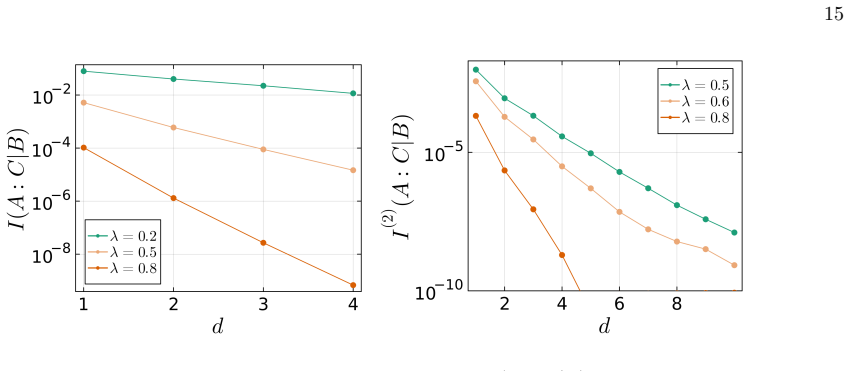
Decaying CMI ofΛ(λ) To justify that Λ(λ) has a decaying CMI with a finite Markov length, we perform a numerical tensor- network simulation. We comment that it is not practical to expect that one can derive this analytically, by noting thatT (N) 1 is Hermitian, and one may interpret−T (N) 1 as a Hamiltonian which allows an MPO representation. One may try t...
-
[64]
Span of consecutive MPO tensors In this section, we prove Equation 53, the span of four consecutive MPO tensors, which relies on the structure of the underlying pre-bialgebraA[16, 59–61]. Define the MPO generated by the tensorAwith boundary condition matrixb, O(N)(A;b) = X {i,j} Tr Ai1j1 Ai2j2 · · ·A iN jN b |i1i2 · · ·i N ⟩⟨j1j2 · · ·j N |, (B1) or graph...
-
[65]
Therefored g1(k+g 2, m+g 2, n+g 2, l+g 2) = dg1(k, m, n, l)
Proof of Equation 57 In this section, we prove [D(4) g1 ,(X g2)⊗4] = 0,∀g 1, g2 (B8) SinceD (4) g1 is diagonal in the computational basis with D(4) g1 |k, m, n, l⟩=d g1(k, m, n, l)|k, m, n, l⟩(B9) and (X g2)⊗4|k, m, n, l⟩=|k+g 2, m+g 2, n+g 2, l+g 2⟩, the commutation condition is equivalent to dg1(k+g 2, m+g 2, n+g 2, l+g 2) =d g1(k, m, n, l).(B10) Note t...
discussion (0)
Sign in with ORCID, Apple, or X to comment. Anyone can read and Pith papers without signing in.