Recognition: 2 theorem links
· Lean TheoremMixed-State Long-Range Entanglement from Dimensional Constraints
Pith reviewed 2026-05-15 03:00 UTC · model grok-4.3
The pith
Maximally mixed states on translation-invariant subspaces of a 1D ring are long-range entangled due to subspace dimension mismatch.
A machine-rendered reading of the paper's core claim, the machinery that carries it, and where it could break.
Core claim
The maximally mixed state in the translation-invariant subspace on a one-dimensional ring exhibits long-range entanglement. This follows because translationally symmetric short-range entangled states span a subspace whose dimension grows only polynomially with system size, whereas the full translation-invariant subspace grows exponentially.
What carries the argument
Dimensional mismatch between the polynomially growing subspace of translationally symmetric short-range entangled states and the exponentially growing full translation-invariant subspace.
Load-bearing premise
The dimension of the translationally symmetric short-range entangled subspace grows only polynomially with system size while the full translation-invariant subspace grows exponentially, and this mismatch implies long-range entanglement in the mixed state.
What would settle it
An explicit construction showing that the number of distinct translationally symmetric short-range entangled states grows exponentially with system size would falsify the claim.
Figures






read the original abstract
We present a new mechanism for long-range entanglement (LRE) in strongly symmetric many-body mixed states that does not rely on symmetry anomalies or long-range correlations. Our primary example is the maximally mixed state in the translation-invariant subspace on a one-dimensional ring. This state is LRE because translationally symmetric short-range entangled states span a subspace whose dimension grows only polynomially with system size, whereas the full translation-invariant subspace grows exponentially. We further discuss certain unconventional properties of this state, including logarithmically growing conditional mutual information, strong-to-weak spontaneous symmetry-breaking, and R\'enyi-index-dependent operator-space entanglement. We also construct a geometrically non-local Lindbladian to stabilize this state as the steady state. Our results identify dimensional mismatch as a novel route to LRE that is intrinsic to many-body mixed states.
Editorial analysis
A structured set of objections, weighed in public.
Referee Report
Summary. The paper claims that the maximally mixed state supported on the translation-invariant subspace of a 1D ring is long-range entangled (LRE) because the subspace spanned by translationally symmetric short-range entangled (SRE) states has only polynomial dimension in system size N, while the full translation-invariant subspace has dimension growing exponentially (~d^N/N). This dimensional mismatch implies that the mixed state cannot lie entirely within the SRE subspace under a support-based definition of LRE. The work further analyzes properties of this state, including logarithmically growing conditional mutual information, strong-to-weak spontaneous symmetry breaking, Rényi-index-dependent operator-space entanglement, and constructs a geometrically non-local Lindbladian whose steady state is the target mixed state.
Significance. If the central counting argument is correct, the result identifies dimensional mismatch under symmetry constraints as a new, intrinsic route to LRE in mixed states that does not require symmetry anomalies or long-range correlations. This could be significant for the classification of mixed-state phases and for understanding entanglement in open systems. The argument is parameter-free, relies on standard SRE definitions (finite-depth translation-symmetric circuits or bounded-range entanglement), and includes an explicit Lindbladian construction together with falsifiable predictions for conditional mutual information and operator entanglement.
major comments (1)
- [§2] §2 (dimensional counting): the statement that the translationally symmetric SRE subspace grows only polynomially must be accompanied by an explicit bound or reference to the parameter counting (e.g., the dimension of the manifold of finite-depth symmetric circuits or the Veronese-type embedding for product states). Without this, the mismatch with the exponential growth of the full invariant subspace (~d^N/N) remains a claim rather than a demonstrated step.
minor comments (3)
- [Introduction] The precise definition of LRE used (support-based) should be stated in a dedicated paragraph early in the manuscript, with a brief comparison to correlation-based or circuit-based definitions.
- [Figure 1] Figure 1 (or equivalent schematic of the subspaces): the axes and scaling should be labeled with explicit N-dependence to make the polynomial vs. exponential contrast visually immediate.
- [Lindbladian section] The Lindbladian construction in the final section: clarify whether the jump operators are strictly local or only geometrically non-local, and state the gap or convergence rate if known.
Simulated Author's Rebuttal
We thank the referee for the careful reading and the recommendation of minor revision. We address the single major comment below and will revise the manuscript to incorporate an explicit bound.
read point-by-point responses
-
Referee: [§2] §2 (dimensional counting): the statement that the translationally symmetric SRE subspace grows only polynomially must be accompanied by an explicit bound or reference to the parameter counting (e.g., the dimension of the manifold of finite-depth symmetric circuits or the Veronese-type embedding for product states). Without this, the mismatch with the exponential growth of the full invariant subspace (~d^N/N) remains a claim rather than a demonstrated step.
Authors: We agree that an explicit bound is needed. In the revised manuscript we will add the following argument to §2: translationally symmetric SRE states are those preparable by a finite-depth translation-symmetric local circuit from a product state, equivalent to a uniform MPS with fixed bond dimension χ = O(1). The amplitudes are homogeneous polynomials of degree N in the m = d χ² tensor entries. The linear span is therefore contained in the space of all such polynomials, whose dimension is at most binom(N + m - 1, m - 1) = O(N^{m-1}), polynomial in N. For product states (χ = 1) this recovers the Veronese embedding, with dimension binom(N + d - 1, d - 1) = O(N^{d-1}). This establishes the polynomial upper bound and the mismatch with the full translation-invariant subspace of dimension ~ d^N / N. We will include the binomial coefficient and the MPS parameter count explicitly. revision: yes
Circularity Check
No significant circularity detected
full rationale
The paper's derivation rests on standard Hilbert-space dimension counting: the subspace spanned by translationally symmetric short-range entangled states has polynomial dimension in system size N, while the full translation-invariant subspace has dimension scaling as ~d^N/N. This mismatch implies that the maximally mixed state on the exponential subspace cannot lie in the SRE subspace, establishing LRE under the paper's support-based definition. No step reduces to a self-definition, fitted input renamed as prediction, or load-bearing self-citation; the counting follows directly from the definitions of SRE (finite-depth circuits or bounded-range entanglement) and translation invariance, analogous to the Veronese embedding for product states. The argument is self-contained against external benchmarks with no internal reduction to its own inputs.
Axiom & Free-Parameter Ledger
axioms (2)
- standard math Hilbert space dimension for translation-invariant states on a ring grows exponentially with system size
- domain assumption Short-range entangled states form a subspace whose dimension grows at most polynomially
Lean theorems connected to this paper
-
IndisputableMonolith/Foundation/AlexanderDuality.leanalexander_duality_circle_linking unclear?
unclearRelation between the paper passage and the cited Recognition theorem.
the dimension of the space spanned by T-invariant SRE states scales at most polynomially in L, while the dimension of the whole T-invariant subspace grows exponentially with L
What do these tags mean?
- matches
- The paper's claim is directly supported by a theorem in the formal canon.
- supports
- The theorem supports part of the paper's argument, but the paper may add assumptions or extra steps.
- extends
- The paper goes beyond the formal theorem; the theorem is a base layer rather than the whole result.
- uses
- The paper appears to rely on the theorem as machinery.
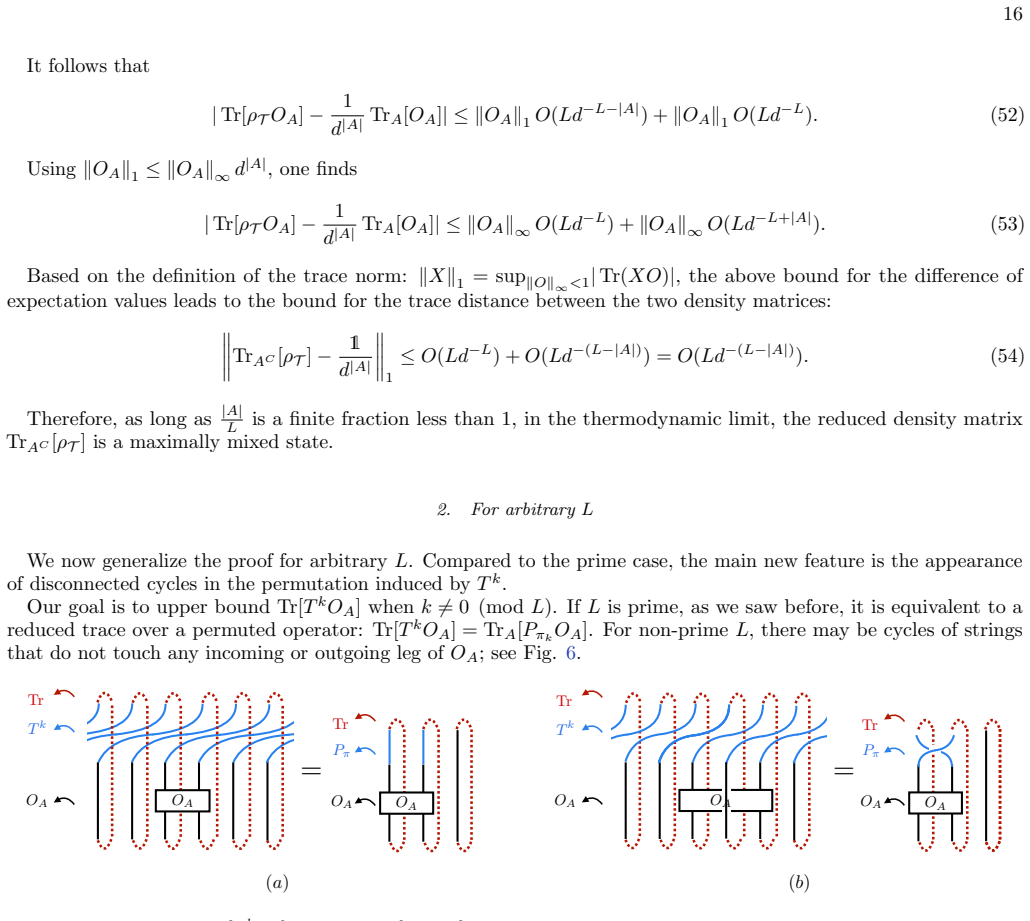
- contradicts
- The paper's claim conflicts with a theorem or certificate in the canon.
- unclear
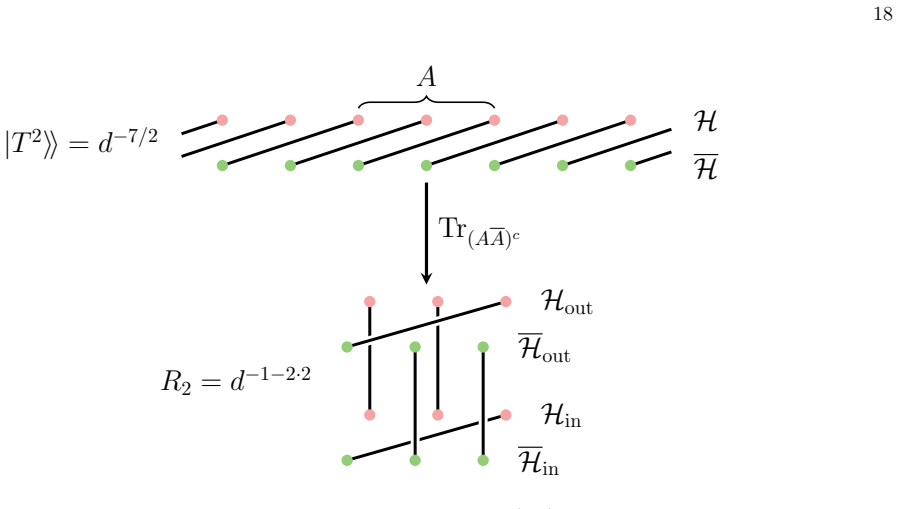
- Pith found a possible connection, but the passage is too broad, indirect, or ambiguous to say the theorem truly supports the claim.
Reference graph
Works this paper leans on
-
[1]
M. B. Hastings, Topological order at nonzero temperature, Phys. Rev. Lett.107, 210501 (2011)
work page 2011
-
[2]
L. A. Lessa, M. Cheng, and C. Wang, Mixed-state quan- tum anomaly and multipartite entanglement, Phys. Rev. X15, 011069 (2025)
work page 2025
-
[3]
Z. Wang and L. Li, Anomaly in open quantum systems and its implications on mixed-state quantum phases (2024), arXiv:2403.14533 [cond-mat, physics:math-ph, physics:quant-ph]
-
[4]
A. Ruiz-de-Alarc´ on, J. Garre-Rubio, A. Moln´ ar, and D. P´ erez-Garc´ ıa, Matrix product operator algebras II: Phases of matter for 1D mixed states, Letters in Mathe- matical Physics114, 43 (2024)
work page 2024
-
[5]
X.-Q. Sun, Anomalous matrix product operator symme- tries and 1D mixed-state phases (2025), arXiv:2504.16985 [quant-ph]
-
[6]
Establishing Mixed-State Phase Equivalence beyond Renormalization Fixed Points
Y. Liu, Establishing Mixed-State Phase Equiva- lence beyond Renormalization Fixed Points (2026), arXiv:2605.04159 [quant-ph]
work page internal anchor Pith review Pith/arXiv arXiv 2026
-
[7]
Y.-H. Chen and T. Grover, Separability transitions in topological states induced by local decoherence, Phys. Rev. Lett.132, 170602 (2024)
work page 2024
- [8]
-
[9]
T.-T. Wang, M. Song, Z. Y. Meng, and T. Grover, Analog of topological entanglement entropy for mixed states, PRX Quantum6, 010358 (2025)
work page 2025
-
[10]
Z. Wang, Z. Wu, and Z. Wang, Intrinsic mixed-state topological order, PRX Quantum6, 010314 (2025)
work page 2025
-
[11]
T. D. Ellison and M. Cheng, Toward a classification of mixed-state topological orders in two dimensions, PRX Quantum6, 010315 (2025)
work page 2025
-
[12]
R. Sohal and A. Prem, Noisy approach to intrinsically mixed-state topological order, PRX Quantum6, 010313 (2025)
work page 2025
-
[13]
S.-T. Zhou, M. Cheng, T. Rakovszky, C. von Keyser- lingk, and T. D. Ellison, Finite-temperature quantum topological order in three dimensions, Phys. Rev. Lett. 135, 040402 (2025)
work page 2025
-
[14]
E. H. Lieb and D. W. Robinson, The finite group velocity of quantum spin systems, Communications in Mathemat- ical Physics28, 251 (1972)
work page 1972
- [15]
-
[16]
T.-C. Lu, Z. Zhang, S. Vijay, and T. H. Hsieh, Mixed- state long-range order and criticality from measurement and feedback, PRX Quantum4, 030318 (2023)
work page 2023
-
[17]
Y.-H. Chen and T. Grover, Symmetry-enforced many- body separability transitions, PRX Quantum5, 030310 8 (2024)
work page 2024
-
[18]
A. Moharramipour, L. A. Lessa, C. Wang, T. H. Hsieh, and S. Sahu, Symmetry-enforced entanglement in maxi- mally mixed states, PRX Quantum5, 040336 (2024)
work page 2024
-
[19]
G. AUBRUN, Partial transposition of random states and non-centered semicircular distributions, Random Ma- trices: Theory and Applications01, 1250001 (2012), https://doi.org/10.1142/S2010326312500013
- [20]
-
[21]
U. T. Bhosale, S. Tomsovic, and A. Lakshminarayan, En- tanglement between two subsystems, the wigner semicircle and extreme-value statistics, Phys. Rev. A85, 062331 (2012)
work page 2012
- [22]
-
[23]
H. Shapourian, S. Liu, J. Kudler-Flam, and A. Vish- wanath, Entanglement negativity spectrum of random mixed states: A diagrammatic approach, PRX Quantum 2, 030347 (2021)
work page 2021
-
[24]
Z. Zhang, J. Tindall, J. Mur-Petit, D. Jaksch, and B. Buˇ ca, Stationary State Degeneracy of Open Quan- tum Systems with Non-Abelian Symmetries, Journal of Physics A: Mathematical and Theoretical53, 215304 (2020), arXiv:1912.12185 [cond-mat, physics:math-ph, physics:physics, physics:quant-ph]
-
[25]
H. Yoshida, Uniqueness of steady states of gorini- kossakowski-sudarshan-lindblad equations: A simple proof, Phys. Rev. A109, 022218 (2024)
work page 2024
-
[26]
Y.-T. Tu, D. M. Long, and D. V. Else, Anomalies of global symmetries on the lattice, Phys. Rev. X16, 011027 (2026)
work page 2026
-
[27]
L. Gioia and C. Wang, Nonzero momentum requires long- range entanglement, Phys. Rev. X12, 031007 (2022)
work page 2022
-
[28]
Y. Li, F. Pollmann, N. Read, and P. Sala, Highly Entan- gled Stationary States from Strong Symmetries, Physical Review X15, 011068 (2025)
work page 2025
-
[29]
J. I. Cirac, D. P´ erez-Garc´ ıa, N. Schuch, and F. Verstraete, Matrix product states and projected entangled pair states: Concepts, symmetries, theorems, Rev. Mod. Phys.93, 045003 (2021)
work page 2021
-
[30]
Werner, Finitely correlated states, inEncyclopedia of Mathematical Physics, edited by J.-P
R. Werner, Finitely correlated states, inEncyclopedia of Mathematical Physics, edited by J.-P. Fran¸ coise, G. L. Naber, and T. S. Tsun (Academic Press, Oxford, 2006) pp. 334–340
work page 2006
-
[31]
C. De Lazzari, H. J. Motwani, T. Seynnaeve,et al., The linear span of uniform matrix product states, SIGMA. Symmetry, Integrability and Geometry: Methods and Applications18, 099 (2022)
work page 2022
-
[32]
M. Florido-Llin` as,´A. M. Alhambra, D. P´ erez-Garc´ ıa, and J. I. Cirac, Uniform matrix product states with a boundary, arXiv preprint arXiv:2512.11968 (2025)
-
[33]
C. H. Bennett, D. P. DiVincenzo, J. A. Smolin, and W. K. Wootters, Mixed-state entanglement and quantum error correction, Phys. Rev. A54, 3824 (1996)
work page 1996
-
[34]
Y. Nakata and M. Murao, Generic Entanglement En- tropy for Quantum States with Symmetry, Entropy22, 10.3390/e22060684 (2020)
-
[35]
S. Sang and T. H. Hsieh, Stability of mixed-state quantum phases via finite markov length, Phys. Rev. Lett.134, 070403 (2025)
work page 2025
- [36]
-
[37]
Zanardi, Entanglement of quantum evolutions, Phys
P. Zanardi, Entanglement of quantum evolutions, Phys. Rev. A63, 040304 (2001)
work page 2001
-
[38]
X. Wang and P. Zanardi, Quantum entanglement of uni- tary operators on bipartite systems, Phys. Rev. A66, 044303 (2002)
work page 2002
-
[39]
T. c. v. Prosen and I. Piˇ zorn, Operator space entanglement entropy in a transverse ising chain, Phys. Rev. A76, 032316 (2007)
work page 2007
-
[40]
I. Piˇ zorn and T. c. v. Prosen, Operator space entanglement entropy in xy spin chains, Phys. Rev. B79, 184416 (2009)
work page 2009
-
[41]
J. Dubail, Entanglement scaling of operators: a confor- mal field theory approach, with a glimpse of simulability of long-time dynamics in 1+1d, Journal of Physics A: Mathematical and Theoretical50, 234001 (2017)
work page 2017
-
[42]
N. Dowling, Classical simulability from operator entan- glement scaling, arXiv preprint arXiv:2603.05656 (2026)
- [43]
-
[44]
J. Y. Lee, C.-M. Jian, and C. Xu, Quantum criticality under decoherence or weak measurement, PRX Quantum 4, 030317 (2023)
work page 2023
-
[45]
P. Sala, S. Gopalakrishnan, M. Oshikawa, and Y. You, Spontaneous strong symmetry breaking in open systems: Purification perspective, Phys. Rev. B110, 155150 (2024)
work page 2024
-
[46]
L. A. Lessa, R. Ma, J.-H. Zhang, Z. Bi, M. Cheng, and C. Wang, Strong-to-weak spontaneous symmetry break- ing in mixed quantum states, PRX Quantum6, 010344 (2025)
work page 2025
- [47]
- [48]
-
[49]
A. W. Harrow, The church of the symmetric subspace, arXiv preprint arXiv:1308.6595 (2013)
work page internal anchor Pith review Pith/arXiv arXiv 2013
-
[50]
H. Barnum and E. Knill, Reversing quantum dynamics with near-optimal quantum and classical fidelity, Journal of Mathematical Physics43, 2097 (2002)
work page 2097
-
[51]
F. Sugino and V. Korepin, R´ enyi entropy of highly entan- gled spin chains, International Journal of Modern Physics B32, 1850306 (2018)
work page 2018
-
[52]
V. Menon, A. Gu, and R. Movassagh, Symmetries, corre- lation functions, and entanglement of general quantum Motzkin spin-chains (2024), arXiv:2408.16070 [quant-ph]. 9 Supplemental Material CONTENTS I. Lemmas and proofs involved in Theorem 1 9 A. The spans of homogeneous pure product states 9 B. Proof of Lemma 1 10 C. Proof of Lemma 2 10 D. Comparison betw...
-
[53]
Operator space entanglement 17 A
For arbitraryL 16 V. Operator space entanglement 17 A. R´ enyi operator space entanglement 19 B. Von Neumann operator space entanglement 21 VI. Non-linear correlators, doubled states, and SW-SSB 23 A. Renyi-2 correlation of local operators 23 B. SWSSB of translation 25
-
[54]
R´ enyi-2 correlations 25
-
[55]
Variance-normalized R´ enyi-2 correlations 27 I. LEMMAS AND PROOFS INVOLVED IN THEOREM 1 A. The spans of homogeneous pure product states Lemma 6.The set of homogeneous pure product states S = {|ψ⟩⊗L | |ψ⟩ ∈ H} spans the permutationally symmetric subspace:spanS=S ⊆ T. Proof.Consider the uniform mixture of all homogeneous pure product states: M := Z |ψ⟩⟨ψ| ...
-
[56]
For primeL Let OA be an arbitrary operator in region A. Then, by the same mechanism of Figure 4, for all k̸ = 0 ( modL ) there is a permutationπ k ∈S A of the indices ofAsuch that Tr[TkOA] = TrA[Pπk OA] = X i1,···,i |A| [OA] iπ(1),...,iπ(|A|) i1,...,i|A| (50) where Pπk ∈ L(HA) is the permutation matrix associated with πk, and in the right-hand side of the...
-
[57]
For arbitraryL We now generalize the proof for arbitrary L. Compared to the prime case, the main new feature is the appearance of disconnected cycles in the permutation induced byT k. Our goal is to upper bound Tr[T kOA] when k̸ = 0 ( modL ). If L is prime, as we saw before, it is equivalent to a reduced trace over a permuted operator: Tr[T kOA] = TrA[Pπk...
-
[58]
Prove that the off-diagonal termsR m,n make up a vanishingly small contribution toR A
-
[59]
Prove that the diagonal termsR n ≡R n,n are approximately orthogonal; 6 More generally, if p is the smallest prime factor of L, then gcd(L, k)≤L/pfor 1≤k≤L−1. 18 |T 2⟩ ⟩=d −7/2 H H A Tr(AA)c R2 =d −1−2·2 Hout Hout Hin Hin FIG. 7. Double Hilbert space representation of the translation operator T n (top) and its reduced density matrix Rn on a contiguous sub...
-
[60]
Finally, calculate the entropy ofR A by employing the approximations above. For the proofs below, we will make heavy use of the fact that the operators involved can be viewed as string diagrams in the tensor network sense, since they are formed by Bell pairs and identity matrices. For the first point, we start with the following lemma Lemma 8.∥R m,n∥1 ≤d ...
-
[61]
R´ enyi-2 correlations With the charged operator defined above, we can explore SWSSB by studying the following correlation function defined for the doubled state: 26 R(2) k = ⟨ ⟨ρT |OkO−kO−kOk|ρT ⟩ ⟩ ⟨ ⟨ρT |ρT ⟩ ⟩ (115) where we have considered k̸ = 0 mod 2π. In terms of the physical mixed state ρT , the above can also be expressed in terms of R(2) k = Tr...
-
[62]
Variance-normalized R´ enyi-2 correlations To motivate the variance-normalized R´ enyi-2 correlator, we consider an alternative aspect of SSB from the response of inserting charged operators. In particular, we define ˜R(2) k as the overlap between the normalized doubled state |ρT ⟩ ⟩√ ⟨ ⟨ρT |ρT ⟩ ⟩ and the doubled state subject to the application of the n...
discussion (0)
Sign in with ORCID, Apple, or X to comment. Anyone can read and Pith papers without signing in.