Recognition: 3 theorem links
· Lean TheoremEnabling Real-Time Training of a Wildfire-to-Smoke Map with Multilinear Operators
Pith reviewed 2026-05-08 17:46 UTC · model grok-4.3
The pith
Multilinear operators on principal components enable fast wildfire smoke mapping from ignition time.
A machine-rendered reading of the paper's core claim, the machinery that carries it, and where it could break.
Core claim
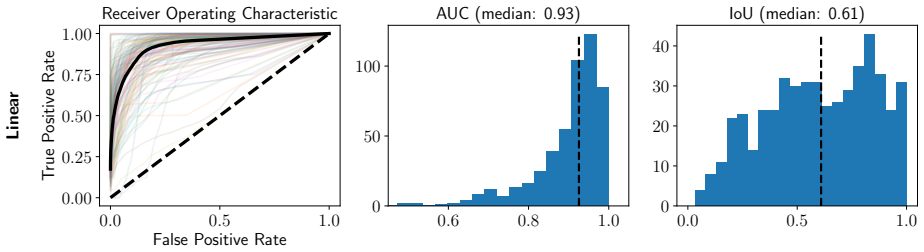
The authors claim that principal components of time-since-ignition and smoke fields from training simulations allow learning a multilinear map from powers of input coefficients to output coefficients. When applied to the Upper Rio Grande Watershed, this produces aerosol optical depth predictions equal in accuracy to Monte Carlo sampling but with fewer than half the coupled model calls, and smoke detection with 65% IoU and 0.95 AUC on holdout data, improving on prior methods' 0.15 IoU and 0.61 AUC.
What carries the argument
A multilinear operator learned to map powers of principal component coefficients of the time-since-ignition field to those of the smoke concentration field.
If this is right
- Training on collected data takes less than 30 seconds on CPU.
- Forward calls complete in less than 1 ms.
- Aerosol optical depth accuracy equals Monte Carlo sampling with under half the model calls.
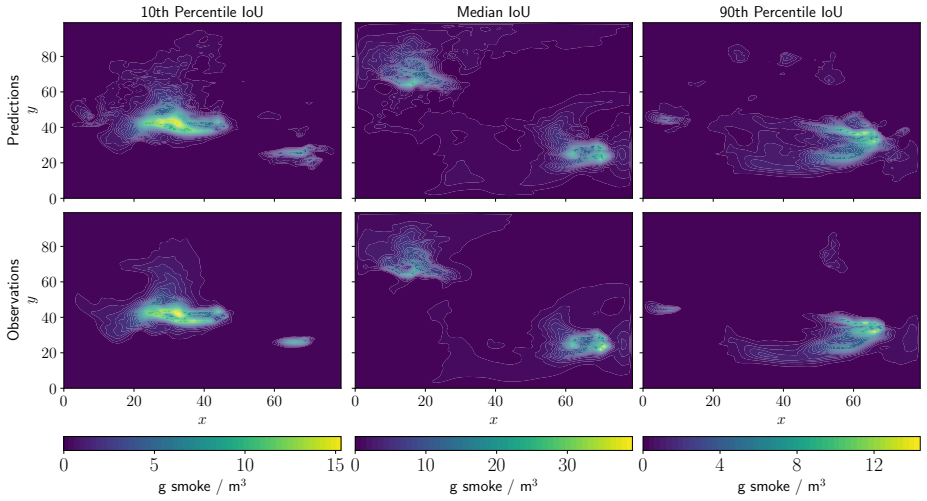
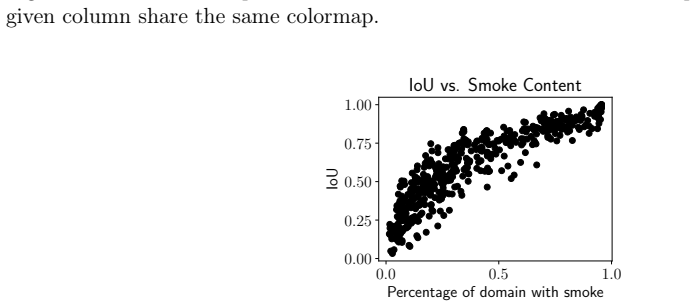
- Smoke detection reaches 65% IoU and 0.95 AUC on holdout data, exceeding similar published classifiers.
Where Pith is reading between the lines
- Such operators could accelerate modeling in other complex environmental systems like air pollution or climate impacts.
- The speed allows exploring many more fuel treatment and succession scenarios than direct simulation permits.
- Real-time smoke maps might support emergency response by updating as new data arrives.
Load-bearing premise
The learned multilinear map and principal components will generalize beyond the specific fuel distributions and events in the training simulations to new conditions.
What would settle it
A direct comparison of predicted smoke fields to those from full coupled simulations or satellite observations in a wildfire event featuring fuel types or ignition patterns outside the training set.
Figures



read the original abstract
Wildfires are a major producer of fine particulate matter, impacting human health and the electrical grid. Accurately forecasting smoke impacts over long time scales incorporates fuel treatment strategies, natural fuel succession, and stochastic events like lightning strikes. However, predicting smoke for each fuel distribution with a forward simulation of a coupled fire-atmosphere model is computationally infeasible. Moreover, relatively simple fire models are tractable to run in many long-time scenarios but do not capture smoke transport. We use data-driven multilinear operators to predict a smoke concentration field from knowledge of the time since ignition for two quantities of interest: aerosol optical depth and smoke detection. Our method first computes the principal components of time-since-ignition and smoke concentration fields and then learns a map from powers of the input coefficients to the output coefficients. We apply our learned operator to smoke prediction in the Upper Rio Grande Watershed. After collecting training data, learning the approximation weights on a CPU takes less than 30 seconds, and each forward call takes less than 1 ms. On a proxy for aerosol optical depth, we obtain equal accuracy to Monte Carlo sampling with fewer than half as many coupled model calls. For smoke detection, we obtain an intersection-over-union (IoU) of 65% and an area under the receiver operating characteristic curve (AUC) of 0.95 on holdout data. Our method is significantly more accurate than the most similar published smoke classifier, which obtains an IoU and AUC of 0.15 and 0.61, respectively, on a 2015 bushfire in Australia.
Editorial analysis
A structured set of objections, weighed in public.
Referee Report
Summary. The manuscript proposes extracting principal components from time-since-ignition and smoke concentration fields generated by coupled fire-atmosphere simulations, then learning a multilinear (polynomial) map from powers of the input coefficients to the output coefficients to predict aerosol optical depth and smoke detection fields. Applied to the Upper Rio Grande Watershed, the approach achieves CPU training of the weights in under 30 seconds and inference in under 1 ms. On holdout data it reports equal accuracy to Monte Carlo sampling for an AOD proxy using fewer than half the coupled model calls, plus smoke detection IoU of 65% and AUC of 0.95, outperforming a prior published classifier (IoU 0.15, AUC 0.61 on a different 2015 Australian event).
Significance. If the in-distribution performance generalizes, the method offers a practical route to real-time smoke mapping that could support long-term forecasting scenarios at far lower cost than repeated full simulations. The sub-30-second training and sub-millisecond inference times, together with the direct Monte Carlo comparison, are concrete strengths. The multilinear operator construction is a reasonable reduced-order modeling choice for this setting.
major comments (2)
- [Abstract] Abstract: the reported holdout metrics (AOD parity with Monte Carlo at <50% calls; smoke IoU 65%, AUC 0.95) are given without any description of the data exclusion protocol, the number of retained principal components, the chosen multilinear degree, hyperparameter selection procedure, or error bars / variability across runs or seeds. These omissions make the central performance claims only partially verifiable.
- [Abstract] Abstract: the motivating use case explicitly requires accurate predictions under new fuel distributions, natural succession, and stochastic ignitions (e.g., lightning) not present in the training ensemble, yet all quantitative results are confined to in-distribution holdout draws from the same Upper Rio Grande Watershed simulations; no out-of-distribution test cases are described, which directly undercuts the long-term forecasting claim.
minor comments (1)
- [Abstract] Abstract: the comparison to the 2015 Australian bushfire classifier is performed on a different geography, fuel type, and event; the manuscript should explicitly note that the datasets are not matched to avoid overstating the relative improvement.
Simulated Author's Rebuttal
We thank the referee for the constructive comments, which have helped us improve the clarity and scope of the manuscript. We address each major comment below.
read point-by-point responses
-
Referee: [Abstract] Abstract: the reported holdout metrics (AOD parity with Monte Carlo at <50% calls; smoke IoU 65%, AUC 0.95) are given without any description of the data exclusion protocol, the number of retained principal components, the chosen multilinear degree, hyperparameter selection procedure, or error bars / variability across runs or seeds. These omissions make the central performance claims only partially verifiable.
Authors: We agree that these details are necessary for verifiability. In the revised manuscript we have expanded the abstract (while remaining within length limits) to state: an 80/20 random train/holdout split with no spatial or temporal leakage; retention of the leading 8 principal components for the time-since-ignition fields and 6 for the smoke fields (capturing >95 % of variance); multilinear degree 2; hyperparameters chosen by 5-fold cross-validation on the training set; and all metrics reported as mean ± one standard deviation across 10 independent random seeds. The same information has also been added to the Methods and Results sections for completeness. revision: yes
-
Referee: [Abstract] Abstract: the motivating use case explicitly requires accurate predictions under new fuel distributions, natural succession, and stochastic ignitions (e.g., lightning) not present in the training ensemble, yet all quantitative results are confined to in-distribution holdout draws from the same Upper Rio Grande Watershed simulations; no out-of-distribution test cases are described, which directly undercuts the long-term forecasting claim.
Authors: We accept this criticism. Our current training ensemble is drawn exclusively from the Upper Rio Grande Watershed with a single fixed fuel map, so true out-of-distribution experiments under altered fuels or different geographic regions are not feasible with the data we possess. We have therefore revised the abstract and added a dedicated Limitations paragraph that (i) explicitly qualifies the long-term forecasting claim to scenarios for which representative training simulations can be obtained, (ii) notes that retraining or domain-adaptation techniques would be required for new fuel distributions, and (iii) lists out-of-distribution generalization as an important direction for future work. revision: partial
- We do not have access to additional coupled fire-atmosphere simulations under new fuel distributions, natural succession, or different watersheds that would be required to perform the requested out-of-distribution tests.
Circularity Check
No significant circularity; standard supervised learning pipeline with independent holdout evaluation.
full rationale
The paper extracts principal components from an ensemble of coupled fire-atmosphere simulations, fits a multilinear polynomial map from input coefficients to output coefficients on training data, and reports performance metrics on separate holdout draws from the same ensemble. No equations reduce the reported AOD parity, IoU, or AUC values back to the fitted weights by construction. The derivation chain is self-contained against the holdout benchmark and does not rely on self-citation chains or ansatzes that presuppose the target result.
Axiom & Free-Parameter Ledger
free parameters (3)
- number of principal components
- multilinear degree / powers
- learned multilinear weights
axioms (2)
- standard math Principal component analysis yields an effective low-dimensional basis for both input time-since-ignition and output smoke fields.
- domain assumption A multilinear function of input coefficients can approximate the mapping to output smoke coefficients.
Lean theorems connected to this paper
-
Foundation.BranchSelection / Cost.FunctionalEquationbranch_selection / washburn_uniqueness_aczel unclearOur method first computes the principal components of time-since-ignition and smoke concentration fields and then learns a map from powers of the input coefficients to the output coefficients.
-
Foundation.AlphaCoordinateFixationJ_uniquely_calibrated_via_higher_derivative unclearwe limit ourselves to d≤2 ... With practical simplifications ... we can derive a closed-form expression for the approximation weights with a linear operator.
-
Foundation.RealityFromDistinction (zero-parameter chain)reality_from_one_distinction unclearWe use the validation set to tune hyperparameters ... We use λ=10^5, which we determined with hyperparameter tuning.
Reference graph
Works this paper leans on
-
[1]
J. T. Abatzoglou and A. P. Williams. “Impact of Anthropogenic Climate Change on Wildfire across Western US Forests.”Proc. Nat. Acad. Sci. USA113.42 (2016), pp. 11770–11775.doi:10.1073/pnas. 1607171113
-
[2]
Computer-BasedModelsofWildlandFireBehavior:AUser’sManual
F.A.Albini.“Computer-BasedModelsofWildlandFireBehavior:AUser’sManual.” Tech.rep.United States Forest Service, 1976.url:https://www.frames.gov/catalog/8178
1976
-
[3]
Data-Driven-Dased Analysis and Modeling for the Impact of Wildfire Smoke on PV Systems
A. J. Ali, L. Zhao, and M. H. Kapourchali. “Data-Driven-Dased Analysis and Modeling for the Impact of Wildfire Smoke on PV Systems.”IEEE Trans. Ind. Appl.60.2 (2023), pp. 2076–2084.doi:10.1109/ TIA.2023.3292807
-
[4]
Ecological restoration of southwestern ponderosa pine ecosystems: a broad perspective
C. D. Allen, M. Savage, D. A. Falk, K. F. Suckling, T. W. Swetnam, T. Schulke, P. B. Stacey, P. Morgan, M. Hoffman, and J. T. Klingel. “Ecological restoration of southwestern ponderosa pine ecosystems: a broad perspective.”Ecol. Appl.12.5 (2002), pp. 1418–1433.doi:10 . 1890 / 1051 - 0761(2002)012[1418:EROSPP]2.0.CO;2
2002
-
[5]
Fire Emission Production Simulator (FEPS) User’s Guide, Version 1.0
G. K. Anderson, D. V. Sandberg, and R. A. Norheim. “Fire Emission Production Simulator (FEPS) User’s Guide, Version 1.0.” Tech. rep. United States Forest Service, 2004.url:https://www.frames. gov/catalog/6921
2004
-
[6]
Aids to Determining Fuel Models for Estimating Fire Behavior
H. E. Anderson. “Aids to Determining Fuel Models for Estimating Fire Behavior.” Tech. rep. INT- GTR-122. United States Forest Service, 1982.doi:10.2737/int-gtr-122
-
[7]
BEHAVE: Fire Behavior Prediction and Fuel Modeling System—BURN Subsystem, Part 1
P. L. Andrews. “BEHAVE: Fire Behavior Prediction and Fuel Modeling System—BURN Subsystem, Part 1.” Tech. rep. INT-GTR-194. United States Forest Service, 1986.doi:10.2737/INT-GTR-194
-
[8]
Current Status and Future Needs of the BehavePlus Fire Modeling System
P. L. Andrews. “Current Status and Future Needs of the BehavePlus Fire Modeling System.”Int. J. Wildland Fire23.1 (2013), 21–33.doi:10.1071/wf12167
-
[9]
A Review of a New Generation of Wildfire–Atmosphere Modeling
A. Bakhshaii and E. A. Johnson. “A Review of a New Generation of Wildfire–Atmosphere Modeling.” Can. J. Forest Res.49.6 (2019), pp. 565–574.doi:10.1139/cjfr-2018-0138
-
[10]
Proceedings of the National Academy of Sciences114(11), 2946–2951 (2017)
J. K. Balch, B. A. Bradley, J. T. Abatzoglou, R. C. Nagy, E. J. Fusco, and A. L. Mahood. “Human- Started Wildfires Expand the Fire Niche across the United States.”Proc. Nat. Acad. Sci. USA114.11 (2017), pp. 2946–2951.doi:10.1073/pnas.1617394114
-
[11]
A North American Hourly Assimilation and Model Forecast Cycle: The Rapid Refresh
S. G. Benjamin, S. S. Weygandt, J. M. Brown, M. Hu, C. R. Alexander, T. G. Smirnova, J. B. Olson, E. P. James, D. C. Dowell, G. A. Grell, H. Lin, S. E. Peckham, T. L. Smith, W. R. Moninger, J. S. Kenyon, and G. S. Manikin. “A North American Hourly Assimilation and Model Forecast Cycle: The Rapid Refresh.”Mon. Weather Rev.144.4 (2016), pp. 1669 –1694.doi:1...
-
[12]
Envi- ronmental Modelling & Software 97, 201–210
J. P. Bolte, D. W. Hulse, S. V. Gregory, and C. Smith. “Modeling Biocomplexity – Actors, Landscapes and Alternative Futures.”Environ. Model. Softw.22.5 (2007), pp. 570–579.doi:10.1016/j.envsoft. 2005.12.033
-
[13]
The Evolution, Complexity and Diversity of Models of Long-Term Forest Dynamics
H. Bugmann and R. Seidl. “The Evolution, Complexity and Diversity of Models of Long-Term Forest Dynamics.”J. Ecol.110.10 (2022), pp. 2288–2307.doi:10.1111/1365-2745.13989. 22
-
[14]
The Contribution of Wildfire to PM2.5 Trends in the USA
M. Burke, M. L. Childs, B. de la Cuesta, M. Qiu, J. Li, C. F. Gould, S. Heft-Neal, and M. Wara. “The Contribution of Wildfire to PM2.5 Trends in the USA.”Nature622.7984 (2023), pp. 761–766.doi: 10.1038/s41586-023-06522-6
-
[15]
Principal Component Flow Map Learning of PDEs from Incomplete, Limited, and Noisy Data
V. Churchill. “Principal Component Flow Map Learning of PDEs from Incomplete, Limited, and Noisy Data.”J. Comput. Phys.524 (2025), p. 113730.doi:10.1016/j.jcp.2025.113730
-
[16]
Flow Map Learning for Unknown Dynamical Systems: Overview, Implemen- tation, and Benchmarks
V. Churchill and D. Xiu. “Flow Map Learning for Unknown Dynamical Systems: Overview, Implemen- tation, and Benchmarks.”J. Mach. Learn. Model. Comput.4.2 (2023), pp. 173–201.doi:10.1615/ JMachLearnModelComput.2023049717
2023
-
[17]
M. M. Clark, T. H. Fletcher, and R. R. Linn. “A Sub-Grid, Mixture–Fraction-Based Thermodynamic Equilibrium Model for Gas Phase Combustion in FIRETEC: Development and Results.”Int. J. Wild- land Fire19.2 (2010), pp. 202–212.doi:10.1071/WF07116
-
[18]
A Small-Scale Dynamic Model Using a Terrain-Following Coordinate Transformation
T. L. Clark. “A Small-Scale Dynamic Model Using a Terrain-Following Coordinate Transformation.” J. Comput. Phys.24.2 (1977), pp. 186–215.doi:10.1016/0021-9991(77)90057-2
-
[19]
Description of a Coupled Atmosphere–Fire Model
T. L. Clark, J. Coen, and D. Latham. “Description of a Coupled Atmosphere–Fire Model.”Int. J. Wildland Fire13.1 (2004), pp. 49–63.doi:10.1071/WF03043
-
[20]
T. L. Clark and W. D. Hall. “Multi-Domain Simulations of the Time-Dependent Navier–Stokes Equa- tions: Benchmark Error Analysis of Some Nesting Procedures.”J. Comput. Phys.92.2 (1991), pp. 456– 481.doi:10.1016/0021-9991(91)90218-A
-
[21]
A CoupledAtmosphere–FireModel: Convective Feedback on Fire-Line Dynamics
T. L. Clark,M. A. Jenkins, J.Coen, and D.Packham. “A CoupledAtmosphere–FireModel: Convective Feedback on Fire-Line Dynamics.”J. Appl. Meteorol. Climatol.35.6 (1996), pp. 875 –901.doi:10. 1175/1520-0450(1996)035<0875:ACAMCF>2.0.CO;2
1996
-
[22]
T. Clark, M. Jenkins, J. Coen, and D. Packham. “A Coupled Atmosphere–Fire Model: Role of the Convective Froude Number and Dynamic Fingering at the Fireline.”Int. J. Wildland Fire6.4 (1996), pp. 177–190.doi:10.1071/WF9960177
-
[23]
Modeling Wildland Fires: A Description of the Coupled Atmosphere–Wildland Fire Model
J. L. Coen. “Modeling Wildland Fires: A Description of the Coupled Atmosphere–Wildland Fire Model.” Tech. rep. NCAR/TN-500+STR. National Center for Atmospheric Research, 2013.doi:10. 5065/D6K64G2G
2013
-
[24]
WRF-Fire: Coupled Weather–Wildland Fire Modeling with the Weather Research and Forecasting Model
J. L. Coen, M. Cameron, J. Michalakes, E. G. Patton, P. J. Riggan, and K. M. Yedinak. “WRF-Fire: Coupled Weather–Wildland Fire Modeling with the Weather Research and Forecasting Model.”J. Appl. Meteorol. Climatol.52.1 (2013), pp. 16–38.doi:10.1175/JAMC-D-12-023.1
-
[25]
SolarEnergy Resource Availability under Extreme and Historical Wildfire Smoke Conditions
K.A.Corwin,J.Burkhardt,C.A.Corr,P.W.Stackhouse,A.Munshi,andE.V.Fischer.“SolarEnergy Resource Availability under Extreme and Historical Wildfire Smoke Conditions.”Nat. Commun.16.1 (2025), p. 245.doi:10.1038/s41467-024-54163-8
-
[26]
A. L. DeCastro, T. W. Juliano, B. Kosović, H. Ebrahimian, and J. K. Balch. “A Computationally Efficient Method for Updating Fuel Inputs for Wildfire Behavior Models Using Sentinel Imagery and Random Forest Classification.”Remote Sens.14.6 (2022), p. 1447.doi:10.3390/rs14061447
-
[27]
J.-L. Dupuy, R. R. Linn, V. Konovalov, F. Pimont, J. A. Vega, and E. Jiménez. “Exploring Three- Dimensional Coupled Fire–Atmosphere Interactions Downwind of Wind-Driven Surface Fires and Their Influence on Backfires Using the HIGRAD-FIRETEC model.”Int. J. Wildland Fire20.6 (2011), pp. 734–750.doi:10.1071/WF10035
-
[28]
V. S. Fanaskov and I. V. Oseledets. “Spectral Neural Operators.”Dokl. Math.108.2 (2023), S226–S232. doi:10.1134/S1064562423701107
-
[29]
Quantifying the Impact of Wildfire Smoke on Solar Photovoltaic Generation in Australia
E. Ford, I. M. Peters, and B. Hoex. “Quantifying the Impact of Wildfire Smoke on Solar Photovoltaic Generation in Australia.”iScience27.2 (2024), p. 108611.doi:10.1016/j.isci.2023.108611
-
[30]
Fully Coupled ‘Online’ Chemistry within the WRF Model
G. A. Grell, S. E. Peckham, R. Schmitz, S. A. McKeen, G. Frost, W. C. Skamarock, and B. Eder. “Fully Coupled ‘Online’ Chemistry within the WRF Model.”Atmos. Environ.39.37 (2005), pp. 6957– 6975.doi:10.1016/j.atmosenv.2005.04.027
-
[31]
PnET-Successionv5.1:Comprehensive Description of an Ecophysiological Succession Extension within the LANDIS-II Forest Landscape Model
E.J.Gustafson,B.R.Miranda,B.R.Sturtevant,andZ.Zhou.“PnET-Successionv5.1:Comprehensive Description of an Ecophysiological Succession Extension within the LANDIS-II Forest Landscape Model.” Tech. rep. United States Forest Service, 2023.url:https : / / research . fs . usda . gov / treesearch/66927
2023
-
[32]
Toward real-time optimization through model reduction and model discrepancy sensitivities
J. Hart, S. A. McQuarrie, Z. Morrow, and B. van Bloemen Waanders. “Toward real-time optimization through model reduction and model discrepancy sensitivities.”Struct. Multidiscip. Optim.69.3 (2026), p. 62.doi:10.1007/s00158-025-04241-2. 23
-
[33]
Neural and Spectral Operator Surrogates: Unified Construction and Expression Rate Bounds
L. Herrmann, C. Schwab, and J. Zech. “Neural and Spectral Operator Surrogates: Unified Construction and Expression Rate Bounds.”Adv. Comput. Math.50.4 (2024), p. 72.doi:10.1007/s10444-024- 10171-2
-
[34]
H. Hersbach, B. Bell, P. Berrisford, S. Hirahara, A. Horányi, J. Muñoz-Sabater, J. Nicolas, C. Peubey, R. Radu, D. Schepers, A. Simmons, C. Soci, S. Abdalla, X. Abellan, G. Balsamo, P. Bechtold, G. Biavati, J. Bidlot, M. Bonavita, G. De Chiara, P. Dahlgren, D. Dee, M. Diamantakis, R. Dragani, J. Flemming, R. Forbes, M. Fuentes, A. Geer, L. Haimberger, S. ...
-
[35]
H. Hotelling. “Analysis of a Complex of Statistical Variables into Principal Components.”J. Educ. Psychol.24 (6 1933), pp. 417–441.doi:10.1037/h0071325
-
[36]
F. Huot, R. L. Hu, N. Goyal, T. Sankar, M. Ihme, and Y.-F. Chen. “Next Day Wildfire Spread: A Machine Learning Dataset to Predict Wildfire Spreading From Remote-Sensing Data.”IEEE Trans. Geosci. Remote Sens.60 (2022), pp. 1–13.doi:10.1109/TGRS.2022.3192974
-
[37]
U.S. Fires Became Larger, More Frequent, and More Widespread in the 2000s
V. Iglesias, J. K. Balch, and W. R. Travis. “U.S. Fires Became Larger, More Frequent, and More Widespread in the 2000s.”Sci. Adv.8.11 (2022), eabc0020.doi:10.1126/sciadv.abc0020
-
[38]
J. Jakeman. “PyApprox: A Software Package for Sensitivity Analysis, Bayesian Inference, Optimal Ex- perimental Design, and Multi-Fidelity Uncertainty Quantification and Surrogate Modeling.”Environ. Model. Softw.170 (2023), p. 105825.doi:10.1016/j.envsoft.2023.105825
-
[39]
Verification and Vali- dation for Trustworthy Scientific Machine Learning
J. D. Jakeman, L. A. Barba, J. R. R. A. Martins, and T. O’Leary-Roseberry. “Verification and Vali- dation for Trustworthy Scientific Machine Learning.” 2025. arXiv:2502.15496
-
[40]
S. Jazebi, F. de León, and A. Nelson. “Review of Wildfire Management Techniques–Part I: Causes, Prevention, Detection, Suppression, and Data Analytics.”IEEE Trans. Power. Deliv.35.1 (2020), pp. 430–439.doi:10.1109/TPWRD.2019.2930055
-
[41]
Explicit Numerical Diffusion in the WRF Model
J. C. Knievel, G. H. Bryan, and J. P. Hacker. “Explicit Numerical Diffusion in the WRF Model.”Mon. Weather Rev.135.11 (2007), pp. 3808 –3824.doi:10.1175/2007MWR2100.1
-
[42]
Spatiotemporal Bag-of-Features for Early Wildfire Smoke Detection
B. Ko, J. Park, and J.-Y. Nam. “Spatiotemporal Bag-of-Features for Early Wildfire Smoke Detection.” Image Vis. Comput.31.10 (2013), pp. 786–795.doi:10.1016/j.imavis.2013.08.001
-
[43]
WRF-Fire Simulation Coupled with a Fuel Moisture Model and Smoke Transport by WRF-Chem
A. K. Kochanski, J. D. Beezley, J. Mandel, and M. Kim. “WRF-Fire Simulation Coupled with a Fuel Moisture Model and Smoke Transport by WRF-Chem.” 2012. arXiv:1208.1059
-
[44]
Toward an Integrated System for Fire, Smoke and Air Quality Simulations
A. K. Kochanski, M. A. Jenkins, K. Yedinak, J. Mandel, J. Beezley, and B. Lamb. “Toward an Integrated System for Fire, Smoke and Air Quality Simulations.”Int. J. Wildland Fire25.5 (2015), pp. 534–546.doi:10.1071/WF14074
-
[45]
A.K.Kochanski,D.V.Mallia,M.G.Fearon,J.Mandel,A.H.Souri,andT.Brown.“ModelingWildfire Smoke Feedback Mechanisms Using a Coupled Fire–Atmosphere Model with a Radiatively Active AerosolScheme.”J. Geophys. Res. Atmos.124.16(2019), pp.9099–9116.doi:10.1029/2019JD030558
-
[46]
Multi-Grid Tensorized Fourier Neural Operator for High-Resolution PDEs
J. Kossaifi, N. B. Kovachki, K. Azizzadenesheli, and A. Anandkumar. “Multi-Grid Tensorized Fourier Neural Operator for High-Resolution PDEs.”Trans. Mach. Learn. Res.(2024).url:https : / / openreview.net/forum?id=AWiDlO63bH
2024
-
[47]
Improved Wildfire Spread Prediction with Time-Series Data and the WSTS+ Benchmark
S. Lahrichi, J. Bova, J. Johnson, and J. Malof. “Improved Wildfire Spread Prediction with Time-Series Data and the WSTS+ Benchmark.” 2025. arXiv:2502.12003
-
[48]
LANDFIRE: 40 Fire Behavior Fuel Models – Scott/Burgan
LANDFIRE. “LANDFIRE: 40 Fire Behavior Fuel Models – Scott/Burgan.” 2022.url:http://www. landfire/viewer
2022
-
[49]
The BlueSky Smoke Modeling Framework
N. K. Larkin, S. M. O’Neill, R. Solomon, S. Raffuse, T. Strand, D. C. Sullivan, C. Krull, M. Rorig, J. Peterson, and S. A. Ferguson. “The BlueSky Smoke Modeling Framework.”Int. J. Wildland Fire 18.8 (2009), pp. 906–920.doi:10.1071/WF07086
-
[50]
A Deep Learning Approach to Identify Smoke Plumes in Satellite Imagery in Near-Real Time for Health Risk Communication
A. Larsen, I. Hanigan, B. J. Reich, Y. Qin, M. Cope, G. Morgan, and A. G. Rappold. “A Deep Learning Approach to Identify Smoke Plumes in Satellite Imagery in Near-Real Time for Health Risk Communication.”J. Expo. Sci. Environ. Epidemiol.31.1 (2021), pp. 170–176.url:https : //pmc.ncbi.nlm.nih.gov/articles/PMC7796988/
2021
-
[51]
A Spatial Causal Analysis of Wildland Fire- Contributed PM2.5 Using Numerical Model Output
A. Larsen, S. Yang, B. J. Reich, and A. G. Rappold. “A Spatial Causal Analysis of Wildland Fire- Contributed PM2.5 Using Numerical Model Output.”Ann. Appl. Stat.16.4 (2022), pp. 2714–2731. doi:10.1214/22-AOAS1610. 24
-
[52]
Z. Li, N. Kovachki, K. Azizzadenesheli, B. Liu, K. Bhattacharya, A. Stuart, and A. Anandkumar. “NeuralOperator:GraphKernelNetworkforPartialDifferentialEquations.” 2020.arXiv:2003.03485
-
[53]
Fourier Neural Operator for Parametric Partial Differential Equations
Z. Li, N. B. Kovachki, K. Azizzadenesheli, B. Liu, K. Bhattacharya, A. Stuart, and A. Anandkumar. “Fourier Neural Operator for Parametric Partial Differential Equations.”International Conference on Learning Representations. 2021.url:https://openreview.net/forum?id=c8P9NQVtmnO
2021
-
[54]
A Transport Model for Prediction of Wildfire Behavior
R. R. Linn. “A Transport Model for Prediction of Wildfire Behavior.” Tech. rep. LA-13334-T. Los Alamos National Laboratory, 1997.doi:10.2172/505313
-
[55]
Studying Wildfire Behavior Using FIRETEC
R. Linn, J. Reisner, J. J. Colman, and J. Winterkamp. “Studying Wildfire Behavior Using FIRETEC.” Int. J. Wildland Fire11.4 (2002), pp. 233–246.doi:10.1071/WF02007
-
[56]
QUIC-Fire: A Fast-Running Simulation Tool for Prescribed Fire Planning
R. Linn, S. Goodrick, S. Brambilla, M. Brown, R. Middleton, J. O’Brien, and J. Hiers. “QUIC-Fire: A Fast-Running Simulation Tool for Prescribed Fire Planning.”Environ. Model. Softw.125 (2020), p. 104616.doi:10.1016/j.envsoft.2019.104616
-
[57]
Comparing Smoke Emissions and Impacts under Alternative Forest Management Regimes
J. W. Long, S. A. Drury, S. G. Evans, C. J. Maxwell, and R. M. Scheller. “Comparing Smoke Emissions and Impacts under Alternative Forest Management Regimes.”Ecol. Soc.27.4 (2022).doi:10.5751/ ES-13553-270426
2022
-
[58]
M.Lowery,J.Turnage,Z.Morrow,J.D.Jakeman,A.Narayan,S.Zhe,andV.Shankar.“KernelNeural Operators (KNOs) for Scalable, Memory-Efficient, Geometrically-Flexible Operator Learning.” 2025. arXiv:2407.00809
work page internal anchor Pith review Pith/arXiv arXiv 2025
-
[59]
L. Lu, P. Jin, G. Pang, Z. Zhang, and G. E. Karniadakis. “Learning Nonlinear Operators via DeepONet Based on the Universal Approximation Theorem of Operators.”Nat. Mach. Intell.3.3 (2021), pp. 218– 229.doi:10.1038/s42256-021-00302-5
-
[60]
L. Lu, X. Meng, S. Cai, Z. Mao, S. Goswami, Z. Zhang, and G. E. Karniadakis. “A Comprehensive and Fair Comparison of Two Neural Operators (with Practical Extensions) Based on FAIR Data.” Comput. Meth. Appl. Mech. Eng.393 (2022), p. 114778.doi:10.1016/j.cma.2022.114778
-
[61]
Long-Term Exposure to Wildland Fire Smoke PM2.5 and Mortality in the Contiguous United States
Y. Ma, E. Zang, Y. Liu, J. Wei, Y. Lu, H. M. Krumholz, M. L. Bell, and K. Chen. “Long-Term Exposure to Wildland Fire Smoke PM2.5 and Mortality in the Contiguous United States.”Proc. Nat. Acad. Sci. USA121.40 (2024), e2403960121.doi:10.1073/pnas.2403960121
-
[62]
Modeling Wildland Fire Propagation with Level Set Methods
V. Mallet, D. Keyes, and F. Fendell. “Modeling Wildland Fire Propagation with Level Set Methods.” Comput. Math. Appl.57.7 (2009), pp. 1089–1101.doi:10.1016/j.camwa.2008.10.089
-
[63]
A Review of Modeling Approaches Used to Simulate Smoke Transport and Dispersion
D. V. Mallia and A. K. Kochanski. “A Review of Modeling Approaches Used to Simulate Smoke Transport and Dispersion.”Landscape Fire, Smoke, and Health. American Geophysical Union, 2023. Chap. 8, pp. 127–148.doi:10.1002/9781119757030.ch8
-
[64]
Coupled Atmosphere–Wildland Fire Modeling with WRF 3.3 and SFIRE 2011
J. Mandel, J. D. Beezley, and A. K. Kochanski. “Coupled Atmosphere–Wildland Fire Modeling with WRF 3.3 and SFIRE 2011.”Geosci. Model Dev.4.3 (2011), pp. 591–610.doi:10.5194/gmd-4-591- 2011
-
[65]
D. Muñoz-Esparza, B. Kosović, P. A. Jiménez, and J. L. Coen. “An Accurate Fire-Spread Algorithm in the Weather Research and Forecasting Model Using the Level-Set Method.”J. Adv. Model. Earth Syst.10.4 (2018), pp. 908–926.doi:10.1002/2017MS001108
-
[66]
WRF Preprocessing System
National Center for Atmospheric Research. “WRF Preprocessing System.” Version 4.6. 2024.url: https://github.com/wrf-model/WPS
2024
-
[67]
S. Osher and J. A. Sethian. “Fronts Propagating with Curvature-Dependent Speed: Algorithms Based on Hamilton–Jacobi Formulations.”J. Comput. Phys.79.1 (1988), pp. 12–49.doi:10.1016/0021- 9991(88)90002-2
-
[68]
Nonlinear Integro-Differential Operator Regression with Neural Net- works
R. G. Patel and O. Desjardins. “Nonlinear Integro-Differential Operator Regression with Neural Net- works.” 2018. arXiv:1810.08552
-
[69]
B. Peherstorfer and K. Willcox. “Data-Driven Operator Inference for Nonintrusive Projection-Based Model Reduction.”Comput. Meth. Appl. Mech. Eng.306 (2016), pp. 196–215.doi:10.1016/j.cma. 2016.03.025
-
[70]
System-Level Feedbacks of Active Fire Regimes in Large Landscapes
N. A. Povak, P. F. Hessburg, R. B. Salter, R. W. Gray, and S. J. Prichard. “System-Level Feedbacks of Active Fire Regimes in Large Landscapes.”Fire Ecol.19.1 (2023), p. 45.doi:10.1186/s42408- 023-00197-0
-
[71]
The Fire and Smoke Model Evaluation Experiment—A Plan for 25 Integrated, Large Fire–Atmosphere Field Campaigns
S. Prichard, N. S. Larkin, R. Ottmar, N. H. French, K. Baker, T. Brown, C. Clements, M. Dickinson, A. Hudak, A. Kochanski, et al. “The Fire and Smoke Model Evaluation Experiment—A Plan for 25 Integrated, Large Fire–Atmosphere Field Campaigns.”Atmos.10.2 (2019), p. 66.doi:10 . 3390 / atmos10020066
2019
-
[72]
The REBURN Model: Simulating System-Level Forest Succession and Wildfire Dynamics
S. J. Prichard, R. B. Salter, P. F. Hessburg, N. A. Povak, and R. W. Gray. “The REBURN Model: Simulating System-Level Forest Succession and Wildfire Dynamics.”Fire Ecol.19.1 (2023), p. 38.doi: 10.1186/s42408-023-00190-7
-
[73]
Lift & Learn: Physics-Informed Machine Learn- ing for Large-Scale Nonlinear Dynamical Systems
E. Qian, B. Kramer, B. Peherstorfer, and K. Willcox. “Lift & Learn: Physics-Informed Machine Learn- ing for Large-Scale Nonlinear Dynamical Systems.”Phys. D Nonlin. Phenom.406 (2020), p. 132401. doi:10.1016/j.physd.2020.132401
-
[74]
C. E. Rasmussen and C. K. I. Williams.Gaussian Processes for Machine Learning. MIT Press, 2006
2006
-
[75]
J. Reisner, S. Wynne, L. Margolin, and R. Linn. “Coupled Atmospheric–Fire Modeling Employing the Method of Averages.”Mon. Weather Rev.128.10 (2000), pp. 3683 –3691.doi:10.1175/1520- 0493(2001)129<3683:CAFMET>2.0.CO;2
-
[76]
C. C. Remy, D. J. Krofcheck, A. R. Keyser, and M. D. Hurteau. “Restoring Frequent Fire to Dry ConiferForestsDelaystheDeclineofSubalpineForestsintheSouthwestUnitedStatesunderProjected Climate.”J. Appl. Ecol.61.7 (2024), pp. 1508–1519.doi:10.1111/1365-2664.14689
-
[77]
A Mathematical Model for Predicting Fire Spread in Wildland Fuels
R. C. Rothermel. “A Mathematical Model for Predicting Fire Spread in Wildland Fuels.” Tech. rep. INT-115. United States Forest Service, 1972.url:https://research.fs.usda.gov/treesearch/ 32533
1972
-
[78]
A Landscape Model of Variable Social– Ecological Fire Regimes
R. Scheller, A. Kretchun, T. J. Hawbaker, and P. D. Henne. “A Landscape Model of Variable Social– Ecological Fire Regimes.”Ecol. Model.401 (2019), pp. 85–93.doi:10.1016/j.ecolmodel.2019.03. 022
-
[79]
R. M. Scheller, J. B. Domingo, B. R. Sturtevant, J. S. Williams, A. Rudy, E. J. Gustafson, and D. J. Mladenoff. “Design, Development, and Application of LANDIS-II, a Spatial Landscape Simulation Model with Flexible Temporal and Spatial Resolution.”Ecol. Model.201.3 (2007), pp. 409–419.doi: 10.1016/j.ecolmodel.2006.10.009
-
[80]
J. H. Scott and R. E. Burgan. “Standard Fire Behavior Fuel Models: A Comprehensive Set for Use with Rothermel’s Surface Fire Spread Model.” Tech. rep. RMRS-GTR-153. United States Forest Service, 2005.doi:10.2737/rmrs-gtr-153
discussion (0)
Sign in with ORCID, Apple, or X to comment. Anyone can read and Pith papers without signing in.