Recognition: 2 theorem links
Orbital motion and dynamical mass of the complex periodic variable binary system 2MASS J05082729-2101444
Pith reviewed 2026-05-08 18:01 UTC · model grok-4.3
The pith
Combined radio astrometry, radial velocities, and imaging yield a dynamical mass of 0.459 solar masses for the eccentric M-dwarf binary 2M0508-21.
A machine-rendered reading of the paper's core claim, the machinery that carries it, and where it could break.
Core claim
The combined fit of VLBA astrometric positions, radial velocity curves, and adaptive optics imaging shows that 2M0508-21 is an M-dwarf binary with an eccentric orbit of period 2.19 years and total dynamical mass 0.459 ± 0.007 solar masses assuming the Gaia parallax. Both stars are resolved as radio sources with comparable flux densities and emission properties consistent with a gyro-synchrotron origin.
What carries the argument
The joint orbital solution to VLBA radio positions, spectroscopic radial velocities, and one adaptive optics relative astrometric point, which fixes the angular semimajor axis before conversion to physical units via the Gaia distance and application of Kepler's third law.
If this is right
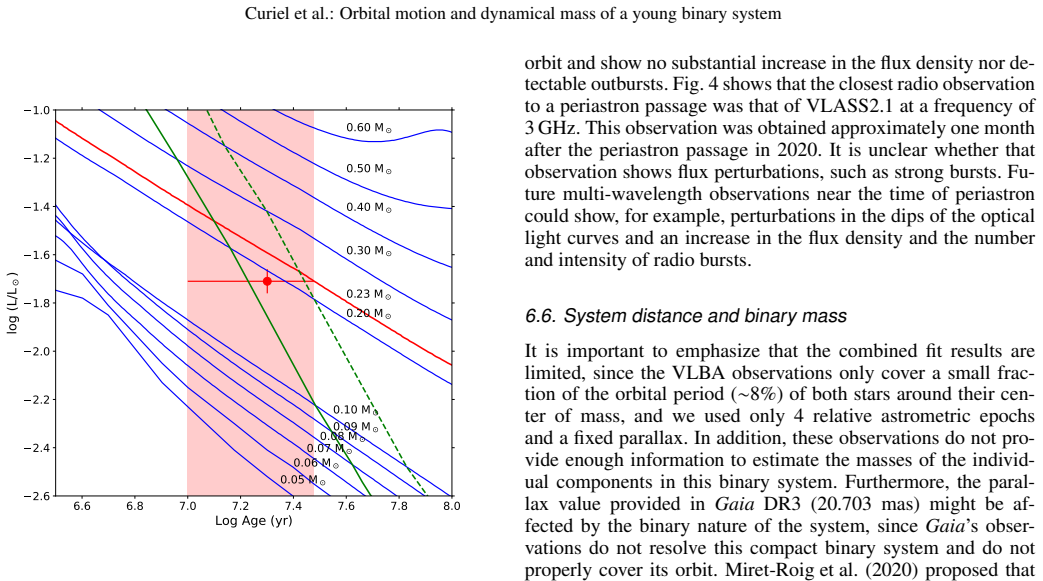
- The measured mass exceeds the value predicted by luminosity and theoretical evolutionary models for the system's age and brightness.
- Both components produce persistent quiescent radio emission at similar levels without detected flares or strong polarization.
- Additional VLBA epochs would allow separation of the individual stellar masses rather than only the total.
- The system provides a dynamical benchmark near the substellar boundary for testing models of young low-mass objects.
Where Pith is reading between the lines
- A confirmed mass excess could indicate that current evolutionary tracks underestimate radii or effective temperatures for young M-dwarfs.
- The multi-epoch radio plus velocity fitting method can be extended to other radio-detected young binaries to enlarge the sample of dynamical masses.
- Verification of the radio emission mechanism would link magnetic activity levels to orbital separation in close pre-main-sequence pairs.
Load-bearing premise
The Gaia parallax value is taken as exact when converting the measured angular semimajor axis into a physical separation for the mass calculation.
What would settle it
An independent parallax or linear size measurement that differs by more than a few percent from the Gaia value would shift the derived total mass outside the stated 0.007 solar mass uncertainty.
Figures


read the original abstract
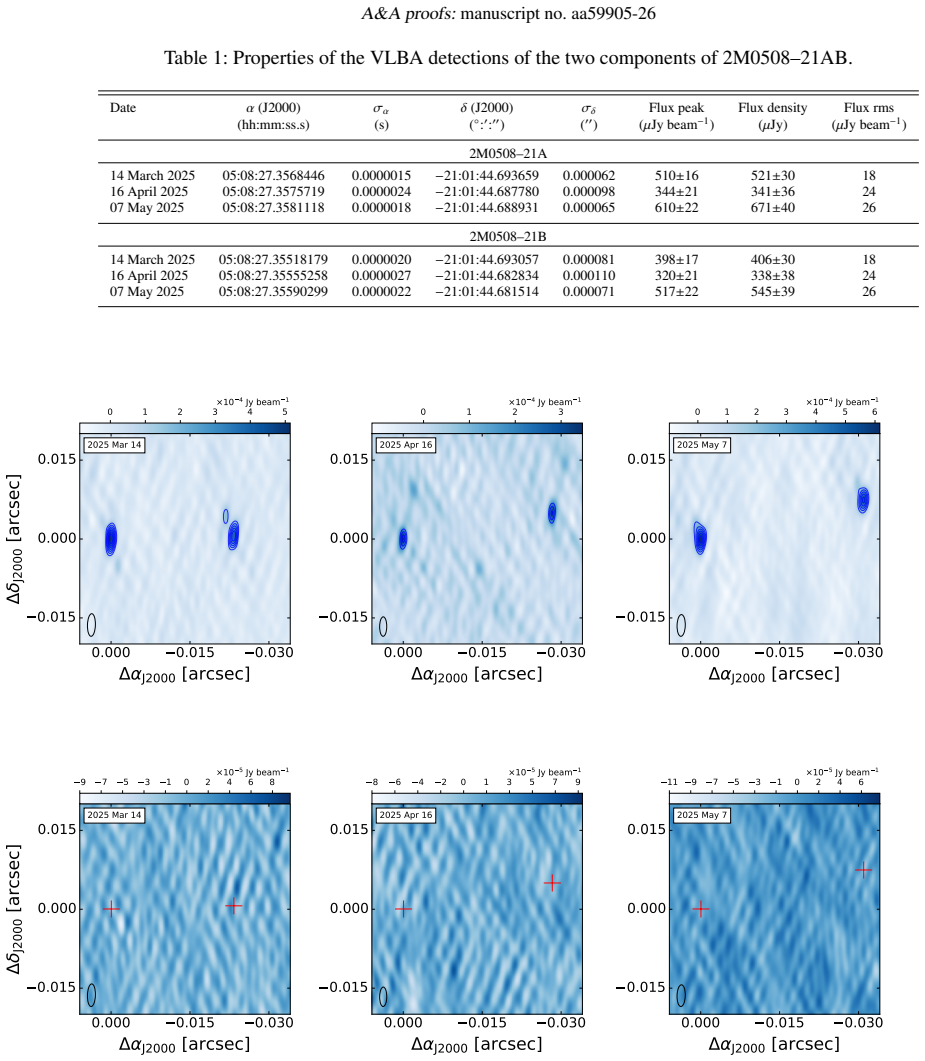
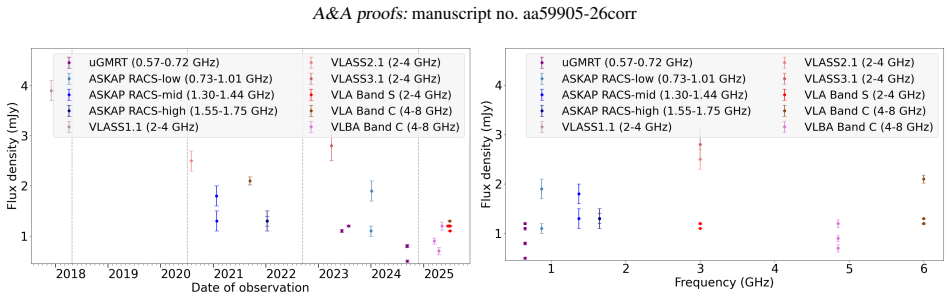
We uses very long baseline interferometry to constrain the orbit of the binary system 2MASS J05082729-2101444. We observed the system with the VLBA in three epochs at a frequency of 4.85 GHz, which provides an angular resolution of about 3 mas. We combined the three radio astrometric observations, 119 RVs (60 VIS and 59 NIR) obtained with the CARMENES high-resolution spectrograph over a period of 8.1 years, and a relative astrometric measurement of an archival H-band Keck NIRC adaptive optics image to fit the orbital motion of the binary system. The VLBA observations resolved the binary system and show emission from both stellar components, with similar flux density levels (0.34-0.67 mJy) and showing slight temporal flux variations. The emission appears quiescent, with no significant circular polarization, and with no flare events. We obtained a fit of the orbital motion of this binary system, which has an eccentric orbit (e = 0.71) with an orbital period of 2.19 yr and a semimajor axis of 26.964 mas (1.3 au). The VLBA observations made it possible to resolve the binary system and identify both stars as radio-loud sources. The combined fit shows that 2M0508-21 is an M-dwarf binary with a total dynamical mass of $0.459\pm0.007$ M$_{\odot}$, assuming Gaia parallax. This mass is slightly larger than those estimated from the luminosity and theoretical evolutionary models. The upper limit of the circular polarization at 4.85 GHz ($\lesssim$10\%), the persistence of the quiescent emission, and the relatively low brightness temperatures are consistent with a gyro-synchrotron or synchrotron origin for the radio emission. Further VLBA observations are needed to obtain the individual masses of the stars, as well as to verify Gaia's parallax of the system. A complete characterization of the system will help improve evolutionary models for young objects at the substellar boundary.
Editorial analysis
A structured set of objections, weighed in public.
Referee Report
Summary. The manuscript reports VLBA radio observations combined with CARMENES radial velocities and Keck AO astrometry to determine the orbital parameters of the binary 2MASS J05082729-2101444. The fit yields an eccentric orbit (e = 0.71) with a period of 2.19 years and angular semimajor axis of 26.964 mas. Using the Gaia parallax, they derive a total dynamical mass of 0.459 ± 0.007 M⊙ for this M-dwarf binary and analyze the radio emission as likely gyro-synchrotron or synchrotron in origin.
Significance. If the central mass result holds after proper error propagation, the paper offers a dynamical mass measurement for a young low-mass binary near the substellar boundary, which is useful for calibrating evolutionary models. The multi-technique approach (VLBA resolving both components, long-baseline RV, and AO) provides a robust orbit solution and is a strength of the work. The radio emission analysis adds context on stellar activity.
major comments (1)
- Abstract: The total dynamical mass is reported as 0.459±0.007 M⊙ with an uncertainty that appears to reflect only the orbital fit parameters. However, the physical scale is set by the Gaia parallax, and mass scales as the cube of distance, so the parallax uncertainty must be included in the error budget. The abstract notes the need to 'verify Gaia's parallax', indicating it should not be treated as exact for the quoted precision.
minor comments (1)
- Abstract: Typo: 'We uses very long baseline interferometry' should read 'We use very long baseline interferometry'.
Simulated Author's Rebuttal
We thank the referee for the positive assessment of our work and the recommendation for minor revision. We address the single major comment below.
read point-by-point responses
-
Referee: Abstract: The total dynamical mass is reported as 0.459±0.007 M⊙ with an uncertainty that appears to reflect only the orbital fit parameters. However, the physical scale is set by the Gaia parallax, and mass scales as the cube of distance, so the parallax uncertainty must be included in the error budget. The abstract notes the need to 'verify Gaia's parallax', indicating it should not be treated as exact for the quoted precision.
Authors: We agree that the quoted uncertainty of ±0.007 M⊙ corresponds to the formal errors from the orbital fit parameters (primarily the angular semimajor axis of 26.964 mas together with the period and eccentricity), while the Gaia parallax is adopted to convert the angular scale to a physical mass. Because total mass scales as distance cubed, the relative parallax uncertainty must be propagated (multiplied by three) and added in quadrature to obtain the full error budget. In the revised manuscript we will update the abstract to state the mass explicitly as derived from the orbital solution assuming the Gaia parallax, and we will include the Gaia parallax contribution in the reported uncertainty. This change will be reflected in both the abstract and the relevant section of the main text without altering the central value. revision: yes
Circularity Check
No significant circularity in dynamical mass derivation
full rationale
The paper derives the total dynamical mass by fitting a joint orbital model to VLBA astrometric positions, 119 radial velocities, and one AO relative position, obtaining an angular semimajor axis of 26.964 mas and period 2.19 yr. Kepler's third law is then applied after scaling the angular size to physical units with an external Gaia parallax. This chain uses independent observational inputs and standard dynamics; no fitted quantity is redefined in terms of the output mass, no prediction is statistically forced by a prior fit, and no self-citation supplies a uniqueness theorem or ansatz for the central result. The paper explicitly flags the parallax assumption and requests future verification, confirming the derivation remains self-contained against external benchmarks.
Axiom & Free-Parameter Ledger
axioms (1)
- standard math The relative motion of the two stars obeys Keplerian two-body dynamics
Reference graph
Works this paper leans on
-
[1]
M., Sip˝ocz, B
Astropy Collaboration, Price-Whelan, A. M., Sip˝ocz, B. M., et al. 2018, AJ, 156, 123 Astropy Collaboration, Robitaille, T. P., Tollerud, E. J., et al. 2013, A&A, 558, A33
2018
-
[2]
2023, A&A, 674, A32
Babusiaux, C., Fabricius, C., Khanna, S., et al. 2023, A&A, 674, A32
2023
-
[3]
2015, A&A, 577, A42
Baraffe, I., Homeier, D., Allard, F., & Chabrier, G. 2015, A&A, 577, A42
2015
-
[4]
2002, ApJ, 572, 503
Berger, E. 2002, ApJ, 572, 503
2002
-
[5]
2006, ApJ, 648, 629
Berger, E. 2006, ApJ, 648, 629
2006
-
[6]
M., et al
Berger, E., Ball, S., Becker, K. M., et al. 2001, Nature, 410, 338
2001
-
[7]
Binks, A. S. & Jeffries, R. D. 2016, MNRAS, 455, 3345
2016
-
[8]
R., Vedantham, H
Bloot, S., Callingham, J. R., Vedantham, H. K., et al. 2024, A&A, 682, A170
2024
-
[9]
Bouma, L. G. & Jardine, M. M. 2025, ApJ, 988, L3
2025
-
[10]
G., Jayaraman, R., Rappaport, S., et al
Bouma, L. G., Jayaraman, R., Rappaport, S., et al. 2024, AJ, 167, 38
2024
-
[11]
J., Melis, C., Todd, J., et al
Burgasser, A. J., Melis, C., Todd, J., et al. 2015, AJ, 150, 180
2015
-
[12]
A., Guàrdia, J., López del Fresno, M., et al
Caballero, J. A., Guàrdia, J., López del Fresno, M., et al. 2016, in Society of Photo-Optical Instrumentation Engineers (SPIE) Conference Series, V ol. 9910, Observatory Operations: Strategies, Processes, and Systems VI, ed. A. B. Peck, R. L. Seaman, & C. R. Benn, 99100E
2016
-
[13]
2022, A&A, 666, A16
Calissendorff, P., Janson, M., Rodet, L., et al. 2022, A&A, 666, A16
2022
-
[14]
R., Pope, B
Callingham, J. R., Pope, B. J. S., Kavanagh, R. D., et al. 2024, Nature Astronomy, 8, 1359
2024
-
[15]
R., Tasse, C., Keers, R., et al
Callingham, J. R., Tasse, C., Keers, R., et al. 2025, Nature, 647, 603
2025
-
[16]
R., Vedantham, H
Callingham, J. R., Vedantham, H. K., Shimwell, T. W., et al. 2021, Nat.As, 5, 1233
2021
-
[17]
Clark, B. G. 1980, A&A, 89, 377
1980
-
[18]
B., Guirado, J
Climent, J. B., Guirado, J. C., Pérez-Torres, M., Marcaide, J. M., & Peña- Moñino, L. 2023, Science, 381, 1120
2023
-
[19]
N., Mioduszewski, A
Curiel, S., Ortiz-León, G. N., Mioduszewski, A. J., & Arenas-Martinez, A. B. 2024, ApJ, 967, 112
2024
-
[20]
N., Mioduszewski, A
Curiel, S., Ortiz-León, G. N., Mioduszewski, A. J., & Sanchez-Bermudez, J. 2022, AJ, 164, 93
2022
-
[21]
N., Mioduszewski, A
Curiel, S., Ortiz-León, G. N., Mioduszewski, A. J., & Torres, R. M. 2020, AJ, 160, 97
2020
-
[22]
N., Pritchard, J., Murphy, T., et al
Driessen, L. N., Pritchard, J., Murphy, T., et al. 2024, PASA, 41, e084
2024
-
[23]
Dulk, G. A. 1985, ARA&A, 23, 169
1985
-
[24]
J., Forbrich, J., Rizzuto, A., et al
Dupuy, T. J., Forbrich, J., Rizzuto, A., et al. 2016, ApJ, 827, 23
2016
-
[25]
2016, The Journal of Open Source Software, 1, 24
Foreman-Mackey, D. 2016, The Journal of Open Source Software, 1, 24
2016
-
[26]
W., Lang, D., & Goodman, J
Foreman-Mackey, D., Hogg, D. W., Lang, D., & Goodman, J. 2013, PASP, 125, 306 Gaia Collaboration, Brown, A. G. A., Vallenari, A., et al. 2021, A&A, 649 Gaia Collaboration, Vallenari, A., Brown, A. G. A., et al. 2023, A&A, 674, A1
2013
-
[27]
Greisen, E. W. 2003, in Astrophysics and Space Science Library, V ol. 285, In- formation Handling in Astronomy - Historical Vistas, ed. A. Heck, 109 Günther, M. N., Berardo, D. A., Ducrot, E., et al. 2022, AJ, 163, 144
2003
-
[28]
Hunter, J. D. 2007, Computing in Science and Engineering, 9, 90
2007
-
[29]
M., Hallinan, G., Pineda, J
Kao, M. M., Hallinan, G., Pineda, J. S., et al. 2016, ApJ, 818, 24
2016
-
[30]
M., Hallinan, G., Pineda, J
Kao, M. M., Hallinan, G., Pineda, J. S., Stevenson, D., & Burgasser, A. 2018, ApJS, 237, 25
2018
-
[31]
M., Mioduszewski, A
Kao, M. M., Mioduszewski, A. J., Villadsen, J., & Shkolnik, E. L. 2023, Nature, 619, 272
2023
-
[32]
Kaur, S., Viganò, D., Béjar, V . J. S., et al. 2024, A&A, 691, L17
2024
-
[33]
M., Béjar, V
Kaur, S., Viganò, D., Girart, J. M., Béjar, V . J. S., & et al. 2026, in prep
2026
-
[34]
2025, A&A, 701, A69
Kaur, S., Viganò, D., Villadsen, J., et al. 2025, A&A, 701, A69
2025
-
[35]
L., Ireland, M
Kraus, A. L., Ireland, M. J., Hillenbrand, L. A., & Martinache, F. 2012, ApJ, 745, 19
2012
-
[36]
A., et al
Launhardt, R., Loinard, L., Dzib, S. A., et al. 2022, ApJ, 931, 43
2022
-
[37]
2021, MNRAS, 507, 1979
Leto, P., Trigilio, C., Krtiˇcka, J., et al. 2021, MNRAS, 507, 1979
2021
-
[38]
F., D’Alessio, P., Rodríguez, M
Loinard, L., Rodríguez, L. F., D’Alessio, P., Rodríguez, M. I., & González, R. F. 2007, ApJ, 657, 916
2007
-
[39]
2016, MNRAS, 457, 1224
Lynch, C., Murphy, T., Ravi, V ., et al. 2016, MNRAS, 457, 1224
2016
-
[40]
Melrose, D. B. & Dulk, G. A. 1982, ApJ, 259, 844
1982
-
[41]
Miret-Roig, N., Galli, P. A. B., Brandner, W., et al. 2020, A&A, 642, A179
2020
-
[42]
2020, lmfit/lmfit-py 1.0.1 Ortiz-León, G
Newville, M., Otten, R., Nelson, A., et al. 2020, lmfit/lmfit-py 1.0.1 Ortiz-León, G. N., Loinard, L., Kounkel, M. A., et al. 2017, ApJ, 834, 141
2020
-
[43]
Parsamyan, E. S. 1995, Astrophysics, 38, 206
1995
-
[44]
S., Hallinan, G., & Kao, M
Pineda, J. S., Hallinan, G., & Kao, M. M. 2017, ApJ, 846, 75
2017
-
[45]
2024, MNRAS, 529, 1258
Pritchard, J., Murphy, T., Heald, G., et al. 2024, MNRAS, 529, 1258
2024
-
[46]
2021, MNRAS, 502, 5438
Pritchard, J., Murphy, T., Zic, A., et al. 2021, MNRAS, 502, 5438
2021
-
[47]
J., Caballero, J
Quirrenbach, A., Amado, P. J., Caballero, J. A., et al. 2016, in Society of Photo- Optical Instrumentation Engineers (SPIE) Conference Series, V ol. 9908, Ground-based and Airborne Instrumentation for Astronomy VI, ed. C. J
2016
-
[48]
J., Caballero, J
Quirrenbach, A., Amado, P. J., Caballero, J. A., et al. 2014, in Society of Photo- Optical Instrumentation Engineers (SPIE) Conference Series, V ol. 9147, Ground-based and Airborne Instrumentation for Astronomy V , ed. S. K. Ram- say, I. S. McLean, & H. Takami, 91471F
2014
-
[49]
J., Ribas, I., et al
Quirrenbach, A., Amado, P. J., Ribas, I., et al. 2018, in Society of Photo-Optical Instrumentation Engineers (SPIE) Conference Series, V ol. 10702, Ground- based and Airborne Instrumentation for Astronomy VII, ed. C. J. Evans, L. Simard, & H. Takami, 107020W
2018
-
[50]
M., Stauffer, J
Rebull, L. M., Stauffer, J. R., Cody, A. M., et al. 2018, AJ, 155, 196
2018
-
[51]
M., Stauffer, J
Rebull, L. M., Stauffer, J. R., Hillenbrand, L. A., et al. 2022, AJ, 164, 80
2022
-
[52]
E., & Harvin, J
Riaz, B., Gizis, J. E., & Harvin, J. 2006, AJ, 132, 866
2006
-
[53]
2018, A&A, 618, A23
Rodet, L., Bonnefoy, M., Durkan, S., et al. 2018, A&A, 618, A23
2018
-
[54]
2023, ApJ, 951, L43
Rose, K., Pritchard, J., Murphy, T., et al. 2023, ApJ, 951, L43
2023
-
[55]
& Wolszczan, A
Route, M. & Wolszczan, A. 2012, ApJ, 747, L22
2012
-
[56]
& Wolszczan, A
Route, M. & Wolszczan, A. 2013, ApJ, 773, 18
2013
-
[57]
& Wolszczan, A
Route, M. & Wolszczan, A. 2016, ApJ, 821, L21
2016
-
[58]
Sanderson, H., Jardine, M., Collier Cameron, A., Morin, J., & Donati, J. F. 2023, MNRAS, 518, 4734
2023
-
[59]
C., Shkolnik, E
Schneider, A. C., Shkolnik, E. L., Allers, K. N., et al. 2019, AJ, 157, 234
2019
-
[60]
Seaquist, E. R. 1993, Reports on Progress in Physics, 56, 1145
1993
-
[61]
C., Bowler, B
Shan, Y ., Yee, J. C., Bowler, B. P., et al. 2017, ApJ, 846, 93
2017
-
[62]
Somers, G., Cao, L., & Pinsonneault, M. H. 2020, ApJ, 891, 29
2020
-
[63]
2017, AJ, 153, 152
Stauffer, J., Collier Cameron, A., Jardine, M., et al. 2017, AJ, 153, 152
2017
-
[64]
M., Jardine, M., et al
Stauffer, J., Rebull, L. M., Jardine, M., et al. 2021, AJ, 161, 60
2021
-
[65]
M., Loinard, L., Mioduszewski, A
Torres, R. M., Loinard, L., Mioduszewski, A. J., & Rodríguez, L. F. 2007, ApJ, 671, 1813
2007
-
[66]
Treumann, R. A. 2006, A&A Rev., 13, 229
2006
-
[67]
2018, A&A, 609, A117 Van Der Walt, S., Colbert, S
Trifonov, T., Kürster, M., Zechmeister, M., et al. 2018, A&A, 609, A117 Van Der Walt, S., Colbert, S. C., & Varoquaux, G. 2011, Computing in Science and Engineering, 13, 22 Article number, page 10 Curiel et al.: Orbital motion and dynamical mass of a young binary system van Lieshout, R. & Rappaport, S. A. 2018, in Handbook of Exoplanets, ed. H. J. Deeg & ...
2018
-
[68]
K., Callingham, J
Vedantham, H. K., Callingham, J. R., Shimwell, T. W., et al. 2020, Nature As- tronomy, 4, 577
2020
-
[69]
E., et al
Virtanen, P., Gommers, R., Oliphant, T. E., et al. 2020, Nature Methods, 17, 261
2020
-
[70]
Waugh, R. F. P. & Jardine, M. M. 2022, MNRAS, 514, 5465
2022
-
[71]
Williams, P. K. G. & Berger, E. 2015, ApJ, 808, 189
2015
-
[72]
Williams, P. K. G., Berger, E., & Zauderer, B. A. 2013, ApJ, 767, L30
2013
-
[73]
Williams, P. K. G., Gizis, J. E., & Berger, E. 2017, ApJ, 834, 117
2017
-
[74]
Yiu, T. W. H., Vedantham, H. K., Callingham, J. R., & Günther, M. N. 2024, A&A, 684, A3
2024
-
[75]
Zarka, P. 1998, J. Geophys. Res., 103, 20159
1998
-
[76]
J., et al
Zechmeister, M., Reiners, A., Amado, P. J., et al. 2018, A&A, 609, A12
2018
-
[77]
2023, ApJ, 953, 65 Article number, page 11 A&A proofs:manuscript no
Zhang, J., Tian, H., Zarka, P., et al. 2023, ApJ, 953, 65 Article number, page 11 A&A proofs:manuscript no. aa59905-26 Appendix A: Corner plot of the combined fit rvsys = 0.8893+0.0092 0.0092 7.50 7.65 7.80 7.95 K K = 7.7117+0.0748 0.0731 800.2 800.8 801.4 802.0 802.6 P P = 801.4040+0.2972 0.2947 4.5 5.0 5.5 6.0 6.5 T0 T0 = 5.5862+0.2308 0.2323 0.705 0.71...
discussion (0)
Sign in with ORCID, Apple, or X to comment. Anyone can read and Pith papers without signing in.