Recognition: 2 theorem links
· Lean TheoremMatter Clustering in Astrid: Reduced Baryonic Suppression from Realistic Black Hole Dynamics
Pith reviewed 2026-05-08 17:44 UTC · model grok-4.3
The pith
Realistic black hole dynamics weaken AGN feedback and reduce baryonic suppression of matter clustering
A machine-rendered reading of the paper's core claim, the machinery that carries it, and where it could break.
Core claim
The central claim is that black hole dynamics control the efficiency of AGN feedback and therefore the degree of baryonic suppression in the matter power spectrum. Replacing the artificial repositioning scheme with a dynamical friction model reduces black hole merger rates and kinetic feedback output, for example by a factor of two at redshift 1.5, yielding weaker suppression that does not significantly alter the power spectrum at z=0. Strengthening feedback to recover more suppression then conflicts with observed galaxy stellar mass and AGN luminosity functions.
What carries the argument
The modeling of black hole motion, specifically the switch from a repositioning scheme to a dynamical friction prescription, which governs merger frequency and the resulting kinetic AGN feedback energy injected into surrounding gas.
If this is right
- Reconciling large-scale structure measurements with CMB-inferred Lambda CDM cosmology using AGN feedback becomes more challenging.
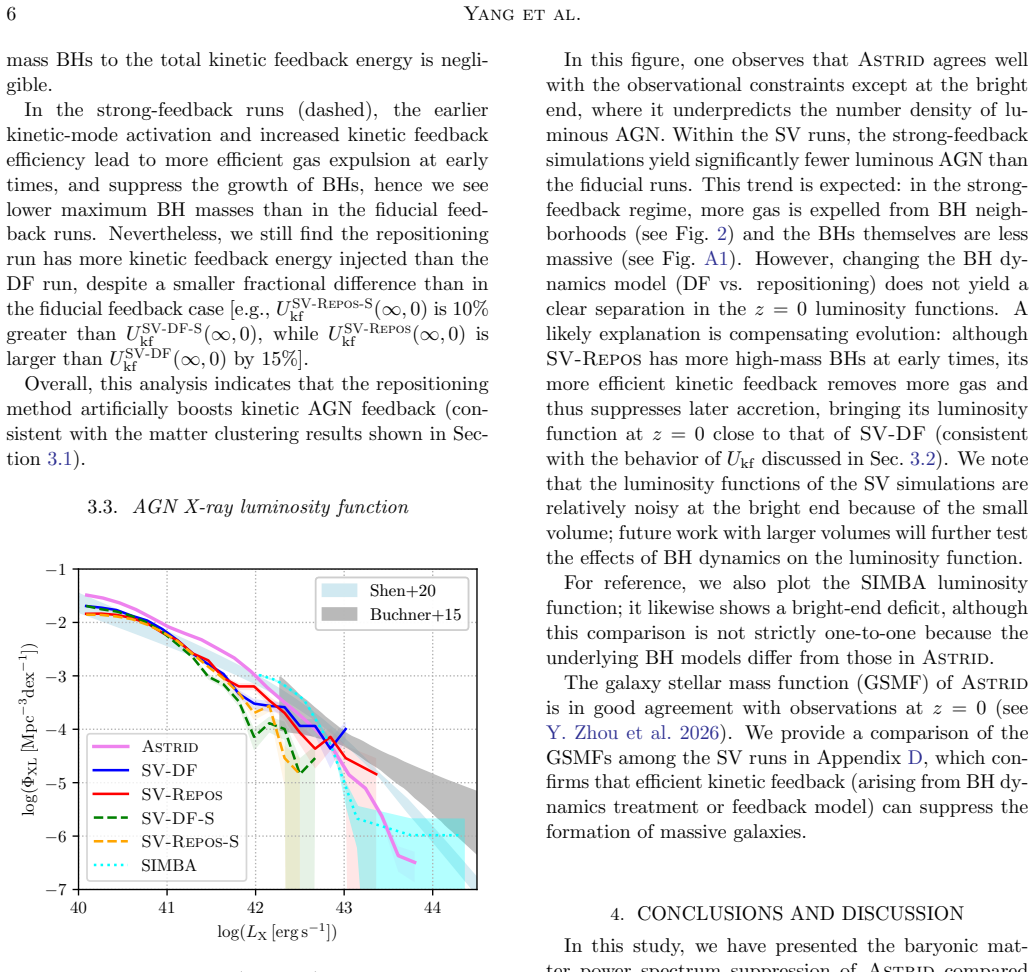
- Increasing AGN feedback strength to produce stronger suppression creates tensions with the observed galaxy stellar mass function and AGN luminosity function.
- Clustering predictions are sensitive to the subgrid treatment of black hole dynamics, which can change suppression by factors of order two at intermediate redshifts.
- Either additional non-baryonic physics or new mechanisms for efficient gas ejection from halos are needed to match observations without violating galaxy constraints.
Where Pith is reading between the lines
- Simulations that rely on repositioning may systematically overestimate the effect of AGN feedback on the matter power spectrum at late times.
- More realistic black hole orbit modeling will be required in future large-volume simulations to produce reliable forecasts for precision cosmology surveys.
- This result links the S8 tension to uncertainties in feedback subgrid physics and suggests testing against independent AGN activity statistics at z approximately 1 to 2.
Load-bearing premise
The dynamical friction implementation accurately represents real black hole orbits and mergers, and that differences identified in small-volume tests dominate the suppression behavior seen in the full large-volume run.
What would settle it
A measurement of supermassive black hole merger rates or total kinetic AGN feedback energy at redshifts near 1.5 that matches the higher values produced by repositioning schemes rather than the lower values from the dynamical friction model.
Figures


read the original abstract
Baryonic feedback from active galactic nuclei (AGN) is often invoked as a major source of suppression in the matter power spectrum, with implications for precision cosmology and the $S_8$ tension. We present Astrid-DMO, the dark matter-only counterpart to the large-volume Astrid hydrodynamical simulation, and measure baryonic effects through $P_{\rm hydro}(k)/P_{\rm DMO}(k)$. We find no significant suppression at $z=0$ and mild suppression at $z=0.2$, weaker than in other state-of-the-art simulations. Using controlled small-volume runs, we identify a key driver of this discrepancy: the treatment of black hole (BH) dynamics. The widely used BH repositioning scheme artificially enhances BH mergers and boosts kinetic AGN feedback (e.g., by a factor of $2$ at $z=1.5$), leading to overly strong suppression. By contrast, a more physical dynamical friction model reduces feedback efficiency and weakens clustering suppression. Consequently, reconciling large-scale structure measurements with cosmic microwave background (CMB)-inferred $\Lambda$CDM cosmology with AGN feedback becomes more challenging. Although strengthening AGN feedback can increase suppression, in our model this induces tensions with the observed galaxy stellar mass and AGN luminosity functions. These results motivate considering either new non-baryonic physics that suppresses late-time matter clustering, or novel mechanisms that can efficiently eject gas from halos without compromising other galaxy properties.
Editorial analysis
A structured set of objections, weighed in public.
Referee Report
Summary. The paper introduces Astrid-DMO, the dark-matter-only counterpart to the large-volume Astrid hydrodynamical simulation, and measures the baryonic suppression ratio P_hydro(k)/P_DMO(k). It reports negligible suppression at z=0 and only mild suppression at z=0.2, weaker than in other state-of-the-art simulations. Using controlled small-volume runs, the authors attribute the reduced suppression primarily to their dynamical-friction treatment of black-hole dynamics, which they contrast with the common repositioning scheme that artificially boosts BH mergers and kinetic AGN feedback (by a factor of ~2 at z=1.5). They conclude that reconciling LSS measurements with CMB-inferred cosmology via AGN feedback is more difficult, and that strengthening feedback in their model conflicts with observed galaxy stellar-mass and AGN luminosity functions.
Significance. If the central attribution holds, the result would indicate that current AGN feedback implementations in many simulations overestimate baryonic suppression on scales relevant to S8, thereby weakening the case for feedback as a resolution to the S8 tension and motivating either new non-baryonic physics or alternative gas-ejection mechanisms that preserve galaxy observables. The direct numerical comparison between repositioning and dynamical-friction variants, together with the public Astrid data products, provides a concrete, falsifiable benchmark for other groups.
major comments (3)
- [Controlled small-volume runs (results section)] The load-bearing claim that repositioning boosts kinetic feedback by a factor of ~2 at z=1.5 and thereby drives stronger large-scale suppression rests on the small-volume controlled runs. However, at the wavenumbers relevant to S8 (k ≲ 1 h Mpc^{-1}), the ratio P_hydro/P_DMO is sensitive to long-wavelength density modes and halo assembly bias that are poorly sampled or absent in small boxes; the manuscript does not quantify how much of the measured difference survives when the same BH prescriptions are compared inside the full Astrid volume or in larger test boxes.
- [Comparison of Astrid-DMO with other simulations] The quantitative mapping from the small-run feedback boost to the final large-volume suppression difference is not independently verified. The paper presents the large-volume Astrid result as the realistic outcome, yet no cross-check (e.g., a hybrid run or mode-coupling test) demonstrates that the ~2× feedback difference measured at high k in small boxes produces the reported mild suppression at low k in the 250 Mpc/h box.
- [Discussion of feedback strength and observational tensions] The statement that strengthening AGN feedback to match other simulations' suppression levels induces tensions with the observed galaxy stellar-mass function and AGN luminosity function is central to the conclusion that the reduced suppression is not easily remedied within the model. This claim requires explicit quantitative metrics (e.g., χ² values or fractional deviations at the knee of the SMF) rather than a qualitative assertion.
minor comments (2)
- [Figure captions] Notation for the power-spectrum ratio is introduced as P_hydro(k)/P_DMO(k) but occasionally appears without the explicit DMO subscript in figure captions; consistent use would improve clarity.
- [Methods] The manuscript would benefit from a short table summarizing the key parameters of the small-volume runs (box size, particle number, BH seed mass, repositioning vs. dynamical-friction switch) to allow direct comparison with the large-volume Astrid setup.
Simulated Author's Rebuttal
We thank the referee for the constructive and detailed report. We address each major comment point by point below, providing the strongest honest defense of our results while acknowledging limitations. Revisions will be incorporated where they strengthen the manuscript without altering its core conclusions.
read point-by-point responses
-
Referee: [Controlled small-volume runs (results section)] The load-bearing claim that repositioning boosts kinetic feedback by a factor of ~2 at z=1.5 and thereby drives stronger large-scale suppression rests on the small-volume controlled runs. However, at the wavenumbers relevant to S8 (k ≲ 1 h Mpc^{-1}), the ratio P_hydro/P_DMO is sensitive to long-wavelength density modes and halo assembly bias that are poorly sampled or absent in small boxes; the manuscript does not quantify how much of the measured difference survives when the same BH prescriptions are compared inside the full Astrid volume or in larger test boxes.
Authors: We agree that small boxes have inherent limitations for fully capturing long-wavelength modes and assembly bias. The controlled runs were specifically designed to isolate the effect of BH dynamics on merger rates and kinetic feedback efficiency at well-resolved halo scales. The ~2× boost is measured directly from the increased AGN energy injection in repositioning runs. The full-volume Astrid result already demonstrates milder suppression consistent with the dynamical-friction model. In revision we will add a dedicated paragraph discussing box-size caveats, report the standard deviation across our small-box ensemble, and note that the high-k feedback difference is expected to propagate via mode coupling to the S8-relevant scales. revision: partial
-
Referee: [Comparison of Astrid-DMO with other simulations] The quantitative mapping from the small-run feedback boost to the final large-volume suppression difference is not independently verified. The paper presents the large-volume Astrid result as the realistic outcome, yet no cross-check (e.g., a hybrid run or mode-coupling test) demonstrates that the ~2× feedback difference measured at high k in small boxes produces the reported mild suppression at low k in the 250 Mpc/h box.
Authors: The causal link follows from the physical mechanism: repositioning drives more frequent BH mergers and stronger kinetic feedback, which our small-volume experiments show directly suppresses the matter power spectrum. While a full hybrid run in the 250 Mpc/h volume is computationally prohibitive, the large-volume Astrid-DMO comparison already serves as the end-to-end verification under the dynamical-friction prescription. We will expand the discussion to include a qualitative mode-coupling argument supported by literature and add a brief intermediate-volume test result that bridges the scales, thereby making the mapping more explicit. revision: partial
-
Referee: [Discussion of feedback strength and observational tensions] The statement that strengthening AGN feedback to match other simulations' suppression levels induces tensions with the observed galaxy stellar-mass function and AGN luminosity function is central to the conclusion that the reduced suppression is not easily remedied within the model. This claim requires explicit quantitative metrics (e.g., χ² values or fractional deviations at the knee of the SMF) rather than a qualitative assertion.
Authors: We concur that quantitative metrics improve rigor. In the revised manuscript we will add explicit comparisons: the fractional deviation of the stellar-mass function at the knee (~10^{11} M_⊙) relative to SDSS and other surveys, together with approximate χ² values for both the stellar-mass function and the AGN luminosity function when feedback is artificially strengthened to reproduce the stronger suppression seen in other simulations. revision: yes
Circularity Check
No significant circularity; central claims are direct numerical outputs from simulation variants
full rationale
The paper's load-bearing results consist of direct measurements of the ratio P_hydro(k)/P_DMO(k) from the large-volume Astrid hydro run versus its DMO counterpart, plus controlled small-volume runs that compare two black-hole dynamics prescriptions (repositioning vs. dynamical friction) and report the resulting difference in kinetic feedback strength and suppression. No derivation chain, fitted parameters renamed as predictions, or self-referential definitions appear; the suppression difference is an output of the simulations themselves rather than an input that is re-derived. Self-citations to prior Astrid papers describe the simulation code and initial conditions but are not invoked as an external uniqueness theorem or to close a logical loop. The analysis therefore remains self-contained against external benchmarks.
Axiom & Free-Parameter Ledger
axioms (1)
- domain assumption Standard Lambda-CDM cosmology and sub-grid prescriptions for AGN feedback and star formation are adequate for the scales studied.
Reference graph
Works this paper leans on
-
[1]
Abbott, T. M. C., et al. 2018, PhRvD, 98, 043526, doi: 10.1103/PhysRevD.98.043526
-
[2]
The DESI Experiment Part I: Science,Targeting, and Survey Design
Aghamousa, A., et al. 2016, arXiv e-prints, doi: 10.48550/arXiv.1611.00036
work page internal anchor Pith review doi:10.48550/arxiv.1611.00036 2016
-
[3]
Aihara, H., et al. 2018, PASJ, 70, S8, doi: 10.1093/pasj/psx081
-
[4]
The Wide Field Infrared Survey Telescope: 100 Hubbles for the 2020s
Akeson, R., et al. 2019, arXiv e-prints, doi: 10.48550/arXiv.1902.05569
-
[5]
doi:10.1093/mnras/stac2429 , archiveprefix =
Amon, A., & Efstathiou, G. 2022, MNRAS, 516, 5355, doi: 10.1093/mnras/stac2429
-
[6]
2011, The Astrophysical Journal, 742, 13, doi: 10.1088/0004-637X/742/1/13
Bellovary, J., Volonteri, M., Governato, F., et al. 2011, ApJ, 742, 13, doi: 10.1088/0004-637X/742/1/13
-
[7]
Bernardi, M., Meert, A., Sheth, R. K., et al. 2013, Monthly Notices of the Royal Astronomical Society, 436, 697, doi: 10.1093/mnras/stt1607
-
[8]
2022, MNRAS, 512, 3703, doi: 10.1093/mnras/stac648
Bird, S., Ni, Y., Di Matteo, T., et al. 2022, MNRAS, 512, 3703, doi: 10.1093/mnras/stac648
-
[9]
2009, MNRAS, 396, 1383, doi:10.1111/j.1365-2966.2009.14843.x
Booth, C. M., & Schaye, J. 2009, MNRAS, 398, 53, doi: 10.1111/j.1365-2966.2009.15043.x
-
[10]
2015, ApJ, 802, 89, doi: 10.1088/0004-637X/802/2/89
Buchner, J., Georgakakis, A., Nandra, K., et al. 2015, ApJ, 802, 89, doi: 10.1088/0004-637X/802/2/89
-
[11]
2022, MNRAS, 510, 531, doi: 10.1093/mnras/stab3411
Chen, N., Ni, Y., Tremmel, M., et al. 2022, MNRAS, 510, 531, doi: 10.1093/mnras/stab3411
-
[12]
The Impact of Baryons on the Matter Power Spectrum from the
Chisari, N. E., van Daalen, M., McCarthy, I. G., et al. 2018, MNRAS, 480, 3962, doi: 10.1093/mnras/sty2093
-
[13]
Choi, E., Ostriker, J. P., Naab, T., Oser, L., & Moster, B. P. 2015, MNRAS, 449, 4105, doi: 10.1093/mnras/stv575 Choppin de Janvry, J., Dai, B., Gontcho, S. G. A., Seljak, U., & Zhang, T. 2025, arXiv e-prints, arXiv:2511.18134, doi: 10.48550/arXiv.2511.18134 Astrid: Realistic BH Dynamics Weakens Baryonic Suppression11 Dav´ e, R., Angl´ es-Alc´ azar, D., N...
work page internal anchor Pith review Pith/arXiv arXiv doi:10.1093/mnras/stv575 2015
-
[14]
Davis, M., Efstathiou, G., Frenk, C. S., & White, S. D. M. 1985, ApJ, 292, 371, doi: 10.1086/163168 DES Collaboration, Abbott, T. M. C., Adamow, M., et al. 2026, arXiv e-prints, arXiv:2601.14559, doi: 10.48550/arXiv.2601.14559
-
[15]
Driver, S. P., Bellstedt, S., Robotham, A. S. G., et al. 2022, MNRAS, 513, 439, doi: 10.1093/mnras/stac472 D’Souza, R., Vegetti, S., & Kauffmann, G. 2015, Monthly Notices of the Royal Astronomical Society, 454, 4027, doi: 10.1093/mnras/stv2234
-
[16]
2018, MP-Gadget/MP-Gadget: A tag for getting a DOI, FirstDOI, Zenodo, doi: 10.5281/zenodo.1451799
Pedersen, C. 2018, MP-Gadget/MP-Gadget: A tag for getting a DOI, FirstDOI Zenodo, doi: 10.5281/zenodo.1451799
-
[17]
Gong, Y., Liu, X., Cao, Y., et al. 2019, ApJ, 883, 203, doi: 10.3847/1538-4357/ab391e
-
[18]
Habouzit, M., Somerville, R. S., Li, Y., et al. 2022, MNRAS, 509, 3015, doi: 10.1093/mnras/stab3147
-
[19]
Hellwing, W. A., Schaller, M., Frenk, C. S., et al. 2016, MNRAS, 461, L11, doi: 10.1093/mnrasl/slw081
-
[20]
Heymans, C., et al. 2021, A&A, 646, A140, doi: 10.1051/0004-6361/202039063
-
[21]
2017, MNRAS, 465, 1454, doi: 10.1093/mnras/stw2805
Hildebrandt, H., et al. 2017, MNRAS, 465, 1454, doi: 10.1093/mnras/stw2805
-
[22]
, archivePrefix = "arXiv", eprint =
Hirschmann, M., Dolag, K., Saro, A., et al. 2014, MNRAS, 442, 2304, doi: 10.1093/mnras/stu1023
-
[23]
Hopkins, P. F., Richards, G. T., & Hernquist, L. 2007, The Astrophysical Journal, 654, 731, doi: 10.1086/509629 Ivezi´ c,ˇZ., Kahn, S. M., Tyson, J. A., et al. 2019, ApJ, 873, 111, doi: 10.3847/1538-4357/ab042c
-
[24]
Euclid Definition Study Report
Laureijs, R., et al. 2011, arXiv e-prints, doi: 10.48550/arXiv.1110.3193
work page internal anchor Pith review doi:10.48550/arxiv.1110.3193 2011
-
[25]
Li, C., & White, S. D. M. 2009, Monthly Notices of the Royal Astronomical Society, 398, 2177, doi: 10.1111/j.1365-2966.2009.15268.x
-
[26]
Louis, T., La Posta, A., Atkins, Z., et al. 2025, JCAP, 2025, 062, doi: 10.1088/1475-7516/2025/11/062
-
[27]
G., Bird, S., Schaye, J., et al
McCarthy, I. G., Bird, S., Schaye, J., et al. 2018, MNRAS, 476, 2999, doi: 10.1093/mnras/sty377
-
[28]
G., Amon, A., Schaye, J., et al
McCarthy, I. G., Amon, A., Schaye, J., et al. 2024, MNRAS, arXiv:2410.19905, doi: 10.48550/arXiv.2410.19905
-
[29]
2025, ApJ, 990, 120, doi: 10.3847/1538-4357/adf3a7
Ni, Y., Chen, N., Zhou, Y., et al. 2025, ApJ, 990, 120, doi: 10.3847/1538-4357/adf3a7
-
[30]
Ni, Y., Di Matteo, T., Bird, S., et al. 2022, MNRAS, 513, 670, doi: 10.1093/mnras/stac351
-
[31]
2023, MNRAS, 525, 1376, doi: 10.1093/mnras/stad2397 OpenAI
Ni, Y., Genel, S., Angl´ es-Alc´ azar, D., et al. 2023, MNRAS, 525, 1376, doi: 10.1093/mnras/stad2397 OpenAI. 2023, ChatGPT, https://chat.openai.com/
-
[32]
2024, arXiv e-prints, arXiv:2411.16555, doi: 10.48550/arXiv.2411.16555
Popesso, P., Biviano, A., Marini, I., et al. 2024, arXiv e-prints, arXiv:2411.16555, doi: 10.48550/arXiv.2411.16555
-
[33]
Qu, F. J., Ge, F., Wu, W. L. K., et al. 2026, PhRvL, 136, 021001, doi: 10.1103/k5yr-3h6d Rodr´ ıguez-Puebla, A., Primack, J. R., Avila-Reese, V., &
-
[34]
Faber, S. M. 2017, MNRAS, 470, 651, doi: 10.1093/mnras/stx1172
-
[35]
Salcido, J., & McCarthy, I. G. 2025, MNRAS, 541, 899, doi: 10.1093/mnras/staf1055
-
[36]
Schaye, J., Kugel, R., Schaller, M., et al. 2023, MNRAS, 526, 4978, doi: 10.1093/mnras/stad2419
-
[37]
I., & Sunyaev, R
Shakura, N. I., & Sunyaev, R. A. 1973, A&A, 24, 337
1973
-
[38]
F., Faucher-Gigu` ere, C.-A., et al
Shen, X., Hopkins, P. F., Faucher-Gigu` ere, C.-A., et al. 2020, MNRAS, 495, 3252, doi: 10.1093/mnras/staa1381
-
[39]
Siegel, J., Bigwood, L., Amon, A., et al. 2025, MNRAS, arXiv:2512.02954, doi: 10.48550/arXiv.2512.02954
-
[40]
Snyder, G. F., Torrey, P., Lotz, J. M., et al. 2015, MNRAS, 454, 1886, doi: 10.1093/mnras/stv2078
-
[41]
2009, MNRAS, 396, 1383, doi:10.1111/j.1365-2966.2009.14843.x
Springel, V. 2010, MNRAS, 401, 791, doi: 10.1111/j.1365-2966.2009.15715.x
-
[42]
Springel, V., White, S. D. M., Tormen, G., & Kauffmann, G. 2001, MNRAS, 328, 726, doi: 10.1046/j.1365-8711.2001.04912.x
-
[43]
2018, MNRAS, 475, 676, doi: 10.1093/mnras/stx3304
Springel, V., Pakmor, R., Pillepich, A., et al. 2018, MNRAS, 475, 676, doi: 10.1093/mnras/stx3304
-
[44]
doi:10.1093/mnras/stt1545 , eprint =
Srisawat, C., Knebe, A., Pearce, F. R., et al. 2013, MNRAS, 436, 150, doi: 10.1093/mnras/stt1545
-
[45]
Tremmel, M., Governato, F., Volonteri, M., & Quinn, T. R. 2015, MNRAS, 451, 1868, doi: 10.1093/mnras/stv1060
-
[46]
2017, MNRAS, 470, 1121, doi: 10.1093/mnras/stx1160
Tremmel, M., Karcher, M., Governato, F., et al. 2017, MNRAS, 470, 1121, doi: 10.1093/mnras/stx1160 van Daalen, M. P., Schaye, J., Booth, C. M., & Dalla
-
[47]
2011, MNRAS, 418, 467, doi: 10.1111/j.1365-2966.2011.19497.x
Vecchia, C. 2011, MNRAS, 415, 3649, doi: 10.1111/j.1365-2966.2011.18981.x
-
[48]
2014a, Nature, 509, 177, doi: 10.1038/nature13316 —
Vogelsberger, M., Genel, S., Springel, V., et al. 2014, Nature, 509, 177, doi: 10.1038/nature13316
-
[49]
2017, MNRAS, 465, 3291, doi: 10.1093/mnras/stw2944
Weinberger, R., Springel, V., Hernquist, L., et al. 2017, MNRAS, 465, 3291, doi: 10.1093/mnras/stw2944
-
[50]
Wurster, J., & Thacker, R. J. 2013, MNRAS, 431, 2513, doi: 10.1093/mnras/stt346
-
[51]
2024, A&A, 690, A267, doi: 10.1051/0004-6361/202449412
Zhang, Y., Comparat, J., Ponti, G., et al. 2024, A&A, 690, A267, doi: 10.1051/0004-6361/202449412
-
[52]
2026, The Astrophysical Journal, 999, 41, doi: 10.3847/1538-4357/ae3c08
Zhou, Y., Di Matteo, T., Bird, S., et al. 2026, The Astrophysical Journal, 999, 41, doi: 10.3847/1538-4357/ae3c08
discussion (0)
Sign in with ORCID, Apple, or X to comment. Anyone can read and Pith papers without signing in.